Tom McDonnell: There has been much commentary in the last week about the Government’s decision to roll back on its commitment to end the Section 23 property tax breaks. The Government has instead committed to an economic analysis of the impact of ending the tax breaks. Although TASC called for the abolition of these reliefs in its pre- Budget submission, economic analysis of budgetary measures is in many ways a welcome development.
The larger issue here is the continuing failure to undertake economic analyses of all budgetary measures. For example, an announcement pointing to a forthcoming econometric analysis of the impact of €6 billion in austerity measures is glaringly conspicuous by its absence. The absence of serious analysis was a causal factor in the economic crash, and it would be criminally negligent not to learn from past mistakes.
At least six months before each annual budget, the Government of the day should produce a long list of the measures it is considering for the forthcoming budget. Each of these measures should then be subjected to a full cost-benefit analysis by independent economists. Opposition parties should have their own opportunity to submit proposals for analysis. The cost-benefit analysis should seek to quantify the impact of the proposal across a variety of indicators. Sample indicators include (but are not limited to) the impact on:
• Economic growth (short and long-term)
• Employment
• The exchequer borrowing requirement
• Economic equality, for example which groups will gain and which groups will lose
• The at risk of poverty rate and other poverty related indicators
• Quality of life indicators, for example health outcomes
• Aggregate stock and composition of productive physical capacity
• Aggregate stock and composition of human capital
• The national innovative capacity
• The environment
The results of each of the cost-benefit analyses should then be independently peer-reviewed and submitted to the Government two months in advance of the budget. Existing policies, for example tax expenditures, should be subjected to regular ex post analysis. All policy measures should be reviewed twelve months after implementation, and then again every two or three years.
In the run-up to the budget the Government’s chosen set of budget proposals should be submitted to an independent Fiscal Council, set up for the express purpose of ensuring the parameters of the budget are counter-cyclical and consistent with the principle of macroeconomic sustainability.
The Government of the day should also seek to ensure that the principle of multi-annual budgeting becomes standard practice. The publication of multi-annual budgetary frameworks, of the type outlined in the National Recovery Plan, need to become semi-annual events.
None of this in any way precludes or infringes on political or economic debate. Political parties will have different positions on the relative importance of the various indicators and these differences will lead to divergent policy choices.
Impact analysis will improve accountability and transparency in budgetary decisions and will make it more difficult for interest groups to lobby Governments to sneak through legislation that benefits their narrow sectional interest at the expense of the wider society.
An indicative timetable might look like this:
January to March: Passing of Finance Bill through the Dáil
April: Publication of ‘Four Year Budgetary Framework’
June: Publication of Long list of budget proposals
June-October: Cost benefit analyses of the long list
October: Publication of ‘Updated Four year Budgetary Framework’
November: Parameters of the current year’s proposed budget audited by independent fiscal council and findings published
December: Budget
The fiscal council should be a purely advisory body, entirely independent from political parties and from powerful vested interests. For example, this would automatically exclude all economists working in the financial sector (or, indeed, for other sectional interests). Lobbying a member of the fiscal council should be made illegal. Ideally, the head of the fiscal council should be an economist of international renown.

Showing posts with label Budget 2011. Show all posts
Showing posts with label Budget 2011. Show all posts
Wednesday, 26 January 2011


A new emergency Budget
Michael Taft: Whatever about the disputes over facilitating the passage of the Finance Bill, what people want to know is what parties are going to do about it when they get into office. And this is where progressives can stop feuding with each other and get the debate back to where it belongs – showing how Budget 2011 will do such harm to economic recovery and fiscal stability. And, more importantly, what can be done to remove that harm and show how a progressive platform will bring immediate benefit to the economy and living standards.
Here’s one way of doing that: a precondition for entering government should be the enactment of an emergency budget within 60 days based on three concrete pledges:
• Repeal the Universal Social Charge
• Immediately release funds for public investment
• Reverse the cuts in social welfare income and the minimum wage
Let’s go through these three pledges.
Pledge 1: Repeal the Universal Social Charge
The Universal Social Charge (USC) should be repealed and the previous tax regime – the Income Levy and Health Contribution Levy – should be reinstated. This has no budgetary implications as it would be, per Government estimates, fiscally neutral. But the benefit to households and the economy would be considerable:

As seen, low-income earners could benefit by up to €10 per week while higher income groups would lose out. This would help economic growth – low-income earners spend their additional income; high-income earners tend to save.
This platform could be developed. For instance, the Health Contribution Levy, while marinating its former thresholds, could be integrated into the Income Levy which has a more progressive base (e.g. rents and dividends are exempt from the Health Levy). Therefore, abolishing USC could actually be a revenue raising measure.
In addition, further progressive tax measures could be introduced alongside repealing the USC. The Community Platform, TASC, ICTU and other civil society organisations – all have put forward practical and easily implemented proposals in the areas of tax expenditures and extension of levies to capital income.
The total impact of this would be to increase tax revenue further while providing a small stimulus to low-average income households in the form of removing deflationary tax increases.
Pledge 2: Immediately Release Funds for Public Investment
The second pledge would be to immediately release €2 billion for investment – to come from a combination of the Pension Fund and Exchequer cash balances (we still have nearly €30 billion in liquid assets). This would be done in tandem with re-opening negotiations with the IMF/EU to ring-fence our cash and assets for investment/fiscal consolidation purposes.
To ensure it gets on-stream as quickly as possible, this investment would be largely pumped into ‘shovel-ready’ projects at central and local government (a good start would be refurbish every school to best standard in time for autumn classes).
However, we can go beyond ‘bricks and mortars’ – as UNITE has shown: modern information systems, preventative health initiatives, one-on-one tutoring to raise literacy and numeracy skills (both in schools and in the community), loan guarantee schemes for SMEs, etc.
The economy would not get a full year benefit from this increased investment. But let’s assume 50 percent of the total multiplier gets into the economy by year’s end (it will continue to benefit the economy for an additional 5 and a half years):
• 10,000 jobs created directly with an additional 3,000 to 4,000 spin-off jobs
• Reduction in unemployment and related costs
• An additional €350 million in tax revenue
• A GDP boost of 0.75 percent
A big impetus – which would take some time to get off the ground – would be an announcement that a public enterprise company will be established to build a Next Generation Broadband network to reach every household and business by 2015. While publicly-directed and owned, private investment can be leveraged in. This would be a clear signal of intent: that we are going to invest our way to economic recovery and fiscal stability.
Pledge 3: Reverse the cuts in social welfare income and the minimum wage
A pledge to reverse the cuts in social welfare income and the minimum wage should also be non-negotiable. This measure would boost demand and GDP, increase business turnover, protect retail employment and raise tax revenue (e.g. VAT, etc.). Therefore, it would end up costing the Exchequer far less than the headline cost of repealing the social welfare cuts (€397 million) while the reversing the minimum wage will actually boost Exchequer revenue.
There are other measures – minimal in cost but capable of lifting inequitable burdens on those on low incomes while increasing demand:
• Repealing the GMS co-payments – not likely to cost much after administrative savings are taken into account
• Protect all minimum wages – namely, no cut in pay rates and working conditions under Joint Labour Committees
• Increase Family Income Supplement by the amount as in Budget 2010 - €6 per child per week: this will enhance living standards of thousands of low and average income families with children.
Any increase on the public expenditure side would be more than compensated by tax measure introduced on high income groups (under Pledge 1), tax revenue from investment activity (under Pledge 2), and the benefit of higher demand that increasing people’s living standards would produce (under Pledge 3).
Its win-win-win.
* * *
This simple three-point programme does not address all the economic and social issues which progressive parties will have to address in their election manifestos, never mind when they are in government.
However, it would give a short, sharp signal to the electorate about progressive values and priorities. It will show people how people will be better off after 60 days of a progressive government. It will give everyone a clear picture of the medium-term direction of the new government.
And it will give something for progressive to agree over, instead of attacking each other. Such feuding only brings the prospect that more of the same failed economic thinking will dominate in the next government.
And who wants that?
Here’s one way of doing that: a precondition for entering government should be the enactment of an emergency budget within 60 days based on three concrete pledges:
• Repeal the Universal Social Charge
• Immediately release funds for public investment
• Reverse the cuts in social welfare income and the minimum wage
Let’s go through these three pledges.
Pledge 1: Repeal the Universal Social Charge
The Universal Social Charge (USC) should be repealed and the previous tax regime – the Income Levy and Health Contribution Levy – should be reinstated. This has no budgetary implications as it would be, per Government estimates, fiscally neutral. But the benefit to households and the economy would be considerable:

As seen, low-income earners could benefit by up to €10 per week while higher income groups would lose out. This would help economic growth – low-income earners spend their additional income; high-income earners tend to save.
This platform could be developed. For instance, the Health Contribution Levy, while marinating its former thresholds, could be integrated into the Income Levy which has a more progressive base (e.g. rents and dividends are exempt from the Health Levy). Therefore, abolishing USC could actually be a revenue raising measure.
In addition, further progressive tax measures could be introduced alongside repealing the USC. The Community Platform, TASC, ICTU and other civil society organisations – all have put forward practical and easily implemented proposals in the areas of tax expenditures and extension of levies to capital income.
The total impact of this would be to increase tax revenue further while providing a small stimulus to low-average income households in the form of removing deflationary tax increases.
Pledge 2: Immediately Release Funds for Public Investment
The second pledge would be to immediately release €2 billion for investment – to come from a combination of the Pension Fund and Exchequer cash balances (we still have nearly €30 billion in liquid assets). This would be done in tandem with re-opening negotiations with the IMF/EU to ring-fence our cash and assets for investment/fiscal consolidation purposes.
To ensure it gets on-stream as quickly as possible, this investment would be largely pumped into ‘shovel-ready’ projects at central and local government (a good start would be refurbish every school to best standard in time for autumn classes).
However, we can go beyond ‘bricks and mortars’ – as UNITE has shown: modern information systems, preventative health initiatives, one-on-one tutoring to raise literacy and numeracy skills (both in schools and in the community), loan guarantee schemes for SMEs, etc.
The economy would not get a full year benefit from this increased investment. But let’s assume 50 percent of the total multiplier gets into the economy by year’s end (it will continue to benefit the economy for an additional 5 and a half years):
• 10,000 jobs created directly with an additional 3,000 to 4,000 spin-off jobs
• Reduction in unemployment and related costs
• An additional €350 million in tax revenue
• A GDP boost of 0.75 percent
A big impetus – which would take some time to get off the ground – would be an announcement that a public enterprise company will be established to build a Next Generation Broadband network to reach every household and business by 2015. While publicly-directed and owned, private investment can be leveraged in. This would be a clear signal of intent: that we are going to invest our way to economic recovery and fiscal stability.
Pledge 3: Reverse the cuts in social welfare income and the minimum wage
A pledge to reverse the cuts in social welfare income and the minimum wage should also be non-negotiable. This measure would boost demand and GDP, increase business turnover, protect retail employment and raise tax revenue (e.g. VAT, etc.). Therefore, it would end up costing the Exchequer far less than the headline cost of repealing the social welfare cuts (€397 million) while the reversing the minimum wage will actually boost Exchequer revenue.
There are other measures – minimal in cost but capable of lifting inequitable burdens on those on low incomes while increasing demand:
• Repealing the GMS co-payments – not likely to cost much after administrative savings are taken into account
• Protect all minimum wages – namely, no cut in pay rates and working conditions under Joint Labour Committees
• Increase Family Income Supplement by the amount as in Budget 2010 - €6 per child per week: this will enhance living standards of thousands of low and average income families with children.
Any increase on the public expenditure side would be more than compensated by tax measure introduced on high income groups (under Pledge 1), tax revenue from investment activity (under Pledge 2), and the benefit of higher demand that increasing people’s living standards would produce (under Pledge 3).
Its win-win-win.
* * *
This simple three-point programme does not address all the economic and social issues which progressive parties will have to address in their election manifestos, never mind when they are in government.
However, it would give a short, sharp signal to the electorate about progressive values and priorities. It will show people how people will be better off after 60 days of a progressive government. It will give everyone a clear picture of the medium-term direction of the new government.
And it will give something for progressive to agree over, instead of attacking each other. Such feuding only brings the prospect that more of the same failed economic thinking will dominate in the next government.
And who wants that?
Monday, 13 December 2010
Only growth can reduce the debt
Michael Burke: Over on Irish Ecoomy, Karl Whelan has initiated a useful discussion highlighting some of the differences between EU Commission and government forecasts. Very usefully, he has created an open spreadsheet which fleshes out the bones of the forecasts, which allows some of the underlying assumptions to be derived.
Only time will tell whether the EU Commission’s forecasts are more accurate. But they do at least have the merit of internal consistency, whereas DoF forecasts have none.
In relation to underlying (non-bank) deficit, the EU forecast a deficit of €16.4bn in 2011. Assuming an underlying deficit of €18.9bn in the current year, this implies that a €6bn ‘fiscal adjustment’ leads to actual deficit-reduction of €2.5bn. Likewise another package of cuts in 2012 amounting to €3.6bn leads to actual deficit-reduction of €1.5bn. In both cases the ratio is the same 1:2.4, €1bn in savings requires €2.4b in cuts/tax increases.
Contrast this with the DoF 1:1.6 in 2011, and an unfeasibly high 1:1.24 in 2012, that is cuts of €3.6bn could lead to a lower deficit of €2.9bn.
The facts are that cuts and tax increases in 2008/10 of €14.6bn led to a wider, not narrower deficit. So in both instances the Commission and the DoF are assuming a much less negative effect on government finances than has actually been the case.
But at least the Commission’s forecasts are at least within the spectrum of reasonable discussion and have the merit of consistency. Neither could be said for the DoF forecasts.
The (23yr old, single) laid off public sector worker previously on €35,000 pa was paying €6,500 a year in direct taxes and is now receiving €7,500 in JSA. At least another €2,000 is lost in VAT receipts on her lower consumption. So, without any account of the wider impact on the economy from this reduction in her output, or the incomes or consumption of others, or other welfare benefits to which she may be entitled, from just the direct effects alone, the gross saving for the government of €35,000 in spending cuts becomes a net saving of just €19,000. A ratio of 1:1.84.
Turning to the EU forecasts alone, it should be clear where the deficit-reduction is coming from. The forecasts are for nominal GDP to increase by €2bn in 2011 and by €4.3bn in 2012. At the same time, the deficit is expected to fall €2.5bn and €1.5bn in those years.
If the assumption is that the growth contribution to changes in government finances were simply the government’s share of total revenues (approx 35%), then growth would be responsible for €700mn of the deficit-reduction in 2011 and €1.5bn in 2012 (the entirety of the deficit-reduction in 2012).
However, this assumption reproduces a commonplace error. The sensitivity of the government finances to changes in GDP is a combination of the marginal tax take (not the average tax rate) plus the sensitivity of government outlays to changes in output (primarily changes in welfare payments). The DoF estimates these together total 0.6 (which seems to be an underestimate in current circumstances).
Using the DoF sensitivity estimate of 0.6, in 2011 growth would be responsible for €1.2bn or nearly half the total forecast deficit reduction, while in 2012 it would account for nearly €2.6bn in deficit-reduction, much greater than the anticipated level of €1.5bn. The measures themselves off-set this growth effect and are counter-productive.
If there is to be any deficit-reduction at all it can only come from growth. The EU forecasts demonstrate that deficit reduction over anything but the very short-term is entirely a function of growth. ‘Austerity’ measures run counter to promoting growth and are likely to lead to counter-productive increases in the deficit. Again.
Only time will tell whether the EU Commission’s forecasts are more accurate. But they do at least have the merit of internal consistency, whereas DoF forecasts have none.
In relation to underlying (non-bank) deficit, the EU forecast a deficit of €16.4bn in 2011. Assuming an underlying deficit of €18.9bn in the current year, this implies that a €6bn ‘fiscal adjustment’ leads to actual deficit-reduction of €2.5bn. Likewise another package of cuts in 2012 amounting to €3.6bn leads to actual deficit-reduction of €1.5bn. In both cases the ratio is the same 1:2.4, €1bn in savings requires €2.4b in cuts/tax increases.
Contrast this with the DoF 1:1.6 in 2011, and an unfeasibly high 1:1.24 in 2012, that is cuts of €3.6bn could lead to a lower deficit of €2.9bn.
The facts are that cuts and tax increases in 2008/10 of €14.6bn led to a wider, not narrower deficit. So in both instances the Commission and the DoF are assuming a much less negative effect on government finances than has actually been the case.
But at least the Commission’s forecasts are at least within the spectrum of reasonable discussion and have the merit of consistency. Neither could be said for the DoF forecasts.
The (23yr old, single) laid off public sector worker previously on €35,000 pa was paying €6,500 a year in direct taxes and is now receiving €7,500 in JSA. At least another €2,000 is lost in VAT receipts on her lower consumption. So, without any account of the wider impact on the economy from this reduction in her output, or the incomes or consumption of others, or other welfare benefits to which she may be entitled, from just the direct effects alone, the gross saving for the government of €35,000 in spending cuts becomes a net saving of just €19,000. A ratio of 1:1.84.
Turning to the EU forecasts alone, it should be clear where the deficit-reduction is coming from. The forecasts are for nominal GDP to increase by €2bn in 2011 and by €4.3bn in 2012. At the same time, the deficit is expected to fall €2.5bn and €1.5bn in those years.
If the assumption is that the growth contribution to changes in government finances were simply the government’s share of total revenues (approx 35%), then growth would be responsible for €700mn of the deficit-reduction in 2011 and €1.5bn in 2012 (the entirety of the deficit-reduction in 2012).
However, this assumption reproduces a commonplace error. The sensitivity of the government finances to changes in GDP is a combination of the marginal tax take (not the average tax rate) plus the sensitivity of government outlays to changes in output (primarily changes in welfare payments). The DoF estimates these together total 0.6 (which seems to be an underestimate in current circumstances).
Using the DoF sensitivity estimate of 0.6, in 2011 growth would be responsible for €1.2bn or nearly half the total forecast deficit reduction, while in 2012 it would account for nearly €2.6bn in deficit-reduction, much greater than the anticipated level of €1.5bn. The measures themselves off-set this growth effect and are counter-productive.
If there is to be any deficit-reduction at all it can only come from growth. The EU forecasts demonstrate that deficit reduction over anything but the very short-term is entirely a function of growth. ‘Austerity’ measures run counter to promoting growth and are likely to lead to counter-productive increases in the deficit. Again.
Beware economists bearing models
The following is abridged from a post that appears on Notes on the Front. See also Nat O'Connor's post here.
Michael Taft: So the 2011 budget is reasonably progressive. Indeed, budgets over the last two years have been reasonably progressive. And to prove all this, the ESRI researchers ran the numbers through their Switch tax/benefit model. It tells some useful things.
But does it tell us how the 2011 budget impacted on people’s living standards? No.
A major omission in the ESRI model is that it assumes disposable income is, by implication, equivalent to ‘living standards’. For instance, they claim that the top quintile experienced a -2.7 percent fall in their disposable income, while the bottom quintile experienced a -2.8 percent. Okay, not progressive; just neutral. But is it?
Out of our disposable incomes we must pay for necessities that we may have little cost-control over. For instance, we need housing, food, electricity, gas, telephone, etc. Therefore, our disposable (after-tax) income can be broken into two elements:
• Non-discretionary disposable income – which is spent on necessities which we have little cost-control over.
• Discretionary disposable income – the amount after both tax and necessities.
The CSO’s Household Budget Survey 2005 puts some numbers on this distinction (the following is indicative - a new Survey will be out soon). And I take only three necessities: housing, food and utilities (fuel, light and fixed-line telephone). We find:
• The bottom quintile spends approximately 58 percent on these necessities (or non-discretionary disposable income).
• The top quintile spends approximately 22.2 percent
So what happens when we apply the ESRI’s fall in disposable incomes to ‘discretionary disposable income’ (that is, after payments for necessities are made)?
The bottom quintile experiences a fall of approximately -6.5 percent while the top quintile is only hit for -3.5 percent.
Even this doesn’t fully measure living standards. A household with surplus income will more easily absorb a fall in disposable income than those who have a deficit (i.e. spends more than they take in).
Again, the Household Budget Survey shows that the poorest households experience the worst deficit at -37 percent; the highest income households had a surplus of 26 percent. High income households can easily absorb substantially higher falls in disposable income than the rest of the population without denting their life-styles.
These are other data must be integrated into any model if we are to get a more accurate measurement of budgetary impacts on living standards. In addition, we must take care to integrate ‘real-life’ wage and income increases. For instance, the CSO shows the decline in average weekly earnings over the last six quarters, 18 months:
• Management / Professionals: -1.1 percent
• Clerical / Secretarial: -6.2 percent
• Production workers: -6.6 percent
Add in the estimate increase in non-wage income next year (29 percent according to the ESRI) and we can see that those on high incomes have been able to protect their living standards (and in some cases, even enhance them) to a much greater extent than the vast majority of workers.
It is incumbent upon the ESRI to produce its full findings, rather than just a newspaper article. It cannot expect the public to accept its findings on faith. We have learned the harsh truth about models.
We know, for instance, that the Government’s model was flawed – fatally so. We also know the considerable limitations of the ESRI’s Hermes model, upon which researchers were actually suggesting only a few months ago, that the Irish economy could return to near full-employment by 2015. We know these were badly mistaken.
At the end of the day, the ESRI’s Switch model cannot tell us about impacts on living standards for it doesn’t seek to do so. It only gives us model-driven data to contribute one piece of a very large, more complex puzzle.
The ESRI started its article by asking the question: ‘Was Budget 2011 fair?’ After reading the article, we are no wiser.
Michael Taft: So the 2011 budget is reasonably progressive. Indeed, budgets over the last two years have been reasonably progressive. And to prove all this, the ESRI researchers ran the numbers through their Switch tax/benefit model. It tells some useful things.
But does it tell us how the 2011 budget impacted on people’s living standards? No.
A major omission in the ESRI model is that it assumes disposable income is, by implication, equivalent to ‘living standards’. For instance, they claim that the top quintile experienced a -2.7 percent fall in their disposable income, while the bottom quintile experienced a -2.8 percent. Okay, not progressive; just neutral. But is it?
Out of our disposable incomes we must pay for necessities that we may have little cost-control over. For instance, we need housing, food, electricity, gas, telephone, etc. Therefore, our disposable (after-tax) income can be broken into two elements:
• Non-discretionary disposable income – which is spent on necessities which we have little cost-control over.
• Discretionary disposable income – the amount after both tax and necessities.
The CSO’s Household Budget Survey 2005 puts some numbers on this distinction (the following is indicative - a new Survey will be out soon). And I take only three necessities: housing, food and utilities (fuel, light and fixed-line telephone). We find:
• The bottom quintile spends approximately 58 percent on these necessities (or non-discretionary disposable income).
• The top quintile spends approximately 22.2 percent
So what happens when we apply the ESRI’s fall in disposable incomes to ‘discretionary disposable income’ (that is, after payments for necessities are made)?
The bottom quintile experiences a fall of approximately -6.5 percent while the top quintile is only hit for -3.5 percent.
Even this doesn’t fully measure living standards. A household with surplus income will more easily absorb a fall in disposable income than those who have a deficit (i.e. spends more than they take in).
Again, the Household Budget Survey shows that the poorest households experience the worst deficit at -37 percent; the highest income households had a surplus of 26 percent. High income households can easily absorb substantially higher falls in disposable income than the rest of the population without denting their life-styles.
These are other data must be integrated into any model if we are to get a more accurate measurement of budgetary impacts on living standards. In addition, we must take care to integrate ‘real-life’ wage and income increases. For instance, the CSO shows the decline in average weekly earnings over the last six quarters, 18 months:
• Management / Professionals: -1.1 percent
• Clerical / Secretarial: -6.2 percent
• Production workers: -6.6 percent
Add in the estimate increase in non-wage income next year (29 percent according to the ESRI) and we can see that those on high incomes have been able to protect their living standards (and in some cases, even enhance them) to a much greater extent than the vast majority of workers.
It is incumbent upon the ESRI to produce its full findings, rather than just a newspaper article. It cannot expect the public to accept its findings on faith. We have learned the harsh truth about models.
We know, for instance, that the Government’s model was flawed – fatally so. We also know the considerable limitations of the ESRI’s Hermes model, upon which researchers were actually suggesting only a few months ago, that the Irish economy could return to near full-employment by 2015. We know these were badly mistaken.
At the end of the day, the ESRI’s Switch model cannot tell us about impacts on living standards for it doesn’t seek to do so. It only gives us model-driven data to contribute one piece of a very large, more complex puzzle.
The ESRI started its article by asking the question: ‘Was Budget 2011 fair?’ After reading the article, we are no wiser.
Friday, 10 December 2010
Progressive Austerity?
Nat O'Connor: There has been a flurry of calculations about the effect of Budget 2011. One technical, but important, point is that our income tax system (inclusive of PRSI and USC) is now less progressive than it was last year.
Nearly everyone pays more tax due to Budget 2011 (except for the self-employed earning over €200,000) but the extent to which 'those who have more will pay more' is lessened.
Some ESRI economists argue that the cumulative effect of now four austerity budgets since the crisis began has hit higher earners more.
Their chart, invisible on the online version, looks like this:
Q1, Q2, etc stands for the income quintiles. The chart shows that those in the lowest quintile are hit most in 2011, but the authors' argument is that higher quintiles have been hit more when all four budgets' effects are combined.
There is an important caveat in the Irish Times article: "Our analysis does not include the wage or employment effects of the reduction in the minimum national minimum wage." This obviously matters a lot to people in the lowest quintile, and potentially to some in the second quintile, whose earnings are linked with the minimum wage.
This example highlights that any model or calculation of the budgetary effects rests on a number of assumptions. The Irish Times article only skims the surface of the technical details of their analysis, but one question which I raise below is the extent to which they assume tax reliefs that already erode the progressivity of the income tax system. They state that they include changes to pension tax relief, among other variables, which is open to challenge.
Similarly, the official Budget documentation provides 12 example household types and how they are affected by tax changes (in Annex A). However, these examples are neither complete nor balanced.
For example, there are no examples of married couples with two earners, and the tables stop at earnings over €175,000; thus failing to illustrate that self-employed people on over €200,000 are in fact better off after tax and social insurance changes in Budget 2011. Also, an unrealistic assumption is made that a six per cent pension contribution is made by workers, regardless of their income. Firstly, the evidence shows that less than half of Irish workers have a private pension. Secondly, it is unrealistic to assume that workers on low gross incomes can afford to save anything, in the context of the current cost of living. Therefore, the examples and the changes in net income they illustrate must be regarded as inaccurate and misleading, which is a serious concern when it occurs in the official Budget documentation.
One way to get to the bottom of this, is to identify the 'baseline' tax system; that is, the bare bones of the tax system.
In the case of income tax, I argue that the baseline system is composed of three elements: the rates (20% and 41%), the bands (e.g. single people pay 41% from €32,800 upwards) and the basic credits (e.g. single person 1,650). I also add in the basic PRSI, USC, etc rates.
Everything else is an addition or modification of the baseline tax system, including the PAYE tax credit, pension tax relief, etc. A problem with the ESRI-SWITCH and Budget calculations of income change from the budget is that a number of tax reliefs have been 'absorbed' into the baseline tax system. In fairness, the SILC data used in the SWITCH model may have an empirical basis for who uses what tax reliefs, but making these assumptions can easily include normative judgements about what's 'normal' tax relief versus what is in effect a 'bonus'.
I argue that tax reliefs (beyond the basic single person or married credits) are a bonus. Someone using reliefs is paying less than the full amount of tax they should otherwise be paying, based on their income level. This, in turn, lessens the progressivity of the tax system. As such, the loss of a tax relief bonus is not the same thing as an actual increase in someone’s tax liability, such as occurred with the rate and band changes in Budget 2011.
Progressivity in the baseline tax system can be simply measured as to whether someone on a higher income pays not just more tax, but a proportionately higher part of their income. And, as the figure below illustrates, this is indeed the case (blue triangles for 2011, red squares for 2010).

Of course, what the curves illustrate is only the baseline, theoretical progressivity of the tax system. When people use tax reliefs, additional credits, etc. the level of effective tax they pay is reduced and progressivity in the tax system is likewise reduced. And we use a great deal of tax relief in Ireland.
What the figure also illustrates is that, with Budget 2011, the curve is slightly flatter in 2011 than in the previous year. That is, the overall effect of income tax (including USC and PRSI) is less progressive. Everyone pays more tax, and a higher proportion of their incomes, but those on higher incomes see their proportion rise by less than those on lower incomes. For example, someone on €40,000 pays 3.6 per cent more in tax/charges, whereas someone on €200,000 only pays an extra 2.2 per cent.
And at a certain point in time, percentage increases and decreases are not useful comparators. For example, a ten per cent income cut for someone on €200,000 is €20,000; whereas ten per cent for someone on €20,000 is €2,000. Yet, the person on the lower income might suffer more hardship than the person who remains on a very high income of €180,000. Hence, we need to move beyond comparing the percentage changes for different income groups and start asking how much money do people need to live a decent life.
The data used in my line chart is as follows. The 2010 position (single PAYE workers, with no children, paying the income levy, health levy, PRSI and income tax):

The 2011 position (single PAYE workers, with no children, paying the Universal Social Charge, PRSI and income tax):

A further point is that many of the real, material effects of Budget 2011 do not manifest as changes to income. Economic equality can be measured as the combined effect of wealth, income, costs and public services on a person’s total net ‘benefit’ from the economy. Budget 2011 affects all four dimensions of economic equality, but some of the Budget’s implications are not immediately obvious. For example, while the Budget makes immediate changes to tax and social welfare, changing people’s incomes, it also sets the available resources for different Government Departments. It will only be as 2011 progresses that people will see the erosion of local services, such as libraries, roads, public transport, as well as a reduction in the resources available to community groups, etc. These cuts to public spending will impinge upon economic equality, with those on the lowest incomes again most badly affected, because they are more reliant on public services.
There is a lack of distributional analysis in the Budget documentation, which is a major flaw. More sophisticated analysis is required to guage the full extent to which budgetary changes affect different people in society.
Nearly everyone pays more tax due to Budget 2011 (except for the self-employed earning over €200,000) but the extent to which 'those who have more will pay more' is lessened.
Some ESRI economists argue that the cumulative effect of now four austerity budgets since the crisis began has hit higher earners more.
Their chart, invisible on the online version, looks like this:

Q1, Q2, etc stands for the income quintiles. The chart shows that those in the lowest quintile are hit most in 2011, but the authors' argument is that higher quintiles have been hit more when all four budgets' effects are combined.
There is an important caveat in the Irish Times article: "Our analysis does not include the wage or employment effects of the reduction in the minimum national minimum wage." This obviously matters a lot to people in the lowest quintile, and potentially to some in the second quintile, whose earnings are linked with the minimum wage.
This example highlights that any model or calculation of the budgetary effects rests on a number of assumptions. The Irish Times article only skims the surface of the technical details of their analysis, but one question which I raise below is the extent to which they assume tax reliefs that already erode the progressivity of the income tax system. They state that they include changes to pension tax relief, among other variables, which is open to challenge.
Similarly, the official Budget documentation provides 12 example household types and how they are affected by tax changes (in Annex A). However, these examples are neither complete nor balanced.
For example, there are no examples of married couples with two earners, and the tables stop at earnings over €175,000; thus failing to illustrate that self-employed people on over €200,000 are in fact better off after tax and social insurance changes in Budget 2011. Also, an unrealistic assumption is made that a six per cent pension contribution is made by workers, regardless of their income. Firstly, the evidence shows that less than half of Irish workers have a private pension. Secondly, it is unrealistic to assume that workers on low gross incomes can afford to save anything, in the context of the current cost of living. Therefore, the examples and the changes in net income they illustrate must be regarded as inaccurate and misleading, which is a serious concern when it occurs in the official Budget documentation.
One way to get to the bottom of this, is to identify the 'baseline' tax system; that is, the bare bones of the tax system.
In the case of income tax, I argue that the baseline system is composed of three elements: the rates (20% and 41%), the bands (e.g. single people pay 41% from €32,800 upwards) and the basic credits (e.g. single person 1,650). I also add in the basic PRSI, USC, etc rates.
Everything else is an addition or modification of the baseline tax system, including the PAYE tax credit, pension tax relief, etc. A problem with the ESRI-SWITCH and Budget calculations of income change from the budget is that a number of tax reliefs have been 'absorbed' into the baseline tax system. In fairness, the SILC data used in the SWITCH model may have an empirical basis for who uses what tax reliefs, but making these assumptions can easily include normative judgements about what's 'normal' tax relief versus what is in effect a 'bonus'.
I argue that tax reliefs (beyond the basic single person or married credits) are a bonus. Someone using reliefs is paying less than the full amount of tax they should otherwise be paying, based on their income level. This, in turn, lessens the progressivity of the tax system. As such, the loss of a tax relief bonus is not the same thing as an actual increase in someone’s tax liability, such as occurred with the rate and band changes in Budget 2011.
Progressivity in the baseline tax system can be simply measured as to whether someone on a higher income pays not just more tax, but a proportionately higher part of their income. And, as the figure below illustrates, this is indeed the case (blue triangles for 2011, red squares for 2010).

Of course, what the curves illustrate is only the baseline, theoretical progressivity of the tax system. When people use tax reliefs, additional credits, etc. the level of effective tax they pay is reduced and progressivity in the tax system is likewise reduced. And we use a great deal of tax relief in Ireland.
What the figure also illustrates is that, with Budget 2011, the curve is slightly flatter in 2011 than in the previous year. That is, the overall effect of income tax (including USC and PRSI) is less progressive. Everyone pays more tax, and a higher proportion of their incomes, but those on higher incomes see their proportion rise by less than those on lower incomes. For example, someone on €40,000 pays 3.6 per cent more in tax/charges, whereas someone on €200,000 only pays an extra 2.2 per cent.
And at a certain point in time, percentage increases and decreases are not useful comparators. For example, a ten per cent income cut for someone on €200,000 is €20,000; whereas ten per cent for someone on €20,000 is €2,000. Yet, the person on the lower income might suffer more hardship than the person who remains on a very high income of €180,000. Hence, we need to move beyond comparing the percentage changes for different income groups and start asking how much money do people need to live a decent life.
The data used in my line chart is as follows. The 2010 position (single PAYE workers, with no children, paying the income levy, health levy, PRSI and income tax):

The 2011 position (single PAYE workers, with no children, paying the Universal Social Charge, PRSI and income tax):
A further point is that many of the real, material effects of Budget 2011 do not manifest as changes to income. Economic equality can be measured as the combined effect of wealth, income, costs and public services on a person’s total net ‘benefit’ from the economy. Budget 2011 affects all four dimensions of economic equality, but some of the Budget’s implications are not immediately obvious. For example, while the Budget makes immediate changes to tax and social welfare, changing people’s incomes, it also sets the available resources for different Government Departments. It will only be as 2011 progresses that people will see the erosion of local services, such as libraries, roads, public transport, as well as a reduction in the resources available to community groups, etc. These cuts to public spending will impinge upon economic equality, with those on the lowest incomes again most badly affected, because they are more reliant on public services.
There is a lack of distributional analysis in the Budget documentation, which is a major flaw. More sophisticated analysis is required to guage the full extent to which budgetary changes affect different people in society.
Thursday, 9 December 2010
TASC analysis of Budget 2011
TASC has issued its analysis of Budget 2011; you can download a PDF of the document here. Comments?
Wednesday, 8 December 2010
A Merry Christmas for plutocrats
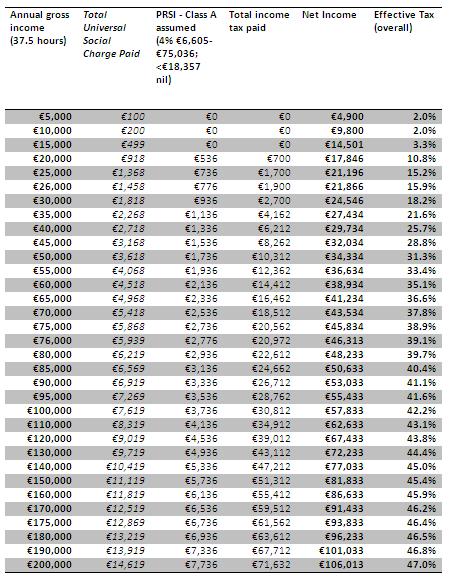
Tom McDonnell: TASC will be releasing a full budget response tomorrow. In the meantime feast your eyes on some good news for all of you single, non-PAYE workers on €200,000 or more. I have followed the Government’s practice of assuming a 6% pension contribution. You can do the calculations yourself using the deloitte tax calculator. See table below the fold, and click to enlarge.


Budget 2011: biggest fiscal consolidation ever
Paul Sweeney: The 2011 Budget is the biggest fiscal consolidation imposed by any government in the developed world since the Second World War. It dwarfs the consolidation under McSharry back in the late Eighties and far exceeds the biggest adjustment in another country - that of Denmark in the mid Eighties. We have heard of the Finnish adjustment after its exports collapsed with the fall of the Soviet Union in the early 1990s, but that was a fraction of this adjustment.
Based on a recent paper by Alesina, Carloni and Lecce, the following emerges. In terms of Ireland’s fiscal adjustment under McSharry, undoing the tax cuts and heavy public spending policies after the 1977 Election, the 4-year adjustment 1986-89 cumulatively was -4.82% of GDP and averaged -1.21%. Finland’s was a four year period of pain and was 6.23%. This averaged just over -1% a year over the six years, 1993-98.
The largest fiscal consolidation was in Denmark and it lasted 4 years between 1983 and 1986, averaging a savage -2.43% consolidation of cuts and tax rises a year.
So with the savage adjustment of €6bn in cuts with some tax rises, which is 4.7% of GNP (4% of GDP) Ireland’s Fianna Fail/Green Government wins the shocking economic prize as the world’s leading (lagging?) deflating government. The total adjustment is to be €29.6bn over the 6.5 years from mid 2008 to 2014 inclusive, (p 6 of Lenihan’s speech) or 23.3% of GNP in 2010 or 2011. The average will be somewhat less at a still massive 4.55% year from mid 2008 to end 2014. This is some pain to be inflicted upon the Irish people.
From a quick read of the EU’s 1st Review of the Greek Economic Adjustment Programme, it appears that the total consolidation will be 8% of GDP over 4 years and the IMF/EU MOU states that the will be 3.2% in 2011 (4.3% if carryovers from 2010 are added in).
As this is a blog post and written quickly, I suggest further study is undertaken by academic economists to see if this is correct and to develop it. It does seem that this Government is making economic history – for all the very wrong reasons!
“We all partied” say some in the commentariat and so we all must pay. Of course, that is untrue and many did not rise in the rising tide of the Domestically-Induced Boom of 2002-08.
But why should the poorest pay most, as per this incredibly regressive Budget? Of course, we may later have the ESRI or some body cited on this Budget to “prove” how progressive it is. But such a study will only examine some aspects of the total package, like income tax and welfare, and it will omit (by necessity of complexity), for example, various charges, indirect taxes, or the failure of Government to insist that the corporate sector step up to the plate in this deep crisis and contribute even 2% of profits (only profits made) which would contribute €630m a year to running this debt-ridden country, the one in which they are happy to operate in.
It was corporate Ireland – specifically the banks, which all but destroyed this economy. And these banks were “governed” by the heads of Ireland leading corporations, heads of public bodies, top advisors and lawyers from the big firms etc., as TASC’s “Mapping the Golden Circle” demonstrates. Thus when you hear calls for public sector reform, modify them to institutional or corporate reform for both public and private sectors.
Alesina et al’s paper is ironically called “The Electoral Consequences of Large Fiscal Adjustments. It is available on Alesina’s website at Harvard.
In this paper they also suggest that “tax-based adjustments” (over cuts) make it more difficult for incumbent governments to be reappointed when they implement large fiscal adjustments. Alesina is criticised on this important point of the supposed superiority of cuts over tax rises by others, including even the IMF in its recent Outlook paper.
Aleseni is often cited by proponents of cuts vs taxes. Lenihan’s Budget statement cites “economic theory” as supporting cuts over taxes. It is of course the liberal economic view, that is the view from a certain side of the house!
In my opinion, this Budget is perhaps the first Irish Budget to be so overtly informed, if that is not too flattering a word, in the language of liberal economic theory. Of course, all Irish Budgets since 1998 have been strong models of this perspective, moderated with some social democratic values. But it was largely the pro-cyclical, direct tax-cutting and de-regulation which led to Ireland’s economic Crash of 2008 and our downfall continues with this Budget.
Last year in his Budget, Mr Lenihan promised “we are on the road to recovery.” Yeah? He concluded by asserting that “our plan is working.” He then asserted that “We have turned the corner”. Green shoots? Where?
With the biggest deflationary Budget in the western world, with this saturation bombing, it will be many years before there are any “green shoots”.
Based on a recent paper by Alesina, Carloni and Lecce, the following emerges. In terms of Ireland’s fiscal adjustment under McSharry, undoing the tax cuts and heavy public spending policies after the 1977 Election, the 4-year adjustment 1986-89 cumulatively was -4.82% of GDP and averaged -1.21%. Finland’s was a four year period of pain and was 6.23%. This averaged just over -1% a year over the six years, 1993-98.
The largest fiscal consolidation was in Denmark and it lasted 4 years between 1983 and 1986, averaging a savage -2.43% consolidation of cuts and tax rises a year.
So with the savage adjustment of €6bn in cuts with some tax rises, which is 4.7% of GNP (4% of GDP) Ireland’s Fianna Fail/Green Government wins the shocking economic prize as the world’s leading (lagging?) deflating government. The total adjustment is to be €29.6bn over the 6.5 years from mid 2008 to 2014 inclusive, (p 6 of Lenihan’s speech) or 23.3% of GNP in 2010 or 2011. The average will be somewhat less at a still massive 4.55% year from mid 2008 to end 2014. This is some pain to be inflicted upon the Irish people.
From a quick read of the EU’s 1st Review of the Greek Economic Adjustment Programme, it appears that the total consolidation will be 8% of GDP over 4 years and the IMF/EU MOU states that the will be 3.2% in 2011 (4.3% if carryovers from 2010 are added in).
As this is a blog post and written quickly, I suggest further study is undertaken by academic economists to see if this is correct and to develop it. It does seem that this Government is making economic history – for all the very wrong reasons!
“We all partied” say some in the commentariat and so we all must pay. Of course, that is untrue and many did not rise in the rising tide of the Domestically-Induced Boom of 2002-08.
But why should the poorest pay most, as per this incredibly regressive Budget? Of course, we may later have the ESRI or some body cited on this Budget to “prove” how progressive it is. But such a study will only examine some aspects of the total package, like income tax and welfare, and it will omit (by necessity of complexity), for example, various charges, indirect taxes, or the failure of Government to insist that the corporate sector step up to the plate in this deep crisis and contribute even 2% of profits (only profits made) which would contribute €630m a year to running this debt-ridden country, the one in which they are happy to operate in.
It was corporate Ireland – specifically the banks, which all but destroyed this economy. And these banks were “governed” by the heads of Ireland leading corporations, heads of public bodies, top advisors and lawyers from the big firms etc., as TASC’s “Mapping the Golden Circle” demonstrates. Thus when you hear calls for public sector reform, modify them to institutional or corporate reform for both public and private sectors.
Alesina et al’s paper is ironically called “The Electoral Consequences of Large Fiscal Adjustments. It is available on Alesina’s website at Harvard.
In this paper they also suggest that “tax-based adjustments” (over cuts) make it more difficult for incumbent governments to be reappointed when they implement large fiscal adjustments. Alesina is criticised on this important point of the supposed superiority of cuts over tax rises by others, including even the IMF in its recent Outlook paper.
Aleseni is often cited by proponents of cuts vs taxes. Lenihan’s Budget statement cites “economic theory” as supporting cuts over taxes. It is of course the liberal economic view, that is the view from a certain side of the house!
In my opinion, this Budget is perhaps the first Irish Budget to be so overtly informed, if that is not too flattering a word, in the language of liberal economic theory. Of course, all Irish Budgets since 1998 have been strong models of this perspective, moderated with some social democratic values. But it was largely the pro-cyclical, direct tax-cutting and de-regulation which led to Ireland’s economic Crash of 2008 and our downfall continues with this Budget.
Last year in his Budget, Mr Lenihan promised “we are on the road to recovery.” Yeah? He concluded by asserting that “our plan is working.” He then asserted that “We have turned the corner”. Green shoots? Where?
With the biggest deflationary Budget in the western world, with this saturation bombing, it will be many years before there are any “green shoots”.
Michael Burke on the British economy may escape an Irish fate
Writing on the Guardian website, PE blogger Michael Burke points out that "British political leaders, like their co-thinkers in Dublin, have no explanation as to how cuts led to a wider deficit. Yet there is one important difference between the two economies that may yet shelter the British economy from an Irish fate, or at least the dominant section of it. The Irish bailout, like Greece before it, is a form of international loan-sharking, where Europe's banks demand repayment in full of existing debt by means of loading Irish taxpayers with ever-greater debts. These banks are headed by British ones, which hold £140bn in bonds issued by Irish borrowers, the biggest national exposure to Irish debt. Almost unremarked here, but not in Ireland, is that the interest rate on these new EU loans will be approximately 7%, compared with just 3% on IMF loans". You can read the rest of his article here.
Tuesday, 7 December 2010
A budget that does not add up
Slí eile: The annual pantomime known as the Budget is an annual fixture. Since the onset of recession in 2008 it has assumed the proportion of an annual (and sometimes twice a year) catharsis. It is carefully planned and delivered through a series of planted leaks, suggestions, threats, ameliorations, political trading and spin. This year, the atmosphere has been characterised by:
1 recession weariness (in some peoples people have been used to a certain level of shock, awe and fear)
2 the publication of a 'four year plan' to resolve the fiscal impasse
3 a sense that control has passed more than before, to some extent, to forces outside Ireland.
On a first reading and hearing of this year's budget the following is apparent:
the poor, the unemployed, families with children, the sick, the young will take the brunt of the adjustment
public services will be further undermined in a country where the public domain was inadequate
taxes will serve to lower living standards across the board but in a way that will impact in absolute terms very severely on those already struggling on low income
key changes in regard to capital, corporate and consumption taxes were either avoided, postponed or introduced in a very limited way.
as in previous years, the amount and quality of information provided leaves much to be desired -
simple to use and transparent data sheets are not available
the full policy and programme implications of reductions Department by Department and vote sub-head by sub-head remain to be spelt out
the macro-economic impact of these adjustments are not presented (e.g. the deflationary impact on tax flows is not shown or explicitly factored in)
the combined impact on household income for different groups (e.g. by decile) has not been shown
the extent of reparations in the form of capital transactions is difficult to isolate out in the data shown in the background material - this needs to be more clearly shown and set against the cut backs to public services and living standards - the price of reparations for the benefit of unknown investors, bondholders and other creditors.
There is a sense from the opposition benches that in the coming months some aspects of the bigger 'plan' can be revisited and even re-negotiated (with respect to composition, timing and interest payments). The speeches from that side of the house were populist but not indicative of how exactly an alternative economic strategy would work and deliver. The most credible, worked-out and progressive alternative package I have seen to date is that provided by UNITE.
1 recession weariness (in some peoples people have been used to a certain level of shock, awe and fear)
2 the publication of a 'four year plan' to resolve the fiscal impasse
3 a sense that control has passed more than before, to some extent, to forces outside Ireland.
On a first reading and hearing of this year's budget the following is apparent:
the poor, the unemployed, families with children, the sick, the young will take the brunt of the adjustment
public services will be further undermined in a country where the public domain was inadequate
taxes will serve to lower living standards across the board but in a way that will impact in absolute terms very severely on those already struggling on low income
key changes in regard to capital, corporate and consumption taxes were either avoided, postponed or introduced in a very limited way.
as in previous years, the amount and quality of information provided leaves much to be desired -
simple to use and transparent data sheets are not available
the full policy and programme implications of reductions Department by Department and vote sub-head by sub-head remain to be spelt out
the macro-economic impact of these adjustments are not presented (e.g. the deflationary impact on tax flows is not shown or explicitly factored in)
the combined impact on household income for different groups (e.g. by decile) has not been shown
the extent of reparations in the form of capital transactions is difficult to isolate out in the data shown in the background material - this needs to be more clearly shown and set against the cut backs to public services and living standards - the price of reparations for the benefit of unknown investors, bondholders and other creditors.
There is a sense from the opposition benches that in the coming months some aspects of the bigger 'plan' can be revisited and even re-negotiated (with respect to composition, timing and interest payments). The speeches from that side of the house were populist but not indicative of how exactly an alternative economic strategy would work and deliver. The most credible, worked-out and progressive alternative package I have seen to date is that provided by UNITE.
A New Deal moment
Michael Taft: The budget will be nasty, brutal but unfortunately not short. Its effects will last – unless people through their popular organisations put enough pressure on the opposition parties to commit to its repeal. But repeal to what end?
We must demand a New Deal moment – a fundamental break from the existing parameters. You can read about this here.
We must demand a New Deal moment – a fundamental break from the existing parameters. You can read about this here.
Monday, 6 December 2010
Was it for this? II
Michael Burke: Ahead of tomorrow's Budget, it may be worth taking stock and posing the question, How did it come to this?
The Irish Times leader column titled Was It for This? caused something of a stir by contrasting the national humiliation of the EU/ECB/IMF landing party to the expression of national independence in 1916. The editorial paints a confused historical picture of how this debacle came about, but the context, and contrast, is not misplaced.
It is clear from the 4-year and wholly misnamed 'Recovery Plan' that the intention is to bind the citizens of this state and their elected representatives to a set of economic, fiscal and social policies that are designed to be wholly immutable. Tomorrow's Budget will fill in the awful details, but the main elements are already in place.
The documents agreed between the government and the international bodies who are actually in charge also make it abundantly clear whose interests are being represented. It is stated that the IMF portion of the package will command an interest rate of just over 3%. If, as stated, the average interest rate is 5.8%, then the EU, non-IMF portion (two-thirds of the total) must be at a rate close to 7%.
It is further stated that, of the €35bn in further funds for the banks, only €10bn is for their immediate recapitalisation- the remainder is for 'contingencies' in the banking sector (which is almost exactly the same as the NPRF's former level of assets, just to underline who it is here that is being protected. It turns out the NPRF was 'rainy day' money for the banking sector, not its contributors.).
This further lifeblood for what are already zombie banks will cost over €1.7bn annually at a 7% interest rate. This annual cost is a large proportion of the planned cuts to current expenditure in December's Budget (€2.09bn), including social welfare, public sector job losses, public sector pensions and 'other expenditure' on goods and services.
Or, it is amost exactly the same as the planned reduction of €1.8bn in govt. capital expenditure.
Irish taxpayers are being foisted with a near-doubling of the national debt- in the name of debt-reduction. The government aim is to keep alive a failed banking system so that it will not pull the plug on property speculators. But the ultimate beneficiaries are British, German and French banks who will be paid out in full despite the stupidity of their lending and in violation of the free-market principles which they extol. These are the real 'vested interests' which determine policy.
Prophetically, Liam Mellowes once said, "Ireland, if her industries and banks were controlled by foreign capital, would be at the mercy of every breeze that ruffled the surface of the world’s money-markets." His response was, "The Irish Republic stands, therefore, for the ownership of Ireland by the people of Ireland."
The current arrangements are the negation of a Republic.
The Irish Times leader column titled Was It for This? caused something of a stir by contrasting the national humiliation of the EU/ECB/IMF landing party to the expression of national independence in 1916. The editorial paints a confused historical picture of how this debacle came about, but the context, and contrast, is not misplaced.
It is clear from the 4-year and wholly misnamed 'Recovery Plan' that the intention is to bind the citizens of this state and their elected representatives to a set of economic, fiscal and social policies that are designed to be wholly immutable. Tomorrow's Budget will fill in the awful details, but the main elements are already in place.
The documents agreed between the government and the international bodies who are actually in charge also make it abundantly clear whose interests are being represented. It is stated that the IMF portion of the package will command an interest rate of just over 3%. If, as stated, the average interest rate is 5.8%, then the EU, non-IMF portion (two-thirds of the total) must be at a rate close to 7%.
It is further stated that, of the €35bn in further funds for the banks, only €10bn is for their immediate recapitalisation- the remainder is for 'contingencies' in the banking sector (which is almost exactly the same as the NPRF's former level of assets, just to underline who it is here that is being protected. It turns out the NPRF was 'rainy day' money for the banking sector, not its contributors.).
This further lifeblood for what are already zombie banks will cost over €1.7bn annually at a 7% interest rate. This annual cost is a large proportion of the planned cuts to current expenditure in December's Budget (€2.09bn), including social welfare, public sector job losses, public sector pensions and 'other expenditure' on goods and services.
Or, it is amost exactly the same as the planned reduction of €1.8bn in govt. capital expenditure.
Irish taxpayers are being foisted with a near-doubling of the national debt- in the name of debt-reduction. The government aim is to keep alive a failed banking system so that it will not pull the plug on property speculators. But the ultimate beneficiaries are British, German and French banks who will be paid out in full despite the stupidity of their lending and in violation of the free-market principles which they extol. These are the real 'vested interests' which determine policy.
Prophetically, Liam Mellowes once said, "Ireland, if her industries and banks were controlled by foreign capital, would be at the mercy of every breeze that ruffled the surface of the world’s money-markets." His response was, "The Irish Republic stands, therefore, for the ownership of Ireland by the people of Ireland."
The current arrangements are the negation of a Republic.
Wednesday, 10 November 2010
Ireland will not run out of money if the December Budget fails
Nat O'Connor: The front page of The Irish Times runs with the Taoiseach claiming that if the Budget is not passed, the country will run out of money. That is technically untrue.
The Taoiseach is absolutely correct that major fiscal adjustments have to be made this year and in subsequent years, but the evidence does not necessarily weigh behind the current plan of frontloading €6 billion.
The Taoiseach is also correct that if Ireland reached the middle of next year, with no coherent economic strategy and a weak Budget that fudged the issues, we could find ourselves running out of money. He is correct that you can't spend €50 billion a year, if you only bring in €31 billion in tax.
But none of the areas where the Taoiseach is factually correct supports his contention that if the Government's Budget is not passed on December 7, that Ireland will then run out of money.
Under the Constitution, only the Dáil deals with 'money' bills, like the Budget, the Finance Act, etc. The Seanad can only make commentary. So, passing the Budget is down to the Dáil vote.
The Budget could at this point easily fail to be passed, if the Green Party defects, if a very small number of backbench Fianna Fáil TDs vote against it, or if a slightly larger number of pro-Government TDs abstain or don't turn up. This assumes that all the Opposition TDs do turn up, and vote against it.
If the Budget is defeated in the Dáil, what will happen next is very predictable based on Ireland's prior parliamentary history. The Opposition will put down a Motion of No Confidence in the Government, which the Government will counter with a Motion of Confidence in themselves. Under the parliamentary rules, the Government's motion gets to be debated first, so there will be some heated speeches in the Dáil. Then the TDs will vote on the motion. It seems to me highly unlikely that the Government would win such a vote. If they lose the Budget vote, they'll almost certainly lose the confidence vote, and a General Election will be called.
Once the election is called, arrangements will be made for what the now 'caretaker' Government will do in its final weeks. The Opposition may be asked to agree a compromise and pass parts of the Budget. That could go in various ways. Fianna Fáil and Fine Gael might agree an alternative €6 billion adjustment at that point. Alternatively, a wider range of TDs might agree a skeleton Budget that simply ensures money is there so that hospitals, schools, etc will all remain open in January.
Once the election is over, the new Government will then propose, and pass, their own Budget (probably in January). Any new Government must have a working majority in the Dáil, so this New Year Budget would almost certainly pass. Depending on its content - and the economic logic of its approach - the bond markets will react accordingly. If the markets react favourably, the new Government could borrow a relatively small amount in the first quarter to 'test the water' and then go back to the markets again in late summer. As ever, what will matter to the markets is a coherent, sustainable growth strategy to demonstrate that Ireland is serious about generating the funds to pay them back.
The Taoiseach is right that Ireland does need to pass a strong Budget and four-year plan before very early next year. But it does not have to be his Budget.
I would go further and suggest that Ireland could be more likely to 'run out of money' if the Government's planned €6 billion budget is passed. If the austerity measures kill growth and stagnate the economy, and if there is no robust plan on jobs, then the bond markets will demand far too high interest rates, making it effectively impossible for Ireland to borrow. And then we really will run out of money.
The Taoiseach is absolutely correct that major fiscal adjustments have to be made this year and in subsequent years, but the evidence does not necessarily weigh behind the current plan of frontloading €6 billion.
The Taoiseach is also correct that if Ireland reached the middle of next year, with no coherent economic strategy and a weak Budget that fudged the issues, we could find ourselves running out of money. He is correct that you can't spend €50 billion a year, if you only bring in €31 billion in tax.
But none of the areas where the Taoiseach is factually correct supports his contention that if the Government's Budget is not passed on December 7, that Ireland will then run out of money.
Under the Constitution, only the Dáil deals with 'money' bills, like the Budget, the Finance Act, etc. The Seanad can only make commentary. So, passing the Budget is down to the Dáil vote.
The Budget could at this point easily fail to be passed, if the Green Party defects, if a very small number of backbench Fianna Fáil TDs vote against it, or if a slightly larger number of pro-Government TDs abstain or don't turn up. This assumes that all the Opposition TDs do turn up, and vote against it.
If the Budget is defeated in the Dáil, what will happen next is very predictable based on Ireland's prior parliamentary history. The Opposition will put down a Motion of No Confidence in the Government, which the Government will counter with a Motion of Confidence in themselves. Under the parliamentary rules, the Government's motion gets to be debated first, so there will be some heated speeches in the Dáil. Then the TDs will vote on the motion. It seems to me highly unlikely that the Government would win such a vote. If they lose the Budget vote, they'll almost certainly lose the confidence vote, and a General Election will be called.
Once the election is called, arrangements will be made for what the now 'caretaker' Government will do in its final weeks. The Opposition may be asked to agree a compromise and pass parts of the Budget. That could go in various ways. Fianna Fáil and Fine Gael might agree an alternative €6 billion adjustment at that point. Alternatively, a wider range of TDs might agree a skeleton Budget that simply ensures money is there so that hospitals, schools, etc will all remain open in January.
Once the election is over, the new Government will then propose, and pass, their own Budget (probably in January). Any new Government must have a working majority in the Dáil, so this New Year Budget would almost certainly pass. Depending on its content - and the economic logic of its approach - the bond markets will react accordingly. If the markets react favourably, the new Government could borrow a relatively small amount in the first quarter to 'test the water' and then go back to the markets again in late summer. As ever, what will matter to the markets is a coherent, sustainable growth strategy to demonstrate that Ireland is serious about generating the funds to pay them back.
The Taoiseach is right that Ireland does need to pass a strong Budget and four-year plan before very early next year. But it does not have to be his Budget.
I would go further and suggest that Ireland could be more likely to 'run out of money' if the Government's planned €6 billion budget is passed. If the austerity measures kill growth and stagnate the economy, and if there is no robust plan on jobs, then the bond markets will demand far too high interest rates, making it effectively impossible for Ireland to borrow. And then we really will run out of money.
Friday, 5 November 2010
2011, 2014, the Bond Markets and Growth
Nat O'Connor: It seems to me that there is some confusion in the way in which international factors on Ireland's deficit are presented to the general public in the media. In particular, the 'requirement' that Ireland's deficit is reduced to three per cent of GDP by 2014 seems to be confused with the issue of whether it may be too expensive for us to borrow from the bond markets early next year. The financial institutions that lend money to countries (i.e. the 'bond markets') do not care whether Ireland reaches three per cent of GDP by 2014, provided we can show evidence of an ability to repay our borrowings. But in terms of providing this evidence, the deadline for satisfying these lenders may well be early 2011, not end-2014.
Those who are offering to lend money to Ireland at the moment (at high rates of nearly eight per cent) are taking a chance on making big money on these loans; balanced against a heightened risk that this or the next Irish Government will decide not to pay back the loan - or only pay back a portion of it. However, they are not crazy. They would not lend to Ireland (except at extortionate, short-term rates) if they thought that it was highly likely that we would default on the loans. So, we are still in a position where some of these large - and coldly calculating - financial institutions think that they can make money. (That is, they are confident that we will pay back the loans, or at least enough years of interest, to make it worth their while taking the risk). Unfortunately, not enough of them are interested in lending to Ireland, hence we would have to borrow at nearly eight per cent from the small pool of risk-takers who are willing to lend.
However, the institutions that might consider lending to Ireland at lower rates are not necessarily the same financial institutions that would lend at higher rates. Some institutions make more conservative lending decisions, while others go for more risky investments. This is an oversimplification, perhaps, as most will have balanced portfolios, but it hopefully illustrates the point that not all participants in the international bond markets are clones.
The more conservative institutions operating in the bond markets want to see more evidence of ability to pay. That is, they want evidence that Ireland has moved into a period of economic growth that can be sustained. And they want evidence that tax revenue is stable. And they certainly want to see public expenditure reduced over time to what the state can afford, based on its revenue. However, as long as there is evidence that the state is on a sustainable path, it doesn't matter whether it is 2014, 2016 or 2020. All that matters is that Ireland is on a stable growth trajectory and can show that it will be able to pay back the money.
Meanwhile, there is another part of the bond market that Ireland must also satisfy. That is those institutions that have already - in better times - lent money to Ireland. (Much of our borrowing is at 3 or 4 per cent interest). Like the conservative financial institutions that will not currently lend to Ireland, those who have already lent to us very urgently want to see evidence of ability to pay! They want to see a credible growth plan, because they are not even benefitting from especially high interest rates on what have become risky loans. Some of these institutions may be the same ones that might lend more money to Ireland in future, but only if presented with evidence of growth.
Finally, there is the EU dimension to all of this. The EU Stability and Growth Pact is a political agreement made between all Eurozone countries. Our Government have pledged to return our deficit to 3 per cent by 2014. This is a political decision. It was perhaps a necessary decision in order to persuade the European Central Bank to assist Ireland by buying some of our bonds, and accepting the IOUs we gave our banks to cash in. But it is only one of the many political compromises we make in Europe all of the time. Much EU business is done by consensus within the Council of Ministers. There is certainly scope for Ireland to gain compromise on this target, with the support of other Eurozone countries who are also in danger of missing the target.
However - and this is where the more immediate bond market question gets mixed up with the EU 2014 question - if we think that our economic strategies are not going to deliver growth, and therefore the international bond markets will not lend to us at a reasonable rate, we have to remain on reasonably good terms with the ECB, so that they will buy our bonds and, ultimately, bail us out with the EU-IMF fund, if the worst comes to pass.
Ironically, the effort to satisfy the EU by aiming for a deficit of 3 per cent by 2014 - in case we need EU help - is likely to make it more likely that we will need to avail of emergency assistance! That is because our sequence of severely contractionary budgets (and a further €6 billion in cuts and taxes planned for December) is shrinking the economy, cutting or even killing growth, and making it less likely that the more risk-averse parts of the bond market will lend to us.
How do we get out of this bind? The answer is simply that we need to deal with 2011 before we deal with 2014. The issue in 2011 is whether Ireland has a credible growth strategy, which will persuade more international lenders to lend us money at a more reasonable rate. The only way that this can be achieved is by a smart combination of tax changes, expenditure changes and measures to foster growth and jobs.
Crucially, Budget 2011 is effectively Ireland's last chance to change direction. The Government has the option of spending sufficient money from the national pensions reserve fund (NPRF) to offset some - or maybe even all - of the contractionary effects of increased taxation and reduced expenditure in 2011. We do still need to lower the deficit by a combination of tax and spending changes. But we also need to boost jobs, boost aggregate demand, and boost economic growth.
At this stage, a number of commentators have made the same observation and a range of bodies have put forward credible options for boosting growth in the economy. Without getting into the pros and cons of the different approaches - and there are profound differences - there are many options that Government could take:
- TASC proposes a €3 billion Economic Recovery Fund in 2011 including a credit guarantee scheme for small businesses and rollout of next generation broadband (which would be labour intensive);
-ICTU calls for a minimum investment of €2 billion per annum, over three years, to be spent on a new water and waste network, retrofitting energy inefficient buildings, educational buildings and broadband (with options to bring in private finance, as well as using NPRF money);
- Fine Gael propose a major state-led investment of €18 billion through their NewERA proposals, funded through selling state assets;
- Labour wants to create a Strategic Investment Bank to invest €2 billion (initially) in SMEs and raise finance for infrastructure;
- Sinn Féin proposes a 3.5 year stimulus, using €7 billion from the NPRF (€2 billion in 2011) to invest in a revised National Development Plan, including remediating the water network, extending and rolling out broadband. Also a 'cash stimulus' through welfare, which would boost aggregate demand in local areas;
- IBEC have stated that only growth will solve the fiscal crisis. They call for limiting cuts to capital investment, reviews to ensure all new government policy and legislative initiatives support employment, a radical overhaul of the public employment service, an ambitious national internship programme and the continued PRSI reduction for employing people who are long-term employed;
- ISME "warns of Government complacency on jobs". They claim that businesses are "handicapped by a reduction in consumer demand exacerbated by exorbitant costs, late payments and a difficulty in accessing bank credit";
There is a broad and growing consensus on the economy. That consensus is on the need to change direction, and focus on jobs and growth.
And this is recognised internationally. Paul Krugman notes the 'experiment' (and here also) that Ireland's austerity resulted in a worse result than Spain's attempts at stimulus. Joseph Stiglitz has claimed that Europe "made a wrong bet with austerity". In particular, Ireland’s struggle to revitalize its economy after the country’s worst recession on record shows the risks of focusing on deficits. "The belief that markets will get new confidence has been shown wrong" by Ireland’s austerity drive, Stiglitz said.
If the Government continues to monomaniacally focus on cuts and taxes, and refuse to present a credible growth strategy, it will bring us much closer to requiring an EU-IMF bailout, allow further collapse in the economy and cause unnecessary hardship for many people.
Those who are offering to lend money to Ireland at the moment (at high rates of nearly eight per cent) are taking a chance on making big money on these loans; balanced against a heightened risk that this or the next Irish Government will decide not to pay back the loan - or only pay back a portion of it. However, they are not crazy. They would not lend to Ireland (except at extortionate, short-term rates) if they thought that it was highly likely that we would default on the loans. So, we are still in a position where some of these large - and coldly calculating - financial institutions think that they can make money. (That is, they are confident that we will pay back the loans, or at least enough years of interest, to make it worth their while taking the risk). Unfortunately, not enough of them are interested in lending to Ireland, hence we would have to borrow at nearly eight per cent from the small pool of risk-takers who are willing to lend.
However, the institutions that might consider lending to Ireland at lower rates are not necessarily the same financial institutions that would lend at higher rates. Some institutions make more conservative lending decisions, while others go for more risky investments. This is an oversimplification, perhaps, as most will have balanced portfolios, but it hopefully illustrates the point that not all participants in the international bond markets are clones.
The more conservative institutions operating in the bond markets want to see more evidence of ability to pay. That is, they want evidence that Ireland has moved into a period of economic growth that can be sustained. And they want evidence that tax revenue is stable. And they certainly want to see public expenditure reduced over time to what the state can afford, based on its revenue. However, as long as there is evidence that the state is on a sustainable path, it doesn't matter whether it is 2014, 2016 or 2020. All that matters is that Ireland is on a stable growth trajectory and can show that it will be able to pay back the money.
Meanwhile, there is another part of the bond market that Ireland must also satisfy. That is those institutions that have already - in better times - lent money to Ireland. (Much of our borrowing is at 3 or 4 per cent interest). Like the conservative financial institutions that will not currently lend to Ireland, those who have already lent to us very urgently want to see evidence of ability to pay! They want to see a credible growth plan, because they are not even benefitting from especially high interest rates on what have become risky loans. Some of these institutions may be the same ones that might lend more money to Ireland in future, but only if presented with evidence of growth.
Finally, there is the EU dimension to all of this. The EU Stability and Growth Pact is a political agreement made between all Eurozone countries. Our Government have pledged to return our deficit to 3 per cent by 2014. This is a political decision. It was perhaps a necessary decision in order to persuade the European Central Bank to assist Ireland by buying some of our bonds, and accepting the IOUs we gave our banks to cash in. But it is only one of the many political compromises we make in Europe all of the time. Much EU business is done by consensus within the Council of Ministers. There is certainly scope for Ireland to gain compromise on this target, with the support of other Eurozone countries who are also in danger of missing the target.
However - and this is where the more immediate bond market question gets mixed up with the EU 2014 question - if we think that our economic strategies are not going to deliver growth, and therefore the international bond markets will not lend to us at a reasonable rate, we have to remain on reasonably good terms with the ECB, so that they will buy our bonds and, ultimately, bail us out with the EU-IMF fund, if the worst comes to pass.
Ironically, the effort to satisfy the EU by aiming for a deficit of 3 per cent by 2014 - in case we need EU help - is likely to make it more likely that we will need to avail of emergency assistance! That is because our sequence of severely contractionary budgets (and a further €6 billion in cuts and taxes planned for December) is shrinking the economy, cutting or even killing growth, and making it less likely that the more risk-averse parts of the bond market will lend to us.
How do we get out of this bind? The answer is simply that we need to deal with 2011 before we deal with 2014. The issue in 2011 is whether Ireland has a credible growth strategy, which will persuade more international lenders to lend us money at a more reasonable rate. The only way that this can be achieved is by a smart combination of tax changes, expenditure changes and measures to foster growth and jobs.
Crucially, Budget 2011 is effectively Ireland's last chance to change direction. The Government has the option of spending sufficient money from the national pensions reserve fund (NPRF) to offset some - or maybe even all - of the contractionary effects of increased taxation and reduced expenditure in 2011. We do still need to lower the deficit by a combination of tax and spending changes. But we also need to boost jobs, boost aggregate demand, and boost economic growth.
At this stage, a number of commentators have made the same observation and a range of bodies have put forward credible options for boosting growth in the economy. Without getting into the pros and cons of the different approaches - and there are profound differences - there are many options that Government could take:
- TASC proposes a €3 billion Economic Recovery Fund in 2011 including a credit guarantee scheme for small businesses and rollout of next generation broadband (which would be labour intensive);
-ICTU calls for a minimum investment of €2 billion per annum, over three years, to be spent on a new water and waste network, retrofitting energy inefficient buildings, educational buildings and broadband (with options to bring in private finance, as well as using NPRF money);
- Fine Gael propose a major state-led investment of €18 billion through their NewERA proposals, funded through selling state assets;
- Labour wants to create a Strategic Investment Bank to invest €2 billion (initially) in SMEs and raise finance for infrastructure;
- Sinn Féin proposes a 3.5 year stimulus, using €7 billion from the NPRF (€2 billion in 2011) to invest in a revised National Development Plan, including remediating the water network, extending and rolling out broadband. Also a 'cash stimulus' through welfare, which would boost aggregate demand in local areas;
- IBEC have stated that only growth will solve the fiscal crisis. They call for limiting cuts to capital investment, reviews to ensure all new government policy and legislative initiatives support employment, a radical overhaul of the public employment service, an ambitious national internship programme and the continued PRSI reduction for employing people who are long-term employed;
- ISME "warns of Government complacency on jobs". They claim that businesses are "handicapped by a reduction in consumer demand exacerbated by exorbitant costs, late payments and a difficulty in accessing bank credit";
There is a broad and growing consensus on the economy. That consensus is on the need to change direction, and focus on jobs and growth.
And this is recognised internationally. Paul Krugman notes the 'experiment' (and here also) that Ireland's austerity resulted in a worse result than Spain's attempts at stimulus. Joseph Stiglitz has claimed that Europe "made a wrong bet with austerity". In particular, Ireland’s struggle to revitalize its economy after the country’s worst recession on record shows the risks of focusing on deficits. "The belief that markets will get new confidence has been shown wrong" by Ireland’s austerity drive, Stiglitz said.
If the Government continues to monomaniacally focus on cuts and taxes, and refuse to present a credible growth strategy, it will bring us much closer to requiring an EU-IMF bailout, allow further collapse in the economy and cause unnecessary hardship for many people.
They didn't even number the pages
Michael Taft: Let me see if I get this. The Government produces a new set of projections yesterday in their Economic and Budgetary Outlook (a new acronym: EBO). Compared to their projections last December, these are the new numbers for 2011:
• GDP growth cut from 3.3 percent to 1.7 percent – that’s a mighty slice
• GNP growth cut from 3 percent to 1 percent - that’s an even mightier slice
• Consumer spending cut from 2.6 percent to 0 – that’s called flat-lining
• Investment cut from 4.5 percent to (–) 6 percent – ouch
• Government spending on public services cut from (-) 0.5 percent to (-) 3 percent – you’ve been warned
• Employment cut (literally) from a 1 percent growth to (-) 0.25 percent – in hard numbers that’s a difference between having 19,000 more people at work and 5,000 less (but don’t worry, Batt O’Keefe is in total control of his Department)
And that’s just for 2011. What about projections up to the 2014? Not as much detail but:
• Nominal GDP has been cut by over €21 billion, or over 10 percent – if the Government’s tax revenue ratio’s hold, underlying tax revenue by 2014 will slump by over €4 billion over last year’s projections.
• Real GDP growth rate cut from 4 percent annual average to 2.7 percent
• No numbers on GNP out to 2014 but that’s not surprising: last year the Government projected GNP growth to 90 percent of GDP growth in 2011; now GNP will only grow by 59 percent of GDP growth. The domestic economy is slipping well behind the headline rate.
• Employment growth has been cut from an average annual rate of 2 percent to 1.1 percent – that will now mean 75,000 fewer people at work.
But, hey, it’s not all doom and gloom. Take those employment figures – they’re collapsing yet the unemployment rate is expected to remain much the same; a slight increase of 0.25 percent in the unemployment rate. How does this occur? The paper puts it eloquently:
‘Net outward migration will restrain the pace of growth in labour supply, which combined with the increase in net employment will reduce unemployment to under 10% by the end of the forecast horizon.’
What a nice way to describe mass emigration.
Or take the export figures. The Government is revising growth upwards for 2011 (no numbers after that) from 3.4 percent to 5 percent. This is in line with other forecasters and shows the strength of, at least, our multi-national exporting sector. But where does that leave the export-led recovery strategy?
But the bottom line is the deficit. And though the world changes – growth rates, employment, emigration and hollow export-growth – though everything is change, we can still rely on death, taxes and Maastricht compliance by 2014 as the ballast that gives compass to our economic lives.
Okay, so we are expected to believe that reduced growth rates, reduced employment, higher emigration, a third consecutive year of domestic-demand recession (that is, excluding net exports), more deflationary policies will somehow translate into fiscal stability; just close your eyes and think of the Stability and Growth Pact.
All this from a 10-page economic and budgetary outlook that was put together and rushed out so quickly, they didn’t even have time to number the pages.
A long sound of exhalation.
• GDP growth cut from 3.3 percent to 1.7 percent – that’s a mighty slice
• GNP growth cut from 3 percent to 1 percent - that’s an even mightier slice
• Consumer spending cut from 2.6 percent to 0 – that’s called flat-lining
• Investment cut from 4.5 percent to (–) 6 percent – ouch
• Government spending on public services cut from (-) 0.5 percent to (-) 3 percent – you’ve been warned
• Employment cut (literally) from a 1 percent growth to (-) 0.25 percent – in hard numbers that’s a difference between having 19,000 more people at work and 5,000 less (but don’t worry, Batt O’Keefe is in total control of his Department)
And that’s just for 2011. What about projections up to the 2014? Not as much detail but:
• Nominal GDP has been cut by over €21 billion, or over 10 percent – if the Government’s tax revenue ratio’s hold, underlying tax revenue by 2014 will slump by over €4 billion over last year’s projections.
• Real GDP growth rate cut from 4 percent annual average to 2.7 percent
• No numbers on GNP out to 2014 but that’s not surprising: last year the Government projected GNP growth to 90 percent of GDP growth in 2011; now GNP will only grow by 59 percent of GDP growth. The domestic economy is slipping well behind the headline rate.
• Employment growth has been cut from an average annual rate of 2 percent to 1.1 percent – that will now mean 75,000 fewer people at work.
But, hey, it’s not all doom and gloom. Take those employment figures – they’re collapsing yet the unemployment rate is expected to remain much the same; a slight increase of 0.25 percent in the unemployment rate. How does this occur? The paper puts it eloquently:
‘Net outward migration will restrain the pace of growth in labour supply, which combined with the increase in net employment will reduce unemployment to under 10% by the end of the forecast horizon.’
What a nice way to describe mass emigration.
Or take the export figures. The Government is revising growth upwards for 2011 (no numbers after that) from 3.4 percent to 5 percent. This is in line with other forecasters and shows the strength of, at least, our multi-national exporting sector. But where does that leave the export-led recovery strategy?
But the bottom line is the deficit. And though the world changes – growth rates, employment, emigration and hollow export-growth – though everything is change, we can still rely on death, taxes and Maastricht compliance by 2014 as the ballast that gives compass to our economic lives.
Okay, so we are expected to believe that reduced growth rates, reduced employment, higher emigration, a third consecutive year of domestic-demand recession (that is, excluding net exports), more deflationary policies will somehow translate into fiscal stability; just close your eyes and think of the Stability and Growth Pact.
All this from a 10-page economic and budgetary outlook that was put together and rushed out so quickly, they didn’t even have time to number the pages.
A long sound of exhalation.
Thursday, 4 November 2010
A better way
Michael Burke: As the population braces itself for another round of swingeing cuts, the government and the overwhelming majority of the media continue to make this claim: That larger cuts will reassure financial markets, allow NTMA to resume borrowing once more and lead to lower interest rates.
Over at the Irish Economy, Colm McCarthy has been expounding his opinion that the government isn't cutting enough, and that more is needed to actually reassure the financial markets.
However, this market participant actually thinks the cuts are undermining Irish credit-worthiness, so making the situation worse: "Nick Stamenkovic, a fixed-income strategist at the Edinburgh-based RIA Capital Markets, told Bloomberg: "The biggest worry about Ireland is the growth picture. Investors are fretting that the actual growth implication of these fiscal consolidation measures may make it more difficult for budget deficit targets to be achieved".
Meanwhile, Sinn Féin leader in the Dáil Caoimhghín Ó Caoláin said at the launch of that party's pre-Budget submission: "The key to recovery is the provision of stimulus to get the economy moving again by protecting and creating jobs and ensuring that those on lower incomes are not pushed into poverty, thus further depressing the economy."
There you have it. Four competing views of the situation: how is any citizen supposed to arrive at an informed view? Well, perhaps recent history should be our guide.
Through those 5 budgetary packages €14.6bn has been withdrawn from the economy, each package larger than the previous one and increasingly loaded towards spending cuts. We will know soon enough how large the current package will be, and the obligation to report this to the EU means we will know (most of) the detail well before December 7. But it looks like being at least the equivalent of last year's 'last big push' of 4€bn.
Using Exchequer Statements (which are not complete, but widely aired) we know that total tax revenue fell by €7.8bn in 2009, while the deficit excluding bank bailouts and NPRF payments widened by €8.3bn. At the same time GDP fell by €20.3bn.
On this basis, we can test the four propositions. First up, the Government.
Let's call it the Lenihan Claim. It argues that its actions saved the economy from a far worse fate (despite the fact that every other Euro Area economy adopted measures to boost the economy in 2009, and they have been out of recession with deficits falling for over a year). But had they done nothing, this €10.6bn of tightening by 2009 would not have happened. In which case the deficit would have widened to €10.6bn + €8.3bn, which equals €18.9bn. Does anyone, even in the government believe that the government is responsible for nearly the entirety of output in this State? €18.9bn of a total €20.3bn. This is a nonsense.
Secondly, let's look at Mr Stamenkovic's view. We'll call it the Market Reality. His argument is that the markets believe that the fiscal policy are damaging growth to such a degree that it is counterproductive, the decline in activity hits both tax revenues and forces up welfare payments to outweigh the 'saving' made by the cuts. How can we test this? One way would be SF submission there is an annex dealing with precisely this question. It uses Philip Lane's first year multiplier of 1.24 and the DoF's 0.6 estimate of the sensitivity of government finances (that's how much both taxes and outlays are affected by changes in GDP). Now, these are estimates based on long-run behavior; this and the current crisis may push both of these estimates higher. But using these to illustrate the point:- this would mean that a €10.6bn fiscal contraction would lead to a €13.14bn decline in GDP, which in turn makes government finances €7.9bn worse off. The actual 'saving' is just €2.7bn- and the economy is much worse.
Surely, then the third bite-the-bullet option is correct?, to be known as McCarthy's Misconception. This is the advocacy of the ambulance-chasing attorney; Your Honour, my client says multipliers don't exist, even if they exist they are very small, even if they are not small it's too late now to deploy them. Having vociferously argued the first two points over a prolonged period (and brought us the priceless assertion in his cuts Report that the deficit, 'would be eliminated by 2011'), the case rests now on the last proposition: OK, maybe large cuts yield only small savings, but that only shows we need extremely large cuts. But this neglects one small point arising from the Lane (and other models). This is that the negative impact of the cuts accumulates over a prolonged period, 1.61 in Year 2, 1.13 in Year 3 and so on. Therefore the damage to government finances accumulates too over a prolonged period. It only begins to turn positive on a net basis when a decade has nearly passed, by using a series of questionable assumptions about private sector confidence and ‘crowding in’. In that case long after the IMF have been called in.
The fourth option recognises the reality, that cuts don't equal savings because they hurt the economy, which in turn hurts government finances. This is the Sinn Fein Appeal to the poor and the workers of Ireland, but also to all progressives and those who simply care about the plight of their fellow citizens and the country in which they live. It is credible because it is based on analysis of this economy from one of its leading economists and the DoF itself. This shows that investment combined with a tax reform which sees the rich making a greater contribution than the poor to financing recovery is not only fair, but the only practical approach. Michael Taft raised some criticisms here of the submission and they are certainly worthy of debate. But the political framework is the key.
As was the case with TASC's recent proposals for Budget 2011, the starting-point is that the current way of approaching this is unfair, increases unemployment and does nothing to promote recovery. There is a growing conviction that there is a better way.
Over at the Irish Economy, Colm McCarthy has been expounding his opinion that the government isn't cutting enough, and that more is needed to actually reassure the financial markets.
However, this market participant actually thinks the cuts are undermining Irish credit-worthiness, so making the situation worse: "Nick Stamenkovic, a fixed-income strategist at the Edinburgh-based RIA Capital Markets, told Bloomberg: "The biggest worry about Ireland is the growth picture. Investors are fretting that the actual growth implication of these fiscal consolidation measures may make it more difficult for budget deficit targets to be achieved".
Meanwhile, Sinn Féin leader in the Dáil Caoimhghín Ó Caoláin said at the launch of that party's pre-Budget submission: "The key to recovery is the provision of stimulus to get the economy moving again by protecting and creating jobs and ensuring that those on lower incomes are not pushed into poverty, thus further depressing the economy."
There you have it. Four competing views of the situation: how is any citizen supposed to arrive at an informed view? Well, perhaps recent history should be our guide.
Through those 5 budgetary packages €14.6bn has been withdrawn from the economy, each package larger than the previous one and increasingly loaded towards spending cuts. We will know soon enough how large the current package will be, and the obligation to report this to the EU means we will know (most of) the detail well before December 7. But it looks like being at least the equivalent of last year's 'last big push' of 4€bn.
Using Exchequer Statements (which are not complete, but widely aired) we know that total tax revenue fell by €7.8bn in 2009, while the deficit excluding bank bailouts and NPRF payments widened by €8.3bn. At the same time GDP fell by €20.3bn.
On this basis, we can test the four propositions. First up, the Government.
Let's call it the Lenihan Claim. It argues that its actions saved the economy from a far worse fate (despite the fact that every other Euro Area economy adopted measures to boost the economy in 2009, and they have been out of recession with deficits falling for over a year). But had they done nothing, this €10.6bn of tightening by 2009 would not have happened. In which case the deficit would have widened to €10.6bn + €8.3bn, which equals €18.9bn. Does anyone, even in the government believe that the government is responsible for nearly the entirety of output in this State? €18.9bn of a total €20.3bn. This is a nonsense.
Secondly, let's look at Mr Stamenkovic's view. We'll call it the Market Reality. His argument is that the markets believe that the fiscal policy are damaging growth to such a degree that it is counterproductive, the decline in activity hits both tax revenues and forces up welfare payments to outweigh the 'saving' made by the cuts. How can we test this? One way would be SF submission there is an annex dealing with precisely this question. It uses Philip Lane's first year multiplier of 1.24 and the DoF's 0.6 estimate of the sensitivity of government finances (that's how much both taxes and outlays are affected by changes in GDP). Now, these are estimates based on long-run behavior; this and the current crisis may push both of these estimates higher. But using these to illustrate the point:- this would mean that a €10.6bn fiscal contraction would lead to a €13.14bn decline in GDP, which in turn makes government finances €7.9bn worse off. The actual 'saving' is just €2.7bn- and the economy is much worse.
Surely, then the third bite-the-bullet option is correct?, to be known as McCarthy's Misconception. This is the advocacy of the ambulance-chasing attorney; Your Honour, my client says multipliers don't exist, even if they exist they are very small, even if they are not small it's too late now to deploy them. Having vociferously argued the first two points over a prolonged period (and brought us the priceless assertion in his cuts Report that the deficit, 'would be eliminated by 2011'), the case rests now on the last proposition: OK, maybe large cuts yield only small savings, but that only shows we need extremely large cuts. But this neglects one small point arising from the Lane (and other models). This is that the negative impact of the cuts accumulates over a prolonged period, 1.61 in Year 2, 1.13 in Year 3 and so on. Therefore the damage to government finances accumulates too over a prolonged period. It only begins to turn positive on a net basis when a decade has nearly passed, by using a series of questionable assumptions about private sector confidence and ‘crowding in’. In that case long after the IMF have been called in.
The fourth option recognises the reality, that cuts don't equal savings because they hurt the economy, which in turn hurts government finances. This is the Sinn Fein Appeal to the poor and the workers of Ireland, but also to all progressives and those who simply care about the plight of their fellow citizens and the country in which they live. It is credible because it is based on analysis of this economy from one of its leading economists and the DoF itself. This shows that investment combined with a tax reform which sees the rich making a greater contribution than the poor to financing recovery is not only fair, but the only practical approach. Michael Taft raised some criticisms here of the submission and they are certainly worthy of debate. But the political framework is the key.
As was the case with TASC's recent proposals for Budget 2011, the starting-point is that the current way of approaching this is unfair, increases unemployment and does nothing to promote recovery. There is a growing conviction that there is a better way.
Wednesday, 3 November 2010
ICTU's Pre-Budget submission
Paul Sweeney: Congress has warned that a continuation of the current austerity programme could literally destroy the Irish economy and kill off any prospects of recovery for many, many years.
Austerity had delivered nothing but higher unemployment and a bigger deficit.
Congress said that “We have tried austerity and it just hasn't worked - it has just made matters worse. There have been three deflationary budgets that have taken €14.5 billion out of the economy and the result is clear: unemployment has almost trebled, the deficit is actually bigger than when we started and the cost of borrowing is at record levels".
This is clearly failure.
The period of adjustment must to be extended. The target of reducing the deficit to 3% of GDP by 2014 is arbitrary and artificial. There was no impediment to extending the adjustment period, either at a national or an EU level.
The focus should be on jobs and growth and the Congress submission contained a number of innovative proposals in that regard.
The full document can be downloaded here and the executive summary here.
Austerity had delivered nothing but higher unemployment and a bigger deficit.
Congress said that “We have tried austerity and it just hasn't worked - it has just made matters worse. There have been three deflationary budgets that have taken €14.5 billion out of the economy and the result is clear: unemployment has almost trebled, the deficit is actually bigger than when we started and the cost of borrowing is at record levels".
This is clearly failure.
The period of adjustment must to be extended. The target of reducing the deficit to 3% of GDP by 2014 is arbitrary and artificial. There was no impediment to extending the adjustment period, either at a national or an EU level.
The focus should be on jobs and growth and the Congress submission contained a number of innovative proposals in that regard.
The full document can be downloaded here and the executive summary here.
INOU Pre-Budget Submission
"Popular media debate would have us all believe that the crisis in the public finances arises because public expenditure went out of control. Did it? It is very debatable whether Ireland used its new found wealth wisely but it should also be noted that Ireland’s population grew during the noughties; Ireland was playing catch-up on previous poor investment in public facilities and services; Irish people’s expectations of services and how they ought to be delivered also grew. Ireland’s efforts to address these issues were not undertaken on a sustainable tax base but one driven by consumption taxes." You can read the rest of the INOU's Pre-Budget Submission here. Comments?
Tuesday, 2 November 2010
At least one party gets it
Michael Taft: With the political consensus obsessed with a €15 billion deflationary juggernaut, it’s a relief that one party gets it. Sinn Fein’s pre-budget submission argues for a major stimulus programme combined with a growth-friendly consolidation package that, taken together, would increase growth and job creation. This would put deficit-reduction on a sustainable path, unlike the calls for contraction which could land the economy in what the ESRI calls a ‘deflationary cycle’.
Does that mean that every one of their proposals can’t be improved on? No. But let’s get this out of the way – put 100 progressives in a room, all working to the same strategy (an expansionary fiscal strategy) and they will come up with 100 different pre-budget submissions and a heated debate about some of the details. But as Franklin Roosevelt put it: ‘There are many ways to go forward, there’s only way to stand still.’ If one has a disagreement with the particulars of Sinn Fein’s submission, it is a disagreement within go-forward parameters. If only the national debate was so framed.
Let’s summarise: Sinn Fein aims to raise €4 billion in tax revenue through a range of reforming tax expenditures (pension contributions, mortgage interest for landlords, legacy property tax reliefs), increased capital taxes and, crucially a new wealth tax, etc.).
They are further seeking public spending savings of €1.2 billion. The biggest categories are capping public sector pay at €100,000, reduce professional fees, and charging private patients the full economic rate in public hospitals.
The main thrust of their submission, however, is the proposals for stimulus. In their main plank, they are seeking a €7 billion ‘employment/infrastructure’ stimulus over the next 3-5 years with €2 billion in 2011; all to be funded from National Pension Reserve Fund (NPRF). They are seeking to create 160,000 jobs. This is just a sample from their ambitious programme:
‘. . . focus on the more labour intensive and necessary infrastructure, such as schools, hospitals, conversion of appropriate vacant accommodation to social housing, improving energy efficiency in homes and public transport provision . . . remediating the leaking water network and extending the current pilot water collection scheme to all schools, thus saving costs on water and creating jobs; and rolling out broadband across the state.’
In addition, they are seeking a national childcare and pre-education network, a civillianisation scheme (whereby the public sector recruits to reduce administrative work currently undertaken by front-line workers), and an innovative one-stop-shop virtual helpdesk for business start-ups.
They are also seeking a ‘financial stimulus’ of €600 million for low-income households (restore Christmas bonus, introduce refundable tax credits, etc.) and to ease the public sector recruitment embargo. The financing of this would, not come from the NPRF, but from the consolidation package – effectively a progressive income distribution.
This is a bold programme to reinvigorate the economy, a programme that understands that employment is key and that the living conditions of low-income households are not an obstacle to growth but rather a pre-condition. In its broad outlines it is worthy of study, debate and support. But let’s see where it might be improved.
First, there is a danger that some of the taxation measures might impact on average income earners. The standardisation of tax expenditures – in particular, pension contributions – would increase tax liability on average income earners. This is not an argument against such standardisation – just that it should only be considered for (a) high income earners initially and (b) extended to everyone once a 2nd tier earnings-related pension is introduced through the social insurance system.
Second, the capping of public sector pay at €100,000 sounds egalitarian but it could undermine the state’s ability to compete for specialist labour (tax specialists in Revenue, financial specialists in the NTMA). The ‘savings’ of €350 million would actually result in considerably less – more than half of that would be lost in reduced tax revenue/PRSI/pension levy.
These are questions regarding details that don’t undermine the progressive thrust of the overall proposals.
Sinn Fein provides a detailed and well-argued appendix on the impact of its stimulus plans on public finances –showing how stimulus acts as the best platform for deficit-reduction.
They argue from the basis of the Lane-Benetrix multipliers and a tax-sensitivity of 60 percent (that is, an increase of GDP from investment results in a tax increase of 60% of the GDP rise). From this, they assume that a €7 billion stimulus will raise an additional €16 billion in tax revenue. This is a correct but I have two concerns:
First, Sinn Fein presents its capital stimulus as permanent increases in expenditure. I wonder how sustainable this is going into the medium-term. They acknowledge this issue when they state: ‘. . .the state might have to continue with some form of stimulus in later years . . .’.
Second, there is a strong argument that tax revenue would rise at a higher ratio than the current 33 percent tax take as a percentage of GDP when coming out of a recession – especially as Sinn Fein’s proposals would directly impact on the domestic economy. However, to what extent that 60 percent sensitivity, evidenced during the fall in output, would hold in subsequent years as the stimulus puts the economy back on a strong growth-path is something worth discussing more.
My concerns are not fatal to the economics of the party’s stimulus. For instance, were the stimulus made temporary with provision for easing in permanent increases in capital spending down the line, we might get over the problem of ‘stimulus withdrawal’. It would still retain the benefits while smoothing out the fiscal adjustments.
Sinn Fein provides a sound basis for which to construct stimulus strategies – in terms of their cost and their returns. My real concern is that their robust analysis will be largely unread and ignored in the wider debate. This is a problem that all progressives have when trying to get the national debate to understand that you can ‘invest your way to fiscal stability’. It’s far more fun (apparently) to debate how many classrooms or hospital wards we’re going to close or how much disposable income we’re going to take off low-income households – such is the degraded state of the debate.
Therefore, it is refreshing to deal with such analysis. Here’s a suggestion to make clearer the impact.
For instance, would creating a national childcare and pre-school network really cost €400 million as Sinn Fein puts it? No (and by the way, I’m sure Sinn Fein knows this – this is just presentational issue). The gross spending would be that amount but let’s go further. 70 percent of that expenditure would be on labour (‘fully-trained accredited childcare workers’). Much of that expenditure would be returned to the Exchequer through taxation. There would also be the increase in consumer spending – another boost to enterprises and the Exchequer. There would also be a reduction in the Live Register – another boost. And if the childcare element was provided at cost to parents, they would experience a reduction in childcare costs, thus releasing more consumer spending in other areas. And none of this counts the long-term benefit of higher educational standards.
Or take the proposals to boost low-income households through redistribution from higher incomes. Such proposals (Christmas bonus, refundable tax credits) are likely to translate into pure demand, boosting consumer spending and tax revenue. You can calculate the benefit of this through marginal propensities to consume. If high income groups have a MPC of 0.5 (they would spend 50 percent of any additional income) while low-income groups have a MPC of 0.9 – the economy gets the benefit of the difference, in terms of growth, tax revenue and even reduced import-content.
Or this little nugget: building schoolrooms would create a permanent saving of €24 million a year on prefab rentals. That would be after the tax/GDP boost from the capital investment of building the schoolrooms. That’s a positive calculation, even if the capital spending were borrowed in normal times (savings over interest payments), leaving aside the long-term supply-side benefits.
When we examine the effects of stimulus in the concrete, in the particular, we can better present the benefit in a popularly understood way. But that is the big challenge – all the more so in a debate that doesn’t get it.
Sinn Fein has laid down a challenge – not just to the deflationary orthodoxy – but to all progressives. They have constructed a submission that goes beyond just Budget 2011 and begins to provide a framework in which an expansionary programme can be developed. By all means, let’s debate policy particulars, let’s discuss measurements - let’s do all the things that proponents of a debased arithmetic approach don’t do (that is, actually debate the economy). But let’s not lose sight of the fact that in that discussion, we are all going forward.
That is the strength of Sinn Fein’s submission – facilitating a conversation that can start us on that path.
Does that mean that every one of their proposals can’t be improved on? No. But let’s get this out of the way – put 100 progressives in a room, all working to the same strategy (an expansionary fiscal strategy) and they will come up with 100 different pre-budget submissions and a heated debate about some of the details. But as Franklin Roosevelt put it: ‘There are many ways to go forward, there’s only way to stand still.’ If one has a disagreement with the particulars of Sinn Fein’s submission, it is a disagreement within go-forward parameters. If only the national debate was so framed.
Let’s summarise: Sinn Fein aims to raise €4 billion in tax revenue through a range of reforming tax expenditures (pension contributions, mortgage interest for landlords, legacy property tax reliefs), increased capital taxes and, crucially a new wealth tax, etc.).
They are further seeking public spending savings of €1.2 billion. The biggest categories are capping public sector pay at €100,000, reduce professional fees, and charging private patients the full economic rate in public hospitals.
The main thrust of their submission, however, is the proposals for stimulus. In their main plank, they are seeking a €7 billion ‘employment/infrastructure’ stimulus over the next 3-5 years with €2 billion in 2011; all to be funded from National Pension Reserve Fund (NPRF). They are seeking to create 160,000 jobs. This is just a sample from their ambitious programme:
‘. . . focus on the more labour intensive and necessary infrastructure, such as schools, hospitals, conversion of appropriate vacant accommodation to social housing, improving energy efficiency in homes and public transport provision . . . remediating the leaking water network and extending the current pilot water collection scheme to all schools, thus saving costs on water and creating jobs; and rolling out broadband across the state.’
In addition, they are seeking a national childcare and pre-education network, a civillianisation scheme (whereby the public sector recruits to reduce administrative work currently undertaken by front-line workers), and an innovative one-stop-shop virtual helpdesk for business start-ups.
They are also seeking a ‘financial stimulus’ of €600 million for low-income households (restore Christmas bonus, introduce refundable tax credits, etc.) and to ease the public sector recruitment embargo. The financing of this would, not come from the NPRF, but from the consolidation package – effectively a progressive income distribution.
This is a bold programme to reinvigorate the economy, a programme that understands that employment is key and that the living conditions of low-income households are not an obstacle to growth but rather a pre-condition. In its broad outlines it is worthy of study, debate and support. But let’s see where it might be improved.
First, there is a danger that some of the taxation measures might impact on average income earners. The standardisation of tax expenditures – in particular, pension contributions – would increase tax liability on average income earners. This is not an argument against such standardisation – just that it should only be considered for (a) high income earners initially and (b) extended to everyone once a 2nd tier earnings-related pension is introduced through the social insurance system.
Second, the capping of public sector pay at €100,000 sounds egalitarian but it could undermine the state’s ability to compete for specialist labour (tax specialists in Revenue, financial specialists in the NTMA). The ‘savings’ of €350 million would actually result in considerably less – more than half of that would be lost in reduced tax revenue/PRSI/pension levy.
These are questions regarding details that don’t undermine the progressive thrust of the overall proposals.
Sinn Fein provides a detailed and well-argued appendix on the impact of its stimulus plans on public finances –showing how stimulus acts as the best platform for deficit-reduction.
They argue from the basis of the Lane-Benetrix multipliers and a tax-sensitivity of 60 percent (that is, an increase of GDP from investment results in a tax increase of 60% of the GDP rise). From this, they assume that a €7 billion stimulus will raise an additional €16 billion in tax revenue. This is a correct but I have two concerns:
First, Sinn Fein presents its capital stimulus as permanent increases in expenditure. I wonder how sustainable this is going into the medium-term. They acknowledge this issue when they state: ‘. . .the state might have to continue with some form of stimulus in later years . . .’.
Second, there is a strong argument that tax revenue would rise at a higher ratio than the current 33 percent tax take as a percentage of GDP when coming out of a recession – especially as Sinn Fein’s proposals would directly impact on the domestic economy. However, to what extent that 60 percent sensitivity, evidenced during the fall in output, would hold in subsequent years as the stimulus puts the economy back on a strong growth-path is something worth discussing more.
My concerns are not fatal to the economics of the party’s stimulus. For instance, were the stimulus made temporary with provision for easing in permanent increases in capital spending down the line, we might get over the problem of ‘stimulus withdrawal’. It would still retain the benefits while smoothing out the fiscal adjustments.
Sinn Fein provides a sound basis for which to construct stimulus strategies – in terms of their cost and their returns. My real concern is that their robust analysis will be largely unread and ignored in the wider debate. This is a problem that all progressives have when trying to get the national debate to understand that you can ‘invest your way to fiscal stability’. It’s far more fun (apparently) to debate how many classrooms or hospital wards we’re going to close or how much disposable income we’re going to take off low-income households – such is the degraded state of the debate.
Therefore, it is refreshing to deal with such analysis. Here’s a suggestion to make clearer the impact.
For instance, would creating a national childcare and pre-school network really cost €400 million as Sinn Fein puts it? No (and by the way, I’m sure Sinn Fein knows this – this is just presentational issue). The gross spending would be that amount but let’s go further. 70 percent of that expenditure would be on labour (‘fully-trained accredited childcare workers’). Much of that expenditure would be returned to the Exchequer through taxation. There would also be the increase in consumer spending – another boost to enterprises and the Exchequer. There would also be a reduction in the Live Register – another boost. And if the childcare element was provided at cost to parents, they would experience a reduction in childcare costs, thus releasing more consumer spending in other areas. And none of this counts the long-term benefit of higher educational standards.
Or take the proposals to boost low-income households through redistribution from higher incomes. Such proposals (Christmas bonus, refundable tax credits) are likely to translate into pure demand, boosting consumer spending and tax revenue. You can calculate the benefit of this through marginal propensities to consume. If high income groups have a MPC of 0.5 (they would spend 50 percent of any additional income) while low-income groups have a MPC of 0.9 – the economy gets the benefit of the difference, in terms of growth, tax revenue and even reduced import-content.
Or this little nugget: building schoolrooms would create a permanent saving of €24 million a year on prefab rentals. That would be after the tax/GDP boost from the capital investment of building the schoolrooms. That’s a positive calculation, even if the capital spending were borrowed in normal times (savings over interest payments), leaving aside the long-term supply-side benefits.
When we examine the effects of stimulus in the concrete, in the particular, we can better present the benefit in a popularly understood way. But that is the big challenge – all the more so in a debate that doesn’t get it.
Sinn Fein has laid down a challenge – not just to the deflationary orthodoxy – but to all progressives. They have constructed a submission that goes beyond just Budget 2011 and begins to provide a framework in which an expansionary programme can be developed. By all means, let’s debate policy particulars, let’s discuss measurements - let’s do all the things that proponents of a debased arithmetic approach don’t do (that is, actually debate the economy). But let’s not lose sight of the fact that in that discussion, we are all going forward.
That is the strength of Sinn Fein’s submission – facilitating a conversation that can start us on that path.
Saturday, 16 October 2010
A new weapon in the anti-deflationary armoury
Michael Taft: One might expect a pre-budget submission in today’s climate to focus on how to ‘save’ money through a lengthy list of public spending cuts combined with tax increases that ‘broaden the tax base’ (that used to refer to high income groups who escaped liability through exploiting tax avoidance mechanisms; not anymore: low-income groups are now the main culprits). Such a submission would then tally up column A and column B and see if the difference brings down that danged deficit. And in the coda, the submission would don ceremonial robes and prostrate itself before the financial markets for fiscal blessing.
Thankfully, TASC produced its own pre-budget submission.
The temptation is to start listing off particular elements one likes or doesn’t like but that approach is not satisfactory. Progressive groups and individuals can produce pre-budget submissions until the end of the time which, while adhering to the same principles, will never agree on the details. As President Franklin Roosevelt said, ‘There are many ways to go forward, there’s only one way to stand still.’
It is far more helpful to stand back and look at the overall composition, the architecture. TASC’s submission rests on two broad pillars:
1. Drive budgetary consolidation through taxation – primarily, reduction of tax expenditures and a residential property tax. The total amount to be raised is €2.7 billion. The underlying principle is to break from the low-tax model and move, over time, to average EU taxation levels.
2. Drive economic growth, employment and, so, deficit reduction through a €3 billion Economic Recovery Fund to be financed from the National Pension Reserve Fund (NPRF).
This is complemented by a number of proposals to increase budget transparency and improve budget documentation. There are some well-considered public efficiencies (e.g. reduce subsidies to fee-paying schools, etc) amounting to €300 million.
So what would the effect of this be in terms of the economy and public finances? Let’s measure it using the ESRI multipliers and compare it with the Government’s original €3 billion package (the ESRI set up a stylised budget for measurement purposes as details of the package’s composition were, naturally, not available).

Just on the budgetary consolidation measures alone, the TASC package is superior. Indeed, it would work out better in practice. First, TASC is rightly aiming at high income groups which would prove less deflationary than ESRI estimates as these assume across board tax increases. This would therefore increase the deficit reduction. Secondly, ESRI warns that its numbers ‘do not take account of the significant positive supply side effects from public investment’. This suggests significant losses to the Exchequer in the medium-term, diluting the deficit-reduction in that category.
However, TASC goes further, transcending the narrow balance sheet mind-set; it actually acknowledges such a thing as the economy – the economy that is the basis for any credible fiscal consolidation process. Their Economic Recovery Fund of €3 billion would start to address our considerable deficits: credit availability, infrastructural capacity, R&D, human resources, etc.
Measuring these impacts is a little more difficult. Traditional multipliers measure investment, non-wage consumption, social transfers, tax cuts, etc. The TASC programme contains programmes such as loan guarantees – which would have a definite economic benefit. However, it is not easy to measure under headline multipliers. In order to draw a conservative baseline, I will include only the infrastructural and education component – acknowledging the remainder as part of a general upside risk, always a good thing to have when entering an uncertain period. When these are included we find:

This is a significant turnaround. Instead of the Government’s deflationary budget with significant downside risks, we have an expansionary one with significant upside risks. And with no extra borrowing. As a result the deficit reduction is much higher than what the Government is proposing.
There’s another significant advantage that TASC delivers: it might be called Deflationary Cascade Avoidance (DCA). By providing an alternative to the current deflationary approach, we may be avoiding what the Government is leading us into – and highlighted by Michael Burke in his analysis of the submission. Michael refers to the IMF finding that fiscal contraction in situations where there is no scope for reducing interest rates further, will suffer a double whammy. A 1 percent fiscal contraction could actually double the deflationary impact – from -1.1 to -2 percent.
Were this to occur, we may be entering into a long-term deflationary trough where growth is sluggish at best and there is no chance of halting the rise in debt and interest payments; stuck in the proverbial creek without a paddle or a boat on a moonless night with the sound of large predators on shore. TASC’s DCA ensures we can be at home, sleeping in our beds.
No doubt the cheerleaders for fiscal contraction will ignore all this. They will ignore the benefits of the TASC submission; they will ignore the ESRI finding that the current strategy will fail to repair public finances for a decade and more and drive up debt to 1980s level and beyond; they will ignore warnings from international bodies about the course we are heading on. If they get their way, we will all sleepwalk into IMF receivership and years of deflationary slump.
We can’t let this happen. We have to start fighting back sometime. Now is not too late.
And we have increased our chances of winning now that TASC has given us this new weapon in the form of the pre-budget submission.
Thankfully, TASC produced its own pre-budget submission.
The temptation is to start listing off particular elements one likes or doesn’t like but that approach is not satisfactory. Progressive groups and individuals can produce pre-budget submissions until the end of the time which, while adhering to the same principles, will never agree on the details. As President Franklin Roosevelt said, ‘There are many ways to go forward, there’s only one way to stand still.’
It is far more helpful to stand back and look at the overall composition, the architecture. TASC’s submission rests on two broad pillars:
1. Drive budgetary consolidation through taxation – primarily, reduction of tax expenditures and a residential property tax. The total amount to be raised is €2.7 billion. The underlying principle is to break from the low-tax model and move, over time, to average EU taxation levels.
2. Drive economic growth, employment and, so, deficit reduction through a €3 billion Economic Recovery Fund to be financed from the National Pension Reserve Fund (NPRF).
This is complemented by a number of proposals to increase budget transparency and improve budget documentation. There are some well-considered public efficiencies (e.g. reduce subsidies to fee-paying schools, etc) amounting to €300 million.
So what would the effect of this be in terms of the economy and public finances? Let’s measure it using the ESRI multipliers and compare it with the Government’s original €3 billion package (the ESRI set up a stylised budget for measurement purposes as details of the package’s composition were, naturally, not available).

Just on the budgetary consolidation measures alone, the TASC package is superior. Indeed, it would work out better in practice. First, TASC is rightly aiming at high income groups which would prove less deflationary than ESRI estimates as these assume across board tax increases. This would therefore increase the deficit reduction. Secondly, ESRI warns that its numbers ‘do not take account of the significant positive supply side effects from public investment’. This suggests significant losses to the Exchequer in the medium-term, diluting the deficit-reduction in that category.
However, TASC goes further, transcending the narrow balance sheet mind-set; it actually acknowledges such a thing as the economy – the economy that is the basis for any credible fiscal consolidation process. Their Economic Recovery Fund of €3 billion would start to address our considerable deficits: credit availability, infrastructural capacity, R&D, human resources, etc.
Measuring these impacts is a little more difficult. Traditional multipliers measure investment, non-wage consumption, social transfers, tax cuts, etc. The TASC programme contains programmes such as loan guarantees – which would have a definite economic benefit. However, it is not easy to measure under headline multipliers. In order to draw a conservative baseline, I will include only the infrastructural and education component – acknowledging the remainder as part of a general upside risk, always a good thing to have when entering an uncertain period. When these are included we find:

This is a significant turnaround. Instead of the Government’s deflationary budget with significant downside risks, we have an expansionary one with significant upside risks. And with no extra borrowing. As a result the deficit reduction is much higher than what the Government is proposing.
There’s another significant advantage that TASC delivers: it might be called Deflationary Cascade Avoidance (DCA). By providing an alternative to the current deflationary approach, we may be avoiding what the Government is leading us into – and highlighted by Michael Burke in his analysis of the submission. Michael refers to the IMF finding that fiscal contraction in situations where there is no scope for reducing interest rates further, will suffer a double whammy. A 1 percent fiscal contraction could actually double the deflationary impact – from -1.1 to -2 percent.
Were this to occur, we may be entering into a long-term deflationary trough where growth is sluggish at best and there is no chance of halting the rise in debt and interest payments; stuck in the proverbial creek without a paddle or a boat on a moonless night with the sound of large predators on shore. TASC’s DCA ensures we can be at home, sleeping in our beds.
No doubt the cheerleaders for fiscal contraction will ignore all this. They will ignore the benefits of the TASC submission; they will ignore the ESRI finding that the current strategy will fail to repair public finances for a decade and more and drive up debt to 1980s level and beyond; they will ignore warnings from international bodies about the course we are heading on. If they get their way, we will all sleepwalk into IMF receivership and years of deflationary slump.
We can’t let this happen. We have to start fighting back sometime. Now is not too late.
And we have increased our chances of winning now that TASC has given us this new weapon in the form of the pre-budget submission.
Subscribe to:
Comments (Atom)