James Wickham: Two charts that tell very different stories about inequality in Ireland today…

Showing posts with label income inequality. Show all posts
Showing posts with label income inequality. Show all posts
Thursday, 13 October 2016


Friday, 27 March 2015
Economic Inequality: Frequently Asked Questions
Cormac Staunton: Since launching our report Cherishing All Equally: Economic Inequality in Ireland we have received a number of questions from a wide range of people interested in the subject. We are encouraged by the level of debate the report has generated and look forward to continuing to discuss this important topic.
In the meantime, here are our answers to some of the most common questions.
In the meantime, here are our answers to some of the most common questions.
Wednesday, 6 March 2013
Effects of the minimum wage on the jobs market
Tom McDonnell: TASC made a short submission last week to the Labour Court review of the JLC wage agreement mechanisms. The submission is available here.
The Joint Committee on Jobs, Enterprise and Innovation published a report in February on actions to address youth and long-term unemployment. It can be found here. One of the recommendations (Number 26) states that there should be an investigation into the effects of the minimum wage (both positive and negative) on the jobs market. This is a sensible recommendation. The independent Low Pay Commission (LPC) in the United Kingdom does this every year. What does the evidence suggest?;
The LPC's 2012 Annual Report is here and their discussion of the minimum wage's impact on the UK's labour market begins on page 48 of the pdf. They state that: The general consensus...is that the NMW (i.e, the national minimum wage) has not significantly affected employment .
Both the theoretical and empirical literature are ambiguous concerning the impacts on employment. While the standard competitive model suggests there should be a negative effect on the jobs market, institutional models and dynamic monopsony models both suggest that the effect is actually much less clear cut. Increased aggregate demand and reduced search costs are just two reasons why the effect on net employment might be minimal or non-existent. Recent empirical work suggests minimum wage have little or no overall effect. See for example this study by Arindajit Dube, William Lester and Michael Reich.
John Schmitt asks why the minimum wage appears to have 'no discernible effect' on the minimum wage here while Barry Hirsch, Bruce Kaufman and Tatyana Zelenska try and explain the lack of effect on employment here through the framework of differing 'channels of adjustment'.
While innovative solutions to the jobs crisis are needed, reduced levels for wage floors are unlikely to be helpful in reducing unemployment. The major effects would likely be to increase financial hardship and vulnerability for low wage workers, and increasing income inequality, without any meaningful impact on overall employment.
The Joint Committee on Jobs, Enterprise and Innovation published a report in February on actions to address youth and long-term unemployment. It can be found here. One of the recommendations (Number 26) states that there should be an investigation into the effects of the minimum wage (both positive and negative) on the jobs market. This is a sensible recommendation. The independent Low Pay Commission (LPC) in the United Kingdom does this every year. What does the evidence suggest?;
The LPC's 2012 Annual Report is here and their discussion of the minimum wage's impact on the UK's labour market begins on page 48 of the pdf. They state that: The general consensus...is that the NMW (i.e, the national minimum wage) has not significantly affected employment .
Both the theoretical and empirical literature are ambiguous concerning the impacts on employment. While the standard competitive model suggests there should be a negative effect on the jobs market, institutional models and dynamic monopsony models both suggest that the effect is actually much less clear cut. Increased aggregate demand and reduced search costs are just two reasons why the effect on net employment might be minimal or non-existent. Recent empirical work suggests minimum wage have little or no overall effect. See for example this study by Arindajit Dube, William Lester and Michael Reich.
John Schmitt asks why the minimum wage appears to have 'no discernible effect' on the minimum wage here while Barry Hirsch, Bruce Kaufman and Tatyana Zelenska try and explain the lack of effect on employment here through the framework of differing 'channels of adjustment'.
While innovative solutions to the jobs crisis are needed, reduced levels for wage floors are unlikely to be helpful in reducing unemployment. The major effects would likely be to increase financial hardship and vulnerability for low wage workers, and increasing income inequality, without any meaningful impact on overall employment.
Tuesday, 10 July 2012
Bathing the rich
Michael Taft: Okay, so you’re not one of those who believe in soaking the rich. But what about bathing? A good bath is healthy for the body and the mind. And the economy. There are a number of arguments for increasing taxation on high incomes: that low-average income earners can’t afford to pay more; that there’ s a lot money to be gained; that it is less damaging to domestic demand; and that it is part of a general egalitarian and solidarity strategy. All these work – though there is always a debate over degrees.
What is not debatable is that inequality is accelerating in Ireland. In the run-up to Budget 2013 there are political choices to make. Let’s be clear: our rich are richer than the rich in other European countries. And we’re in recession. And we’re in bail-out.
Let’s take a tour through some data on high-income groups, how much they make, how much tax they pay. Let’s see if there is an argument for Budget 2013 to disproportionately impact on the highest earners.
1. Share of Income
How much share of the income pie do high income groups take? And how does it compare to other EU countries? All figures are taken from Eurostat. Statistical note: this refers to ‘equivalised income’. This is an artificial measurement that factors in the number of people in a household. For example: you might have two households with the same amount of income. However, there are more people in the second household which means that individually they have less income. ‘Equivalised income’ takes account of this.

As seen, high income groups in Ireland take a larger share of equivalised income than in other EU countries. The top Irish 1 percent takes over 6 percent of total income here. Throughout Europe, the top 1 percent take less – 4.6 percent; while in more egalitarian Sweden, the elite 1 percent takes only 3.7 percent of total income there.
The story is similar for the top Irish 5 percent and 10 percent. Our high income groups take up more of the national income pie than their counterparts throughout the EU-15.
To put this in perspective, the top 10 percent in Ireland take in almost as much income as the lowest half of the entire population. The lowest half takes in less than 28 percent, while the top 10 percent takes in 26.6 percent.

In short, our high income groups take more from the economy than high income groups of any other EU-15 country.
2. Levels of Income
What does this mean in income terms? Eurostat provides some insight but, again, here are some stat notes. First, it only provides the minimum and maximum income per decile. For instance, in Ireland the middle 5th decile household averages €31,565 in Disposable income. The range of Gross income in this 5th decile goes from €30,361 to €37,467. So an income of €30,361 is the starting income for the 5th decile.
Second, the following figures, again, refer to the artificial equivalised income.
So let’s look at the starting income for high income groups. What is the minimum income you need to get into this exclusive company?

In Ireland, the minimum equivalised income needed to get into the elite 1 percent is €98,000. In other EU-15 countries it is €67,000 while in Sweden, it is nearly half that of Ireland - €50,200. In other words, our elite 1 percent pull receive a lot more money than their elite EU counterparts.
Again, the story is similar for the top 5 percent and top 10 percent. In Ireland, these income groups not only take a larger share of the national income pie, they take in more Euros than similar high-income groups in the EU-15.
Just to remove any confusion – these income figures refer to ‘equivalised income’ and only to the minimum income in each decile. For instance, the the chart above shows that the minimum equivalised income to get into the top 10 percent to be €41,200. However, the actual average income for the top 10 percent is over €123,000. The difference is down to factoring in the number of people in the household.
The main point here is that Irish high-income groups compare very favourably to high income groups in other countries.
3. Implications for Budget 2013
Let’s play a game. Let’s say that the Government wanted to increase taxation on high-income groups but didn’t want to ‘soak’ them. Let’s say that they would only increase taxation to the extent that it reduces the disposable income of high income groups to EU averages. How much revenue could they expect to take in? This is based on the disposable income figures provided by the ESRI in their recent Economic Commentary.

If the Government fashioned a set of tax measures – rates, reduction of tax expenditures, new taxes, etc. – to bring the disposable income of the top 10 percent to EU averages, it would take in between €3 billion and €3.5 billion, enough to reach their Budget 2013 deficit target. If the Government went Nordic, it would be enough for the next two budgets.
Would this be too onerous on high income groups? No. It would mean they would be ‘earning’ the same as their EU counterparts. But let’s not forget: we are in recession, we are in a bail-out. If there is a time to ask people who can afford it to make a sacrifice, now is that time.
None of the above should be taken as an argument that we can tax-the-rich out of this crisis. For that, we need to increase growth, employment and wages. However, increasing tax on high-incomes can supplant cuts in public services, public investment and social protection, and would minimise damage to domestic demand. One does not need to be some wild-eyed, paid up member of the local ‘eat-the-rich’ chapter to see the pragmatic benefits of this approach.
Others have. As Cedar Lounge Revolution points out – in one country a party and presidential candidate actually kept their campaign promise to increase taxation on high income groups; up to 75 percent on the richest in the economy. Vive la France!
So let’s apply a little common sense. Let’s pursue a rational fiscal approach. Let’s bring a little equity into policy.
Let’s turn on the bath water.
Thanks to Dara Turnball for alerting me to this Eurostat database.
What is not debatable is that inequality is accelerating in Ireland. In the run-up to Budget 2013 there are political choices to make. Let’s be clear: our rich are richer than the rich in other European countries. And we’re in recession. And we’re in bail-out.
Let’s take a tour through some data on high-income groups, how much they make, how much tax they pay. Let’s see if there is an argument for Budget 2013 to disproportionately impact on the highest earners.
1. Share of Income
How much share of the income pie do high income groups take? And how does it compare to other EU countries? All figures are taken from Eurostat. Statistical note: this refers to ‘equivalised income’. This is an artificial measurement that factors in the number of people in a household. For example: you might have two households with the same amount of income. However, there are more people in the second household which means that individually they have less income. ‘Equivalised income’ takes account of this.

As seen, high income groups in Ireland take a larger share of equivalised income than in other EU countries. The top Irish 1 percent takes over 6 percent of total income here. Throughout Europe, the top 1 percent take less – 4.6 percent; while in more egalitarian Sweden, the elite 1 percent takes only 3.7 percent of total income there.
The story is similar for the top Irish 5 percent and 10 percent. Our high income groups take up more of the national income pie than their counterparts throughout the EU-15.
To put this in perspective, the top 10 percent in Ireland take in almost as much income as the lowest half of the entire population. The lowest half takes in less than 28 percent, while the top 10 percent takes in 26.6 percent.

In short, our high income groups take more from the economy than high income groups of any other EU-15 country.
2. Levels of Income
What does this mean in income terms? Eurostat provides some insight but, again, here are some stat notes. First, it only provides the minimum and maximum income per decile. For instance, in Ireland the middle 5th decile household averages €31,565 in Disposable income. The range of Gross income in this 5th decile goes from €30,361 to €37,467. So an income of €30,361 is the starting income for the 5th decile.
Second, the following figures, again, refer to the artificial equivalised income.
So let’s look at the starting income for high income groups. What is the minimum income you need to get into this exclusive company?

In Ireland, the minimum equivalised income needed to get into the elite 1 percent is €98,000. In other EU-15 countries it is €67,000 while in Sweden, it is nearly half that of Ireland - €50,200. In other words, our elite 1 percent pull receive a lot more money than their elite EU counterparts.
Again, the story is similar for the top 5 percent and top 10 percent. In Ireland, these income groups not only take a larger share of the national income pie, they take in more Euros than similar high-income groups in the EU-15.
Just to remove any confusion – these income figures refer to ‘equivalised income’ and only to the minimum income in each decile. For instance, the the chart above shows that the minimum equivalised income to get into the top 10 percent to be €41,200. However, the actual average income for the top 10 percent is over €123,000. The difference is down to factoring in the number of people in the household.
The main point here is that Irish high-income groups compare very favourably to high income groups in other countries.
3. Implications for Budget 2013
Let’s play a game. Let’s say that the Government wanted to increase taxation on high-income groups but didn’t want to ‘soak’ them. Let’s say that they would only increase taxation to the extent that it reduces the disposable income of high income groups to EU averages. How much revenue could they expect to take in? This is based on the disposable income figures provided by the ESRI in their recent Economic Commentary.

If the Government fashioned a set of tax measures – rates, reduction of tax expenditures, new taxes, etc. – to bring the disposable income of the top 10 percent to EU averages, it would take in between €3 billion and €3.5 billion, enough to reach their Budget 2013 deficit target. If the Government went Nordic, it would be enough for the next two budgets.
Would this be too onerous on high income groups? No. It would mean they would be ‘earning’ the same as their EU counterparts. But let’s not forget: we are in recession, we are in a bail-out. If there is a time to ask people who can afford it to make a sacrifice, now is that time.
None of the above should be taken as an argument that we can tax-the-rich out of this crisis. For that, we need to increase growth, employment and wages. However, increasing tax on high-incomes can supplant cuts in public services, public investment and social protection, and would minimise damage to domestic demand. One does not need to be some wild-eyed, paid up member of the local ‘eat-the-rich’ chapter to see the pragmatic benefits of this approach.
Others have. As Cedar Lounge Revolution points out – in one country a party and presidential candidate actually kept their campaign promise to increase taxation on high income groups; up to 75 percent on the richest in the economy. Vive la France!
So let’s apply a little common sense. Let’s pursue a rational fiscal approach. Let’s bring a little equity into policy.
Let’s turn on the bath water.
Thanks to Dara Turnball for alerting me to this Eurostat database.
Wednesday, 28 March 2012
Welcome to the inequality cycle
Michael Taft: We are now starting to get data to assess just who in society is getting hit and who is getting by. Of course, we know about unemployment rates, deprivation rates, and income inequality rates. But the CSO’s 2010 Survey of Income and Living Conditions gives us an insight as to who has lost how much in the first two years of the crisis, namely 2009 and 2010. Let’s take a particular look at three deciles – the lowest, the highest and the middle 6th decile.
First, what levels of income are we discussing within these groups?
• The lowest decile includes households with gross incomes of less than €13,249 or less; or approximately €10,000 per adult in the household.
• The middle decile includes households with gross incomes between €37, 467 and €46,561; or approximately between €18,000 and €21,000 per adult in the household. (Question: is this the squeezed middle that the Irish Times series was recently chronicling?).
• The average for the highest household is a gross income of over €171,000; or approximately €62,000 per adult in the household.
For the lowest decile, income levels are extremely low while in the middle decile, incomes are extremely modest. Incomes at the higher level are in another place altogether.
Now, let’s look at disposable income – that is, income after tax.

Nationally, weekly income fell by nearly 12 percent on average. However, as seen the worst hit were those who could least afford it , with the lowest 10 percent income earners experiencing a fall of over 20 percent. The next biggest decline is found in the middle 6th decile. All deciles experienced a fall in double digits with one exception: the highest earners pretty much escaped the impact of the recession.
However, the story is a little more complicated.

In 2009, the lowest decile experienced a minimal impact. It was the middle decile that took the biggest hit with the highest income earners also experiencing a significant decline. However, the picture changed in 2010. The lowest income groups experienced substantial income decline – in this year social transfers were cut. The middle income group suffered further decline. However, the highest income groups returned to growth.
The SILC data shows that income inequality experienced a large rise in 2010, rising from a ratio of 4.3 to 5.5 (the ratio of the income of the top 20 percent to the bottom 20 percent). This was the biggest single year jump in income inequality experienced in any country since the EU started recording this data. In 2010, Ireland ranked 9th in the EU-27 for income inequality.
These trends are likely to continue and may even accelerate. The 2011 budget saw further cuts in social transfers combined with highly regressive tax measures (the USC and the reduction in personal tax credits). The 2012 budget – which the ESRI described as the most regressive of all budgets introduced since the crisis began – will further exacerbate this.
So we have a new cycle to discuss – alongside the deflationary cycle, the debt cycle and the long-term unemployment cycle: the inequality cycle. And this is likely to be as vicious and socially degrading as the others.
First, what levels of income are we discussing within these groups?
• The lowest decile includes households with gross incomes of less than €13,249 or less; or approximately €10,000 per adult in the household.
• The middle decile includes households with gross incomes between €37, 467 and €46,561; or approximately between €18,000 and €21,000 per adult in the household. (Question: is this the squeezed middle that the Irish Times series was recently chronicling?).
• The average for the highest household is a gross income of over €171,000; or approximately €62,000 per adult in the household.
For the lowest decile, income levels are extremely low while in the middle decile, incomes are extremely modest. Incomes at the higher level are in another place altogether.
Now, let’s look at disposable income – that is, income after tax.

Nationally, weekly income fell by nearly 12 percent on average. However, as seen the worst hit were those who could least afford it , with the lowest 10 percent income earners experiencing a fall of over 20 percent. The next biggest decline is found in the middle 6th decile. All deciles experienced a fall in double digits with one exception: the highest earners pretty much escaped the impact of the recession.
However, the story is a little more complicated.

In 2009, the lowest decile experienced a minimal impact. It was the middle decile that took the biggest hit with the highest income earners also experiencing a significant decline. However, the picture changed in 2010. The lowest income groups experienced substantial income decline – in this year social transfers were cut. The middle income group suffered further decline. However, the highest income groups returned to growth.
The SILC data shows that income inequality experienced a large rise in 2010, rising from a ratio of 4.3 to 5.5 (the ratio of the income of the top 20 percent to the bottom 20 percent). This was the biggest single year jump in income inequality experienced in any country since the EU started recording this data. In 2010, Ireland ranked 9th in the EU-27 for income inequality.
These trends are likely to continue and may even accelerate. The 2011 budget saw further cuts in social transfers combined with highly regressive tax measures (the USC and the reduction in personal tax credits). The 2012 budget – which the ESRI described as the most regressive of all budgets introduced since the crisis began – will further exacerbate this.
So we have a new cycle to discuss – alongside the deflationary cycle, the debt cycle and the long-term unemployment cycle: the inequality cycle. And this is likely to be as vicious and socially degrading as the others.
Wednesday, 7 March 2012
Gender equality and the economy
Sinéad Pentony: As we face into years of more austerity, it will be no surprise to learn that the European Union birth rate is dropping, highlighting a longer-term trend of women in developed countries having less children in the countries that help them least.
While Ireland is experiencing a baby boom at the moment the overall trajectory for birth rates is downwards. The OECD average (total) fertility rate is 1.6 births per woman, when 2.1 is needed to stay stable. Immigration will offset some of this decline, but not completely.
In the UK, the Resolution Foundation’s new research, The Price of Motherhood, shows how vital women’s work is to household income: in 1968, women provide 11 per cent of household income while men provided 70 per cent. In 2009, men provided 40 per cent of household income and women provided 24 per cent. The lack of good part-time jobs means that nearly half of mothers take lower-grade jobs than their qualifications – and lose out forever.
The latest report from the European Commission on the Gender Pay Gap shows that the gender pay gap is alive and well, with women in the EU earning 17 per cent less per hour than men. Ireland’s gender pay gap is the same as the EU average. The impact of the gender pay gap means that women earn less over their lifetime and this results in lower pensions and a greater risk of poverty in old age.
A recent study on Older Women Workers’ Access to Pensions clearly illustrates the difficulty of contributing towards pensions due to low pay. Current pension policy also reinforces income inequality in old age due to the regressive nature of pension tax reliefs whereby those who earn more benefit more from such reliefs. The report’s recommendations echo those made by TASC and the NWCI in relation to a universal state pension equal to 40 per cent of average earnings and reducing tax reliefs in a way that eliminates the inequities in this system.
However, ensuring that women do not experience income inequality and poverty in old age means that the right policies need to be in put in place when women start their working lives. The three studies mentioned above identify a wide range of policy responses that are needed to address gender inequality. These include the following:
- A comprehensive gendered approach across all social welfare policies, such as childcare, maternity benefits, paternity leave etc..., along with the introduction of family friendly employment policies aimed at helping parents minimise childcare costs by allowing them to balance caring responsibilities between themselves. The provision of affordable quality childcare and afterschool care, is a decisive factor in improving fertility rates. Most women want and need to work: if having more children prevents them from this they will stop having babies.
- The lack of flexibility offered by full-time employment makes it very difficult to juggle work and family commitments. Access to well paid, high skilled employment on a part-time basis also has form part of the policy mix.
- Even in the midst of the current economic crisis it is important to keep the issue of gender equality and the closing of the gender pay gap alive. Policies aimed at addressing the gender pay gap include legislative measures, transparent pay systems, collective pay agreements the establishment of Equal Pay Commissions along with a range of awareness raising campaigns aimed at closing the gap.
- It is vital that gender equality is not further undermined by budget cuts. TASC’s equality audit of Budget 2011 – Winners and Losers clearly shows how women on low incomes lost proportionately more of their income than other groups following the budgetary measures that were introduced. This research highlights the need for the budget to be equality proofed.
Gender equality is essential for achieving employment growth, competitiveness and economic recovery, so any strategy for growth must include the range of policy measures listed above, as part of the economic engine.
While Ireland is experiencing a baby boom at the moment the overall trajectory for birth rates is downwards. The OECD average (total) fertility rate is 1.6 births per woman, when 2.1 is needed to stay stable. Immigration will offset some of this decline, but not completely.
In the UK, the Resolution Foundation’s new research, The Price of Motherhood, shows how vital women’s work is to household income: in 1968, women provide 11 per cent of household income while men provided 70 per cent. In 2009, men provided 40 per cent of household income and women provided 24 per cent. The lack of good part-time jobs means that nearly half of mothers take lower-grade jobs than their qualifications – and lose out forever.
The latest report from the European Commission on the Gender Pay Gap shows that the gender pay gap is alive and well, with women in the EU earning 17 per cent less per hour than men. Ireland’s gender pay gap is the same as the EU average. The impact of the gender pay gap means that women earn less over their lifetime and this results in lower pensions and a greater risk of poverty in old age.
A recent study on Older Women Workers’ Access to Pensions clearly illustrates the difficulty of contributing towards pensions due to low pay. Current pension policy also reinforces income inequality in old age due to the regressive nature of pension tax reliefs whereby those who earn more benefit more from such reliefs. The report’s recommendations echo those made by TASC and the NWCI in relation to a universal state pension equal to 40 per cent of average earnings and reducing tax reliefs in a way that eliminates the inequities in this system.
However, ensuring that women do not experience income inequality and poverty in old age means that the right policies need to be in put in place when women start their working lives. The three studies mentioned above identify a wide range of policy responses that are needed to address gender inequality. These include the following:
- A comprehensive gendered approach across all social welfare policies, such as childcare, maternity benefits, paternity leave etc..., along with the introduction of family friendly employment policies aimed at helping parents minimise childcare costs by allowing them to balance caring responsibilities between themselves. The provision of affordable quality childcare and afterschool care, is a decisive factor in improving fertility rates. Most women want and need to work: if having more children prevents them from this they will stop having babies.
- The lack of flexibility offered by full-time employment makes it very difficult to juggle work and family commitments. Access to well paid, high skilled employment on a part-time basis also has form part of the policy mix.
- Even in the midst of the current economic crisis it is important to keep the issue of gender equality and the closing of the gender pay gap alive. Policies aimed at addressing the gender pay gap include legislative measures, transparent pay systems, collective pay agreements the establishment of Equal Pay Commissions along with a range of awareness raising campaigns aimed at closing the gap.
- It is vital that gender equality is not further undermined by budget cuts. TASC’s equality audit of Budget 2011 – Winners and Losers clearly shows how women on low incomes lost proportionately more of their income than other groups following the budgetary measures that were introduced. This research highlights the need for the budget to be equality proofed.
Gender equality is essential for achieving employment growth, competitiveness and economic recovery, so any strategy for growth must include the range of policy measures listed above, as part of the economic engine.
Friday, 27 January 2012
(V) Curbing growing income inequality
Paul Sweeney: No public servant is worth more than £1,000 a year. So said De Valera in 1931 (He paid himself more - £1,500 in March 1932 - but this was a reduction of £1000 or 40%). No man is worth more than €200,000 so declared Brendan Howlin in 2011, as the Government tries to limit the pay of top public servants. Howlin’s move will a) help the public purse, b) help narrow a growing pay gap for the first time in decades, c), it should also have a major demonstration effect and d) its popularity may help in addressing the crisis in a radical way by actually changing the pay gap and thus improving social solidarity.
It has been seen that gross Irish incomes doubled over 20 years in the boom but are relatively stable now. For most at work, they are not falling and for some, in the export and other dynamic sectors, there are small wage rises of around two per cent. Yet Ireland is one of the more unequal societies in the developed world. Financial insecurity and precarious incomes are becoming more commonplace.
Yet it is in time of crisis that some of the most progressive moves have been made. Just after the war, Britain brought in the National Health Service, and Rab Butler, a conservative, radically reformed education in 1944, making secondary education free for all pupils. With vision and leadership, it is possible that this government could steer us out of this deep crisis in a way which makes Ireland the best place in the world in which to work, live and grow old.
It has been seen that the labour market is also becoming polarized between “cool jobs and crap jobs”. At the top, owners and top executives are paying themselves obscene and utterly undeserved sums, as shareholders are unable to govern them. They have rewritten the rules of corporate governance, of “shareholder capitalism”, in their favour and that is what makes government policy on top pay so important.
While we have had endless debate on “public sector reform”. there is no debate on private sector reform. The rot was in the boards of the private banks.
Even US corporate investor Carl Icahn is scathing of US corporate governance, saying “Many US companies are very poorly run and non-competitive because corporate governance in the US is, to a large extent, dysfunctional. Boards do not hold managements accountable, and corporate elections for the most part are travesties.” (Fortune 4 July,2011).
The fight back against reform of top pay has began with the utterances of Michael Somers, who called for the boss of the state-owned AIB to be paid more than half a million because, in his view, this paltry sum may not attract talent.
There is no shortage of talented executives who would gladly work for less than half a million. Further, it is clear that the more the bank executives were paid, the more reckless they became. They did not just destroy three big banks worth around €66bn, but also contributed to bankrupting this country. So any nonsense in favour of widening the pay gap should be dismissed.
The outrage in Ireland on executive pay and wealth accumulation will probably be temporary, as it has been in the UK and US, and even Germany. The ex-head of Germany’s Bundesbank, Axel Weber, was “rewarded” with SFr2m ($4.4m) ‘hello money’ when he became deputy chair at the UBS of Switzerland. It had been one of the first banks to fail in the financial meltdown. There is a long and growing list of “excessive rewards,” peer-endowed, by the supposed “masters of the universe” in the corporate world.
In my view, people should be paid a good salary to do their job. Bonuses should only be for exceptional performance. Most performance-related pay can be, and is, rigged by “peers”. Nobel economist Akerlof is highly skeptical of performance-related pay. It is just a way for those at the top to take more for themselves under the pretence of some kind of good performance. Unless these mega-rewards, which can so distort corporate performance, are stopped, the capitalist system will crash again.
Goldman Sachs (GS) has paid its employees $125bn during the past ten years, twice what it made in net profits. It is to pay them a further £8bn, or an average of £238,000 each. for 2011. That is a good illustration of how perverted the current capitalist system has become, and how far it has moved from its old risk-reward model.
The investors’ Lex column in the Financial Times, commenting on the GS results, said “The reality, however, is that banks also support a thick layer of second tier executives, as well as legions of pen-pushing, meeting-loving, middle- and back-office workers who are paid multiples of their worth and contribution, especially compared with other industries. And market dynamics matter. If the whole financial sector started paying less, the bargaining power would fall for even star employees.”
There is a wide debate about the capitalist system abroad, but little here. Here it is about “public sector reform”. Even the Financial Times is running a long series called “Capitalism in Crisis.”
Mr. Howlin has made a radical move on closing what was a growing gap in pay between those at the top of the public service and those below. What is now needed, to improve economic performance and its sustainability, is reform of private sector governance. The National Competiveness Council calls for such reform in governance in its Competitiveness Challenge, recently published.
Some of the reforms on governance which could be implemented to narrow the pay gap in the rest of the economy would include:
1. Cease all tax subsidies to companies who pay excessive amounts to high earners. For example, no pay of over, say, €200,000 can be offset against a company’s tax (the US has such a limit on offsetting high pay against corporate tax).
2. Curb excessive tax breaks for executive pensions.
3. Limit bonuses to between one-third and one half of salary, otherwise they cannot be offset against tax, and maybe also impose a tax surcharge on them.
4. Reform Irish company law to make it more transparent, by removing the option for all large companies to avoid disclosure by a) going unlimited or b) by merging Irish businesses into European consortia or c) any other means.
5. All public interest companies should have to disclose the full accounts of those individual subsidiaries which are deemed to be of interest to the public.
6. The Irish subsidiaries of European companies which are public interest companies should no longer be able to lump all their assets and sales into one big company.
7. Companies should no longer be allowed to operate in Ireland by profiting from activities here if they are registered in tax havens like Liechtenstein or the Bahamas, without also having an Irish registered base and disclosing all information in accordance with Irish law.
8. There should be a higher tax rate on very high incomes, when we recognise that there are many who “earn” over a million a year.
9. A systematic and vigorous pursuit of Irish tax exiles must begin, to ensure that they are tax compliant on residence
10. Reform company law on transparency of executive remuneration with tighter legislation for all large companies in Ireland. It should be similar to the SEC (the regulator) in the US, where there is a clear statement of annual remuneration for top executives. Thus there would be a single total figure for the year, with simple disclosure rules covering all top executive remuneration, including pensions, share options, chauffeured company cars, use of helicopters, aeroplanes and other benefits. This should apply to all senior positions in the public sector too and to published in the State Directory (which must be brought back and published electronically again - by Dept Public Expenditure and Reform).
11. Introduce a law to set broad parameters under which top executive pay is to be set by company boards in Ireland. This would include measurable objective criteria, including financial performance, employee welfare, consumer satisfaction, environmental protection, etc.
12. There must be the appointment of at least two or one- fifth of the board of real outsiders as non-executive directors of all major companies. These would be appointed by a government corporate appointments body and/or an investor grouping, and/or by a pension fund.
13. At least two worker representatives should be on every board. This is the rule in Germany and most Nordic countries. In the light of the excessive remuneration and poor performances of many of those at the top of the corporate world, stakeholder in companies need representation on the boards and who better than representatives of the company’s own employee? (e.g. Norwegian Airlines, the up and coming European low cost airline, has two employee reps on the seven person board.)
On the broader side,
1) we need to reform the private sector by change from the Anglo American model of company law which is purported to be dominated by the interests of shareholders. In reality shareholders are diffused and too often have little or no say in the governance of companies. The power is “captured by the top management”. That is what happened the banks. We are reforming bank regulation but not even discussing this core issue.
2) Trade unions must be facilitated – not blocked - by the state in building up as the progressive force they were in the past to shift the imbalance where power is tilted in favour of corporations / capital. .This can be done by changing the laws which have made it so much more difficult for workers to have the civil right to join trade unions. Monti 2, a forthcoming Directive on collective bargaining from the EU Commission, now in the grip of the right, will make is even more difficult for workers to have the civil right to join trade unions.
3) There is need for greater education on why progressive tax systems are a key to redistribution, fairness, sustainable economic demand and social progress.
4) Finally there is a need to return to Social Europe. It is being unwound by the current Commission, the Council of Ministers and Merkozy.
In conclusion, Brendan Howlin’s move to cap the remuneration of top public servants is an historic move, reversing what seemed to be an inexorably growing gap between the top and bottom. The collapse in all six Irish banks has meant there is less excessive pay in them, and the crisis has reined in the remuneration of developers and other business executives. But events in UK show that, as soon as they can, the current business elite cannot wait to get back to the remuneration trough.
There has been much talk and action on public sector reform. What is now required is reform of the private sector – of the corporate governance of private companies, of company law to radically reform their boardrooms and practices – whereby the wider stakeholders interest must become paramount. Such reform of the private sector could, if done effectively, bring an end to corporate greed, risk-taking and huge value destruction.
But private sector reform – the end of Irish Crony Capitalism - is not even on the government’s agenda.
It has been seen that gross Irish incomes doubled over 20 years in the boom but are relatively stable now. For most at work, they are not falling and for some, in the export and other dynamic sectors, there are small wage rises of around two per cent. Yet Ireland is one of the more unequal societies in the developed world. Financial insecurity and precarious incomes are becoming more commonplace.
Yet it is in time of crisis that some of the most progressive moves have been made. Just after the war, Britain brought in the National Health Service, and Rab Butler, a conservative, radically reformed education in 1944, making secondary education free for all pupils. With vision and leadership, it is possible that this government could steer us out of this deep crisis in a way which makes Ireland the best place in the world in which to work, live and grow old.
It has been seen that the labour market is also becoming polarized between “cool jobs and crap jobs”. At the top, owners and top executives are paying themselves obscene and utterly undeserved sums, as shareholders are unable to govern them. They have rewritten the rules of corporate governance, of “shareholder capitalism”, in their favour and that is what makes government policy on top pay so important.
While we have had endless debate on “public sector reform”. there is no debate on private sector reform. The rot was in the boards of the private banks.
Even US corporate investor Carl Icahn is scathing of US corporate governance, saying “Many US companies are very poorly run and non-competitive because corporate governance in the US is, to a large extent, dysfunctional. Boards do not hold managements accountable, and corporate elections for the most part are travesties.” (Fortune 4 July,2011).
The fight back against reform of top pay has began with the utterances of Michael Somers, who called for the boss of the state-owned AIB to be paid more than half a million because, in his view, this paltry sum may not attract talent.
There is no shortage of talented executives who would gladly work for less than half a million. Further, it is clear that the more the bank executives were paid, the more reckless they became. They did not just destroy three big banks worth around €66bn, but also contributed to bankrupting this country. So any nonsense in favour of widening the pay gap should be dismissed.
The outrage in Ireland on executive pay and wealth accumulation will probably be temporary, as it has been in the UK and US, and even Germany. The ex-head of Germany’s Bundesbank, Axel Weber, was “rewarded” with SFr2m ($4.4m) ‘hello money’ when he became deputy chair at the UBS of Switzerland. It had been one of the first banks to fail in the financial meltdown. There is a long and growing list of “excessive rewards,” peer-endowed, by the supposed “masters of the universe” in the corporate world.
In my view, people should be paid a good salary to do their job. Bonuses should only be for exceptional performance. Most performance-related pay can be, and is, rigged by “peers”. Nobel economist Akerlof is highly skeptical of performance-related pay. It is just a way for those at the top to take more for themselves under the pretence of some kind of good performance. Unless these mega-rewards, which can so distort corporate performance, are stopped, the capitalist system will crash again.
Goldman Sachs (GS) has paid its employees $125bn during the past ten years, twice what it made in net profits. It is to pay them a further £8bn, or an average of £238,000 each. for 2011. That is a good illustration of how perverted the current capitalist system has become, and how far it has moved from its old risk-reward model.
The investors’ Lex column in the Financial Times, commenting on the GS results, said “The reality, however, is that banks also support a thick layer of second tier executives, as well as legions of pen-pushing, meeting-loving, middle- and back-office workers who are paid multiples of their worth and contribution, especially compared with other industries. And market dynamics matter. If the whole financial sector started paying less, the bargaining power would fall for even star employees.”
There is a wide debate about the capitalist system abroad, but little here. Here it is about “public sector reform”. Even the Financial Times is running a long series called “Capitalism in Crisis.”
Mr. Howlin has made a radical move on closing what was a growing gap in pay between those at the top of the public service and those below. What is now needed, to improve economic performance and its sustainability, is reform of private sector governance. The National Competiveness Council calls for such reform in governance in its Competitiveness Challenge, recently published.
Some of the reforms on governance which could be implemented to narrow the pay gap in the rest of the economy would include:
1. Cease all tax subsidies to companies who pay excessive amounts to high earners. For example, no pay of over, say, €200,000 can be offset against a company’s tax (the US has such a limit on offsetting high pay against corporate tax).
2. Curb excessive tax breaks for executive pensions.
3. Limit bonuses to between one-third and one half of salary, otherwise they cannot be offset against tax, and maybe also impose a tax surcharge on them.
4. Reform Irish company law to make it more transparent, by removing the option for all large companies to avoid disclosure by a) going unlimited or b) by merging Irish businesses into European consortia or c) any other means.
5. All public interest companies should have to disclose the full accounts of those individual subsidiaries which are deemed to be of interest to the public.
6. The Irish subsidiaries of European companies which are public interest companies should no longer be able to lump all their assets and sales into one big company.
7. Companies should no longer be allowed to operate in Ireland by profiting from activities here if they are registered in tax havens like Liechtenstein or the Bahamas, without also having an Irish registered base and disclosing all information in accordance with Irish law.
8. There should be a higher tax rate on very high incomes, when we recognise that there are many who “earn” over a million a year.
9. A systematic and vigorous pursuit of Irish tax exiles must begin, to ensure that they are tax compliant on residence
10. Reform company law on transparency of executive remuneration with tighter legislation for all large companies in Ireland. It should be similar to the SEC (the regulator) in the US, where there is a clear statement of annual remuneration for top executives. Thus there would be a single total figure for the year, with simple disclosure rules covering all top executive remuneration, including pensions, share options, chauffeured company cars, use of helicopters, aeroplanes and other benefits. This should apply to all senior positions in the public sector too and to published in the State Directory (which must be brought back and published electronically again - by Dept Public Expenditure and Reform).
11. Introduce a law to set broad parameters under which top executive pay is to be set by company boards in Ireland. This would include measurable objective criteria, including financial performance, employee welfare, consumer satisfaction, environmental protection, etc.
12. There must be the appointment of at least two or one- fifth of the board of real outsiders as non-executive directors of all major companies. These would be appointed by a government corporate appointments body and/or an investor grouping, and/or by a pension fund.
13. At least two worker representatives should be on every board. This is the rule in Germany and most Nordic countries. In the light of the excessive remuneration and poor performances of many of those at the top of the corporate world, stakeholder in companies need representation on the boards and who better than representatives of the company’s own employee? (e.g. Norwegian Airlines, the up and coming European low cost airline, has two employee reps on the seven person board.)
On the broader side,
1) we need to reform the private sector by change from the Anglo American model of company law which is purported to be dominated by the interests of shareholders. In reality shareholders are diffused and too often have little or no say in the governance of companies. The power is “captured by the top management”. That is what happened the banks. We are reforming bank regulation but not even discussing this core issue.
2) Trade unions must be facilitated – not blocked - by the state in building up as the progressive force they were in the past to shift the imbalance where power is tilted in favour of corporations / capital. .This can be done by changing the laws which have made it so much more difficult for workers to have the civil right to join trade unions. Monti 2, a forthcoming Directive on collective bargaining from the EU Commission, now in the grip of the right, will make is even more difficult for workers to have the civil right to join trade unions.
3) There is need for greater education on why progressive tax systems are a key to redistribution, fairness, sustainable economic demand and social progress.
4) Finally there is a need to return to Social Europe. It is being unwound by the current Commission, the Council of Ministers and Merkozy.
In conclusion, Brendan Howlin’s move to cap the remuneration of top public servants is an historic move, reversing what seemed to be an inexorably growing gap between the top and bottom. The collapse in all six Irish banks has meant there is less excessive pay in them, and the crisis has reined in the remuneration of developers and other business executives. But events in UK show that, as soon as they can, the current business elite cannot wait to get back to the remuneration trough.
There has been much talk and action on public sector reform. What is now required is reform of the private sector – of the corporate governance of private companies, of company law to radically reform their boardrooms and practices – whereby the wider stakeholders interest must become paramount. Such reform of the private sector could, if done effectively, bring an end to corporate greed, risk-taking and huge value destruction.
But private sector reform – the end of Irish Crony Capitalism - is not even on the government’s agenda.
Thursday, 26 January 2012
(IV) The rise of the new aristocracy
Paul Sweeney: Mitt Romney’s pay of $42.5m – all unearned – in two years on which he paid an effective income tax rate of only 14.65 per cent summarises all I am saying in these five blogs on living standards. We have a new aristocracy, new barons and earls who live in splendour, whose children will live in untold luxury while most of us struggle. But unlike the barons of old who had contributed to crude welfare systems, many of these guys see it as their duty to contribute as little as possible to society. The post-war Social Contract is broken.
In the last post, it was seen that the middle is being squeezed. In this one we will have a look over the pay, or more accurately the remuneration, that some of the biggest and best of our great corporate leaders have paid themselves, and issues around why they get away with it.
It will be seen that even with the Crash of 2008, and the poor performance of many firms, they are a paying themselves far too much. And the shareholder value system which is supposed to govern them is clearly broken. The top executives run the top firms as personal fiefdoms – not to generate added value for shareholders, workers and communities, but mainly for themselves. The post war business model of “shareholder value” is broken too.
Indeed, in just five or seven years at the top of a major corporation, many top executives pay themselves staggering amounts. Such are the “rewards” extracted from the firms that they have become a new aristocracy, whereby, after a life of untold luxury, they can leave vast sums, often untaxed, to their descendants.
As the typical company board resembles a retirement home for the great and the good, usually male and from the same social background, with many cross-directorships (as shown so clearly for Ireland in Mapping the Golden Circle published by TASC in 2010). Boards are filled with retired businessmen, ousted politicians and, more recently, retired senior public servants from regulators or economic departments, all of whom are selected, by each other, on the basis of their unwillingness to challenge each other or the company’s executives.
In the UK there is a raging debate on executive pay and particularly on top bankers' pay. The UK public is incensed at the pay the bosses of the state owned banks are paying themselves.
RBS is 83 per cent state-owned and has been the target of the UK Chancellor's calls for restraint as the banks announce their bonus awards next month. Despite being under strong pressure to pay less to their bosses, and the fact that its share price fell by almost half in 2011 and that it has sacked thousands of employees – RBS’s board is going ahead with plans to pay big bonuses to its top executives. CEO Stephen Hester is getting the maximum pay-out of 6m shares for 2011 – worth about £1.5m on the closing price of a week ago. That is 25 per cent less than the £2.04m bonus he accepted last year. This is on top of his basic salary of £1.2 million.
John Hourican, head of its investment banking business, is about to receive a £5m share bonus that was awarded in 2009. The latest bonus round comes as RBS makes thousands more job cuts after deciding to close large parts of its investment banking business.
Bob Diamond, Barclays’ chief executive announced in line for a £10 million bonus, leading to renewed anger about the excessive rewards enjoyed by bankers. Barclays shed 3,000 jobs across the group last year.
Mr Diamond, once described by Lord Mandelson as ‘the unacceptable face of banking’, is “entitled” to a bonus in shares of up to seven and a half times his £1.35million salary.
Diamond introduced what he calls 'the no-jerk rule' and has encouraged at least 40 executives at his firm to find jobs elsewhere. The American-born chief executive of Barclays said he does not care how good people are at what they do, if they are not suitable, they will be told to go. He said dozens of executives have been shown the door after behaving like jerks or spending lavish amounts of money.
The median income of FTSE 100 bosses has soared from 47 to 102 times employees’ median earnings since 2000. Similarly, senior executives’ pay has quadrupled since 2002, while the FTSE 100 index has stagnated and employee pay has gone up by a fraction of the amount.
FTSE 100 directors had a 49 per cent increase in their total earnings the last financial years. This gave them an average pay of £2.7 million each.
Top earners at some of the world’s biggest banks are still taking annual bonus equal to their salary according to a survey by the Financial Stability Board, a Basel-based committee of regulators. The use of bonuses is particularly pronounced in the US and the UK, where bonus payments account for between 80 and 96 per cent of the total pay awarded to US banks’ highest-paid employees, and between 78 and 93 per cent of the total pay awarded to UK banks’ highest-paid executives, according to the survey.
The world’s super rich are taking delivery of ever larger and more motor yachts this year with the biggest being “Topaz” a 147 metre yacht built in Germany for the Al Nahyan family of Abu Dhabi. These cost over $100m and can cost $1m a week to charter. Topaz will be the fourth in length with Roman Abramovich Eclipse a 164m being the largest. In spite of the recession, more of these super yachts were sold last year than in 2010.
Let’s have a quick look at some of the remuneration packages which the executives of top companies are “earning”. And remember, there are then of thousand of staggeringly wealthy people, who like Mitt Romney have such vast wealth that it is generating incomes of tens of millions a year, without having to work. And most pay little tax, under the regimes which have become acceptable in even “social” Europe. Such is the level of acceptance of low taxes for rich people that some regular folks even are heard to “praise” Michael O’ Leary for paying his income tax here. But if his wealth is €600 million and it generates 5 per cent a year, that’s another €30m. What is the rate of tax he pays on this?
The highest paid UK executives in 2010/11 were Mick Davis of Xstrata who paid himself £18.4m, followed closely behind by Bert Becht of Reckett Benckiser at $17.9m. Next was Michael Spencer of ICAP at $13.4m and our own Sir Terry Leahy of Tesco at a mere €12m. Tesco refuse to publish separate accounts for their Irish operations in case we see how well they are doing here (with Government approval). Close behind was Tom Albanese of Rio Tinto at $11.6m.
This week the UK government watered down its plans to tackle executive pay. It is now only seeking to get shareholders to change company policy with a binding vote on remuneration. It eschewed direct regulation and the mild reforms were welcomed by the likes of PWC, the CBI employers’ group, and the Institute of Directors. Mr Cable, the Business Secretary, was under pressure from Downing Street, and withdrew the proposal that most worried companies’ bosses – putting an employee representative on the remuneration committee. He also backed off the reform to require companies to publish a standardised ratio between executive pay and employee earnings, which would have been more transparent. A single pay figure for total pay of each director is to be published, which is one small step forward. Cable is still unsure about barring executives from one company from sitting on the remuneration committee of another.
The British Labour Party recently promised a new regime of transparency and the publication of a league table of companies that have the biggest pay gaps between bosses and shopfloor staff and to have employee reps on the remuneration committees.
Francisco Luzón, a senior director of Santander, the eurozone’s biggest bank by market capitalisation, is retiring with a pension pot of €56m. He ran the Americas division for 15 years as an executive director. Santander remained profitable throughout the western world’s economic and financial crisis thanks in part to its lucrative operations in Brazil and elsewhere in Latin America.
The annual salary of Lloyd Blankfein, Goldman’s chief executive, more than tripled in January, from $600,000 to $2m. Bankers at other groups have had their fixed pay increased by between 30 and 100 per cent, depending on their seniority, according to headhunters.
A few years ago the head of Porsche Wendelin Wiedenkin was Europe’s highest paid businessman with €67m in 2007. There was outrage in Germany as CEOs who had “earned” 14 times average employees salaries ten years earlier, were by then pulling 44 times the average.
In an unusual move, shareholders at Cairn Energy’s blocked plans to award its chairman an extra £2.5m share incentive this week.
Moving to Ireland, just a few years ago, here was the pay of the Anglo Irish Bank Bosses in 2007.

Sure was not every cent of the 8.4 million paid to these guys warranted? Look at the value they added to the banks and to Ireland. But did not the Irish taxpayer pay just one of the debts run up by these immensely rewarded men on 25th January for a staggering €1.3bn.
Here was the pay of some top executives back in 2006

The above pay of Irish bosses is from “Narrowing the Pay Gap”, published by Irish Congress of Trade Unions back in early 2998. When it was published, few were interested in high pay, as the Crash, well underway, was hardly noticeable. Today, we have an inordinate focus on what our money as consumers or taxpayers is paying our betters/servants.
Andrew Smithers, an interesting UK financial commentator, of Smithers and Co, quoted in the FT on 6th January 2012, has suggested that “the whole corporate culture in the boardroom has changed with the rise of the bonus culture and share options for business executives. They have not responded by cutting prices and competing like fury, they’ve responded by cutting staff.” The average chief executive of an S&P500 company is only in the job for five or six years and their pay is often closely linked to the share price of their corporation or to its returns on equity.
That creates strong incentives to keep profits high in the short term, and Mr Smithers suggests that “these incentives changed the way in which management has acted in the recession. Instead of hoarding labour and cutting prices to increase market share, companies are sacking workers, holding prices and choosing to buy back their own equity rather than make new investments.”
In the next and final post on living standards, we will see what can be done to reform the scandal of the rise of this new aristocracy at the top of companies in our democratic societies. One which has distorted the management of these companies, often into losing billions, leading to many job losses and which contributed so much to the financial crisis.
In the last post, it was seen that the middle is being squeezed. In this one we will have a look over the pay, or more accurately the remuneration, that some of the biggest and best of our great corporate leaders have paid themselves, and issues around why they get away with it.
It will be seen that even with the Crash of 2008, and the poor performance of many firms, they are a paying themselves far too much. And the shareholder value system which is supposed to govern them is clearly broken. The top executives run the top firms as personal fiefdoms – not to generate added value for shareholders, workers and communities, but mainly for themselves. The post war business model of “shareholder value” is broken too.
Indeed, in just five or seven years at the top of a major corporation, many top executives pay themselves staggering amounts. Such are the “rewards” extracted from the firms that they have become a new aristocracy, whereby, after a life of untold luxury, they can leave vast sums, often untaxed, to their descendants.
As the typical company board resembles a retirement home for the great and the good, usually male and from the same social background, with many cross-directorships (as shown so clearly for Ireland in Mapping the Golden Circle published by TASC in 2010). Boards are filled with retired businessmen, ousted politicians and, more recently, retired senior public servants from regulators or economic departments, all of whom are selected, by each other, on the basis of their unwillingness to challenge each other or the company’s executives.
In the UK there is a raging debate on executive pay and particularly on top bankers' pay. The UK public is incensed at the pay the bosses of the state owned banks are paying themselves.
RBS is 83 per cent state-owned and has been the target of the UK Chancellor's calls for restraint as the banks announce their bonus awards next month. Despite being under strong pressure to pay less to their bosses, and the fact that its share price fell by almost half in 2011 and that it has sacked thousands of employees – RBS’s board is going ahead with plans to pay big bonuses to its top executives. CEO Stephen Hester is getting the maximum pay-out of 6m shares for 2011 – worth about £1.5m on the closing price of a week ago. That is 25 per cent less than the £2.04m bonus he accepted last year. This is on top of his basic salary of £1.2 million.
John Hourican, head of its investment banking business, is about to receive a £5m share bonus that was awarded in 2009. The latest bonus round comes as RBS makes thousands more job cuts after deciding to close large parts of its investment banking business.
Bob Diamond, Barclays’ chief executive announced in line for a £10 million bonus, leading to renewed anger about the excessive rewards enjoyed by bankers. Barclays shed 3,000 jobs across the group last year.
Mr Diamond, once described by Lord Mandelson as ‘the unacceptable face of banking’, is “entitled” to a bonus in shares of up to seven and a half times his £1.35million salary.
Diamond introduced what he calls 'the no-jerk rule' and has encouraged at least 40 executives at his firm to find jobs elsewhere. The American-born chief executive of Barclays said he does not care how good people are at what they do, if they are not suitable, they will be told to go. He said dozens of executives have been shown the door after behaving like jerks or spending lavish amounts of money.
The median income of FTSE 100 bosses has soared from 47 to 102 times employees’ median earnings since 2000. Similarly, senior executives’ pay has quadrupled since 2002, while the FTSE 100 index has stagnated and employee pay has gone up by a fraction of the amount.
FTSE 100 directors had a 49 per cent increase in their total earnings the last financial years. This gave them an average pay of £2.7 million each.
Top earners at some of the world’s biggest banks are still taking annual bonus equal to their salary according to a survey by the Financial Stability Board, a Basel-based committee of regulators. The use of bonuses is particularly pronounced in the US and the UK, where bonus payments account for between 80 and 96 per cent of the total pay awarded to US banks’ highest-paid employees, and between 78 and 93 per cent of the total pay awarded to UK banks’ highest-paid executives, according to the survey.
The world’s super rich are taking delivery of ever larger and more motor yachts this year with the biggest being “Topaz” a 147 metre yacht built in Germany for the Al Nahyan family of Abu Dhabi. These cost over $100m and can cost $1m a week to charter. Topaz will be the fourth in length with Roman Abramovich Eclipse a 164m being the largest. In spite of the recession, more of these super yachts were sold last year than in 2010.
Let’s have a quick look at some of the remuneration packages which the executives of top companies are “earning”. And remember, there are then of thousand of staggeringly wealthy people, who like Mitt Romney have such vast wealth that it is generating incomes of tens of millions a year, without having to work. And most pay little tax, under the regimes which have become acceptable in even “social” Europe. Such is the level of acceptance of low taxes for rich people that some regular folks even are heard to “praise” Michael O’ Leary for paying his income tax here. But if his wealth is €600 million and it generates 5 per cent a year, that’s another €30m. What is the rate of tax he pays on this?
The highest paid UK executives in 2010/11 were Mick Davis of Xstrata who paid himself £18.4m, followed closely behind by Bert Becht of Reckett Benckiser at $17.9m. Next was Michael Spencer of ICAP at $13.4m and our own Sir Terry Leahy of Tesco at a mere €12m. Tesco refuse to publish separate accounts for their Irish operations in case we see how well they are doing here (with Government approval). Close behind was Tom Albanese of Rio Tinto at $11.6m.
This week the UK government watered down its plans to tackle executive pay. It is now only seeking to get shareholders to change company policy with a binding vote on remuneration. It eschewed direct regulation and the mild reforms were welcomed by the likes of PWC, the CBI employers’ group, and the Institute of Directors. Mr Cable, the Business Secretary, was under pressure from Downing Street, and withdrew the proposal that most worried companies’ bosses – putting an employee representative on the remuneration committee. He also backed off the reform to require companies to publish a standardised ratio between executive pay and employee earnings, which would have been more transparent. A single pay figure for total pay of each director is to be published, which is one small step forward. Cable is still unsure about barring executives from one company from sitting on the remuneration committee of another.
The British Labour Party recently promised a new regime of transparency and the publication of a league table of companies that have the biggest pay gaps between bosses and shopfloor staff and to have employee reps on the remuneration committees.
Francisco Luzón, a senior director of Santander, the eurozone’s biggest bank by market capitalisation, is retiring with a pension pot of €56m. He ran the Americas division for 15 years as an executive director. Santander remained profitable throughout the western world’s economic and financial crisis thanks in part to its lucrative operations in Brazil and elsewhere in Latin America.
The annual salary of Lloyd Blankfein, Goldman’s chief executive, more than tripled in January, from $600,000 to $2m. Bankers at other groups have had their fixed pay increased by between 30 and 100 per cent, depending on their seniority, according to headhunters.
A few years ago the head of Porsche Wendelin Wiedenkin was Europe’s highest paid businessman with €67m in 2007. There was outrage in Germany as CEOs who had “earned” 14 times average employees salaries ten years earlier, were by then pulling 44 times the average.
In an unusual move, shareholders at Cairn Energy’s blocked plans to award its chairman an extra £2.5m share incentive this week.
Moving to Ireland, just a few years ago, here was the pay of the Anglo Irish Bank Bosses in 2007.

Sure was not every cent of the 8.4 million paid to these guys warranted? Look at the value they added to the banks and to Ireland. But did not the Irish taxpayer pay just one of the debts run up by these immensely rewarded men on 25th January for a staggering €1.3bn.
Here was the pay of some top executives back in 2006

The above pay of Irish bosses is from “Narrowing the Pay Gap”, published by Irish Congress of Trade Unions back in early 2998. When it was published, few were interested in high pay, as the Crash, well underway, was hardly noticeable. Today, we have an inordinate focus on what our money as consumers or taxpayers is paying our betters/servants.
Andrew Smithers, an interesting UK financial commentator, of Smithers and Co, quoted in the FT on 6th January 2012, has suggested that “the whole corporate culture in the boardroom has changed with the rise of the bonus culture and share options for business executives. They have not responded by cutting prices and competing like fury, they’ve responded by cutting staff.” The average chief executive of an S&P500 company is only in the job for five or six years and their pay is often closely linked to the share price of their corporation or to its returns on equity.
That creates strong incentives to keep profits high in the short term, and Mr Smithers suggests that “these incentives changed the way in which management has acted in the recession. Instead of hoarding labour and cutting prices to increase market share, companies are sacking workers, holding prices and choosing to buy back their own equity rather than make new investments.”
In the next and final post on living standards, we will see what can be done to reform the scandal of the rise of this new aristocracy at the top of companies in our democratic societies. One which has distorted the management of these companies, often into losing billions, leading to many job losses and which contributed so much to the financial crisis.
Obama on Income Equality and Economic Recovery
Nat O'Connor: President Obama used his State of the Union address 2012 to highlight income inequality. His speech is only one of a number of examples of a growing international awareness that economic inequality is a core problem for developed economies and societies.
In addition, his speech echoed many progressive suggestions for how to achieve economic recovery in the current context.
President Obama was very clear on the issue of inequality. For example, saying, "We can either settle for a country where a shrinking number of people do really well while a growing number of Americans barely get by, or we can restore an economy where everyone gets a fair shot ..." He observed that "Folks at the top saw their incomes rise like never before, but most hardworking Americans struggled with costs that were growing, paychecks that weren’t, and personal debt that kept piling up."
In particular, President Obama focused on the tax breaks that Congress has given to the wealthiest Americans: "Right now, we’re poised to spend nearly $1 trillion more on what was supposed to be a temporary tax break for the wealthiest 2 percent of Americans. Right now, because of loopholes and shelters in the tax code, a quarter of all millionaires pay lower tax rates than millions of middle-class households. ... Do we want to keep these tax cuts for the wealthiest Americans? Or do we want to keep our investments in everything else – like education and medical research; a strong military and care for our veterans? Because if we’re serious about paying down our debt, we can’t do both."
Obama was also clear about the mathematics of tax breaks for wealthy individuals. "... when I get a tax break I don’t need and the country can’t afford, it either adds to the deficit, or somebody else has to make up the difference — like a senior on a fixed income, or a student trying to get through school, or a family trying to make ends meet."
In terms of economic policy, President Obama is of course hugely restricted in what he can actually achieve if Congress disagrees. Also, the speech is a centrepiece of his re-election campaign, therefore some of the promises may be taken with a grain of salt. He nevertheless spelled out a clear critique of previous policy and a framework for a progressive economic recovery that would serve society.
Obama stated that "we will not go back to an economy weakened by outsourcing, bad debt, and phony financial profits."
He outlined some measures to help "responsible homeowners" caught in mortgage debt, such as "a plan that gives every responsible homeowner the chance to save about $3,000 a year on their mortgage, by refinancing at historically low rates." And it would be financed through "A small fee on the largest financial institutions [to] ensure that it won’t add to the deficit and will give those banks that were rescued by taxpayers a chance to repay a deficit of trust."
Obama made a number of observations about the same rules applying equally to everyone, including the financial system: "we need smart regulations to prevent irresponsible behavior." ... "if you are a big bank or financial institution, you’re no longer allowed to make risky bets with your customers’ deposits. You’re required to write out a 'living will' that details exactly how you’ll pay the bills if you fail – because the rest of us are not bailing you out ever again." And significantly, Obama seeks to "establish a Financial Crimes Unit of highly trained investigators to crack down on large-scale fraud and protect people’s investments."
As he outlined his preferred economic policies, Obama's message on multinational corporations should not be ignored in Ireland: "no American company should be able to avoid paying its fair share of taxes by moving jobs and profits overseas" ... "From now on, every multinational company should have to pay a basic minimum tax. And every penny should go towards lowering taxes for companies that choose to stay here and hire here in America."
He had a clear focus on supporting productive investment and job creation in the USA, especially good jobs in deprived areas: "if you’re an American manufacturer, you should get a bigger tax cut. If you’re a high-tech manufacturer, we should double the tax deduction you get for making your products here. And if you want to relocate in a community that was hit hard when a factory left town, you should get help financing a new plant, equipment, or training for new workers."
He also identified the important role of education in long-term sustainable growth: "Higher education can’t be a luxury - it is an economic imperative that every family in America should be able to afford."
He also had clear messages on gender equality and environmental sustainability: "women should earn equal pay for equal work" and "we don’t have to choose between our environment and our economy".
He clearly identified that productive investment by government can form part of productive investment to grow the economy, for example: "government support is critical in helping businesses get new energy ideas off the ground".
Furthermore he identified the need to repair national infrastructure: "So much of America needs to be rebuilt. We’ve got crumbling roads and bridges; a power grid that wastes too much energy; an incomplete high-speed broadband network that prevents a small business owner in rural America from selling her products all over the world."
In brief, Obama's desired economic policy is: smart regulation of financial institutions; ensure multinationals pay their taxes; support for manufacturing (especially high-tech and investments in deprived areas); affordable higher education for all; equal pay for women and men; environmentally sound investments in clean energy; government-funded research and development; and state-led action to repair and rebuild national infrastructure (from basics like roads, to new essentials like broadband).
All of these objectives are equally valid here and should form part of a Plan B alternative to current economic policies that are socially destructive and economically inefficient.
Of course, while supporting much that Obama proposes, one can still dislike a lot of the reality of US economic policy and accompanying ideology. The admiration of wealth gained by 'success' tends to underestimate the deep economic and social divides between different groups in the USA, and the reality that a family's wealth often allows their children to become wealthy in turn. Likewise, the narrow focus on equality of opportunity tends to ignore the evidence that a measure of equality of outcome is required before an economic system will actually reward merit rather than privilege. Nonetheless, there is much to agree with in the economic vision that Obama has outlined. Just as there is much to disagree with the lack of a similar vision for a change of direction in economic policy here.
In addition, his speech echoed many progressive suggestions for how to achieve economic recovery in the current context.
President Obama was very clear on the issue of inequality. For example, saying, "We can either settle for a country where a shrinking number of people do really well while a growing number of Americans barely get by, or we can restore an economy where everyone gets a fair shot ..." He observed that "Folks at the top saw their incomes rise like never before, but most hardworking Americans struggled with costs that were growing, paychecks that weren’t, and personal debt that kept piling up."
In particular, President Obama focused on the tax breaks that Congress has given to the wealthiest Americans: "Right now, we’re poised to spend nearly $1 trillion more on what was supposed to be a temporary tax break for the wealthiest 2 percent of Americans. Right now, because of loopholes and shelters in the tax code, a quarter of all millionaires pay lower tax rates than millions of middle-class households. ... Do we want to keep these tax cuts for the wealthiest Americans? Or do we want to keep our investments in everything else – like education and medical research; a strong military and care for our veterans? Because if we’re serious about paying down our debt, we can’t do both."
Obama was also clear about the mathematics of tax breaks for wealthy individuals. "... when I get a tax break I don’t need and the country can’t afford, it either adds to the deficit, or somebody else has to make up the difference — like a senior on a fixed income, or a student trying to get through school, or a family trying to make ends meet."
In terms of economic policy, President Obama is of course hugely restricted in what he can actually achieve if Congress disagrees. Also, the speech is a centrepiece of his re-election campaign, therefore some of the promises may be taken with a grain of salt. He nevertheless spelled out a clear critique of previous policy and a framework for a progressive economic recovery that would serve society.
Obama stated that "we will not go back to an economy weakened by outsourcing, bad debt, and phony financial profits."
He outlined some measures to help "responsible homeowners" caught in mortgage debt, such as "a plan that gives every responsible homeowner the chance to save about $3,000 a year on their mortgage, by refinancing at historically low rates." And it would be financed through "A small fee on the largest financial institutions [to] ensure that it won’t add to the deficit and will give those banks that were rescued by taxpayers a chance to repay a deficit of trust."
Obama made a number of observations about the same rules applying equally to everyone, including the financial system: "we need smart regulations to prevent irresponsible behavior." ... "if you are a big bank or financial institution, you’re no longer allowed to make risky bets with your customers’ deposits. You’re required to write out a 'living will' that details exactly how you’ll pay the bills if you fail – because the rest of us are not bailing you out ever again." And significantly, Obama seeks to "establish a Financial Crimes Unit of highly trained investigators to crack down on large-scale fraud and protect people’s investments."
As he outlined his preferred economic policies, Obama's message on multinational corporations should not be ignored in Ireland: "no American company should be able to avoid paying its fair share of taxes by moving jobs and profits overseas" ... "From now on, every multinational company should have to pay a basic minimum tax. And every penny should go towards lowering taxes for companies that choose to stay here and hire here in America."
He had a clear focus on supporting productive investment and job creation in the USA, especially good jobs in deprived areas: "if you’re an American manufacturer, you should get a bigger tax cut. If you’re a high-tech manufacturer, we should double the tax deduction you get for making your products here. And if you want to relocate in a community that was hit hard when a factory left town, you should get help financing a new plant, equipment, or training for new workers."
He also identified the important role of education in long-term sustainable growth: "Higher education can’t be a luxury - it is an economic imperative that every family in America should be able to afford."
He also had clear messages on gender equality and environmental sustainability: "women should earn equal pay for equal work" and "we don’t have to choose between our environment and our economy".
He clearly identified that productive investment by government can form part of productive investment to grow the economy, for example: "government support is critical in helping businesses get new energy ideas off the ground".
Furthermore he identified the need to repair national infrastructure: "So much of America needs to be rebuilt. We’ve got crumbling roads and bridges; a power grid that wastes too much energy; an incomplete high-speed broadband network that prevents a small business owner in rural America from selling her products all over the world."
In brief, Obama's desired economic policy is: smart regulation of financial institutions; ensure multinationals pay their taxes; support for manufacturing (especially high-tech and investments in deprived areas); affordable higher education for all; equal pay for women and men; environmentally sound investments in clean energy; government-funded research and development; and state-led action to repair and rebuild national infrastructure (from basics like roads, to new essentials like broadband).
All of these objectives are equally valid here and should form part of a Plan B alternative to current economic policies that are socially destructive and economically inefficient.
Of course, while supporting much that Obama proposes, one can still dislike a lot of the reality of US economic policy and accompanying ideology. The admiration of wealth gained by 'success' tends to underestimate the deep economic and social divides between different groups in the USA, and the reality that a family's wealth often allows their children to become wealthy in turn. Likewise, the narrow focus on equality of opportunity tends to ignore the evidence that a measure of equality of outcome is required before an economic system will actually reward merit rather than privilege. Nonetheless, there is much to agree with in the economic vision that Obama has outlined. Just as there is much to disagree with the lack of a similar vision for a change of direction in economic policy here.
Wednesday, 25 January 2012
(III) The squeezed middle
Paul Sweeney: There has been much discussion on what is called the Squeezed Middle. This refers to those middle class families who are seeing declines in their incomes and in additional benefits, like free college fees in the UK or reduced health care. It is a real issue. There is a strong case for what are called middle class people to join with the working class for a rebalancing in society through a downward adjustment in the incomes and wealth of those who are taking too much – those at the top.
This would not just be a redistribution on grounds of equity: a more equitable society also generates more demand and investment in the economy.
As will be seen in other posts in this series, the decline in incomes was hidden or masked by the credit boom when the chattering classes could only talk about the rise in the value of their homes. They believed that they were substantially better off and took longer or more expensive holidays, bought cars they really could not afford, and ate out more.
With the credit boom well and truly over, the middle classes everywhere are now feeling the squeeze. Politicians are raising taxes to pay for big holes in public finances and cutting public services, many of which the middle class also enjoy. It is hurting nowhere more than here in Ireland, as our collapse is the biggest and worst, exacerbated by the gravely erroneous decision to repay all private bank debts, in full and with all interest.
It has been seen that there are harsh lessons from the USA where median incomes have not risen since the early 1970s in real terms. This means that most Americans have not seen any improvement in their living standards for about 40 odd years. Many had the illusion of improvement when they took equity out of their homes during the housing bubble. In contrast, here in Ireland we have seen a great rise in real incomes in the 20 years up to the Crash of 2008.
As there has been substantial growth in the US and also in productivity in the period, where is the rise in national income per head going? As the Occupy Movement correctly reminds us, it is going to the very top. It is the top 1 per cent in the US who are pocketing all the money earned by the majority. Back 40 years ago, this elite pocketed 8 per cent of national income, but now they take almost one fifth of all income in the US.
While there are varying statistics on the infamous top 1 %, I have not seen any reasonable analysis which does not broadly concur that they have been reaping most of the rewards of growth in the US.
In the US the cost of healthcare and of college education has soared. In the States one can go to university in one’s own state for modest fees, but as the public universities are strapped for cash, with the cutbacks in public funding – because of the tax cuts over the decades, they are raising fees. And private colleges charge fees of $30-40,000 and more a year. 75% of Americans now think college is too expensive, according to Pew Research. And when you graduate, all is not rosy. Many graduates have huge debts to repay. Also while college graduates typically earned €20,000 a year more than non graduates in the US, this is changing. Average starting salaries for college graduates in the US have been falling in the past four years.
Owning your own home, and latterly getting a college education, was part of the American Dream. Now both are not repaying in the way that hard working American families expected. They feel very let down by the system.
There are similar trends in many other countries of the Western world, where education is not the social escalator it once was. European states are cutting public services and that includes education and health. Both are labour intensive and expensive. Health inflation has been far higher than average inflation for years. People want better public services but do not want to pay for them. Our government, certainly the FG wing, promises no rise in income tax. The government programme laid out to 2015 for the Troika shows a reduction in public spending from 45 per cent in 2011 to just 38 per cent in 2014 (assuming growth at 4 per cent!).
And we are to repay the bondholders in full, which may knock perhaps up to two per cent off GDP for decades? Meaning less for schools, roads, hospitals and other public services, which are not just used by the working class.
A further insecurity for the middle class, which we have seen very clearly in Ireland, is the reneging on the promises made for employees on retirement. In many middle class jobs, you could expect to retire at 60 or 65 with a good pension of half your final salary - or in some cases even two thirds. And it was linked to rises in salaries (which generally rise faster than inflation) back in the office. The wholesale move by employers, including some of the very best employers and richest firms, to get rid of defined benefit pensions has hit the middle class very hard. Many younger people have not realised how much this action will cost them. And pension adjustments include working longer, though we are all living much longer. But that is cutting off job opportunities for graduates and other young people at the entry scales.
Many of the pension changes represent a unilateral change to a key element of the social contract which people in Western societies had come to expect. Of course, such pensions were based on financial markets. They had been moved from solid investments to more speculative investments by fund managers, and so the schemes got severely burnt. People are also living longer than the actuaries had calculated. For some years, these pension funds performed so well that few considered the possible alternative of paying more for an enhanced and safer state pension. That must be an alternative now.
Of course, if the middle class are being squeezed, spare a thought for the working class. In the US and Europe the mass departure of well-paid manufacturing jobs to Asia has hit this class hard. In Ireland the huge collapse of construction has hit manual and skilled workers (and professionals and others) brutally too. Ireland still has a fair proportion of manufacturing jobs, but many are taken by the middle class. But the manufacturing sector is not as safe as it used to be. Weekly we see the threats from mobile capital to shift abroad unless our government does this or that. The alternative service sector jobs are not as well paid, though here in Ireland, where service exports now almost equal good exports, service jobs can be very good.
But it could be worse. The West has built up a good safety net in social security, healthcare and education for its citizens which has helped. Middle classes also benefit hugely from public spending in these areas. This safety net has also acted as an “automatic stabiliser” in this major recession, boosting demand to a level it would not have reached in it its absence. It is important that the welfare state is preserved and maintained even with the stark challenges which face us here in Ireland and elsewhere.
While the growth in the incomes and wealth of the top 1 per cent has soared to levels which have brought the divide back to around the level of the 1920s in the US, and perhaps also in the UK and some other states, it is unlikely to go back to the level of Victorian times. This is because of the safety net which protects both those at the bottom and many in the middle. What is most interesting is that, with several decades of growing pressure on the Squeezed Middle in the US, as it is they who represent most voters, they have not found a way to rebuild the American Dream. Indeed, astute observes would argue that the Squeezed Middle in the US seems hell-bent on increased, python-like squeezing of itself.
Is this what awaits us in Europe? The current leadership in Europe, while incapable of real leadership and decisiveness on dealing with the Euro and the broader European economic crisis, is very cunningly dismantling Social Europe. Three currently proposed Commission “reforms” will make things a lot worse for the vast majority of EU citizens. First, Monti 2 will curb trade unions greatly in collective bargaining; the Euro Plus Pact will institutionalise the shift in national income from labour to capital under a lot of verbiage about “competiveness” and thirdly, the pre-Keynesian straight jacket which it is designing for “balanced Budgets” will greatly hamper any actions that progressive governments can take in times of crisis.
In conclusion, trends generated by globalisation, technology and de-regulation have rapidly transformed western economies, brought much progress, but also much change which is uncomfortable for many, including the middle classes. Cuts in public spending by governments, which have had to bail out private banks, and the loss of revenue through the general collapse, have engendered greater insecurity. The shifts in jobs to lower cost areas and enabling technology which allows former higher quality jobs to be outsourced abroad is hitting middle class security. Whether the “coping classes”, who are the voting classes, will seek an effective re-alignment in politics to give greater protection from rapid change and recognise the value of taxation, remains to be seen.
In the next post I will look at the great improvements in living standards enjoyed by the new aristocracy, the great “entrepreneurs” - i.e., top executives of top firms.
This would not just be a redistribution on grounds of equity: a more equitable society also generates more demand and investment in the economy.
As will be seen in other posts in this series, the decline in incomes was hidden or masked by the credit boom when the chattering classes could only talk about the rise in the value of their homes. They believed that they were substantially better off and took longer or more expensive holidays, bought cars they really could not afford, and ate out more.
With the credit boom well and truly over, the middle classes everywhere are now feeling the squeeze. Politicians are raising taxes to pay for big holes in public finances and cutting public services, many of which the middle class also enjoy. It is hurting nowhere more than here in Ireland, as our collapse is the biggest and worst, exacerbated by the gravely erroneous decision to repay all private bank debts, in full and with all interest.
It has been seen that there are harsh lessons from the USA where median incomes have not risen since the early 1970s in real terms. This means that most Americans have not seen any improvement in their living standards for about 40 odd years. Many had the illusion of improvement when they took equity out of their homes during the housing bubble. In contrast, here in Ireland we have seen a great rise in real incomes in the 20 years up to the Crash of 2008.
As there has been substantial growth in the US and also in productivity in the period, where is the rise in national income per head going? As the Occupy Movement correctly reminds us, it is going to the very top. It is the top 1 per cent in the US who are pocketing all the money earned by the majority. Back 40 years ago, this elite pocketed 8 per cent of national income, but now they take almost one fifth of all income in the US.
While there are varying statistics on the infamous top 1 %, I have not seen any reasonable analysis which does not broadly concur that they have been reaping most of the rewards of growth in the US.
In the US the cost of healthcare and of college education has soared. In the States one can go to university in one’s own state for modest fees, but as the public universities are strapped for cash, with the cutbacks in public funding – because of the tax cuts over the decades, they are raising fees. And private colleges charge fees of $30-40,000 and more a year. 75% of Americans now think college is too expensive, according to Pew Research. And when you graduate, all is not rosy. Many graduates have huge debts to repay. Also while college graduates typically earned €20,000 a year more than non graduates in the US, this is changing. Average starting salaries for college graduates in the US have been falling in the past four years.
Owning your own home, and latterly getting a college education, was part of the American Dream. Now both are not repaying in the way that hard working American families expected. They feel very let down by the system.
There are similar trends in many other countries of the Western world, where education is not the social escalator it once was. European states are cutting public services and that includes education and health. Both are labour intensive and expensive. Health inflation has been far higher than average inflation for years. People want better public services but do not want to pay for them. Our government, certainly the FG wing, promises no rise in income tax. The government programme laid out to 2015 for the Troika shows a reduction in public spending from 45 per cent in 2011 to just 38 per cent in 2014 (assuming growth at 4 per cent!).
And we are to repay the bondholders in full, which may knock perhaps up to two per cent off GDP for decades? Meaning less for schools, roads, hospitals and other public services, which are not just used by the working class.
A further insecurity for the middle class, which we have seen very clearly in Ireland, is the reneging on the promises made for employees on retirement. In many middle class jobs, you could expect to retire at 60 or 65 with a good pension of half your final salary - or in some cases even two thirds. And it was linked to rises in salaries (which generally rise faster than inflation) back in the office. The wholesale move by employers, including some of the very best employers and richest firms, to get rid of defined benefit pensions has hit the middle class very hard. Many younger people have not realised how much this action will cost them. And pension adjustments include working longer, though we are all living much longer. But that is cutting off job opportunities for graduates and other young people at the entry scales.
Many of the pension changes represent a unilateral change to a key element of the social contract which people in Western societies had come to expect. Of course, such pensions were based on financial markets. They had been moved from solid investments to more speculative investments by fund managers, and so the schemes got severely burnt. People are also living longer than the actuaries had calculated. For some years, these pension funds performed so well that few considered the possible alternative of paying more for an enhanced and safer state pension. That must be an alternative now.
Of course, if the middle class are being squeezed, spare a thought for the working class. In the US and Europe the mass departure of well-paid manufacturing jobs to Asia has hit this class hard. In Ireland the huge collapse of construction has hit manual and skilled workers (and professionals and others) brutally too. Ireland still has a fair proportion of manufacturing jobs, but many are taken by the middle class. But the manufacturing sector is not as safe as it used to be. Weekly we see the threats from mobile capital to shift abroad unless our government does this or that. The alternative service sector jobs are not as well paid, though here in Ireland, where service exports now almost equal good exports, service jobs can be very good.
But it could be worse. The West has built up a good safety net in social security, healthcare and education for its citizens which has helped. Middle classes also benefit hugely from public spending in these areas. This safety net has also acted as an “automatic stabiliser” in this major recession, boosting demand to a level it would not have reached in it its absence. It is important that the welfare state is preserved and maintained even with the stark challenges which face us here in Ireland and elsewhere.
While the growth in the incomes and wealth of the top 1 per cent has soared to levels which have brought the divide back to around the level of the 1920s in the US, and perhaps also in the UK and some other states, it is unlikely to go back to the level of Victorian times. This is because of the safety net which protects both those at the bottom and many in the middle. What is most interesting is that, with several decades of growing pressure on the Squeezed Middle in the US, as it is they who represent most voters, they have not found a way to rebuild the American Dream. Indeed, astute observes would argue that the Squeezed Middle in the US seems hell-bent on increased, python-like squeezing of itself.
Is this what awaits us in Europe? The current leadership in Europe, while incapable of real leadership and decisiveness on dealing with the Euro and the broader European economic crisis, is very cunningly dismantling Social Europe. Three currently proposed Commission “reforms” will make things a lot worse for the vast majority of EU citizens. First, Monti 2 will curb trade unions greatly in collective bargaining; the Euro Plus Pact will institutionalise the shift in national income from labour to capital under a lot of verbiage about “competiveness” and thirdly, the pre-Keynesian straight jacket which it is designing for “balanced Budgets” will greatly hamper any actions that progressive governments can take in times of crisis.
In conclusion, trends generated by globalisation, technology and de-regulation have rapidly transformed western economies, brought much progress, but also much change which is uncomfortable for many, including the middle classes. Cuts in public spending by governments, which have had to bail out private banks, and the loss of revenue through the general collapse, have engendered greater insecurity. The shifts in jobs to lower cost areas and enabling technology which allows former higher quality jobs to be outsourced abroad is hitting middle class security. Whether the “coping classes”, who are the voting classes, will seek an effective re-alignment in politics to give greater protection from rapid change and recognise the value of taxation, remains to be seen.
In the next post I will look at the great improvements in living standards enjoyed by the new aristocracy, the great “entrepreneurs” - i.e., top executives of top firms.
Tuesday, 24 January 2012
(II) The first generation to face lower living standards
Paul Sweeney: Ireland’s younger generations may be the first since the Post War period not to have higher incomes than those of their parents. The combined impact of globalisation, liberalisation, and the technological and communications revolution on the labour market are squeezing the working and middle classes as never before.
The young will see no further rises in real incomes unless there are fundamental changes in society. Trends in income distribution and labour markets indicate that they will not have their parents’ lifestyle, security, nor expect to age comfortably.
Young people in the US and in parts of Europe already have lower living standards than those of their parents. It is not only that well paid manufacturing jobs have shifted to Asia, but many middle class jobs are being broken down into segments by technology and are shifting east too. Hundreds of millions are joining the middle classes in Asia, Russia and South America and competing for jobs. Many of the jobs will be servicing consumers in the West from there.
There has been a major shift in incomes to the very top earners, with labour’s share of national income in decline for decades in most advanced countries. The graph below shows how progressive income distribution has been rolled back in the US to levels last seen in the 1920s.

Source: Economist 21 Jan 2012
And those at the very top are reaping most of the benefits. And as they don’t spend all their money – because they have too much – aggregate demand is slowing. Nor do they invest it, as in the past. Many can pass it on, often undiminished and untaxed to their children.
The top 1% in the US had an average income of $1.8m in 2008 and in net worth the top 1% started at $6.9m in 2009 per the Federal Reserve, which was down 23% on 2007. The 1% richest get half of their incomes from salaries, a quarter from self employment and business income and the other quarter from capital i.e. interest, dividends, capital gains and rent (Economist 21 Jan).
There is a hollowing out of the middle with a growth in “Cool Jobs and Crap Jobs”. Solid pensionable jobs like banking and computing, parts of accounting, engineering etc. are being de-skilled and outsourced. One upside to this is that, at present, Ireland is winning some of these jobs, with its growth in export services.
Median male earnings in the US have not risen since 1975, in spite of substantial economic growth and growth in productivity. Nor have average household disposable incomes in Japan and Germany grown in a decade. It is no wonder Germany is not consuming as workers had no extra pay (until recently). The OECD found rising income inequality in 17 of 22 advanced countries.
The share of National Income taken by the top 1 per cent in the US had declined between the 1930s Depression and 1970, but 58% of the increase in total incomes since then went to this tiny group.
Is this because we are evolving into a “winner takes all” version of capitalism? Globalisation and communications have meant that entertainment and sports stars have turned local markets into one big global market, generating vast earnings for themselves and their backers. As stars are much admired in the celebrity society, they lead in the defence of the growing inequity of global income and wealth distribution. They are so unique, entertain us so much they deserve every penny they get. That is the market!
CEOs and CFOs may also argue that they are exceptional and talented and must be paid vast sums, untaxed, otherwise they will emigrate. Yet there is a clear inverse relationship between super pay and poor corporate performance world-wide, especially in finance. For example, as the remuneration, especially bonuses and share options, of the top executives of AIB, BOI and Anglo soared, they took bigger and bigger risks – to boost their remuneration packages. They took the risks with shareholders’ funds and they lost, bigtime. Their boards, likeminded men (some token women) who are still running many organisations in Ireland, cheered them on.
Most executives are not outstanding. They have simply “captured executive position.” There are many others just below them to take their place. In Ireland, it was the best paid of our business elite in banking who destroyed enormous value in just a few years. They almost destroyed the country as well, because the government socialised the losses of our “private enterprise” model.
There are hard lessons to be learned from America. The American Dream of real rising incomes and home ownership is dead. The stagnation in incomes was masked for some time because the working and middle classes borrowed against their homes. Now the home ownership dream has turned into a nightmare for many with negative equity and big debts. It was also masked by a dramatic fall in the prices of many goods now imported from abroad.
It was further masked by the growth in dual-income families, where there had only been on earner in the past. Male, unionised and in well paid manufacturing, these American workers had previously seen themselves as firmly in the “middle class.” From 1970, even with two incomes and their homes in hock, many workers in manufacturing and service industries began to struggle. Then came the property and the bank collapses.
Globalisation, accelerated by technology, falling prices in transport, instant communications, and in turn, accentuated by liberalisation of borders and markets, especially labour markets, have facilitated such radical change in incomes.
The decline of trade unions and the paucity of vision and lack of ambition in progressive parties, which should be counterforces to such trends, also facilitated the stagnation of incomes of the majority, in spite of economic growth and growth in labour productivity.
There is also a view that corporations and the rich should not have to pay “too much tax” as it is a disincentive to investment. Yet people are demanding more and better public services, but have been increasingly unwilling to pay for them through taxation. In spite of the outstanding crisis in Ireland, our leaders are terrified to demand that very profitable corporations pay a little more in corporation tax. We cut public services, instead, while we pay the debts of other corporations from worker’s taxes.
It is noteworthy that the very public services which people want more of are health and education, which are labour intensive and more costly. There is a real dilemma here and few politicians lead on it. It also seems that where people are willing to pay taxation, they seem to prefer to pay regressive taxes like VAT instead of progressive taxes on incomes and capital.
On the basis of what has been happening in the USA for thirty years, the stagnation of wages, mitigated for a while by extracting income from homes through credit and dual incomes, we can expect great insecurity. There is likely to be stagnating incomes, increasingly precarious employment and uncertainty - unless there is a radical re-think of key issues like taxation, sound regulation, labour rights and the governance of companies worldwide.
It is not just the recent Crash, with the ensuing immense burden of debt which governments and bankers have hung around our necks, which is driving this pessimistic outlook for incomes and thus living standards. There are the major trends in labour markets, in regressive income distribution, in power relationships between corporations and workers, between capital and labour, between governments, regulators and international bodies. The latter bodies appear to have been “captured” by corporations and these forces are driving down incomes for working and middle class people. These trends have been greatly exacerbated by globalization and by technology.
Ireland’s catch-up with Europe during the real Celtic Tiger period boosted incomes and wealth for many, and modernised our economy, but it has also masked these major trends for us.
A great many have gained from the benefits of technology and globalization, in gadgets and in communications, in lifestyle changes and in lower prices. But the globalization and technology have also brought change and disruption at an unprecedented rate, creating great insecurity as political systems lag behind these changes.
It is now clear that the post-war Social Contract in Europe and the US is breaking down and breaking down fast. This is a major step change in our world.
This is not just an economic and financial crisis. It is an existential crisis for society. We must look at a less consuming and more sustainable economy, which, happily, modern technology allows us to build. We, as citizens, have to decide what kind of society we want to live in. It is increasingly precarious, insecure, unstable, with increasing divisions, but it does not have to be like that.
The next post in this series on living standards will examine the “Squeezed Middle” where the middle classes are increasingly insecure as society changes rapidly.
The young will see no further rises in real incomes unless there are fundamental changes in society. Trends in income distribution and labour markets indicate that they will not have their parents’ lifestyle, security, nor expect to age comfortably.
Young people in the US and in parts of Europe already have lower living standards than those of their parents. It is not only that well paid manufacturing jobs have shifted to Asia, but many middle class jobs are being broken down into segments by technology and are shifting east too. Hundreds of millions are joining the middle classes in Asia, Russia and South America and competing for jobs. Many of the jobs will be servicing consumers in the West from there.
There has been a major shift in incomes to the very top earners, with labour’s share of national income in decline for decades in most advanced countries. The graph below shows how progressive income distribution has been rolled back in the US to levels last seen in the 1920s.

Source: Economist 21 Jan 2012
And those at the very top are reaping most of the benefits. And as they don’t spend all their money – because they have too much – aggregate demand is slowing. Nor do they invest it, as in the past. Many can pass it on, often undiminished and untaxed to their children.
The top 1% in the US had an average income of $1.8m in 2008 and in net worth the top 1% started at $6.9m in 2009 per the Federal Reserve, which was down 23% on 2007. The 1% richest get half of their incomes from salaries, a quarter from self employment and business income and the other quarter from capital i.e. interest, dividends, capital gains and rent (Economist 21 Jan).
There is a hollowing out of the middle with a growth in “Cool Jobs and Crap Jobs”. Solid pensionable jobs like banking and computing, parts of accounting, engineering etc. are being de-skilled and outsourced. One upside to this is that, at present, Ireland is winning some of these jobs, with its growth in export services.
Median male earnings in the US have not risen since 1975, in spite of substantial economic growth and growth in productivity. Nor have average household disposable incomes in Japan and Germany grown in a decade. It is no wonder Germany is not consuming as workers had no extra pay (until recently). The OECD found rising income inequality in 17 of 22 advanced countries.
The share of National Income taken by the top 1 per cent in the US had declined between the 1930s Depression and 1970, but 58% of the increase in total incomes since then went to this tiny group.
Is this because we are evolving into a “winner takes all” version of capitalism? Globalisation and communications have meant that entertainment and sports stars have turned local markets into one big global market, generating vast earnings for themselves and their backers. As stars are much admired in the celebrity society, they lead in the defence of the growing inequity of global income and wealth distribution. They are so unique, entertain us so much they deserve every penny they get. That is the market!
CEOs and CFOs may also argue that they are exceptional and talented and must be paid vast sums, untaxed, otherwise they will emigrate. Yet there is a clear inverse relationship between super pay and poor corporate performance world-wide, especially in finance. For example, as the remuneration, especially bonuses and share options, of the top executives of AIB, BOI and Anglo soared, they took bigger and bigger risks – to boost their remuneration packages. They took the risks with shareholders’ funds and they lost, bigtime. Their boards, likeminded men (some token women) who are still running many organisations in Ireland, cheered them on.
Most executives are not outstanding. They have simply “captured executive position.” There are many others just below them to take their place. In Ireland, it was the best paid of our business elite in banking who destroyed enormous value in just a few years. They almost destroyed the country as well, because the government socialised the losses of our “private enterprise” model.
There are hard lessons to be learned from America. The American Dream of real rising incomes and home ownership is dead. The stagnation in incomes was masked for some time because the working and middle classes borrowed against their homes. Now the home ownership dream has turned into a nightmare for many with negative equity and big debts. It was also masked by a dramatic fall in the prices of many goods now imported from abroad.
It was further masked by the growth in dual-income families, where there had only been on earner in the past. Male, unionised and in well paid manufacturing, these American workers had previously seen themselves as firmly in the “middle class.” From 1970, even with two incomes and their homes in hock, many workers in manufacturing and service industries began to struggle. Then came the property and the bank collapses.
Globalisation, accelerated by technology, falling prices in transport, instant communications, and in turn, accentuated by liberalisation of borders and markets, especially labour markets, have facilitated such radical change in incomes.
The decline of trade unions and the paucity of vision and lack of ambition in progressive parties, which should be counterforces to such trends, also facilitated the stagnation of incomes of the majority, in spite of economic growth and growth in labour productivity.
There is also a view that corporations and the rich should not have to pay “too much tax” as it is a disincentive to investment. Yet people are demanding more and better public services, but have been increasingly unwilling to pay for them through taxation. In spite of the outstanding crisis in Ireland, our leaders are terrified to demand that very profitable corporations pay a little more in corporation tax. We cut public services, instead, while we pay the debts of other corporations from worker’s taxes.
It is noteworthy that the very public services which people want more of are health and education, which are labour intensive and more costly. There is a real dilemma here and few politicians lead on it. It also seems that where people are willing to pay taxation, they seem to prefer to pay regressive taxes like VAT instead of progressive taxes on incomes and capital.
On the basis of what has been happening in the USA for thirty years, the stagnation of wages, mitigated for a while by extracting income from homes through credit and dual incomes, we can expect great insecurity. There is likely to be stagnating incomes, increasingly precarious employment and uncertainty - unless there is a radical re-think of key issues like taxation, sound regulation, labour rights and the governance of companies worldwide.
It is not just the recent Crash, with the ensuing immense burden of debt which governments and bankers have hung around our necks, which is driving this pessimistic outlook for incomes and thus living standards. There are the major trends in labour markets, in regressive income distribution, in power relationships between corporations and workers, between capital and labour, between governments, regulators and international bodies. The latter bodies appear to have been “captured” by corporations and these forces are driving down incomes for working and middle class people. These trends have been greatly exacerbated by globalization and by technology.
Ireland’s catch-up with Europe during the real Celtic Tiger period boosted incomes and wealth for many, and modernised our economy, but it has also masked these major trends for us.
A great many have gained from the benefits of technology and globalization, in gadgets and in communications, in lifestyle changes and in lower prices. But the globalization and technology have also brought change and disruption at an unprecedented rate, creating great insecurity as political systems lag behind these changes.
It is now clear that the post-war Social Contract in Europe and the US is breaking down and breaking down fast. This is a major step change in our world.
This is not just an economic and financial crisis. It is an existential crisis for society. We must look at a less consuming and more sustainable economy, which, happily, modern technology allows us to build. We, as citizens, have to decide what kind of society we want to live in. It is increasingly precarious, insecure, unstable, with increasing divisions, but it does not have to be like that.
The next post in this series on living standards will examine the “Squeezed Middle” where the middle classes are increasingly insecure as society changes rapidly.
Monday, 23 January 2012
(I) What has happened to incomes since the crash?
Paul Sweeney: This is the first of five posts examining trends in living standards in the past, present and the likely future. As we explore the polarization of incomes between the top and bottom, it is apparent that the fat cats are getting fatter. The phenomenon of the “squeezed middle” will also be examined. We will find considerable evidence that that the middle classes are indeed being squeezed in the Western countries. It will be seen that the younger generations in Ireland today are the first since WW2 which may not see its living standards exceed those of their parents - unless there is change. Finally, some remedies will be examined which might reduce income polarisation and make society more secure, equal, stable and dynamic.
Part 1 What has happened to Incomes Since the Crash?
The previous government tried to reduce workers’ incomes to improve “competitiveness”. Because there could be no devaluation, as we are in a single currency area, the Eurozone, it tried an experiment in Internal Devaluation. Unlike a regular devaluation of a currency where virtually everyone, bar exporters, suffers somewhat equally, only employees would suffer under the Green Party/ Fianna Fail plan. Happily, it will be seen that this strategy failed.
Had it worked, the recession would be even worse. It would have sucked more demand out of the economy. It would also have been inequitable, transferring part of employees’ incomes to employers. And with demand down, most employers would not have re-invested the surplus.
Irish domestic demand has plummeted by 25 per cent in just four years, leading to many closures and job losses. Irish wages of the 1.5 million employees (of whom over one-fifth only work part time) totaled €68bn last year, down from a peak of €75.5bn in 2008. And it will be even less this year. Most of the decline was due to the fall in employment and in hours worked.
The biggest hit on living standards since the Crash of 2008 has been on the vast numbers – over 300,000 - who lost their jobs; followed by many who are discouraged workers and would like to work; and the many who are under-employed. The crisis has also engendered great insecurity.
Since the Crash of four years ago, the incomes of most remaining workers – well over one million employees - have not fallen, but have been stable. A key reason why there has not been more anger on the streets against the Austerity Programmes over the last three years is this fact - that the incomes of the vast majority workers who retained their jobs and that was most of them, have been reasonably stable since beginning of the Crash of 2008, and for some, incomes actually rose slightly in real terms.
This stability in incomes followed a massive rise in incomes during the previous two decades. Disposable incomes doubled in the 20 years of Irish Social Partnership from 1987.
The 20 year boom included a superb economic performance during the Celtic Tiger period which morphed into the bubble during the McCreevy/Cowan era. There were four phases, (each lasting seven years) of the Celtic Tiger Era. The first seven years was “Takeoff”, with social solidarity but “jobless growth” from 1987 to 1993.
Between 1994 to 2000 inclusive, Ireland’s economy performed extraordinarily well. This was the real “Celtic Tiger” phase of sustainable growth and progress.
The “False Boom” / “Bubble” period was the next seven years, 2001 to 2007. It was the ideology of ultra free-market economics which led to the Bust worldwide and especially in Ireland, where McCreevy implemented these ideas in an extreme fashion, with tax-shifting, direct tax cuts, deregulation, no regulation and privatisation.
We are now in the fourth phase which is “Bust and Recovery”. This may be another seven years period 2008 to 2014. However, if we - our government, employers, unions and all do not get it right and if the EU does not pull its act together, the Recovery part will take longer. Today, seven years looks too short. It now seems that Ireland is highly unlikely to recover to our 2007 levels of national income until around 2018-21.
Recovery certainly does not look as if it is happening, due a) to the inability of the EU to act, b) to the continuing worldwide recession and c) the severity of the Austerity programme at home.
Irish living standards doubled in the first three phases of the Tiger years, in less than 20 years. This was a remarkable improvement in living standards for average workers. This doubling of incomes was unique worldwide, particularly as it coincided with a doubling in employment too. It must be noted that incomes continued to rise during the Bubble period 2001 to 2007.
What has happened to incomes since the crash in 2008? The weekly incomes of all workers saw no change since the beginning of the Crash in Q1 2008 to Q3, 2011 (CSO). However, as there was deflation - prices fell in part of this period - most workers had a small real rise in incomes. Hourly earnings rose by a little more in the period, giving a real rise in the period of almost four years.
The figures vary if different categories of workers and different periods are taken, but overall, the average employee saw no fall in real incomes from the beginning of 2008 when the Crash began. For some workers, in the export and other dynamic sectors, there have been small wage rises of around 2 per cent.
This relative stability in real incomes since the Crash of 2008 is one factor contributing to the explanation of why there has been no rioting in Ireland. It has also been extremely important in ensuing that the terrible collapse in domestic demand – of one quarter in less than four years – was not worse. This is because averagely paid workers generally spend most of their incomes.
Labour market experts know that nominal wages and salaries are like a ratchet. They go up or stay still, but seldom fall. They only fall in very exceptional circumstances.
The real losers are those who have lost their jobs. A total of 352,000 lost employment between Q1, 2008 and Q3 2011. This includes many self-employed who have also lost their work, with many now substantially underemployed. Other big losers are all public servants who had their earnings reduced by an average of 14 per cent.
If we now move to the division of the national cake, National Income, we see that there has been a major shift in the share of the national cake, worldwide. This shift has been from labour to capital over the past two decades.
While Ireland has seen a partial reversal of this trend in the past few years, with a shift in some more national income back to employees, their share is still well below that in most countries. However, at 63 per cent in 2011, labour’s share of national income in Ireland is below that of Germany (68.3%), UK (71.3%), or even the US (64.3%).
Some Irish economists actually argue that shifting income from employees to employers will improve Irish “competitiveness”. They have argued for cutting wages in the hope that firms will then make more money which means they become more profitable, and then they may invest. But why would any firm invest when the biggest problem facing them is the huge fall in domestic demand?
Most importantly, this “wage competitiveness” argument ignores the real driver of increased incomes for all, which is productivity. Merely shifting national income from the 1.5 million employees in Ireland to employers, particularly when the employees’ share is low compared to most other countries, is both regressive and will not work.
Productivity is the key to continuing economic success, provided its rewards are shared equitably. After falls in productivity, it is rising rapidly having risen by a substantial 5 per cent last year, on top of rises in previous years. The fall in Irish unit labour costs has been around 15 per cent over the past four years compared to under 6 per cent in the Eurozone. The decline of low productivity sectors like construction and services (including the public) has contributed, as has the growth in the high sectors such as the foreign owned export sector. The lower wage rises here than in Europe in recent years have also contributed (to a lesser degree than the decline of low productivity sectors) to the improvement in unit labour costs. Thus unit labour costs here have fallen very substantially compared to competitors since 2008. But, where are the jobs?
While Irish wages have risen over the past twenty years, total labour costs are 12th in OECD, at $49,830 a year, well below Germany and Belgium at over $61,000 and UK at over $59,000. Irish productivity suffered during the boom, but has since recovered. It is amongst the highest in the world. Ireland’s public service was already small by international standards before the crash and the current reform should improve overall productivity.
However, it will be seen that there is the chilling prospect that the majority of Irish workers may not see any rise in their living standards or real incomes for a decade or more. Prolonged stagnation in earnings could also happen here. It has already begun. It has happened in the USA. The American Dream is dead. US workers have seen no real increase in earnings since 1975. The middle class was squeezed in many developed countries over the past decade and a half. Ireland was an exception to this trend. More recently, wages have stagnated in Germany for a decade till recently (one key reason for the lack of demand there).
In the next post, it will be seen that rises in Irish living standards may be ending, even after recovery. This is because of major external trends. Our young may be the first post-war generation not to achieve a higher standard of living than their parents.
Part 1 What has happened to Incomes Since the Crash?
The previous government tried to reduce workers’ incomes to improve “competitiveness”. Because there could be no devaluation, as we are in a single currency area, the Eurozone, it tried an experiment in Internal Devaluation. Unlike a regular devaluation of a currency where virtually everyone, bar exporters, suffers somewhat equally, only employees would suffer under the Green Party/ Fianna Fail plan. Happily, it will be seen that this strategy failed.
Had it worked, the recession would be even worse. It would have sucked more demand out of the economy. It would also have been inequitable, transferring part of employees’ incomes to employers. And with demand down, most employers would not have re-invested the surplus.
Irish domestic demand has plummeted by 25 per cent in just four years, leading to many closures and job losses. Irish wages of the 1.5 million employees (of whom over one-fifth only work part time) totaled €68bn last year, down from a peak of €75.5bn in 2008. And it will be even less this year. Most of the decline was due to the fall in employment and in hours worked.
The biggest hit on living standards since the Crash of 2008 has been on the vast numbers – over 300,000 - who lost their jobs; followed by many who are discouraged workers and would like to work; and the many who are under-employed. The crisis has also engendered great insecurity.
Since the Crash of four years ago, the incomes of most remaining workers – well over one million employees - have not fallen, but have been stable. A key reason why there has not been more anger on the streets against the Austerity Programmes over the last three years is this fact - that the incomes of the vast majority workers who retained their jobs and that was most of them, have been reasonably stable since beginning of the Crash of 2008, and for some, incomes actually rose slightly in real terms.
This stability in incomes followed a massive rise in incomes during the previous two decades. Disposable incomes doubled in the 20 years of Irish Social Partnership from 1987.
The 20 year boom included a superb economic performance during the Celtic Tiger period which morphed into the bubble during the McCreevy/Cowan era. There were four phases, (each lasting seven years) of the Celtic Tiger Era. The first seven years was “Takeoff”, with social solidarity but “jobless growth” from 1987 to 1993.
Between 1994 to 2000 inclusive, Ireland’s economy performed extraordinarily well. This was the real “Celtic Tiger” phase of sustainable growth and progress.
The “False Boom” / “Bubble” period was the next seven years, 2001 to 2007. It was the ideology of ultra free-market economics which led to the Bust worldwide and especially in Ireland, where McCreevy implemented these ideas in an extreme fashion, with tax-shifting, direct tax cuts, deregulation, no regulation and privatisation.
We are now in the fourth phase which is “Bust and Recovery”. This may be another seven years period 2008 to 2014. However, if we - our government, employers, unions and all do not get it right and if the EU does not pull its act together, the Recovery part will take longer. Today, seven years looks too short. It now seems that Ireland is highly unlikely to recover to our 2007 levels of national income until around 2018-21.
Recovery certainly does not look as if it is happening, due a) to the inability of the EU to act, b) to the continuing worldwide recession and c) the severity of the Austerity programme at home.
Irish living standards doubled in the first three phases of the Tiger years, in less than 20 years. This was a remarkable improvement in living standards for average workers. This doubling of incomes was unique worldwide, particularly as it coincided with a doubling in employment too. It must be noted that incomes continued to rise during the Bubble period 2001 to 2007.
What has happened to incomes since the crash in 2008? The weekly incomes of all workers saw no change since the beginning of the Crash in Q1 2008 to Q3, 2011 (CSO). However, as there was deflation - prices fell in part of this period - most workers had a small real rise in incomes. Hourly earnings rose by a little more in the period, giving a real rise in the period of almost four years.
The figures vary if different categories of workers and different periods are taken, but overall, the average employee saw no fall in real incomes from the beginning of 2008 when the Crash began. For some workers, in the export and other dynamic sectors, there have been small wage rises of around 2 per cent.
This relative stability in real incomes since the Crash of 2008 is one factor contributing to the explanation of why there has been no rioting in Ireland. It has also been extremely important in ensuing that the terrible collapse in domestic demand – of one quarter in less than four years – was not worse. This is because averagely paid workers generally spend most of their incomes.
Labour market experts know that nominal wages and salaries are like a ratchet. They go up or stay still, but seldom fall. They only fall in very exceptional circumstances.
The real losers are those who have lost their jobs. A total of 352,000 lost employment between Q1, 2008 and Q3 2011. This includes many self-employed who have also lost their work, with many now substantially underemployed. Other big losers are all public servants who had their earnings reduced by an average of 14 per cent.
If we now move to the division of the national cake, National Income, we see that there has been a major shift in the share of the national cake, worldwide. This shift has been from labour to capital over the past two decades.
While Ireland has seen a partial reversal of this trend in the past few years, with a shift in some more national income back to employees, their share is still well below that in most countries. However, at 63 per cent in 2011, labour’s share of national income in Ireland is below that of Germany (68.3%), UK (71.3%), or even the US (64.3%).
Some Irish economists actually argue that shifting income from employees to employers will improve Irish “competitiveness”. They have argued for cutting wages in the hope that firms will then make more money which means they become more profitable, and then they may invest. But why would any firm invest when the biggest problem facing them is the huge fall in domestic demand?
Most importantly, this “wage competitiveness” argument ignores the real driver of increased incomes for all, which is productivity. Merely shifting national income from the 1.5 million employees in Ireland to employers, particularly when the employees’ share is low compared to most other countries, is both regressive and will not work.
Productivity is the key to continuing economic success, provided its rewards are shared equitably. After falls in productivity, it is rising rapidly having risen by a substantial 5 per cent last year, on top of rises in previous years. The fall in Irish unit labour costs has been around 15 per cent over the past four years compared to under 6 per cent in the Eurozone. The decline of low productivity sectors like construction and services (including the public) has contributed, as has the growth in the high sectors such as the foreign owned export sector. The lower wage rises here than in Europe in recent years have also contributed (to a lesser degree than the decline of low productivity sectors) to the improvement in unit labour costs. Thus unit labour costs here have fallen very substantially compared to competitors since 2008. But, where are the jobs?
While Irish wages have risen over the past twenty years, total labour costs are 12th in OECD, at $49,830 a year, well below Germany and Belgium at over $61,000 and UK at over $59,000. Irish productivity suffered during the boom, but has since recovered. It is amongst the highest in the world. Ireland’s public service was already small by international standards before the crash and the current reform should improve overall productivity.
However, it will be seen that there is the chilling prospect that the majority of Irish workers may not see any rise in their living standards or real incomes for a decade or more. Prolonged stagnation in earnings could also happen here. It has already begun. It has happened in the USA. The American Dream is dead. US workers have seen no real increase in earnings since 1975. The middle class was squeezed in many developed countries over the past decade and a half. Ireland was an exception to this trend. More recently, wages have stagnated in Germany for a decade till recently (one key reason for the lack of demand there).
In the next post, it will be seen that rises in Irish living standards may be ending, even after recovery. This is because of major external trends. Our young may be the first post-war generation not to achieve a higher standard of living than their parents.
Thursday, 1 December 2011
The impoverishment of Ireland
Michael Taft: The CSO has produced the preliminary results from the annual EU Survey on Income and Living Conditions. And the results show an inexorable decline into poverty, deprivation and hardship (see also Sinéad Pentony's post here).
The headline figures show that those ‘at risk’ of poverty have increased from 14 percent in 2009 to nearly 16 percent last year. However, we should treat this cautiously for it is not an absolute measurement. This ‘at risk’ figure is based on 60 percent of the median income (that is, the figure at which 50 percent of the population is below and 50 percent above). When the median figure falls, as it will during the recession, so does the at-risk poverty threshold of 60 percent.

Since equivalised median income fell between 2009 and 2010, so did the threshold – by `10.2 percent each. This sets up the anomalous situation whereby someone on an equivalised income of €12,000 in 2009 would be below the at-risk threshold. If their income fell by 5 percent last year you’d assume they would be worse off (and they would be). However, since median income fell (and, so, the threshold) by a larger amount, that person is now not considered at-risk of poverty.
This doesn’t undermine the validity of the relative at-risk threshold – but we should always be careful about what relative measurements tells us and what they don’t. For instance, even with the threshold falling by 10 percent, there are still more people in the at-risk category.
There is, though, another measurement we can turn to that assesses in absolute terms another definition of poverty: the deprivation indicators. This measures how many people experience certain types of enforced deprivation. This tells a rather alarming story.

The most widespread deprivation indicator shows that one-in-five of our fellow Irish residents can’t afford to replace worn out furniture (this rises to 30 percent among those living in poverty risk but even those not living in poverty risk suffer nearly the national average).
Further, we are creating a nation whereby a number of people cannot afford simple social activities – an evening out, having friends over. These are top deprivation categories. That one-in-ten can’t afford heating at some stage (rising to nearly one-in-five for those living in poverty risk) tells a real story of unhealthy living standards.
The growth in just the past few years in people suffering these deprivation experiences tells the real story behind the growing impoverishment of Irish society.

More than one-in-five of all people suffer two or more of the above deprivation experiences. Almost as many who are not at risk of poverty also suffer these experiences. This is a serious indictment of the failed austerity policies. These proportions have risen dramatically since 2007.
It is likely that deprivation will increase. These numbers take us up to 2010. However, the last budget cut social protection rates, Child Benefit and Rent Supplement, while imposing extra taxation (though the USC and cutting personal tax credits) on the low-paid. This will drive more people into more deprivation experiences.
The idea that we can promote economic growth and repair public finances with policies that drive more people into deprivation is an economic nonsense and a social obscenity. In the run-up to the Budget all Government Ministers and backbenchers should memorise and internalise these figures.
And act accordingly.
The headline figures show that those ‘at risk’ of poverty have increased from 14 percent in 2009 to nearly 16 percent last year. However, we should treat this cautiously for it is not an absolute measurement. This ‘at risk’ figure is based on 60 percent of the median income (that is, the figure at which 50 percent of the population is below and 50 percent above). When the median figure falls, as it will during the recession, so does the at-risk poverty threshold of 60 percent.

Since equivalised median income fell between 2009 and 2010, so did the threshold – by `10.2 percent each. This sets up the anomalous situation whereby someone on an equivalised income of €12,000 in 2009 would be below the at-risk threshold. If their income fell by 5 percent last year you’d assume they would be worse off (and they would be). However, since median income fell (and, so, the threshold) by a larger amount, that person is now not considered at-risk of poverty.
This doesn’t undermine the validity of the relative at-risk threshold – but we should always be careful about what relative measurements tells us and what they don’t. For instance, even with the threshold falling by 10 percent, there are still more people in the at-risk category.
There is, though, another measurement we can turn to that assesses in absolute terms another definition of poverty: the deprivation indicators. This measures how many people experience certain types of enforced deprivation. This tells a rather alarming story.

The most widespread deprivation indicator shows that one-in-five of our fellow Irish residents can’t afford to replace worn out furniture (this rises to 30 percent among those living in poverty risk but even those not living in poverty risk suffer nearly the national average).
Further, we are creating a nation whereby a number of people cannot afford simple social activities – an evening out, having friends over. These are top deprivation categories. That one-in-ten can’t afford heating at some stage (rising to nearly one-in-five for those living in poverty risk) tells a real story of unhealthy living standards.
The growth in just the past few years in people suffering these deprivation experiences tells the real story behind the growing impoverishment of Irish society.

More than one-in-five of all people suffer two or more of the above deprivation experiences. Almost as many who are not at risk of poverty also suffer these experiences. This is a serious indictment of the failed austerity policies. These proportions have risen dramatically since 2007.
It is likely that deprivation will increase. These numbers take us up to 2010. However, the last budget cut social protection rates, Child Benefit and Rent Supplement, while imposing extra taxation (though the USC and cutting personal tax credits) on the low-paid. This will drive more people into more deprivation experiences.
The idea that we can promote economic growth and repair public finances with policies that drive more people into deprivation is an economic nonsense and a social obscenity. In the run-up to the Budget all Government Ministers and backbenchers should memorise and internalise these figures.
And act accordingly.
Wednesday, 30 November 2011
Poverty, inequality and Budget 2012
Sinéad Pentony: The publication of the preliminary results from the 2010 Survey of Income and Living Conditions (SILC) is very timely in the run up to the budget as it clearly illustrates the impact of austerity measures on the levels inequality and poverty. The results also confirm the findings from TASC’s Equality Audit of Budget 2011, which clearly shows that low income groups lost proportionately more of their income than higher income groups as result of the budgetary measures for 2011. These measures will exacerbate income inequality and lead to growing numbers being put ‘at risk of poverty’ and forced to live in poverty. Given that next week’s budget looks set to continue the failed austerity policies of previous budgets, we can expect to see these trends continue for the foreseeable future. However, there are alternatives, and the choices that are made next week will clearly illustrate the political priorities of the current government.
The headline SILC results show us that income inequality between 2009 and 2010 increased, with the average income of those in the highest income quintile 5.5 times that of those in the lowest income quintile. The ratio between 2008 and 2009 was 4.3 times. The ‘at risk of poverty’ threshold decreased from €12,064 to €10,831, reflecting declining incomes and cuts in social welfare payments over the last number of budgets, and this was accompanied by a sharp rise (12 per cent) in the number of people who are now classed as being ‘at risk of poverty’ - from 14.1 per cent in 2009 to 15.8 per cent in 2010. The proportion of the population ‘at risk of poverty’ is now back to 2006-2007 levels.
One of the most striking figures is the 30 per cent increase in the deprivation rate, which is defined as being deprived of two or more essential items that are deemed essential for meeting basic living requirements. The deprivation rate increased from 17.1 per cent to 22.5 per cent between 2009 and 2010 and the CSO has highlighted the fact that much of the increase has come from those who are NOT ‘at risk of poverty’. The combination of the deprivation rate and at risk of poverty rate gives us the measure of consistent poverty, and this increased from 5.5 per cent to 6.2 per cent. While this might not sound like a lot, the number of people in consistent poverty has increased by almost 50 per cent since 2008, the onset of the current crisis.
Once again, the SILC 2010 preliminary results show us that the groups identified as being most ‘at risk of poverty’ were children and single adult households with children. Almost one in five children were ‘at risk of poverty’ in 2010, with the rate increasing from 18.6 per cent to 19.5 per cent between 2009 and 2010. The ‘at risk of poverty’ rate for households composed of one adult with children was 20.5 per cent. When we look at the rate of consistent poverty, we see once again that children are the group most likely to experience consistent poverty.
The crucial role of social transfers in providing a large proportion of the population with income supports to meet basic needs is also evident, with the results showing us that over half of the population - 51 per cent - would be deemed to be’ at risk of poverty’ if social transfers were excluded from income. In 2004, this figure stood at 39.8 per cent.
These results show us the devastating effects of the policy responses to the crisis on children in particular and on single adult households with children. The burden of the adjustment has clearly been placed on those groups in society that are least able to absorb reductions in income and loss of access to vital public services. There are also strong economic arguments for protecting the incomes of those already on low incomes, particularly in relation to maintaining and boosting demand in the domestic economy.
The National Anti-Poverty Strategy is in tatters, and that there is a need for a complete shift in policy and how we formulate policies aimed at addressing poverty and inequality. All budget proposals should be equality proofed in advance of the budget, and this can only be achieved by undertaking a full distributional analysis to identify how different groups in society are likely to be affected. Budgetary measures should be audited for their effects on different groups after implementation.
We also need to change our system of taxation and benefits to increase the incomes of the low paid and those on welfare. This will have the dual impact of reducing poverty and inequality and protecting existing jobs in the local economy by maintaining aggregate demand. So we potentially have a win-win situation for the economy, and for the society which it should serve.
The headline SILC results show us that income inequality between 2009 and 2010 increased, with the average income of those in the highest income quintile 5.5 times that of those in the lowest income quintile. The ratio between 2008 and 2009 was 4.3 times. The ‘at risk of poverty’ threshold decreased from €12,064 to €10,831, reflecting declining incomes and cuts in social welfare payments over the last number of budgets, and this was accompanied by a sharp rise (12 per cent) in the number of people who are now classed as being ‘at risk of poverty’ - from 14.1 per cent in 2009 to 15.8 per cent in 2010. The proportion of the population ‘at risk of poverty’ is now back to 2006-2007 levels.
One of the most striking figures is the 30 per cent increase in the deprivation rate, which is defined as being deprived of two or more essential items that are deemed essential for meeting basic living requirements. The deprivation rate increased from 17.1 per cent to 22.5 per cent between 2009 and 2010 and the CSO has highlighted the fact that much of the increase has come from those who are NOT ‘at risk of poverty’. The combination of the deprivation rate and at risk of poverty rate gives us the measure of consistent poverty, and this increased from 5.5 per cent to 6.2 per cent. While this might not sound like a lot, the number of people in consistent poverty has increased by almost 50 per cent since 2008, the onset of the current crisis.
Once again, the SILC 2010 preliminary results show us that the groups identified as being most ‘at risk of poverty’ were children and single adult households with children. Almost one in five children were ‘at risk of poverty’ in 2010, with the rate increasing from 18.6 per cent to 19.5 per cent between 2009 and 2010. The ‘at risk of poverty’ rate for households composed of one adult with children was 20.5 per cent. When we look at the rate of consistent poverty, we see once again that children are the group most likely to experience consistent poverty.
The crucial role of social transfers in providing a large proportion of the population with income supports to meet basic needs is also evident, with the results showing us that over half of the population - 51 per cent - would be deemed to be’ at risk of poverty’ if social transfers were excluded from income. In 2004, this figure stood at 39.8 per cent.
These results show us the devastating effects of the policy responses to the crisis on children in particular and on single adult households with children. The burden of the adjustment has clearly been placed on those groups in society that are least able to absorb reductions in income and loss of access to vital public services. There are also strong economic arguments for protecting the incomes of those already on low incomes, particularly in relation to maintaining and boosting demand in the domestic economy.
The National Anti-Poverty Strategy is in tatters, and that there is a need for a complete shift in policy and how we formulate policies aimed at addressing poverty and inequality. All budget proposals should be equality proofed in advance of the budget, and this can only be achieved by undertaking a full distributional analysis to identify how different groups in society are likely to be affected. Budgetary measures should be audited for their effects on different groups after implementation.
We also need to change our system of taxation and benefits to increase the incomes of the low paid and those on welfare. This will have the dual impact of reducing poverty and inequality and protecting existing jobs in the local economy by maintaining aggregate demand. So we potentially have a win-win situation for the economy, and for the society which it should serve.
Monday, 21 November 2011
Bad plan, false arguments
Michael Taft: The Minister for Finance’s comments justifying VAT increases are deeply worrying, for they evince either considerable unfamiliarity with basic economic facts; or considerable indifference to such facts in pursuit of a particular agenda. Here’s what he had to say on RTE (22 minutes in):
‘It (the VAT increase) will apply to everybody who purchases things but obviously rich people have a lot more disposable income than poor people and rich people will buy a lot more and will pay a lot more VAT. There’s no VAT of any sort on food and poor people spend a very large proportion of their budget on food so it will not impact as much on the poor as on the well-off people.’
This is wrong. Full stop. It is well known that consumption taxes impact on lower income groups more as they consume most of their income. Indeed, the Minister (or his advisors) would be well aware of a recent study published in the Economic and Social Review in the summer, ‘The Distributional Effects of Value Added Tax in Ireland’ by ESRI researchers Eimear Leahy, Sean Lyons and Richard Tol. They studied the impact of VAT and VAT rises on income deciles – from the lowest 10 percent income to the top (this is a tabular estimate of Figure 10 in the report).
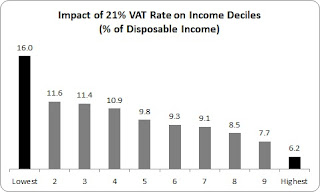
Unsurprisingly, the 21 percent VAT rate has a higher impact on the disposable income of the lowest income groups (16 percent), compared to the highest income groups (6.2 percent). Again, unsurprisingly, average income groups also face a higher burden than high income groups.
This is consistent with the findings from the study by the Combat Poverty Agency/ESRI, which showed that ten years ago total VAT and excise taxes made up more than 20 percent of the gross income of the lowest decile, compared to less than 10 percent of the highest income groups.
So the 21 percent VAT rate hits the lowest income households by more than two-and-a-half times the highest income groups. So much for the Minister’s claim.
But the ESRI researchers also measured the impact of increasing the VAT rate to 23 percent – as the Minister is proposing (again, a tabular estimate of Figure 10 in the report).

Increasing VAT will impact harder on lower income groups – by 1 percent compared to less than 0.4 percent for higher income groups. Again, so much for the Minister’s groundless claim that increasing VAT ‘will not impact as much on the poor as on the well-off people.’
Budget 2011 was bad enough. The low-paid were disproportionately hit through the introduction of the Universal Charge and the reduction of personal tax credits (which amounted to a flat-rate increase in income tax).
But the Minister’s planned VAT rate is even worse for it will not just hit people at work. It will hit everyone, including those on social protection payments (pensioners, widows/ers, unemployed, lone parents, etc.). And the lowest decile group is made up of people living in some of the worst forms of absolute deprivation.
All this has to be set in the wider context. This year, social protection recipients of working age (that is, excluding pensioners) saw their real payments – after inflation – fall by -5.2 percent. Whatever about the leaks regarding Budget 2012, we can reasonably assume that social protection payments will not increase. With the Government’s projected inflation rate, real payments will fall by -1.2 percent. That’s just a start.
Now add in the VAT increases and real incomes will fall further. And that’ s before the myriad of cuts and freezes are applied to child payments, rent and mortgage supplements, etc. It’s looking like another grim year for the poorest in society.
If I were Minister and wanted to protect the living standards of the highest income groups in the state, I would be doing exactly what Michael Noonan is doing – increasing VAT and introducing flat-rate taxes on households. That’s the ticket.
‘It (the VAT increase) will apply to everybody who purchases things but obviously rich people have a lot more disposable income than poor people and rich people will buy a lot more and will pay a lot more VAT. There’s no VAT of any sort on food and poor people spend a very large proportion of their budget on food so it will not impact as much on the poor as on the well-off people.’
This is wrong. Full stop. It is well known that consumption taxes impact on lower income groups more as they consume most of their income. Indeed, the Minister (or his advisors) would be well aware of a recent study published in the Economic and Social Review in the summer, ‘The Distributional Effects of Value Added Tax in Ireland’ by ESRI researchers Eimear Leahy, Sean Lyons and Richard Tol. They studied the impact of VAT and VAT rises on income deciles – from the lowest 10 percent income to the top (this is a tabular estimate of Figure 10 in the report).

Unsurprisingly, the 21 percent VAT rate has a higher impact on the disposable income of the lowest income groups (16 percent), compared to the highest income groups (6.2 percent). Again, unsurprisingly, average income groups also face a higher burden than high income groups.
This is consistent with the findings from the study by the Combat Poverty Agency/ESRI, which showed that ten years ago total VAT and excise taxes made up more than 20 percent of the gross income of the lowest decile, compared to less than 10 percent of the highest income groups.
So the 21 percent VAT rate hits the lowest income households by more than two-and-a-half times the highest income groups. So much for the Minister’s claim.
But the ESRI researchers also measured the impact of increasing the VAT rate to 23 percent – as the Minister is proposing (again, a tabular estimate of Figure 10 in the report).

Increasing VAT will impact harder on lower income groups – by 1 percent compared to less than 0.4 percent for higher income groups. Again, so much for the Minister’s groundless claim that increasing VAT ‘will not impact as much on the poor as on the well-off people.’
Budget 2011 was bad enough. The low-paid were disproportionately hit through the introduction of the Universal Charge and the reduction of personal tax credits (which amounted to a flat-rate increase in income tax).
But the Minister’s planned VAT rate is even worse for it will not just hit people at work. It will hit everyone, including those on social protection payments (pensioners, widows/ers, unemployed, lone parents, etc.). And the lowest decile group is made up of people living in some of the worst forms of absolute deprivation.
All this has to be set in the wider context. This year, social protection recipients of working age (that is, excluding pensioners) saw their real payments – after inflation – fall by -5.2 percent. Whatever about the leaks regarding Budget 2012, we can reasonably assume that social protection payments will not increase. With the Government’s projected inflation rate, real payments will fall by -1.2 percent. That’s just a start.
Now add in the VAT increases and real incomes will fall further. And that’ s before the myriad of cuts and freezes are applied to child payments, rent and mortgage supplements, etc. It’s looking like another grim year for the poorest in society.
If I were Minister and wanted to protect the living standards of the highest income groups in the state, I would be doing exactly what Michael Noonan is doing – increasing VAT and introducing flat-rate taxes on households. That’s the ticket.
Subscribe to:
Posts (Atom)