Michael Burke: Yesterday, UK Shadow Chancellor Alan Johnson introduced a new policy- increasing taxes on banks in order to finance £7.5bn in infrastructure investment.
This piece on leftfootforward examines what could usefully be done with £7.5bn, and argues that the effects are so overwhelmingly positive that a multiple of that investment should be made.

Tuesday, 19 October 2010


Guest post by Dr Rory Hearne: Why aren't the Irish protesting?
Rory Hearne: A short while back, I was asked the question for the This Week Rte Radio 1 show was ‘why aren’t the Irish protesting?’
I thought about it and on reflection developed this analysis. What is it about France, Spain, Greece, Iceland – that they have all had significant protests in the last year against the cuts to public sector, increasing retirement age, fiscal austerity and bailing out of the financial system. Why are we not seeing any here? The answer is complex. It’s not just a case that Irish people just like to ‘moan’ from bar stools or on liveline and no other action.
When the first austerity budget was being proposed in late 2008 the pensioners organised (through, amongst others, the Irish Senior Citizens Parliament) themselves and protested. They successfully managed to get a roll-back on the plan to abolish their automatic entitlement to a medical card.
However, their momentum and success did not translate or effuse into the wider population. Last year, as the economic crisis deepened and the recession continued, there was an emergence of a division between ‘public’ and ‘private’ sector approaches. The public sector, represented through the unions, planned and held strikes against pay cuts. They explained that they didn’t cause the crisis and, therefore, why should they be paying for it. The emergency budget in April 2009 imposed a levy on the public sector and left the private sector generally untouched (either taxed or provided employment support). The private sector and the newly unemployed argued that they were suffering pay cuts and job loss while the public sector should feel lucky to at least have jobs. This division was heightened and manipulated by Government and other interests in an attempt to divide and conquer.
Then this year as the scale of the property collapse, the billions required for the bail outs, the drop in tax revenue for the government and economists and government threatening that the IMF and the ECB could have to come in with even more severe austerity, all led to a fear and associated paralysis taking hold in the Irish people. A fear that, literally, the country was going to be shut down through bankruptcy. The fear was successful from the point of view of the establishment as the scale of the crisis terrifies people. Unsurprising then in April the majority of the public sector unions agreed, on the basis that there was no other alternative, to the Croke Park deal and it was ratified by their members in June.
Throughout this period then while ICTU have argued for their ten point plan, in reality the Croke Park deal meant they have been restrained in the strength to which they can argue and organise protest for the other aspects of the plan such as stimulus through employment schemes, increasing taxes etc. Their case for an alternative approach has not gained popular support.
Meanwhile Labour has articulated different ways to tackle the crisis. But they have been unclear to the extent it is very different from the Government’s approach. Their position has been, not to organise protest, but, in line with its history and tradition, to argue that change will come through an election.
When we look at other countries it is the trade unions, large left political parties and civil society that have organised the protests. Here in Ireland, we can see from above some reasons for why such sectors have not led protests against the Government’s approach in the last few months.
In terms of Civil Society, there are small movements happening – the local hospital protests, the community sector mobilisations – for example. There is the Claiming Our Futures conference on October 30th which is looking to build, from the grassroots, an alternative vision.
But there is also something more fundamental going on. The Celtic Tiger period promoted an individualism that was underpinned by, in essence, the values of the American Dream. Big money was being made – by many people - apprentices, carpenters, builders, architects, retailers, hoteliers, developers, financiers, bankers ... the list is very long.
The unions had partnership where they won significant wage increases for their members. Concepts, values and policies of solidarity, discussion on what sort of public services do we need, of the distribution of wealth, taxation, and the organisational structures that would require articulation and mobilisation around progression on such issues were dismantled, were replaced by the values of individualism, and money was thrown by Ahern’s government at whoever made any noise. Now we are suffering from the fallout of 20 years of ‘partnership’ and the Celtic Tiger. This has left us divided, unorganised and, intellectually, unable to mobilise for or articulate alternatives.
Of course, our history has also had an impact. The left in Ireland is relatively weak in comparison to other countries. The North dominated politics for the majority of the history of our State. Social issues and the debate about what type of society we lived in were secondary. Just when the North was being ‘sorted’ in the late 1990s and social issues began to be raised, the Celtic Tiger repressed them again. Protest is not the key issue or question. Change is. How can we bring about a fundamental change so that we get away from the unsustainable boom bust model?
Dr Rory Hearne has worked for the past three years as a regeneration community worker in Dolphin House
I thought about it and on reflection developed this analysis. What is it about France, Spain, Greece, Iceland – that they have all had significant protests in the last year against the cuts to public sector, increasing retirement age, fiscal austerity and bailing out of the financial system. Why are we not seeing any here? The answer is complex. It’s not just a case that Irish people just like to ‘moan’ from bar stools or on liveline and no other action.
When the first austerity budget was being proposed in late 2008 the pensioners organised (through, amongst others, the Irish Senior Citizens Parliament) themselves and protested. They successfully managed to get a roll-back on the plan to abolish their automatic entitlement to a medical card.
However, their momentum and success did not translate or effuse into the wider population. Last year, as the economic crisis deepened and the recession continued, there was an emergence of a division between ‘public’ and ‘private’ sector approaches. The public sector, represented through the unions, planned and held strikes against pay cuts. They explained that they didn’t cause the crisis and, therefore, why should they be paying for it. The emergency budget in April 2009 imposed a levy on the public sector and left the private sector generally untouched (either taxed or provided employment support). The private sector and the newly unemployed argued that they were suffering pay cuts and job loss while the public sector should feel lucky to at least have jobs. This division was heightened and manipulated by Government and other interests in an attempt to divide and conquer.
Then this year as the scale of the property collapse, the billions required for the bail outs, the drop in tax revenue for the government and economists and government threatening that the IMF and the ECB could have to come in with even more severe austerity, all led to a fear and associated paralysis taking hold in the Irish people. A fear that, literally, the country was going to be shut down through bankruptcy. The fear was successful from the point of view of the establishment as the scale of the crisis terrifies people. Unsurprising then in April the majority of the public sector unions agreed, on the basis that there was no other alternative, to the Croke Park deal and it was ratified by their members in June.
Throughout this period then while ICTU have argued for their ten point plan, in reality the Croke Park deal meant they have been restrained in the strength to which they can argue and organise protest for the other aspects of the plan such as stimulus through employment schemes, increasing taxes etc. Their case for an alternative approach has not gained popular support.
Meanwhile Labour has articulated different ways to tackle the crisis. But they have been unclear to the extent it is very different from the Government’s approach. Their position has been, not to organise protest, but, in line with its history and tradition, to argue that change will come through an election.
When we look at other countries it is the trade unions, large left political parties and civil society that have organised the protests. Here in Ireland, we can see from above some reasons for why such sectors have not led protests against the Government’s approach in the last few months.
In terms of Civil Society, there are small movements happening – the local hospital protests, the community sector mobilisations – for example. There is the Claiming Our Futures conference on October 30th which is looking to build, from the grassroots, an alternative vision.
But there is also something more fundamental going on. The Celtic Tiger period promoted an individualism that was underpinned by, in essence, the values of the American Dream. Big money was being made – by many people - apprentices, carpenters, builders, architects, retailers, hoteliers, developers, financiers, bankers ... the list is very long.
The unions had partnership where they won significant wage increases for their members. Concepts, values and policies of solidarity, discussion on what sort of public services do we need, of the distribution of wealth, taxation, and the organisational structures that would require articulation and mobilisation around progression on such issues were dismantled, were replaced by the values of individualism, and money was thrown by Ahern’s government at whoever made any noise. Now we are suffering from the fallout of 20 years of ‘partnership’ and the Celtic Tiger. This has left us divided, unorganised and, intellectually, unable to mobilise for or articulate alternatives.
Of course, our history has also had an impact. The left in Ireland is relatively weak in comparison to other countries. The North dominated politics for the majority of the history of our State. Social issues and the debate about what type of society we lived in were secondary. Just when the North was being ‘sorted’ in the late 1990s and social issues began to be raised, the Celtic Tiger repressed them again. Protest is not the key issue or question. Change is. How can we bring about a fundamental change so that we get away from the unsustainable boom bust model?
Dr Rory Hearne has worked for the past three years as a regeneration community worker in Dolphin House
Meanwhile, elsewhere ....
In the UK, the Progressive Economics Alternatives Coalition has published a pamphlet, 'Challenging the Cuts Consensus', with articles from a range of contributors including PE's own Michael Burke, Diana Abbott, Caroline Lucas MP of the Green Party, Richard Murphy of the Tax Justice Network, Jimmy Kelly (Regional Secretary of UNITE, giving an Irish perspective), Ann Pettifor and many more. Meanwhile, a new blog, Fixing the Economists, takes a look at international economics from an Irish perspective.
Fine Gael's 3:1 Ratio
Nat O'Connor: Fine Gael has given some useful clarity on their fiscal policy position with the declaration that they would seek €1 billion in tax increases for every €3 billion in cuts (Irish Examiner). Across the period of the four-year plan, this suggests that they would seek to close the deficit while making Ireland an even lower tax economy than it was before the boom; which can only mean the wholesale removal or reduction of public services, and significant cuts to public pay and/or numbers.
The implications of the 3:1 ratio can be spelled out in more detail once we establish just how much needs to be cut in the four-year plan.
The Opposition finance spokespersons were given access to data by the Department of Finance today. Is it just political theatre, or did the spokepersons really not know that the adjustment needs to be more than €7.5 billion over the four-year plan?
Consider, we have known for some time that the deficit is c.€19 billion (not including the banks), although it now seems that it might come closer to €20 billion. In July, the IMF's most recent report on Ireland suggests that the structural deficit is eight and a half per cent of GDP (i.e. the bit that won't go away when the economy recovers, welfare payment decrease, tax increases, etc.); which is €13.6 billion (8.5% of 2010's estimated GDP of c.€160 billion). So, it should have been obvious to them for some time that the four-year plan will have to make adjustments of c. €12-14 billion to meet the target of 3 per cent of GDP by 2014.
Note, I'm assuming that the economy will not have moved to the height of another economic cycle, so we would need to clear the entire structural deficit by 2014, assuming that at least €5 billion of a cyclical deficit remains, which will diminish with further economic growth. (€5 billion in today's money is the 3 per cent of GDP requirement under the Eurozone SGP). Arguably, the target for cutting the structural deficit could be slightly less, if the economy recovers faster and helps closes the gap. Hence, my use of the range €12-14 billion.
If we seek a €12 billion adjustment, Fine Gael's 3:1 ratio equates to €3 billion in taxation and €9 billion in cuts; €14 billion would imply €3.5 billion in tax and €10.5 billion in cuts.
A more moderate approach would be a 1:1 ratio, with an equal balance of tax and spending reductions; for €6-7 billion of each.
Patrick Honahan, before he became Governor of the Central Bank, suggested that Ireland's tax take could increase by 3 per cent of GDP (i.e. €4.8 billion) (e.g. quoted here). And that level of tax increase is just to return us to the same type of low tax economy we had before the boom. Nonetheless, if €4.8 billion was taken as an ideal level of tax increases, that would imply €7.2 billion to €9.2 billion in cuts. That is a ratio of 2:3 or almost 1:2 (depending on whether we adjust by €12 or €14 billion). Hence, Fine Gael, with only €3 or €3.5 billion in taxes, would not even reach the €4.8 billion that Patrick Honahan suggests is a credible target.
And once we have established what levels of tax and spending cuts each party wants in the four-year plan, the next question is timing; that is, should we frontload the adjustment? Or keep a more even pace? Or should be push out the deadline for fiscal adjustment by a few years? Leo Varadker of Fine Gael is on record calling for more adjustment sooner. TASC argues for a slower pace (€3 billion adjustment in 2010) to avoid damaging the economy too much in one year.
Of course, we will have to deal with more than the structural part of the deficit if we don't foster recovery in the economy!
TASC's budget proposals argue that we need to foster economic growth through targetted investment to build up human capital and intellectual capital (education, training, R&D) as well as physical infrastructure (broadband, schools, renewable energy). Speaking at the Kenmare economics conference, Leo Varadker emphasised his disagreement with the TASC proposals and signaled Fine Gael's intention to focus all investment on infrastructure (including broadband and renewable energy, but also forestry and other areas).
It would be nice if every political party could state what ratio they would choose between tax and cuts, as it would be a useful rule-of-thumb for the broad implications of their fiscal policy. Likewise, we'd need to see their timescale and what they would do to foster economic recovery.
More importantly, from TASC's perspective, it will be essential to see how each party's four-year plan would change the distribution of income and level of economic equality in Ireland. Tax change and cuts to public services affect different segments of the society differently. Whatever package of fiscal policy decisions are taken in these four-year plans will shape our society, as well as the economy, for quite some time.
The implications of the 3:1 ratio can be spelled out in more detail once we establish just how much needs to be cut in the four-year plan.
The Opposition finance spokespersons were given access to data by the Department of Finance today. Is it just political theatre, or did the spokepersons really not know that the adjustment needs to be more than €7.5 billion over the four-year plan?
Consider, we have known for some time that the deficit is c.€19 billion (not including the banks), although it now seems that it might come closer to €20 billion. In July, the IMF's most recent report on Ireland suggests that the structural deficit is eight and a half per cent of GDP (i.e. the bit that won't go away when the economy recovers, welfare payment decrease, tax increases, etc.); which is €13.6 billion (8.5% of 2010's estimated GDP of c.€160 billion). So, it should have been obvious to them for some time that the four-year plan will have to make adjustments of c. €12-14 billion to meet the target of 3 per cent of GDP by 2014.
Note, I'm assuming that the economy will not have moved to the height of another economic cycle, so we would need to clear the entire structural deficit by 2014, assuming that at least €5 billion of a cyclical deficit remains, which will diminish with further economic growth. (€5 billion in today's money is the 3 per cent of GDP requirement under the Eurozone SGP). Arguably, the target for cutting the structural deficit could be slightly less, if the economy recovers faster and helps closes the gap. Hence, my use of the range €12-14 billion.
If we seek a €12 billion adjustment, Fine Gael's 3:1 ratio equates to €3 billion in taxation and €9 billion in cuts; €14 billion would imply €3.5 billion in tax and €10.5 billion in cuts.
A more moderate approach would be a 1:1 ratio, with an equal balance of tax and spending reductions; for €6-7 billion of each.
Patrick Honahan, before he became Governor of the Central Bank, suggested that Ireland's tax take could increase by 3 per cent of GDP (i.e. €4.8 billion) (e.g. quoted here). And that level of tax increase is just to return us to the same type of low tax economy we had before the boom. Nonetheless, if €4.8 billion was taken as an ideal level of tax increases, that would imply €7.2 billion to €9.2 billion in cuts. That is a ratio of 2:3 or almost 1:2 (depending on whether we adjust by €12 or €14 billion). Hence, Fine Gael, with only €3 or €3.5 billion in taxes, would not even reach the €4.8 billion that Patrick Honahan suggests is a credible target.
And once we have established what levels of tax and spending cuts each party wants in the four-year plan, the next question is timing; that is, should we frontload the adjustment? Or keep a more even pace? Or should be push out the deadline for fiscal adjustment by a few years? Leo Varadker of Fine Gael is on record calling for more adjustment sooner. TASC argues for a slower pace (€3 billion adjustment in 2010) to avoid damaging the economy too much in one year.
Of course, we will have to deal with more than the structural part of the deficit if we don't foster recovery in the economy!
TASC's budget proposals argue that we need to foster economic growth through targetted investment to build up human capital and intellectual capital (education, training, R&D) as well as physical infrastructure (broadband, schools, renewable energy). Speaking at the Kenmare economics conference, Leo Varadker emphasised his disagreement with the TASC proposals and signaled Fine Gael's intention to focus all investment on infrastructure (including broadband and renewable energy, but also forestry and other areas).
It would be nice if every political party could state what ratio they would choose between tax and cuts, as it would be a useful rule-of-thumb for the broad implications of their fiscal policy. Likewise, we'd need to see their timescale and what they would do to foster economic recovery.
More importantly, from TASC's perspective, it will be essential to see how each party's four-year plan would change the distribution of income and level of economic equality in Ireland. Tax change and cuts to public services affect different segments of the society differently. Whatever package of fiscal policy decisions are taken in these four-year plans will shape our society, as well as the economy, for quite some time.
Monday, 18 October 2010
Bacon's Mortgage Suggestion Does Not Add Up
Nat O'Connor: Peter Bacon has suggested that semi-state assets be sold, and the money used to pay off the negative equity part of mortgages, where younger households are struggling. (Interview in the Irish Independent, and further article on mortgage debt). On a purely economic level, this is an argument to increase demand and boost the economy. But on a social and political level, it represents an appalling machination that could damage the economy in order to bail out only a small part of the population.
Bacon is correct to identify a need to do something about huge mortgage debt, although the articles do not give a lot of detail about what economic reasons motivated his suggestion. However, one can speculate. On a purely economic basis, bailing out our 'prodigal' sons and daughters would increase their spending, and thus boost aggregate demand in the economy. Releasing younger people from some of their debt would help maximise the productive capacity of the younger generation, and this could benefit the whole economy. But it is not clear that such benefits outweigh the inequality of the suggestion.
Young households who rent, or who bought smaller homes, or who are still living with their parents would receive nothing. Worse, their share of our semi-states would be given over to those younger households who bought more than they could afford.
And selling semi-states at the bottom of the economic cycle is like selling the family silver when everyone else is doing the same, and the price for silver has hit rock bottom in the market. These strategic assets have a role to play in generating annual revenue to bailout the entire country, and should not be sacrificed for the benefit of a minority group.
There are good economic arguments for the state doing something to help those struggling with mortgages, but there are far better methods. For example, the state could subsidise interest rates, so that people continue to pay back their loans, but are not overwhealmed. Keeping the mortgage repayment money flowing to the banks would reduce the cost of bank recapitalisation while helping people pay their debts. Alternatively, the state could set maximum amounts that householders have to pay on their housing costs, like a third of net income, through a deferral scheme. They'd still pay their debts, but more slowly.
Bacon is correct to identify a need to do something about huge mortgage debt, although the articles do not give a lot of detail about what economic reasons motivated his suggestion. However, one can speculate. On a purely economic basis, bailing out our 'prodigal' sons and daughters would increase their spending, and thus boost aggregate demand in the economy. Releasing younger people from some of their debt would help maximise the productive capacity of the younger generation, and this could benefit the whole economy. But it is not clear that such benefits outweigh the inequality of the suggestion.
Young households who rent, or who bought smaller homes, or who are still living with their parents would receive nothing. Worse, their share of our semi-states would be given over to those younger households who bought more than they could afford.
And selling semi-states at the bottom of the economic cycle is like selling the family silver when everyone else is doing the same, and the price for silver has hit rock bottom in the market. These strategic assets have a role to play in generating annual revenue to bailout the entire country, and should not be sacrificed for the benefit of a minority group.
There are good economic arguments for the state doing something to help those struggling with mortgages, but there are far better methods. For example, the state could subsidise interest rates, so that people continue to pay back their loans, but are not overwhealmed. Keeping the mortgage repayment money flowing to the banks would reduce the cost of bank recapitalisation while helping people pay their debts. Alternatively, the state could set maximum amounts that householders have to pay on their housing costs, like a third of net income, through a deferral scheme. They'd still pay their debts, but more slowly.
Saturday, 16 October 2010
A new weapon in the anti-deflationary armoury
Michael Taft: One might expect a pre-budget submission in today’s climate to focus on how to ‘save’ money through a lengthy list of public spending cuts combined with tax increases that ‘broaden the tax base’ (that used to refer to high income groups who escaped liability through exploiting tax avoidance mechanisms; not anymore: low-income groups are now the main culprits). Such a submission would then tally up column A and column B and see if the difference brings down that danged deficit. And in the coda, the submission would don ceremonial robes and prostrate itself before the financial markets for fiscal blessing.
Thankfully, TASC produced its own pre-budget submission.
The temptation is to start listing off particular elements one likes or doesn’t like but that approach is not satisfactory. Progressive groups and individuals can produce pre-budget submissions until the end of the time which, while adhering to the same principles, will never agree on the details. As President Franklin Roosevelt said, ‘There are many ways to go forward, there’s only one way to stand still.’
It is far more helpful to stand back and look at the overall composition, the architecture. TASC’s submission rests on two broad pillars:
1. Drive budgetary consolidation through taxation – primarily, reduction of tax expenditures and a residential property tax. The total amount to be raised is €2.7 billion. The underlying principle is to break from the low-tax model and move, over time, to average EU taxation levels.
2. Drive economic growth, employment and, so, deficit reduction through a €3 billion Economic Recovery Fund to be financed from the National Pension Reserve Fund (NPRF).
This is complemented by a number of proposals to increase budget transparency and improve budget documentation. There are some well-considered public efficiencies (e.g. reduce subsidies to fee-paying schools, etc) amounting to €300 million.
So what would the effect of this be in terms of the economy and public finances? Let’s measure it using the ESRI multipliers and compare it with the Government’s original €3 billion package (the ESRI set up a stylised budget for measurement purposes as details of the package’s composition were, naturally, not available).

Just on the budgetary consolidation measures alone, the TASC package is superior. Indeed, it would work out better in practice. First, TASC is rightly aiming at high income groups which would prove less deflationary than ESRI estimates as these assume across board tax increases. This would therefore increase the deficit reduction. Secondly, ESRI warns that its numbers ‘do not take account of the significant positive supply side effects from public investment’. This suggests significant losses to the Exchequer in the medium-term, diluting the deficit-reduction in that category.
However, TASC goes further, transcending the narrow balance sheet mind-set; it actually acknowledges such a thing as the economy – the economy that is the basis for any credible fiscal consolidation process. Their Economic Recovery Fund of €3 billion would start to address our considerable deficits: credit availability, infrastructural capacity, R&D, human resources, etc.
Measuring these impacts is a little more difficult. Traditional multipliers measure investment, non-wage consumption, social transfers, tax cuts, etc. The TASC programme contains programmes such as loan guarantees – which would have a definite economic benefit. However, it is not easy to measure under headline multipliers. In order to draw a conservative baseline, I will include only the infrastructural and education component – acknowledging the remainder as part of a general upside risk, always a good thing to have when entering an uncertain period. When these are included we find:

This is a significant turnaround. Instead of the Government’s deflationary budget with significant downside risks, we have an expansionary one with significant upside risks. And with no extra borrowing. As a result the deficit reduction is much higher than what the Government is proposing.
There’s another significant advantage that TASC delivers: it might be called Deflationary Cascade Avoidance (DCA). By providing an alternative to the current deflationary approach, we may be avoiding what the Government is leading us into – and highlighted by Michael Burke in his analysis of the submission. Michael refers to the IMF finding that fiscal contraction in situations where there is no scope for reducing interest rates further, will suffer a double whammy. A 1 percent fiscal contraction could actually double the deflationary impact – from -1.1 to -2 percent.
Were this to occur, we may be entering into a long-term deflationary trough where growth is sluggish at best and there is no chance of halting the rise in debt and interest payments; stuck in the proverbial creek without a paddle or a boat on a moonless night with the sound of large predators on shore. TASC’s DCA ensures we can be at home, sleeping in our beds.
No doubt the cheerleaders for fiscal contraction will ignore all this. They will ignore the benefits of the TASC submission; they will ignore the ESRI finding that the current strategy will fail to repair public finances for a decade and more and drive up debt to 1980s level and beyond; they will ignore warnings from international bodies about the course we are heading on. If they get their way, we will all sleepwalk into IMF receivership and years of deflationary slump.
We can’t let this happen. We have to start fighting back sometime. Now is not too late.
And we have increased our chances of winning now that TASC has given us this new weapon in the form of the pre-budget submission.
Thankfully, TASC produced its own pre-budget submission.
The temptation is to start listing off particular elements one likes or doesn’t like but that approach is not satisfactory. Progressive groups and individuals can produce pre-budget submissions until the end of the time which, while adhering to the same principles, will never agree on the details. As President Franklin Roosevelt said, ‘There are many ways to go forward, there’s only one way to stand still.’
It is far more helpful to stand back and look at the overall composition, the architecture. TASC’s submission rests on two broad pillars:
1. Drive budgetary consolidation through taxation – primarily, reduction of tax expenditures and a residential property tax. The total amount to be raised is €2.7 billion. The underlying principle is to break from the low-tax model and move, over time, to average EU taxation levels.
2. Drive economic growth, employment and, so, deficit reduction through a €3 billion Economic Recovery Fund to be financed from the National Pension Reserve Fund (NPRF).
This is complemented by a number of proposals to increase budget transparency and improve budget documentation. There are some well-considered public efficiencies (e.g. reduce subsidies to fee-paying schools, etc) amounting to €300 million.
So what would the effect of this be in terms of the economy and public finances? Let’s measure it using the ESRI multipliers and compare it with the Government’s original €3 billion package (the ESRI set up a stylised budget for measurement purposes as details of the package’s composition were, naturally, not available).

Just on the budgetary consolidation measures alone, the TASC package is superior. Indeed, it would work out better in practice. First, TASC is rightly aiming at high income groups which would prove less deflationary than ESRI estimates as these assume across board tax increases. This would therefore increase the deficit reduction. Secondly, ESRI warns that its numbers ‘do not take account of the significant positive supply side effects from public investment’. This suggests significant losses to the Exchequer in the medium-term, diluting the deficit-reduction in that category.
However, TASC goes further, transcending the narrow balance sheet mind-set; it actually acknowledges such a thing as the economy – the economy that is the basis for any credible fiscal consolidation process. Their Economic Recovery Fund of €3 billion would start to address our considerable deficits: credit availability, infrastructural capacity, R&D, human resources, etc.
Measuring these impacts is a little more difficult. Traditional multipliers measure investment, non-wage consumption, social transfers, tax cuts, etc. The TASC programme contains programmes such as loan guarantees – which would have a definite economic benefit. However, it is not easy to measure under headline multipliers. In order to draw a conservative baseline, I will include only the infrastructural and education component – acknowledging the remainder as part of a general upside risk, always a good thing to have when entering an uncertain period. When these are included we find:

This is a significant turnaround. Instead of the Government’s deflationary budget with significant downside risks, we have an expansionary one with significant upside risks. And with no extra borrowing. As a result the deficit reduction is much higher than what the Government is proposing.
There’s another significant advantage that TASC delivers: it might be called Deflationary Cascade Avoidance (DCA). By providing an alternative to the current deflationary approach, we may be avoiding what the Government is leading us into – and highlighted by Michael Burke in his analysis of the submission. Michael refers to the IMF finding that fiscal contraction in situations where there is no scope for reducing interest rates further, will suffer a double whammy. A 1 percent fiscal contraction could actually double the deflationary impact – from -1.1 to -2 percent.
Were this to occur, we may be entering into a long-term deflationary trough where growth is sluggish at best and there is no chance of halting the rise in debt and interest payments; stuck in the proverbial creek without a paddle or a boat on a moonless night with the sound of large predators on shore. TASC’s DCA ensures we can be at home, sleeping in our beds.
No doubt the cheerleaders for fiscal contraction will ignore all this. They will ignore the benefits of the TASC submission; they will ignore the ESRI finding that the current strategy will fail to repair public finances for a decade and more and drive up debt to 1980s level and beyond; they will ignore warnings from international bodies about the course we are heading on. If they get their way, we will all sleepwalk into IMF receivership and years of deflationary slump.
We can’t let this happen. We have to start fighting back sometime. Now is not too late.
And we have increased our chances of winning now that TASC has given us this new weapon in the form of the pre-budget submission.
Friday, 15 October 2010
How to deal with the bond markets
Jim Stewart: Recent Government policy decisions (postponing the monthly bond auction, recapitalisation of banks, etc. and other announcements) have been evaluated in terms of changes in Irish Government bond yields - a rise indicating poor policy and a fall good policy. The problem with such analysis is that bond yields are determined by forces that may be only loosely connected to economic policy. Trading in Government debt is once again dominated by hedge funds (Financial Times, 15 September 2010). This may partly explain volatility in the prices and hence yields on government debt. Greek bonds although yields are the highest in the eurozone, provided the highest eurozone bond returns over the entire month of September.
The Minister for Finance stated on September 30 that subordinated bond holders will suffer losses in both Anglo-Irish and INBS via resolution and reorganisation legislation. At the same time, he specifically stated that there would be no ‘legislative’ changes in relation to senior bond holders. However, negotiation with bond holders does not require legislation or permission from any other body, and the Regulator, Matthew Elderfield, on October 6th raised the possibility of negotiating with senior bond holders.
The Financial Times, in an interview with the Minister for Finance (October 12), reported that, typically, a voluntary negotiation with bond holders is done to ensure that it does not constitute a default as regards credit default swaps - instruments which apart from enabling speculation in bond values may also provide insurance in the event of default . This raises the issue of why holders of such bonds who have also purchased Credit Default Swaps on those bonds, would enter into negotiations which would result in a diminution of the value of their investment without recourse to the guarantees given by the counterparties of credit default swaps. In this case, in the event of ‘default’, the counterparties of credit default swaps would make large losses. Who are they? Most likely Goldman Sachs, Merrill Lynch, etc. Hence we can expect representatives of such institutions to be vociferous in their condemnation of burden-sharing policies with owners of bank bonds, and rather emphasise ‘austerity' (see reports of speech by Peter Sutherland http://www.independent.ie, September 25). Yet such policies must be pursued. The greater the loss faced by existing bondholders, the lower the required capital contribution to banks by the State, and the lower government borrowing. As a result, the greater the likelihood that the cost of future state borrowing will fall. There is a clear distinction between the existing debts of the nationalized banks and State debt. What is bad for the former is good for the latter.
In the coming months, the State should pursue strategies that drive down the market price of existing debt of the now nationalized banks. This can only be done in the context of the removal of guarantees on existing debt.
Will Ireland be ‘Shut Out’ of the Bond Markets?
Given the high cost and volatility, the decision ‘not to proceed’ with bond auctions scheduled for October and November is rational. The minister stated, that “as the NTMA is fully funded until late June 2011 the Agency has decided not to proceed with bond auctions” until early 2011.
The NTMA has a policy of prefunding, so that cash balances at the end of June amounted to €20 billion (NTMA). This is explained by the NTMA, who state that “maintaining large cash balances has underpinned investor confidence and provided valuable flexibility in the timing of its borrowing”. The NTMA are also quoted as stating that, if they do not issue debt, the market will interpret this as a signal that the Government cannot issue debt.
Policy pursued up to September 30 appeared to be that new debt must be issued every month to ensure the overfunding position remains. So, even though interest rates on Irish government debt rose throughout 2010, the NTMA continued to issue debt. Rather than signalling that the government cannot issue debt, this policy may have signalled that the NTMA held non-public information which would be adverse for bond prices.
The NTMA should suspend bond auctions until there is greater certainty (for example in relation to future government policies). This may mean suspending auctions until March next year or later. Reduced uncertainty will result in some convergence of Irish bond yields with eurozone bond yields. It is also possible that speculative forces in the bond market will diminish and will result in greater convergence in eurozone bond yields. This means rising German yields and falls in the yields of peripheral countries such as Ireland and Portugal.
An issue that may arise is that uncertainty rather than diminishing may continue to exist, for example in relation to the formation of a new government, or the policies of a new Government. Hence it is desirable that financing the deficit is less dependent on external investors (international investors hold 85% of long term debt). One solution is to use the remaining funds (€14 billion) in the National Pension Reserve Fund after providing for bank funding, to provide support for the Irish bond market.
Establishing the National Pension Reserve Fund was misguided (although hailed by some such as the current Governor of the Central Bank, as the most important policy decision for a decade). Transfers of resources (bread, haircuts, etc.) to future retirees can only come from future output. The best way to safeguard current and future pensions is to ensure that the current and future economy is as productive as possible.
Borrowing to invest in equities and other risky assets is equivalent to the State behaving like a hedge fund. There is a national crisis. In this crisis the National Pension Reserve Fund should be utilised. One way is to announce that the investment policy will change, so that from the New Year the National Pension Reserve Fund will be used to purchase new Government debt if prospective yields are above some stated figure (say 5%). If Ireland remains part of the Euro system (which is highly likely), such returns would be much higher than those achieved to date. Volatility and risk would be reduced.
In the longer term the State is likely to have high levels of borrowing for some time. Current policies to reduce borrowing by cutting expenditure will perversely have the effect of increasing the need for borrowing and may depress property prices further, as well as bank capital. Even if policies change, the legacy of the banking and economic crisis will still ensure high future levels of borrowing. At the same time, it is likely that the extra premium payable on Irish Government debt will remain.
To finance this deficit a greater proportion of government borrowing should and can be sourced internally. For example, investment choice in the proposed new auto-enrolment pension scheme should be limited to the purchase of Irish Government debt. Apart from financing the exchequer deficit until pension payments must be made (10-15 years), this would also have the effect of reducing costs and risk. In effect this new proposed supplementary scheme would then become a type of PAYG system, but with pension payments more closely tied to contributions and returns.
Some commentators, and no doubt some (Department of Finance) officials, would welcome IMF/EU intervention, as cuts could be presented as being externally imposed. The difficult task of increasing efficiency in the public sector by negotiating and implementing necessary change, would be seen as no longer necessary. The existing Department of Finance/McCarthy report on Public Sector Numbers and Expenditures and the forthcoming Department of Finance/McCarthy report on privatization would form a major part of any imposed IMF/EU intervention.
But IMF/EU intervention similar to that in Greece is unlikely. However closer monitoring by the ECB, and EU bodies is certain. This will lead to policy changes but in addition considerable negotiating skills are required to try to ensure that external policies, encourage rather than hinder the prospects for economic success. There needs to be careful monitoring of policies and economic data in other EU countries, in particular those in the eurozone so that Ireland can be presented as ‘average’ rather than an outlier.
The issues discussed above are holding policies. What is needed is a fundamental change in economic policy.
The Minister for Finance stated on September 30 that subordinated bond holders will suffer losses in both Anglo-Irish and INBS via resolution and reorganisation legislation. At the same time, he specifically stated that there would be no ‘legislative’ changes in relation to senior bond holders. However, negotiation with bond holders does not require legislation or permission from any other body, and the Regulator, Matthew Elderfield, on October 6th raised the possibility of negotiating with senior bond holders.
The Financial Times, in an interview with the Minister for Finance (October 12), reported that, typically, a voluntary negotiation with bond holders is done to ensure that it does not constitute a default as regards credit default swaps - instruments which apart from enabling speculation in bond values may also provide insurance in the event of default . This raises the issue of why holders of such bonds who have also purchased Credit Default Swaps on those bonds, would enter into negotiations which would result in a diminution of the value of their investment without recourse to the guarantees given by the counterparties of credit default swaps. In this case, in the event of ‘default’, the counterparties of credit default swaps would make large losses. Who are they? Most likely Goldman Sachs, Merrill Lynch, etc. Hence we can expect representatives of such institutions to be vociferous in their condemnation of burden-sharing policies with owners of bank bonds, and rather emphasise ‘austerity' (see reports of speech by Peter Sutherland http://www.independent.ie, September 25). Yet such policies must be pursued. The greater the loss faced by existing bondholders, the lower the required capital contribution to banks by the State, and the lower government borrowing. As a result, the greater the likelihood that the cost of future state borrowing will fall. There is a clear distinction between the existing debts of the nationalized banks and State debt. What is bad for the former is good for the latter.
In the coming months, the State should pursue strategies that drive down the market price of existing debt of the now nationalized banks. This can only be done in the context of the removal of guarantees on existing debt.
Will Ireland be ‘Shut Out’ of the Bond Markets?
Given the high cost and volatility, the decision ‘not to proceed’ with bond auctions scheduled for October and November is rational. The minister stated, that “as the NTMA is fully funded until late June 2011 the Agency has decided not to proceed with bond auctions” until early 2011.
The NTMA has a policy of prefunding, so that cash balances at the end of June amounted to €20 billion (NTMA). This is explained by the NTMA, who state that “maintaining large cash balances has underpinned investor confidence and provided valuable flexibility in the timing of its borrowing”. The NTMA are also quoted as stating that, if they do not issue debt, the market will interpret this as a signal that the Government cannot issue debt.
Policy pursued up to September 30 appeared to be that new debt must be issued every month to ensure the overfunding position remains. So, even though interest rates on Irish government debt rose throughout 2010, the NTMA continued to issue debt. Rather than signalling that the government cannot issue debt, this policy may have signalled that the NTMA held non-public information which would be adverse for bond prices.
The NTMA should suspend bond auctions until there is greater certainty (for example in relation to future government policies). This may mean suspending auctions until March next year or later. Reduced uncertainty will result in some convergence of Irish bond yields with eurozone bond yields. It is also possible that speculative forces in the bond market will diminish and will result in greater convergence in eurozone bond yields. This means rising German yields and falls in the yields of peripheral countries such as Ireland and Portugal.
An issue that may arise is that uncertainty rather than diminishing may continue to exist, for example in relation to the formation of a new government, or the policies of a new Government. Hence it is desirable that financing the deficit is less dependent on external investors (international investors hold 85% of long term debt). One solution is to use the remaining funds (€14 billion) in the National Pension Reserve Fund after providing for bank funding, to provide support for the Irish bond market.
Establishing the National Pension Reserve Fund was misguided (although hailed by some such as the current Governor of the Central Bank, as the most important policy decision for a decade). Transfers of resources (bread, haircuts, etc.) to future retirees can only come from future output. The best way to safeguard current and future pensions is to ensure that the current and future economy is as productive as possible.
Borrowing to invest in equities and other risky assets is equivalent to the State behaving like a hedge fund. There is a national crisis. In this crisis the National Pension Reserve Fund should be utilised. One way is to announce that the investment policy will change, so that from the New Year the National Pension Reserve Fund will be used to purchase new Government debt if prospective yields are above some stated figure (say 5%). If Ireland remains part of the Euro system (which is highly likely), such returns would be much higher than those achieved to date. Volatility and risk would be reduced.
In the longer term the State is likely to have high levels of borrowing for some time. Current policies to reduce borrowing by cutting expenditure will perversely have the effect of increasing the need for borrowing and may depress property prices further, as well as bank capital. Even if policies change, the legacy of the banking and economic crisis will still ensure high future levels of borrowing. At the same time, it is likely that the extra premium payable on Irish Government debt will remain.
To finance this deficit a greater proportion of government borrowing should and can be sourced internally. For example, investment choice in the proposed new auto-enrolment pension scheme should be limited to the purchase of Irish Government debt. Apart from financing the exchequer deficit until pension payments must be made (10-15 years), this would also have the effect of reducing costs and risk. In effect this new proposed supplementary scheme would then become a type of PAYG system, but with pension payments more closely tied to contributions and returns.
Some commentators, and no doubt some (Department of Finance) officials, would welcome IMF/EU intervention, as cuts could be presented as being externally imposed. The difficult task of increasing efficiency in the public sector by negotiating and implementing necessary change, would be seen as no longer necessary. The existing Department of Finance/McCarthy report on Public Sector Numbers and Expenditures and the forthcoming Department of Finance/McCarthy report on privatization would form a major part of any imposed IMF/EU intervention.
But IMF/EU intervention similar to that in Greece is unlikely. However closer monitoring by the ECB, and EU bodies is certain. This will lead to policy changes but in addition considerable negotiating skills are required to try to ensure that external policies, encourage rather than hinder the prospects for economic success. There needs to be careful monitoring of policies and economic data in other EU countries, in particular those in the eurozone so that Ireland can be presented as ‘average’ rather than an outlier.
The issues discussed above are holding policies. What is needed is a fundamental change in economic policy.
IMF study indicates 6 billion cuts could risk over 20,000 jobs
Tom McDonnell: It is claimed in an IMF paper ('Will It Hurt? Macroeconomic Effects of Fiscal Consolidation') that fiscal consolidation measures can be linked to increased unemployment.
Caution should be applied in the direct transfer of these findings to Ireland, as all country characteristics are different. However, we can look at some of the basic numbers.
The IMF paper states that "Fiscal consolidation typically has a contractionary effect on output. A fiscal consolidation equal to 1 percent of GDP typically reduces GDP by about 0.5 percent within two years and raises the unemployment rate by about 0.3 percentage point. Domestic demand—consumption and investment—falls by about 1 percent."
Summarising this for Ireland, one could estimate the following:
- Ireland's GDP is €159 billion;
- 1 per cent of GDP is equal to €1.6 billion
- All things being equal, TASC's €3 billion of austerity measures equals 1.89 per cent of GDP, which leads to an expected reduction in GDP of 0.94 per cent (c.€1.5 billion).
- The suggestion that Ireland should 'frontload' a €6 billion austerity package in 2011, would have an expected reduction in GDP of c.2 per cent (c.€3 billion)
- The labour force is currently 2,152,700 people
- 0.3 per cent of the labour force is 6,458. This is the level of increase in unemployment expected for every 1 per cent of GDP worth of fiscal contraction
- All things being equal, TASC's €3 billion of austerity measures (mostly on the tax side) risks increasing unemployment by 12,206
- But an austerity package of €6 billion (an additional €3 billion) doubles this to an increase of 24,412 in unemployment.
Of course, all things are not equal. TASC argues in its Budget proposals that different types of cut and different taxes have different effects on the economy. And TASC's proposals are as growth-friendly as possible, with an Economic Recovery Fund to maintain and create jobs to compensate for the deflationary impact of taxation.
Another difference in applying the IMF study to Ireland is that emigration might occur more than people adding to the live register. Nevertheless, it is reasonable to suggest that frontloading €6 billion in cuts risks over 20,000 jobs.
Caution should be applied in the direct transfer of these findings to Ireland, as all country characteristics are different. However, we can look at some of the basic numbers.
The IMF paper states that "Fiscal consolidation typically has a contractionary effect on output. A fiscal consolidation equal to 1 percent of GDP typically reduces GDP by about 0.5 percent within two years and raises the unemployment rate by about 0.3 percentage point. Domestic demand—consumption and investment—falls by about 1 percent."
Summarising this for Ireland, one could estimate the following:
- Ireland's GDP is €159 billion;
- 1 per cent of GDP is equal to €1.6 billion
- All things being equal, TASC's €3 billion of austerity measures equals 1.89 per cent of GDP, which leads to an expected reduction in GDP of 0.94 per cent (c.€1.5 billion).
- The suggestion that Ireland should 'frontload' a €6 billion austerity package in 2011, would have an expected reduction in GDP of c.2 per cent (c.€3 billion)
- The labour force is currently 2,152,700 people
- 0.3 per cent of the labour force is 6,458. This is the level of increase in unemployment expected for every 1 per cent of GDP worth of fiscal contraction
- All things being equal, TASC's €3 billion of austerity measures (mostly on the tax side) risks increasing unemployment by 12,206
- But an austerity package of €6 billion (an additional €3 billion) doubles this to an increase of 24,412 in unemployment.
Of course, all things are not equal. TASC argues in its Budget proposals that different types of cut and different taxes have different effects on the economy. And TASC's proposals are as growth-friendly as possible, with an Economic Recovery Fund to maintain and create jobs to compensate for the deflationary impact of taxation.
Another difference in applying the IMF study to Ireland is that emigration might occur more than people adding to the live register. Nevertheless, it is reasonable to suggest that frontloading €6 billion in cuts risks over 20,000 jobs.
Impact of TASC Budget Proposals
Michael Burke: One of the strange features of the debate on the economy and government finances is that the consensus has solidified around further deep cuts in public spending even as the evidence mounts that this policy is wholly counter-productive. We are told repeatedly that it is impossible to invest our way to recovery because it would lead to a wider deficit, higher bond yields and even being shut out of the international markets altogether. Yet all this has come to pass while a fiscal contraction equivalent to 9.1% of GDP has been implemented. A further €4.5bn in cuts this year would bring this total fiscal contraction to approximately 12% of GDP.
Therefore the contribution from TASC to the 2011 Budget debate, Investing in Recovery, Jobs, Equality, is extremely welcome. Breaking entirely from the dominant misconceptions that spending cuts will restore either the economy or government finances, the proposals centre on tax increases for the wealthy and spending increases to boost jobs.
Tax increases for the wealthy are not simply about fairness, although it is monstrously unfair for PSRI contributions to be capped on salaries above €75,000 and not to be levied at all on unearnt income on financial and other assets. Personal consumption has fallen by nearly 11% and €10bn in real terms in the course of the recession. These income groups have the lowest propensity to consume of all, and the redistributive effect of higher, fairer taxes on the rich while boosting employment will be to increase overall demand in the economy.
Increased spending to maintain and create jobs would have a decisive effect on both economic activity and the Budget deficit. TASC proposes a €3bn Economic Recovery Fund, financed by funds from the NPRF. This would be an important contribution to addressing the real decline in investment during the recession, a fall of €22bn, down 49%.
'What would be the effect of such a policy? Thanks to Philip Lane on Irish Economy, who provides a link to an IMF paper, Will It Hurt? The Macroeconomic Effects of Fiscal Consolidation. Its author Daniel Leigh spoke at a TCD on October 14th. The Irish Times carries this report, which includes this important point, “The research also points to the negative effects of fiscal tightening being twice as large in the absence of monetary loosening (ie cuts in interest rates). It is twice as large again if fiscal tightening is taking place simultaneously elsewhere".
The charts below highlight those propositions, that the negative impact of public spending cuts is doubled when there is no ability to cuts interest rates simultaneously, and increased too by simultaneous fiscal tightening globally, as is currently the case. (Canada is chosen because of its openness).

Crucially, those two conditions apply to this economy currently, an inability to lower interest rates (in fact Irish market rates are rising) and the negative impact of simultaneous public spending cuts elsewhere. It can be seen from the charts that the response to a fiscal tightening equivalent to 1% of GDP lowers GDP by 2% in the first year alone. Cumulatively, the IMF research shows that over 5 years the lost output is approximately 6% of GDP.
Any shock which lowers output by 6% will of course negatively impact government finances, by far greater than the initial 1% ‘saving’. This is precisely what has happened- spending cuts have led to a wider deficit.
These responses tend to be symmetrical; the change induced is the same positively or negatively. So, to take TASC’s €3bn in investment, this IMF estimate suggests it would have a €6bn positive impact in the following year and provide a cumulative boost of approximately €18bn.
What then of government finances? This would need to be based on both parts of the public sector accounts, increased tax revenues from higher levels of activity and lower welfare payments as people are brought back into work and poverty declines. The DoF estimates that the sensitivity of public finances to changes in output is 0.6. So, government finances would improve by €3.6bn in the following year (€6bn X 0.6) and by €10.8bn cumulatively (€18bn X 0.6).
That’s a genuine deficit-reduction plan based on growth.
Therefore the contribution from TASC to the 2011 Budget debate, Investing in Recovery, Jobs, Equality, is extremely welcome. Breaking entirely from the dominant misconceptions that spending cuts will restore either the economy or government finances, the proposals centre on tax increases for the wealthy and spending increases to boost jobs.
Tax increases for the wealthy are not simply about fairness, although it is monstrously unfair for PSRI contributions to be capped on salaries above €75,000 and not to be levied at all on unearnt income on financial and other assets. Personal consumption has fallen by nearly 11% and €10bn in real terms in the course of the recession. These income groups have the lowest propensity to consume of all, and the redistributive effect of higher, fairer taxes on the rich while boosting employment will be to increase overall demand in the economy.
Increased spending to maintain and create jobs would have a decisive effect on both economic activity and the Budget deficit. TASC proposes a €3bn Economic Recovery Fund, financed by funds from the NPRF. This would be an important contribution to addressing the real decline in investment during the recession, a fall of €22bn, down 49%.
'What would be the effect of such a policy? Thanks to Philip Lane on Irish Economy, who provides a link to an IMF paper, Will It Hurt? The Macroeconomic Effects of Fiscal Consolidation. Its author Daniel Leigh spoke at a TCD on October 14th. The Irish Times carries this report, which includes this important point, “The research also points to the negative effects of fiscal tightening being twice as large in the absence of monetary loosening (ie cuts in interest rates). It is twice as large again if fiscal tightening is taking place simultaneously elsewhere".
The charts below highlight those propositions, that the negative impact of public spending cuts is doubled when there is no ability to cuts interest rates simultaneously, and increased too by simultaneous fiscal tightening globally, as is currently the case. (Canada is chosen because of its openness).

Crucially, those two conditions apply to this economy currently, an inability to lower interest rates (in fact Irish market rates are rising) and the negative impact of simultaneous public spending cuts elsewhere. It can be seen from the charts that the response to a fiscal tightening equivalent to 1% of GDP lowers GDP by 2% in the first year alone. Cumulatively, the IMF research shows that over 5 years the lost output is approximately 6% of GDP.
Any shock which lowers output by 6% will of course negatively impact government finances, by far greater than the initial 1% ‘saving’. This is precisely what has happened- spending cuts have led to a wider deficit.
These responses tend to be symmetrical; the change induced is the same positively or negatively. So, to take TASC’s €3bn in investment, this IMF estimate suggests it would have a €6bn positive impact in the following year and provide a cumulative boost of approximately €18bn.
What then of government finances? This would need to be based on both parts of the public sector accounts, increased tax revenues from higher levels of activity and lower welfare payments as people are brought back into work and poverty declines. The DoF estimates that the sensitivity of public finances to changes in output is 0.6. So, government finances would improve by €3.6bn in the following year (€6bn X 0.6) and by €10.8bn cumulatively (€18bn X 0.6).
That’s a genuine deficit-reduction plan based on growth.
Thursday, 14 October 2010
Realistic Fiscal Planning Requires Much More Budget Transparency
Nat O'Connor: The BBC reports (here) that in a rare public act, Communist Party elders in China has issued a call for increased free speech, which is allowed in their constitution but firmly denied in practice. For example, they call for a change in "the mission of propaganda authorities, from preventing the leak of information to facilitating its accurate and timely spread".
It is all too easy for us to see the issue of free speech as only a struggle in authoritarian regimes, where the situation is undeniably much worse than here. But, as organisations like The Story, PoliticalReform.ie or Transparency Ireland will testify, there is a need here too for public authorities to change from "preventing the leak of information" and do much more to facilitate "its accurate and timely spread". The Budget is one example of where there is a lack of accurate and timely information in Ireland.
The UK have much improved the ease with which the general public, businesses and civil society organisations can access and get to grips with budgetary documentation. The UK Budget website not only provides a clear set of documents, but also provides a range of other supporting material. There are links to user-friendly summaries of the budget material for the members of the public, as well as a business-focused summary. The Treasury uses Internet new media to communicate with citizens (e.g. YouTube Treasury channel). Spending information is also provided as raw data in spreadsheet format. This is highly relevant to allow business, policy analysts and civil society organisations across the country to do their own analysis of expenditure.
In TASC's pre-Budget proposals launched today (executive summary), one of the issues TASC addresses is the lack of transparency about Budget documentation. In addition to a range of other proposals, TASC is calling on the Government and Department of Finance to improve transparency by:
• Providing Budget documentation and supporting material in easily accessible formats, appropriate to the needs of different sectors;
• Making all data relating to the Budget available in raw form (e.g. spreadsheets) so that analysis can be conducted;
• Compiling a single database of all state assets and liabilities, revenue and expenditure, and making it publicly available online;
• Allowing written Parliamentary Questions over the summer recess period when these are related to preparation of Budget proposals, as this will allow for an improved level of debate and analysis by opposition parties;
• Publishing an annual Equality Statement, showing the distributional impact of all Budget measures.
Consider just one example. At present, TDs and Senators do not have the right to ask Parliamentary Questions during the summer recess, the length and timing of which is determined by the pro-Government majority in the Dáil. Usually, the Department of Finance is busy preparing the Budget over the summer and by end-October it is almost too late for any Opposition amendments to influence their thinking, no matter how sensible they might be. This year the Dáil returned on September 29th, giving the Opposition only two weeks to send in PQs and seek data upon which to cost their own Budget proposals. And then, the ‘goalposts’ were shifted twice, with the Government’s call for a €4 billion fiscal adjustment, and then the demand to come up with a multi-annual plan. How can they come up with sensible suggestions, if they don't have access to up-to-date and detailed financial information?
There is also something terribly wrong with the fuss about Opposition leaders being given the opportunity to access information held by Finance officials. In almost every other democracy in Europe, detail is provided to parliamentary committees in a timely manner, including sensitive material that is kept confidential in a mature fashion by committee members. As I have argued elsewhere, Ireland’s Cabinet is uniquely secretive. It is an aberration of democracy that access to ‘secret’ Finance files should be a ‘special treat’ for the Opposition; and this information is only made available because Ireland is plunged into possibly the greatest post-War crisis of any Western economy! It should be absolutely normal for much more detailed information to be routinely made available to parliament, researchers and the wider public, so that policy mistakes such as we have made can be identified and corrected much sooner, and multi-year planning can proceed on the basis of evidence and detailed analysis.
The existence of the dedicated Budget.gov.ie website is welcome, but the material seems to be primarily provided for policy-makers, without regard for the needs of the general public to access and understand what is being done with their money. The budgetary process is one of the most important annual elements of democratic politics in Ireland. It lays out the framework of resources within which Government policy objectives are to be achieved. How many or how few resources are allocated to different areas is a clear indication of the Government’s priorities. Easy access to this information by all citizens should be a basic democratic requirement. It should be clear to everyone where tax money is coming from, and where it is being spent. This is a basic democratic right.
In addition, basic data on Ireland’s financial situation falls short of what is needed. There needs to be a single source that compiles all State assets and liabilities in one place. This should include data on the total assets and liabilities of all state bodies, semi-state companies, etc. It should also include social insurance alongside other taxation and expenditure, as well as data on the deficit, national debt, economic activity, etc.
Finally, the Budget has the potential to greatly change the distribution of wealth and income through changes to taxation and social welfare, as well as to change the level of funding for public services upon which many people rely – especially people on low incomes. For example, the Scottish government produces an Equality Statement as part of its budget documentation. TASC argues that Ireland should provide a comprehensive analysis of the distributional impact of measures as part of the annual Budget documentation.
It is all too easy for us to see the issue of free speech as only a struggle in authoritarian regimes, where the situation is undeniably much worse than here. But, as organisations like The Story, PoliticalReform.ie or Transparency Ireland will testify, there is a need here too for public authorities to change from "preventing the leak of information" and do much more to facilitate "its accurate and timely spread". The Budget is one example of where there is a lack of accurate and timely information in Ireland.
The UK have much improved the ease with which the general public, businesses and civil society organisations can access and get to grips with budgetary documentation. The UK Budget website not only provides a clear set of documents, but also provides a range of other supporting material. There are links to user-friendly summaries of the budget material for the members of the public, as well as a business-focused summary. The Treasury uses Internet new media to communicate with citizens (e.g. YouTube Treasury channel). Spending information is also provided as raw data in spreadsheet format. This is highly relevant to allow business, policy analysts and civil society organisations across the country to do their own analysis of expenditure.
In TASC's pre-Budget proposals launched today (executive summary), one of the issues TASC addresses is the lack of transparency about Budget documentation. In addition to a range of other proposals, TASC is calling on the Government and Department of Finance to improve transparency by:
• Providing Budget documentation and supporting material in easily accessible formats, appropriate to the needs of different sectors;
• Making all data relating to the Budget available in raw form (e.g. spreadsheets) so that analysis can be conducted;
• Compiling a single database of all state assets and liabilities, revenue and expenditure, and making it publicly available online;
• Allowing written Parliamentary Questions over the summer recess period when these are related to preparation of Budget proposals, as this will allow for an improved level of debate and analysis by opposition parties;
• Publishing an annual Equality Statement, showing the distributional impact of all Budget measures.
Consider just one example. At present, TDs and Senators do not have the right to ask Parliamentary Questions during the summer recess, the length and timing of which is determined by the pro-Government majority in the Dáil. Usually, the Department of Finance is busy preparing the Budget over the summer and by end-October it is almost too late for any Opposition amendments to influence their thinking, no matter how sensible they might be. This year the Dáil returned on September 29th, giving the Opposition only two weeks to send in PQs and seek data upon which to cost their own Budget proposals. And then, the ‘goalposts’ were shifted twice, with the Government’s call for a €4 billion fiscal adjustment, and then the demand to come up with a multi-annual plan. How can they come up with sensible suggestions, if they don't have access to up-to-date and detailed financial information?
There is also something terribly wrong with the fuss about Opposition leaders being given the opportunity to access information held by Finance officials. In almost every other democracy in Europe, detail is provided to parliamentary committees in a timely manner, including sensitive material that is kept confidential in a mature fashion by committee members. As I have argued elsewhere, Ireland’s Cabinet is uniquely secretive. It is an aberration of democracy that access to ‘secret’ Finance files should be a ‘special treat’ for the Opposition; and this information is only made available because Ireland is plunged into possibly the greatest post-War crisis of any Western economy! It should be absolutely normal for much more detailed information to be routinely made available to parliament, researchers and the wider public, so that policy mistakes such as we have made can be identified and corrected much sooner, and multi-year planning can proceed on the basis of evidence and detailed analysis.
The existence of the dedicated Budget.gov.ie website is welcome, but the material seems to be primarily provided for policy-makers, without regard for the needs of the general public to access and understand what is being done with their money. The budgetary process is one of the most important annual elements of democratic politics in Ireland. It lays out the framework of resources within which Government policy objectives are to be achieved. How many or how few resources are allocated to different areas is a clear indication of the Government’s priorities. Easy access to this information by all citizens should be a basic democratic requirement. It should be clear to everyone where tax money is coming from, and where it is being spent. This is a basic democratic right.
In addition, basic data on Ireland’s financial situation falls short of what is needed. There needs to be a single source that compiles all State assets and liabilities in one place. This should include data on the total assets and liabilities of all state bodies, semi-state companies, etc. It should also include social insurance alongside other taxation and expenditure, as well as data on the deficit, national debt, economic activity, etc.
Finally, the Budget has the potential to greatly change the distribution of wealth and income through changes to taxation and social welfare, as well as to change the level of funding for public services upon which many people rely – especially people on low incomes. For example, the Scottish government produces an Equality Statement as part of its budget documentation. TASC argues that Ireland should provide a comprehensive analysis of the distributional impact of measures as part of the annual Budget documentation.
Wednesday, 13 October 2010
Leo Varadkar and Capital Programme Stimulus
Leo Varadkar has an interesting piece in the Sunday Business Post, available here.
Basically he suggests that we get the fiscal changes over quickly (basically in one or two budgets), and he proposes almost all the changes come about through cuts, rather than tax increases. With everything done people would supposedly have something to look forward to.
What is interesting is that he makes a clear distinction between capital and current spending (something that I think has been missing from the debate). To offset the damaging effects of contracting current spending, he proposes increasing capital spending.
I disagree with Leo Varadkar in putting all the changes on the expenditure side (I would put most of the emphasis on taxation, and increase inheritance tax significantly), but I do agree with the idea of distinguishing between current and capital expenditure and using capital spending to boost the economy while getting current spending back on track.
I suppose it is important to further refine the idea, by getting the structural deficit, rather than current deficit, back on track. This would mean that for the next few years we would still run a deficit on the current side as unemployment is above the structural norm, so we would pay higher levels of unemployment benefit, and also receive a lower tax take. This would be just the normal reaction of the 'automatic stabilisers'. A problem with targeting the structural deficit is that it is hard to calculate, and it is affected by the actions we take today. If we allow long term unemployment to fester, then we will have larger structural unemployment resulting in a need to have higher taxes, or lower spending over the long run. But if we improve our infrastructure and long term growth potential this means we can afford higher current spending today. But in debating our fiscal plans I think its important to clearly differential between the overall fiscal deficit, the current deficit and the structural deficit, and be patient in explaining to people their differences.
So overall I think it would be feasible to create a plan that:
1) Gets our structural deficit back on track in one or two budgets
2) Achieves this mainly through adjusting taxes (really I mean increases, but I may as well get in on the political jargon)
3) Offsets the negative effects by increased capital spending
4) Allow the citizens to vote on the plan so its implementation gains credibility with the bond markets.
Basically he suggests that we get the fiscal changes over quickly (basically in one or two budgets), and he proposes almost all the changes come about through cuts, rather than tax increases. With everything done people would supposedly have something to look forward to.
What is interesting is that he makes a clear distinction between capital and current spending (something that I think has been missing from the debate). To offset the damaging effects of contracting current spending, he proposes increasing capital spending.
I disagree with Leo Varadkar in putting all the changes on the expenditure side (I would put most of the emphasis on taxation, and increase inheritance tax significantly), but I do agree with the idea of distinguishing between current and capital expenditure and using capital spending to boost the economy while getting current spending back on track.
I suppose it is important to further refine the idea, by getting the structural deficit, rather than current deficit, back on track. This would mean that for the next few years we would still run a deficit on the current side as unemployment is above the structural norm, so we would pay higher levels of unemployment benefit, and also receive a lower tax take. This would be just the normal reaction of the 'automatic stabilisers'. A problem with targeting the structural deficit is that it is hard to calculate, and it is affected by the actions we take today. If we allow long term unemployment to fester, then we will have larger structural unemployment resulting in a need to have higher taxes, or lower spending over the long run. But if we improve our infrastructure and long term growth potential this means we can afford higher current spending today. But in debating our fiscal plans I think its important to clearly differential between the overall fiscal deficit, the current deficit and the structural deficit, and be patient in explaining to people their differences.
So overall I think it would be feasible to create a plan that:
1) Gets our structural deficit back on track in one or two budgets
2) Achieves this mainly through adjusting taxes (really I mean increases, but I may as well get in on the political jargon)
3) Offsets the negative effects by increased capital spending
4) Allow the citizens to vote on the plan so its implementation gains credibility with the bond markets.
Tuesday, 12 October 2010
Time to grow up and be angry
James Wickham: Quite early in the crisis, Colm McCarthy remarked that ‘anger is not policy’ (Frontline 28 September 2009). As others have commented, this was a highly political comment. Claiming that a particular political position is not political is what old-fashioned Marxists used to call ideology. That itself is an old-fashioned term, but at least it doesn’t imply personal dishonesty or personal immorality, and it’s probably therefore still useful.
There are two problems with the “There’s no point in getting angry” argument. They both say a lot about the relationship between economics and political choices.
Firstly, and most obviously, in the context in which it was made the remark suggested that there was no point in trying to blame someone for the current crisis. Confronted by a disaster such as Ireland now experiences, you would have thought that most adults would want to know how we got here, and furthermore, who if anyone was responsible for it. If we declare such questions irrelevant, then we can’t reflect critically on the policies of the previous decades, we can’t ask questions about the quality of political leadership. Even if we buy the argument that the only solution to the crisis is competitive deflation (slash and burn), it hardly follows that the best people to do this is the same government and the same elite that got us into this mess. Yet ‘not getting angry’ had that implicit and highly political meaning in that particular socio-political context.
Secondly, and more interestingly, the remark raises the relationship between economics and moral values. Like many or probably most conventional economists, McCarthy would like his prescriptions to be taken as ‘value-neutral’ and disinterested. The problem is that ultimately most economic choices have consequences for people. Equally, the range of choices we discuss is itself bounded by moral choices.
One obvious economic solution to our current problems might well be to sell all Irish children as slaves on the global market. After all, there are estimated to be 27 million slaves in the world today and surely we should get a share of this lucrative market? McCarthy might produce a cost-benefit analysis that would conveniently suggest that this wouldn’t really be profitable after all. If we got a few Nobel Prize winners to challenge his calculations, he’d probably shift his ground. He’d end up saying that such a strategy was ‘immoral’. While most of us might well doubt his first economic argument, almost all of us would accept his moral argument.
It seems to me that such moral judgements are necessarily also emotional arguments: we feel that it’s wrong to sell children. And that feeling is valuable. Fortunately we’re not yet considering selling the children, though the government may well make cuts that will shorten some people’s life expectancy. Oddly enough, getting angry might help a more grown up discussion about economic choices.
In the meantime, I would suggest that all ‘objective commentators’ re-read Jonathan Swift’s A Modest Proposal...
Sunday, 10 October 2010
Just how much is enough?
Slí Eile: Just how much deflation and for how long must it be applied to (i) secure market confidence 'going forward' and (ii) reduce the fiscal deficit to 3% of GDP and (iii) restore consumer and investor confidence? Any clues from the past or the present? Empirical evidence welcome.
If €50bn in bank recapitalisation is less of a problem than an annual fiscal deficit of €22bn per annum (not that there would be any connection between the two don't you know) than is it any wonder that those who think and believe this have wantonly exposed Ireland to a level of debt transfer from private accounts to public accounts which threatens credit into the future.
If €50bn in bank recapitalisation is less of a problem than an annual fiscal deficit of €22bn per annum (not that there would be any connection between the two don't you know) than is it any wonder that those who think and believe this have wantonly exposed Ireland to a level of debt transfer from private accounts to public accounts which threatens credit into the future.
Friday, 8 October 2010
All pain, no gain, no gain at all
Michael Taft: No doubt the Government will blame the need for increased contraction through a multi-annual budget on the banking crisis. There certainly is a good reason doing so – the banking crisis impacts on finances in a number of ways: debt addition, interest payment, addition, impact on bond yields, output depression and opportunity costs to beat the band. But don’t buy into the diversion. The blame lies with the Government’s own fiscal policy – a deflationary strategy that has proven self-defeating.
One of the central contentions on this blog is that deflationary policies will do just that – deflate the economy. They will depress growth which, in turn will depress tax revenue while increasing public expenditure through higher unemployment costs arising from the low level of output. Recent estimates from the Central Bank (and, no doubt, data that only the Government has sight of) is starting to show this. Growth figures are coming in well below Government projections in the last budget.
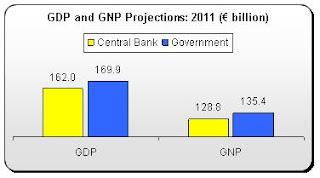
Nominally, the economy will be much lower than the Government originally projected. This is particularly borne out by key domestic indicators:

As can be seen, every indicator is going south. While the Government expected consumer spending to increase towards 3 percent, the Central Bank estimates that it will be effectively stagnant. Critically, while the Government estimated investment to grow by over 4 percent, the Central Bank estimates it will still be negative. The result is that the Central Bank estimates the domestic economy will grow at about half the rate as the Government hoped.
What does this mean for the deficit next year? The Central Bank doesn’t give an estimate. But even if the Government’s budgetary targets are met (tax revenue, current and capital spending) the deficit will start to rise – merely as a function of lower GDP. Instead of being -10 percent as the Government hoped, it will be -10.5 percent.
However, if the Government’s own tax revenue ratio holds (i.e. tax revenue as a percentage of GDP – the Government uses a ratio of 19.3 percent between 2010 and 2014), then the real trouble starts. With the deflated GDP, tax revenue will undershoot by €1.5 billion. If this holds, then the deficit will slide back to levels this year. In other words, there will be no progress on the public finances. In fact, it could be even worse.
The Government hoped that employment would rise by approximately 18,000 in 2011. The Central Bank estimates it will continue declining – by 7,000. Unless emigration increases, unemployment could rise – increasing public spending above what the Government estimated, thus adding even more to the deficit.
So, all that pain and no gain at all. And none of the above counts the cost of the banking crisis. Now, throw in the cost of that – the extra interest payments, the higher rates on Government borrowing and no wonder the Government is going back to the drawing board. Because all its current projections are beyond repair.
This is the result of the Government’s deflationary policies – the very deflation demanded by commentators, analysts and politicians on both sides of the house. If the Government continues to pursue this strategy through a multi-annual programme, then it will be continuing policies that have failed to date.
And if the Opposition parties buy into this – in the name of a ‘national consensus’ – they will be aiding and abetting what is essentially a crime against the economy.
One of the central contentions on this blog is that deflationary policies will do just that – deflate the economy. They will depress growth which, in turn will depress tax revenue while increasing public expenditure through higher unemployment costs arising from the low level of output. Recent estimates from the Central Bank (and, no doubt, data that only the Government has sight of) is starting to show this. Growth figures are coming in well below Government projections in the last budget.

Nominally, the economy will be much lower than the Government originally projected. This is particularly borne out by key domestic indicators:

As can be seen, every indicator is going south. While the Government expected consumer spending to increase towards 3 percent, the Central Bank estimates that it will be effectively stagnant. Critically, while the Government estimated investment to grow by over 4 percent, the Central Bank estimates it will still be negative. The result is that the Central Bank estimates the domestic economy will grow at about half the rate as the Government hoped.
What does this mean for the deficit next year? The Central Bank doesn’t give an estimate. But even if the Government’s budgetary targets are met (tax revenue, current and capital spending) the deficit will start to rise – merely as a function of lower GDP. Instead of being -10 percent as the Government hoped, it will be -10.5 percent.
However, if the Government’s own tax revenue ratio holds (i.e. tax revenue as a percentage of GDP – the Government uses a ratio of 19.3 percent between 2010 and 2014), then the real trouble starts. With the deflated GDP, tax revenue will undershoot by €1.5 billion. If this holds, then the deficit will slide back to levels this year. In other words, there will be no progress on the public finances. In fact, it could be even worse.
The Government hoped that employment would rise by approximately 18,000 in 2011. The Central Bank estimates it will continue declining – by 7,000. Unless emigration increases, unemployment could rise – increasing public spending above what the Government estimated, thus adding even more to the deficit.
So, all that pain and no gain at all. And none of the above counts the cost of the banking crisis. Now, throw in the cost of that – the extra interest payments, the higher rates on Government borrowing and no wonder the Government is going back to the drawing board. Because all its current projections are beyond repair.
This is the result of the Government’s deflationary policies – the very deflation demanded by commentators, analysts and politicians on both sides of the house. If the Government continues to pursue this strategy through a multi-annual programme, then it will be continuing policies that have failed to date.
And if the Opposition parties buy into this – in the name of a ‘national consensus’ – they will be aiding and abetting what is essentially a crime against the economy.
One of the most catastrophic political decisions in post-war Europe?
Writing on the Eurointelligence blog, Financial Times columnist Wolfgang Munchau says that:
"[...] on Tuesday, 30 September 2008, when Brian Cowen, the Irish prime minister, gave a blanket guarantee for the entire banking sector. His decision bounded the other eurozone leaders into following suit. The rest is history.
I would go as far as to classify the decision as one of the most catastrophic political decision taken in post-war Europe. This not so much because of the decision itself – it was necessary to stop the rot at the time – but because of a lack of action to embed the decision into a strategy to solve the problems of the banking sector – lack of capitalisation, abundance of toxic assets, poor management, and of course, excessive size. The consequences of that strategy will only become apparent in the years to come." You can read the rest of the piece here.
"[...] on Tuesday, 30 September 2008, when Brian Cowen, the Irish prime minister, gave a blanket guarantee for the entire banking sector. His decision bounded the other eurozone leaders into following suit. The rest is history.
I would go as far as to classify the decision as one of the most catastrophic political decision taken in post-war Europe. This not so much because of the decision itself – it was necessary to stop the rot at the time – but because of a lack of action to embed the decision into a strategy to solve the problems of the banking sector – lack of capitalisation, abundance of toxic assets, poor management, and of course, excessive size. The consequences of that strategy will only become apparent in the years to come." You can read the rest of the piece here.
Thursday, 7 October 2010
Benefitting all the children equally
In an Irish Times 'Double Vision' piece with Friends First economist Jim Power, TASC Head of Policy Sinéad Pentony argues this morning that the universal provision of public services or other benefits is fundamental to bridging Ireland's equality divide. You can read the full piece here.
Wednesday, 6 October 2010
IBEC and Social Justice Ireland call for Higher Taxes (Revised)
Nat O'Connor: IBEC (in their pre-Budget submission) have proposed that Ireland's level of taxation should be 36 to 38 per cent of GNP. Social Justice Ireland (in their submission) call for tax to be 34.9 of GDP.
This is a revised version of yesterday's post. Thanks to Seamus Coffey for pointing out an error in the table re total tax revenue.
Professor John Fitz Gerald of the ESRI some time ago suggested 45 per cent of GDP as a long-term target, which would place Ireland in the middle of other European countries in terms of tax.
European economics commissioner Olli Rehn has already stated that Ireland must move from being a low tax economy to "a normal tax country in the European context"(Irish Times). The European average is 45 per cent of GDP.
If we go back to 2007 figures for GDP and GNP (which are the last stable pre-crisis figures), GDP was €189 billion and GNP was €163 billion (Source: CSO). This represents a 'boom' year. Figures for 2008 represent the beginning of the 'bust'. The following table illustrates what each of the suggested rates would have meant in those years, in terms of total tax revenue (taken from the Stability Update, and including social insurance as well as non-Exchequer tax, such as local authority commercial rates). Although it should be noted that GDP and GNP continued to fall in 2009 also.

Complete figures for 2009 are not yet available, but they are likely to show a continued deterioration of tax revenue (as stamps, VAT, etc. all continued to fall between 2008 and 2009; likewise higher unemployment means less PRSI paid and business closures reduce commercial rates). Hence, to meet the various tax take targets in 2009 would require even further increases in taxation.
IBEC's rates (36-38 per cent) would have represented less or the same level of tax in 2007, but up to €3.2 billion more tax in 2008. However, the significant collapse of GDP/GNP in 2009 makes it likely that IBEC's preferred tax take will be lower than actual tax take (as a percentage of GNP).
SJI's preferred rate would have called for over €4 billion in addition taxation in 2007 and over €7 billion in 2008. Despite the collapse of GDP/GNP in 2009 SJI's preferred rate will probably remain several billion higher than actual total tax revenue. In this context, it should be noted that SJI's stated aim is for Ireland to remain a 'low tax' economy.
A European average level of taxation (45 per cent of GDP) would have meant €23.7 billion more in tax in 2007 and €25.5 billion more in tax in 2008. That is nearly half again as much taxation. Of course, it would take years to carefully raise taxation towards this kind of target, and it would involve a transformation of Ireland's economy and industrial policy.
In reality, it is reasonable to suggest that increasing tax will cause some companies to leave Ireland, which will lower GDP. However, a more sustainable economic model might combine a more modest level of GDP with higher taxation; and more tax from a smaller number of companies and people might still mean more money for Government than lower tax from a larger number; including multi-nationals who are using tax breaks to avoid paying much tax here (or anywhere).
For example, the Social Justice Ireland document (page 2) shows a table of effective taxation in Ireland that suggests much higher taxation in the 1990s and early 2000s, which was also a time of stronger economic performance.
In this context, we could imagine that GDP falls to the same level of GNP, due to many multi-nationals leaving Ireland. In such a scenario, 45% of GNP would have taken an additional €11.8 billion in tax in 2007 and €14.8 billion in 2008. That's probably a more realistic estimate of what higher corporation tax, plus much higher social insurance, along with property tax could yield.
The bottom line is that the collapse of the tax take (by one third, €14 billion, between 2007 and 2009) is a major part of Ireland's financial problems. And this was on top of an already 'low tax' model, as the actual figures for both years show.
A broad coalition appears to agree that raising tax must be part of the solution for Ireland. And that means seeking higher taxes and new taxes.
That's where the debate really begins. IBEC want the Government to target people on the minimum wage for income tax, but they also call for property tax. Whereas Social Justice Ireland seek the reform of tax breaks (which generally benefit people on higher incomes).
This is a revised version of yesterday's post. Thanks to Seamus Coffey for pointing out an error in the table re total tax revenue.
Professor John Fitz Gerald of the ESRI some time ago suggested 45 per cent of GDP as a long-term target, which would place Ireland in the middle of other European countries in terms of tax.
European economics commissioner Olli Rehn has already stated that Ireland must move from being a low tax economy to "a normal tax country in the European context"(Irish Times). The European average is 45 per cent of GDP.
If we go back to 2007 figures for GDP and GNP (which are the last stable pre-crisis figures), GDP was €189 billion and GNP was €163 billion (Source: CSO). This represents a 'boom' year. Figures for 2008 represent the beginning of the 'bust'. The following table illustrates what each of the suggested rates would have meant in those years, in terms of total tax revenue (taken from the Stability Update, and including social insurance as well as non-Exchequer tax, such as local authority commercial rates). Although it should be noted that GDP and GNP continued to fall in 2009 also.

Complete figures for 2009 are not yet available, but they are likely to show a continued deterioration of tax revenue (as stamps, VAT, etc. all continued to fall between 2008 and 2009; likewise higher unemployment means less PRSI paid and business closures reduce commercial rates). Hence, to meet the various tax take targets in 2009 would require even further increases in taxation.
IBEC's rates (36-38 per cent) would have represented less or the same level of tax in 2007, but up to €3.2 billion more tax in 2008. However, the significant collapse of GDP/GNP in 2009 makes it likely that IBEC's preferred tax take will be lower than actual tax take (as a percentage of GNP).
SJI's preferred rate would have called for over €4 billion in addition taxation in 2007 and over €7 billion in 2008. Despite the collapse of GDP/GNP in 2009 SJI's preferred rate will probably remain several billion higher than actual total tax revenue. In this context, it should be noted that SJI's stated aim is for Ireland to remain a 'low tax' economy.
A European average level of taxation (45 per cent of GDP) would have meant €23.7 billion more in tax in 2007 and €25.5 billion more in tax in 2008. That is nearly half again as much taxation. Of course, it would take years to carefully raise taxation towards this kind of target, and it would involve a transformation of Ireland's economy and industrial policy.
In reality, it is reasonable to suggest that increasing tax will cause some companies to leave Ireland, which will lower GDP. However, a more sustainable economic model might combine a more modest level of GDP with higher taxation; and more tax from a smaller number of companies and people might still mean more money for Government than lower tax from a larger number; including multi-nationals who are using tax breaks to avoid paying much tax here (or anywhere).
For example, the Social Justice Ireland document (page 2) shows a table of effective taxation in Ireland that suggests much higher taxation in the 1990s and early 2000s, which was also a time of stronger economic performance.
In this context, we could imagine that GDP falls to the same level of GNP, due to many multi-nationals leaving Ireland. In such a scenario, 45% of GNP would have taken an additional €11.8 billion in tax in 2007 and €14.8 billion in 2008. That's probably a more realistic estimate of what higher corporation tax, plus much higher social insurance, along with property tax could yield.
The bottom line is that the collapse of the tax take (by one third, €14 billion, between 2007 and 2009) is a major part of Ireland's financial problems. And this was on top of an already 'low tax' model, as the actual figures for both years show.
A broad coalition appears to agree that raising tax must be part of the solution for Ireland. And that means seeking higher taxes and new taxes.
That's where the debate really begins. IBEC want the Government to target people on the minimum wage for income tax, but they also call for property tax. Whereas Social Justice Ireland seek the reform of tax breaks (which generally benefit people on higher incomes).
Saturday, 2 October 2010
What shall we do with our new banks?
Slí Eile: as the sweet tones of the 'People's flag is deepest red it shrouded oft our martyred dead' signalled the end of that very nice protest on Kildare St last Wednesday it became obvious that the authorities were so impressed that at long last they decided by 6.30am the following morning to take majority public control of Allied Irish Banks. The commanding heights are now in full view and socialism (for bankers) is within reach. From each according to their means (higher interest payments to unknown investors) to each according to their needs (the same unknown investors are are senior bondholders). No wonder it can be claimed that some €15bn in senior debt (in Anglo-Irish) has the same status as deposits and this is a legal matter (did I hear some mutter the constitution - they must be talking about private property). Now would readers of this site care to suggest what we the people of Ireland - gnáth phobal na hEireann - might do with this new found resource. This is about democracy. Truly Marx was right when he said that the modern State is but a committee for the management of the common affairs of the bourgeoisie. Except that the international bourgeoisie are not too impressed with the efforts.
How not to reduce the fiscal deficit
Slí Eile: Today's opinion poll in the Irish Times is odd. One of the questions is: 'Asked if the Government should stick by its target of reducing the budget deficit by €3 billion or doing more as suggested by Mr Lenihan, 54 per cent opted for the €3 billion target, while 26 per cent accepted that it should be more.' According to the print version of the newspaper, the question is introduced as follows: 'The Government has signalled that the gap between national income and expenditure will be reduced by €3billion...'.
Clearly, someone is confused about:
the difference between national accounts and public finances
reducing spending, increasing taxes and reducing deficits.
The story says that 20% didn't know, 54% said same reduction and 26% said more is needed.
Well, I belong to the 'make reduction' of more than €3bn in the deficit by not cutting spending and directing some of the cash in NTMA to job creation in new green tech industries.
Put another way, cuts do not equal savings due to the dynamics and interactions between domestic demand, investment and tax receipt flows. The empirical evidence reviewed on this site and elsewhere suggests that the underlying deficit remains stuck not because the Government has not cut enough but because the economy is in a prolonged recession and, to some extent, domestic fiscal policy has made the situation worse.
The best way to embed the deficit is to continue cutting - especially on the capital side. That is exactly what Fianna Fáil and inter-party Governments did in the 1950s and they reaped a whirlwind of rising emigration, unemployment, poverty and stagnation.
Clearly, someone is confused about:
the difference between national accounts and public finances
reducing spending, increasing taxes and reducing deficits.
The story says that 20% didn't know, 54% said same reduction and 26% said more is needed.
Well, I belong to the 'make reduction' of more than €3bn in the deficit by not cutting spending and directing some of the cash in NTMA to job creation in new green tech industries.
Put another way, cuts do not equal savings due to the dynamics and interactions between domestic demand, investment and tax receipt flows. The empirical evidence reviewed on this site and elsewhere suggests that the underlying deficit remains stuck not because the Government has not cut enough but because the economy is in a prolonged recession and, to some extent, domestic fiscal policy has made the situation worse.
The best way to embed the deficit is to continue cutting - especially on the capital side. That is exactly what Fianna Fáil and inter-party Governments did in the 1950s and they reaped a whirlwind of rising emigration, unemployment, poverty and stagnation.
Friday, 1 October 2010
At least we're not Iceland
Michael Burke: Over on Irish Economy, Kevin O'Rourke has criticised the Finance Minister for arguing that not allowing a default of bank debt had been a positive - the example given where that had happened being Iceland.
The are two aspects to this strange official boast.
The first is to do with the banking policy, where Iceland could not prevent its banks from bankruptcy and default. It is a simple matter of fact that as a result Iceland does not now have an additional millstone of bank debt tied around the neck of all future taxpayers. However, the country itself was bankrupted and required funds from the IMF and Nordic neighbours. I know of no-one who believes that this State is currently insolvent. The Finance Minister seems to believe that it would have been- had fewer liabilities accrued to the State with no bank bail-out and their default. The example cited is usually Lehmans, but this is incorrect. Lehman's balance sheet was a multiple of the entire Irish banking system combined, and its trading interrelationships vastly greater. Even so, when it went under, it took other financial institutions with it, but no sovereign borrower. The Iceland/Lehman example does not stand up.
However, many observers suggest that the 'final' bill for the bank bailout here is up to €50bn. This may be an underestimate. The stress test on the portfolio of loans applied was 70%, and it is taxpayer's capital which is filling the breach. But NAMA is already applying losses to loans it is purchasing of 67%. So this doesnt' look like a very stressful test.
If further cuts are in the pipeline, the economy will not revive significantly and the loan losses may continue to mount. This is a situation worse than Iceland, created by policy.
The other aspect of the boast is an economic one, which has more exercised the contributors over at IE. On a national accounts seasonally adjusted basis Iceland’s GDP indeed peaked in Q3 2007 and has fallen by a cumulative 16.3%, in line with the OECD data cited, and compared to a 13.4% decline here.
But there is a strange tendency in economic debate to treat Ireland as if it is an economy sui generis. So, it is insisted that, as GDP data is distorted by MNC transfer pricing, GNP should be the real reference for the economy. Agreed. But other countries have an external sector too. Ireland’s GNP should properly be compared to Iceland’s GNP. This contracted in Q2 by 7.7% q-o-q and by 7.8% y-o-y. A link to the actual data can be found via this quirky piece. This shows that the latest decline is driven by an extraordinary run-down in inventories, which reduced GDP by 5% in the quarter.
In current prices, not s.adj., Icelandic GNP fell by 11.8% from its peak, compared to a 26.3% fall in Irish GNP (or 17% in real terms). This nominal measure is crucial regarding taxation revenues, since, unfortunately taxes are paid in current, not 2008, Euros. It is from current taxes that existing debt interest payments as well as principal repayments must be made. But on either measure, the Irish position is much worse.
The new Icelandic government has increased taxes, so that revenues are 9.4% higher in the year to August, compared to 2009. Tax revenues fell here by 19% in 2009 and are down 9% in the year to August.
So the Minister is right. Ireland is not Iceland. It’s much worse.
The are two aspects to this strange official boast.
The first is to do with the banking policy, where Iceland could not prevent its banks from bankruptcy and default. It is a simple matter of fact that as a result Iceland does not now have an additional millstone of bank debt tied around the neck of all future taxpayers. However, the country itself was bankrupted and required funds from the IMF and Nordic neighbours. I know of no-one who believes that this State is currently insolvent. The Finance Minister seems to believe that it would have been- had fewer liabilities accrued to the State with no bank bail-out and their default. The example cited is usually Lehmans, but this is incorrect. Lehman's balance sheet was a multiple of the entire Irish banking system combined, and its trading interrelationships vastly greater. Even so, when it went under, it took other financial institutions with it, but no sovereign borrower. The Iceland/Lehman example does not stand up.
However, many observers suggest that the 'final' bill for the bank bailout here is up to €50bn. This may be an underestimate. The stress test on the portfolio of loans applied was 70%, and it is taxpayer's capital which is filling the breach. But NAMA is already applying losses to loans it is purchasing of 67%. So this doesnt' look like a very stressful test.
If further cuts are in the pipeline, the economy will not revive significantly and the loan losses may continue to mount. This is a situation worse than Iceland, created by policy.
The other aspect of the boast is an economic one, which has more exercised the contributors over at IE. On a national accounts seasonally adjusted basis Iceland’s GDP indeed peaked in Q3 2007 and has fallen by a cumulative 16.3%, in line with the OECD data cited, and compared to a 13.4% decline here.
But there is a strange tendency in economic debate to treat Ireland as if it is an economy sui generis. So, it is insisted that, as GDP data is distorted by MNC transfer pricing, GNP should be the real reference for the economy. Agreed. But other countries have an external sector too. Ireland’s GNP should properly be compared to Iceland’s GNP. This contracted in Q2 by 7.7% q-o-q and by 7.8% y-o-y. A link to the actual data can be found via this quirky piece. This shows that the latest decline is driven by an extraordinary run-down in inventories, which reduced GDP by 5% in the quarter.
In current prices, not s.adj., Icelandic GNP fell by 11.8% from its peak, compared to a 26.3% fall in Irish GNP (or 17% in real terms). This nominal measure is crucial regarding taxation revenues, since, unfortunately taxes are paid in current, not 2008, Euros. It is from current taxes that existing debt interest payments as well as principal repayments must be made. But on either measure, the Irish position is much worse.
The new Icelandic government has increased taxes, so that revenues are 9.4% higher in the year to August, compared to 2009. Tax revenues fell here by 19% in 2009 and are down 9% in the year to August.
So the Minister is right. Ireland is not Iceland. It’s much worse.
Subscribe to:
Posts (Atom)