An Saoi: The Department of Finance has issued the February 2012 tax figures, which can be viewed here. The figures are so confusing a detailed explanatory note has been issued to explain the discrepancies.
Let us start with the headline figure. It is 12.53% over profile. However we now have three different explanations as to why the figures are so far over target.
a) Corporation Tax which came in too late for inclusion in 2011. See here for an explanation – discrepancy €261M
b) Corporation Tax refunds not processed - discrepancy €50m?
c) 2011 Income Tax, wrongly accounted for as Social Insurance – discrepancy €350M estimated (see below for explanation)
This gives a total discrepancy of around €661M and reduces the total from €5,891M to €5,230M or close to the expected target €5,237M.
Firstly in looking at the Income Tax figures, let us start with the Social Insurance Fund. The estimated yield for the SIF in 2011 was €7,148M while the outcome was €7,543M, a discrepancy of €395M. Income Tax for 2011 was €327M below target. Income tax began falling behind profile in the latter half of the year and it completely beggars belief that the Collector General and his staff were not aware of the movement in the two, Social Insurance over target and Income Tax below target by a very similar amount. It is unbelievable that they had to wait until the filing of forms P35 to discover the discrepancy. Anyone who has any experience of Revenue computer systems and its Management Information Systems knows that this discrepancy would have been picked up. While as the Department correctly points out that it doesn’t change the overall position, it does improve the tax position for 2012 while weakening the Social Insurance Fund. Effectively a lump of 2011 Income Tax was hidden as Social Insurance in 2011 and that money is now being taken back in 2012.
By taking this action, the position of the Social Insurance Fund has been considerably weakened. The size of the deficit in the SIF will be far greater than originally expected. In a classic neo-liberal tactic, are we about to see the State's financial hole depicted as the fault of Welfare spending, allowing it to be targeted in to bear most of the cuts for 2013?
The complete opposition of Dept of Finance to the Insurance principle and the opposition of Fine Gael to the extension of Social Insurance to other sources of income further weakens the position of the Social Insurance Fund.
Many questions were raised about the Income Tax target at Budget time. We now of course know why the Minister for Finance was so sure that the figure would be reached. Apart from the pensioners, he had this €300M tucked away. He also has a once off bonus of several hundred million Euro coming his way later in the year. Facebook’s Irish staff will be receiving their Restricted Stock Units some six months after the Initial Public Offering and with nearly 10% of their worldwide staff here, there should be lots of additional tax due. The Financial Times recently estimated that the total value of these RSUs will be in the region of $23,000M, with the tax due on vesting.
There should also be a substantial yield from a further investigation relating to those receiving foreign pensions, as described by Niamh Connolly in the Sunday Business Post on 19th February last.
Income Tax looks likely to well exceed its annual target for 2012.
Moving on to Value Added Tax, the target for the month was €220M net. The State received €194M net or just 88.2% of its target, which is only four weeks old. March’s figures which will cover the Jan/Feb period will reflect the cold blast of the retail sales decline and is highly unlikely to get anywhere near target.
Excise figures were €14M off reflecting the problems in the motor trade. It is unclear whether this is a temporary blip or something more permanent. Finance for the purchase of new cars is readily available to the solvent customers, both from the specialist lenders owned by the motor groups and from Credit Unions.
The inability to process CT repayments in a timely manner reflects the loss of staff. Taxpayers are going to have to get used to this as it will become the norm.
The other tax heads show figures on or very close to target.
The real story however is the further evidence of the cynical manipulation of tax figures to ensure that the 2012 figures look good. First, the movement of corporation tax from December to January and now we hear about this problem with income tax. One wonders what else has fallen down behind the sofa cushions?

Showing posts with label An Saoi. Show all posts
Showing posts with label An Saoi. Show all posts
Tuesday, 6 March 2012


Friday, 3 February 2012
January 2012 tax - have we reached the bottom?
An Saoi: The January tax figures have given the Government a bit of good news, but the question is how much?
The Table below gives the figures for January from 2010 to 2012 and superficially the figures look like a big improvement and certainly some particular tax heads look particularly good.
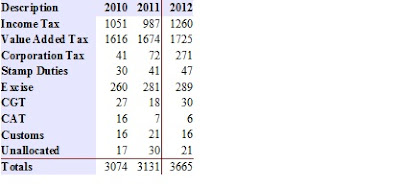
The Income Tax is well ahead over previous years mainly because the payments relate to 2011 and are influenced by the Brian Lenihan changes and weekly paid staff had an additional payday in December, a Week 53, which added to the tax yield. The income tax figures for the last four months of 2011 were well behind target and perhaps there is a degree of balancing payments being submitted with forms P35. The weakness of Income Tax in 2011 may have been overstated and was perhaps a cashflow issue for employers.
The Corporation Tax figure must be a serious worry to the Government. It includes €261M which they told us really belonged in December 2011 but arrived late. This suggests that the net figure for January was just €10M. It will be May before enough is known to hazard a guess at the final outcome.
Value Added Tax is up €51M on the same period and reflects the better weather in November and December 2011 over the previous year and perhaps a degree of shopping ahead of the increase in the standard rate of VAT which took effect from 1st January. The Retail Sales Figures released by the CSO suggest that the motor trade performed strongly in December. The slight increase in Excise Figures confirms this also.
The other taxes, even together, do not amount to very much and are not really worth a comment for a few more months. It will be March before we can see a definite trend, but on these figures, the Government has a chance of reaching its targets.
The Table below gives the figures for January from 2010 to 2012 and superficially the figures look like a big improvement and certainly some particular tax heads look particularly good.

The Income Tax is well ahead over previous years mainly because the payments relate to 2011 and are influenced by the Brian Lenihan changes and weekly paid staff had an additional payday in December, a Week 53, which added to the tax yield. The income tax figures for the last four months of 2011 were well behind target and perhaps there is a degree of balancing payments being submitted with forms P35. The weakness of Income Tax in 2011 may have been overstated and was perhaps a cashflow issue for employers.
The Corporation Tax figure must be a serious worry to the Government. It includes €261M which they told us really belonged in December 2011 but arrived late. This suggests that the net figure for January was just €10M. It will be May before enough is known to hazard a guess at the final outcome.
Value Added Tax is up €51M on the same period and reflects the better weather in November and December 2011 over the previous year and perhaps a degree of shopping ahead of the increase in the standard rate of VAT which took effect from 1st January. The Retail Sales Figures released by the CSO suggest that the motor trade performed strongly in December. The slight increase in Excise Figures confirms this also.
The other taxes, even together, do not amount to very much and are not really worth a comment for a few more months. It will be March before we can see a definite trend, but on these figures, the Government has a chance of reaching its targets.
Monday, 23 January 2012
Who will collect our taxes?
An Saoi: Staffing in the Office of the Revenue Commissioners was already a concern when this PQ was asked on 3rd July 2008. The same question was asked on 19th January 2012 and received the following reply.
Below is a Table summarising the level of decline.

The decline is most extreme amongst male staff, particularly those involved in operational and specialist areas, with an overall 27.2% decline in male staff at the three grades.
The figures for 1st March may indeed be an overestimate. They include 28 staff over 60 and 362 staff over 55. It is questionable whether many of those people will stay.
While there are “… discussions on how to address critical skills losses that will arise due to these retirements”, it is clearly a bit late in the day: this problem was clear to many four years ago. There seems little danger of receiving an audit notification in the next few years at least.
Losses in the Revenue are disproportionate to other Government services and are being implanted at a critical time for the State when maximising tax collection is crucial. Such slashing of staff numbers raise major questions as to the ability of the Revenue to effectively police tax, customs and excise collection and doubts of the Government’s ability to reach its tax targets.
Below is a Table summarising the level of decline.

The decline is most extreme amongst male staff, particularly those involved in operational and specialist areas, with an overall 27.2% decline in male staff at the three grades.
The figures for 1st March may indeed be an overestimate. They include 28 staff over 60 and 362 staff over 55. It is questionable whether many of those people will stay.
While there are “… discussions on how to address critical skills losses that will arise due to these retirements”, it is clearly a bit late in the day: this problem was clear to many four years ago. There seems little danger of receiving an audit notification in the next few years at least.
Losses in the Revenue are disproportionate to other Government services and are being implanted at a critical time for the State when maximising tax collection is crucial. Such slashing of staff numbers raise major questions as to the ability of the Revenue to effectively police tax, customs and excise collection and doubts of the Government’s ability to reach its tax targets.
Friday, 20 January 2012
Questions and answers
An Saoi: On Thursday 12/1/2012, Finance Minister Michael Noonan answered a series of questions on inheritances and Capital Acquisitions Tax.
The questions and the answers start here and continue over the next few pages of the Oireachtas website and provide a huge amount of detailed information on the subject of inheritances and gifts, but even more interesting is the information not provided.
The issue of estimating the tax yield has been fraught for many years. So in response to her question on the preparation of the estimate of CAT, Mr. Noonan advised that “… projections for capital acquisition tax receipts are not produced by reference to details of the numbers of deaths, gifts, property values, reliefs and exemptions.” It seems they stick a wet finger in the air, see which way the wind is blowing. Their general level of accuracy is reflected by their haphazard approach.
CAT appears to have a very low level of priority within the Revenue as the level of compliance in submission of Inland Revenue Affidavits (Form CA24) shows. As always, click to enlarge graphics.

.. or perhaps the degree of the appalling job the Revenue is doing is better reflected in a graph:

The Minister would not/could not provide details of the number of Capital Acquisition Tax audits that had taken place in recent years. Instead provided total figures for audits carried out under three headings, Stamp Duty, Pensions & CAT. Even then the numbers were appalling. However in the circumstances it is fair to say that no CAT audits have taken place in recent years.

It is time to move on to the meaty part – the figures.

There are huge discrepancies between gross inheritances and taxable benefits taken at death with just 37.1% of the gross being taxable in 2006 & 2009 with higher figures in the intervening years. No reasons were given for the size of the difference.
The average size of estates where forms have been returned is calculated in the table below.

The Minister refused to provide any separate analysis of the number of gift returns made, perhaps because of the average size of gift and the degree of tax avoidance. However let us look at the average tax yield on benefits taken at death and (declared) gifts.
Taken at death

* I have used a composite rate of 23.5%
Gifts

The answers provided by the Minister raise as many questions as they answer. I hope that Joanna will follow through with some more questions in the near future to shine a further beam of light on this area.
The level of compliance is alarming. There is a lack of a clear picture of what is going on, nor any sign of a desire to tackle the issue. The percentage tax paid of (declared) gifts and inheritances is extremely low. There have been further slight amendments this year, but we don’t why or on basis those changes were made. Finally the level of openly admitted ignorance of Dept. of Finance is incredible, if not surprising.
Since the appointment of Dermot Quigley initially as a Commissioner and subsequently as Chairman of the Revenue, the organisation has certainly had the slickest PR & Media operation in the Public Service. Even the recent road bump over the pensioners was handled with panache by the current Chairman Josephine Feehily who wiped the floor with the Teachtaí in Committee Room 4 when called to account for her handling of the issue. I would be interested to see what she has to say about this CATastrophe.
Notes:
1. No of deaths for 2005 to 2008 are actual deaths in the year, for 2009 & 2010 it is the number of deaths registered.
2. Revenue Commissioners Annual Statistical Reports
3. Revenue Commissioners Annual Statistical Reports
The questions and the answers start here and continue over the next few pages of the Oireachtas website and provide a huge amount of detailed information on the subject of inheritances and gifts, but even more interesting is the information not provided.
The issue of estimating the tax yield has been fraught for many years. So in response to her question on the preparation of the estimate of CAT, Mr. Noonan advised that “… projections for capital acquisition tax receipts are not produced by reference to details of the numbers of deaths, gifts, property values, reliefs and exemptions.” It seems they stick a wet finger in the air, see which way the wind is blowing. Their general level of accuracy is reflected by their haphazard approach.
CAT appears to have a very low level of priority within the Revenue as the level of compliance in submission of Inland Revenue Affidavits (Form CA24) shows. As always, click to enlarge graphics.

.. or perhaps the degree of the appalling job the Revenue is doing is better reflected in a graph:

The Minister would not/could not provide details of the number of Capital Acquisition Tax audits that had taken place in recent years. Instead provided total figures for audits carried out under three headings, Stamp Duty, Pensions & CAT. Even then the numbers were appalling. However in the circumstances it is fair to say that no CAT audits have taken place in recent years.

It is time to move on to the meaty part – the figures.

There are huge discrepancies between gross inheritances and taxable benefits taken at death with just 37.1% of the gross being taxable in 2006 & 2009 with higher figures in the intervening years. No reasons were given for the size of the difference.
The average size of estates where forms have been returned is calculated in the table below.

The Minister refused to provide any separate analysis of the number of gift returns made, perhaps because of the average size of gift and the degree of tax avoidance. However let us look at the average tax yield on benefits taken at death and (declared) gifts.
Taken at death

* I have used a composite rate of 23.5%
Gifts

The answers provided by the Minister raise as many questions as they answer. I hope that Joanna will follow through with some more questions in the near future to shine a further beam of light on this area.
The level of compliance is alarming. There is a lack of a clear picture of what is going on, nor any sign of a desire to tackle the issue. The percentage tax paid of (declared) gifts and inheritances is extremely low. There have been further slight amendments this year, but we don’t why or on basis those changes were made. Finally the level of openly admitted ignorance of Dept. of Finance is incredible, if not surprising.
Since the appointment of Dermot Quigley initially as a Commissioner and subsequently as Chairman of the Revenue, the organisation has certainly had the slickest PR & Media operation in the Public Service. Even the recent road bump over the pensioners was handled with panache by the current Chairman Josephine Feehily who wiped the floor with the Teachtaí in Committee Room 4 when called to account for her handling of the issue. I would be interested to see what she has to say about this CATastrophe.
Notes:
1. No of deaths for 2005 to 2008 are actual deaths in the year, for 2009 & 2010 it is the number of deaths registered.
2. Revenue Commissioners Annual Statistical Reports
3. Revenue Commissioners Annual Statistical Reports
Friday, 6 January 2012
End of year Exchequer Returns 2011
An Saoi: You can read the Government's gloss on 2011's awful tax figures here (Slides 5-7). The tax yield has indeed risen but only after
• the reclassification of the Health Levy as a tax within the USC
• substantial cuts in various tax credits
• the introduction of various new levies
After the massive changes introduced the figures still were €873M short of target. We are told that €261M in Corporation Tax arrived “late” and the Dept. of Finance have decided to “adjust” the figures accordingly. Now late payment of tax is regularly occurs, but this is the first time any Government has decided to make such adjustment. I understand the reason for the late payment was a delay in transferring the tax due from a UK account, because of course the multi-national involved does not trust the Irish banking system. While it may account for its sales in Ireland it sure as hell will ensure that its cash is not here!
Let us look at the main figures, starting with Value Added Tax. Yield is down €489M from target or 4.8% & €360M short of the 2010 figure. The VAT yield weakened throughout the year, reflecting insipid consumer activity, which will it is forecast continue into 2012. The number of credit cards and their use continues to plummet, suggesting even those who can afford to spend do are not listening to Michael Noonan's plea that they spend, rather they believe "Ireland is facing 10 years of austerity" , as Dr. Richard Tol so succinctly put it as he flees the island.
The withdrawal of income involved in the Budget changes will lead to a drop in the VAT yield, which the Government has implicitly taken into account in its tax projections for 2012 by accepting that the VAT rate increase will yield far less than would be expected. The actual affects of the Budget changes were not broken down in the Budget documents.
The degree of non payment or late payment is also not detailed though the Revenue Commissioners are promising to specifically target collection as part of its Comprehensive Expenditure Review. However the graph below shows the level of change in VAT in just five years. Click on graphics to enlarge.

Income Tax came in €327M below target for 2011, but is of course not properly comparable with previous years because of the USC. The real challenge is 2012 particularly since the yield from Income Tax actually weakened in December against the Minister's estimate at Budget time, just four weeks ago. Budget papers expected the 2012 yield to increase by €1,202M (8.7%) over the 2011 outturn and looks well nigh impossible. This surely will be clear by the end of March or April, leaving a mini-Budget inevitable.
The position of the two capital taxes, Capital Acquisitions Tax & Capital Gains Tax from 2006 to 2012 is mapped on the chart below (CGT LHS & CAT RHS). Both taxes performed reasonably well in 2011, CGT considerably exceeding its target as many people took advantage of the existing rate, before the Budget increase to 30%. The various changes introduced by the late Brian Lenihan to CAT ensured that the outturn was only marginally below the expected yield. Further changes introduced in the 2012 Budget are expected to increase the yield further. Irish CAT relief, in particular the provisions on agricultural and business transfers are extremely generous. There are huge options to increase the yield from this source without damaging economic activity.

The lack of access to cash to fund purchases whether it is property or business assets leaves the position of CGT particularly problematic.
“Stamp Duties” are now mainly made up of various levies on pensions, insurance policies etc. The historcial sources of property and financial documents are now but a small part of the yield. A breakdown of the various sources up to 2009 is available from the Revenue Commissioners here and in a written answer provided to a well-known cloth cap you can see the 2010 property figures yield. There is little or no logic to many of these ad hoc taxes, other than to fill some financial hole quickly and their efficacy needs to be reviewed urgently. In the meantime they yielded €1,391M in 2011.
Excise Duties also covers a wide range of different fees and flat rate charges and taxes on services and goods, details of which are available from this chapter of the Revenue Commissioners Annual Statistical Report and came in bang on target as the forecasting is not done by the Dept. Of Finance! The yield is the same as in 2010 and the expected increase in 2012 is just €125M, an increase of under 3% and 2012 should come in on target.
Finally Corporation Tax. This is not so much a tax any more as a voluntary contribution from multi-nationals. The yield from this source is still impressive at €3,520M in 2011, if only just over half €6,683M paid in 2006.Unfortunately much of the tax paid in the glory years of 2006 & 2007 has been repaid since as huge losses incurred in the financial service and property industries have been offset against earlier profits. The 2011 figure was €500M short on target. However they claim to have €261M already in the bank, which should help to make reaching the target of €3,770M a little easier.

Conclusion: 2011 was a bad tax year. An economy on short-time with little access to cash was always going to be that way. The issue now is 2012. It is impossible to see the Government reaching the intended target for 2012 without some form of increased economic activity. This may be clear very quickly, as early as March or April.
A further year of economic stagnation lies ahead and Economist Meg of Roubini Global Economics thinks we are in serious trouble and I agree. However we got ourselves into this problem and it is up to ourselves to dig ourselves out of it.
The additional taxes required to bring the figure up to €36,250M as required by the Government would need to be carefully selected if they are not to seriously reduce existing taxes. Blunt tools such as a VAT rate increase, raising duties on tobacco products & alcohol are unlikely to raise additional taxes as they are likely to lead to lower consumption where they cannot be avoided or increased traffic North or smuggling.
Expediting the withdrawal of the property tax breaks which played a major part in getting us into our current difficulties could yield in excess of €1,000M. These would include a “use it or lose it” amendment, ending all of these capital allowance schemes with effect 31st December 2011 and allowing no further carry forward of unused capital allowances or losses created by them after that date. Also the deductibility of interest against all rental income should be ended with effect from 31st December 2011. The withdrawal of tax expenditures would be the most effective way of collecting the money and have the least effect on private consumption.
Enforcement of existing legislation and the collection of taxes as they fall due is also crucial. The Revenue will be particularly badly hit over the next few months by retirements because of the organisation's age structure. Additional Revenue staff not just replacements for those leaving are required to ensure compliance. Sadly this will not be happening. Indeed, one Commissioner is leaving.
A little bit of joined up thinking is required, but it is as seriously lacking in our current Government as in the one that it replaced. God help us.
• the reclassification of the Health Levy as a tax within the USC
• substantial cuts in various tax credits
• the introduction of various new levies
After the massive changes introduced the figures still were €873M short of target. We are told that €261M in Corporation Tax arrived “late” and the Dept. of Finance have decided to “adjust” the figures accordingly. Now late payment of tax is regularly occurs, but this is the first time any Government has decided to make such adjustment. I understand the reason for the late payment was a delay in transferring the tax due from a UK account, because of course the multi-national involved does not trust the Irish banking system. While it may account for its sales in Ireland it sure as hell will ensure that its cash is not here!
Let us look at the main figures, starting with Value Added Tax. Yield is down €489M from target or 4.8% & €360M short of the 2010 figure. The VAT yield weakened throughout the year, reflecting insipid consumer activity, which will it is forecast continue into 2012. The number of credit cards and their use continues to plummet, suggesting even those who can afford to spend do are not listening to Michael Noonan's plea that they spend, rather they believe "Ireland is facing 10 years of austerity" , as Dr. Richard Tol so succinctly put it as he flees the island.
The withdrawal of income involved in the Budget changes will lead to a drop in the VAT yield, which the Government has implicitly taken into account in its tax projections for 2012 by accepting that the VAT rate increase will yield far less than would be expected. The actual affects of the Budget changes were not broken down in the Budget documents.
The degree of non payment or late payment is also not detailed though the Revenue Commissioners are promising to specifically target collection as part of its Comprehensive Expenditure Review. However the graph below shows the level of change in VAT in just five years. Click on graphics to enlarge.

Income Tax came in €327M below target for 2011, but is of course not properly comparable with previous years because of the USC. The real challenge is 2012 particularly since the yield from Income Tax actually weakened in December against the Minister's estimate at Budget time, just four weeks ago. Budget papers expected the 2012 yield to increase by €1,202M (8.7%) over the 2011 outturn and looks well nigh impossible. This surely will be clear by the end of March or April, leaving a mini-Budget inevitable.
The position of the two capital taxes, Capital Acquisitions Tax & Capital Gains Tax from 2006 to 2012 is mapped on the chart below (CGT LHS & CAT RHS). Both taxes performed reasonably well in 2011, CGT considerably exceeding its target as many people took advantage of the existing rate, before the Budget increase to 30%. The various changes introduced by the late Brian Lenihan to CAT ensured that the outturn was only marginally below the expected yield. Further changes introduced in the 2012 Budget are expected to increase the yield further. Irish CAT relief, in particular the provisions on agricultural and business transfers are extremely generous. There are huge options to increase the yield from this source without damaging economic activity.

The lack of access to cash to fund purchases whether it is property or business assets leaves the position of CGT particularly problematic.
“Stamp Duties” are now mainly made up of various levies on pensions, insurance policies etc. The historcial sources of property and financial documents are now but a small part of the yield. A breakdown of the various sources up to 2009 is available from the Revenue Commissioners here and in a written answer provided to a well-known cloth cap you can see the 2010 property figures yield. There is little or no logic to many of these ad hoc taxes, other than to fill some financial hole quickly and their efficacy needs to be reviewed urgently. In the meantime they yielded €1,391M in 2011.
Excise Duties also covers a wide range of different fees and flat rate charges and taxes on services and goods, details of which are available from this chapter of the Revenue Commissioners Annual Statistical Report and came in bang on target as the forecasting is not done by the Dept. Of Finance! The yield is the same as in 2010 and the expected increase in 2012 is just €125M, an increase of under 3% and 2012 should come in on target.
Finally Corporation Tax. This is not so much a tax any more as a voluntary contribution from multi-nationals. The yield from this source is still impressive at €3,520M in 2011, if only just over half €6,683M paid in 2006.Unfortunately much of the tax paid in the glory years of 2006 & 2007 has been repaid since as huge losses incurred in the financial service and property industries have been offset against earlier profits. The 2011 figure was €500M short on target. However they claim to have €261M already in the bank, which should help to make reaching the target of €3,770M a little easier.

Conclusion: 2011 was a bad tax year. An economy on short-time with little access to cash was always going to be that way. The issue now is 2012. It is impossible to see the Government reaching the intended target for 2012 without some form of increased economic activity. This may be clear very quickly, as early as March or April.
A further year of economic stagnation lies ahead and Economist Meg of Roubini Global Economics thinks we are in serious trouble and I agree. However we got ourselves into this problem and it is up to ourselves to dig ourselves out of it.
The additional taxes required to bring the figure up to €36,250M as required by the Government would need to be carefully selected if they are not to seriously reduce existing taxes. Blunt tools such as a VAT rate increase, raising duties on tobacco products & alcohol are unlikely to raise additional taxes as they are likely to lead to lower consumption where they cannot be avoided or increased traffic North or smuggling.
Expediting the withdrawal of the property tax breaks which played a major part in getting us into our current difficulties could yield in excess of €1,000M. These would include a “use it or lose it” amendment, ending all of these capital allowance schemes with effect 31st December 2011 and allowing no further carry forward of unused capital allowances or losses created by them after that date. Also the deductibility of interest against all rental income should be ended with effect from 31st December 2011. The withdrawal of tax expenditures would be the most effective way of collecting the money and have the least effect on private consumption.
Enforcement of existing legislation and the collection of taxes as they fall due is also crucial. The Revenue will be particularly badly hit over the next few months by retirements because of the organisation's age structure. Additional Revenue staff not just replacements for those leaving are required to ensure compliance. Sadly this will not be happening. Indeed, one Commissioner is leaving.
A little bit of joined up thinking is required, but it is as seriously lacking in our current Government as in the one that it replaced. God help us.
Monday, 25 July 2011
Our disappearing corporate taxes
An Saoi: Stand up and take a bow, the tax team of Microsoft Inc! You managed to reduce the effective corporate tax rate to just 17.53% for the year ended 30th June 2011 from 25% in the year ended 30th June 2010. This reduction saved the company $2,097M or $0.247 a share of the $0.60 increase in income per share. You have therefore contributed 41% of the increase in net income. I hope that Mr. Ballmer remembers you all at bonus time for your stakhanovite efforts on his behalf.
Let us not forget the helping hand of their Irish advisors KPMG for their consistently top class advice. This reduction in the effective rate was managed despite an increase of 25% in your headline Irish tax rate from 10% to 12.5%. Microsoft’s Irish operations account for between a quarter and a third of worldwide sales so Dutch sandwiches and Bermudan barbeques seem to be heavily on the menu.
It is a pity that Ireland seems to have been one of the countries that suffered at the hands of your new found ueber-aggressiveness where tax planning is concerned. I thought our May corporate tax figures were very low and it seems that you have now provided a good deal of the answer. You have of course protected most of your Irish operations, leaving just one company open to public scrutiny.
Historically, Microsoft was not an overly aggressive tax planner. The 2009 effective rate was 26.5% and 2008 slightly lower at 25.75%. Deferral seemed to be the name of the game rather than the over the top activities of Google. However corporate pressure seems to have changed the rules and you certainly have done your bit for earnings per share.
What is left for Ireland? Very little it seems. A few bones will continue be thrown from the table to the lazy dog lying underneath. But when the dog wakes he may find that all he is left with is an itch from some unwelcome visitors. Perhaps it was Microsoft that M. Sarkozy had in mind when he spoke about tax theft. Who would blame him for kicking such a lazy flea infested dog?
Let us not forget the helping hand of their Irish advisors KPMG for their consistently top class advice. This reduction in the effective rate was managed despite an increase of 25% in your headline Irish tax rate from 10% to 12.5%. Microsoft’s Irish operations account for between a quarter and a third of worldwide sales so Dutch sandwiches and Bermudan barbeques seem to be heavily on the menu.
It is a pity that Ireland seems to have been one of the countries that suffered at the hands of your new found ueber-aggressiveness where tax planning is concerned. I thought our May corporate tax figures were very low and it seems that you have now provided a good deal of the answer. You have of course protected most of your Irish operations, leaving just one company open to public scrutiny.
Historically, Microsoft was not an overly aggressive tax planner. The 2009 effective rate was 26.5% and 2008 slightly lower at 25.75%. Deferral seemed to be the name of the game rather than the over the top activities of Google. However corporate pressure seems to have changed the rules and you certainly have done your bit for earnings per share.
What is left for Ireland? Very little it seems. A few bones will continue be thrown from the table to the lazy dog lying underneath. But when the dog wakes he may find that all he is left with is an itch from some unwelcome visitors. Perhaps it was Microsoft that M. Sarkozy had in mind when he spoke about tax theft. Who would blame him for kicking such a lazy flea infested dog?
Monday, 11 July 2011
June tax figures
An Saoi: The half year tax figures came out during the week and there have been various comments published around them. Constantin Gurdgiev’s piece is available here and is full of nice colourful graphs and gives a multi-year view of payments. I want to focus in on just two of the tax heads, Corporation Tax & Income Tax this month. Both suggest trouble ahead.
Corporation Tax paid in June was €824M net against a monthly target or profile of €871M. This follows on the May when €310M net against the profile figure €450M. All companies have now made the first of their two Corporation Tax payments and the Revenue now have all of the information required to figures are extremely worrying.
The figure is also well below the cumulative figure at June 2010 €1,424M against €1,610M. The 2010 figure would surely have been heavily influenced by refunds arising from losses made by companies in their trading years 2008 & 2009. This makes the continued slippage in 2011 even more alarming and suggests that the final CT figure for 2011 will hardly break €3,400M or around €600M below profile. Back in April after the March tax returns, I had expected Corporation Tax figures to come in at €4,800M, well ahead of profile. This projection was based on the level of trading of many International firms with large presences in Ireland. All of these companies have now at least part paid their current liabilities and there is no way the Exchequer will get close to its target.
We know that the level of trading losses within the financial services industry was at least €34,309M arising from a Dail question. The only journalist to pick up the importance of the story was Kathleen Barrington here in the Sunday Business Post. The level of payments being made by the historically large payers outside of the financial services sector must also be falling, suggesting greater internal pressure to reduce the tax cost of doing business in Ireland. Even 12.5% is too high. This is despite increasing profitability and turnover in those companies.
Few Valued Added Tax returns fall due in June and the overall level of payments for the month was small. However the figure €208M was €42M or 16.8% short of profile. However timing of refunds may explain such a large discrepancy.
The May/June VAT returns are due this month (July) and should be reasonably good. June was the last month and as can be seen from these SIMI Stats, it was a good month in the motor trade. However the rest of year will surely be poor as over 40% of car sales were part of the scrappage scheme. Preliminary retail sales figures for May showed non motor trade spending continues to fall. This would suggest that VAT for the year is unlikely to break €10,000M for the year, probably coming in somewhere between €9,600M & €9,800M.
Income Tax incorporating the USC remains on target. While it is nominally ahead of last year, when you take the substantial tax changes in the Finance Act and the replacement of the Health Levy with the USC, it is behind perhaps €300M against the same month last year on a like for like basis. There is an expectation of increased income tax payments for the rest of the year, which seems more of a hope than expectation, but only time will tell. Employment and wage levels continue to fall but perhaps self employed payments will bail the State out later in the year?
Excise Duty remains ahead of target buoyed by the new car sales. The next six months may reflect a different story. Stamp duty remains in the doldrums.
Movements in the other taxes do not materially change the picture as their collective contribution is so small. Customs Duties are collected by the State on behalf of the European Union and while included in the figures are remitted to the EU, minus 40% to cover local costs.
The final outcome suggests that the cumulative tax changes introduced by the outgoing Government have not improved the Exchequer position. Retail activity other than in the car trade continues to fall and with the tax take following suit. The fall in Corporation Tax was not expected, least of all by me and shows just how fickle the multi national sector’s relationship with Ireland is.
June’s figures may also explain Mr. Noonan’s comments about the necessity to find even more than the €3,600M in planned cuts. It would be helpful if he let us all in on the information he has been given by his officials. The final tax yield for 2011 looks as it will fall a good deal short of the €34,900M.
There is an urgent need to expand the Tax base and the Social Insurance base by withdrawing without delay all the various tax breaks, deductibility of interest against property purchase, carry forward of losses, exemptions applied to certain income etc.
The effects of the tax changes introduced this year also make it clear that there is a need to selectively reduce the tax burden but certainly not to increase rates. Proposed changes in the standard rate (21%) VAT rate should not be introduced under any circumstances and a substantial rowing back on the effects of individualisation should also be considered to protect the position of many one income households.
The need to get property related business costs down without delay needs to be tackled with the same alacrity as Richard Bruton has pursued the low paid.
Corporation Tax paid in June was €824M net against a monthly target or profile of €871M. This follows on the May when €310M net against the profile figure €450M. All companies have now made the first of their two Corporation Tax payments and the Revenue now have all of the information required to figures are extremely worrying.
The figure is also well below the cumulative figure at June 2010 €1,424M against €1,610M. The 2010 figure would surely have been heavily influenced by refunds arising from losses made by companies in their trading years 2008 & 2009. This makes the continued slippage in 2011 even more alarming and suggests that the final CT figure for 2011 will hardly break €3,400M or around €600M below profile. Back in April after the March tax returns, I had expected Corporation Tax figures to come in at €4,800M, well ahead of profile. This projection was based on the level of trading of many International firms with large presences in Ireland. All of these companies have now at least part paid their current liabilities and there is no way the Exchequer will get close to its target.
We know that the level of trading losses within the financial services industry was at least €34,309M arising from a Dail question. The only journalist to pick up the importance of the story was Kathleen Barrington here in the Sunday Business Post. The level of payments being made by the historically large payers outside of the financial services sector must also be falling, suggesting greater internal pressure to reduce the tax cost of doing business in Ireland. Even 12.5% is too high. This is despite increasing profitability and turnover in those companies.
Few Valued Added Tax returns fall due in June and the overall level of payments for the month was small. However the figure €208M was €42M or 16.8% short of profile. However timing of refunds may explain such a large discrepancy.
The May/June VAT returns are due this month (July) and should be reasonably good. June was the last month and as can be seen from these SIMI Stats, it was a good month in the motor trade. However the rest of year will surely be poor as over 40% of car sales were part of the scrappage scheme. Preliminary retail sales figures for May showed non motor trade spending continues to fall. This would suggest that VAT for the year is unlikely to break €10,000M for the year, probably coming in somewhere between €9,600M & €9,800M.
Income Tax incorporating the USC remains on target. While it is nominally ahead of last year, when you take the substantial tax changes in the Finance Act and the replacement of the Health Levy with the USC, it is behind perhaps €300M against the same month last year on a like for like basis. There is an expectation of increased income tax payments for the rest of the year, which seems more of a hope than expectation, but only time will tell. Employment and wage levels continue to fall but perhaps self employed payments will bail the State out later in the year?
Excise Duty remains ahead of target buoyed by the new car sales. The next six months may reflect a different story. Stamp duty remains in the doldrums.
Movements in the other taxes do not materially change the picture as their collective contribution is so small. Customs Duties are collected by the State on behalf of the European Union and while included in the figures are remitted to the EU, minus 40% to cover local costs.
The final outcome suggests that the cumulative tax changes introduced by the outgoing Government have not improved the Exchequer position. Retail activity other than in the car trade continues to fall and with the tax take following suit. The fall in Corporation Tax was not expected, least of all by me and shows just how fickle the multi national sector’s relationship with Ireland is.
June’s figures may also explain Mr. Noonan’s comments about the necessity to find even more than the €3,600M in planned cuts. It would be helpful if he let us all in on the information he has been given by his officials. The final tax yield for 2011 looks as it will fall a good deal short of the €34,900M.
There is an urgent need to expand the Tax base and the Social Insurance base by withdrawing without delay all the various tax breaks, deductibility of interest against property purchase, carry forward of losses, exemptions applied to certain income etc.
The effects of the tax changes introduced this year also make it clear that there is a need to selectively reduce the tax burden but certainly not to increase rates. Proposed changes in the standard rate (21%) VAT rate should not be introduced under any circumstances and a substantial rowing back on the effects of individualisation should also be considered to protect the position of many one income households.
The need to get property related business costs down without delay needs to be tackled with the same alacrity as Richard Bruton has pursued the low paid.
Saturday, 4 June 2011
May is a wicked month
An Saoi: The tax figures were released with a range of different views expressed. Read Dan O'Brien as an example of the general tenor of comment.
Thursday, 5 May 2011
April tax figures - not as good as they look
An Saoi: At an initial examination the April figures appear to be very good. However, at closer examination I think that there are a number of specific reasons - administrative and technical - explaining why the underlying figures tell another story.
The Income Tax figure looks excellent at first view. However, the estimate for April appears to have been far below the underlying liability. March involved five pay weeks for those paid weekly, and three pay fortnights. The estimate was just €1,080M - just €100M over the previous month, while €1,271M was actually paid. The profiler clearly did not get out his diary and calculate the full effect of the additional pay weeks.
Bi-monthly VAT returns are not due in April and the net VAT paid for April was €287M well in excess of €205M profiled. This is probably a reflection of delays in VAT repayment claims due to staff shortages, rather than additional taxes paid. The Revenue does not publish any details of repayment claims on hands at the end of the month therefore we can only guess what the actually position is. There have been strong rumours that the Revenue has been staggering large repayments over a longer period because of staffing and cashflow problems. The real test will occur with next month’s figures, which will include the March/April VAT returns. March spending on credit cards published by the Central Bank last week reflected very poor consumer activity in the month, and suggests that the VAT returns will be poor. Add to this the processing of the balance of the repayment claims arising from earlier periods and
Corporation Tax for the month was on target and remains ahead of target. May is a crucial month for Corporation Tax. Companies with account years ending 30th November & 30th June must make payments. In Ireland this includes Microsoft, Pfizer, Oracle & Diageo (Guinness). Last month I commented as follows on Corporation Tax,
“Little or no Corporation Tax is now paid by Irish owned businesses, while a very small proportion of the net yield is accounted for by those multi nationals actually trading in the Irish economy, e.g. Vodafone & O2. The increase in yield from Corporation Tax reflects the activities of multinationals in Ireland, using Ireland as their point of sale for goods and services. The annual target for Corporation Tax of €4,020M is likely to be comfortably exceeded. The net target for March was just €10M compared to €111M actually received. Such a monthly discrepancy needs some explanation, which was not forthcoming from Dept. of Finance.”
Corporation Tax bears no relation to actually Irish economic activity rather it is paid by multi-nationals for Ireland facilitating their activities.
Excise, which includes VRT is slightly below target in April (€406M versus profile €420M), however remains slightly ahead of target. Ongoing car sales are helping to keep figures up. The real test will occur after 30th June and the scrappage scheme ends. The continuing collapse of major garages such as Maxwell Motors would suggest that without this crutch, trade will collapse in the second half of the year.
Customs Duties are collected by the Irish Revenue on behalf of the European Union. The increase in yield is down to large multi-nationals using Ireland as their point of entry on imports from outside of the European Union and is irrelevant to the Irish Exchequer.
I made a technical error last month in relation to CAT which of course was brought into the pay and file system in Finance Act 2010. We will therefore have to wait until later in the year before we can make any real comparison. Stamp Duty & CGT are both running marginally below their very low targets.
However, I would hold with my tentative projection of March, which you can access here. Real cutbacks have not yet been felt, despite what people may think. Substantial losses of jobs will continue in the Public Sector and in Construction. The May figures should enable us to make more confident predictions for the final outcome.
The Income Tax figure looks excellent at first view. However, the estimate for April appears to have been far below the underlying liability. March involved five pay weeks for those paid weekly, and three pay fortnights. The estimate was just €1,080M - just €100M over the previous month, while €1,271M was actually paid. The profiler clearly did not get out his diary and calculate the full effect of the additional pay weeks.
Bi-monthly VAT returns are not due in April and the net VAT paid for April was €287M well in excess of €205M profiled. This is probably a reflection of delays in VAT repayment claims due to staff shortages, rather than additional taxes paid. The Revenue does not publish any details of repayment claims on hands at the end of the month therefore we can only guess what the actually position is. There have been strong rumours that the Revenue has been staggering large repayments over a longer period because of staffing and cashflow problems. The real test will occur with next month’s figures, which will include the March/April VAT returns. March spending on credit cards published by the Central Bank last week reflected very poor consumer activity in the month, and suggests that the VAT returns will be poor. Add to this the processing of the balance of the repayment claims arising from earlier periods and
Corporation Tax for the month was on target and remains ahead of target. May is a crucial month for Corporation Tax. Companies with account years ending 30th November & 30th June must make payments. In Ireland this includes Microsoft, Pfizer, Oracle & Diageo (Guinness). Last month I commented as follows on Corporation Tax,
“Little or no Corporation Tax is now paid by Irish owned businesses, while a very small proportion of the net yield is accounted for by those multi nationals actually trading in the Irish economy, e.g. Vodafone & O2. The increase in yield from Corporation Tax reflects the activities of multinationals in Ireland, using Ireland as their point of sale for goods and services. The annual target for Corporation Tax of €4,020M is likely to be comfortably exceeded. The net target for March was just €10M compared to €111M actually received. Such a monthly discrepancy needs some explanation, which was not forthcoming from Dept. of Finance.”
Corporation Tax bears no relation to actually Irish economic activity rather it is paid by multi-nationals for Ireland facilitating their activities.
Excise, which includes VRT is slightly below target in April (€406M versus profile €420M), however remains slightly ahead of target. Ongoing car sales are helping to keep figures up. The real test will occur after 30th June and the scrappage scheme ends. The continuing collapse of major garages such as Maxwell Motors would suggest that without this crutch, trade will collapse in the second half of the year.
Customs Duties are collected by the Irish Revenue on behalf of the European Union. The increase in yield is down to large multi-nationals using Ireland as their point of entry on imports from outside of the European Union and is irrelevant to the Irish Exchequer.
I made a technical error last month in relation to CAT which of course was brought into the pay and file system in Finance Act 2010. We will therefore have to wait until later in the year before we can make any real comparison. Stamp Duty & CGT are both running marginally below their very low targets.
However, I would hold with my tentative projection of March, which you can access here. Real cutbacks have not yet been felt, despite what people may think. Substantial losses of jobs will continue in the Public Sector and in Construction. The May figures should enable us to make more confident predictions for the final outcome.
Tuesday, 5 April 2011
March tax returns
An Saoi: The tax returns for March give us our first real feel for what is happening in the economy in 2011 through the bi-monthly VAT returns.
VAT paid in March covers the period January/ February and the VAT for November/ December was paid in January. Two of the six VAT returns due in the year have therefore been submitted and below is a comparison of VAT received for the first three months of each of the last nine years.

The figures would seem to suggest that VAT for the year is likely to fall quite a bit short of the projected figure of €10,230M. Figures for the first three months are inflated by the extension of the car incentive scheme which will end shortly. VAT payments in the first quarter normally account for around one third of annual VAT paid (31.84% (2010), 34.65% (2009), 33.71% (2008)). The underlying trend would seem to point towards VAT for the year of close to €9,500M.
The VAT figures should not come as a surprise to anyone and reflect the Retail Sales figures for January & February issued by the CSO on 28th March 2011 or the Central Bank’s Credit Card Statistics (Table A13) issued on 31st March. The real Irish economy remains in recession.
The Income Tax position also appears very problematic. The March figures were over 8.1% off the monthly target. This may be partly down to some technical explanation and if so should be corrected in the April figures. Tax deducted in March will be paid over in April and will include five weeks than the normal four and in the case of Public Sector workers, three pay fortnights rather than the normal two. However if the trend continues then the new Government will be in serious trouble.
Little or no Corporation Tax is now paid by Irish owned businesses, while a very small proportion of the net yield is accounted for by those multi nationals actually trading in the Irish economy, e.g. Vodafone & O2. The increase in yield from Corporation Tax reflects the activities of multinationals in Ireland, using Ireland as their point of sale for goods and services. The annual target for Corporation Tax of €4,020M is likely to be comfortably exceeded. The net target for March was just €10M compared to €111M actually received. Such a monthly discrepancy needs some explanation, which was not forthcoming from Dept. of Finance.
The Excise figure for March is slightly above profile, €367M against €350M. This reflects higher than expected car sales. However once the incentive scheme ends it may be difficult for the expected profile figures later in the year to be reached.
Capital Acquisitions Tax paid is just 45% of the amount paid at the same time last year, though strangely ahead of profile. The reduction in the thresholds should have gone some way to protecting the yield despite the decline in asset values.
The March returns suggest that the new Government will find it very difficult to achieve the tax figures set out just two months ago in February. Looking at the figures I would suggest the following as an early projection.
 The continued deep recession in the domestic economy make it unlikely that the tax figures can be reached. If such a discrepancy arises, the Government will be under pressure to apply additional cuts to meet targets, sending the economy into a further spiral of decline.
Pressure on households to reduce debt and the lack of access to any new credit will continue to inhibit consumer spending, even if customers wanted to spend. Income taxes will remain weak as employment numbers continue to fall. Any increases in employment numbers in the multinational sector will be swamped by the tsunami of job losses in the local economy
It is not a pretty picture.
VAT paid in March covers the period January/ February and the VAT for November/ December was paid in January. Two of the six VAT returns due in the year have therefore been submitted and below is a comparison of VAT received for the first three months of each of the last nine years.

The figures would seem to suggest that VAT for the year is likely to fall quite a bit short of the projected figure of €10,230M. Figures for the first three months are inflated by the extension of the car incentive scheme which will end shortly. VAT payments in the first quarter normally account for around one third of annual VAT paid (31.84% (2010), 34.65% (2009), 33.71% (2008)). The underlying trend would seem to point towards VAT for the year of close to €9,500M.
The VAT figures should not come as a surprise to anyone and reflect the Retail Sales figures for January & February issued by the CSO on 28th March 2011 or the Central Bank’s Credit Card Statistics (Table A13) issued on 31st March. The real Irish economy remains in recession.
The Income Tax position also appears very problematic. The March figures were over 8.1% off the monthly target. This may be partly down to some technical explanation and if so should be corrected in the April figures. Tax deducted in March will be paid over in April and will include five weeks than the normal four and in the case of Public Sector workers, three pay fortnights rather than the normal two. However if the trend continues then the new Government will be in serious trouble.
Little or no Corporation Tax is now paid by Irish owned businesses, while a very small proportion of the net yield is accounted for by those multi nationals actually trading in the Irish economy, e.g. Vodafone & O2. The increase in yield from Corporation Tax reflects the activities of multinationals in Ireland, using Ireland as their point of sale for goods and services. The annual target for Corporation Tax of €4,020M is likely to be comfortably exceeded. The net target for March was just €10M compared to €111M actually received. Such a monthly discrepancy needs some explanation, which was not forthcoming from Dept. of Finance.
The Excise figure for March is slightly above profile, €367M against €350M. This reflects higher than expected car sales. However once the incentive scheme ends it may be difficult for the expected profile figures later in the year to be reached.
Capital Acquisitions Tax paid is just 45% of the amount paid at the same time last year, though strangely ahead of profile. The reduction in the thresholds should have gone some way to protecting the yield despite the decline in asset values.
The March returns suggest that the new Government will find it very difficult to achieve the tax figures set out just two months ago in February. Looking at the figures I would suggest the following as an early projection.

Pressure on households to reduce debt and the lack of access to any new credit will continue to inhibit consumer spending, even if customers wanted to spend. Income taxes will remain weak as employment numbers continue to fall. Any increases in employment numbers in the multinational sector will be swamped by the tsunami of job losses in the local economy
It is not a pretty picture.
Tuesday, 8 February 2011
Credit cards in December
An Saoi: The Central Bank provides an analysis of credit cards as part of its monthly statistical report. It is the very final Table in the monthly report. It is of interest because expenditure on credit cards follows the trend of movement in retail sales, excluding motor vehicles (a person is unlikely to buy a car on a credit card.).
The December figures don't disappoint, and reflect the trend CSO estimates for December (Table 2). Helpfully, the report provides a split between cards held personally and those held for business purposes. The new expenditure on business cards is holding steady, but expenditure on personal cards fell by 11.3% against December 2009 & 27.5% against December 2007, when the Irish recession was getting going. Seamus Coffey has a vey good review, complete with numerous graphs, of the December retail sales available here.
The report also shows an extraordinary decline in the number of personal credit cards issued in Ireland, a drop of 36,000 cards in just one month and a drop of 103,000 in the last twelve, leaving just 2,072,000 in use, still a huge number by continental European standards. This fall is significant in itself as it reflects the closing off of access to short-term borrowing for a very large number of people.
New personal expenditure on the cards has fallen back to the levels of December 2004 and indebtedness is also falling albeit at an excruciatingly slow pace. The balance outstanding (owed) is now “just” 3.37 times the monthly expenditure
It would be interesting to know how many of the cards were cancelled by the issuer or voluntarily handed back. Also how much outstanding debt was written off or converted or “consolidated” into loans on cancellation.
However if we look at the trend, then it is clear that activity in the economy will continue to fall for sometime yet. Credit cards are used by many Irish people for their regular out of pocket purchases. This is called "Froopp" in the language of Eurostat (Frequent Out Of Pocket Purchases), which represent a large proportion of personal expenditure. A drop in credit card activity represents a decline in overall consumer activity. A decline in credit card numbers represents a serious decline in the confidence levels of both the issuing banks and consumers for the future.
Credit card spending is not restricted by weather, indeed bad weather is a boon for internet shopping, for which a credit card is a pre-requisite. The bad weather should be reflected by greater use of credit cards, not less as people used the internet instead of venturing from their homes.
Unless we see some upturn in the domestic economy very soon, the Central Bank's recent gloomy forecasts will begin to look overly optimistic.
The December figures don't disappoint, and reflect the trend CSO estimates for December (Table 2). Helpfully, the report provides a split between cards held personally and those held for business purposes. The new expenditure on business cards is holding steady, but expenditure on personal cards fell by 11.3% against December 2009 & 27.5% against December 2007, when the Irish recession was getting going. Seamus Coffey has a vey good review, complete with numerous graphs, of the December retail sales available here.
The report also shows an extraordinary decline in the number of personal credit cards issued in Ireland, a drop of 36,000 cards in just one month and a drop of 103,000 in the last twelve, leaving just 2,072,000 in use, still a huge number by continental European standards. This fall is significant in itself as it reflects the closing off of access to short-term borrowing for a very large number of people.
New personal expenditure on the cards has fallen back to the levels of December 2004 and indebtedness is also falling albeit at an excruciatingly slow pace. The balance outstanding (owed) is now “just” 3.37 times the monthly expenditure
It would be interesting to know how many of the cards were cancelled by the issuer or voluntarily handed back. Also how much outstanding debt was written off or converted or “consolidated” into loans on cancellation.
However if we look at the trend, then it is clear that activity in the economy will continue to fall for sometime yet. Credit cards are used by many Irish people for their regular out of pocket purchases. This is called "Froopp" in the language of Eurostat (Frequent Out Of Pocket Purchases), which represent a large proportion of personal expenditure. A drop in credit card activity represents a decline in overall consumer activity. A decline in credit card numbers represents a serious decline in the confidence levels of both the issuing banks and consumers for the future.
Credit card spending is not restricted by weather, indeed bad weather is a boon for internet shopping, for which a credit card is a pre-requisite. The bad weather should be reflected by greater use of credit cards, not less as people used the internet instead of venturing from their homes.
Unless we see some upturn in the domestic economy very soon, the Central Bank's recent gloomy forecasts will begin to look overly optimistic.
Monday, 31 January 2011
Banking crisis looms
An Saoi: Last Friday's Irish Independent had a story suggesting that the Credit Union movement is skeptical about the value of the Government's Bank guarantee to depositors. Back in January 2009, the Registrar of Credit Unions wrote a letter to all Credit Unions advising in relation to surplus funds:
“In the current financial environment, priority should be given to the holding of surplus funds in short term deposit accounts in credit institutions where the amount deposited is statutorily guaranteed. Where commercial considerations clearly justify longer term deposits, these should only be considered where there is no undue risk to members’ savings. However, such investments should be the subject of detailed analysis and careful consideration by the full board, having regard to the future liquidity requirements of your credit union.”
In effect, Mr. Logue, the Registrar, told Credit Unions to place or keep over €3,000M on deposit in the Irish Banks, which would not have happened using any rational analysis – why would you risk placing all your spare cash on deposit in failing financial institutions that needed a State guarantee to stay open?
In a piece I did last week, see here, I commented on household deposits. It now seems a major group of commercial depositors also wish to withdraw their cash from the beleaguered Irish banks. Tuesday 1st February will see the publication of the December banking statistics by the Central Bank, which are likely to show further falls in deposits. It now appears that despite NAMA, all the money from the State & National Pension Fund that has gone into the banks to date and finally the next tranche to be poured into the black hole via the EU/IMF deal, no one trusts the Irish banking system. A banking crisis looms and will be the first of many such crises to face the incoming Government. Squeaky bum time!
“In the current financial environment, priority should be given to the holding of surplus funds in short term deposit accounts in credit institutions where the amount deposited is statutorily guaranteed. Where commercial considerations clearly justify longer term deposits, these should only be considered where there is no undue risk to members’ savings. However, such investments should be the subject of detailed analysis and careful consideration by the full board, having regard to the future liquidity requirements of your credit union.”
In effect, Mr. Logue, the Registrar, told Credit Unions to place or keep over €3,000M on deposit in the Irish Banks, which would not have happened using any rational analysis – why would you risk placing all your spare cash on deposit in failing financial institutions that needed a State guarantee to stay open?
In a piece I did last week, see here, I commented on household deposits. It now seems a major group of commercial depositors also wish to withdraw their cash from the beleaguered Irish banks. Tuesday 1st February will see the publication of the December banking statistics by the Central Bank, which are likely to show further falls in deposits. It now appears that despite NAMA, all the money from the State & National Pension Fund that has gone into the banks to date and finally the next tranche to be poured into the black hole via the EU/IMF deal, no one trusts the Irish banking system. A banking crisis looms and will be the first of many such crises to face the incoming Government. Squeaky bum time!
Monday, 24 January 2011
Where are all our deposits going?
An Saoi: Household savings should be the most stable part of the your deposit base. Very few households have access to an Austrian or Swiss bank account - deposits are normally kept close to home for ease of access. Yet Irish household deposits fell precipitously during November declining by 2.4% in just one month. While there has been a continuous decline all year since they peaked in January 2010, November saw the trickle becoming a flood.
Such a movement raises many questions. We were already aware that many savers have moved their cash from the Irish owned banks, not trusting the Government guarantee with savers opting for foreign operators such as Rabobank and, at a more local level, many of the larger better run Credit Unions have also seen a substantial influx of cash. The better off or better connected have always had other options as Kathleen Barrington mentioned in her Sunday Business Post column back in October, and discussed more recently here; however, this is clearly only open to a few.
The reasons for the decline may also be more mundane - depositors needed the cash for general living expenses, or have decided to repay debt with their deposits. However, savers and borrowers are generally not the same people, though many parents may be helping adult children with loans and living expenses.
There is also a possible third reason – the public have decided to open their purse strings and start spending because they believe in Brian Lenihan's words, “we have turned a corner.”
No, I gather you don't believe that either.
The probable causes are a mixture of the reasons mentioned above together with two others: 1) the need by many small and medium business owners to put money back into businesses as loans for working capital have dried up, and (2) migrants taking savings home with them.
The ECB is vainly attempting to wean the Irish banks off their dependence on the interbank market. They are to be forced to reduce their lending to the level of their deposits. by the sale of large parts of their loan books to others, complete with a State guarantee for the purchasers from the Irish taxpayer. The proceeds of these loan sales will of course be used to pay back the ECB. But if the Irish banks have a shrunken domestic deposit base, where is the money to balance their remaining loan books to come from? Loans in 2011 for whatever purpose are likely to be even harder to come by than in 2010.
Assuming that the trend continues, the banks will have a very small pool of savings to draw from for which they will have to pay premium rates of interest. This will force them to withdraw existing short-term facilities as they cannot extricate themselves from their long-term commitments in the form of mortgage loans. Loan repayments received will be used to pay off the ECB, leaving little or no money available for new lending. We are looking at a group of zombie like banks, open but with empty shelves.
December normally sees a substantial rise in household deposits. Therefore any further decline when the returns are published at the month will be disastrous. The snow and ice of December will have prevented the rich from taking their suitcases of cash to Switzerland & Austria. Movements are likely to be driven by domestic factors and it is already suggested that the November trend has continued into December.
However if this trend of deposit withdrawal is to continue through 2011 then the tightening of credit conditions will not only continue but get worse. No new money available for business, no new money for mortgages. The only financial institutions with cash available to lend are the Credit Unions, who are not involved to any degree involved in these two areas of lending.
The Government have consistently said that they had to get involved in guaranteeing the banks to keep cash moving. Well the only cash moving is out of the banks as quickly as possible.
Why should we be worried? Seamus Coffey provided a graphic analysis of the Central Bank trends in a post he did on the October figures available here.
Such a movement raises many questions. We were already aware that many savers have moved their cash from the Irish owned banks, not trusting the Government guarantee with savers opting for foreign operators such as Rabobank and, at a more local level, many of the larger better run Credit Unions have also seen a substantial influx of cash. The better off or better connected have always had other options as Kathleen Barrington mentioned in her Sunday Business Post column back in October, and discussed more recently here; however, this is clearly only open to a few.
The reasons for the decline may also be more mundane - depositors needed the cash for general living expenses, or have decided to repay debt with their deposits. However, savers and borrowers are generally not the same people, though many parents may be helping adult children with loans and living expenses.
There is also a possible third reason – the public have decided to open their purse strings and start spending because they believe in Brian Lenihan's words, “we have turned a corner.”
No, I gather you don't believe that either.
The probable causes are a mixture of the reasons mentioned above together with two others: 1) the need by many small and medium business owners to put money back into businesses as loans for working capital have dried up, and (2) migrants taking savings home with them.
The ECB is vainly attempting to wean the Irish banks off their dependence on the interbank market. They are to be forced to reduce their lending to the level of their deposits. by the sale of large parts of their loan books to others, complete with a State guarantee for the purchasers from the Irish taxpayer. The proceeds of these loan sales will of course be used to pay back the ECB. But if the Irish banks have a shrunken domestic deposit base, where is the money to balance their remaining loan books to come from? Loans in 2011 for whatever purpose are likely to be even harder to come by than in 2010.
Assuming that the trend continues, the banks will have a very small pool of savings to draw from for which they will have to pay premium rates of interest. This will force them to withdraw existing short-term facilities as they cannot extricate themselves from their long-term commitments in the form of mortgage loans. Loan repayments received will be used to pay off the ECB, leaving little or no money available for new lending. We are looking at a group of zombie like banks, open but with empty shelves.
December normally sees a substantial rise in household deposits. Therefore any further decline when the returns are published at the month will be disastrous. The snow and ice of December will have prevented the rich from taking their suitcases of cash to Switzerland & Austria. Movements are likely to be driven by domestic factors and it is already suggested that the November trend has continued into December.
However if this trend of deposit withdrawal is to continue through 2011 then the tightening of credit conditions will not only continue but get worse. No new money available for business, no new money for mortgages. The only financial institutions with cash available to lend are the Credit Unions, who are not involved to any degree involved in these two areas of lending.
The Government have consistently said that they had to get involved in guaranteeing the banks to keep cash moving. Well the only cash moving is out of the banks as quickly as possible.
Why should we be worried? Seamus Coffey provided a graphic analysis of the Central Bank trends in a post he did on the October figures available here.
Friday, 5 November 2010
October tax figures
An Saoi: Seamus Coffey from UCC has produced an excellent analysis of the October Tax Returns on his site Economic Incentives. There you will find a variety of tables providing a seriously good overview of the tax movements, not just of the year to date, but also of the position at this stage for each of the last four years.
The tax figures are ahead of where I expected them to be, the reasons for which I will discuss later. But in discussing the tax figures, the old adage of lies, damn lies and statistics comes immediately to mind. The majority of media stories have correctly pointed out that the Government is for the first time ahead of its forecast. However it is of course substantially below the position of any recent year. We are now back to 2003 tax levels and are unlikely to move much from those levels for some time.
Corporation Tax is the only reason tax figures are ahead of forecast, though even it is €200M down on 2009 figure. The money laundering fees received for facilitating tax avoidance described in a recent article by the journalist Jesse Drucker published by Bloomberg and available here, make up most if not all of this source of tax. My hunch is that Corporation Tax for 2010 will finish with a flourish and will probably end up around €500M over target, with the additional yield coming from just a handful of international fairy godmothers.
The heading Income Tax covers a myriad of different sources of tax including withholding taxes stopped on State service contracts (PSWT), Construction related withholding taxes (RCT), taxes retained on dividends (DWT), taxes retained on deposit interest (DIRT) as well as “normal” income tax paid over through the PAYE system as Income Tax & Income Levy or remitted directly to the Revenue Commissioners by the self employed. The final figure is also net of certain other payments such as mortgage interest and private medical insurance subsidies (TRS) paid directly to lenders and insurers. Income tax has consistently fallen below forecasts and previous year figures as can be seen from the tables available here (thanks again to Seamus Coffey). The reasons for the consistent weakness in Income tax are all around us unemployment, pay cuts and lack of real economic activity. It is a pity that a more detailed analysis is not publicly provided.
Value Added Tax is running slightly over forecast, but nearly €500M below last year. Indeed the figure is back below the 2004 figure. The VAT yield has benefited from Budget changes introduced in an effort to stem the flow North and also the weakening of the Euro against sterling in the interim.
Certain right wing economists have suggested that there is room to increase VAT rates, particularly in light of the UK’s intention to increase their standard rate from 17.5% to 20%. I would caution strongly against such action and indeed would argue that there is a strong case for targeted reductions in VAT to encourage local demand and even to encourage the traffic to move in the opposite direction. The Euro has strengthened by over 7% against sterling since the end of June and may grow stronger over the next few months. There are already stories appearing in the media commenting on the traffic North. It is likely that many NI retailers have already factored in the UK VAT increase and increasing VAT with a strengthening currency would be tantamount to shooting ourselves in both feet.
Excise Duties include vehicle-based taxes (VRT) & taxes on alcohol & tobacco. They show little movement from 2009 or forecasts. The decline in rates of duty charged has kept up the yield, stemming the flow northwards. However the weakness of sterling and the ongoing smuggling problems in relation to cigarettes is likely to keep the pressure on yield. The Government may have no option but to cut duties on alcohol and tobacco to protect the yield. A modest cut in the taxes on cigarettes with more restrictive sales legislation may cut consumption but increase tax yield. Smuggling is estimated to be providing approx. 30% of tobacco products consumed.
The benefit of the reduction in VRT is far more problematic. It is interesting to note that around 33%of the increase in new car sales was made up by a decline in used imports.
The minor taxes sources all remain weak. Capital Acquisitions Tax surely provides opportunities for targeted tax increases, which would be relatively painless. A further reduction in thresholds and also the trimming of the over generous business/agricultural relief available could yield several hundred million euro. It would also go some way to broadening the tax base.
The tax figures are ahead of where I expected them to be, the reasons for which I will discuss later. But in discussing the tax figures, the old adage of lies, damn lies and statistics comes immediately to mind. The majority of media stories have correctly pointed out that the Government is for the first time ahead of its forecast. However it is of course substantially below the position of any recent year. We are now back to 2003 tax levels and are unlikely to move much from those levels for some time.
Corporation Tax is the only reason tax figures are ahead of forecast, though even it is €200M down on 2009 figure. The money laundering fees received for facilitating tax avoidance described in a recent article by the journalist Jesse Drucker published by Bloomberg and available here, make up most if not all of this source of tax. My hunch is that Corporation Tax for 2010 will finish with a flourish and will probably end up around €500M over target, with the additional yield coming from just a handful of international fairy godmothers.
The heading Income Tax covers a myriad of different sources of tax including withholding taxes stopped on State service contracts (PSWT), Construction related withholding taxes (RCT), taxes retained on dividends (DWT), taxes retained on deposit interest (DIRT) as well as “normal” income tax paid over through the PAYE system as Income Tax & Income Levy or remitted directly to the Revenue Commissioners by the self employed. The final figure is also net of certain other payments such as mortgage interest and private medical insurance subsidies (TRS) paid directly to lenders and insurers. Income tax has consistently fallen below forecasts and previous year figures as can be seen from the tables available here (thanks again to Seamus Coffey). The reasons for the consistent weakness in Income tax are all around us unemployment, pay cuts and lack of real economic activity. It is a pity that a more detailed analysis is not publicly provided.

Value Added Tax is running slightly over forecast, but nearly €500M below last year. Indeed the figure is back below the 2004 figure. The VAT yield has benefited from Budget changes introduced in an effort to stem the flow North and also the weakening of the Euro against sterling in the interim.
Certain right wing economists have suggested that there is room to increase VAT rates, particularly in light of the UK’s intention to increase their standard rate from 17.5% to 20%. I would caution strongly against such action and indeed would argue that there is a strong case for targeted reductions in VAT to encourage local demand and even to encourage the traffic to move in the opposite direction. The Euro has strengthened by over 7% against sterling since the end of June and may grow stronger over the next few months. There are already stories appearing in the media commenting on the traffic North. It is likely that many NI retailers have already factored in the UK VAT increase and increasing VAT with a strengthening currency would be tantamount to shooting ourselves in both feet.
Excise Duties include vehicle-based taxes (VRT) & taxes on alcohol & tobacco. They show little movement from 2009 or forecasts. The decline in rates of duty charged has kept up the yield, stemming the flow northwards. However the weakness of sterling and the ongoing smuggling problems in relation to cigarettes is likely to keep the pressure on yield. The Government may have no option but to cut duties on alcohol and tobacco to protect the yield. A modest cut in the taxes on cigarettes with more restrictive sales legislation may cut consumption but increase tax yield. Smuggling is estimated to be providing approx. 30% of tobacco products consumed.
The benefit of the reduction in VRT is far more problematic. It is interesting to note that around 33%of the increase in new car sales was made up by a decline in used imports.
The minor taxes sources all remain weak. Capital Acquisitions Tax surely provides opportunities for targeted tax increases, which would be relatively painless. A further reduction in thresholds and also the trimming of the over generous business/agricultural relief available could yield several hundred million euro. It would also go some way to broadening the tax base.
Friday, 6 August 2010
July tax figures
An Saoi: That paragon of objective comment, the Sunday Independent, informed us last Sunday that "Public finances (were) buoyed by July Revenue takings", which sort of gave the game away. The Government had something to hide. The by-line informed us that “Income tax receipts 'better than expected'”, and so they were. Income Tax paid in the month to the Revenue Commissioners was €852M against €837M expected, though still far below the July remittances of previous years. To emphasise this possible little green shoot the Dept. of Finance “Information Note” also informs us that “it is important to note that it came in ahead of its monthly target for July.”
July’s unemployment figure goes some way to explain the discrepancy, available here. No longer are the foreigners being let go (Table 9), no longer are the forms P45 going to shop workers and those in the building trade. Table 6 provides a stark analysis of those recently sent on their way. No: this time, 24.3% were professionals and 31.7% in administrative roles. Accrued holiday pay and ex-gratia termination payments paid as they walk through the door for the last time provided a temporary boost in the tax yield, which will be claimed as refunds over the next few months. 75.6% of those let go this month were female, but 82.1% of the professionals sacked were women and 86.4% of clerical/admin staff let go were women. These were core staff to most of the businesses in which they worked. And they have few immediate job prospects
Income Tax is in fact €289M behind a target set less than six months ago, and a massive €483M behind July 2009. Refunds of tax due to the recently unemployed will no doubt increase that discrepancy.
Next, let us look at Excise & VAT together. Excise yield has held up well despite (because) of the reduction in duties on alcohol and the cut on VRT charged on imported new cars. The substantial differential that has opened up between diesel & petrol prices along the border has also boosted fuel sales in this State. However, VAT remains nearly 7% below last year’s figure. The continued decline in retail prices is clearly one factor; however, the continuing decline in demand for goods and services is the real problem. Spending on credit cards is a very good barometer of consumer sentiment and dropped substantially in June 2010 over June 2009, despite glorious weather for the whole month. Approx. two thirds of the annual VAT liability is paid in the first seven months, suggesting that the final outcome is unlikely to break €9,700M, nearly €1,000M short of last year’s outcome.
Our yield from consumption taxes remain very much at the whim of currency movements and UK tax policy. The UK Government are thankfully playing Russian roulette with the Northern economy, with their VAT increase in January next. There is little we can do about currency movements; however, targeted cuts in VAT would give us some protection in ensuring that prices remain attractive on this side of the border.
Corporation Tax looks like the one possible source of Revenue picking up. Most of the big refunds arising from losses in banking and property should have been washed through at this stage, while many of the US multi-nationals who use Ireland to launder their EMEA sales are announcing bumper profits. I have tried to project forward for the last five months of the year using the preliminary tax paid to date & would expect to see the final CT yield in excess of the target, though still well below 2009 and earlier years, say in the region of €3,400M. This should not be seen as a sign of improvement in local economic conditions, but rather as reflecting the activities of a handful of large multi-nationals using Ireland as their sales base.
The other tax sources remain anaemic, though Capital Acquisitions Tax remains robust. Very simple adjustments could dramatically improve the yield. Capital Gains Tax is low with little activity in the sales of assets. The same applies to Stamp Duties. The tax base remains very worryingly narrow as we approach a further slowdown in activity. Yields from the main four sources may yet dry up to a mere trickle.
It is very hard to see how the current Government can hold to their promises of no pay cuts in the Public Service, when they will be cutting services and Social Welfare payments left, right and centre. A 10% cut looks probable with serious consequences for tax yield.
The outlook for the current year remains poor, with 2011 also beginning to look ominous.
July’s unemployment figure goes some way to explain the discrepancy, available here. No longer are the foreigners being let go (Table 9), no longer are the forms P45 going to shop workers and those in the building trade. Table 6 provides a stark analysis of those recently sent on their way. No: this time, 24.3% were professionals and 31.7% in administrative roles. Accrued holiday pay and ex-gratia termination payments paid as they walk through the door for the last time provided a temporary boost in the tax yield, which will be claimed as refunds over the next few months. 75.6% of those let go this month were female, but 82.1% of the professionals sacked were women and 86.4% of clerical/admin staff let go were women. These were core staff to most of the businesses in which they worked. And they have few immediate job prospects
Income Tax is in fact €289M behind a target set less than six months ago, and a massive €483M behind July 2009. Refunds of tax due to the recently unemployed will no doubt increase that discrepancy.
Next, let us look at Excise & VAT together. Excise yield has held up well despite (because) of the reduction in duties on alcohol and the cut on VRT charged on imported new cars. The substantial differential that has opened up between diesel & petrol prices along the border has also boosted fuel sales in this State. However, VAT remains nearly 7% below last year’s figure. The continued decline in retail prices is clearly one factor; however, the continuing decline in demand for goods and services is the real problem. Spending on credit cards is a very good barometer of consumer sentiment and dropped substantially in June 2010 over June 2009, despite glorious weather for the whole month. Approx. two thirds of the annual VAT liability is paid in the first seven months, suggesting that the final outcome is unlikely to break €9,700M, nearly €1,000M short of last year’s outcome.
Our yield from consumption taxes remain very much at the whim of currency movements and UK tax policy. The UK Government are thankfully playing Russian roulette with the Northern economy, with their VAT increase in January next. There is little we can do about currency movements; however, targeted cuts in VAT would give us some protection in ensuring that prices remain attractive on this side of the border.
Corporation Tax looks like the one possible source of Revenue picking up. Most of the big refunds arising from losses in banking and property should have been washed through at this stage, while many of the US multi-nationals who use Ireland to launder their EMEA sales are announcing bumper profits. I have tried to project forward for the last five months of the year using the preliminary tax paid to date & would expect to see the final CT yield in excess of the target, though still well below 2009 and earlier years, say in the region of €3,400M. This should not be seen as a sign of improvement in local economic conditions, but rather as reflecting the activities of a handful of large multi-nationals using Ireland as their sales base.
The other tax sources remain anaemic, though Capital Acquisitions Tax remains robust. Very simple adjustments could dramatically improve the yield. Capital Gains Tax is low with little activity in the sales of assets. The same applies to Stamp Duties. The tax base remains very worryingly narrow as we approach a further slowdown in activity. Yields from the main four sources may yet dry up to a mere trickle.
It is very hard to see how the current Government can hold to their promises of no pay cuts in the Public Service, when they will be cutting services and Social Welfare payments left, right and centre. A 10% cut looks probable with serious consequences for tax yield.
The outlook for the current year remains poor, with 2011 also beginning to look ominous.
Monday, 5 July 2010
Meitheamh
 An Saoi: This has been a busy week for the publication of economic information, not least the June tax figures. We now have the 2nd quarter’s figures, and in the Table above I have compared them to, a) the Government’s projection and also the 2nd Quarter of 2009.
It seems that some of the Government’s policies are working. In particular the adjustment to excise to stem the flow of money across the border has, with the help of the strength of sterling, considerably improved sales of certain goods. I gather that stock leaving bonded warehouses has increased considerably and the price differential on petrol and particularly diesel makes it worthwhile coming South for a fill up. This will of course only increase from January next, when the UK VAT rate moves to 20%. A modest reduction in excise duty on fuel could ensure a substantial increase in this cross border trade and inflict serious damage to the Six County economy.
Assuming the continuation of this pattern, the Government may collect much more in this tax, despite no increase in local consumption. A targeted reduction in VAT, as has been argued elsewhere on this site on goods and services such as hotels and restaurants, would provide a serious fillip to those industries, increasing and maintaining employment. This is particularly so with VAT rates in the North moving in the opposite direction.
Corporation Tax is high this month with the first instalment of payments due for companies with a 31st December year end. This tax will be quiet again until October. The imponderable is the level of large repayments within the system, which may fall to be repaid over the next few months. Many companies may also have front loaded payments to ensure no interest charges arising if they underpay by accident. I am still however of the opinion that the company will struggle to hit their target here.
Income Tax is the key problem, and despite the imposition of the Income levy continues to collapse. It is very hard to see the Government getting within €500M of its target Employed numbers continue to fall and with a planned reduction of 25,000 in public service numbers, the trend will only continue. The long rumoured redundancies in AIB and Bank of Ireland must also be on their way.
I was of the opinion during 2009 that Income Tax yield held up because of the size of ex gratia redundancy payments. The degree of the fall in Income Tax in the last few months is down to a variety of reasons such as less people at work, salary reductions, cuts in bonus payments etc. However I have heard anecdotally that many multi nationals have paid increased bonus payments as well as general pay increases. It would be of interest if the Revenue published more information on this issue
The size of the current Budget deficit has been achieved with considerable difficulty to date. Further reductions required can only be achieved by substantial reductions in numbers and I feel pay levels, which will of course hit the yield from Income Tax. Capital expenditure cuts alone will not make up the difference. Borrowing at a real interest rate of more than 6% clearly makes no sense at all. Nominal GNP and GDP are going to come into their own, because the debt is very real. As Dr. Seamus Coffey of UCC’s Economics Dept has pointed out – core inflation continues to drop. This can only lead to further falls in tax yield
Looking at my previous estimates, two figures seem far too low, a) VAT & b) Corporation Tax. If sterling remains strong and there is no effort to increase duties in this State, then at least an additional €800M will fall to the Irish Exchequer from VAT. This is made up of no shoppers going North and fuel sales coming South. The Corporation Tax figure bears no relationship to the Irish economy and with increased profits being washed through the Irish laundry the cleaners’ few cents could yet be quite large. However I cannot see the figure breaking €30,000M for 2010, which still leaves the Government with additional cuts to make.
The level of unpaid taxes must also be increasing quite considerably. Areas such as services must be under quite a strain as taxes such as VAT are levied with little VAT credits claimed by way of inputs. It is worth the risk to try a little economic stimulation by following the French example and cutting VAT on restaurants & hotel accommodation. A reduction to say 6% from 13.5% would be a positive move and if it is found not to be having any effect, after twelve or twenty four months, could be withdrawn. Then at least the Government could say it tried.
Sunday, 13 June 2010
Revised rent supports
An Saoi: The Dept. of Social Protection (formerly Dept. of SFA) has finally announced the revised rent supports, effective from now until Secember 2011. It is unfortunate that An tAire Ó Cúiv did not publish the Report on which the revised figures are based. The Report was prepared from, “Information from the Private Residential Property Board databases; the CSO Rental Indices, in addition to the various rental market reports was utilised. Consultation with certain local Superintendent Community Welfare Officers also took place as part of the review.” It certainly would make interesting reading.
It has been suggested in the past (and the Minister made reference to it in interviews) that rent support had become a floor in the private rental market. Our friends in Daft do a comprehensive quarterly report of advertised rent levels, see for example their Quarter 1 2010 Report . Agreed rents may be slightly lower, but this does not devalue the importance of these reports.
I decided to do a comparison between the requested rents and the level of rent supports. In Table 1 the rents quoted are for a two bed unit and the level of rent support is the maximum available for a one child family (one or two parent). The Discrepancy is the percentage difference between requested rent levels and the revised support levels.
Table 1

As can be seen the variation is quite considerable. It would also suggest that outside of urban Cork, Galway & Sligo, all of which have unusually high student populations, the level of rental support may be excessive and indeed acting to prevent rents falling.
In Table 2 the rents quoted are for a three bed unit and the level of rent support is the maximum available for a family with two children (one or two parent). Again, the Discrepancy is the percentage difference between requested rent levels and the revised support levels.
Table 2

The pattern is somewhat similar with the discrepancies in the student dominated markets of Sligo Galway & Cork standing out. In general the discrepancies are less than those in Table 1.
The rents listed above are of course from the first quarter of 2010 and it will be the third quarter before the announced reductions have fed into the system. The reductions in rent supports are to be welcomed but leaving the current levels in place until 2012 seems excessive. A further review of rent support levels in six months could yield substantial further savings to the State.
It has been suggested in the past (and the Minister made reference to it in interviews) that rent support had become a floor in the private rental market. Our friends in Daft do a comprehensive quarterly report of advertised rent levels, see for example their Quarter 1 2010 Report . Agreed rents may be slightly lower, but this does not devalue the importance of these reports.
I decided to do a comparison between the requested rents and the level of rent supports. In Table 1 the rents quoted are for a two bed unit and the level of rent support is the maximum available for a one child family (one or two parent). The Discrepancy is the percentage difference between requested rent levels and the revised support levels.
Table 1

As can be seen the variation is quite considerable. It would also suggest that outside of urban Cork, Galway & Sligo, all of which have unusually high student populations, the level of rental support may be excessive and indeed acting to prevent rents falling.
In Table 2 the rents quoted are for a three bed unit and the level of rent support is the maximum available for a family with two children (one or two parent). Again, the Discrepancy is the percentage difference between requested rent levels and the revised support levels.
Table 2

The pattern is somewhat similar with the discrepancies in the student dominated markets of Sligo Galway & Cork standing out. In general the discrepancies are less than those in Table 1.
The rents listed above are of course from the first quarter of 2010 and it will be the third quarter before the announced reductions have fed into the system. The reductions in rent supports are to be welcomed but leaving the current levels in place until 2012 seems excessive. A further review of rent support levels in six months could yield substantial further savings to the State.
Friday, 4 June 2010
May figures
An Saoi: May’s Tax figures suggest little sign of a pick up, despite the Dept of Finance’s brave effort to suggest that all is still on target. If there was any real improvement happening, then the tax figures should be beginning to show it. They are not. We remain over 10% below last year’s levels. The drop is not uniform, with perhaps small signs that those who have kept their jobs are wandering back into town on paydays.
Income Tax figures are 8.9% behind last year, and a full €219M below their estimates made just four months ago. This is perhaps the most worrying of all the figures. The publication of the most recent unemployment figures on the same day emphasised the point made so many times here – Tax flows from economic activity, not from cutting the economy further.
The Corporation Tax figures continue to show our addict-like dependence on multi-nationals, in particular big pharma & US computer software companies. Most of this month’s money may have come from just a handful of companies. Because companies pay their preliminary tax on fixed dates based on their accounting year end, payers in May would have either a 30th June year end or 30th November. Next month will see the first payments from companies with a 31st December year end, which makes up the majority of Irish companies
Jack Fagan in Thursday’s Irish Times Property supplement suggested that Executor led sales had picked up, however the Stamp Duty figures suggest that there is no bottoming out at all yet. Payments are 17.3% below last year and more alarmingly 14.3% below expectations. Capital Acquisitions Tax is ahead of both last year and profile, which perhaps confirmation of Mr. Fagan’s comments.
Capital Gains Tax is also down 41.4% on 2009, but is up on profile, but is miniscule compared to previous years.
The VAT figures were reasonable, reflecting a slowing in the rate of decline in retail purchases. The Central Bank’s analysis of credit card spending confirms this trend. A drop in the number of people shopping in the North may also have assisted. The suicidal dependency of all of the Irish banks on interbank borrowing to fund their loan books will ensure that providing new loans to Irish business or public will remain a dream.
There is a massive latent VAT bonanza for the State if even a small number of the empty new builds are sold, as effectively one sixth of the price will go to the State in VAT. However, sales are very unlikely for many years.
The forthcoming funding crisis facing not just the Irish banks, but all those banks across Europe who became dependent on the crack cocaine of banking, inter bank loans, will adversely influence the rest of the year. Even the dealer of last resort, the ECB, will not be able to deal with the demand.
There is a major caveat on all these figures – The Revenue provides no summary of outstanding refunds. Corporation Tax & VAT refunds can be huge, particularly VAT refunds for service exporters and the overhang can be substantial and material to the overall totals. There has been constant innuendo that the Revenue have slowed up the issuance of refunds, which maybe partially caused by the lost of experienced staff.
Without a substantial pick up in the economy happening very quickly, I cannot see the Minister getting close to his projection and remain wedded to my previous estimates.
Income Tax figures are 8.9% behind last year, and a full €219M below their estimates made just four months ago. This is perhaps the most worrying of all the figures. The publication of the most recent unemployment figures on the same day emphasised the point made so many times here – Tax flows from economic activity, not from cutting the economy further.
The Corporation Tax figures continue to show our addict-like dependence on multi-nationals, in particular big pharma & US computer software companies. Most of this month’s money may have come from just a handful of companies. Because companies pay their preliminary tax on fixed dates based on their accounting year end, payers in May would have either a 30th June year end or 30th November. Next month will see the first payments from companies with a 31st December year end, which makes up the majority of Irish companies
Jack Fagan in Thursday’s Irish Times Property supplement suggested that Executor led sales had picked up, however the Stamp Duty figures suggest that there is no bottoming out at all yet. Payments are 17.3% below last year and more alarmingly 14.3% below expectations. Capital Acquisitions Tax is ahead of both last year and profile, which perhaps confirmation of Mr. Fagan’s comments.
Capital Gains Tax is also down 41.4% on 2009, but is up on profile, but is miniscule compared to previous years.
The VAT figures were reasonable, reflecting a slowing in the rate of decline in retail purchases. The Central Bank’s analysis of credit card spending confirms this trend. A drop in the number of people shopping in the North may also have assisted. The suicidal dependency of all of the Irish banks on interbank borrowing to fund their loan books will ensure that providing new loans to Irish business or public will remain a dream.
There is a massive latent VAT bonanza for the State if even a small number of the empty new builds are sold, as effectively one sixth of the price will go to the State in VAT. However, sales are very unlikely for many years.
The forthcoming funding crisis facing not just the Irish banks, but all those banks across Europe who became dependent on the crack cocaine of banking, inter bank loans, will adversely influence the rest of the year. Even the dealer of last resort, the ECB, will not be able to deal with the demand.
There is a major caveat on all these figures – The Revenue provides no summary of outstanding refunds. Corporation Tax & VAT refunds can be huge, particularly VAT refunds for service exporters and the overhang can be substantial and material to the overall totals. There has been constant innuendo that the Revenue have slowed up the issuance of refunds, which maybe partially caused by the lost of experienced staff.
Without a substantial pick up in the economy happening very quickly, I cannot see the Minister getting close to his projection and remain wedded to my previous estimates.
Thursday, 6 May 2010
April figures
An Saoi: I said last month that April is a boring tax month with little happening. I had half intended skipping over making any comments but these figures are intriguing. They clearly show something is happening in the economy. What exactly it is, I am not sure.
The increase in Customs duties is massive and if it continues over the next few months will be a clear sign of increased activity in the economy. The increase in Excise maybe mainly down to the increase in car sales but currency movements and the decline in duty on alcohol may also be influencing the figures. Again this is a sign of increased stabilising or increased activity. The almost complete collapse in Capital Gains Tax reflects little or no activity in the disposal of assets. What little activity there is may be arising from forced sales, where any gain is being offset against existing losses.
The increase in CAT may be a product of the drop in CAT thresholds last year and also increased Revenue audit activity in the area. A small number of settlements would be enough to increase the yield significantly. The lack of any movement in stamp duty suggests that there is little movement in the property market. Income tax has stabilised at a very low level, despite the huge personal tax increases by way of the levies. Planned Public Sector job cuts and continued reduction in spending may see Income Tax falling again from summer onwards because there is little sign of the private sector hiring. The VAT increase is I assume from the same source as the Customs duties, on imports from the outside the EU (VAT at point of entry still applies)
Corporation Tax is up significantly, but this maybe down to just one or two multinationals. The amount over target suggests that at least an additional €1,000M “profits” were washed through Ireland. This of course happened with little or no employment gain!
We will see within a few months whether this is the month where things turned or is it just one more false dawn.
Monthly Figures
Table 1 Actual Projected
 Cumulative Figures
Table 2 Actual Projected

May is now a crucial month with many of the largest Corporate tax payers due to make payments (those with 30th June & 30th November year ends), together with the March/April VAT returns. Assuming the big corporate payers come good, and some slight improvement in retail activity, the Government may exceed its target for the month of €3,253M. Income Tax for May should be well over the current month as April had 5 pay weeks for the weekly paid and 3 pay fortnights for all those fortnightly paid Civil Servants & Teachers. Indeed the May estimate for Income tax looks very low.
The Central Bank’s monthly statistics for March, available here, show signs of spending on credit cards levelling out and the March/April VAT returns due later this month, may see a slight upward movement. The problem is that core employment and economic activity remains anaemic. The cumulative effect of the next round of Government cuts and increases in lending rates will also act as a serious damper on activity.
It remains problematic whether the Government can reach its end of year targets. We may be close to the bottom, but there remain few signs of increased activity. Multi-national exports are unlikely to create many jobs. Any growth is unfortunately likely to be of the jobless variety.
The increase in Customs duties is massive and if it continues over the next few months will be a clear sign of increased activity in the economy. The increase in Excise maybe mainly down to the increase in car sales but currency movements and the decline in duty on alcohol may also be influencing the figures. Again this is a sign of increased stabilising or increased activity. The almost complete collapse in Capital Gains Tax reflects little or no activity in the disposal of assets. What little activity there is may be arising from forced sales, where any gain is being offset against existing losses.
The increase in CAT may be a product of the drop in CAT thresholds last year and also increased Revenue audit activity in the area. A small number of settlements would be enough to increase the yield significantly. The lack of any movement in stamp duty suggests that there is little movement in the property market. Income tax has stabilised at a very low level, despite the huge personal tax increases by way of the levies. Planned Public Sector job cuts and continued reduction in spending may see Income Tax falling again from summer onwards because there is little sign of the private sector hiring. The VAT increase is I assume from the same source as the Customs duties, on imports from the outside the EU (VAT at point of entry still applies)
Corporation Tax is up significantly, but this maybe down to just one or two multinationals. The amount over target suggests that at least an additional €1,000M “profits” were washed through Ireland. This of course happened with little or no employment gain!
We will see within a few months whether this is the month where things turned or is it just one more false dawn.
Monthly Figures
Table 1 Actual Projected

Table 2 Actual Projected

May is now a crucial month with many of the largest Corporate tax payers due to make payments (those with 30th June & 30th November year ends), together with the March/April VAT returns. Assuming the big corporate payers come good, and some slight improvement in retail activity, the Government may exceed its target for the month of €3,253M. Income Tax for May should be well over the current month as April had 5 pay weeks for the weekly paid and 3 pay fortnights for all those fortnightly paid Civil Servants & Teachers. Indeed the May estimate for Income tax looks very low.
The Central Bank’s monthly statistics for March, available here, show signs of spending on credit cards levelling out and the March/April VAT returns due later this month, may see a slight upward movement. The problem is that core employment and economic activity remains anaemic. The cumulative effect of the next round of Government cuts and increases in lending rates will also act as a serious damper on activity.
It remains problematic whether the Government can reach its end of year targets. We may be close to the bottom, but there remain few signs of increased activity. Multi-national exports are unlikely to create many jobs. Any growth is unfortunately likely to be of the jobless variety.
Monday, 29 March 2010
Lies, Damn Lies & Irish Economic Statistics - A Basic Lesson in Corporate Tax Planning
An Saoi: I have had enough of all of those stockbroker economists & politicians who lecture us incessantly that exports are the key to getting us out of their economic mess. I decided to put together this note on “Irish” exports, or more correctly Ireland’s role in worldwide tax planning. You will doubtless have heard that “Irish” exports have fallen very little through this depression. This post tries to explain why.
Please make the effort to read it all; I have tried my best to keep it as simple as possible.
The diagrams below show a basic simple structure used by many multi-nationals to avoid paying tax. Sales are booked through an Irish trading company for perhaps the whole of Europe, and the profits are quickly hoovered into another “Irish” company, but this one is actually in a tax haven. It is sometimes referred to as a “double Irish”.
Let us say a US multi-national wants to set up an Irish trading subsidiary or as they are normally described by the IDA a “European Headquarters”. Instead of setting up one company however it sets up two, a trading sub, which will carry out the activity and a holding company, which will move its centre of management and control to a tax haven, let us say the Bahamas, directly after formation. This company is Irish Registered and Non-Resident or an IRNR.
The IRNR will own the license or intellectual property required by the trading company and issues a sub-license to a Dutch BV.
The Dutch BV passes on a sub-license to the Irish trading company. This avoids the IRNR being deemed to be resident in Ireland and thus taxable in this State. It is the reason you interpose a Dutch BV, which acts as a conduit to get the profits tax free up to the IRNR.
The Irish trading company “sells” the license, goods or whatever the company makes or does throughout Europe, paying local subsidiaries a small commission to do the marketing. It passes most of the profit upwards in the form of a royalty payment. Instead of paying a tax rate of 12.5%, it actually has a tax rate of about 3% or even less.
The US accepts that companies are resident in the country where the company is resident, but Ireland looks at its so-called “centre of management and control”. The haven company therefore is Irish as far as the Yanks are concerned, but is not consider Irish by the Revenue Commissioners.
Fig. 1

Fig. 2

Kathleen Barrington of the Sunday Business Post described here how NCR washed most of its profits through Ireland and Simon Bowers writing in the Guardian showed how Google books all its sales through Google Ireland Ltd here.
Tax avoidance is a serious issue, which as an Oxfam publication issued in March 2009 showed costs lives. Ireland is a prime player in world tax avoidance because we happily co-operate with many of the largest multi-nationals, by not just allowing these types of structures, but actually marketing the country as the place to locate.
The accounts of the Irish trading entity would look something like this. This is not an extreme example, but should give a flavour of the type of “exports” we really produce.

(*I have assumed that Depreciation = Capital Allowances)
Please make the effort to read it all; I have tried my best to keep it as simple as possible.
The diagrams below show a basic simple structure used by many multi-nationals to avoid paying tax. Sales are booked through an Irish trading company for perhaps the whole of Europe, and the profits are quickly hoovered into another “Irish” company, but this one is actually in a tax haven. It is sometimes referred to as a “double Irish”.
Let us say a US multi-national wants to set up an Irish trading subsidiary or as they are normally described by the IDA a “European Headquarters”. Instead of setting up one company however it sets up two, a trading sub, which will carry out the activity and a holding company, which will move its centre of management and control to a tax haven, let us say the Bahamas, directly after formation. This company is Irish Registered and Non-Resident or an IRNR.
The IRNR will own the license or intellectual property required by the trading company and issues a sub-license to a Dutch BV.
The Dutch BV passes on a sub-license to the Irish trading company. This avoids the IRNR being deemed to be resident in Ireland and thus taxable in this State. It is the reason you interpose a Dutch BV, which acts as a conduit to get the profits tax free up to the IRNR.
The Irish trading company “sells” the license, goods or whatever the company makes or does throughout Europe, paying local subsidiaries a small commission to do the marketing. It passes most of the profit upwards in the form of a royalty payment. Instead of paying a tax rate of 12.5%, it actually has a tax rate of about 3% or even less.
The US accepts that companies are resident in the country where the company is resident, but Ireland looks at its so-called “centre of management and control”. The haven company therefore is Irish as far as the Yanks are concerned, but is not consider Irish by the Revenue Commissioners.
Fig. 1

Fig. 2

Kathleen Barrington of the Sunday Business Post described here how NCR washed most of its profits through Ireland and Simon Bowers writing in the Guardian showed how Google books all its sales through Google Ireland Ltd here.
Tax avoidance is a serious issue, which as an Oxfam publication issued in March 2009 showed costs lives. Ireland is a prime player in world tax avoidance because we happily co-operate with many of the largest multi-nationals, by not just allowing these types of structures, but actually marketing the country as the place to locate.
The accounts of the Irish trading entity would look something like this. This is not an extreme example, but should give a flavour of the type of “exports” we really produce.

(*I have assumed that Depreciation = Capital Allowances)
Subscribe to:
Posts (Atom)