Martin O'Dea lectures in Management and Human Resource Management at the Dublin Business School
In our day-to-day lives we consume, enjoy, utilise etc a broad, but not inexhaustible, range of products and services. One month or year spent analysing all of your outgoings and categorising them makes for very interesting reading.
Generally speaking the greater the percentage of money we spend on productive, innovative products/services the better, as in the round the innovation and betterment of society is best–served. Fighting this, to some extent, is the urge for wealthy interests to try to retain control over certain flows of money. This gives us punitive costs (akin to crossing a palm with silver just to get permission to cross a bridge – or taking your chances on a train in the wild West against the percentages of train robberies). We should, in essence, analyse the productivity of our individual spending. How? Well, does 'the spend' provide for employment, does it promote innovation or improvements in the quality, accessibility etc of products/services?
One quick and obvious result of this type of spending review is the amount of money that is taken up by your car, and transport in general; say car parking and petrol, as particularly unproductive spends. We would also look at monies that are prohibitive in the manner by which they tax as a means to raise income from inactive economies.
In a given week, I might spend money on coffees and restaurants; on food, on petrol, on some sports activity, on use of a train, on health insurance, car insurance, pensions provision, city car parking facility, perhaps an outing to a cinema or theatre, telephone bills, utilities, more infrequent gadget purchases, perhaps a pub or a match or saving towards a holiday. Perhaps a dentist/doctor/accountant/barrister will be met, or a hairdresser/mechanic/piano instructor. I will, like many of my generation, consign a huge portion of the money I earn - by contributing to the output of my company and the spending generated by that company - to repaying a mortgage and an incredibly large amount of money on childcare.
Okay, in these instances, I can see how the cinema, theatre, sports activity, match, coffee, food, restaurant, hairdresser/mechanic/piano instructor may provide me with what I feel is value for money, provide jobs; and generate income to the government through the taxes that the people employed in providing these services/products pay, and by the V.A.T. that my spending generates.
One of a government’s key concentrations should be that my money provides jobs and opportunities for as many as possible, as well as providing the opportunity for future products that will make my life more comfortable and enjoyable, as well as freer and longer-lived in better health.
If we see all of this we must question the use of the car park (mere unchanging space acquiring vast sums), or indeed, the petrol, insurance and taxation associated with the car. Of course, a private car is a significant part of our lifestyle, and would account for a large portion of our finances in a more ‘value-for-money’ based system, but surely not this much; and perhaps it is over-priced and well beyond the point where it provides return for the citizen spend; and while we must acknowledge the open aspect of our country, certainly, the volume of money that leaves for oil-rich countries is pretty astounding, and abetted by the drain on economic throughput of going straight to the Exchequer via the majority stake of the government charge.
What about people spending the equivalent of a mortgage on having their two young children cared for while they go and try to contribute to other work environments? How much of the money involved here is justified, how much goes to the wages of those involved and is, so, run through the economy further by their spending? What of an argument to utilise the infrastructure of existing schools to provide the option for public provided child-care covered over a lifetime contribution to taxation as opposed to strangling the spending of a huge and heavily indebted portion of current economy? What of the amount of money that is taken from the general economic activity directly as taxation on items like drink and cigarettes: is this truly productive and providing jobs and innovation and societal and technological improvement, or is it an example of short-sightedness and the desire for quick money for the exchequer?
Of course, we had items in this country like the NTR and the stunning arrangements that allowed them to open the cash-point that was their M50 toll. We can include exorbitant fees charged by professionals such as barristers, accountants, medical professionals and others (accounting for the majority of the richest top percentage earners in the land and benefitting from very regressive tax systems), and how these concentrate on areas of society where people find themselves without choice but to avail of the services; and dealing with self-regulated and non-competitive traditional strongholds of Irish society.
It is a line of thinking that shows you that, by just extending the un-productivity and protection afforded to certain vital or state-supported endeavours, we end up quickly at corruption.
Ponder the results of a range of tribunals, look at taxpayers picking up the tabs in a whole range of dealings, and see how the most massive misappropriation of funds of them all (the bank guarantee) was a continuation of a cultural practice by the elite factions of a society moulded in the promoted deference of its civilians. We must also look, together, at fees for public services that are operated in the face of innovation, in many instances. Finally, a long and international look needs to be given to a form of Tobin Tax (or an equivalent) on the trillions of euro of financial transactions and market activities that are devoid of tax.
There are two obvious elements to this: firstly, it can only work if adopted internationally (and it has at least been discussed at G8 level - and Ireland might lead the fight for this), and secondly it has the potential to right an awful lot of what is wrong about an unfettered market model, as well as affording society at large to reap the benefits from the enormous progress it is actually making. Of course, to name and tackle elements of a society that are unproductive and examples of ‘protected’ money is not that easy a thing to do, and will meet with resistance from the very factions involved. The question remains, then: will politics in Ireland see itself as the servant of the people as a whole and society as a whole or, will it continue with the practice of representing separate elements of society in a supposedly ballot-box friendly, yet, eventually counter-productive, manner?
If this government want a new way of doing things, then the public sector reform government post should have its remit widened to a public/private sector forum for encouraging productivity and innovation.

Showing posts with label consumption. Show all posts
Showing posts with label consumption. Show all posts
Thursday, 31 March 2011


Wednesday, 24 February 2010
Let us invest in the future
Michael Burke: In today's Financial Times, chief economics commentator Martin Wolf has an interesting piece on how we can get out of the crisis. He argues that conventional wisdom about the prospects for economic recovery, and the policy adjustents that will be necessary, is completely wrong.
"The conventional wisdom is that it will also be possible to manage a smooth exit. Nothing seems less likely."
The reason for his more sober assessment is the trend in private sector financial balances; that is, the growing surpluses of private sector incomes over private sector expenditures. For the OECD as a whole this surplus is projected to reach 7.4% of GDP this year. Six countries, Ireland is one of them, will run surpluses of more than 10% of GDP. In Ireland's case it is projected that the private sector will earn more than it spends to the equivalent of over 15% of GDP, the third highest of OECD economies behind only Spain and Iceland.
This has been dubbed 'the paradox of debt' by Paul Krugman, following the Keynesian notion of the 'paradox of thrift'. The argument is that, while for each highly-indebted company or individual it makes sense to save, or, in the current climate pay down debt, for the economy as a whole it is disastrous. The aggregate saving reduces final demand, both household spending and business investment and thereby deepens the recession. Incomes for individual and companies fall further, so they repsond by cutting expenditures further, and so on.
There are many criticisms of this notion from what has become orthodoxy over the past several years. The only serious one is that, if the private sector saves in this way but continues to consume and invest in the same proportions all that will then happen is that prices will fall, and goods and services will be cheaper at the new, lower level of spending. However, this ignores two trends that occur in crises and are happening currently, most especially in Ireland.
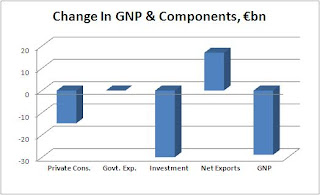
The first is that investment tends to fall much faster than consumption, for obvious reasons. Of a total decline in Ireland's GNP of €28.9bn, personal consumption has fallen by 15.1% (€14.7bn) and investment has fallen by 52.5% (€30bn). In fact, as the data shows, the fall in investment accounts for more than the entire decline in GNP, with the difference mainly accounted by foreign earnings. This pattern, where investment is the main driver of the recession, is replicated across the OECD although in some other countries it is net exports which have also plunged, not private consumption as in Ireland.
The second reason why this orthodox criticism is invalid is the level of debt. As prices fall, as they have in Ireland, the real level of the debt only increases. The many vociferous calls for 'competitive deflation' ignore this fundamental fact. Not only is (un)competitiveness a misdiagnosis of the current situation, but the 'cure', lower prices in Ireland than the rest of the EU would only increase the debt-servicing burden for all who earn their incomes in Ireland, individuals, companies and the government.
To return to the Martin Wolf article, he argues that, while extremely loose monetary policy has been necessary, by itself it stores up two alternative problems, both of which lead ultimately to disaster. One possibility is that cheap money reignites a boom in consumption, which itself just postpones an even bigger future financial crisis. The other possiility is that there is no recovery in consumption and the fiscal poston deteriorates further, to the point of widespread government defaults.
Happily, there is another option. Or actually two, according to Wolf, one of which is a surge in demand in 'emerging' economies. But for highly indebted countries like Ireland the policy option to avert disaster is clear: "a surge in private and public investment in the deficit countries ....[where] .....higher future income would make today’s borrowing sustainable."
He argues that the hope that the world will go back to as it was before the crisis is forlorn one. As we have already seen, it is the huge investment deficit which is driving the recesson, and only an enormous increase in invesment can restore both prior levels of activity and government finances.
"Let us not repeat past errors. Let us not hope that a credit-fuelled consumption binge will save us. Let us invest in the future, instead."
"The conventional wisdom is that it will also be possible to manage a smooth exit. Nothing seems less likely."
The reason for his more sober assessment is the trend in private sector financial balances; that is, the growing surpluses of private sector incomes over private sector expenditures. For the OECD as a whole this surplus is projected to reach 7.4% of GDP this year. Six countries, Ireland is one of them, will run surpluses of more than 10% of GDP. In Ireland's case it is projected that the private sector will earn more than it spends to the equivalent of over 15% of GDP, the third highest of OECD economies behind only Spain and Iceland.
This has been dubbed 'the paradox of debt' by Paul Krugman, following the Keynesian notion of the 'paradox of thrift'. The argument is that, while for each highly-indebted company or individual it makes sense to save, or, in the current climate pay down debt, for the economy as a whole it is disastrous. The aggregate saving reduces final demand, both household spending and business investment and thereby deepens the recession. Incomes for individual and companies fall further, so they repsond by cutting expenditures further, and so on.
There are many criticisms of this notion from what has become orthodoxy over the past several years. The only serious one is that, if the private sector saves in this way but continues to consume and invest in the same proportions all that will then happen is that prices will fall, and goods and services will be cheaper at the new, lower level of spending. However, this ignores two trends that occur in crises and are happening currently, most especially in Ireland.
The first is that investment tends to fall much faster than consumption, for obvious reasons. Of a total decline in Ireland's GNP of €28.9bn, personal consumption has fallen by 15.1% (€14.7bn) and investment has fallen by 52.5% (€30bn). In fact, as the data shows, the fall in investment accounts for more than the entire decline in GNP, with the difference mainly accounted by foreign earnings. This pattern, where investment is the main driver of the recession, is replicated across the OECD although in some other countries it is net exports which have also plunged, not private consumption as in Ireland.

The second reason why this orthodox criticism is invalid is the level of debt. As prices fall, as they have in Ireland, the real level of the debt only increases. The many vociferous calls for 'competitive deflation' ignore this fundamental fact. Not only is (un)competitiveness a misdiagnosis of the current situation, but the 'cure', lower prices in Ireland than the rest of the EU would only increase the debt-servicing burden for all who earn their incomes in Ireland, individuals, companies and the government.
To return to the Martin Wolf article, he argues that, while extremely loose monetary policy has been necessary, by itself it stores up two alternative problems, both of which lead ultimately to disaster. One possibility is that cheap money reignites a boom in consumption, which itself just postpones an even bigger future financial crisis. The other possiility is that there is no recovery in consumption and the fiscal poston deteriorates further, to the point of widespread government defaults.
Happily, there is another option. Or actually two, according to Wolf, one of which is a surge in demand in 'emerging' economies. But for highly indebted countries like Ireland the policy option to avert disaster is clear: "a surge in private and public investment in the deficit countries ....[where] .....higher future income would make today’s borrowing sustainable."
He argues that the hope that the world will go back to as it was before the crisis is forlorn one. As we have already seen, it is the huge investment deficit which is driving the recesson, and only an enormous increase in invesment can restore both prior levels of activity and government finances.
"Let us not repeat past errors. Let us not hope that a credit-fuelled consumption binge will save us. Let us invest in the future, instead."
Subscribe to:
Posts (Atom)