Michael Taft: Seamus Coffey has written a provocative post over at Irish Economy on the recent Exchequer statement, showing that Government borrowing is not falling even after the €20 billion fiscal contraction over the last few budgets. Some of the commentators on the post find this surprising but it shouldn’t be. The TASC open letter signed by a number economists and analysts predicted this would happen. Contributors on this blog have gone through the numbers to show why this would happen. Nonetheless, the failure to reduce Government borrowing will no doubt spark renewed demands for more contraction; this may explain the Finance Minister’s warning that cuts will be even deeper than anticipated in the Programme for Government.
The problem, however, goes much deeper than argument over numbers. It goes to the heart of how we debate the economy – a debate that currently inhibits a proper understanding of fiscal contraction, public finances and economic growth. In short, we are trapped in an analytical prison.
The current debate over fiscal policy is based on a fundamental confusion – that the finances of a government are analogous to household finances. When spending in the household, exceeds income, goes the argument, the household must reduce its expenditure. People go out less, buy less, take less holidays, postpone major purchases, etc. The key point here is that if I cut my spending, this doesn’t reduce my wage or income. My wage is unaffected by me buying less books. Therefore, spending reductions are a net gain. It is a rational act at household level.
However, governments are not households. When a government cuts its spending, it cuts its revenue as well – because it cuts the economy’s revenue. This is fairly straight-forward and the ESRI has published two studies on this subject. For example, it found that cutting public sector employment equivalent to reducing spending by 0.6 percent of GDP, actually drives down the domestic economy (GNP – where our tax base lies) by over twice that amount in the short-term: -1.1 percent. Therefore, after the fall in demand and business output, and the rise in unemployment (which they measure) the actual ‘savings’ to the Government in the form of deficit reduction is minimal: 0.2 percent. We get little bang for our contraction buck, but we have weakened the economy’s ability to generate revenue in the future by the resulting deflation.
That is why, when using the ESRI measurements, we find that the Government policy of cutting over 20,000 jobs from the public sector will make almost no contribution to fiscal reduction. But it will drive more businesses out of business and more people on to the dole queues or the emigration planes.
Again, this shouldn’t be surprising. If you cut social welfare, people will spend less thus cutting domestic demand which impacts negatively on businesses reliant on that demand. Tax revenue falls, unemployment costs rise; the ‘savings’ turns out to be no such thing.
If you cut contracts to the private sector (which account for one-third of spending on public services), domestic business activity contracts. So don’t be surprised when tax revenue falls and, again, unemployment costs increase.
This is what happens in normal times (and the ESRI simulations were based on a growth base-line). But to do this at the same time as private sector output is contracting is a recipe for accelerating the recession (which is what happened) and embed low-growth into the economy going forward (which is what is happening).
All this because the current debate is based on a false analogy.
A related problem is that the debate confuses means and ends. The goal is to reduce the deficit. However, the debate obsesses over spending cuts and tax increases and measures success in the amount of (downward) fiscal adjustments we can come up with. This is known at the ‘arithmetic’ approach and we see this popping up everywhere. If we cut x, then we save x – but as we know, cuts do not equal savings. We do not debate fiscal effectiveness; we debate different numbers on the revenue and spending balance sheet and delude ourselves that we are discussing fiscal stability. As Seamus has shown, however, this is not happening.
Most crucially, we don’t even acknowledge that the nation’s balance sheet is made up of three elements – revenue, spending and investment. The latter is rarely referred to even though it has been the driving force in the Irish recession. Investment is a tool of fiscal consolidation – a down-payment on future income; an activity that drives up demand in the short-term and continues to contribute to economic growth and revenue raising in the long-term through its supply input.
We are left with a wholly inadequate framework with which to understand, never mind debate, the continuing economic and fiscal crisis. All we get, with every fresh round of bad economic and fiscal news, is call to ‘tighten’ our belt even more, take ‘tough’ decisions, and make ‘sacrifices’. It is depressing that those calls are part of the problem, not part of the solution.
What we need is a new analytical framework – a new fiscal framework if you will. One that can explain why we are still mired in this mess. One that can help explain how an economy – households and businesses – interact with fiscal and investment measures. On that can provide a platform for sustainable pathways back to economic recovery and fiscal stability.
Otherwise, we will continue to sink. And all we will get is ‘solutions’ that will sink us even further.

Showing posts with label borrowing. Show all posts
Showing posts with label borrowing. Show all posts
Thursday, 7 July 2011


Friday, 27 August 2010
The excuse factory
Michael Taft: During the Greek debt crisis, we were constantly told that we weren’t Spain or Portugal or Italy, that the international markets were treating us differently, better, because we had taken the difficult fiscal decisions (i.e. spending cuts). This was despite the fact that the main indices showed otherwise, that we were competing with Portugal for the worst bond performance once Greece exited the market. It was just one more case of commentators making excuses, after they had spent all last year assuring us that if we took harsh economic medicine, our borrowing costs would fall.
The excuses keep coming. Our deteriorating bond performance is due to S&P’s ill-informed ratings downgrade. Another excuse: it’s not so much that Irish bonds are weakening; the gap between the German 10-year bonds has more to do with the fall in German yields.
First, our bond performance was in pretty poor shape even before the downgrade. It was already 323 basis points above German bonds prior to S&P’s announcement – well above the level at which some commentators suggest we should all start drinking ouzo.
Second, the growing spread between Irish and German bonds is a combination of falling German yields and rising Irish yields. But 60 percent of the gap that has grown since August 16th has been deteriorating Irish bonds – not the fall in German yields.
I’m sure when the whole thing goes over the edge many of our commentators will find more scapegoats (I suggest here that it could be culinary).
One could despair of even getting a factual description of the problem, never mind an analysis that bears some relationship with reality. All we will get is ever more excuses from people who claimed that the bank guarantee was ‘bold and visionary’, that deflationary policies would please the international markets, that our bank bail-out policy is ‘affordable and manageable’ and that we are, finally, back in recovery mode.
Thank god it’s Friday.
The excuses keep coming. Our deteriorating bond performance is due to S&P’s ill-informed ratings downgrade. Another excuse: it’s not so much that Irish bonds are weakening; the gap between the German 10-year bonds has more to do with the fall in German yields.
First, our bond performance was in pretty poor shape even before the downgrade. It was already 323 basis points above German bonds prior to S&P’s announcement – well above the level at which some commentators suggest we should all start drinking ouzo.
Second, the growing spread between Irish and German bonds is a combination of falling German yields and rising Irish yields. But 60 percent of the gap that has grown since August 16th has been deteriorating Irish bonds – not the fall in German yields.
I’m sure when the whole thing goes over the edge many of our commentators will find more scapegoats (I suggest here that it could be culinary).
One could despair of even getting a factual description of the problem, never mind an analysis that bears some relationship with reality. All we will get is ever more excuses from people who claimed that the bank guarantee was ‘bold and visionary’, that deflationary policies would please the international markets, that our bank bail-out policy is ‘affordable and manageable’ and that we are, finally, back in recovery mode.
Thank god it’s Friday.
Wednesday, 28 April 2010
Lessons from Greece
Michael Burke: Irish Economy has a thread on the impact on Ireland on the decision to downgrade Greece and Portugal.
The credibility of the ratings' agencies ought to have been dealt a fatal blow by the sub-prime debacle. But, as far as sovereign debt is concerned, it seems financial market participants like to have an additional, outsourced voice of neo-liberal orthodoxy as well as their own. The FF-led government has done everythng demanded of them by the ratings' agencies, and more, so it might be impolitic to downgrade Irish government debt too.
However, the bond markets reflect the nature of the crisis. The yield levels at 10yr maturities for govt. debt were as follows as of close of business Tuesday (%, FT bond table);
Austria 3.38
Belgium 3.52
Finland 3.21
France 3.26
Germany 2.93
Greece 9.54
Ireland 5.25
Italy 3.95
Netherlands 3.20
Portugal 5.61
Spain 4.03
Greek yields rose 81bps yesterday, Portugal up 59bps and Ireland up 46bps. Portugal is widely thought to be next in line from the ‘contagion’ effects of the Greek crisis. If so, in terms of both level and change in yields, Ireland cannot be far behind.
Of course, Ireland’s unique experiment in fiscal contraction was designed to “reassure the financial markets”. It has clearly done nothing of the kind. No-one, not even Greece, has a higher projected general government budget deficit this year. And many countries with higher levels of debt now have considerably lower yields, including Belgium, Italy and France.
Yield levels which exceed nominal growth rates, or more accurately the growth rate in taxation revenues which derive from them, cannot be sustained indefinitely. Perhaps, post the German elecions all will return to normaility and yields subside. Perhaps not.
But even in the optimistic scenario, it is clear that Irish government policy has failed in its own terms. Growth has not resumed, taxes continue to decline and the deficit continus to widen. Unsurprisingly, none of this has reasured financial markets and relative borrowing costs have continued to climb.
Perhaps it is worth trying to learn something from the Greek experience, as well as from others. The Greek recesion had been milder than the EU average, and recovering, before austerity measures were adopted, as both the PMI and GDP charts here show.
Now the Bank of Greece warns that the austerity measures themselves have lowered taxation revenues and argues therefore (!) for greater austerity measures. This sounds depressingly familiar.
By contrast, other EU countries adopted fiscal stimulus measures. Their debt has stabilised along with economic activity and they have been rewarded with much lower bond yields than Ireland.
The credibility of the ratings' agencies ought to have been dealt a fatal blow by the sub-prime debacle. But, as far as sovereign debt is concerned, it seems financial market participants like to have an additional, outsourced voice of neo-liberal orthodoxy as well as their own. The FF-led government has done everythng demanded of them by the ratings' agencies, and more, so it might be impolitic to downgrade Irish government debt too.
However, the bond markets reflect the nature of the crisis. The yield levels at 10yr maturities for govt. debt were as follows as of close of business Tuesday (%, FT bond table);
Austria 3.38
Belgium 3.52
Finland 3.21
France 3.26
Germany 2.93
Greece 9.54
Ireland 5.25
Italy 3.95
Netherlands 3.20
Portugal 5.61
Spain 4.03
Greek yields rose 81bps yesterday, Portugal up 59bps and Ireland up 46bps. Portugal is widely thought to be next in line from the ‘contagion’ effects of the Greek crisis. If so, in terms of both level and change in yields, Ireland cannot be far behind.
Of course, Ireland’s unique experiment in fiscal contraction was designed to “reassure the financial markets”. It has clearly done nothing of the kind. No-one, not even Greece, has a higher projected general government budget deficit this year. And many countries with higher levels of debt now have considerably lower yields, including Belgium, Italy and France.
Yield levels which exceed nominal growth rates, or more accurately the growth rate in taxation revenues which derive from them, cannot be sustained indefinitely. Perhaps, post the German elecions all will return to normaility and yields subside. Perhaps not.
But even in the optimistic scenario, it is clear that Irish government policy has failed in its own terms. Growth has not resumed, taxes continue to decline and the deficit continus to widen. Unsurprisingly, none of this has reasured financial markets and relative borrowing costs have continued to climb.
Perhaps it is worth trying to learn something from the Greek experience, as well as from others. The Greek recesion had been milder than the EU average, and recovering, before austerity measures were adopted, as both the PMI and GDP charts here show.

Now the Bank of Greece warns that the austerity measures themselves have lowered taxation revenues and argues therefore (!) for greater austerity measures. This sounds depressingly familiar.
By contrast, other EU countries adopted fiscal stimulus measures. Their debt has stabilised along with economic activity and they have been rewarded with much lower bond yields than Ireland.
Thursday, 22 April 2010
The great fiscal shell game
Michael Taft: The only enjoyable aspect of Eurostat’s decision today to reclassify the Anglo-Irish Bank subsidy as a liability on the General Government Balance/Debt is to watch the Government’s hands move even faster in an increasingly vain attempt to prevent us from seeing under which shell the real deficit is hidden. But they must be getting tired; and eventually we’ll glimpse it
In short, the Government keeps two sets of books: one for the EU which determines our General Government Balance (GGB or annual deficit) and our General Government Debt (GGD or overall debt) for the purposes of the Maastricht guidelines; GGB must be kept below -3 percent and our GGD must be kept below 60 percent of GDP). That’s one set of books – the other is for us. There’s nothing shady about this – there are a number of expenditure items that don’t appear on the EU books (e.g. payments into the Pension Fund), while there is revenue that appears on the EU books but not on our own (e.g. Social Insurance Fund surplus).
As a rule, expenditures in the form of bank recapitalisations don’t count in the EU books as they are considered equity investments. For instance, recapping Bank of Ireland through equity purchases should, in theory, be recouped. The Government had hoped that recapping Anglo-Irish would also be considered as an equity purchase and, therefore, not appear on the books they keep for the EU. Eurostat put paid to that. The money flowing into Anglo-Irish, according to Eurostat, could not realistically be considered an equity investment. Instead, it is now considered a straight-forward capital transfer. This transfer now appears on both sets of books.
Does this make any difference to the bottom-line? In one sense it is merely re-aligning statistical methodology with economic reality. At the end of the day, regardless of whether the capital transfer to Anglo-Irish appears on the EU books or not, it certainly will weigh down the economy’s books. This is money that has to be borrowed on the bond market. These borrowings will have to be serviced. For every €1 billion we borrow, we increase our debt servicing costs by €45 million at current rates. If the Government transfers the maximum amount - €22 billion – this debt servicing cost will rise to nearly €1 billion a year. It doesn’t matter whether the debt appears on this book or that; it will be a very real item on the current budget.
How will Eurostat’s reclassification impact on the Maastricht guidelines and the Government’s target of reducing the annual deficit to below -3 percent by 2014? Be prepared to receive two new words into the popular economic debate: the ‘headline’ deficit and the ‘underlying’ deficit. The Government will make this distinction to downplay the official (for EU purposes) GGB, or annual deficit, level.
For instance, prior to the reclassification, the Government estimated the GGB to be -11.7 percent. After today, it is 14.3 percent. The Government will claim that the former is the true, or ‘underlying’ figure; while the latter, the ‘headline’ figure, is merely the product of a one-off – in this case, the one-off capital transfer to Anglo-Irish.
The problem with this is that there may be considerably more one-offs in regards to Anglo-Irish. Philip Lane points out that such transfers will count on the EU books at the time of the commitment. While the Government may drip-feed the capital transfers into Anglo-Irish over a number of years through promissory notes, it will nonetheless be recorded in the year the decision is made. So if the Government commits €8 billion, it will be recorded immediately.
Still, the Government will hope to have done with these commitments so that by 2014, no such liability for the purpose of determining that year’s GGB, or annual deficit will arise. In that sense, they hope the ‘underlying’ reading will prevail.
But there is no such distinction when it comes to calculating our GGD, or overall debt. This will be a permanent feature. The Government had hoped to keep the GGD below 80 percent of GDP. If they have to hand over the full €22 billion to Anglo-Irish, the GGD will balloon to over 91 percent. Both the optics and the reality of that ballooning debt will not be good.
And here is where the Government is on a slippery slope. This reclassification will invite further scrutiny and this kind of scrutiny rarely has a favourable conclusion. Regardless of Eurostat rules, investors into our debt will start examining NAMA’s impact and may start their own mental reclassifications.
Further scrutiny may be made of the Government’s credibility in regard to their strategy. Already, the EU Commission has recently given a thumbs-down in its update on their excessive deficit procedure against Ireland. They have concluded that (a) the Government’s growth projections are too optimistic (and if this is the case, unemployment, tax revenue and the deficit will all go south); (b) the Government’s future fiscal consolidation plans are too vague; and (c) even if the Government somehow manages to hit their targets, they will still have to make more fiscal adjustments than planned for.
In short, this reclassification by Eurostat could prompt an opening up of Pandora’s deflationary box. Independent forecasters are already predicting lower growth and higher debt than the Government is doing – and that’s without today’s decision.
So the Government has no choice but to keep up this glorified shell game – continually reassuring all of us that nothing has changed. But it has. It is. It will.
And don’t forget – shell games are just a confidence trick. If you buy into it, you will lose.
In short, the Government keeps two sets of books: one for the EU which determines our General Government Balance (GGB or annual deficit) and our General Government Debt (GGD or overall debt) for the purposes of the Maastricht guidelines; GGB must be kept below -3 percent and our GGD must be kept below 60 percent of GDP). That’s one set of books – the other is for us. There’s nothing shady about this – there are a number of expenditure items that don’t appear on the EU books (e.g. payments into the Pension Fund), while there is revenue that appears on the EU books but not on our own (e.g. Social Insurance Fund surplus).
As a rule, expenditures in the form of bank recapitalisations don’t count in the EU books as they are considered equity investments. For instance, recapping Bank of Ireland through equity purchases should, in theory, be recouped. The Government had hoped that recapping Anglo-Irish would also be considered as an equity purchase and, therefore, not appear on the books they keep for the EU. Eurostat put paid to that. The money flowing into Anglo-Irish, according to Eurostat, could not realistically be considered an equity investment. Instead, it is now considered a straight-forward capital transfer. This transfer now appears on both sets of books.
Does this make any difference to the bottom-line? In one sense it is merely re-aligning statistical methodology with economic reality. At the end of the day, regardless of whether the capital transfer to Anglo-Irish appears on the EU books or not, it certainly will weigh down the economy’s books. This is money that has to be borrowed on the bond market. These borrowings will have to be serviced. For every €1 billion we borrow, we increase our debt servicing costs by €45 million at current rates. If the Government transfers the maximum amount - €22 billion – this debt servicing cost will rise to nearly €1 billion a year. It doesn’t matter whether the debt appears on this book or that; it will be a very real item on the current budget.
How will Eurostat’s reclassification impact on the Maastricht guidelines and the Government’s target of reducing the annual deficit to below -3 percent by 2014? Be prepared to receive two new words into the popular economic debate: the ‘headline’ deficit and the ‘underlying’ deficit. The Government will make this distinction to downplay the official (for EU purposes) GGB, or annual deficit, level.
For instance, prior to the reclassification, the Government estimated the GGB to be -11.7 percent. After today, it is 14.3 percent. The Government will claim that the former is the true, or ‘underlying’ figure; while the latter, the ‘headline’ figure, is merely the product of a one-off – in this case, the one-off capital transfer to Anglo-Irish.
The problem with this is that there may be considerably more one-offs in regards to Anglo-Irish. Philip Lane points out that such transfers will count on the EU books at the time of the commitment. While the Government may drip-feed the capital transfers into Anglo-Irish over a number of years through promissory notes, it will nonetheless be recorded in the year the decision is made. So if the Government commits €8 billion, it will be recorded immediately.
Still, the Government will hope to have done with these commitments so that by 2014, no such liability for the purpose of determining that year’s GGB, or annual deficit will arise. In that sense, they hope the ‘underlying’ reading will prevail.
But there is no such distinction when it comes to calculating our GGD, or overall debt. This will be a permanent feature. The Government had hoped to keep the GGD below 80 percent of GDP. If they have to hand over the full €22 billion to Anglo-Irish, the GGD will balloon to over 91 percent. Both the optics and the reality of that ballooning debt will not be good.
And here is where the Government is on a slippery slope. This reclassification will invite further scrutiny and this kind of scrutiny rarely has a favourable conclusion. Regardless of Eurostat rules, investors into our debt will start examining NAMA’s impact and may start their own mental reclassifications.
Further scrutiny may be made of the Government’s credibility in regard to their strategy. Already, the EU Commission has recently given a thumbs-down in its update on their excessive deficit procedure against Ireland. They have concluded that (a) the Government’s growth projections are too optimistic (and if this is the case, unemployment, tax revenue and the deficit will all go south); (b) the Government’s future fiscal consolidation plans are too vague; and (c) even if the Government somehow manages to hit their targets, they will still have to make more fiscal adjustments than planned for.
In short, this reclassification by Eurostat could prompt an opening up of Pandora’s deflationary box. Independent forecasters are already predicting lower growth and higher debt than the Government is doing – and that’s without today’s decision.
So the Government has no choice but to keep up this glorified shell game – continually reassuring all of us that nothing has changed. But it has. It is. It will.
And don’t forget – shell games are just a confidence trick. If you buy into it, you will lose.
Monday, 22 March 2010
Economically damaging and fiscally irrelevant
Michael Burke & Michael Taft: It is often stated that to reduce the fiscal deficit we must cut public spending. There is an assumption, never substantiated, that cuts equal savings. However, the evidence shows otherwise: public spending cuts will not significantly reduce the fiscal deficit and, in some scenarios, may actually increase it.
In April 2009 the ESRI assessed the economic impact of various fiscal measures (tax increases, spending cuts) on a number of variables over a six year period: GDP/GNP growth, consumption, employment, output, wages, borrowing, etc. On the basis of their estimates we will assess the impact of the Government’s current spending cuts on growth and the deficit up to 2014.
Impact on GDP
Since the 2009 budget the Government has announced slightly more than €6 billion in current spending cuts. These include wage cuts, employment reductions, cuts in purchases of goods and services, and social transfer cuts.
Public sector wage cuts: the ESRI estimates that the first year impact of public sector wage cuts on GDP was – 0.335, or -0.2 percent That is, for every €1 billion reduction in public sector wages, the GDP falls by €335 million. This is primarily due to reduced consumer spending (falling by 0.8 percent or approximately €700 million) with a knock-on effect on employment (a loss of 0.1 percent, or approximately 2,000 jobs).
The ESRI also projected that the deflationary effect accelerates – so that by the fifth year the impact on GDP is approximately -0.774, or -0.4 percent of GDP causing further loss in consumer spending and employment.
Other current spending cuts: The ESRI only provides a simulation for employment cuts. Here, they estimate a first year impact of -1.179, or -0.7 percent: for every €1 billion reduction through job losses, the GDP declines by €1,179 million. The driving force behind this impact is the loss of employment – 1 percent, or approximately 19,000 jobs in the first year. There is only a slight easing of the deflationary effect through the years. In the fifth year, the impact is estimated to be approximately -1.165 or -0.6 percent of GDP.
The ESRI does not provide simulations for reduction in government consumption or social transfers. Therefore, we will use the employment reduction multiplier as a proxy. This can be justified on the following grounds:
The fiscal shock from increasing government non-wage consumption was projected by Lane and Benetrix to have a first-year multiplier of in excess of 2.0. While it cannot be assumed the opposite will hold (an equivalent negative multiplier from a cut in consumption), it does show the Irish economy is very sensitive to this type of shock (given that Lane-Benetrix was measuring over a period of 20 years, this impact is likely to be higher during a recession).
While there are no Irish measurements for social transfers, in the US extension of unemployment benefits and transfers to food stamp recipients had higher multipliers (1.64 and 1.73 respectively) than other forms of spending increases or tax reductions. This should not be surprising. The size of the multipliers is directly related to the ‘propensity to consume’; i.e. what proportion of each additional € in income is consumed and what is saved. Transfers to the poor or low-paid are likely to have a stimulative effect since they are obliged to consume a greater proportion of their incomes. Again, while not assuming the opposite is true here, it is expected that such cuts will provoke a significant negative shock among groups with a high propensity to consumer.
Therefore, we find the following (assuming, for the purposes of this exercise, that the cuts of €6 billion took place in 2009 and taking the Government’s growth projection as the base-line):

The first year impact will result in a GDP decline of €4.9 billion, or -3 percent of GDP. In the long-term, the decline accelerates to a decline of €6.4 billion or -3.1 of GDP. These are significantly deflationary.
Impact on Borrowing Requirement
Turning to the impact on the borrowing requirement (EBR), the ESRI simulations estimate that:
(a) A reduction of €1 billion through public sector wage cuts, results in a reduction of 0.3 percent in the EBR in the first year. Because of the acceleration of the deflationary impact, this falls to 0.2 percent in the fifth year.
(b) A reduction of €1 billion through public sector employment losses results in a reduction in the EBR of 0.2 percent in the first year. By the second year, this is reduced to a mere 0.1 percent and continues at this level through to the fifth year.
Therefore, we find the impact on the EBR to be:

The Government’s current spending cuts reduce the EBR by 1.4 percent in the first year; declining to a mere 0.8 percent by the fifth year.

It is important to put this in perspective. The Government intends to reduce the General Government Balance by 8.7 percent of GDP between 2009 and 2014 (a reduction of 7.3 percent in the Exchequer balance).
Yet, the ESRI estimates that current spending cuts will, after factoring in the deflationary impact on the economy, make only the smallest of contributions to that reduction.
However, the ESRI simulations themselves may seriously under-estimate the debilitating impact on the economy and, therefore, over-estimate the reduction in borrowing.
• First, the ESRI simulations are based on long-run average behaviour, which includes both booms and busts. Fiscal tightening in a recession, when there is already spare capacity, will have a greater depressing effect than the same during a boom.
• Second, the ESRI model may assume certain behaviour – ‘crowding in’ of private investment, lower bond yields, increased economic activity, emigration levels – which may not occur. Factors such as the continuing credit crunch, household deleveraging, structural deficits in our infrastructure and indigenous enterprise base may overwhelm such theoretical assumptions.
• Third, the ESRI measures impact in tranches of €1 billion. However, when these tranches are multiplied (e.g. the impact of the April Budget tax/levy increases was €2.8 billion) the cumulative impact may be higher.
• Fourth, the ESRI simulations analyse fiscal measures in isolation. When combinations of these measures are introduced the cumulative impact may be higher.
• Fifth, when access to credit is constrained, the depressing impact on activity arising from fiscal contraction is also likely to be amplified.
In other words, such are the downside risks to the ESRI estimates, that we may experience perverse results: that the fiscal deficit burden may actually rise as a result of public spending cuts.
Conclusion
The Department of Finance is correct: quantifying impacts ‘requires a combination of econometric model simulations and judgement’. Judgement and experience tells us that cutting spending during a recession (a) reduces economic activity and (b) reduces tax revenue and increases unemployment costs. That this occurs is beyond doubt; what we need to do is find the extent.
We have shown that ‘savings’ are minimal and the impact on GDP severe. And such is the fractional impact on borrowing there is a distinct downside possibility that such cuts will increase the deficit burden. This is reinforced when we note the deflationary impact on the domestic economy is even more severe. Whereas GDP will decline by -3.1 percent by 2014 as a result of the current spending cuts, GNP will decline by -3.8 percent. This is what the TASC letter referred to as ‘a low-growth, high debt future’.
Cuts do not equal savings. Cuts degrade economic activity with only a marginal impact on borrowing. The next time a commentator says ‘we’re borrowing €400 million a week’ as a justification for more spending cuts, they can easily be answered: cutting spending won’t affect that ‘€400 million a week’ and it may only make things worse.
To bring the deficit under control we need another alternative – one based on growth and not deflation.
In April 2009 the ESRI assessed the economic impact of various fiscal measures (tax increases, spending cuts) on a number of variables over a six year period: GDP/GNP growth, consumption, employment, output, wages, borrowing, etc. On the basis of their estimates we will assess the impact of the Government’s current spending cuts on growth and the deficit up to 2014.
Impact on GDP
Since the 2009 budget the Government has announced slightly more than €6 billion in current spending cuts. These include wage cuts, employment reductions, cuts in purchases of goods and services, and social transfer cuts.
Public sector wage cuts: the ESRI estimates that the first year impact of public sector wage cuts on GDP was – 0.335, or -0.2 percent That is, for every €1 billion reduction in public sector wages, the GDP falls by €335 million. This is primarily due to reduced consumer spending (falling by 0.8 percent or approximately €700 million) with a knock-on effect on employment (a loss of 0.1 percent, or approximately 2,000 jobs).
The ESRI also projected that the deflationary effect accelerates – so that by the fifth year the impact on GDP is approximately -0.774, or -0.4 percent of GDP causing further loss in consumer spending and employment.
Other current spending cuts: The ESRI only provides a simulation for employment cuts. Here, they estimate a first year impact of -1.179, or -0.7 percent: for every €1 billion reduction through job losses, the GDP declines by €1,179 million. The driving force behind this impact is the loss of employment – 1 percent, or approximately 19,000 jobs in the first year. There is only a slight easing of the deflationary effect through the years. In the fifth year, the impact is estimated to be approximately -1.165 or -0.6 percent of GDP.
The ESRI does not provide simulations for reduction in government consumption or social transfers. Therefore, we will use the employment reduction multiplier as a proxy. This can be justified on the following grounds:
The fiscal shock from increasing government non-wage consumption was projected by Lane and Benetrix to have a first-year multiplier of in excess of 2.0. While it cannot be assumed the opposite will hold (an equivalent negative multiplier from a cut in consumption), it does show the Irish economy is very sensitive to this type of shock (given that Lane-Benetrix was measuring over a period of 20 years, this impact is likely to be higher during a recession).
While there are no Irish measurements for social transfers, in the US extension of unemployment benefits and transfers to food stamp recipients had higher multipliers (1.64 and 1.73 respectively) than other forms of spending increases or tax reductions. This should not be surprising. The size of the multipliers is directly related to the ‘propensity to consume’; i.e. what proportion of each additional € in income is consumed and what is saved. Transfers to the poor or low-paid are likely to have a stimulative effect since they are obliged to consume a greater proportion of their incomes. Again, while not assuming the opposite is true here, it is expected that such cuts will provoke a significant negative shock among groups with a high propensity to consumer.
Therefore, we find the following (assuming, for the purposes of this exercise, that the cuts of €6 billion took place in 2009 and taking the Government’s growth projection as the base-line):

The first year impact will result in a GDP decline of €4.9 billion, or -3 percent of GDP. In the long-term, the decline accelerates to a decline of €6.4 billion or -3.1 of GDP. These are significantly deflationary.
Impact on Borrowing Requirement
Turning to the impact on the borrowing requirement (EBR), the ESRI simulations estimate that:
(a) A reduction of €1 billion through public sector wage cuts, results in a reduction of 0.3 percent in the EBR in the first year. Because of the acceleration of the deflationary impact, this falls to 0.2 percent in the fifth year.
(b) A reduction of €1 billion through public sector employment losses results in a reduction in the EBR of 0.2 percent in the first year. By the second year, this is reduced to a mere 0.1 percent and continues at this level through to the fifth year.
Therefore, we find the impact on the EBR to be:

The Government’s current spending cuts reduce the EBR by 1.4 percent in the first year; declining to a mere 0.8 percent by the fifth year.

It is important to put this in perspective. The Government intends to reduce the General Government Balance by 8.7 percent of GDP between 2009 and 2014 (a reduction of 7.3 percent in the Exchequer balance).
Yet, the ESRI estimates that current spending cuts will, after factoring in the deflationary impact on the economy, make only the smallest of contributions to that reduction.
However, the ESRI simulations themselves may seriously under-estimate the debilitating impact on the economy and, therefore, over-estimate the reduction in borrowing.
• First, the ESRI simulations are based on long-run average behaviour, which includes both booms and busts. Fiscal tightening in a recession, when there is already spare capacity, will have a greater depressing effect than the same during a boom.
• Second, the ESRI model may assume certain behaviour – ‘crowding in’ of private investment, lower bond yields, increased economic activity, emigration levels – which may not occur. Factors such as the continuing credit crunch, household deleveraging, structural deficits in our infrastructure and indigenous enterprise base may overwhelm such theoretical assumptions.
• Third, the ESRI measures impact in tranches of €1 billion. However, when these tranches are multiplied (e.g. the impact of the April Budget tax/levy increases was €2.8 billion) the cumulative impact may be higher.
• Fourth, the ESRI simulations analyse fiscal measures in isolation. When combinations of these measures are introduced the cumulative impact may be higher.
• Fifth, when access to credit is constrained, the depressing impact on activity arising from fiscal contraction is also likely to be amplified.
In other words, such are the downside risks to the ESRI estimates, that we may experience perverse results: that the fiscal deficit burden may actually rise as a result of public spending cuts.
Conclusion
The Department of Finance is correct: quantifying impacts ‘requires a combination of econometric model simulations and judgement’. Judgement and experience tells us that cutting spending during a recession (a) reduces economic activity and (b) reduces tax revenue and increases unemployment costs. That this occurs is beyond doubt; what we need to do is find the extent.
We have shown that ‘savings’ are minimal and the impact on GDP severe. And such is the fractional impact on borrowing there is a distinct downside possibility that such cuts will increase the deficit burden. This is reinforced when we note the deflationary impact on the domestic economy is even more severe. Whereas GDP will decline by -3.1 percent by 2014 as a result of the current spending cuts, GNP will decline by -3.8 percent. This is what the TASC letter referred to as ‘a low-growth, high debt future’.
Cuts do not equal savings. Cuts degrade economic activity with only a marginal impact on borrowing. The next time a commentator says ‘we’re borrowing €400 million a week’ as a justification for more spending cuts, they can easily be answered: cutting spending won’t affect that ‘€400 million a week’ and it may only make things worse.
To bring the deficit under control we need another alternative – one based on growth and not deflation.
Wednesday, 24 February 2010
Let us invest in the future
Michael Burke: In today's Financial Times, chief economics commentator Martin Wolf has an interesting piece on how we can get out of the crisis. He argues that conventional wisdom about the prospects for economic recovery, and the policy adjustents that will be necessary, is completely wrong.
"The conventional wisdom is that it will also be possible to manage a smooth exit. Nothing seems less likely."
The reason for his more sober assessment is the trend in private sector financial balances; that is, the growing surpluses of private sector incomes over private sector expenditures. For the OECD as a whole this surplus is projected to reach 7.4% of GDP this year. Six countries, Ireland is one of them, will run surpluses of more than 10% of GDP. In Ireland's case it is projected that the private sector will earn more than it spends to the equivalent of over 15% of GDP, the third highest of OECD economies behind only Spain and Iceland.
This has been dubbed 'the paradox of debt' by Paul Krugman, following the Keynesian notion of the 'paradox of thrift'. The argument is that, while for each highly-indebted company or individual it makes sense to save, or, in the current climate pay down debt, for the economy as a whole it is disastrous. The aggregate saving reduces final demand, both household spending and business investment and thereby deepens the recession. Incomes for individual and companies fall further, so they repsond by cutting expenditures further, and so on.
There are many criticisms of this notion from what has become orthodoxy over the past several years. The only serious one is that, if the private sector saves in this way but continues to consume and invest in the same proportions all that will then happen is that prices will fall, and goods and services will be cheaper at the new, lower level of spending. However, this ignores two trends that occur in crises and are happening currently, most especially in Ireland.
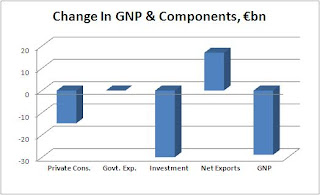
The first is that investment tends to fall much faster than consumption, for obvious reasons. Of a total decline in Ireland's GNP of €28.9bn, personal consumption has fallen by 15.1% (€14.7bn) and investment has fallen by 52.5% (€30bn). In fact, as the data shows, the fall in investment accounts for more than the entire decline in GNP, with the difference mainly accounted by foreign earnings. This pattern, where investment is the main driver of the recession, is replicated across the OECD although in some other countries it is net exports which have also plunged, not private consumption as in Ireland.
The second reason why this orthodox criticism is invalid is the level of debt. As prices fall, as they have in Ireland, the real level of the debt only increases. The many vociferous calls for 'competitive deflation' ignore this fundamental fact. Not only is (un)competitiveness a misdiagnosis of the current situation, but the 'cure', lower prices in Ireland than the rest of the EU would only increase the debt-servicing burden for all who earn their incomes in Ireland, individuals, companies and the government.
To return to the Martin Wolf article, he argues that, while extremely loose monetary policy has been necessary, by itself it stores up two alternative problems, both of which lead ultimately to disaster. One possibility is that cheap money reignites a boom in consumption, which itself just postpones an even bigger future financial crisis. The other possiility is that there is no recovery in consumption and the fiscal poston deteriorates further, to the point of widespread government defaults.
Happily, there is another option. Or actually two, according to Wolf, one of which is a surge in demand in 'emerging' economies. But for highly indebted countries like Ireland the policy option to avert disaster is clear: "a surge in private and public investment in the deficit countries ....[where] .....higher future income would make today’s borrowing sustainable."
He argues that the hope that the world will go back to as it was before the crisis is forlorn one. As we have already seen, it is the huge investment deficit which is driving the recesson, and only an enormous increase in invesment can restore both prior levels of activity and government finances.
"Let us not repeat past errors. Let us not hope that a credit-fuelled consumption binge will save us. Let us invest in the future, instead."
"The conventional wisdom is that it will also be possible to manage a smooth exit. Nothing seems less likely."
The reason for his more sober assessment is the trend in private sector financial balances; that is, the growing surpluses of private sector incomes over private sector expenditures. For the OECD as a whole this surplus is projected to reach 7.4% of GDP this year. Six countries, Ireland is one of them, will run surpluses of more than 10% of GDP. In Ireland's case it is projected that the private sector will earn more than it spends to the equivalent of over 15% of GDP, the third highest of OECD economies behind only Spain and Iceland.
This has been dubbed 'the paradox of debt' by Paul Krugman, following the Keynesian notion of the 'paradox of thrift'. The argument is that, while for each highly-indebted company or individual it makes sense to save, or, in the current climate pay down debt, for the economy as a whole it is disastrous. The aggregate saving reduces final demand, both household spending and business investment and thereby deepens the recession. Incomes for individual and companies fall further, so they repsond by cutting expenditures further, and so on.
There are many criticisms of this notion from what has become orthodoxy over the past several years. The only serious one is that, if the private sector saves in this way but continues to consume and invest in the same proportions all that will then happen is that prices will fall, and goods and services will be cheaper at the new, lower level of spending. However, this ignores two trends that occur in crises and are happening currently, most especially in Ireland.
The first is that investment tends to fall much faster than consumption, for obvious reasons. Of a total decline in Ireland's GNP of €28.9bn, personal consumption has fallen by 15.1% (€14.7bn) and investment has fallen by 52.5% (€30bn). In fact, as the data shows, the fall in investment accounts for more than the entire decline in GNP, with the difference mainly accounted by foreign earnings. This pattern, where investment is the main driver of the recession, is replicated across the OECD although in some other countries it is net exports which have also plunged, not private consumption as in Ireland.

The second reason why this orthodox criticism is invalid is the level of debt. As prices fall, as they have in Ireland, the real level of the debt only increases. The many vociferous calls for 'competitive deflation' ignore this fundamental fact. Not only is (un)competitiveness a misdiagnosis of the current situation, but the 'cure', lower prices in Ireland than the rest of the EU would only increase the debt-servicing burden for all who earn their incomes in Ireland, individuals, companies and the government.
To return to the Martin Wolf article, he argues that, while extremely loose monetary policy has been necessary, by itself it stores up two alternative problems, both of which lead ultimately to disaster. One possibility is that cheap money reignites a boom in consumption, which itself just postpones an even bigger future financial crisis. The other possiility is that there is no recovery in consumption and the fiscal poston deteriorates further, to the point of widespread government defaults.
Happily, there is another option. Or actually two, according to Wolf, one of which is a surge in demand in 'emerging' economies. But for highly indebted countries like Ireland the policy option to avert disaster is clear: "a surge in private and public investment in the deficit countries ....[where] .....higher future income would make today’s borrowing sustainable."
He argues that the hope that the world will go back to as it was before the crisis is forlorn one. As we have already seen, it is the huge investment deficit which is driving the recesson, and only an enormous increase in invesment can restore both prior levels of activity and government finances.
"Let us not repeat past errors. Let us not hope that a credit-fuelled consumption binge will save us. Let us invest in the future, instead."
Wednesday, 20 January 2010
Greek Tragedy
Michael Burke: Today's Financial Times carries an interesting piece from Martin Wolf on the severe difficulties being faced by Greece as it attempts to come to terms with its current econmic crisis.
The FT's veteran commentator places Greece's plight in the overall context of developments within the EU, and so has something to say about Ireland. Without minimising the problems of any country, he clearly shows that it is Greece which is an extreme case, not - as is often claimed here - Ireland.
"The problems of Greece are extreme, because it alone of the vulnerable eurozone member countries has both high fiscal deficits and high debt. Other countries with large fiscal deficits are Ireland (12.2 per cent of GDP in 2009) and Spain (9.6 per cent). But, while net public borrowing was 86 per cent of GDP at the end of 2009 in Greece, according to the OECD, in Ireland and Spain it was only 25 and 33 per cent, respectively. Meanwhile, Italy, with a net debt ratio of 97 per cent, had a deficit of “only” 5.5 per cent. Portugal is in the middle, with net debt of 56 per cent of GDP and a deficit of 6.7 per cent of GDP. Thus, the challenge for Greece is larger and more urgent than for the others."
He also warns that those pinning their hopes on export-led growth are in perliously crowded boat in choppy waters, as they now comprise (at least) 70% of the world's economy.
Finally, he has a very illuminating chart of unitl labour costs based on OECD data. Although the chart is small, the trend for Ireland is clear and unmistakeable. Ireland has already experienced a sharp reduction in unit labour costs relative to Greece, Italy and Spain. Of course, Germany is an outlier, with unit labour costs way below that group. But, although it isn't stated by Martin Wolf, that's based on the much stronger growth of German investment.
The FT's veteran commentator places Greece's plight in the overall context of developments within the EU, and so has something to say about Ireland. Without minimising the problems of any country, he clearly shows that it is Greece which is an extreme case, not - as is often claimed here - Ireland.
"The problems of Greece are extreme, because it alone of the vulnerable eurozone member countries has both high fiscal deficits and high debt. Other countries with large fiscal deficits are Ireland (12.2 per cent of GDP in 2009) and Spain (9.6 per cent). But, while net public borrowing was 86 per cent of GDP at the end of 2009 in Greece, according to the OECD, in Ireland and Spain it was only 25 and 33 per cent, respectively. Meanwhile, Italy, with a net debt ratio of 97 per cent, had a deficit of “only” 5.5 per cent. Portugal is in the middle, with net debt of 56 per cent of GDP and a deficit of 6.7 per cent of GDP. Thus, the challenge for Greece is larger and more urgent than for the others."
He also warns that those pinning their hopes on export-led growth are in perliously crowded boat in choppy waters, as they now comprise (at least) 70% of the world's economy.
Finally, he has a very illuminating chart of unitl labour costs based on OECD data. Although the chart is small, the trend for Ireland is clear and unmistakeable. Ireland has already experienced a sharp reduction in unit labour costs relative to Greece, Italy and Spain. Of course, Germany is an outlier, with unit labour costs way below that group. But, although it isn't stated by Martin Wolf, that's based on the much stronger growth of German investment.
Thursday, 3 December 2009
Current government policy is misguided
Jim Stewart: The current stated policy of the Government is to reduce the fiscal deficit as a percentage of GDP to 3% or under by 2014 (formerly 2013). This target is unlikely to be achieved and the attempt to do so will delay recovery..
According to the recent OECD report on Ireland, almost every other country in the OECD has pursued a policy of a fiscal stimulus to varying degrees (OECD, p. 52 and fig.2.3). Even countries which are likely to have a higher deficit as a percentage of GDP than Ireland such as the UK are pursuing a fiscal stimulus policy. A member of the MPC in the UK is quoted in the Financial Times (17/11/09) as stating “it would be a mistake for government to rush too quickly to unwind fiscal deficits.” While recognising the deficit should be reduced, this is seen as “a long term project” that is over five years or more. Those countries that have pursued a fiscal stimulus policy such as the UK and Germany, have recorded recent increases in output.
All the larger countries in the Eurozone will have a budget deficit in 2009 greater than 3%. The forecast average for the Eurozone for 2010 is 6.9% (http/www.euractiv.com/en/euro/). It is likely that all will have a debt/GDP ratio greater than 60% in 2010 (Finland may be an exception). The forecast average debt/GDP for all eurozone countries for 2010 is 88.2%. The forecast debt/GDP ratio for Ireland is 78% (excluding cash balances held by the NTMA and the NPRF it is 51%)[*see note below]. It is likely that several countries in the Eurozone will have a fiscal deficit greater than 3% in 2014.
What is our Borrowing Requirement?
The Pre-Budget Outlook (See Department of Finance, November 2009, Table 6) estimates the Exchequer Balance to be €25.75 billion for 2009, but €3 billion of this relates to a payment to the NPRF in order to provide the banks with extra capital. This expenditure represents a financial transfer to a state agency (NPRF) which used the funds for a financial investment. This investment is most likely to result in a net gain (but the gain accrues to the NPRF rather than the Exchequer, and should be excluded from any analysis of the underlying or structural balance). A further €9 billion relates to capital expenditure. Assuming this capital expenditure has positive net present values it should again be excluded from the underlying or structural imbalance.

The NTMA has a policy of over funding. Free cash balances in December 2007 were €4.7 billion, €20 billion in December 2008, were almost €30 billion in October (NTMA Press Release 6/10/09) and Are likely to be higher now. There is very little economic analysis of this strategy. A policy of over-borrowing adds to the interest bill. Assuming a gross cost of 4.5%, and a 1% rate of interest earned on depositing funds with the ECB results in a net cost of 3.5%. On cash balances of €30 billion this would amount to annual cost of approx. €1 billion thus increasing the current budget deficit. It may also result in a slightly higher interest rate because of increased supply. It does however indicate no issue with raising debt. This is consistently demonstrated in bids for Irish government at a multiple of amounts on offer. The interest rate on Irish Government 10 year bonds has since the start of the banking crisis in November 2008, remained around 1% above the average Eurozone bond yield, but the differential has fallen compared with Germany (see diagram), and is lower than Greece since 13th November. Recent rises in Irish Government debt yields following the Dubai crisis, are unlikely to be lasting. Sovereign debt in the Eurozone area is unlikely to be the next subprime crisis, and will not result in the breakup of the Eurozone. Those who consider this to be the case (See Financial Times articles by Wolfgang Munchau 30/11/2009 and Gillian Tett 23/11/2009), underestimate the political and economic investment in creating the Eurozone, especially by Germany.
Expenditure Cuts Alone Will not Solve the Problem
Expenditure cuts alone cannot be the sole basis for a rational economic strategy. This is so in particular because a little more than half the projected deficit is accounted for by current spending and the rest by capital expenditure and contributions to the NPRF which in turn funded the banks. Cutting capital expenditure without assessing its role in the future economic success is neither sensible nor prudent.
There is however scope for reducing current expenditure. The Report largely produced by the Department of Finance (misleadingly called the McCarthy Report as many of the chapters are very similar to responses by the Department of Finance to proposals from individual departments, see:- Department of Finance - Evaluation Papers from Department of Finance) does have several sensible suggestions, for example, reducing the number of reports that are translated into Irish, ceasing payments into the National Pension Reserve Fund, amalgamating the Pensions Regulator with the Financial Regulator, reducing added years in public sector pension entitlements).
The case for solving the economic crisis by expenditure cuts alone has not been made. Other policies are needed.
My next post will suggest some policy options.
*Note: This excludes liabilities of semi-state companies such as Anglo-Irish Bank and loans issued to NAMA but the same conventions apply in measuring debt/GDP ratios in other Eurozone countries.
According to the recent OECD report on Ireland, almost every other country in the OECD has pursued a policy of a fiscal stimulus to varying degrees (OECD, p. 52 and fig.2.3). Even countries which are likely to have a higher deficit as a percentage of GDP than Ireland such as the UK are pursuing a fiscal stimulus policy. A member of the MPC in the UK is quoted in the Financial Times (17/11/09) as stating “it would be a mistake for government to rush too quickly to unwind fiscal deficits.” While recognising the deficit should be reduced, this is seen as “a long term project” that is over five years or more. Those countries that have pursued a fiscal stimulus policy such as the UK and Germany, have recorded recent increases in output.
All the larger countries in the Eurozone will have a budget deficit in 2009 greater than 3%. The forecast average for the Eurozone for 2010 is 6.9% (http/www.euractiv.com/en/euro/). It is likely that all will have a debt/GDP ratio greater than 60% in 2010 (Finland may be an exception). The forecast average debt/GDP for all eurozone countries for 2010 is 88.2%. The forecast debt/GDP ratio for Ireland is 78% (excluding cash balances held by the NTMA and the NPRF it is 51%)[*see note below]. It is likely that several countries in the Eurozone will have a fiscal deficit greater than 3% in 2014.
What is our Borrowing Requirement?
The Pre-Budget Outlook (See Department of Finance, November 2009, Table 6) estimates the Exchequer Balance to be €25.75 billion for 2009, but €3 billion of this relates to a payment to the NPRF in order to provide the banks with extra capital. This expenditure represents a financial transfer to a state agency (NPRF) which used the funds for a financial investment. This investment is most likely to result in a net gain (but the gain accrues to the NPRF rather than the Exchequer, and should be excluded from any analysis of the underlying or structural balance). A further €9 billion relates to capital expenditure. Assuming this capital expenditure has positive net present values it should again be excluded from the underlying or structural imbalance.

The NTMA has a policy of over funding. Free cash balances in December 2007 were €4.7 billion, €20 billion in December 2008, were almost €30 billion in October (NTMA Press Release 6/10/09) and Are likely to be higher now. There is very little economic analysis of this strategy. A policy of over-borrowing adds to the interest bill. Assuming a gross cost of 4.5%, and a 1% rate of interest earned on depositing funds with the ECB results in a net cost of 3.5%. On cash balances of €30 billion this would amount to annual cost of approx. €1 billion thus increasing the current budget deficit. It may also result in a slightly higher interest rate because of increased supply. It does however indicate no issue with raising debt. This is consistently demonstrated in bids for Irish government at a multiple of amounts on offer. The interest rate on Irish Government 10 year bonds has since the start of the banking crisis in November 2008, remained around 1% above the average Eurozone bond yield, but the differential has fallen compared with Germany (see diagram), and is lower than Greece since 13th November. Recent rises in Irish Government debt yields following the Dubai crisis, are unlikely to be lasting. Sovereign debt in the Eurozone area is unlikely to be the next subprime crisis, and will not result in the breakup of the Eurozone. Those who consider this to be the case (See Financial Times articles by Wolfgang Munchau 30/11/2009 and Gillian Tett 23/11/2009), underestimate the political and economic investment in creating the Eurozone, especially by Germany.
Expenditure Cuts Alone Will not Solve the Problem
Expenditure cuts alone cannot be the sole basis for a rational economic strategy. This is so in particular because a little more than half the projected deficit is accounted for by current spending and the rest by capital expenditure and contributions to the NPRF which in turn funded the banks. Cutting capital expenditure without assessing its role in the future economic success is neither sensible nor prudent.
There is however scope for reducing current expenditure. The Report largely produced by the Department of Finance (misleadingly called the McCarthy Report as many of the chapters are very similar to responses by the Department of Finance to proposals from individual departments, see:- Department of Finance - Evaluation Papers from Department of Finance) does have several sensible suggestions, for example, reducing the number of reports that are translated into Irish, ceasing payments into the National Pension Reserve Fund, amalgamating the Pensions Regulator with the Financial Regulator, reducing added years in public sector pension entitlements).
The case for solving the economic crisis by expenditure cuts alone has not been made. Other policies are needed.
My next post will suggest some policy options.
*Note: This excludes liabilities of semi-state companies such as Anglo-Irish Bank and loans issued to NAMA but the same conventions apply in measuring debt/GDP ratios in other Eurozone countries.
Monday, 27 July 2009
Dublin Consensus backed by Garret
Slí Eile: The Dublin Consensus is solid. Garret the Good has added his voice to the Consensus in his most recent Saturday column. He writes:
In the same edition, Noel Whelan ('Lee's economic solutions look unrealistic') suggests a type of clock:
Something similar has been suggested by Swedish economist Jens Henricksson.
Yet again, we are served a diet of mild hysteria and tilted ideology. Taking a figure of €50m per day (dividing €18bn net borrowing by 365 days) - approximately €25m of that goes for capital spending. The remaining €25m arises largely from cyclical factors associated with the surge in payments of unemployment benefit. These may be viewed as partial stabilisers.
We don't hear a prominent chorus for a 'national unemployment clock' on our thoroughfares. Neither do we hear calls for a 'tax relief clock' showing an estimate of how much Government is losing in taxes on subsidised private health, pensions for super-earners etc.
Political and union forces on the left need to stand up to this.
It is now crucially important that the Government secure sufficient Dáil support in the December budget to deliver on its 2010/2011 commitment to reduce current and capital spending by €3 billion and €1.75 billion respectively, as well as to raise tax revenue by €4.6 billion. Failure to secure this support would gravely damage our financial credibility.He also goes on to support - reluctantly - some reductions in social welfare:
While I am certainly not happy about that proposal, the alternative of up to €2 billion in cuts in the total cost of health and education means that I cannot rationally reject the need to take some action in relation to social welfare.Again, it is part of the old Dublin Consensus line that 'There Is No Alternative'. It's a zero sum game: if you don't agree to slash A you are, effectively, supporting a slashing of B and/or C. The 'markets' have already ruled out any discretion on borrowing and any increases in taxes must be moderated (even though we continue to tax the very wealthy very lightly).
In the same edition, Noel Whelan ('Lee's economic solutions look unrealistic') suggests a type of clock:
...a “national debt clock” should be erected in Dublin city centre as a means of focusing minds on how rapidly our national debt is rising....Like 'Today we are borrowing €70 million' as the digits keep rising.
Something similar has been suggested by Swedish economist Jens Henricksson.
Yet again, we are served a diet of mild hysteria and tilted ideology. Taking a figure of €50m per day (dividing €18bn net borrowing by 365 days) - approximately €25m of that goes for capital spending. The remaining €25m arises largely from cyclical factors associated with the surge in payments of unemployment benefit. These may be viewed as partial stabilisers.
We don't hear a prominent chorus for a 'national unemployment clock' on our thoroughfares. Neither do we hear calls for a 'tax relief clock' showing an estimate of how much Government is losing in taxes on subsidised private health, pensions for super-earners etc.
Political and union forces on the left need to stand up to this.
Tuesday, 7 April 2009
Labour and the budget
The story goes that, when asked to evaluate the long-term impact of the French revolution, a student replied that it was too early to say. The long-term implications of Budget 2009 (Round Two) will as hard to assess as the impact of Round One last October. One detects a subtle shift in public mood – on the street, on the bus and in the workplace (for those still in employment) – from a predominant mood of intense anger to one of anger plus fear, with the latter beginning to swamp anger. Whatever the political (and electoral) implications of recent Government economic and fiscal policies, it is clear that ‘Ireland’ is deeply divided on where we go from here. Political leadership is called for. On the left of the political spectrum the two main parties – Labour and Sinn Féin - are enjoying a boost in the polls. Enjoy it while it lasts, say some on the Government benches.
Could we even see the emergence of a real choice between two competing visions for society in a general election some time in the next few years? – one pointing towards a high-skill, high-productivity, high-wage, high-tax, high social services, competitive social market economy – the other towards …. a continuation of the present paradigm? Some argue that the Irish people have never had a real choice in any general election since Labour first contested in 1922.
So, what is Labour saying?.....
On Thursday 2nd April, Labour published Building a New, Better and Fairer Future – Labour’s Priorities for the Emergency Budget.
In summary:
Labour is cross that detailed information on budget trends and forecasts has been withheld;
Labour argues for a comprehensive and multi-annual approach to the fiscal problem;
It warns against too fierce a fiscal adjustment in the next 9 months which might only place us on a further deflationary slide (there is evidence that the Department of Finance’s overly-conservative fiscal stance in the 1950s was a major break on economic development at the time).
Labour settles for a target reduction in borrowing of around €2.8billion in a full-year term from this April – which is no small fry.
Read on ………
To be credible, Labour needs to spell out its key priorities and how it would seek to move from where we are now to one of sustainable recovery. People ‘on the street, on the bus and in the workplace for those still in employment’ are concerned about Jobs, Jobs and Jobs. Just listen. It is the economy ….. as the saying goes. Labour’s pre-budget submission does offer important clues:
Employment creation and upskilling are given number one priority
Fairness determines the adjustment in the tax base and rates
‘structural adjustments’
More specifically, the document proposes a range of measures, including labour market activation, a new NDP and a top-up of €1b to the National Training Fund (from bank fees for the Guarantee scheme), pre-school education roll-out with a reversal of some recent cuts in public spending (such as, for example, special education). Costings are given, but the underlying specifics are not spelt out.
Where would the adjustment of €2.8b in a full-year come from? The bulk of it would come from tax increases – capital, tax relief reductions, carbon taxes, excise taxes, higher top tax rate, targetting of tax exiles. Some estimates are given for each proposal. Good stuff as far as it goes. By contrast Fine Gael does not go near the 41 and 20 tax rates. FG is calling for 15,000 voluntary redundancies in the public service (it is not clear how this would save money in the short-term).
Courageously (for Labour) the document addresses a number of thorny public sector issues including insider labour market practices and restrictions (regarding recruitment, mobility and promotion), as well as the issue of the widening spread of pay over time (pointing out that top civil servants earn over 10 times what is earned by a lower-paid worker in the public sector compared to a ratio of 6:1 twenty years ago). Labour comes down, clearly, on the side of reducing the public sector pay bill. If this is to be done – within the context of maintaining social services – there are only two options:
Reduce average pay and/or
Reduce numbers employed.
The first option, above, can be loaded on public sector workers above a certain threshold. The document estimates that a cap of €200,000 per year on top-level salaries in the public sector would yield a saving of €100m (this must be an error or typo?). If that were true, this saving would pay for a cervical cancer vaccine for all teenage girls five times over, plus a Cystic Fibrosis Treatment Centre.
Reducing numbers would be fraught since, to begin with, by OECD country standards Ireland has a lower proportion of workers employed public sector.
Like Sinn Féin and Fine Gael (‘Rebuilding Ireland a NewEra for the Irish Economy’), Labour is calling for some type of semi-state bank tasked with lending. In this case, Labour is proposing a National Development Bank to 'fund infrastructure projects'. As with CORI, Labour calls for a discontinuation of a wide range of tax reliefs (including relief on trade union subscriptions which would save €11m per year). Tax reliefs, shelters and 'non-standardisation' of reliefs are really a type of 'low-hanging fruit', and it beggars belief that the Government has not accelerated reform here instead of referring to a time-wasting wait on the Commission on Taxation to report (although it doesn't beggar belief when you consider how, for example, the private pensions lobby is upping the case against reform – see Attacks on Pension Relief short-sighted and reckless)
But, does Labour chart a way forward in terms of a fundamental shift in the balance of economic and social power along with the distribution of income and wealth? It seems to me that a coherent, well-thought-out strategy must identify:
immediate costed, realistic steps to address - as best as possile – the five 'crises' referred to by NESC
a medium-term strategy to re-build the economy and society, and greatly strengthen the quality and level of public services; and
a long-term strategy to realise a new society based on principles of equality, solidarity and community.
The school report might say this plan has good potential but that 'the student needs to work harder'.
Saturday, 4 April 2009
Its all about choices
Listening to the RTE News at 9 pm some evenings is not a healthy night cap for those worried about jobs – their own or those of their loved ones. Between Rating Agencies, banking economist forecasters, Government ministers and political pundits, you could be forgiven for thinking that the end of the world is nigh. At least three features of this hysteria stand out:
There is a terribly narrow and short-term focus: the latest closure, the latest shocking live register figures, the latest rumour about more cuts and budgets on the way (does anyone think that April 7th is the end of it?)
Evidence is selective (picking those facts that suit and brushing over inconvenient facts)
The recipe is similar: cut wages, cut public spending, leave some lucrative tax reliefs in place and - not infrequently - open the way to more public asset-stripping.
To redress the balance, one should look at a working paper by the Economic and Social Research Institute. Bergin, Conefrey, Fitzgerald and Kearney make the case that things are not so bad that we do not have opportunities to address the disorder in public finances while continuing to invest in key areas such as health and education. Yes, the ESRI researchers do call for public spending cuts, including cuts in wages and salaries (as does Henricksson), but they also point out that:
If the international economy recovers as early as 2011 Ireland is set to bounce back and possibly grow faster than other countries, given the estimated size of the Output Gap (actual to potential following the 2008-09 recession) in Ireland (page 7);
When allowance is made for financial assets held at the National Treasury Management Agency, our debt to GDP ratio is not as bad as its seems – in fact it is closer to 20% and not 40%; and
The Balance of Payments is heading for surplus in 2009 (as imports fall).
So we are still some distance from a sovereign default and the IMF, ECB, Germany, etc coming into ‘sort us out’. The ESRI make a useful conceptual distinction between the structural and cyclical components of the Government deficit – a point picked up swiftly by Fine Gael and Labour in their pre-budget submissions. However, in practice, such a distinction is difficult to put into operation as the structural component, itself, is contaminated by cyclical elements (the skewed nature of our tax base and its inter-action with the Construction sector) and is related to the unusually low level of direct taxes (by international and EU level). Nevertheless, the ESRI paper says that Government should seek to address the structural component – which they estimate to be between 6 and 8 % of GDP) and the not cyclical one.
The ESRI authors make the case for a front-loading of fiscal adjustment ‘just in case’ the international recession lasts longer than two years. Clearly, they are on the side of cutting nominal wages (but not necessarily real?) as well as well public spending. They support new sources of revenue including taxes on carbon and on property. Tellingly, they comment:
If the public wishes to preserve the current level of public services, then revenues will have to be raised to between 35 per cent and 40 per cent of GNP
(not to divert to a technical discussion at this point – they should be relating taxes to GDP and not GNP since taxes are levied on all income or output generated within the State and, potentially, taxable before it flows out through profit and other income repatriation).
This is a key point and one that the political parties – by and large – have evaded since the onset of the Celtic Tiger. What level of public services do people want and how do they want to fund it? For a long time, some interests tried to evade the issue by pretending that vast improvements in public service delivery could be made through efficiencies without significantly touching the tax base and tax rates. This fallacy is being exposed in the clear light of the new economic realities. Ireland lags behind most European countries in terms of tax take as a percentage of national income – whether measured by GNP or GDP.
CORI Justice argues that Ireland’s total tax take should be raised to a level that is 1.5% below the EU-average between now and 2013 – providing two thirds of the adjustment sought by Government and the European Commission. This is a very modest but realisable goal.
Tuesday, 10 March 2009
Borrow, Tax and Spend?
“This notion that the economy is self-stabilising is usually right but it is wrong a few times a century. And this is one of those times . . . there’s a need for extraordinary public action at those times.” Thus Lawrence Summers is quoted in the Financial Times yesterday (Europe Rejects Extra Stimulus Appeal)
What of borrowing in Ireland?Last December, in its publication 'Building Ireland's Smart Economy', the Government stated that 'It is likely that borrowing to pay for day-to-day services will be in the region of €9 billion next year. This is not sustainable or sensible' (page 44).
Alongside borrowing for 'day-to-day' spending a borrowing requirement of an additional €9 is required to cover what is termed capital spending. The total borrowing requirement is estimated at €18 billion against a backdrop of a projected figure of about €180 billion in Gross Domestic Product (all figures based on the Department of Finance Addendum to the Irish Stability Programme Update January 2009 - which is probably somewhat out of date two months later). This gives a figure of just under 10% of GDP. Set against the 'Growth and Stability' limit of 3%, the conclusion drawn by many conservative commentators is that we must retrench rapidly through a combination of tax hikes and spending cuts.
A number of points need to be made in this regard:
The application of an EU fixed limit of 3% in the current recessionary climate is clearly inappropriate, and this is conceded in practice by all concerned;
The borrowing requirement of very roughly 5% of GDP for 'capital' purposes is 'sustainable and sensible' on the grounds that such spending is a contribution to vital social and economic infrastructure which can yield long-term fruits (and a stream of repayments).
The borrowing requirement of another, additional, 5% of GDP for 'current' purposes is justifiable if it contributes to economic and social well-being at a time of crises. It could be viewed as a type of economic stimulus as well as a necessary measure to defend the quantity and quality of public services. An objection could be made to the way in which public (and national) accounting mis-specifiy spending on areas such as health and education as 'current consumption'. Spending on education and health represents investment in human and social capital, and this should be reflected in the way we look at public spending and measure the difference between 'day-to-day' spending and 'capital' (for the future) spending.
When commentators refer to a huge hole of €20 billion in our public finances they rarely mention that this includes 'capital' spending, for which borrowing is quite acceptable, as well as 'current spending' (for which borrowing is acceptable in a counter-cyclical strategy).
However, a prudent course is to constrain borrowing to around 10% and possibly reduce it to 8% - through a graduated series of tax-raising measures aimed at widening the tax base, increasing marginal taxes for higher-income earners and beginning the process of tax reform in regard to property, local and capital taxes of various kinds. Is some reduction in public expenditure required? Not if it means reductions in spending on:
- Key social infrastructure such as health, education and affordable accommodation
- Social transfers to those in need
If there are some areas of public spending that can be pruned and efficiencies made, then that needs to be done rapidly. On top of all this, there is scope to defer payments to the Pre-Funding for Future Pension Liabilities of about €1.5 billion per annum. Based on the Department of Finance's own estimates, Total Gross Government Debt will go to over 50% in 2009 compared to 25% in 2008 (and levelling off at around €65billion towards 2011/12). This is still manageable if fiscal policy is adjusted, wisely, to protect the incomes of those who are vulnerable to poverty, safeguard jobs in the public and private sectors, shift taxes towards those who do not pay their fair share currently and provide an economic stimulus to sectors and areas of investment that will bring Ireland forward in terms of jobs, environment and worthwhile social services.
The thinking that got us into this crisis is not the thinking that will get us out of it.
Subscribe to:
Posts (Atom)