
Showing posts with label Michael Taft. Show all posts
Showing posts with label Michael Taft. Show all posts
Wednesday, 16 January 2013
Comparison of EU Bank Bailouts
Michael Taft uses Eurostat data here to compare the 'direct' impacts on General Government Deficits caused by the EU's numerous bank bailouts. In some cases these figures dont even capture the full cost of the bailouts as, for example, in the case of Ireland the €20 billion taken from the National Pension Reserve Fund is not included in the Eurostat figures.


Monday, 30 July 2012
A long ways to go
Michael Taft: It is difficult to come to a judgement on the NTMA bond sale. That we entered the bond market accessing new money is a plus, especially against a backdrop of yet another twist in the Eurozone crisis. That it builds up liquidity assets in anticipation of a large bond redemption in January 2014 is another plus. However, there are downsides and disappointments.
NamaWineLake compares the costs of the new bonds with borrowings from the EU-IMF bailout and finds that it will cost us nearly €1 billion more in interest payments up to 2020. However, this may not be the best comparator as it is the intention to exit the EU-IMF deal late next year. To test the water, so to speak, was always going to prove expensive at first.
There are two better comparisons. First, how do the interest rates compare with the secondary market? On the day of the bond sale, this is how the comparison stood using Bloomberg data.
For the 5-year bond (raising €3.9 billion):
• Bond sale: 6.1 percent
• Secondary market: 5.3
For the 8-year bond: (raising €1.3 billion):
• Bond Sale: 6.1 percent
• Secondary market: 6.2 percent
The majority of funds (from the 5-year bond sale) were borrowed at rates that compare badly with the secondary market. This is a disappointment. The 8-year sale just beat the interest rates on the secondary market.
Another comparison is with the beginning of 2010 – the year we started sliding into the bail-out with interest rates getting out of control. However, at the beginning of the year out interest rates were sustainable, though still high by comparison with most other EU-15 countries.
For the 5-year bond sale:
• Bond Sale: 5.9 percent
• January 2010: 3.3 percent
For the 8-year bond sale:
• Bond Sale: 6.1 percent
• January 2010: 4.5 percent
Again, the 5-year bond compares badly while the 8-year comparison shows a significant gap.
Can we close these gaps on a permanent basis by the end of next year? The only thing we can conclude from last week’s intervention is that we have a long, long way to go.
NamaWineLake compares the costs of the new bonds with borrowings from the EU-IMF bailout and finds that it will cost us nearly €1 billion more in interest payments up to 2020. However, this may not be the best comparator as it is the intention to exit the EU-IMF deal late next year. To test the water, so to speak, was always going to prove expensive at first.
There are two better comparisons. First, how do the interest rates compare with the secondary market? On the day of the bond sale, this is how the comparison stood using Bloomberg data.
For the 5-year bond (raising €3.9 billion):
• Bond sale: 6.1 percent
• Secondary market: 5.3
For the 8-year bond: (raising €1.3 billion):
• Bond Sale: 6.1 percent
• Secondary market: 6.2 percent
The majority of funds (from the 5-year bond sale) were borrowed at rates that compare badly with the secondary market. This is a disappointment. The 8-year sale just beat the interest rates on the secondary market.
Another comparison is with the beginning of 2010 – the year we started sliding into the bail-out with interest rates getting out of control. However, at the beginning of the year out interest rates were sustainable, though still high by comparison with most other EU-15 countries.
For the 5-year bond sale:
• Bond Sale: 5.9 percent
• January 2010: 3.3 percent
For the 8-year bond sale:
• Bond Sale: 6.1 percent
• January 2010: 4.5 percent
Again, the 5-year bond compares badly while the 8-year comparison shows a significant gap.
Can we close these gaps on a permanent basis by the end of next year? The only thing we can conclude from last week’s intervention is that we have a long, long way to go.
Tuesday, 10 July 2012
Bathing the rich
Michael Taft: Okay, so you’re not one of those who believe in soaking the rich. But what about bathing? A good bath is healthy for the body and the mind. And the economy. There are a number of arguments for increasing taxation on high incomes: that low-average income earners can’t afford to pay more; that there’ s a lot money to be gained; that it is less damaging to domestic demand; and that it is part of a general egalitarian and solidarity strategy. All these work – though there is always a debate over degrees.
What is not debatable is that inequality is accelerating in Ireland. In the run-up to Budget 2013 there are political choices to make. Let’s be clear: our rich are richer than the rich in other European countries. And we’re in recession. And we’re in bail-out.
Let’s take a tour through some data on high-income groups, how much they make, how much tax they pay. Let’s see if there is an argument for Budget 2013 to disproportionately impact on the highest earners.
1. Share of Income
How much share of the income pie do high income groups take? And how does it compare to other EU countries? All figures are taken from Eurostat. Statistical note: this refers to ‘equivalised income’. This is an artificial measurement that factors in the number of people in a household. For example: you might have two households with the same amount of income. However, there are more people in the second household which means that individually they have less income. ‘Equivalised income’ takes account of this.

As seen, high income groups in Ireland take a larger share of equivalised income than in other EU countries. The top Irish 1 percent takes over 6 percent of total income here. Throughout Europe, the top 1 percent take less – 4.6 percent; while in more egalitarian Sweden, the elite 1 percent takes only 3.7 percent of total income there.
The story is similar for the top Irish 5 percent and 10 percent. Our high income groups take up more of the national income pie than their counterparts throughout the EU-15.
To put this in perspective, the top 10 percent in Ireland take in almost as much income as the lowest half of the entire population. The lowest half takes in less than 28 percent, while the top 10 percent takes in 26.6 percent.

In short, our high income groups take more from the economy than high income groups of any other EU-15 country.
2. Levels of Income
What does this mean in income terms? Eurostat provides some insight but, again, here are some stat notes. First, it only provides the minimum and maximum income per decile. For instance, in Ireland the middle 5th decile household averages €31,565 in Disposable income. The range of Gross income in this 5th decile goes from €30,361 to €37,467. So an income of €30,361 is the starting income for the 5th decile.
Second, the following figures, again, refer to the artificial equivalised income.
So let’s look at the starting income for high income groups. What is the minimum income you need to get into this exclusive company?

In Ireland, the minimum equivalised income needed to get into the elite 1 percent is €98,000. In other EU-15 countries it is €67,000 while in Sweden, it is nearly half that of Ireland - €50,200. In other words, our elite 1 percent pull receive a lot more money than their elite EU counterparts.
Again, the story is similar for the top 5 percent and top 10 percent. In Ireland, these income groups not only take a larger share of the national income pie, they take in more Euros than similar high-income groups in the EU-15.
Just to remove any confusion – these income figures refer to ‘equivalised income’ and only to the minimum income in each decile. For instance, the the chart above shows that the minimum equivalised income to get into the top 10 percent to be €41,200. However, the actual average income for the top 10 percent is over €123,000. The difference is down to factoring in the number of people in the household.
The main point here is that Irish high-income groups compare very favourably to high income groups in other countries.
3. Implications for Budget 2013
Let’s play a game. Let’s say that the Government wanted to increase taxation on high-income groups but didn’t want to ‘soak’ them. Let’s say that they would only increase taxation to the extent that it reduces the disposable income of high income groups to EU averages. How much revenue could they expect to take in? This is based on the disposable income figures provided by the ESRI in their recent Economic Commentary.

If the Government fashioned a set of tax measures – rates, reduction of tax expenditures, new taxes, etc. – to bring the disposable income of the top 10 percent to EU averages, it would take in between €3 billion and €3.5 billion, enough to reach their Budget 2013 deficit target. If the Government went Nordic, it would be enough for the next two budgets.
Would this be too onerous on high income groups? No. It would mean they would be ‘earning’ the same as their EU counterparts. But let’s not forget: we are in recession, we are in a bail-out. If there is a time to ask people who can afford it to make a sacrifice, now is that time.
None of the above should be taken as an argument that we can tax-the-rich out of this crisis. For that, we need to increase growth, employment and wages. However, increasing tax on high-incomes can supplant cuts in public services, public investment and social protection, and would minimise damage to domestic demand. One does not need to be some wild-eyed, paid up member of the local ‘eat-the-rich’ chapter to see the pragmatic benefits of this approach.
Others have. As Cedar Lounge Revolution points out – in one country a party and presidential candidate actually kept their campaign promise to increase taxation on high income groups; up to 75 percent on the richest in the economy. Vive la France!
So let’s apply a little common sense. Let’s pursue a rational fiscal approach. Let’s bring a little equity into policy.
Let’s turn on the bath water.
Thanks to Dara Turnball for alerting me to this Eurostat database.
What is not debatable is that inequality is accelerating in Ireland. In the run-up to Budget 2013 there are political choices to make. Let’s be clear: our rich are richer than the rich in other European countries. And we’re in recession. And we’re in bail-out.
Let’s take a tour through some data on high-income groups, how much they make, how much tax they pay. Let’s see if there is an argument for Budget 2013 to disproportionately impact on the highest earners.
1. Share of Income
How much share of the income pie do high income groups take? And how does it compare to other EU countries? All figures are taken from Eurostat. Statistical note: this refers to ‘equivalised income’. This is an artificial measurement that factors in the number of people in a household. For example: you might have two households with the same amount of income. However, there are more people in the second household which means that individually they have less income. ‘Equivalised income’ takes account of this.

As seen, high income groups in Ireland take a larger share of equivalised income than in other EU countries. The top Irish 1 percent takes over 6 percent of total income here. Throughout Europe, the top 1 percent take less – 4.6 percent; while in more egalitarian Sweden, the elite 1 percent takes only 3.7 percent of total income there.
The story is similar for the top Irish 5 percent and 10 percent. Our high income groups take up more of the national income pie than their counterparts throughout the EU-15.
To put this in perspective, the top 10 percent in Ireland take in almost as much income as the lowest half of the entire population. The lowest half takes in less than 28 percent, while the top 10 percent takes in 26.6 percent.

In short, our high income groups take more from the economy than high income groups of any other EU-15 country.
2. Levels of Income
What does this mean in income terms? Eurostat provides some insight but, again, here are some stat notes. First, it only provides the minimum and maximum income per decile. For instance, in Ireland the middle 5th decile household averages €31,565 in Disposable income. The range of Gross income in this 5th decile goes from €30,361 to €37,467. So an income of €30,361 is the starting income for the 5th decile.
Second, the following figures, again, refer to the artificial equivalised income.
So let’s look at the starting income for high income groups. What is the minimum income you need to get into this exclusive company?

In Ireland, the minimum equivalised income needed to get into the elite 1 percent is €98,000. In other EU-15 countries it is €67,000 while in Sweden, it is nearly half that of Ireland - €50,200. In other words, our elite 1 percent pull receive a lot more money than their elite EU counterparts.
Again, the story is similar for the top 5 percent and top 10 percent. In Ireland, these income groups not only take a larger share of the national income pie, they take in more Euros than similar high-income groups in the EU-15.
Just to remove any confusion – these income figures refer to ‘equivalised income’ and only to the minimum income in each decile. For instance, the the chart above shows that the minimum equivalised income to get into the top 10 percent to be €41,200. However, the actual average income for the top 10 percent is over €123,000. The difference is down to factoring in the number of people in the household.
The main point here is that Irish high-income groups compare very favourably to high income groups in other countries.
3. Implications for Budget 2013
Let’s play a game. Let’s say that the Government wanted to increase taxation on high-income groups but didn’t want to ‘soak’ them. Let’s say that they would only increase taxation to the extent that it reduces the disposable income of high income groups to EU averages. How much revenue could they expect to take in? This is based on the disposable income figures provided by the ESRI in their recent Economic Commentary.

If the Government fashioned a set of tax measures – rates, reduction of tax expenditures, new taxes, etc. – to bring the disposable income of the top 10 percent to EU averages, it would take in between €3 billion and €3.5 billion, enough to reach their Budget 2013 deficit target. If the Government went Nordic, it would be enough for the next two budgets.
Would this be too onerous on high income groups? No. It would mean they would be ‘earning’ the same as their EU counterparts. But let’s not forget: we are in recession, we are in a bail-out. If there is a time to ask people who can afford it to make a sacrifice, now is that time.
None of the above should be taken as an argument that we can tax-the-rich out of this crisis. For that, we need to increase growth, employment and wages. However, increasing tax on high-incomes can supplant cuts in public services, public investment and social protection, and would minimise damage to domestic demand. One does not need to be some wild-eyed, paid up member of the local ‘eat-the-rich’ chapter to see the pragmatic benefits of this approach.
Others have. As Cedar Lounge Revolution points out – in one country a party and presidential candidate actually kept their campaign promise to increase taxation on high income groups; up to 75 percent on the richest in the economy. Vive la France!
So let’s apply a little common sense. Let’s pursue a rational fiscal approach. Let’s bring a little equity into policy.
Let’s turn on the bath water.
Thanks to Dara Turnball for alerting me to this Eurostat database.
Thursday, 28 June 2012
Splashing the water
Michael Taft: First there was Claiming our Future with its bold but common-sensical proposals to promote growth and equity in the economy. Now we have the Nevin Economic Research Institute (NERI) laying down a new fiscal framework to pursue such an alternative economic strategy. And it poses a real challenge to all progressives.
Some of us have just been working at the edges of the pond. For instance, some of us have argued for a freezing of current public expenditure at current levels up to 2015, substituting tax increases in place of spending cuts, and relying on an investment programme (mostly paid out of own resources) to increase our productive capacity in the medium-term. Of course, this approach accepts real cuts in the overall spending package (after inflation) but the argument is that savings on unemployment costs can be redirected into other areas of current spending. It still represents an expansionary fiscal platform, but a tight one.
NERI, however, runs past us all, jumps into the pond with both feet and starts splashing the water all around – including all over us. They, too, propose an expansionary programme but instead of freezing public spending, they want to increase it – increasing it to EU averages in the long-term. This would be combined with increasing government revenue to similar EU levels.
Let’s look at the differences – comparing Government projections, a ‘freeze-spending’ scenario, and NERI’s proposals. The following looks at overall spending minus interest payments – that is, primary expenditure.

As seen, while freezing spending would provide an additional €4.3 billion for current and capital spending above the Government’s projections, NERI’s proposals would provide an additional €9.8 billion. That’s a mighty sum.
The objections will be loud and voluminous – you’re adding to debt, you’re avoiding tough decisions (no one ever mentions avoiding bad decisions), you’re padding an already wasteful and inefficient public sector, etc. etc. and more etc.
But let’s briefly looks at some of the issues NERI’s proposals raise.
The first is whether you use GDP or GNP (or more properly GNI – which is GNP plus net EU payments) to measure spending. This is one of those bottom-less pit debates where consensus is almost impossible. I don’t intend to re-run the arguments here. However, it is worth noting that while Irish GDP per capita exceeds the EU-15 average, owing to the froth of multi-national accounting, Irish GNI per capita is about average. Average income, average spend – that’s NERI’s approach.
This suggests another approach to looking at expenditure. The following looks at Government spending on public services per capita. This is useful category given that overall spending can be skewered by pension expenditure in EU countries with a much older demographic.

Ireland would have to increase its spending on public services by €7.5 billion just to reach the average EU-levels. There’s doing more with less as the mantra goes; then there’s doing less with a lot less.
Second, NERI’s proposes to increase Government revenue to EU-15 averages. This would be a substantial sum. By 2017 it would mean €13 billion extra. I can hear a big gulp. But the important point here is that this doesn’t mean that this amount must be met by increasing current tax levels. Increasing growth and employment will make up a large part of this gap.
For instance, the Government intends to increase tax by €3 billion over the next three years. However, they project government revenue will increase by €7.5 billion. Growth will increase government revenue by nearly two-thirds; the fiscal adjustments will only account for a third. And that’s in a scenario where the Government is cutting investment and domestic demand. Imagine the increase in government revenue in a scenario where investment and domestic demand is increasing.
Third, the idea that public spending is a drain on public finances has been firmly established in the public debate by the austerity orthodoxy. NERI’s programme challenges this view.
For instance, the ESRI shows that increasing spending on public services by €1 billion (a combination of increased employment and wages) would mean an increase in the borrowing requirement of €580 million in the first year. Increasing income tax by €1 billion would reduce the borrowing requirement by €744 million. In other words, a straight one-for-one increase in income tax and spending on public services would result in a net reduction in the borrowing requirement.
This is not an argument that we can spend our way out of a recession. We can’t, we must invest. But it is an argument for a more sophisticated fiscal approach which uses a number of instruments in a carefully calibrated way. Increasing taxation beyond the economy’s capacity to absorb it (such as happened in the last few years) while increasing public spending without regard to productivity (which happened under Fianna Fail’s failed programme in the late 1970s) is a recipe for a real mess.
However, increased spending combined with similar increases in taxation can be a net boost to the economy and public finances. Imagine if we introduce a wealth tax and took the proceeds to roll-out an early childhood education network – that would be a boost in the short and long-term.
None of the above constitutes a ‘model’. There is still considerable work to be carried out. But there is considerable evidence to show that NERI’s programme would work, that Claiming our Future’s vision is achievable.
NERI has jumped into the pond and is splashing the water all around. I suggest we all follow suit. I have dipped my toe in. And the waters of an expansionary economic strategy are just fine.
Some of us have just been working at the edges of the pond. For instance, some of us have argued for a freezing of current public expenditure at current levels up to 2015, substituting tax increases in place of spending cuts, and relying on an investment programme (mostly paid out of own resources) to increase our productive capacity in the medium-term. Of course, this approach accepts real cuts in the overall spending package (after inflation) but the argument is that savings on unemployment costs can be redirected into other areas of current spending. It still represents an expansionary fiscal platform, but a tight one.
NERI, however, runs past us all, jumps into the pond with both feet and starts splashing the water all around – including all over us. They, too, propose an expansionary programme but instead of freezing public spending, they want to increase it – increasing it to EU averages in the long-term. This would be combined with increasing government revenue to similar EU levels.
Let’s look at the differences – comparing Government projections, a ‘freeze-spending’ scenario, and NERI’s proposals. The following looks at overall spending minus interest payments – that is, primary expenditure.

As seen, while freezing spending would provide an additional €4.3 billion for current and capital spending above the Government’s projections, NERI’s proposals would provide an additional €9.8 billion. That’s a mighty sum.
The objections will be loud and voluminous – you’re adding to debt, you’re avoiding tough decisions (no one ever mentions avoiding bad decisions), you’re padding an already wasteful and inefficient public sector, etc. etc. and more etc.
But let’s briefly looks at some of the issues NERI’s proposals raise.
The first is whether you use GDP or GNP (or more properly GNI – which is GNP plus net EU payments) to measure spending. This is one of those bottom-less pit debates where consensus is almost impossible. I don’t intend to re-run the arguments here. However, it is worth noting that while Irish GDP per capita exceeds the EU-15 average, owing to the froth of multi-national accounting, Irish GNI per capita is about average. Average income, average spend – that’s NERI’s approach.
This suggests another approach to looking at expenditure. The following looks at Government spending on public services per capita. This is useful category given that overall spending can be skewered by pension expenditure in EU countries with a much older demographic.

Ireland would have to increase its spending on public services by €7.5 billion just to reach the average EU-levels. There’s doing more with less as the mantra goes; then there’s doing less with a lot less.
Second, NERI’s proposes to increase Government revenue to EU-15 averages. This would be a substantial sum. By 2017 it would mean €13 billion extra. I can hear a big gulp. But the important point here is that this doesn’t mean that this amount must be met by increasing current tax levels. Increasing growth and employment will make up a large part of this gap.
For instance, the Government intends to increase tax by €3 billion over the next three years. However, they project government revenue will increase by €7.5 billion. Growth will increase government revenue by nearly two-thirds; the fiscal adjustments will only account for a third. And that’s in a scenario where the Government is cutting investment and domestic demand. Imagine the increase in government revenue in a scenario where investment and domestic demand is increasing.
Third, the idea that public spending is a drain on public finances has been firmly established in the public debate by the austerity orthodoxy. NERI’s programme challenges this view.
For instance, the ESRI shows that increasing spending on public services by €1 billion (a combination of increased employment and wages) would mean an increase in the borrowing requirement of €580 million in the first year. Increasing income tax by €1 billion would reduce the borrowing requirement by €744 million. In other words, a straight one-for-one increase in income tax and spending on public services would result in a net reduction in the borrowing requirement.
This is not an argument that we can spend our way out of a recession. We can’t, we must invest. But it is an argument for a more sophisticated fiscal approach which uses a number of instruments in a carefully calibrated way. Increasing taxation beyond the economy’s capacity to absorb it (such as happened in the last few years) while increasing public spending without regard to productivity (which happened under Fianna Fail’s failed programme in the late 1970s) is a recipe for a real mess.
However, increased spending combined with similar increases in taxation can be a net boost to the economy and public finances. Imagine if we introduce a wealth tax and took the proceeds to roll-out an early childhood education network – that would be a boost in the short and long-term.
None of the above constitutes a ‘model’. There is still considerable work to be carried out. But there is considerable evidence to show that NERI’s programme would work, that Claiming our Future’s vision is achievable.
NERI has jumped into the pond and is splashing the water all around. I suggest we all follow suit. I have dipped my toe in. And the waters of an expansionary economic strategy are just fine.
Friday, 11 May 2012
The structural deficit just got worse
Michael Taft: The latest EU Commission projections are out and, if anything, they show an even higher structural deficit than what the Government is projecting. This provides a perspective on what additional austerity might be in store for us under the Fiscal Treaty.
The EU Commission’s Spring Economic forecasts shows Ireland‘s structural budget balance to be far and away the highest in the Eurozone – at 7.9 percent for 2013. The Eurozone average is 1.8. We are much higher than Greece (4.5 percent), Spain (4.8 percent) and Portugal (4.6 percent).
The EU projection compares unfavourably to the Government’s own projection of 6.9 percent for 2013. In nominal terms, the EU is projecting a structural deficit over €1.6 billion higher than the Government for next year.
What is particularly noteworthy is how sluggishly the deficit is falling. Between 2011 and 2013, factoring in €7 billion worth of fiscal adjustments, the structural deficit falls by a mere 0.5 percent. The Government is hoping for a fall of 1 percent.
The EU doesn’t make projections outward to 2015. However, if we were to take 2013 as the starting point and use the Government’s pace of deficit reduction, we’d find a structural deficit of 4.5 percent for 2015. If this holds, the structural deficit has deteriorated and the gap between the EU projection and the Fiscal Treaty target has now widened to €7.2 billion. The Government estimated that it would be €5.4 billion.
To date, the Government has refused to engage with this issue. Instead, it insists that increased investment and micro-economic reforms will raise our productive capacity and that this will be enough to close the structural deficit gap without any further fiscal adjustments. However, whatever about the talk of growth and investment, the Government is doing the exact opposite as discussed here.
This is, of course, all a bit speculative as we don’t have EU projections out to 2015. But, with the new EU projections, we could now be facing into a higher structural deficit than that projected by the Government with a much slower decline. All things remaining the same, this means that the gap between the structural deficit and the Fiscal Treaty target just got larger. And, potentially, the amount of austerity needed just got greater.
The EU Commission’s Spring Economic forecasts shows Ireland‘s structural budget balance to be far and away the highest in the Eurozone – at 7.9 percent for 2013. The Eurozone average is 1.8. We are much higher than Greece (4.5 percent), Spain (4.8 percent) and Portugal (4.6 percent).
The EU projection compares unfavourably to the Government’s own projection of 6.9 percent for 2013. In nominal terms, the EU is projecting a structural deficit over €1.6 billion higher than the Government for next year.
What is particularly noteworthy is how sluggishly the deficit is falling. Between 2011 and 2013, factoring in €7 billion worth of fiscal adjustments, the structural deficit falls by a mere 0.5 percent. The Government is hoping for a fall of 1 percent.
The EU doesn’t make projections outward to 2015. However, if we were to take 2013 as the starting point and use the Government’s pace of deficit reduction, we’d find a structural deficit of 4.5 percent for 2015. If this holds, the structural deficit has deteriorated and the gap between the EU projection and the Fiscal Treaty target has now widened to €7.2 billion. The Government estimated that it would be €5.4 billion.
To date, the Government has refused to engage with this issue. Instead, it insists that increased investment and micro-economic reforms will raise our productive capacity and that this will be enough to close the structural deficit gap without any further fiscal adjustments. However, whatever about the talk of growth and investment, the Government is doing the exact opposite as discussed here.
This is, of course, all a bit speculative as we don’t have EU projections out to 2015. But, with the new EU projections, we could now be facing into a higher structural deficit than that projected by the Government with a much slower decline. All things remaining the same, this means that the gap between the structural deficit and the Fiscal Treaty target just got larger. And, potentially, the amount of austerity needed just got greater.
Tuesday, 8 May 2012
Will the Fiscal Treaty Cost Us?
Michael Taft: Will the Fiscal Treaty – in particular, the notorious structural deficit rule – require additional austerity? John McHale of the Fiscal Council says it won’t. He accepts that in 2015 the gap between the Department of Finance’s projected structural deficit (3.5 percent) and the Fiscal Treaty target (0.5 percent) is €5.4 billion. But then he argues that growth can wipe that deficit out:
‘Growth affects both the denominator and the numerator of the structural deficit as a share of GDP. (For simplicity I assume that actual and potential GDP grow at equal rates post 2015.) The denominator effect is straightforward. For the numerator, we could use the standard coefficient used by the European Commission for Ireland that assumes that the reduction in the deficit is 0.4 times the change in nominal GDP. (This coefficient is usually used for doing cyclical adjustments, but it should also be applicable for measuring the impact of changes in nominal potential GDP on structural balance in the absence of discretionary adjustments to tax and expenditure parameters.)’
On this basis John does some calculations – using a more conservative co-efficient of 0.2. He finds the structural deficit is effectively wiped out by 2019 / 2020 without any additional austerity because growth has done all the heavy lifting.
I would suggest that this line of argument is flawed. First, I assume the co-efficient he uses refers to the cyclical sensitivity measurement of 0.4. This measurement is used to deconstruct the deficit into its ‘cyclical’ and ‘structural’ components. Essentially, you measure the gap between the real GDP and potential GDP growth and then apply the 0.4 to see how much of the gap is cyclical.
And herein lies the first problem – the 0.4 is an instrument to define the cyclical component of the output gap. It is not a measurement which defines the relationship between nominal growth rates and deficit reduction – whether it is the general or structural deficit. It is analogous to using a car clamp to change a light bulb. It is the wrong instrument. As the Department of Finance puts it:
‘Indeed, by definition, reducing the structural element of the deficit will require policy action. . . .‘
The whole point of structural deficit measurements is to determine what the deficit will be when the economy returns to full capacity. If the economy is firing on all cylinders and there is still a deficit, then the Government must take policy action to correct this, because growth cannot.
In doing his calculations, John assumes that real and potential GDP grow at the same rate. Never mind that the Government estimates that real GDP is growing at twice the rate of potential GDP in 2015 (yes, I know, this suggest that the economy is ‘over-heating’ – one of the absurdities with the model that the Department of Finance is using). If the output gap is zero, there is no role for applying the 0.4 co-efficient because there is no cyclical component to measure.
Seamus Coffey does his own calculations based on John’s more conservative co-efficient of 0.2 and applies it to GDP growth (though Seamus does say ‘There is no way of knowing what this’ co-efficient is). He comes up with a similar result to John.
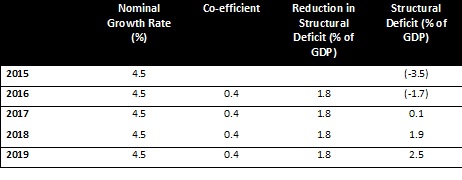
But there is a problem here. Why use a conservative 0.2 co-efficient? If you believe that 0.4 tells the story, go with it. And why, use a nominal growth rate of 3.5 percent? The Government claims that in 2015 the nominal growth rate is 4.5 percent. So let’s go with that.
What do we get? We find that the structural deficit turns into a structural surplus without doing anything.

And what a surplus! By 2019 we will have a structural surplus of 2.5 percent. We outdo even the Germans. We get to go to the top of the class.
Is this likely? No. But we don’t have to argue the toss about cyclical sensitivity measurements or coefficients of elasticity. We merely have to go to the IMF’s own projection – which helps because (a) they stretch out to 2017 and (b) they assume, like John, no fiscal adjustment after 2015. What do they find?

In percentage terms, the reduction in the structural deficit is minimal: less than 0.1 percent of GDP each year.
But why should this surprise us? If there is deficit left over after the output gap is closed (after the economy returns to full capacity), what remains is the structural deficit which requires ‘policy action’ to reduce.
Political Implications
But there’s more to all this than duelling statistics. The Government and their austerity supporters have co-opted the language of progressives to avoid answering a fundamental question: what the cost of the Fiscal Treaty will be in terms of future austerity measures. They are now talking about ‘growth’ being the main instrument of deficit-reduction. The Government has even gone so far as to say that investment will grow the productive capacity and, therefore, reduce the deficit. Some of us have been saying that since the start of the crisis – UNITE and the trade union movement, TASC, contributors on Progressive-Economy; all we got was ridicule and scorn.
Here’s how the Department of Finance puts it:
‘Indeed, by definition, reducing the structural element of the deficit will require policy action, though not necessarily taxation and expenditure adjustments. Other options are available . . . . Such measures include labour market reforms - some of which are already in train - together with investment in technology and infrastructure to boost the productive capacity of the economy. To this end, the Government has established NewERA and the Strategic Investment Fund . . .
This ambitious programme of microeconomic reforms, by boosting the productive capacity of the economy, is expected to help reduce the structural element of the deficit by the middle part of the decade. For example, reforms along the lines of those set out in the Action Plan for Jobs 2012 and the Pathways to Work initiative, aimed at addressing some of the skills mis-match in the labour market, should help lower the unemployment rate. This would have a structurally beneficial impact on the public finances, on both the revenue and expenditure sides. In other words, the structural fiscal position is set to improve with these microeconomic reforms.’
And, yet, yet – the Government still refuses to provide a projection for this. If they are convinced that investment and labour market reforms will boost our productivity, they can project this – through the ‘potential GDP’ which measures the contribution of labour, capital and productivity.
This is all a charade. At the same time as the Government is assuring us that growing our potential GDP will reduce the structural deficit, they are actually revising downwards potential GDP.

In the last budget, the Government projected that our productive capacity would grow by 3.4 percent between 2010 and 2015. Only a few months later, the Government is now projecting growth at 2.4 percent. This revision downwards reflects their lower GDP projections.
In other words, we are going forward by going backwards.
This is the ultimate game plan. Stonewall any questions about the cost of the Fiscal Treaty with talk of growing our productive capacity even as you revise downwards our productive capacity. ‘Prove’ that growth will reduce the structural deficit by using variables that have little reference to structural deficit reduction. But don’t ‘prove’ it too much because it will look nonsensical. Ignore what current projections (IMF) have to say about all this. Even ignore the definition of a structural deficit. Above all, abandon your austerity clothes and don the robes of an expansionary programme – even as you promise to cut public investment next year and cut spending on public services and social protection by even more than you did this year.
Do all this. But don’t call it austerity.
‘Growth affects both the denominator and the numerator of the structural deficit as a share of GDP. (For simplicity I assume that actual and potential GDP grow at equal rates post 2015.) The denominator effect is straightforward. For the numerator, we could use the standard coefficient used by the European Commission for Ireland that assumes that the reduction in the deficit is 0.4 times the change in nominal GDP. (This coefficient is usually used for doing cyclical adjustments, but it should also be applicable for measuring the impact of changes in nominal potential GDP on structural balance in the absence of discretionary adjustments to tax and expenditure parameters.)’
On this basis John does some calculations – using a more conservative co-efficient of 0.2. He finds the structural deficit is effectively wiped out by 2019 / 2020 without any additional austerity because growth has done all the heavy lifting.
I would suggest that this line of argument is flawed. First, I assume the co-efficient he uses refers to the cyclical sensitivity measurement of 0.4. This measurement is used to deconstruct the deficit into its ‘cyclical’ and ‘structural’ components. Essentially, you measure the gap between the real GDP and potential GDP growth and then apply the 0.4 to see how much of the gap is cyclical.
And herein lies the first problem – the 0.4 is an instrument to define the cyclical component of the output gap. It is not a measurement which defines the relationship between nominal growth rates and deficit reduction – whether it is the general or structural deficit. It is analogous to using a car clamp to change a light bulb. It is the wrong instrument. As the Department of Finance puts it:
‘Indeed, by definition, reducing the structural element of the deficit will require policy action. . . .‘
The whole point of structural deficit measurements is to determine what the deficit will be when the economy returns to full capacity. If the economy is firing on all cylinders and there is still a deficit, then the Government must take policy action to correct this, because growth cannot.
In doing his calculations, John assumes that real and potential GDP grow at the same rate. Never mind that the Government estimates that real GDP is growing at twice the rate of potential GDP in 2015 (yes, I know, this suggest that the economy is ‘over-heating’ – one of the absurdities with the model that the Department of Finance is using). If the output gap is zero, there is no role for applying the 0.4 co-efficient because there is no cyclical component to measure.
Seamus Coffey does his own calculations based on John’s more conservative co-efficient of 0.2 and applies it to GDP growth (though Seamus does say ‘There is no way of knowing what this’ co-efficient is). He comes up with a similar result to John.
But there is a problem here. Why use a conservative 0.2 co-efficient? If you believe that 0.4 tells the story, go with it. And why, use a nominal growth rate of 3.5 percent? The Government claims that in 2015 the nominal growth rate is 4.5 percent. So let’s go with that.
What do we get? We find that the structural deficit turns into a structural surplus without doing anything.
And what a surplus! By 2019 we will have a structural surplus of 2.5 percent. We outdo even the Germans. We get to go to the top of the class.
Is this likely? No. But we don’t have to argue the toss about cyclical sensitivity measurements or coefficients of elasticity. We merely have to go to the IMF’s own projection – which helps because (a) they stretch out to 2017 and (b) they assume, like John, no fiscal adjustment after 2015. What do they find?

In percentage terms, the reduction in the structural deficit is minimal: less than 0.1 percent of GDP each year.
But why should this surprise us? If there is deficit left over after the output gap is closed (after the economy returns to full capacity), what remains is the structural deficit which requires ‘policy action’ to reduce.
Political Implications
But there’s more to all this than duelling statistics. The Government and their austerity supporters have co-opted the language of progressives to avoid answering a fundamental question: what the cost of the Fiscal Treaty will be in terms of future austerity measures. They are now talking about ‘growth’ being the main instrument of deficit-reduction. The Government has even gone so far as to say that investment will grow the productive capacity and, therefore, reduce the deficit. Some of us have been saying that since the start of the crisis – UNITE and the trade union movement, TASC, contributors on Progressive-Economy; all we got was ridicule and scorn.
Here’s how the Department of Finance puts it:
‘Indeed, by definition, reducing the structural element of the deficit will require policy action, though not necessarily taxation and expenditure adjustments. Other options are available . . . . Such measures include labour market reforms - some of which are already in train - together with investment in technology and infrastructure to boost the productive capacity of the economy. To this end, the Government has established NewERA and the Strategic Investment Fund . . .
This ambitious programme of microeconomic reforms, by boosting the productive capacity of the economy, is expected to help reduce the structural element of the deficit by the middle part of the decade. For example, reforms along the lines of those set out in the Action Plan for Jobs 2012 and the Pathways to Work initiative, aimed at addressing some of the skills mis-match in the labour market, should help lower the unemployment rate. This would have a structurally beneficial impact on the public finances, on both the revenue and expenditure sides. In other words, the structural fiscal position is set to improve with these microeconomic reforms.’
And, yet, yet – the Government still refuses to provide a projection for this. If they are convinced that investment and labour market reforms will boost our productivity, they can project this – through the ‘potential GDP’ which measures the contribution of labour, capital and productivity.
This is all a charade. At the same time as the Government is assuring us that growing our potential GDP will reduce the structural deficit, they are actually revising downwards potential GDP.

In the last budget, the Government projected that our productive capacity would grow by 3.4 percent between 2010 and 2015. Only a few months later, the Government is now projecting growth at 2.4 percent. This revision downwards reflects their lower GDP projections.
In other words, we are going forward by going backwards.
This is the ultimate game plan. Stonewall any questions about the cost of the Fiscal Treaty with talk of growing our productive capacity even as you revise downwards our productive capacity. ‘Prove’ that growth will reduce the structural deficit by using variables that have little reference to structural deficit reduction. But don’t ‘prove’ it too much because it will look nonsensical. Ignore what current projections (IMF) have to say about all this. Even ignore the definition of a structural deficit. Above all, abandon your austerity clothes and don the robes of an expansionary programme – even as you promise to cut public investment next year and cut spending on public services and social protection by even more than you did this year.
Do all this. But don’t call it austerity.
Tuesday, 24 April 2012
Ireland's financing alternatives - the EFSF
Tom McDonnell and Michael Taft: In our first post, we outlined some of Ireland’s financing alternatives; namely through the IMF and the European Stability Mechanism. There is, however, a more compelling source of institutional funding in the eventuality of a No vote: the European Financial Stability Facility (EFSF).
The EFSF is one of four external sources of funding for the current Irish bail-out (along with the IMF, the European Financial Stabilisation Mechanism, and bi-lateral loan agreements with the UK, Sweden and Denmark). The EFSF remains a source of funding for all Eurozone countries until the middle of next year.
The EFSF stands apart from the ESM and the Fiscal Treaty. Ireland, and all countries who are members of the EFSF, has access to this fund as of right, depending on the following conditions:
• They cannot access funding at reasonable rates on the international markets
• They have negotiated a Memorandum of Understanding with the EU and the IMF
A further stipulation is unanimous consent from the Finance Ministers of the Eurozone (Eurogroup), which would follow on from an agreement with the EU/IMF. Applications for this funding can be made up to the end of June 2013. After that the EFSF will only administer funding that has already been agreed.
According to the recent Eurogroup statement (the Finance Ministers of Eurozone countries):
‘For a transitional period until mid-2013, it (the EFSF) may engage in new programmes in order to ensure a full fresh lending capacity of EUR 500 billion (for the ESM).’
This is confirmed by the EFSF itself which states:
‘ . . . following the Eurogroup meeting held on 30 March, it was decided that the EFSF would remain active until July 2013 . . . For a transitional period until 2013, EFSF may engage in new programmes in order to ensure a full fresh lending capacity of €500 billion . . . after June 2013, EFSF [will] not enter into any new programmes.’
Therefore, were Ireland to apply for a second bail-out prior to July 1st 2013, it would be granted if such an application were accompanied by a Memorandum of Understanding negotiated between Ireland, the EU and the IMF – similar to the first bail-out. This funding is not contingent upon the ratification of the Fiscal Treaty.
In all probability, funding for Ireland’s second bail-out – whether it approves the Fiscal Treaty or not – will be routed through the EFSF. The EFSF (the temporary bailout fund in place up to July 2013) and the ESM (permanent bailout mechanism) are different companies. The EFSF has €440 billion (see page 1 of the EFSF document) of which €192 billion already committed to Ireland, Portugal and Greece (see the diagram on page 20 of the EFSF document). The remaining lending capacity of the EFSF for programmes initiated before July 2013 is therefore €248 billion. The EFSF will remain in place to manage its existing programmes (see diagram on page 20 of the EFSF document) and any other new programmes approved prior to July 2013, until such time as all these programmes are all wound down.
The ESM itself has €500 billion and is scheduled to enter force on 1 July 2012. As stated above, the intention would be to ensure the ESM retains its full lending capacity of €500 billion. This no doubt refers to the prospect of larger countries, in particular Spain, needing a bail-out. The ESM would require full capacity to accommodate new countries’ need for a bail-out.
Ireland’s continuing access to institutional funding beyond the current bail-out programme has been guaranteed not once, but twice, by the Heads of States and Government; first, on July 21st of last year when the establishment of the European Stability Mechanism was agreed, and most recently on January 30th of this year – after the Fiscal Treaty was signed:
‘We welcome the latest positive reviews of the Irish and Portuguese programmes which concluded that quantitative performance criteria and structural benchmarks have been met. We will continue to provide support to countries under a programme until they have regained market access, provided they successfully implement their programmes.’
This is an important and helpful guarantee. There is no condition set on continued support until we return to the markets – except that we implement agreed programmes. If continued support were contingent upon acceptance of the Treaty, we should have expected it to be highlighted in this statement.
This helps explain another issue we highlighted in the first post. The drafters of the European Stability Mechanism Treaty inserted clauses that provide manoeuvrability in negotiations with any Eurozone country in need of financing, regardless of the Fiscal Treaty. In particular, they inserted references to ‘new programmes under the European Stability Mechanism’, a clause which would have been unnecessary if all financing under the ESM were strictly conditional on a yes vote. They have seemingly factored in a situation whereby a second bail-out for Ireland (and potentially Portugal and Greece) would constitute ‘rolled-over’ financing, rather than ‘new’ financing. This buttresses the guarantee given by the Heads of States and Governments – namely that Ireland will continue to be supported until we return to the markets.
This is an important debate as there is a high probability that Ireland will require a second bail-out. We are expected to return to the markets in late 2013 and fully by 2014. However, the IMF is cautious:
‘Debt sustainability remains fragile, especially with respect to medium-term growth prospects . . . In this context, the prospects for regaining the substantial access to market funding that is assumed in 2013 remain uncertain.’
Were a second bail-out required, we estimate that it could be as large as €45 billion and possibly more for the years 2014 and 2015, taking into account the Exchequer balance and bond redemptions. This does not include bank payments. While this is less than the current bail-out provision it is clear that Ireland, without access to either market or institutional funding, would not be able to cope with this fiscally. We would be heading into a default – quite possibly on both sovereign and banking debt. This would have negative spillover effects for other Eurozone countries.
We reiterate the point from our first post: there is no reason to resort to counter-posing ‘appalling scenarios’. Some argue that Ireland will be frozen out of both market and institutional funding if we vote No. Clearly, this would be an appalling scenario. Others argue that it would never come to this because of the impact on the Eurozone (defaults, contagion) – another appalling scenario.
This is not a satisfactory way to debate this issue. This will trap us in a ‘race-to-disaster’ debate which will be particularly uninformative. We have attempted to outline concrete alternative funding scenarios for Ireland. Whether these would become available is a subject for legitimate debate. However, those who claim that Ireland would be denied access to EFSF funding – or any other funding sources – should provide concrete evidence to this effect. Evidence one way or the other would be a valuable contribution.
The debate over the Fiscal Treaty should be just that – a debate about the provisions of the Treaty. In this respect, it is helpful to note wider European developments. Spain has, unsurprisingly, officially re-entered recession putting at risk their deficit targets; the prospect of a Socialist Party victory in the French second-round Presidential vote raises the prospect of some renegotiation of the Fiscal Treaty; the fall of the Dutch government over failure to agree budget cuts highlights the problems posed by the Fiscal Compact in a major core country.
As Ireland prepares for the referendum vote, the ground under the Fiscal Treaty may already be shifting. Resort to ‘appalling scenarios’ will only confuse the issue when the debate should be focused on whether the provisions of the Fiscal Treaty are good, or even sustainable, for Ireland and the Eurozone.
The EFSF is one of four external sources of funding for the current Irish bail-out (along with the IMF, the European Financial Stabilisation Mechanism, and bi-lateral loan agreements with the UK, Sweden and Denmark). The EFSF remains a source of funding for all Eurozone countries until the middle of next year.
The EFSF stands apart from the ESM and the Fiscal Treaty. Ireland, and all countries who are members of the EFSF, has access to this fund as of right, depending on the following conditions:
• They cannot access funding at reasonable rates on the international markets
• They have negotiated a Memorandum of Understanding with the EU and the IMF
A further stipulation is unanimous consent from the Finance Ministers of the Eurozone (Eurogroup), which would follow on from an agreement with the EU/IMF. Applications for this funding can be made up to the end of June 2013. After that the EFSF will only administer funding that has already been agreed.
According to the recent Eurogroup statement (the Finance Ministers of Eurozone countries):
‘For a transitional period until mid-2013, it (the EFSF) may engage in new programmes in order to ensure a full fresh lending capacity of EUR 500 billion (for the ESM).’
This is confirmed by the EFSF itself which states:
‘ . . . following the Eurogroup meeting held on 30 March, it was decided that the EFSF would remain active until July 2013 . . . For a transitional period until 2013, EFSF may engage in new programmes in order to ensure a full fresh lending capacity of €500 billion . . . after June 2013, EFSF [will] not enter into any new programmes.’
Therefore, were Ireland to apply for a second bail-out prior to July 1st 2013, it would be granted if such an application were accompanied by a Memorandum of Understanding negotiated between Ireland, the EU and the IMF – similar to the first bail-out. This funding is not contingent upon the ratification of the Fiscal Treaty.
In all probability, funding for Ireland’s second bail-out – whether it approves the Fiscal Treaty or not – will be routed through the EFSF. The EFSF (the temporary bailout fund in place up to July 2013) and the ESM (permanent bailout mechanism) are different companies. The EFSF has €440 billion (see page 1 of the EFSF document) of which €192 billion already committed to Ireland, Portugal and Greece (see the diagram on page 20 of the EFSF document). The remaining lending capacity of the EFSF for programmes initiated before July 2013 is therefore €248 billion. The EFSF will remain in place to manage its existing programmes (see diagram on page 20 of the EFSF document) and any other new programmes approved prior to July 2013, until such time as all these programmes are all wound down.
The ESM itself has €500 billion and is scheduled to enter force on 1 July 2012. As stated above, the intention would be to ensure the ESM retains its full lending capacity of €500 billion. This no doubt refers to the prospect of larger countries, in particular Spain, needing a bail-out. The ESM would require full capacity to accommodate new countries’ need for a bail-out.
Ireland’s continuing access to institutional funding beyond the current bail-out programme has been guaranteed not once, but twice, by the Heads of States and Government; first, on July 21st of last year when the establishment of the European Stability Mechanism was agreed, and most recently on January 30th of this year – after the Fiscal Treaty was signed:
‘We welcome the latest positive reviews of the Irish and Portuguese programmes which concluded that quantitative performance criteria and structural benchmarks have been met. We will continue to provide support to countries under a programme until they have regained market access, provided they successfully implement their programmes.’
This is an important and helpful guarantee. There is no condition set on continued support until we return to the markets – except that we implement agreed programmes. If continued support were contingent upon acceptance of the Treaty, we should have expected it to be highlighted in this statement.
This helps explain another issue we highlighted in the first post. The drafters of the European Stability Mechanism Treaty inserted clauses that provide manoeuvrability in negotiations with any Eurozone country in need of financing, regardless of the Fiscal Treaty. In particular, they inserted references to ‘new programmes under the European Stability Mechanism’, a clause which would have been unnecessary if all financing under the ESM were strictly conditional on a yes vote. They have seemingly factored in a situation whereby a second bail-out for Ireland (and potentially Portugal and Greece) would constitute ‘rolled-over’ financing, rather than ‘new’ financing. This buttresses the guarantee given by the Heads of States and Governments – namely that Ireland will continue to be supported until we return to the markets.
This is an important debate as there is a high probability that Ireland will require a second bail-out. We are expected to return to the markets in late 2013 and fully by 2014. However, the IMF is cautious:
‘Debt sustainability remains fragile, especially with respect to medium-term growth prospects . . . In this context, the prospects for regaining the substantial access to market funding that is assumed in 2013 remain uncertain.’
Were a second bail-out required, we estimate that it could be as large as €45 billion and possibly more for the years 2014 and 2015, taking into account the Exchequer balance and bond redemptions. This does not include bank payments. While this is less than the current bail-out provision it is clear that Ireland, without access to either market or institutional funding, would not be able to cope with this fiscally. We would be heading into a default – quite possibly on both sovereign and banking debt. This would have negative spillover effects for other Eurozone countries.
We reiterate the point from our first post: there is no reason to resort to counter-posing ‘appalling scenarios’. Some argue that Ireland will be frozen out of both market and institutional funding if we vote No. Clearly, this would be an appalling scenario. Others argue that it would never come to this because of the impact on the Eurozone (defaults, contagion) – another appalling scenario.
This is not a satisfactory way to debate this issue. This will trap us in a ‘race-to-disaster’ debate which will be particularly uninformative. We have attempted to outline concrete alternative funding scenarios for Ireland. Whether these would become available is a subject for legitimate debate. However, those who claim that Ireland would be denied access to EFSF funding – or any other funding sources – should provide concrete evidence to this effect. Evidence one way or the other would be a valuable contribution.
The debate over the Fiscal Treaty should be just that – a debate about the provisions of the Treaty. In this respect, it is helpful to note wider European developments. Spain has, unsurprisingly, officially re-entered recession putting at risk their deficit targets; the prospect of a Socialist Party victory in the French second-round Presidential vote raises the prospect of some renegotiation of the Fiscal Treaty; the fall of the Dutch government over failure to agree budget cuts highlights the problems posed by the Fiscal Compact in a major core country.
As Ireland prepares for the referendum vote, the ground under the Fiscal Treaty may already be shifting. Resort to ‘appalling scenarios’ will only confuse the issue when the debate should be focused on whether the provisions of the Fiscal Treaty are good, or even sustainable, for Ireland and the Eurozone.
Thursday, 12 April 2012
Responding to the Minister
Michael Taft: The Minister for Public Expenditure and Reform, Brendan Howlin, has responded to the open letter signed by 39 economists, social scientists and analysts. It is welcomed that a Government Minister is willing to engage constructively as this can only improve the public debate. That the Minister claims there is considerable common ground between the contributors and the Government is further welcomed. But ultimately the Minister doesn’t believe the strategy outlined by the contributors is viable. I’d like to address some of the issues the Minister raised in his article. I speak, of course, only for myself and not for any other signatory of the open letter.
The first problem we confront is a disconnect between what the Minister claims and what is actually happening in the economy. He states:
‘The importance of growth is factored into our budgetary figures. Our own economy has returned to modest growth and indeed, the greatest impediment to future growth is the state of the global economy.’
The problem here is that the economy has actually returned to recession – a double-dip recession. The latest quarterly data we have – from the second half of last year – shows GDP in decline. When we turn to the domestic economy, we find the biggest fall since the dark days of 2009. It is difficult to reconcile the statement ‘our own economy has returned to modest growth’ with the fact that we are back in recession.
The second problem is a denial of what the Government is actually doing.
‘Contrary to the view articulated (by the contributors), the Government is not pursuing an “austerity” strategy. The opposite is the case.’
Again, it is hard to reconcile this with what the current Government is doing. In the last budget, the Government engaged in a fiscal contraction equivalent to €4.3 billion (according to the EU Commission, factoring in the carryover from Budget 2011). This was made up of tax increases – primarily regressive VAT increases – and spending cuts, in particular a significant €750 million capital investment cut.
This will have a profound impact, not only on the social fabric, but on economic growth. The Minister for Finance has estimated that for every €1 billion in cuts/tax increases, the GDP falls by €500 million. On this basis, the Government reduced growth by €2.15 billion or over 1 percent off real GDP.
It is worth noting that the Government is now at pains to distance itself from the word ‘austerity’ – such is the low esteem it is now held among people since it is a by-word for low-growth, job losses and rising debt. However, to maintain that you are not pursuing austerity while at the same time doing just that is slightly disingenuous.
From these highly contestable propositions – that the economy has returned to growth and the Government is not actually pursuing austerity – the Minister takes critical aim. But it is not clear exactly who he is aiming at. First, he claims:
‘It is perplexing then to see a problem of this scale (the deficit) effectively dismissed by the suggestion that there is a better, simpler, pain-free way.’
Clearly, this does not refer to the open letter which sets out a very rational approach to fiscal consolidation – ‘smart’ or ‘growth-friendly’ fiscal consolidation:
‘Such an investment programme must be accompanied by “smart” fiscal consolidation, focusing on the least contractionary forms of fiscal adjustment. This requires progressive and equality-proofed taxation targeting high-income groups, property assets, unproductive activity and passive income, as well as environmental measures.’
I doubt there is any Government minister that would disagree with this formulation. And this certainly doesn’t suggest ‘a simpler, pain-free way’ – though it does suggest a ‘better’ way.
Ultimately, the issue is not whether there should be fiscal consolidation or whether it should be pain-free, but what is the most effective and efficient means. According to the ESRI, spending cuts are the least efficient and effective means of deficit reduction for the reason that they most contractionary forms of adjustment. Again, the Minister would be aware of this research – and the common sense behind it.
It also overlooks the fact that investment itself is an effective means of deficit reduction. Putting people back to work, increasing the productive capacity to grow cuts both the general and the structural deficit. In this regard, the Nevin Economic Research Institute’s (NERI) recent report puts the growth potential of investment in perspective.
Second, the Minister claims:
‘The idea that we would use all of our available resources in an all-or-nothing attempt to kick-start the economy strikes me as more Fianna Fáil circa 1977 than John Maynard Keynes, bearing in mind that the sum mentioned, €15 billion, equates to approximately one year’s exchequer borrowing requirement, money borrowed to pay day-to-day costs.’
There is, of course a difference between Fianna Fail’s economic adventurism and the investment-based approach advanced in the open letter. In the late 1970s Fianna Fail gambled that cutting taxation and boosting Government consumption would lead to increased consumer spending. As a result, the indigenous private sector would expand to meet growth among indigenous firms which they assumed would respond with a surge of expansion. This didn’t happen, of course; all we got was the stagflation of the 1980s.
The open letter strategy, however, is to address the economic and social deficits through investment which will grow the productive capacity - a strategy completely at odds with the badly misjudged Fianna Fail strategy of pump-priming consumer expenditure.
In this context, the ‘all or nothing’ reference is curious: it is hardly ‘all or nothing’ to roll out a next generation broadband, to invest in education from pre-primary to lifelong learning, to modernise our water & waste system. This is not about kick-starting, it is about creating new assets that will generate income and reduce spending in the future.
The phrase ‘silver bullet’ only reinforces the notion that the Minister was debating other positions. Even the reference to the ‘€15 billion’: the open letter didn’t propose a €15 billion programme (though NERI has). It merely outlined the sources where investment could commence – the €5 billion in the pension fund, the €15 billion in cash balances, the use of public enterprises’ commercial potential. Regarding the cash balances, even the Government has admitted that using €6 billion of this amount to write-down debt would still leave the balance ‘relatively healthy’. Why not redirect this amount into building our productive capacity?
While it is welcome that the Minister has publicly engaged with the open letter, it is disappointing that he argued from highly contestable premises while failing to address the real and practical propositions that the letter put forward. We are still left with the need for the Government to actually put forward concrete evidence that spending-based fiscal contraction is economically efficient; that privatisation will enhance our net investment position; that an economy that has returned to recession and suffering from rising joblessness and poverty can somehow, at the same time, repair its public finances.
We are still left with the need for the Government to admit that its austerity strategy is not going as planned and, therefore, that it is willing to canvas alternatives.
The first problem we confront is a disconnect between what the Minister claims and what is actually happening in the economy. He states:
‘The importance of growth is factored into our budgetary figures. Our own economy has returned to modest growth and indeed, the greatest impediment to future growth is the state of the global economy.’
The problem here is that the economy has actually returned to recession – a double-dip recession. The latest quarterly data we have – from the second half of last year – shows GDP in decline. When we turn to the domestic economy, we find the biggest fall since the dark days of 2009. It is difficult to reconcile the statement ‘our own economy has returned to modest growth’ with the fact that we are back in recession.
The second problem is a denial of what the Government is actually doing.
‘Contrary to the view articulated (by the contributors), the Government is not pursuing an “austerity” strategy. The opposite is the case.’
Again, it is hard to reconcile this with what the current Government is doing. In the last budget, the Government engaged in a fiscal contraction equivalent to €4.3 billion (according to the EU Commission, factoring in the carryover from Budget 2011). This was made up of tax increases – primarily regressive VAT increases – and spending cuts, in particular a significant €750 million capital investment cut.
This will have a profound impact, not only on the social fabric, but on economic growth. The Minister for Finance has estimated that for every €1 billion in cuts/tax increases, the GDP falls by €500 million. On this basis, the Government reduced growth by €2.15 billion or over 1 percent off real GDP.
It is worth noting that the Government is now at pains to distance itself from the word ‘austerity’ – such is the low esteem it is now held among people since it is a by-word for low-growth, job losses and rising debt. However, to maintain that you are not pursuing austerity while at the same time doing just that is slightly disingenuous.
From these highly contestable propositions – that the economy has returned to growth and the Government is not actually pursuing austerity – the Minister takes critical aim. But it is not clear exactly who he is aiming at. First, he claims:
‘It is perplexing then to see a problem of this scale (the deficit) effectively dismissed by the suggestion that there is a better, simpler, pain-free way.’
Clearly, this does not refer to the open letter which sets out a very rational approach to fiscal consolidation – ‘smart’ or ‘growth-friendly’ fiscal consolidation:
‘Such an investment programme must be accompanied by “smart” fiscal consolidation, focusing on the least contractionary forms of fiscal adjustment. This requires progressive and equality-proofed taxation targeting high-income groups, property assets, unproductive activity and passive income, as well as environmental measures.’
I doubt there is any Government minister that would disagree with this formulation. And this certainly doesn’t suggest ‘a simpler, pain-free way’ – though it does suggest a ‘better’ way.
Ultimately, the issue is not whether there should be fiscal consolidation or whether it should be pain-free, but what is the most effective and efficient means. According to the ESRI, spending cuts are the least efficient and effective means of deficit reduction for the reason that they most contractionary forms of adjustment. Again, the Minister would be aware of this research – and the common sense behind it.
It also overlooks the fact that investment itself is an effective means of deficit reduction. Putting people back to work, increasing the productive capacity to grow cuts both the general and the structural deficit. In this regard, the Nevin Economic Research Institute’s (NERI) recent report puts the growth potential of investment in perspective.
Second, the Minister claims:
‘The idea that we would use all of our available resources in an all-or-nothing attempt to kick-start the economy strikes me as more Fianna Fáil circa 1977 than John Maynard Keynes, bearing in mind that the sum mentioned, €15 billion, equates to approximately one year’s exchequer borrowing requirement, money borrowed to pay day-to-day costs.’
There is, of course a difference between Fianna Fail’s economic adventurism and the investment-based approach advanced in the open letter. In the late 1970s Fianna Fail gambled that cutting taxation and boosting Government consumption would lead to increased consumer spending. As a result, the indigenous private sector would expand to meet growth among indigenous firms which they assumed would respond with a surge of expansion. This didn’t happen, of course; all we got was the stagflation of the 1980s.
The open letter strategy, however, is to address the economic and social deficits through investment which will grow the productive capacity - a strategy completely at odds with the badly misjudged Fianna Fail strategy of pump-priming consumer expenditure.
In this context, the ‘all or nothing’ reference is curious: it is hardly ‘all or nothing’ to roll out a next generation broadband, to invest in education from pre-primary to lifelong learning, to modernise our water & waste system. This is not about kick-starting, it is about creating new assets that will generate income and reduce spending in the future.
The phrase ‘silver bullet’ only reinforces the notion that the Minister was debating other positions. Even the reference to the ‘€15 billion’: the open letter didn’t propose a €15 billion programme (though NERI has). It merely outlined the sources where investment could commence – the €5 billion in the pension fund, the €15 billion in cash balances, the use of public enterprises’ commercial potential. Regarding the cash balances, even the Government has admitted that using €6 billion of this amount to write-down debt would still leave the balance ‘relatively healthy’. Why not redirect this amount into building our productive capacity?
While it is welcome that the Minister has publicly engaged with the open letter, it is disappointing that he argued from highly contestable premises while failing to address the real and practical propositions that the letter put forward. We are still left with the need for the Government to actually put forward concrete evidence that spending-based fiscal contraction is economically efficient; that privatisation will enhance our net investment position; that an economy that has returned to recession and suffering from rising joblessness and poverty can somehow, at the same time, repair its public finances.
We are still left with the need for the Government to admit that its austerity strategy is not going as planned and, therefore, that it is willing to canvas alternatives.
Wednesday, 28 March 2012
Welcome to the inequality cycle
Michael Taft: We are now starting to get data to assess just who in society is getting hit and who is getting by. Of course, we know about unemployment rates, deprivation rates, and income inequality rates. But the CSO’s 2010 Survey of Income and Living Conditions gives us an insight as to who has lost how much in the first two years of the crisis, namely 2009 and 2010. Let’s take a particular look at three deciles – the lowest, the highest and the middle 6th decile.
First, what levels of income are we discussing within these groups?
• The lowest decile includes households with gross incomes of less than €13,249 or less; or approximately €10,000 per adult in the household.
• The middle decile includes households with gross incomes between €37, 467 and €46,561; or approximately between €18,000 and €21,000 per adult in the household. (Question: is this the squeezed middle that the Irish Times series was recently chronicling?).
• The average for the highest household is a gross income of over €171,000; or approximately €62,000 per adult in the household.
For the lowest decile, income levels are extremely low while in the middle decile, incomes are extremely modest. Incomes at the higher level are in another place altogether.
Now, let’s look at disposable income – that is, income after tax.

Nationally, weekly income fell by nearly 12 percent on average. However, as seen the worst hit were those who could least afford it , with the lowest 10 percent income earners experiencing a fall of over 20 percent. The next biggest decline is found in the middle 6th decile. All deciles experienced a fall in double digits with one exception: the highest earners pretty much escaped the impact of the recession.
However, the story is a little more complicated.

In 2009, the lowest decile experienced a minimal impact. It was the middle decile that took the biggest hit with the highest income earners also experiencing a significant decline. However, the picture changed in 2010. The lowest income groups experienced substantial income decline – in this year social transfers were cut. The middle income group suffered further decline. However, the highest income groups returned to growth.
The SILC data shows that income inequality experienced a large rise in 2010, rising from a ratio of 4.3 to 5.5 (the ratio of the income of the top 20 percent to the bottom 20 percent). This was the biggest single year jump in income inequality experienced in any country since the EU started recording this data. In 2010, Ireland ranked 9th in the EU-27 for income inequality.
These trends are likely to continue and may even accelerate. The 2011 budget saw further cuts in social transfers combined with highly regressive tax measures (the USC and the reduction in personal tax credits). The 2012 budget – which the ESRI described as the most regressive of all budgets introduced since the crisis began – will further exacerbate this.
So we have a new cycle to discuss – alongside the deflationary cycle, the debt cycle and the long-term unemployment cycle: the inequality cycle. And this is likely to be as vicious and socially degrading as the others.
First, what levels of income are we discussing within these groups?
• The lowest decile includes households with gross incomes of less than €13,249 or less; or approximately €10,000 per adult in the household.
• The middle decile includes households with gross incomes between €37, 467 and €46,561; or approximately between €18,000 and €21,000 per adult in the household. (Question: is this the squeezed middle that the Irish Times series was recently chronicling?).
• The average for the highest household is a gross income of over €171,000; or approximately €62,000 per adult in the household.
For the lowest decile, income levels are extremely low while in the middle decile, incomes are extremely modest. Incomes at the higher level are in another place altogether.
Now, let’s look at disposable income – that is, income after tax.

Nationally, weekly income fell by nearly 12 percent on average. However, as seen the worst hit were those who could least afford it , with the lowest 10 percent income earners experiencing a fall of over 20 percent. The next biggest decline is found in the middle 6th decile. All deciles experienced a fall in double digits with one exception: the highest earners pretty much escaped the impact of the recession.
However, the story is a little more complicated.

In 2009, the lowest decile experienced a minimal impact. It was the middle decile that took the biggest hit with the highest income earners also experiencing a significant decline. However, the picture changed in 2010. The lowest income groups experienced substantial income decline – in this year social transfers were cut. The middle income group suffered further decline. However, the highest income groups returned to growth.
The SILC data shows that income inequality experienced a large rise in 2010, rising from a ratio of 4.3 to 5.5 (the ratio of the income of the top 20 percent to the bottom 20 percent). This was the biggest single year jump in income inequality experienced in any country since the EU started recording this data. In 2010, Ireland ranked 9th in the EU-27 for income inequality.
These trends are likely to continue and may even accelerate. The 2011 budget saw further cuts in social transfers combined with highly regressive tax measures (the USC and the reduction in personal tax credits). The 2012 budget – which the ESRI described as the most regressive of all budgets introduced since the crisis began – will further exacerbate this.
So we have a new cycle to discuss – alongside the deflationary cycle, the debt cycle and the long-term unemployment cycle: the inequality cycle. And this is likely to be as vicious and socially degrading as the others.
Tuesday, 20 March 2012
Ireland's funding options: Time to end the 'race-to-disaster' debate
Tom McDonnell & Michael Taft: Even before the wording has been published and a referendum date named there is one issue that looks set to dominate the debate over the Fiscal Treaty; namely, what future financing options does Ireland have in the eventuality of a ‘No’ vote. While we are not taking a position on the substantive issue in this post, the following is intended to aid the debate by helping to answer that question.
The ‘Indispensable’ Condition
First, regardless of the Treaty vote, Ireland is guaranteed funding under the current programme – as long as it meets its targets. A Yes or No vote will not change this.
In the event of a No vote with Ireland unable to fully return to the markets, what would the situation be?
‘ . . . the granting of assistance in the framework of new programmes under the European Stability Mechanism will be conditional, as of 1 March 2013, on the ratification of this Treaty by the Contracting Party.’
This clearly states that new financing under the European Stability Mechanism is contingent upon ratification of the Treaty. However, we would put the following points that suggest that the issue contains potentially significant ambiguity.
First, the text of the European Stability Mechanism Treaty states that there are two conditions for providing support for ESM members:
‘The purpose of the ESM shall be to mobilise funding and provide stability support under strict conditionality, appropriate to the financial assistance instrument chosen, to the benefit of ESM Members which are experiencing, or are threatened by, severe financing problems, if indispensable to safeguard the financial stability of the euro area as a whole and of its Member States.’
The two conditions for support under the ESM appear to be (a) a member-state requires assistance, and (b) such assistance is ‘indispensable’ to the stability of Euro area. The indispensable clause, not surprisingly, is stated four times in the ESM treaty; unsurprising as this is the purpose of the ESM – to safeguard the Eurozone’s stability.
For argument’s sake, let’s assume Ireland – a member of the ESM but having voted No in the referendum – is in demonstrable need of financial assistance; and further, it can be objectively established that, without such assistance, there is a threat to Eurozone stability (issues of both state and bank default which may arise if assistance isn’t forthcoming). A literalist reading of the Fiscal Treaty would seem to settle the issue – Ireland, if voting No, would be excluded from the fund. But how final is this literalism?
‘Indispensable’ to the financial stability of the Euro area does not become less indispensable merely because Ireland, an ESM member, has not incorporated rules (rules that it has already agreed to) into its constitution through a process unique in the Eurozone – that is, a popular referendum. It is difficult to imagine a situation where the financial stability of the Eurozone (and Eurozone countries from Spain to Germany) is at risk and the resolution of that risk is barred because of a referendum result in a member-state. This would effectively undermine the intent of the ESM and its ability to respond to financial risks in the Eurozone.
What this crisis has shown is the flexibility of the Eurozone and EU institutions to respond to the crisis, whether we agree with the policies or not. For instance, the European Central Bank is legally barred from acting as a lender of last resort to sovereign states. But that did not stop it from, first, participating in the secondary bond markets and, second, from providing over €1 trillion in liquidity to European banks through their Long-Term Refinancing Operations (LTROs). The LTRO was intended to indirectly ease pressure on Spanish and Italian bond yields and was effectively a roundabout method of overcoming the bar to lend to sovereign states. Both of these were innovative and flexible responses. This resort to flexibility has implications for Ireland in the event of a No vote.
The Fiscal Compact refers to ‘new programmes under the European Stability Mechanism’. The ‘new’ may provide some flexibility, especially if Ireland is unable to re-enter the market and seeks a continuation of the current programme. This could be buttressed by the statement by the EU Heads of State or Government in July of last year. This, too, is definitive:
‘We are determined to continue to provide support to countries under programmes until they have regained market access, provided they successfully implement those programmes.’
Minister Michael Noonan confirmed this after the summit:
'There is a commitment that if countries continue to fulfil the conditions of their programme the European authorities will continue to supply them with money even when the programme is concluded . . . The commitment is now written in that if we are not back in the markets the European authorities will give us money until we get back in the markets.’
That both the EU leaders commitment and the Minister’s statement followed on from agreement to establish the ESM – with the same clause that disbursement of funds is based on the same ‘indispensability’ condition referred to above – suggests that there is considerable room for all sides to manoeuvre, even in the eventuality of a No vote. We are not suggesting that this is a definitive outcome. However, resort to a literal reading could lead us to the conclusion that Ireland, even if voted Yes, could be denied funding under the ESM if it was concluded at EU level that assistance was not indispensable to Eurozone stability. We seriously doubt this scenario which is why literal readings of one section of one treaty can lead us to unjustified conclusions. This holds when discussing the outcomes of either a Yes or No vote.
Alternative Sources of Funding
Regardless of the above, there is a credible argument that Ireland, in the eventuality that it needs a second bailout, has access to funding sources apart from the ESM; namely the IMF. This is the same ‘insurance’ or ‘back-stop’ that all EU countries are entitled to as members of the IMF. More EU countries have accessed IMF support than EU support in the last decade: Latvia, Lithuania, Poland, Bulgaria, Romania, Hungary, and Estonia.
The IMF programmes have recently undergone considerable reform in order to tailor support for the specific need of a country. Further support from the IMF does not necessarily have to come via the Extended Facility that Ireland currently participates in. Some of these programmes may even be more suitable to the Irish economy than an ESM programme modelled on the current one. This is because IMF programmes can provide credit lines on a precautionary basis. In these circumstances, Ireland may be able to enter the market even on a partial basis but have recourse to the IMF if and when further support is needed. A particular strength of some of these programmes is that Ireland may not have to draw down any funds (though it would make a ‘down-payment’ to participate in the particular programme).
There is a range of programmes that Ireland may be able to avail of:
Stand-by Arrangements with high-access precautionary provisions. The IMF describes this as its ‘workhorse lending instrument’.
The Flexible Credit Scheme which does not carry with it any conditions (and which the IMF claims ‘reduces the perceived stigma of borrowing from the IMF’.
The Precautionary and Liquidity Line is another line of support which provides finance and, according to the IMF, ‘is intended to serve as insurance and help resolve crises’.
Rapid Financing Instrument provides a quick response to an outside shock – including economic shocks.
These programmes are separate from the current Extended Facility programme we are in. Some have conditions attached to them; one does not (the Flexible Credit Scheme). They have a range of participating and payback periods, with provision for roll-over. We are not suggesting that Ireland would comply with all of the above; however, it shows the considerable potential sources of funding. There are two issues that might arise in considering these alternatives.
First, will Ireland be eligible for future financing? IMF financing is based on quotas assigned to each country with programmes laying down specific amounts that can be lent. However, all the programmes have exceptional access policy whereby limits are waived – with the exception of the Flexible Credit Line which, in any event, has no cap on funding.
In fact, for many countries there is a natural progression from the type of IMF funding Ireland is currently in (an Extended programme) to the programmes listed above. Poland is an example which started out in an Extended Programme, progressed to a Standby Arrangement and is now in a Flexible Credit Line which has no conditions attached. Ireland could make a similar progression.
Second, it has been suggested that the IMF actually regards Ireland as a high-risk country and may, therefore, refuse to lend further. In the first instance this would certainly be curious. To date, Ireland has abided by the programme that the IMF itself helped design (it’s fairly typical of IMF extended facilities). If the IMF suddenly claimed Ireland was too risky, this would be tantamount to an admission of their own failure. Would Ireland be penalised by the IMF for adhering to a programme that the IMF helped designed?
There is a strong argument that Ireland fulfils all four criteria for an ‘exceptional access’:
(a) The member is experiencing or has the potential to experience pressures resulting in a need for Fund financing that cannot be met within the normal limits.
(b) There is a high probability that the member’s public debt is sustainable in the medium term. However, in instances where there are significant uncertainties that make it difficult to state categorically that there is a high probability that the debt is sustainable over this period, exceptional access would be justified if there is a high risk of international systemic spillovers.
(c) The member has prospects of gaining or regaining access to private capital markets within the timeframe when Fund resources are outstanding.
(d) The policy program of the member provides a reasonably strong prospect of success, including not only the member’s adjustment plans but also its institutional and political capacity to deliver that adjustment.
We would draw attention to the condition in (b); in particular where exceptional access is justified if there is a high risk of international ‘spillovers’. There is a strong argument that Ireland is in such a situation. That the IMF participated in the current bail-out, despite the staff country report in December 2010 stating that Ireland would entail ‘substantial risks’, only confirms their determination to participate in programmes where the risks of spillovers are significant.
Another issue is the scale to which Ireland has already borrowed from the IMF. Currently, Ireland is the third largest debtor to the IMF – behind Greece and Portugal. Poland has a similar level of contingent debt, while Mexico is much higher – though these countries are in the Flexible Credit Line have not drawn down funds. There is a limit to which a country can borrow – even if complying with the provisions of the exceptional access. The IMF has lent a considerable amount to EU countries already and while it still retains considerable reserves, and while further precautionary lending to EU countries would not impact unduly, the possibility of larger countries needing assistance (Spain, Italy) could squeeze available funds to Ireland.
Taking all of the above on board, that the IMF has decided to extend its assistance to Greece in the form of a second bail-out suggests that Ireland would be a credible candidate for further support if it cannot access the international markets. If so, this could be a viable alternative to ESM funding.
Appalling Scenarios and a Legitimate Debate
None of the above can be certain. But that is no reason to resort to counter-posing ‘appalling scenarios’. Some argue that Ireland will be frozen out of both market and institutional funding if we vote No. Clearly, this would be an appalling scenario. Others argue that it would never come to this because of the impact on the Eurozone (defaults, contagion) – another appalling scenario.
This is not a satisfactory way to debate this issue. This will trap us in a ‘race-to-disaster’ debate which will be particularly uninformative. We have attempted to outline concrete scenarios for Ireland apart from the ESM. Whether these would become available is a subject for legitimate debate. The fact that Ireland may have a secure safety net with IMF funding is likely to induce cooperative, if ad hoc, relationships with the EU. Competing disaster scenarios will only undermine our understanding of these difficult issues.
In one respect, debating non-market funding has an air of unreality about it – if we are to heed the Government’s dismissal of a second bail-out as ‘ludicrous’. The fact that this issue is being taken seriously is a testament to the common sense of the debate. While we respect the fact that no Government will intentionally play down the prospect of being able to borrow on the international markets, in our own opinion a second bail-out is a real and probable outcome of current policies.
And this is not in the best interests of the Irish economy, whether that support comes from the IMF, the EU’s ESM , some other ad hoc EU support or any combination of these.
The ‘Indispensable’ Condition
First, regardless of the Treaty vote, Ireland is guaranteed funding under the current programme – as long as it meets its targets. A Yes or No vote will not change this.
In the event of a No vote with Ireland unable to fully return to the markets, what would the situation be?
‘ . . . the granting of assistance in the framework of new programmes under the European Stability Mechanism will be conditional, as of 1 March 2013, on the ratification of this Treaty by the Contracting Party.’
This clearly states that new financing under the European Stability Mechanism is contingent upon ratification of the Treaty. However, we would put the following points that suggest that the issue contains potentially significant ambiguity.
First, the text of the European Stability Mechanism Treaty states that there are two conditions for providing support for ESM members:
‘The purpose of the ESM shall be to mobilise funding and provide stability support under strict conditionality, appropriate to the financial assistance instrument chosen, to the benefit of ESM Members which are experiencing, or are threatened by, severe financing problems, if indispensable to safeguard the financial stability of the euro area as a whole and of its Member States.’
The two conditions for support under the ESM appear to be (a) a member-state requires assistance, and (b) such assistance is ‘indispensable’ to the stability of Euro area. The indispensable clause, not surprisingly, is stated four times in the ESM treaty; unsurprising as this is the purpose of the ESM – to safeguard the Eurozone’s stability.
For argument’s sake, let’s assume Ireland – a member of the ESM but having voted No in the referendum – is in demonstrable need of financial assistance; and further, it can be objectively established that, without such assistance, there is a threat to Eurozone stability (issues of both state and bank default which may arise if assistance isn’t forthcoming). A literalist reading of the Fiscal Treaty would seem to settle the issue – Ireland, if voting No, would be excluded from the fund. But how final is this literalism?
‘Indispensable’ to the financial stability of the Euro area does not become less indispensable merely because Ireland, an ESM member, has not incorporated rules (rules that it has already agreed to) into its constitution through a process unique in the Eurozone – that is, a popular referendum. It is difficult to imagine a situation where the financial stability of the Eurozone (and Eurozone countries from Spain to Germany) is at risk and the resolution of that risk is barred because of a referendum result in a member-state. This would effectively undermine the intent of the ESM and its ability to respond to financial risks in the Eurozone.
What this crisis has shown is the flexibility of the Eurozone and EU institutions to respond to the crisis, whether we agree with the policies or not. For instance, the European Central Bank is legally barred from acting as a lender of last resort to sovereign states. But that did not stop it from, first, participating in the secondary bond markets and, second, from providing over €1 trillion in liquidity to European banks through their Long-Term Refinancing Operations (LTROs). The LTRO was intended to indirectly ease pressure on Spanish and Italian bond yields and was effectively a roundabout method of overcoming the bar to lend to sovereign states. Both of these were innovative and flexible responses. This resort to flexibility has implications for Ireland in the event of a No vote.
The Fiscal Compact refers to ‘new programmes under the European Stability Mechanism’. The ‘new’ may provide some flexibility, especially if Ireland is unable to re-enter the market and seeks a continuation of the current programme. This could be buttressed by the statement by the EU Heads of State or Government in July of last year. This, too, is definitive:
‘We are determined to continue to provide support to countries under programmes until they have regained market access, provided they successfully implement those programmes.’
Minister Michael Noonan confirmed this after the summit:
'There is a commitment that if countries continue to fulfil the conditions of their programme the European authorities will continue to supply them with money even when the programme is concluded . . . The commitment is now written in that if we are not back in the markets the European authorities will give us money until we get back in the markets.’
That both the EU leaders commitment and the Minister’s statement followed on from agreement to establish the ESM – with the same clause that disbursement of funds is based on the same ‘indispensability’ condition referred to above – suggests that there is considerable room for all sides to manoeuvre, even in the eventuality of a No vote. We are not suggesting that this is a definitive outcome. However, resort to a literal reading could lead us to the conclusion that Ireland, even if voted Yes, could be denied funding under the ESM if it was concluded at EU level that assistance was not indispensable to Eurozone stability. We seriously doubt this scenario which is why literal readings of one section of one treaty can lead us to unjustified conclusions. This holds when discussing the outcomes of either a Yes or No vote.
Alternative Sources of Funding
Regardless of the above, there is a credible argument that Ireland, in the eventuality that it needs a second bailout, has access to funding sources apart from the ESM; namely the IMF. This is the same ‘insurance’ or ‘back-stop’ that all EU countries are entitled to as members of the IMF. More EU countries have accessed IMF support than EU support in the last decade: Latvia, Lithuania, Poland, Bulgaria, Romania, Hungary, and Estonia.
The IMF programmes have recently undergone considerable reform in order to tailor support for the specific need of a country. Further support from the IMF does not necessarily have to come via the Extended Facility that Ireland currently participates in. Some of these programmes may even be more suitable to the Irish economy than an ESM programme modelled on the current one. This is because IMF programmes can provide credit lines on a precautionary basis. In these circumstances, Ireland may be able to enter the market even on a partial basis but have recourse to the IMF if and when further support is needed. A particular strength of some of these programmes is that Ireland may not have to draw down any funds (though it would make a ‘down-payment’ to participate in the particular programme).
There is a range of programmes that Ireland may be able to avail of:
Stand-by Arrangements with high-access precautionary provisions. The IMF describes this as its ‘workhorse lending instrument’.
The Flexible Credit Scheme which does not carry with it any conditions (and which the IMF claims ‘reduces the perceived stigma of borrowing from the IMF’.
The Precautionary and Liquidity Line is another line of support which provides finance and, according to the IMF, ‘is intended to serve as insurance and help resolve crises’.
Rapid Financing Instrument provides a quick response to an outside shock – including economic shocks.
These programmes are separate from the current Extended Facility programme we are in. Some have conditions attached to them; one does not (the Flexible Credit Scheme). They have a range of participating and payback periods, with provision for roll-over. We are not suggesting that Ireland would comply with all of the above; however, it shows the considerable potential sources of funding. There are two issues that might arise in considering these alternatives.
First, will Ireland be eligible for future financing? IMF financing is based on quotas assigned to each country with programmes laying down specific amounts that can be lent. However, all the programmes have exceptional access policy whereby limits are waived – with the exception of the Flexible Credit Line which, in any event, has no cap on funding.
In fact, for many countries there is a natural progression from the type of IMF funding Ireland is currently in (an Extended programme) to the programmes listed above. Poland is an example which started out in an Extended Programme, progressed to a Standby Arrangement and is now in a Flexible Credit Line which has no conditions attached. Ireland could make a similar progression.
Second, it has been suggested that the IMF actually regards Ireland as a high-risk country and may, therefore, refuse to lend further. In the first instance this would certainly be curious. To date, Ireland has abided by the programme that the IMF itself helped design (it’s fairly typical of IMF extended facilities). If the IMF suddenly claimed Ireland was too risky, this would be tantamount to an admission of their own failure. Would Ireland be penalised by the IMF for adhering to a programme that the IMF helped designed?
There is a strong argument that Ireland fulfils all four criteria for an ‘exceptional access’:
(a) The member is experiencing or has the potential to experience pressures resulting in a need for Fund financing that cannot be met within the normal limits.
(b) There is a high probability that the member’s public debt is sustainable in the medium term. However, in instances where there are significant uncertainties that make it difficult to state categorically that there is a high probability that the debt is sustainable over this period, exceptional access would be justified if there is a high risk of international systemic spillovers.
(c) The member has prospects of gaining or regaining access to private capital markets within the timeframe when Fund resources are outstanding.
(d) The policy program of the member provides a reasonably strong prospect of success, including not only the member’s adjustment plans but also its institutional and political capacity to deliver that adjustment.
We would draw attention to the condition in (b); in particular where exceptional access is justified if there is a high risk of international ‘spillovers’. There is a strong argument that Ireland is in such a situation. That the IMF participated in the current bail-out, despite the staff country report in December 2010 stating that Ireland would entail ‘substantial risks’, only confirms their determination to participate in programmes where the risks of spillovers are significant.
Another issue is the scale to which Ireland has already borrowed from the IMF. Currently, Ireland is the third largest debtor to the IMF – behind Greece and Portugal. Poland has a similar level of contingent debt, while Mexico is much higher – though these countries are in the Flexible Credit Line have not drawn down funds. There is a limit to which a country can borrow – even if complying with the provisions of the exceptional access. The IMF has lent a considerable amount to EU countries already and while it still retains considerable reserves, and while further precautionary lending to EU countries would not impact unduly, the possibility of larger countries needing assistance (Spain, Italy) could squeeze available funds to Ireland.
Taking all of the above on board, that the IMF has decided to extend its assistance to Greece in the form of a second bail-out suggests that Ireland would be a credible candidate for further support if it cannot access the international markets. If so, this could be a viable alternative to ESM funding.
Appalling Scenarios and a Legitimate Debate
None of the above can be certain. But that is no reason to resort to counter-posing ‘appalling scenarios’. Some argue that Ireland will be frozen out of both market and institutional funding if we vote No. Clearly, this would be an appalling scenario. Others argue that it would never come to this because of the impact on the Eurozone (defaults, contagion) – another appalling scenario.
This is not a satisfactory way to debate this issue. This will trap us in a ‘race-to-disaster’ debate which will be particularly uninformative. We have attempted to outline concrete scenarios for Ireland apart from the ESM. Whether these would become available is a subject for legitimate debate. The fact that Ireland may have a secure safety net with IMF funding is likely to induce cooperative, if ad hoc, relationships with the EU. Competing disaster scenarios will only undermine our understanding of these difficult issues.
In one respect, debating non-market funding has an air of unreality about it – if we are to heed the Government’s dismissal of a second bail-out as ‘ludicrous’. The fact that this issue is being taken seriously is a testament to the common sense of the debate. While we respect the fact that no Government will intentionally play down the prospect of being able to borrow on the international markets, in our own opinion a second bail-out is a real and probable outcome of current policies.
And this is not in the best interests of the Irish economy, whether that support comes from the IMF, the EU’s ESM , some other ad hoc EU support or any combination of these.
Tuesday, 13 March 2012
Cleaning up the debate
Michael Taft: In Saturday’s Irish Times Stephen Collins wrote:
‘Far from outlawing Keynesian economics, what the treaty seeks to do is to put an end to the kind of populist and inept fiscal policies that brought Ireland to the brink of ruin. The treaty on its own won’t achieve that objective but it should at least make it more difficult for politicians to behave irresponsibly in the future – and that can only be a good thing.’
Eoin O'Broin has already pointed out the many flaws in Collins’ piece. Here I just want to examine one point – namely, whether the Fiscal Compact would have either ended ‘populist and inept fiscal policies’ or ‘make it more difficult’ to pursue such policies; and to do so from the EU Commission’s perspective.
Collins is no doubt referring to the structural deficit rule whereby, regardless of a Government’s General Deficit, it must maintain a structural deficit of -0.5 percent or less (-1 percent for countries with a general debt of 60 percent or less). There is also an assumption that the Government’s fiscal policy during the speculative boom period, while in compliance with the Maastricht guidelines, was running structural deficits. If so, this would have inevitably led to a mismatch between revenue and expenditure, as the former would have been bloated by the property bubble.
Therefore, Collins assumes that had the Fiscal Treaty been in place during that period, it would have first, exposed this structural defect and, secondly, required the Government to repair it.
All of this is mistaken - at least according to the EU Commission (see Note at end of post).

According to the EU Commission, Irish Governments ran, on average, both general and structural surpluses, not deficits. The above estimates come from the latest EU Commission forecasts – not the ones made prior to the recession.
Had the Fiscal Treaty been in place during that period, Ireland would have been allowed a structural deficit of -1 percent since we had a general debt of less than 60 percent of GDP. But only twice during the 8-year period did Irish budgets run afoul of the structural deficit rule – and in 2003 it was quickly transformed into a surplus.
So according to the EU Commission Ireland’s fiscal performance during the period up to the recession was fiscally responsible. Had the Fiscal Treaty been in situ it would have made no difference whatsoever to Irish budgetary policy. Indeed, the ‘inept fiscal policies’ that brought us to ruin would have been vindicated by the Fiscal Treaty.
This should, of course, lead to questions as to how one can trust this type of formulation since the EU Commission completely missed the speculative bubble in the Irish economy. And it was a big bubble to miss. Even years after the fact the EU Commission insists that Irish budgets were fundamentally sound and the economy was performing normally.
Collins could have brought this easily accessible information to his readers’ attention and pointed out, whether one supports or opposes the Treaty, that these measurements are suspect, to put it mildly. He could have also brought to his readers’ attention the Government’s own verdict on the EU Commission’s methodology for calculating the structural deficit – namely that it is ‘highly uncertain’ and ‘unrealistic’. He didn’t.
Instead, he made an assertion that is wholly unsupported by the evidence.
Unfortunately, we are likely to get a lot of that during the debate. Therefore, it is imperative when such unfounded assertions are made in the debate, they are quickly challenged.
On this score, we can only hope that the statement that the Fiscal Treaty would have prevented or modified the budgetary policies prior to the recession is never repeated again.
NOTE: 2001 and 2002 structural deficit estimates come from the Spring 2010 EU Commission estimates as they were not available in the current estimate.
‘Far from outlawing Keynesian economics, what the treaty seeks to do is to put an end to the kind of populist and inept fiscal policies that brought Ireland to the brink of ruin. The treaty on its own won’t achieve that objective but it should at least make it more difficult for politicians to behave irresponsibly in the future – and that can only be a good thing.’
Eoin O'Broin has already pointed out the many flaws in Collins’ piece. Here I just want to examine one point – namely, whether the Fiscal Compact would have either ended ‘populist and inept fiscal policies’ or ‘make it more difficult’ to pursue such policies; and to do so from the EU Commission’s perspective.
Collins is no doubt referring to the structural deficit rule whereby, regardless of a Government’s General Deficit, it must maintain a structural deficit of -0.5 percent or less (-1 percent for countries with a general debt of 60 percent or less). There is also an assumption that the Government’s fiscal policy during the speculative boom period, while in compliance with the Maastricht guidelines, was running structural deficits. If so, this would have inevitably led to a mismatch between revenue and expenditure, as the former would have been bloated by the property bubble.
Therefore, Collins assumes that had the Fiscal Treaty been in place during that period, it would have first, exposed this structural defect and, secondly, required the Government to repair it.
All of this is mistaken - at least according to the EU Commission (see Note at end of post).

According to the EU Commission, Irish Governments ran, on average, both general and structural surpluses, not deficits. The above estimates come from the latest EU Commission forecasts – not the ones made prior to the recession.
Had the Fiscal Treaty been in place during that period, Ireland would have been allowed a structural deficit of -1 percent since we had a general debt of less than 60 percent of GDP. But only twice during the 8-year period did Irish budgets run afoul of the structural deficit rule – and in 2003 it was quickly transformed into a surplus.
So according to the EU Commission Ireland’s fiscal performance during the period up to the recession was fiscally responsible. Had the Fiscal Treaty been in situ it would have made no difference whatsoever to Irish budgetary policy. Indeed, the ‘inept fiscal policies’ that brought us to ruin would have been vindicated by the Fiscal Treaty.
This should, of course, lead to questions as to how one can trust this type of formulation since the EU Commission completely missed the speculative bubble in the Irish economy. And it was a big bubble to miss. Even years after the fact the EU Commission insists that Irish budgets were fundamentally sound and the economy was performing normally.
Collins could have brought this easily accessible information to his readers’ attention and pointed out, whether one supports or opposes the Treaty, that these measurements are suspect, to put it mildly. He could have also brought to his readers’ attention the Government’s own verdict on the EU Commission’s methodology for calculating the structural deficit – namely that it is ‘highly uncertain’ and ‘unrealistic’. He didn’t.
Instead, he made an assertion that is wholly unsupported by the evidence.
Unfortunately, we are likely to get a lot of that during the debate. Therefore, it is imperative when such unfounded assertions are made in the debate, they are quickly challenged.
On this score, we can only hope that the statement that the Fiscal Treaty would have prevented or modified the budgetary policies prior to the recession is never repeated again.
NOTE: 2001 and 2002 structural deficit estimates come from the Spring 2010 EU Commission estimates as they were not available in the current estimate.
Wednesday, 22 February 2012
The EU-IMF Deal Does Not Require Privatisation
Michael Taft: Whatever about the case-by-case merits of the Government’s announcement today regarding the sell-off of state assets, we should be clear: the EU-IMF Memorandum of Understanding does not require privatisation, in whole or in part. In addition, the discussion of the sale of state assets in the Memorandum does not take place in the fiscal section but rather in the section regarding obstacles to competitiveness. In other words, if there is to be a sale of state assets, the objective is not to write down debt but to improve competitiveness. Indeed, it is hardly likely that the Troika would demand that state assets be sold in order to reduce the projected debt of 115 percent in 2015 down to 114 percent (which is what the Government’s announcement today would do).
The quarterly reviews conducted by the Troika make it clear that the provision for selling state assets did not come from them – it came from the Government and its Programme for Government. And it was Fine Gael that was the driver of the privatisation provision in the Programme – Labour campaigned against privatisation in the last general election.
What we have had is an elaborate choreography around the issue of privatisation, shifting blame and inventing targets which have had the effect of obfuscating the issue. Nonetheless, this should not blind us to where the demand for privatisation is coming from. Senator Shane Ross, writing about the meeting between the Troika and the Technical Group of TDs, reported this exchange on the subject:
‘The troika delegates insisted that they had not prescribed any privatisations. They wanted to see certain semi-states "restructured" and competition in the market. Contrary to media perceptions, they were not pressing the Government to raise any specific amount from the sale of State assets. The figures in the public arena of between €2bn and €6bn did not come from them.’
That this is confirmed by Sinn Fein, from their meeting with the Troika, only reinforces this point.
The demand for privatisation – and the paying down of debt – does not come from the Troika. It comes from our own Government.
For a detailed overview of this issue you can read this post I wrote back in October.
The quarterly reviews conducted by the Troika make it clear that the provision for selling state assets did not come from them – it came from the Government and its Programme for Government. And it was Fine Gael that was the driver of the privatisation provision in the Programme – Labour campaigned against privatisation in the last general election.
What we have had is an elaborate choreography around the issue of privatisation, shifting blame and inventing targets which have had the effect of obfuscating the issue. Nonetheless, this should not blind us to where the demand for privatisation is coming from. Senator Shane Ross, writing about the meeting between the Troika and the Technical Group of TDs, reported this exchange on the subject:
‘The troika delegates insisted that they had not prescribed any privatisations. They wanted to see certain semi-states "restructured" and competition in the market. Contrary to media perceptions, they were not pressing the Government to raise any specific amount from the sale of State assets. The figures in the public arena of between €2bn and €6bn did not come from them.’
That this is confirmed by Sinn Fein, from their meeting with the Troika, only reinforces this point.
The demand for privatisation – and the paying down of debt – does not come from the Troika. It comes from our own Government.
For a detailed overview of this issue you can read this post I wrote back in October.
Thursday, 26 January 2012
26 into one won't go
Michael Taft: Media outlets are reporting a new crackdown on the unemployed. Apparently, the Department of Social Protection intends to introduce new regulations whereby ‘target-dates’ for exiting the Live Register will be set for different categories of unemployed. If someone remains on the Live Register past that target-date, they may be subject to a new set of interviews and investigations which could lead to reductions or even ending their unemployment payment. This, no doubt, reflects the Minister’s description of unemployment as a ‘life-style’ choice for a growing number of jobless, especially young jobless.
This also reflects a new twist in victimising the unemployed for a crisis not of their making.
This also reflects a policy mind-set that is detached from the reality of the labour market and even from the Government’s own employment projections.
First, Eurostat produces a ‘job vacancy rate’ which measures the number of job vacancies in the EU economies. Using this we can estimate how the number of job vacancies compares with the actual number of unemployed. What is the ratio of unemployed per job vacancy in Ireland? 26:1. Let’s ‘reflect’ on that for a moment.
There are 26 unemployed people for every 1 job vacancy.

How do we compare with other EU countries? The first chart shows the figures for the 23 EU countries whose data are available at Eurostat. The numbers are calculated from the Eurostat data using conservative assumptions that if anything are likely to result in an underestimate of the figures shown. Ireland is one of the worst performers in the EU. It ranks 4th last out of 23 countries reporting, with more than three times the EU-27 ratio of unemployed per vacancy. The figures for some countries require some qualification, but are mostly accurate enough to provide a reasonable picture across Europe.
However, the crucial point is that one can interview, examine and investigate the unemployed for as long as whenever – if there are 26 people chasing one vacancy, then the dole queues will continue to stretch out on to the street. To threaten reduction or suspension of unemployment payments in such conditions is little short of callous.
But this is all convenient for the Government because it takes attention away from the driving force behind unemployment – the simple lack of jobs. It also takes attention away to the Government’s self-admitted losing battle over job creation:
• In April of last year the Government projected that there would be over 100,000 new net jobs in the economy by 2015.
• In the last budget they reduced this job creation projection to 62,000.
This explains why they revised their unemployment projections in 2015 from 10 percent (in April 2011) to 11.6 percent in the last budget.
Indeed, the Government has admitted that there will be no short-term relief from unemployment. In the Regulatory Impact Analysis in the appendix of the Industrial Relations (Amendment) (No.3) Bill, 2011, the Government openly admits:
‘Ireland has experienced a very sharp increase in unemployment in recent years, with little prospect of improvement in the short term . . . ‘
So with employment projections shrinking, unemployment projections rising, and a public admission that the jobless situation will not improve in the short-term, the Government thinks it’s a good idea to start targeting the unemployed, rather than the policies that would get them back to work.
No matter what is done using supply-side policies –through training, up-skilling or negative incentives – you cannot squeeze 310,000 unemployed into the approximately 13,000 total jobs that are available (calculated from the most recent Eurostat data, 3rd quarter 2011). Even if all the vacancies are filled instantly, approximately 300,000 will remain unemployed. Essentially, what training does in terms of unemployment in this situation is to change the names of the lucky ones to get jobs.
It has been also argued that the problem is a mismatch between the unemployed and the jobs available. These figures give the lie to that as the central problem. It is true that there are skill mismatches, notably due to the downsizing of the swollen construction sector in the boom. However, the large majority of these workers could be employed in other sectors with a certain amount of re-training - but only if the jobs are there. And herein lies the rub. There are few jobs as the data above show. Punishing people will not solve the problem. Only the provision of jobs will.
Ireland has 59.3% of the unemployed out of work for at least a year, over 180,000 people, and this number has increased sharply, well above that of the EU countries as a whole, as the second chart shows. The reason the unemployed are out of work is due to the lack of jobs, and not a sudden bout of laziness in the population. In the 27 countries of the EU, Ireland has the third highest long-term unemployment share among total unemployment, after Slovakia and Bulgaria, both of which had particular historical problems including the de-industrialisation that followed the shift from Communism.

By delaying the solution to this problem, permanent damage is done to the prospects of many unemployed, as many studies show, referring to a lasting “scarring” effect. Youth unemployment is also particularly high in Ireland compared to other EU countries, coming 6th last in the ranking with a 30% unemployment rate among youth.
While measures to support the long-term unemployed will certainly be welcomed, Breda O’Brien from the Irish National Organisation of the Unemployed is sceptical:
"Breda O’Brien said the new service would assess people but that the supports offered to those with a higher probability of re-entering employment would be minimal. 'The Government has to seriously address this issue. It cannot be threatening people to have their social welfare cut if there is no job there'.”
Reducing or cutting off unemployment pay becomes a matter of punishing the unemployed, something that was supposed to have gone out with the Poor Law of centuries past. Why is policy regressing to this approach of Victorian times? And why are the unemployed being made scapegoats for failing employment policies?
Supply-side policies of any kind – the only ones that are being tried – simply cannot work in this context. Only demand-side policies that actually create the required number of jobs can have an effect on unemployment of any significance.
I am grateful to Ronan O’Brien for his contribution to the data and analysis.
This also reflects a new twist in victimising the unemployed for a crisis not of their making.
This also reflects a policy mind-set that is detached from the reality of the labour market and even from the Government’s own employment projections.
First, Eurostat produces a ‘job vacancy rate’ which measures the number of job vacancies in the EU economies. Using this we can estimate how the number of job vacancies compares with the actual number of unemployed. What is the ratio of unemployed per job vacancy in Ireland? 26:1. Let’s ‘reflect’ on that for a moment.
There are 26 unemployed people for every 1 job vacancy.

How do we compare with other EU countries? The first chart shows the figures for the 23 EU countries whose data are available at Eurostat. The numbers are calculated from the Eurostat data using conservative assumptions that if anything are likely to result in an underestimate of the figures shown. Ireland is one of the worst performers in the EU. It ranks 4th last out of 23 countries reporting, with more than three times the EU-27 ratio of unemployed per vacancy. The figures for some countries require some qualification, but are mostly accurate enough to provide a reasonable picture across Europe.
However, the crucial point is that one can interview, examine and investigate the unemployed for as long as whenever – if there are 26 people chasing one vacancy, then the dole queues will continue to stretch out on to the street. To threaten reduction or suspension of unemployment payments in such conditions is little short of callous.
But this is all convenient for the Government because it takes attention away from the driving force behind unemployment – the simple lack of jobs. It also takes attention away to the Government’s self-admitted losing battle over job creation:
• In April of last year the Government projected that there would be over 100,000 new net jobs in the economy by 2015.
• In the last budget they reduced this job creation projection to 62,000.
This explains why they revised their unemployment projections in 2015 from 10 percent (in April 2011) to 11.6 percent in the last budget.
Indeed, the Government has admitted that there will be no short-term relief from unemployment. In the Regulatory Impact Analysis in the appendix of the Industrial Relations (Amendment) (No.3) Bill, 2011, the Government openly admits:
‘Ireland has experienced a very sharp increase in unemployment in recent years, with little prospect of improvement in the short term . . . ‘
So with employment projections shrinking, unemployment projections rising, and a public admission that the jobless situation will not improve in the short-term, the Government thinks it’s a good idea to start targeting the unemployed, rather than the policies that would get them back to work.
No matter what is done using supply-side policies –through training, up-skilling or negative incentives – you cannot squeeze 310,000 unemployed into the approximately 13,000 total jobs that are available (calculated from the most recent Eurostat data, 3rd quarter 2011). Even if all the vacancies are filled instantly, approximately 300,000 will remain unemployed. Essentially, what training does in terms of unemployment in this situation is to change the names of the lucky ones to get jobs.
It has been also argued that the problem is a mismatch between the unemployed and the jobs available. These figures give the lie to that as the central problem. It is true that there are skill mismatches, notably due to the downsizing of the swollen construction sector in the boom. However, the large majority of these workers could be employed in other sectors with a certain amount of re-training - but only if the jobs are there. And herein lies the rub. There are few jobs as the data above show. Punishing people will not solve the problem. Only the provision of jobs will.
Ireland has 59.3% of the unemployed out of work for at least a year, over 180,000 people, and this number has increased sharply, well above that of the EU countries as a whole, as the second chart shows. The reason the unemployed are out of work is due to the lack of jobs, and not a sudden bout of laziness in the population. In the 27 countries of the EU, Ireland has the third highest long-term unemployment share among total unemployment, after Slovakia and Bulgaria, both of which had particular historical problems including the de-industrialisation that followed the shift from Communism.

By delaying the solution to this problem, permanent damage is done to the prospects of many unemployed, as many studies show, referring to a lasting “scarring” effect. Youth unemployment is also particularly high in Ireland compared to other EU countries, coming 6th last in the ranking with a 30% unemployment rate among youth.
While measures to support the long-term unemployed will certainly be welcomed, Breda O’Brien from the Irish National Organisation of the Unemployed is sceptical:
"Breda O’Brien said the new service would assess people but that the supports offered to those with a higher probability of re-entering employment would be minimal. 'The Government has to seriously address this issue. It cannot be threatening people to have their social welfare cut if there is no job there'.”
Reducing or cutting off unemployment pay becomes a matter of punishing the unemployed, something that was supposed to have gone out with the Poor Law of centuries past. Why is policy regressing to this approach of Victorian times? And why are the unemployed being made scapegoats for failing employment policies?
Supply-side policies of any kind – the only ones that are being tried – simply cannot work in this context. Only demand-side policies that actually create the required number of jobs can have an effect on unemployment of any significance.
I am grateful to Ronan O’Brien for his contribution to the data and analysis.
Tuesday, 17 January 2012
If we don't talk about it, nothing bad will happen
Michael Taft: It is frustrating that so much debate about the economy is informed by denial (the insanity of the speculative boom was denied for years and then we heard the chants: ‘soft landing, soft landing’). It is further frustrating that Government Ministers and so many commentators refuse to engage in an open and honest dialogue about the problems that lie ahead (we will return to the markets, all is well). This despite the fact that independent forecasters are lining up with depressing projections: low growth, missed targets, high debts – and, yes, the growing prospect of a second bail-out, 'ludicrous’ as that might sound.
Let’s take a tour of what some of these forecasters – NCB, Goodbody and Davy - are estimating, bearing in mind they are only projections based on the current situation.
NCB and Goodbody (not available yet on-line) are a good place to start as they stretch out their projections to 2015 (click graphic to enlarge).

Both the forecasters are projecting growth rates at substantially less than the Government. This will entail lower tax revenue and higher unemployment costs – so much so that they are projecting that the Government will miss the Maastricht target by 2015 – miss it by a substantial amount.
Further, they are projecting debt levels to be higher than the Government’s estimate. Overall debt levels haven’t got as much attention as they should – despite Richard Tol’s warning about a decade of austerity. The debate is obsessed about meeting the EU-IMF programme targets and the Maastricht target of -3 percent. However, higher debt levels undermine debt sustainability and increase interest payment costs – key indicators that international markets examine when considering whether to lend to a government (and at what rate).
Taking our eye of this ball could be costly. For instance, the Government revised growth projections downwards three times since taking office (yes, three times). They ramped up the level austerity over what Fianna Fail had planned. And all with a view to hitting the 2015 Maastricht target. And, yet, they had to revise upwards their projections for overall debt levels – three times. And that’s with the benefit of the €3.6 billion mistake, interest rate cuts from the EU-IMF lending facility, and less bank capitalisation than previously projected.
The difference in debt projections is not just a number on the page. It could amount to substantially increased interest payments – between €300 and €400 million a year by 2015 and growing, using the NCB projections. And even when (when?) the Maastricht target is hit, we will be looking into years of further austerity to reduce these high debt levels.
Davy projects only up to 2013 – but these are no less grim for that. For 2012 and 2013 combined Davy projects:
• GDP growth at 2.0 percent (the Government: 3.7 percent)
• GNP growth at 0.4 percent (the Government: 2.4 percent)
Davy estimates the Government will miss its deficit target – in both 2012 and 2013 as a result of lower growth. This will lead to debt rising to 122 percent of GDP – in line with the other forecasters.
And to make things more unnerving, Davy admits there is a ‘significant risk’ that GDP growth will undershoot even their pessimistic projections – with all the consequences that would have for our debt levels.
Of course, this may not happen. These forecasters may have got it wrong. Maybe the Government has a handle on the situation and has contingency plans for a fall in external demand (though, I suspect, their plan – if they have one – would mean further measures to depress domestic demand further; and down the recessionary rabbit-hole we go).
But to call this scenario ‘ludicrous’ is hardly a response to instil confidence. A better strategy would be to assess whether the current strategy is working, is likely to work. And, if not, start debating an alternative approach – and invite people into an open and honest discussion.
That is the best way to restore confidence in the Irish economy.
Let’s take a tour of what some of these forecasters – NCB, Goodbody and Davy - are estimating, bearing in mind they are only projections based on the current situation.
NCB and Goodbody (not available yet on-line) are a good place to start as they stretch out their projections to 2015 (click graphic to enlarge).

Both the forecasters are projecting growth rates at substantially less than the Government. This will entail lower tax revenue and higher unemployment costs – so much so that they are projecting that the Government will miss the Maastricht target by 2015 – miss it by a substantial amount.
Further, they are projecting debt levels to be higher than the Government’s estimate. Overall debt levels haven’t got as much attention as they should – despite Richard Tol’s warning about a decade of austerity. The debate is obsessed about meeting the EU-IMF programme targets and the Maastricht target of -3 percent. However, higher debt levels undermine debt sustainability and increase interest payment costs – key indicators that international markets examine when considering whether to lend to a government (and at what rate).
Taking our eye of this ball could be costly. For instance, the Government revised growth projections downwards three times since taking office (yes, three times). They ramped up the level austerity over what Fianna Fail had planned. And all with a view to hitting the 2015 Maastricht target. And, yet, they had to revise upwards their projections for overall debt levels – three times. And that’s with the benefit of the €3.6 billion mistake, interest rate cuts from the EU-IMF lending facility, and less bank capitalisation than previously projected.
The difference in debt projections is not just a number on the page. It could amount to substantially increased interest payments – between €300 and €400 million a year by 2015 and growing, using the NCB projections. And even when (when?) the Maastricht target is hit, we will be looking into years of further austerity to reduce these high debt levels.
Davy projects only up to 2013 – but these are no less grim for that. For 2012 and 2013 combined Davy projects:
• GDP growth at 2.0 percent (the Government: 3.7 percent)
• GNP growth at 0.4 percent (the Government: 2.4 percent)
Davy estimates the Government will miss its deficit target – in both 2012 and 2013 as a result of lower growth. This will lead to debt rising to 122 percent of GDP – in line with the other forecasters.
And to make things more unnerving, Davy admits there is a ‘significant risk’ that GDP growth will undershoot even their pessimistic projections – with all the consequences that would have for our debt levels.
Of course, this may not happen. These forecasters may have got it wrong. Maybe the Government has a handle on the situation and has contingency plans for a fall in external demand (though, I suspect, their plan – if they have one – would mean further measures to depress domestic demand further; and down the recessionary rabbit-hole we go).
But to call this scenario ‘ludicrous’ is hardly a response to instil confidence. A better strategy would be to assess whether the current strategy is working, is likely to work. And, if not, start debating an alternative approach – and invite people into an open and honest discussion.
That is the best way to restore confidence in the Irish economy.
Thursday, 1 December 2011
The impoverishment of Ireland
Michael Taft: The CSO has produced the preliminary results from the annual EU Survey on Income and Living Conditions. And the results show an inexorable decline into poverty, deprivation and hardship (see also Sinéad Pentony's post here).
The headline figures show that those ‘at risk’ of poverty have increased from 14 percent in 2009 to nearly 16 percent last year. However, we should treat this cautiously for it is not an absolute measurement. This ‘at risk’ figure is based on 60 percent of the median income (that is, the figure at which 50 percent of the population is below and 50 percent above). When the median figure falls, as it will during the recession, so does the at-risk poverty threshold of 60 percent.

Since equivalised median income fell between 2009 and 2010, so did the threshold – by `10.2 percent each. This sets up the anomalous situation whereby someone on an equivalised income of €12,000 in 2009 would be below the at-risk threshold. If their income fell by 5 percent last year you’d assume they would be worse off (and they would be). However, since median income fell (and, so, the threshold) by a larger amount, that person is now not considered at-risk of poverty.
This doesn’t undermine the validity of the relative at-risk threshold – but we should always be careful about what relative measurements tells us and what they don’t. For instance, even with the threshold falling by 10 percent, there are still more people in the at-risk category.
There is, though, another measurement we can turn to that assesses in absolute terms another definition of poverty: the deprivation indicators. This measures how many people experience certain types of enforced deprivation. This tells a rather alarming story.

The most widespread deprivation indicator shows that one-in-five of our fellow Irish residents can’t afford to replace worn out furniture (this rises to 30 percent among those living in poverty risk but even those not living in poverty risk suffer nearly the national average).
Further, we are creating a nation whereby a number of people cannot afford simple social activities – an evening out, having friends over. These are top deprivation categories. That one-in-ten can’t afford heating at some stage (rising to nearly one-in-five for those living in poverty risk) tells a real story of unhealthy living standards.
The growth in just the past few years in people suffering these deprivation experiences tells the real story behind the growing impoverishment of Irish society.

More than one-in-five of all people suffer two or more of the above deprivation experiences. Almost as many who are not at risk of poverty also suffer these experiences. This is a serious indictment of the failed austerity policies. These proportions have risen dramatically since 2007.
It is likely that deprivation will increase. These numbers take us up to 2010. However, the last budget cut social protection rates, Child Benefit and Rent Supplement, while imposing extra taxation (though the USC and cutting personal tax credits) on the low-paid. This will drive more people into more deprivation experiences.
The idea that we can promote economic growth and repair public finances with policies that drive more people into deprivation is an economic nonsense and a social obscenity. In the run-up to the Budget all Government Ministers and backbenchers should memorise and internalise these figures.
And act accordingly.
The headline figures show that those ‘at risk’ of poverty have increased from 14 percent in 2009 to nearly 16 percent last year. However, we should treat this cautiously for it is not an absolute measurement. This ‘at risk’ figure is based on 60 percent of the median income (that is, the figure at which 50 percent of the population is below and 50 percent above). When the median figure falls, as it will during the recession, so does the at-risk poverty threshold of 60 percent.

Since equivalised median income fell between 2009 and 2010, so did the threshold – by `10.2 percent each. This sets up the anomalous situation whereby someone on an equivalised income of €12,000 in 2009 would be below the at-risk threshold. If their income fell by 5 percent last year you’d assume they would be worse off (and they would be). However, since median income fell (and, so, the threshold) by a larger amount, that person is now not considered at-risk of poverty.
This doesn’t undermine the validity of the relative at-risk threshold – but we should always be careful about what relative measurements tells us and what they don’t. For instance, even with the threshold falling by 10 percent, there are still more people in the at-risk category.
There is, though, another measurement we can turn to that assesses in absolute terms another definition of poverty: the deprivation indicators. This measures how many people experience certain types of enforced deprivation. This tells a rather alarming story.

The most widespread deprivation indicator shows that one-in-five of our fellow Irish residents can’t afford to replace worn out furniture (this rises to 30 percent among those living in poverty risk but even those not living in poverty risk suffer nearly the national average).
Further, we are creating a nation whereby a number of people cannot afford simple social activities – an evening out, having friends over. These are top deprivation categories. That one-in-ten can’t afford heating at some stage (rising to nearly one-in-five for those living in poverty risk) tells a real story of unhealthy living standards.
The growth in just the past few years in people suffering these deprivation experiences tells the real story behind the growing impoverishment of Irish society.

More than one-in-five of all people suffer two or more of the above deprivation experiences. Almost as many who are not at risk of poverty also suffer these experiences. This is a serious indictment of the failed austerity policies. These proportions have risen dramatically since 2007.
It is likely that deprivation will increase. These numbers take us up to 2010. However, the last budget cut social protection rates, Child Benefit and Rent Supplement, while imposing extra taxation (though the USC and cutting personal tax credits) on the low-paid. This will drive more people into more deprivation experiences.
The idea that we can promote economic growth and repair public finances with policies that drive more people into deprivation is an economic nonsense and a social obscenity. In the run-up to the Budget all Government Ministers and backbenchers should memorise and internalise these figures.
And act accordingly.
Monday, 21 November 2011
Bad plan, false arguments
Michael Taft: The Minister for Finance’s comments justifying VAT increases are deeply worrying, for they evince either considerable unfamiliarity with basic economic facts; or considerable indifference to such facts in pursuit of a particular agenda. Here’s what he had to say on RTE (22 minutes in):
‘It (the VAT increase) will apply to everybody who purchases things but obviously rich people have a lot more disposable income than poor people and rich people will buy a lot more and will pay a lot more VAT. There’s no VAT of any sort on food and poor people spend a very large proportion of their budget on food so it will not impact as much on the poor as on the well-off people.’
This is wrong. Full stop. It is well known that consumption taxes impact on lower income groups more as they consume most of their income. Indeed, the Minister (or his advisors) would be well aware of a recent study published in the Economic and Social Review in the summer, ‘The Distributional Effects of Value Added Tax in Ireland’ by ESRI researchers Eimear Leahy, Sean Lyons and Richard Tol. They studied the impact of VAT and VAT rises on income deciles – from the lowest 10 percent income to the top (this is a tabular estimate of Figure 10 in the report).
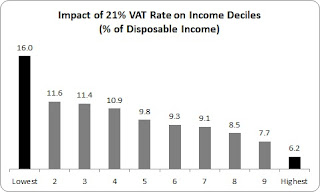
Unsurprisingly, the 21 percent VAT rate has a higher impact on the disposable income of the lowest income groups (16 percent), compared to the highest income groups (6.2 percent). Again, unsurprisingly, average income groups also face a higher burden than high income groups.
This is consistent with the findings from the study by the Combat Poverty Agency/ESRI, which showed that ten years ago total VAT and excise taxes made up more than 20 percent of the gross income of the lowest decile, compared to less than 10 percent of the highest income groups.
So the 21 percent VAT rate hits the lowest income households by more than two-and-a-half times the highest income groups. So much for the Minister’s claim.
But the ESRI researchers also measured the impact of increasing the VAT rate to 23 percent – as the Minister is proposing (again, a tabular estimate of Figure 10 in the report).

Increasing VAT will impact harder on lower income groups – by 1 percent compared to less than 0.4 percent for higher income groups. Again, so much for the Minister’s groundless claim that increasing VAT ‘will not impact as much on the poor as on the well-off people.’
Budget 2011 was bad enough. The low-paid were disproportionately hit through the introduction of the Universal Charge and the reduction of personal tax credits (which amounted to a flat-rate increase in income tax).
But the Minister’s planned VAT rate is even worse for it will not just hit people at work. It will hit everyone, including those on social protection payments (pensioners, widows/ers, unemployed, lone parents, etc.). And the lowest decile group is made up of people living in some of the worst forms of absolute deprivation.
All this has to be set in the wider context. This year, social protection recipients of working age (that is, excluding pensioners) saw their real payments – after inflation – fall by -5.2 percent. Whatever about the leaks regarding Budget 2012, we can reasonably assume that social protection payments will not increase. With the Government’s projected inflation rate, real payments will fall by -1.2 percent. That’s just a start.
Now add in the VAT increases and real incomes will fall further. And that’ s before the myriad of cuts and freezes are applied to child payments, rent and mortgage supplements, etc. It’s looking like another grim year for the poorest in society.
If I were Minister and wanted to protect the living standards of the highest income groups in the state, I would be doing exactly what Michael Noonan is doing – increasing VAT and introducing flat-rate taxes on households. That’s the ticket.
‘It (the VAT increase) will apply to everybody who purchases things but obviously rich people have a lot more disposable income than poor people and rich people will buy a lot more and will pay a lot more VAT. There’s no VAT of any sort on food and poor people spend a very large proportion of their budget on food so it will not impact as much on the poor as on the well-off people.’
This is wrong. Full stop. It is well known that consumption taxes impact on lower income groups more as they consume most of their income. Indeed, the Minister (or his advisors) would be well aware of a recent study published in the Economic and Social Review in the summer, ‘The Distributional Effects of Value Added Tax in Ireland’ by ESRI researchers Eimear Leahy, Sean Lyons and Richard Tol. They studied the impact of VAT and VAT rises on income deciles – from the lowest 10 percent income to the top (this is a tabular estimate of Figure 10 in the report).

Unsurprisingly, the 21 percent VAT rate has a higher impact on the disposable income of the lowest income groups (16 percent), compared to the highest income groups (6.2 percent). Again, unsurprisingly, average income groups also face a higher burden than high income groups.
This is consistent with the findings from the study by the Combat Poverty Agency/ESRI, which showed that ten years ago total VAT and excise taxes made up more than 20 percent of the gross income of the lowest decile, compared to less than 10 percent of the highest income groups.
So the 21 percent VAT rate hits the lowest income households by more than two-and-a-half times the highest income groups. So much for the Minister’s claim.
But the ESRI researchers also measured the impact of increasing the VAT rate to 23 percent – as the Minister is proposing (again, a tabular estimate of Figure 10 in the report).

Increasing VAT will impact harder on lower income groups – by 1 percent compared to less than 0.4 percent for higher income groups. Again, so much for the Minister’s groundless claim that increasing VAT ‘will not impact as much on the poor as on the well-off people.’
Budget 2011 was bad enough. The low-paid were disproportionately hit through the introduction of the Universal Charge and the reduction of personal tax credits (which amounted to a flat-rate increase in income tax).
But the Minister’s planned VAT rate is even worse for it will not just hit people at work. It will hit everyone, including those on social protection payments (pensioners, widows/ers, unemployed, lone parents, etc.). And the lowest decile group is made up of people living in some of the worst forms of absolute deprivation.
All this has to be set in the wider context. This year, social protection recipients of working age (that is, excluding pensioners) saw their real payments – after inflation – fall by -5.2 percent. Whatever about the leaks regarding Budget 2012, we can reasonably assume that social protection payments will not increase. With the Government’s projected inflation rate, real payments will fall by -1.2 percent. That’s just a start.
Now add in the VAT increases and real incomes will fall further. And that’ s before the myriad of cuts and freezes are applied to child payments, rent and mortgage supplements, etc. It’s looking like another grim year for the poorest in society.
If I were Minister and wanted to protect the living standards of the highest income groups in the state, I would be doing exactly what Michael Noonan is doing – increasing VAT and introducing flat-rate taxes on households. That’s the ticket.
Subscribe to:
Posts (Atom)