
Showing posts with label VAT. Show all posts
Showing posts with label VAT. Show all posts
Tuesday, 3 January 2012
Taxing questions
The VAT increase announced in Budget 2012 (and flagged some time before) came into increase on January 1st, and yesterday TASC Director Nat O'Connor had an opinion piece in the Irish Times highlighting the regressive distributional impact of consumption taxes - and pointing out some of the flaws in the argument that increasing consumption taxes in preference to taxes on income or wealth leaves us with more 'choice'. You can read the full article here.


Sunday, 4 December 2011
More tax questions than answers
Sheila Killian: The 2012 Estimates published over the weekend make for interesting reading in the context of what has already been leaked from the budget. In particular, the tax forecasts raise two or three questions. With luck, answers will be provided when we get more details on the budget proposals next week.
The first thing to note is that for all taxes the take in 2012 is predicted to be at least as high, if not higher, than that in 2011. The msot striking prediction is on Income Tax. Despite Leo Varadkar's promise that there will be no tax change affecting people's incomes, the take is predicted to rise from 13.8 billion to ust over 15 billion. That's a 9% increase. If there's really no change to Income Tax, that could mean that what's being forecast here is some combination of nine per cent more people working and paying in tax in Ireland, or nine per cent pay increases across the board. Neither of these seems likely in 2012, especially in light of the predicted increase in Corporation Tax - presumably mirroring company profits in Ireland - of less than 2%. Perhaps the tax take will be increased by changes to the Universal Social Charge, the bands or a reduction in credits. Or perhaps the base is being broadened, or avoidance is to be tackled in a very significant way. Either way, it will be interesting to learn how this increase is revenue is to be achieved.
The take from Capital Acquisitions Tax is expected to rise by 6%, following a reform of the rules. Capital Gains Tax revenue is expected to stay static, despite a widely-flagged rate increase. This isn't surprising, given the scarcity of gains these days. Nonetheless, a higher rate will eventually bring in more revenue, and should also dampen the enthusiasm for tax schemes based around re-characterising income as gains. Customs, Excise and Stamp Duties are also predicted to remain fairly flat in 2012.
On VAT, despite the 2% increase to the top rate promised in the leaked documents, the overall take in 2012 is expected remain fairly steady at 9.76 billion, increasing by less than 1%. This makes a certain amount of sense - when prices rise, people wil buy less. Still, it begs a more fundamental question, why bother with a regressive and controversial change that is not expected to bring in much-needed revenue? I think we may return to this question, after the clarification of the budget speeches.
The first thing to note is that for all taxes the take in 2012 is predicted to be at least as high, if not higher, than that in 2011. The msot striking prediction is on Income Tax. Despite Leo Varadkar's promise that there will be no tax change affecting people's incomes, the take is predicted to rise from 13.8 billion to ust over 15 billion. That's a 9% increase. If there's really no change to Income Tax, that could mean that what's being forecast here is some combination of nine per cent more people working and paying in tax in Ireland, or nine per cent pay increases across the board. Neither of these seems likely in 2012, especially in light of the predicted increase in Corporation Tax - presumably mirroring company profits in Ireland - of less than 2%. Perhaps the tax take will be increased by changes to the Universal Social Charge, the bands or a reduction in credits. Or perhaps the base is being broadened, or avoidance is to be tackled in a very significant way. Either way, it will be interesting to learn how this increase is revenue is to be achieved.
The take from Capital Acquisitions Tax is expected to rise by 6%, following a reform of the rules. Capital Gains Tax revenue is expected to stay static, despite a widely-flagged rate increase. This isn't surprising, given the scarcity of gains these days. Nonetheless, a higher rate will eventually bring in more revenue, and should also dampen the enthusiasm for tax schemes based around re-characterising income as gains. Customs, Excise and Stamp Duties are also predicted to remain fairly flat in 2012.
On VAT, despite the 2% increase to the top rate promised in the leaked documents, the overall take in 2012 is expected remain fairly steady at 9.76 billion, increasing by less than 1%. This makes a certain amount of sense - when prices rise, people wil buy less. Still, it begs a more fundamental question, why bother with a regressive and controversial change that is not expected to bring in much-needed revenue? I think we may return to this question, after the clarification of the budget speeches.
Monday, 21 November 2011
Bad plan, false arguments
Michael Taft: The Minister for Finance’s comments justifying VAT increases are deeply worrying, for they evince either considerable unfamiliarity with basic economic facts; or considerable indifference to such facts in pursuit of a particular agenda. Here’s what he had to say on RTE (22 minutes in):
‘It (the VAT increase) will apply to everybody who purchases things but obviously rich people have a lot more disposable income than poor people and rich people will buy a lot more and will pay a lot more VAT. There’s no VAT of any sort on food and poor people spend a very large proportion of their budget on food so it will not impact as much on the poor as on the well-off people.’
This is wrong. Full stop. It is well known that consumption taxes impact on lower income groups more as they consume most of their income. Indeed, the Minister (or his advisors) would be well aware of a recent study published in the Economic and Social Review in the summer, ‘The Distributional Effects of Value Added Tax in Ireland’ by ESRI researchers Eimear Leahy, Sean Lyons and Richard Tol. They studied the impact of VAT and VAT rises on income deciles – from the lowest 10 percent income to the top (this is a tabular estimate of Figure 10 in the report).
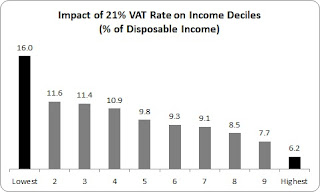
Unsurprisingly, the 21 percent VAT rate has a higher impact on the disposable income of the lowest income groups (16 percent), compared to the highest income groups (6.2 percent). Again, unsurprisingly, average income groups also face a higher burden than high income groups.
This is consistent with the findings from the study by the Combat Poverty Agency/ESRI, which showed that ten years ago total VAT and excise taxes made up more than 20 percent of the gross income of the lowest decile, compared to less than 10 percent of the highest income groups.
So the 21 percent VAT rate hits the lowest income households by more than two-and-a-half times the highest income groups. So much for the Minister’s claim.
But the ESRI researchers also measured the impact of increasing the VAT rate to 23 percent – as the Minister is proposing (again, a tabular estimate of Figure 10 in the report).

Increasing VAT will impact harder on lower income groups – by 1 percent compared to less than 0.4 percent for higher income groups. Again, so much for the Minister’s groundless claim that increasing VAT ‘will not impact as much on the poor as on the well-off people.’
Budget 2011 was bad enough. The low-paid were disproportionately hit through the introduction of the Universal Charge and the reduction of personal tax credits (which amounted to a flat-rate increase in income tax).
But the Minister’s planned VAT rate is even worse for it will not just hit people at work. It will hit everyone, including those on social protection payments (pensioners, widows/ers, unemployed, lone parents, etc.). And the lowest decile group is made up of people living in some of the worst forms of absolute deprivation.
All this has to be set in the wider context. This year, social protection recipients of working age (that is, excluding pensioners) saw their real payments – after inflation – fall by -5.2 percent. Whatever about the leaks regarding Budget 2012, we can reasonably assume that social protection payments will not increase. With the Government’s projected inflation rate, real payments will fall by -1.2 percent. That’s just a start.
Now add in the VAT increases and real incomes will fall further. And that’ s before the myriad of cuts and freezes are applied to child payments, rent and mortgage supplements, etc. It’s looking like another grim year for the poorest in society.
If I were Minister and wanted to protect the living standards of the highest income groups in the state, I would be doing exactly what Michael Noonan is doing – increasing VAT and introducing flat-rate taxes on households. That’s the ticket.
‘It (the VAT increase) will apply to everybody who purchases things but obviously rich people have a lot more disposable income than poor people and rich people will buy a lot more and will pay a lot more VAT. There’s no VAT of any sort on food and poor people spend a very large proportion of their budget on food so it will not impact as much on the poor as on the well-off people.’
This is wrong. Full stop. It is well known that consumption taxes impact on lower income groups more as they consume most of their income. Indeed, the Minister (or his advisors) would be well aware of a recent study published in the Economic and Social Review in the summer, ‘The Distributional Effects of Value Added Tax in Ireland’ by ESRI researchers Eimear Leahy, Sean Lyons and Richard Tol. They studied the impact of VAT and VAT rises on income deciles – from the lowest 10 percent income to the top (this is a tabular estimate of Figure 10 in the report).

Unsurprisingly, the 21 percent VAT rate has a higher impact on the disposable income of the lowest income groups (16 percent), compared to the highest income groups (6.2 percent). Again, unsurprisingly, average income groups also face a higher burden than high income groups.
This is consistent with the findings from the study by the Combat Poverty Agency/ESRI, which showed that ten years ago total VAT and excise taxes made up more than 20 percent of the gross income of the lowest decile, compared to less than 10 percent of the highest income groups.
So the 21 percent VAT rate hits the lowest income households by more than two-and-a-half times the highest income groups. So much for the Minister’s claim.
But the ESRI researchers also measured the impact of increasing the VAT rate to 23 percent – as the Minister is proposing (again, a tabular estimate of Figure 10 in the report).

Increasing VAT will impact harder on lower income groups – by 1 percent compared to less than 0.4 percent for higher income groups. Again, so much for the Minister’s groundless claim that increasing VAT ‘will not impact as much on the poor as on the well-off people.’
Budget 2011 was bad enough. The low-paid were disproportionately hit through the introduction of the Universal Charge and the reduction of personal tax credits (which amounted to a flat-rate increase in income tax).
But the Minister’s planned VAT rate is even worse for it will not just hit people at work. It will hit everyone, including those on social protection payments (pensioners, widows/ers, unemployed, lone parents, etc.). And the lowest decile group is made up of people living in some of the worst forms of absolute deprivation.
All this has to be set in the wider context. This year, social protection recipients of working age (that is, excluding pensioners) saw their real payments – after inflation – fall by -5.2 percent. Whatever about the leaks regarding Budget 2012, we can reasonably assume that social protection payments will not increase. With the Government’s projected inflation rate, real payments will fall by -1.2 percent. That’s just a start.
Now add in the VAT increases and real incomes will fall further. And that’ s before the myriad of cuts and freezes are applied to child payments, rent and mortgage supplements, etc. It’s looking like another grim year for the poorest in society.
If I were Minister and wanted to protect the living standards of the highest income groups in the state, I would be doing exactly what Michael Noonan is doing – increasing VAT and introducing flat-rate taxes on households. That’s the ticket.
Thursday, 12 August 2010
VAT paid by people on low incomes
Nat O'Connor: This is a follow up to comments on the Corporation Tax post about VAT.
As was pointed out to me, although the main VAT rate is 21%, this means that for every €100 I spend, €17.35 is tax (i.e. 17.35 per cent). That is because €82.65 plus VAT at 21 per cent is €100. (That is, €100 minus €82.65 equals €17.35).
Similarly, if I buy things at the 13.5% reduced VAT rate, I pay €11.90 per €100. And I pay €4.58 per €100 at the 4.8% super reduced VAT rate.
Let's work out how much VAT I might pay if I was on a low income.
The Vincentians (http://www.budgeting.ie/) provide typical weekly baskets of goods in their analyses. Let’s imagine that I am living on an example weekly household budget they give, as follows:
But let’s just stick with the €147.06 total for the moment. I got more details on Ireland’s VAT from an EU publication. This gives the following information about VAT, based on the above spending:

That’s surprises me, as I thought it would be higher given that I usually think about VAT at the standard rate of 21%. (Please let me know if I have missed something important in this calculation!)
I think I can reasonably include the TV licence as another €3.50 tax, for €11.99 total (8.1 per cent of my spending). Carbon tax, Excise, etc. are also relevant, but I haven’t time to make a full study out of this.
Nearly €12 paid in tax is highly relevant in the real-life context that the Vincentians are describing, where the family in question had a shortfall of €26.59 in making ends meet every week.
It also cannot be said, as one Government minister did recently, than many half of households in Ireland are “not paying a bob of tax”.
As was pointed out to me, although the main VAT rate is 21%, this means that for every €100 I spend, €17.35 is tax (i.e. 17.35 per cent). That is because €82.65 plus VAT at 21 per cent is €100. (That is, €100 minus €82.65 equals €17.35).
Similarly, if I buy things at the 13.5% reduced VAT rate, I pay €11.90 per €100. And I pay €4.58 per €100 at the 4.8% super reduced VAT rate.
Let's work out how much VAT I might pay if I was on a low income.
The Vincentians (http://www.budgeting.ie/) provide typical weekly baskets of goods in their analyses. Let’s imagine that I am living on an example weekly household budget they give, as follows:
- €40 on Food;
- €10.50 on Travel;
- €63.00 on Housekeeping;
- €19.24 on Clothing;
- €11.00 on Rent;
- €4.00 on Education.
But let’s just stick with the €147.06 total for the moment. I got more details on Ireland’s VAT from an EU publication. This gives the following information about VAT, based on the above spending:
- Basic food has 0% VAT, but some processed food attracts 4.8% or 13.5%. Let’s split this three ways across my €40;
- Travel is exempt from VAT;
- Housekeeping includes ESB, fuel, telephone, TV licence (€3.50 a week), cleaning products, pocket money for kids, bus fares, chemist and €8 for social life. I’m going to assume 0% VAT for most of this, except for (a) the €8 social life, which I am going to allocate to two pints of beer at €4 each (VAT 21%), and (b) €10 telephone and €5 on cleaning materials at 21% VAT;
- Clothing and shoes include 13.5% VAT;
- Rent in social housing includes 13.5% VAT;
- I’m going to count Education as 0% VAT as well (e.g. books are 0% as I’m not sure about education services; although newspapers include 13.5% VAT).
In this scenario, my VAT tax bill will come to €8.49 out of the €147.06 I spent; that is 5.75 per cent of my spending.

That’s surprises me, as I thought it would be higher given that I usually think about VAT at the standard rate of 21%. (Please let me know if I have missed something important in this calculation!)
I think I can reasonably include the TV licence as another €3.50 tax, for €11.99 total (8.1 per cent of my spending). Carbon tax, Excise, etc. are also relevant, but I haven’t time to make a full study out of this.
Nearly €12 paid in tax is highly relevant in the real-life context that the Vincentians are describing, where the family in question had a shortfall of €26.59 in making ends meet every week.
It also cannot be said, as one Government minister did recently, than many half of households in Ireland are “not paying a bob of tax”.
For contrast, in a 2010 report (on 2008 data) Revenue reports 56 cases of people earning more than €250,000 and paying less than 5% effective income tax. If we imagine €50,000 of this income is spent on goods at 21% VAT, this comes to another 3.5% of their income; that is, less than 8.5% tax in total. So on a very low income (€7,682 per year), I could be paying close to the same proportion of my income on tax as someone earning a quarter of a million euro!
And unlike people on high incomes, who can avail of many tax breaks, there is no relief from VAT for people with insufficient incomes to buy the essentials. Instead, many people on low incomes go to moneylenders who can legally charge 150% interest or more (see for example Life and Debt, TASC's latest report).
Saturday, 23 January 2010
VAT and local authorities
An Saoi: We were directed by Europe some time ago that VAT must be charged by Local Authorities on certain services such as parking, waste disposal and entry into leisure facilities. Competitors had to charge it and as such it is appropriate that State & Municipal bodies should have to do so also. It was well know that this was going to occur and just as happened in relation to toll charges, we dragged our feet. The original Court Case in relation to those charges took place in 1997 and the law was finally amended here from 1st July 2001.
The extension of VAT to these services is an opportunity to reduce the standard rate of VAT to 20% and ensure that the adjustment is at least neutral to the economy. Adding VAT to those charges is very close to pure income for the Government as the allowable VAT inputs credits are very small.
A further reduction in VAT with effect from 1st July 2010 is just what a tired economy might need.
The extension of VAT to these services is an opportunity to reduce the standard rate of VAT to 20% and ensure that the adjustment is at least neutral to the economy. Adding VAT to those charges is very close to pure income for the Government as the allowable VAT inputs credits are very small.
A further reduction in VAT with effect from 1st July 2010 is just what a tired economy might need.
Subscribe to:
Posts (Atom)