Colm O'Doherty: Earlier this year, in Davos, Enda Kenny spoke about moral failure and its responsibility for our economic crash. He said that easy access to credit had spawned greed to a point where it just went out of control completely and ended with a spectacular crash. There was an immediate outcry in Ireland on foot of his comments and he was accused of playing the blame game. However, with the referendum on the fiscal treaty now being debated across the country, it is timely to ask some hard questions about ourselves – can we be trusted run our own affairs in a fair, just and moral way? If we are not externally regulated, do we run the risk of handing over our country to greedy business people and greedy politicians as we have repeatedly done over the past thirty years? Greedy capitalism and the inequalities it rests on, triggered the economic crash.
As Finnish academic Antti Kauppinen points out the sub-prime loans given out in the US to poor people, who because of historical injustices were unable to access mainstream credit, triggered the world wide crash. Inequality lit the fuse which started the meltdown in the US. Inequality in Ireland has been well documented by Combat Poverty, the Irish Anti-Poverty Network and the OECD. Our fiscal policies are the core problem here. The policies which spawned our economic crisis have their origins in Leinster House rather than Brussels. Regressive taxation policies which re-distributed income from the least well off to the middle and upper classes through tax breaks encouraged reckless property speculation. These policies have been repeatedly endorsed by the electorate over the past twenty years. The tax base has been narrowed to a point where we have an extremely low tax-to-GDP ratio. At 28.2% in 2009, the total tax-to-GDP ratio here was the third lowest in the EU and the second lowest in the euro area. The ratio in Denmark for the same period stood at 48.1%. It is no wonder that we are reliant on bail-outs from the EU to fund public services. Clearly the State cannot fund essential education, social protection, activation and health services on an income which is lower than that achieved in Slovakia and Bulgaria. While this ratio was on an upward trend between 2002 and 2006, it has decreased by four percentage points from 2006 to 2009.
As Antti Kauppinen, commenting on the layers of greed capitalism which were enshrined in our tax system, said in a recent address to the Policy Unit in TCD:
In Ireland, we know the ethos of greed reached the highest offices in the land . From an outsider’s perspective, the number of former Taoisceachs and ministers hauled in front of tribunals is comical. If the elected representatives of people use their position for personal enrichment at the expense of ordinary people, why would businessmen hold themselves to higher standards? As if personal example wasn’t enough, Ireland as a country has pursued its self-interest at the expense of others with its now sacrosanct low corporate tax rate.
So rather than scapegoating the EU for the inequalities which have been key to the inflation of our home-grown economic bubble, we now need their assistance in protecting us from ourselves. We need to raise our corporation tax to pay for our public services. We need to widen our tax base so that the high earners and wealthy members of Irish society pay their fair share. The path to follow is greater austerity for the rich. At present a person earning over 32,800 Euro enters the 41% top tax rate and is paying the same rate of tax as an individual earning multiples of their income. Structural inequalities in Irish society are patterned by the differential opportunities available to individuals to gain economic, social and cultural capital. In simple terms, the dice are loaded in favour of the well- off promoting their class interests through a tax system which takes no account of their favoured position in an unequal society. Their social contract is more important and is afforded a superior status - they cannot be required to shoulder a greater share of the financial burden resulting from our economic crash because this would cause them to flee abroad.
By increasing the tax revenues available to the State we can reduce our level of borrowing from the EU and the IMF. At the very least, if taxing the rich is not an option, then they should have to pay more for services and receive less in state support so that funds can be directed at the most vulnerable and disadvantaged in society. These are direct actions which can be taken here and now by Irish citizens. It should be obvious to everybody that a myth that was used as a fig leaf for our Irish model of greedy capitalism - that American levels of tax (low) can produce Scandinavian levels of public services (high quality and expensive) - was just a myth. What is hard to understand is why anti-treaty voices on the left have decided that the enemy is the EU, when it is clearly our own brand of greedy capitalism which has forced austerity on the less well-off citizens of our state. It is not hard to understand why the 'no' campaigners on the right want to blame the EU and cut us loose from fiscal regulation. Libertas and other neo-liberal voices supporting unfettered and de regulated capitalism are opposed to the managed capitalism promoted by the EU. Sinn Fein’s implicit view that everything native is good and that everything foreign is bad is consistent but doesn’t square with the facts.
Citizens voting on the treaty need to seriously think about the damage caused to our society by home-grown taxation policies which have clearly favoured the well-off and re-distributed funding from public services to speculators. They need then to make links between our fiscal insolvency, the ongoing need for financial support from the EU and these inequitable and unsustainable taxation policies.

Showing posts with label Fiscal Stability Treaty. Show all posts
Showing posts with label Fiscal Stability Treaty. Show all posts
Tuesday, 29 May 2012


Tuesday, 8 May 2012
Will the Fiscal Treaty Cost Us?
Michael Taft: Will the Fiscal Treaty – in particular, the notorious structural deficit rule – require additional austerity? John McHale of the Fiscal Council says it won’t. He accepts that in 2015 the gap between the Department of Finance’s projected structural deficit (3.5 percent) and the Fiscal Treaty target (0.5 percent) is €5.4 billion. But then he argues that growth can wipe that deficit out:
‘Growth affects both the denominator and the numerator of the structural deficit as a share of GDP. (For simplicity I assume that actual and potential GDP grow at equal rates post 2015.) The denominator effect is straightforward. For the numerator, we could use the standard coefficient used by the European Commission for Ireland that assumes that the reduction in the deficit is 0.4 times the change in nominal GDP. (This coefficient is usually used for doing cyclical adjustments, but it should also be applicable for measuring the impact of changes in nominal potential GDP on structural balance in the absence of discretionary adjustments to tax and expenditure parameters.)’
On this basis John does some calculations – using a more conservative co-efficient of 0.2. He finds the structural deficit is effectively wiped out by 2019 / 2020 without any additional austerity because growth has done all the heavy lifting.
I would suggest that this line of argument is flawed. First, I assume the co-efficient he uses refers to the cyclical sensitivity measurement of 0.4. This measurement is used to deconstruct the deficit into its ‘cyclical’ and ‘structural’ components. Essentially, you measure the gap between the real GDP and potential GDP growth and then apply the 0.4 to see how much of the gap is cyclical.
And herein lies the first problem – the 0.4 is an instrument to define the cyclical component of the output gap. It is not a measurement which defines the relationship between nominal growth rates and deficit reduction – whether it is the general or structural deficit. It is analogous to using a car clamp to change a light bulb. It is the wrong instrument. As the Department of Finance puts it:
‘Indeed, by definition, reducing the structural element of the deficit will require policy action. . . .‘
The whole point of structural deficit measurements is to determine what the deficit will be when the economy returns to full capacity. If the economy is firing on all cylinders and there is still a deficit, then the Government must take policy action to correct this, because growth cannot.
In doing his calculations, John assumes that real and potential GDP grow at the same rate. Never mind that the Government estimates that real GDP is growing at twice the rate of potential GDP in 2015 (yes, I know, this suggest that the economy is ‘over-heating’ – one of the absurdities with the model that the Department of Finance is using). If the output gap is zero, there is no role for applying the 0.4 co-efficient because there is no cyclical component to measure.
Seamus Coffey does his own calculations based on John’s more conservative co-efficient of 0.2 and applies it to GDP growth (though Seamus does say ‘There is no way of knowing what this’ co-efficient is). He comes up with a similar result to John.
But there is a problem here. Why use a conservative 0.2 co-efficient? If you believe that 0.4 tells the story, go with it. And why, use a nominal growth rate of 3.5 percent? The Government claims that in 2015 the nominal growth rate is 4.5 percent. So let’s go with that.
What do we get? We find that the structural deficit turns into a structural surplus without doing anything.

And what a surplus! By 2019 we will have a structural surplus of 2.5 percent. We outdo even the Germans. We get to go to the top of the class.
Is this likely? No. But we don’t have to argue the toss about cyclical sensitivity measurements or coefficients of elasticity. We merely have to go to the IMF’s own projection – which helps because (a) they stretch out to 2017 and (b) they assume, like John, no fiscal adjustment after 2015. What do they find?

In percentage terms, the reduction in the structural deficit is minimal: less than 0.1 percent of GDP each year.
But why should this surprise us? If there is deficit left over after the output gap is closed (after the economy returns to full capacity), what remains is the structural deficit which requires ‘policy action’ to reduce.
Political Implications
But there’s more to all this than duelling statistics. The Government and their austerity supporters have co-opted the language of progressives to avoid answering a fundamental question: what the cost of the Fiscal Treaty will be in terms of future austerity measures. They are now talking about ‘growth’ being the main instrument of deficit-reduction. The Government has even gone so far as to say that investment will grow the productive capacity and, therefore, reduce the deficit. Some of us have been saying that since the start of the crisis – UNITE and the trade union movement, TASC, contributors on Progressive-Economy; all we got was ridicule and scorn.
Here’s how the Department of Finance puts it:
‘Indeed, by definition, reducing the structural element of the deficit will require policy action, though not necessarily taxation and expenditure adjustments. Other options are available . . . . Such measures include labour market reforms - some of which are already in train - together with investment in technology and infrastructure to boost the productive capacity of the economy. To this end, the Government has established NewERA and the Strategic Investment Fund . . .
This ambitious programme of microeconomic reforms, by boosting the productive capacity of the economy, is expected to help reduce the structural element of the deficit by the middle part of the decade. For example, reforms along the lines of those set out in the Action Plan for Jobs 2012 and the Pathways to Work initiative, aimed at addressing some of the skills mis-match in the labour market, should help lower the unemployment rate. This would have a structurally beneficial impact on the public finances, on both the revenue and expenditure sides. In other words, the structural fiscal position is set to improve with these microeconomic reforms.’
And, yet, yet – the Government still refuses to provide a projection for this. If they are convinced that investment and labour market reforms will boost our productivity, they can project this – through the ‘potential GDP’ which measures the contribution of labour, capital and productivity.
This is all a charade. At the same time as the Government is assuring us that growing our potential GDP will reduce the structural deficit, they are actually revising downwards potential GDP.

In the last budget, the Government projected that our productive capacity would grow by 3.4 percent between 2010 and 2015. Only a few months later, the Government is now projecting growth at 2.4 percent. This revision downwards reflects their lower GDP projections.
In other words, we are going forward by going backwards.
This is the ultimate game plan. Stonewall any questions about the cost of the Fiscal Treaty with talk of growing our productive capacity even as you revise downwards our productive capacity. ‘Prove’ that growth will reduce the structural deficit by using variables that have little reference to structural deficit reduction. But don’t ‘prove’ it too much because it will look nonsensical. Ignore what current projections (IMF) have to say about all this. Even ignore the definition of a structural deficit. Above all, abandon your austerity clothes and don the robes of an expansionary programme – even as you promise to cut public investment next year and cut spending on public services and social protection by even more than you did this year.
Do all this. But don’t call it austerity.
‘Growth affects both the denominator and the numerator of the structural deficit as a share of GDP. (For simplicity I assume that actual and potential GDP grow at equal rates post 2015.) The denominator effect is straightforward. For the numerator, we could use the standard coefficient used by the European Commission for Ireland that assumes that the reduction in the deficit is 0.4 times the change in nominal GDP. (This coefficient is usually used for doing cyclical adjustments, but it should also be applicable for measuring the impact of changes in nominal potential GDP on structural balance in the absence of discretionary adjustments to tax and expenditure parameters.)’
On this basis John does some calculations – using a more conservative co-efficient of 0.2. He finds the structural deficit is effectively wiped out by 2019 / 2020 without any additional austerity because growth has done all the heavy lifting.
I would suggest that this line of argument is flawed. First, I assume the co-efficient he uses refers to the cyclical sensitivity measurement of 0.4. This measurement is used to deconstruct the deficit into its ‘cyclical’ and ‘structural’ components. Essentially, you measure the gap between the real GDP and potential GDP growth and then apply the 0.4 to see how much of the gap is cyclical.
And herein lies the first problem – the 0.4 is an instrument to define the cyclical component of the output gap. It is not a measurement which defines the relationship between nominal growth rates and deficit reduction – whether it is the general or structural deficit. It is analogous to using a car clamp to change a light bulb. It is the wrong instrument. As the Department of Finance puts it:
‘Indeed, by definition, reducing the structural element of the deficit will require policy action. . . .‘
The whole point of structural deficit measurements is to determine what the deficit will be when the economy returns to full capacity. If the economy is firing on all cylinders and there is still a deficit, then the Government must take policy action to correct this, because growth cannot.
In doing his calculations, John assumes that real and potential GDP grow at the same rate. Never mind that the Government estimates that real GDP is growing at twice the rate of potential GDP in 2015 (yes, I know, this suggest that the economy is ‘over-heating’ – one of the absurdities with the model that the Department of Finance is using). If the output gap is zero, there is no role for applying the 0.4 co-efficient because there is no cyclical component to measure.
Seamus Coffey does his own calculations based on John’s more conservative co-efficient of 0.2 and applies it to GDP growth (though Seamus does say ‘There is no way of knowing what this’ co-efficient is). He comes up with a similar result to John.
But there is a problem here. Why use a conservative 0.2 co-efficient? If you believe that 0.4 tells the story, go with it. And why, use a nominal growth rate of 3.5 percent? The Government claims that in 2015 the nominal growth rate is 4.5 percent. So let’s go with that.
What do we get? We find that the structural deficit turns into a structural surplus without doing anything.
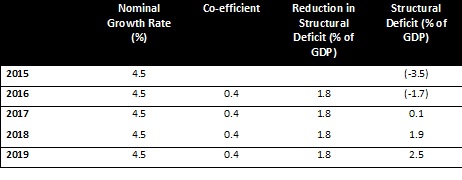
And what a surplus! By 2019 we will have a structural surplus of 2.5 percent. We outdo even the Germans. We get to go to the top of the class.
Is this likely? No. But we don’t have to argue the toss about cyclical sensitivity measurements or coefficients of elasticity. We merely have to go to the IMF’s own projection – which helps because (a) they stretch out to 2017 and (b) they assume, like John, no fiscal adjustment after 2015. What do they find?

In percentage terms, the reduction in the structural deficit is minimal: less than 0.1 percent of GDP each year.
But why should this surprise us? If there is deficit left over after the output gap is closed (after the economy returns to full capacity), what remains is the structural deficit which requires ‘policy action’ to reduce.
Political Implications
But there’s more to all this than duelling statistics. The Government and their austerity supporters have co-opted the language of progressives to avoid answering a fundamental question: what the cost of the Fiscal Treaty will be in terms of future austerity measures. They are now talking about ‘growth’ being the main instrument of deficit-reduction. The Government has even gone so far as to say that investment will grow the productive capacity and, therefore, reduce the deficit. Some of us have been saying that since the start of the crisis – UNITE and the trade union movement, TASC, contributors on Progressive-Economy; all we got was ridicule and scorn.
Here’s how the Department of Finance puts it:
‘Indeed, by definition, reducing the structural element of the deficit will require policy action, though not necessarily taxation and expenditure adjustments. Other options are available . . . . Such measures include labour market reforms - some of which are already in train - together with investment in technology and infrastructure to boost the productive capacity of the economy. To this end, the Government has established NewERA and the Strategic Investment Fund . . .
This ambitious programme of microeconomic reforms, by boosting the productive capacity of the economy, is expected to help reduce the structural element of the deficit by the middle part of the decade. For example, reforms along the lines of those set out in the Action Plan for Jobs 2012 and the Pathways to Work initiative, aimed at addressing some of the skills mis-match in the labour market, should help lower the unemployment rate. This would have a structurally beneficial impact on the public finances, on both the revenue and expenditure sides. In other words, the structural fiscal position is set to improve with these microeconomic reforms.’
And, yet, yet – the Government still refuses to provide a projection for this. If they are convinced that investment and labour market reforms will boost our productivity, they can project this – through the ‘potential GDP’ which measures the contribution of labour, capital and productivity.
This is all a charade. At the same time as the Government is assuring us that growing our potential GDP will reduce the structural deficit, they are actually revising downwards potential GDP.

In the last budget, the Government projected that our productive capacity would grow by 3.4 percent between 2010 and 2015. Only a few months later, the Government is now projecting growth at 2.4 percent. This revision downwards reflects their lower GDP projections.
In other words, we are going forward by going backwards.
This is the ultimate game plan. Stonewall any questions about the cost of the Fiscal Treaty with talk of growing our productive capacity even as you revise downwards our productive capacity. ‘Prove’ that growth will reduce the structural deficit by using variables that have little reference to structural deficit reduction. But don’t ‘prove’ it too much because it will look nonsensical. Ignore what current projections (IMF) have to say about all this. Even ignore the definition of a structural deficit. Above all, abandon your austerity clothes and don the robes of an expansionary programme – even as you promise to cut public investment next year and cut spending on public services and social protection by even more than you did this year.
Do all this. But don’t call it austerity.
Thursday, 3 May 2012
The Fiscal Compact - crisis resolution?
Tom McDonnell: Sebastian Dullien has a useful piece on the Fiscal Compact over at the Social Europe Journal.
Sebastian correctly argues that none of the Fiscal Compact rules will make a direct impact on fiscal policy for at least half a decade. In part this is because most countries are already in an Excessive Deficit Procedure (EDP) agreed with the European Commission. Ireland’s current EDP ends in 2015. The Stability and Growth Pact and the Six Pack, rather than the Fiscal Compact, are driving the current austerity.
And the austerity itself is a major part of the problem. The cumulative effect of each Euro zone country accelerating the austerity drive is a recipe for prolonged stagnation and high unemployment across the continent. Sebastian calls for a longer adjustment period, a reorganisation of public investment financing with the European Investment Bank playing a central role and a move towards euro-bonds or some form of European debt redemption fund.
One hopeful sign is that Francois Hollande is evidently calling for the ESM to be given a banking licence. See here.
Germany will resist. Hollande’s success or failure on that issue will go a long way to determining the outcome of the crisis. With a banking licence the ESM (or indeed the EFSF) could perform real time unlimited Lender of Last Resort functions. Without such an institution in place it is difficult to see how the Euro can survive in the long run.
Sebastian correctly argues that none of the Fiscal Compact rules will make a direct impact on fiscal policy for at least half a decade. In part this is because most countries are already in an Excessive Deficit Procedure (EDP) agreed with the European Commission. Ireland’s current EDP ends in 2015. The Stability and Growth Pact and the Six Pack, rather than the Fiscal Compact, are driving the current austerity.
And the austerity itself is a major part of the problem. The cumulative effect of each Euro zone country accelerating the austerity drive is a recipe for prolonged stagnation and high unemployment across the continent. Sebastian calls for a longer adjustment period, a reorganisation of public investment financing with the European Investment Bank playing a central role and a move towards euro-bonds or some form of European debt redemption fund.
One hopeful sign is that Francois Hollande is evidently calling for the ESM to be given a banking licence. See here.
Germany will resist. Hollande’s success or failure on that issue will go a long way to determining the outcome of the crisis. With a banking licence the ESM (or indeed the EFSF) could perform real time unlimited Lender of Last Resort functions. Without such an institution in place it is difficult to see how the Euro can survive in the long run.
Wednesday, 2 May 2012
Terrence McDonough on the Fiscal Treaty
IRELAND MAY well need a second bailout after 2013. And as treaties are currently worded, a No vote on the fiscal compact treaty will forbid us from accessing funds from the European Stability Mechanism (ESM).
It is claimed this situation will result in disaster, and that even if we believe the fiscal treaty is a serious mistake, we have a gun to our head. In fact, Ireland will have a number of options in this event.
Click here to read the rest of Terrence McDonough's opinion piece in today's Irish Times.
It is claimed this situation will result in disaster, and that even if we believe the fiscal treaty is a serious mistake, we have a gun to our head. In fact, Ireland will have a number of options in this event.
Click here to read the rest of Terrence McDonough's opinion piece in today's Irish Times.
Tuesday, 24 April 2012
Ireland's financing alternatives - the EFSF
Tom McDonnell and Michael Taft: In our first post, we outlined some of Ireland’s financing alternatives; namely through the IMF and the European Stability Mechanism. There is, however, a more compelling source of institutional funding in the eventuality of a No vote: the European Financial Stability Facility (EFSF).
The EFSF is one of four external sources of funding for the current Irish bail-out (along with the IMF, the European Financial Stabilisation Mechanism, and bi-lateral loan agreements with the UK, Sweden and Denmark). The EFSF remains a source of funding for all Eurozone countries until the middle of next year.
The EFSF stands apart from the ESM and the Fiscal Treaty. Ireland, and all countries who are members of the EFSF, has access to this fund as of right, depending on the following conditions:
• They cannot access funding at reasonable rates on the international markets
• They have negotiated a Memorandum of Understanding with the EU and the IMF
A further stipulation is unanimous consent from the Finance Ministers of the Eurozone (Eurogroup), which would follow on from an agreement with the EU/IMF. Applications for this funding can be made up to the end of June 2013. After that the EFSF will only administer funding that has already been agreed.
According to the recent Eurogroup statement (the Finance Ministers of Eurozone countries):
‘For a transitional period until mid-2013, it (the EFSF) may engage in new programmes in order to ensure a full fresh lending capacity of EUR 500 billion (for the ESM).’
This is confirmed by the EFSF itself which states:
‘ . . . following the Eurogroup meeting held on 30 March, it was decided that the EFSF would remain active until July 2013 . . . For a transitional period until 2013, EFSF may engage in new programmes in order to ensure a full fresh lending capacity of €500 billion . . . after June 2013, EFSF [will] not enter into any new programmes.’
Therefore, were Ireland to apply for a second bail-out prior to July 1st 2013, it would be granted if such an application were accompanied by a Memorandum of Understanding negotiated between Ireland, the EU and the IMF – similar to the first bail-out. This funding is not contingent upon the ratification of the Fiscal Treaty.
In all probability, funding for Ireland’s second bail-out – whether it approves the Fiscal Treaty or not – will be routed through the EFSF. The EFSF (the temporary bailout fund in place up to July 2013) and the ESM (permanent bailout mechanism) are different companies. The EFSF has €440 billion (see page 1 of the EFSF document) of which €192 billion already committed to Ireland, Portugal and Greece (see the diagram on page 20 of the EFSF document). The remaining lending capacity of the EFSF for programmes initiated before July 2013 is therefore €248 billion. The EFSF will remain in place to manage its existing programmes (see diagram on page 20 of the EFSF document) and any other new programmes approved prior to July 2013, until such time as all these programmes are all wound down.
The ESM itself has €500 billion and is scheduled to enter force on 1 July 2012. As stated above, the intention would be to ensure the ESM retains its full lending capacity of €500 billion. This no doubt refers to the prospect of larger countries, in particular Spain, needing a bail-out. The ESM would require full capacity to accommodate new countries’ need for a bail-out.
Ireland’s continuing access to institutional funding beyond the current bail-out programme has been guaranteed not once, but twice, by the Heads of States and Government; first, on July 21st of last year when the establishment of the European Stability Mechanism was agreed, and most recently on January 30th of this year – after the Fiscal Treaty was signed:
‘We welcome the latest positive reviews of the Irish and Portuguese programmes which concluded that quantitative performance criteria and structural benchmarks have been met. We will continue to provide support to countries under a programme until they have regained market access, provided they successfully implement their programmes.’
This is an important and helpful guarantee. There is no condition set on continued support until we return to the markets – except that we implement agreed programmes. If continued support were contingent upon acceptance of the Treaty, we should have expected it to be highlighted in this statement.
This helps explain another issue we highlighted in the first post. The drafters of the European Stability Mechanism Treaty inserted clauses that provide manoeuvrability in negotiations with any Eurozone country in need of financing, regardless of the Fiscal Treaty. In particular, they inserted references to ‘new programmes under the European Stability Mechanism’, a clause which would have been unnecessary if all financing under the ESM were strictly conditional on a yes vote. They have seemingly factored in a situation whereby a second bail-out for Ireland (and potentially Portugal and Greece) would constitute ‘rolled-over’ financing, rather than ‘new’ financing. This buttresses the guarantee given by the Heads of States and Governments – namely that Ireland will continue to be supported until we return to the markets.
This is an important debate as there is a high probability that Ireland will require a second bail-out. We are expected to return to the markets in late 2013 and fully by 2014. However, the IMF is cautious:
‘Debt sustainability remains fragile, especially with respect to medium-term growth prospects . . . In this context, the prospects for regaining the substantial access to market funding that is assumed in 2013 remain uncertain.’
Were a second bail-out required, we estimate that it could be as large as €45 billion and possibly more for the years 2014 and 2015, taking into account the Exchequer balance and bond redemptions. This does not include bank payments. While this is less than the current bail-out provision it is clear that Ireland, without access to either market or institutional funding, would not be able to cope with this fiscally. We would be heading into a default – quite possibly on both sovereign and banking debt. This would have negative spillover effects for other Eurozone countries.
We reiterate the point from our first post: there is no reason to resort to counter-posing ‘appalling scenarios’. Some argue that Ireland will be frozen out of both market and institutional funding if we vote No. Clearly, this would be an appalling scenario. Others argue that it would never come to this because of the impact on the Eurozone (defaults, contagion) – another appalling scenario.
This is not a satisfactory way to debate this issue. This will trap us in a ‘race-to-disaster’ debate which will be particularly uninformative. We have attempted to outline concrete alternative funding scenarios for Ireland. Whether these would become available is a subject for legitimate debate. However, those who claim that Ireland would be denied access to EFSF funding – or any other funding sources – should provide concrete evidence to this effect. Evidence one way or the other would be a valuable contribution.
The debate over the Fiscal Treaty should be just that – a debate about the provisions of the Treaty. In this respect, it is helpful to note wider European developments. Spain has, unsurprisingly, officially re-entered recession putting at risk their deficit targets; the prospect of a Socialist Party victory in the French second-round Presidential vote raises the prospect of some renegotiation of the Fiscal Treaty; the fall of the Dutch government over failure to agree budget cuts highlights the problems posed by the Fiscal Compact in a major core country.
As Ireland prepares for the referendum vote, the ground under the Fiscal Treaty may already be shifting. Resort to ‘appalling scenarios’ will only confuse the issue when the debate should be focused on whether the provisions of the Fiscal Treaty are good, or even sustainable, for Ireland and the Eurozone.
The EFSF is one of four external sources of funding for the current Irish bail-out (along with the IMF, the European Financial Stabilisation Mechanism, and bi-lateral loan agreements with the UK, Sweden and Denmark). The EFSF remains a source of funding for all Eurozone countries until the middle of next year.
The EFSF stands apart from the ESM and the Fiscal Treaty. Ireland, and all countries who are members of the EFSF, has access to this fund as of right, depending on the following conditions:
• They cannot access funding at reasonable rates on the international markets
• They have negotiated a Memorandum of Understanding with the EU and the IMF
A further stipulation is unanimous consent from the Finance Ministers of the Eurozone (Eurogroup), which would follow on from an agreement with the EU/IMF. Applications for this funding can be made up to the end of June 2013. After that the EFSF will only administer funding that has already been agreed.
According to the recent Eurogroup statement (the Finance Ministers of Eurozone countries):
‘For a transitional period until mid-2013, it (the EFSF) may engage in new programmes in order to ensure a full fresh lending capacity of EUR 500 billion (for the ESM).’
This is confirmed by the EFSF itself which states:
‘ . . . following the Eurogroup meeting held on 30 March, it was decided that the EFSF would remain active until July 2013 . . . For a transitional period until 2013, EFSF may engage in new programmes in order to ensure a full fresh lending capacity of €500 billion . . . after June 2013, EFSF [will] not enter into any new programmes.’
Therefore, were Ireland to apply for a second bail-out prior to July 1st 2013, it would be granted if such an application were accompanied by a Memorandum of Understanding negotiated between Ireland, the EU and the IMF – similar to the first bail-out. This funding is not contingent upon the ratification of the Fiscal Treaty.
In all probability, funding for Ireland’s second bail-out – whether it approves the Fiscal Treaty or not – will be routed through the EFSF. The EFSF (the temporary bailout fund in place up to July 2013) and the ESM (permanent bailout mechanism) are different companies. The EFSF has €440 billion (see page 1 of the EFSF document) of which €192 billion already committed to Ireland, Portugal and Greece (see the diagram on page 20 of the EFSF document). The remaining lending capacity of the EFSF for programmes initiated before July 2013 is therefore €248 billion. The EFSF will remain in place to manage its existing programmes (see diagram on page 20 of the EFSF document) and any other new programmes approved prior to July 2013, until such time as all these programmes are all wound down.
The ESM itself has €500 billion and is scheduled to enter force on 1 July 2012. As stated above, the intention would be to ensure the ESM retains its full lending capacity of €500 billion. This no doubt refers to the prospect of larger countries, in particular Spain, needing a bail-out. The ESM would require full capacity to accommodate new countries’ need for a bail-out.
Ireland’s continuing access to institutional funding beyond the current bail-out programme has been guaranteed not once, but twice, by the Heads of States and Government; first, on July 21st of last year when the establishment of the European Stability Mechanism was agreed, and most recently on January 30th of this year – after the Fiscal Treaty was signed:
‘We welcome the latest positive reviews of the Irish and Portuguese programmes which concluded that quantitative performance criteria and structural benchmarks have been met. We will continue to provide support to countries under a programme until they have regained market access, provided they successfully implement their programmes.’
This is an important and helpful guarantee. There is no condition set on continued support until we return to the markets – except that we implement agreed programmes. If continued support were contingent upon acceptance of the Treaty, we should have expected it to be highlighted in this statement.
This helps explain another issue we highlighted in the first post. The drafters of the European Stability Mechanism Treaty inserted clauses that provide manoeuvrability in negotiations with any Eurozone country in need of financing, regardless of the Fiscal Treaty. In particular, they inserted references to ‘new programmes under the European Stability Mechanism’, a clause which would have been unnecessary if all financing under the ESM were strictly conditional on a yes vote. They have seemingly factored in a situation whereby a second bail-out for Ireland (and potentially Portugal and Greece) would constitute ‘rolled-over’ financing, rather than ‘new’ financing. This buttresses the guarantee given by the Heads of States and Governments – namely that Ireland will continue to be supported until we return to the markets.
This is an important debate as there is a high probability that Ireland will require a second bail-out. We are expected to return to the markets in late 2013 and fully by 2014. However, the IMF is cautious:
‘Debt sustainability remains fragile, especially with respect to medium-term growth prospects . . . In this context, the prospects for regaining the substantial access to market funding that is assumed in 2013 remain uncertain.’
Were a second bail-out required, we estimate that it could be as large as €45 billion and possibly more for the years 2014 and 2015, taking into account the Exchequer balance and bond redemptions. This does not include bank payments. While this is less than the current bail-out provision it is clear that Ireland, without access to either market or institutional funding, would not be able to cope with this fiscally. We would be heading into a default – quite possibly on both sovereign and banking debt. This would have negative spillover effects for other Eurozone countries.
We reiterate the point from our first post: there is no reason to resort to counter-posing ‘appalling scenarios’. Some argue that Ireland will be frozen out of both market and institutional funding if we vote No. Clearly, this would be an appalling scenario. Others argue that it would never come to this because of the impact on the Eurozone (defaults, contagion) – another appalling scenario.
This is not a satisfactory way to debate this issue. This will trap us in a ‘race-to-disaster’ debate which will be particularly uninformative. We have attempted to outline concrete alternative funding scenarios for Ireland. Whether these would become available is a subject for legitimate debate. However, those who claim that Ireland would be denied access to EFSF funding – or any other funding sources – should provide concrete evidence to this effect. Evidence one way or the other would be a valuable contribution.
The debate over the Fiscal Treaty should be just that – a debate about the provisions of the Treaty. In this respect, it is helpful to note wider European developments. Spain has, unsurprisingly, officially re-entered recession putting at risk their deficit targets; the prospect of a Socialist Party victory in the French second-round Presidential vote raises the prospect of some renegotiation of the Fiscal Treaty; the fall of the Dutch government over failure to agree budget cuts highlights the problems posed by the Fiscal Compact in a major core country.
As Ireland prepares for the referendum vote, the ground under the Fiscal Treaty may already be shifting. Resort to ‘appalling scenarios’ will only confuse the issue when the debate should be focused on whether the provisions of the Fiscal Treaty are good, or even sustainable, for Ireland and the Eurozone.
Friday, 30 March 2012
Michael O'Sullivan on the European project
Michael O'Sullivan, author of 'Ireland and the Global question', has an interesting opinion piece in today's Financial Times.
Monday, 26 March 2012
Dishonesty and the 'structural deficit'
Michael Burke: An article in the Irish Times by Stephen Collins which asserts that the new Treaty “seeks to do is to put an end to the kind of populist and inept fiscal policies that brought Ireland to the brink of ruin” has already drawn strong rebuttals here and here.
It is an entirely valid argument that fiscal policies brought Ireland ‘to the brink of ruin’- but only because the actual sequence of events was that it was the political decision to bail out the failed private sector banks that fatally undermined the state’s finances.
But there is no legitimacy to any suggestion that the new rules would have required successive Irish governments to act in a significantly different manner, until after the crisis hit. The table below shows that the EU commission assessed there was no structural deficit at all until 2007.
It is worth simply pointing out what the EU Commission has recorded on the Irish ‘structural deficit’.

In fact, even this low ‘structural deficit’ is dishonest. It is an example of what statisticians call ‘data-fitting’; that is, adjusting the data to get the desired outcome. Here’s what the Commission was saying in late 2008, after the crisis and the Irish slump had begun. Somehow a 2008 deficit of 4.9% has become a deficit of 7.2%.

The point of the ‘structural deficit’ is that is exceptionally malleable- it can be made to fit almost any desired level at all. In this article, the impeccably mainstream ‘Investor’s Chronicle’ magazine argues that the ‘structural deficit’ is a myth.
Nor was there a debt problem in Ireland which raised any issue regarding the 60% of GDP limit, not until 2009 for Ireland. As can be seen, it was the so-called ‘core’ countries which were the serial offenders on debt levels before the crisis.
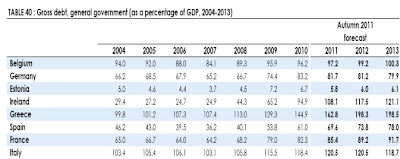
The assertion that the new Treaty would have prevented the crisis in Ireland is groundless.
It is an entirely valid argument that fiscal policies brought Ireland ‘to the brink of ruin’- but only because the actual sequence of events was that it was the political decision to bail out the failed private sector banks that fatally undermined the state’s finances.
But there is no legitimacy to any suggestion that the new rules would have required successive Irish governments to act in a significantly different manner, until after the crisis hit. The table below shows that the EU commission assessed there was no structural deficit at all until 2007.
It is worth simply pointing out what the EU Commission has recorded on the Irish ‘structural deficit’.

In fact, even this low ‘structural deficit’ is dishonest. It is an example of what statisticians call ‘data-fitting’; that is, adjusting the data to get the desired outcome. Here’s what the Commission was saying in late 2008, after the crisis and the Irish slump had begun. Somehow a 2008 deficit of 4.9% has become a deficit of 7.2%.

The point of the ‘structural deficit’ is that is exceptionally malleable- it can be made to fit almost any desired level at all. In this article, the impeccably mainstream ‘Investor’s Chronicle’ magazine argues that the ‘structural deficit’ is a myth.
Nor was there a debt problem in Ireland which raised any issue regarding the 60% of GDP limit, not until 2009 for Ireland. As can be seen, it was the so-called ‘core’ countries which were the serial offenders on debt levels before the crisis.

The assertion that the new Treaty would have prevented the crisis in Ireland is groundless.
Tuesday, 20 March 2012
Ireland's funding options: Time to end the 'race-to-disaster' debate
Tom McDonnell & Michael Taft: Even before the wording has been published and a referendum date named there is one issue that looks set to dominate the debate over the Fiscal Treaty; namely, what future financing options does Ireland have in the eventuality of a ‘No’ vote. While we are not taking a position on the substantive issue in this post, the following is intended to aid the debate by helping to answer that question.
The ‘Indispensable’ Condition
First, regardless of the Treaty vote, Ireland is guaranteed funding under the current programme – as long as it meets its targets. A Yes or No vote will not change this.
In the event of a No vote with Ireland unable to fully return to the markets, what would the situation be?
‘ . . . the granting of assistance in the framework of new programmes under the European Stability Mechanism will be conditional, as of 1 March 2013, on the ratification of this Treaty by the Contracting Party.’
This clearly states that new financing under the European Stability Mechanism is contingent upon ratification of the Treaty. However, we would put the following points that suggest that the issue contains potentially significant ambiguity.
First, the text of the European Stability Mechanism Treaty states that there are two conditions for providing support for ESM members:
‘The purpose of the ESM shall be to mobilise funding and provide stability support under strict conditionality, appropriate to the financial assistance instrument chosen, to the benefit of ESM Members which are experiencing, or are threatened by, severe financing problems, if indispensable to safeguard the financial stability of the euro area as a whole and of its Member States.’
The two conditions for support under the ESM appear to be (a) a member-state requires assistance, and (b) such assistance is ‘indispensable’ to the stability of Euro area. The indispensable clause, not surprisingly, is stated four times in the ESM treaty; unsurprising as this is the purpose of the ESM – to safeguard the Eurozone’s stability.
For argument’s sake, let’s assume Ireland – a member of the ESM but having voted No in the referendum – is in demonstrable need of financial assistance; and further, it can be objectively established that, without such assistance, there is a threat to Eurozone stability (issues of both state and bank default which may arise if assistance isn’t forthcoming). A literalist reading of the Fiscal Treaty would seem to settle the issue – Ireland, if voting No, would be excluded from the fund. But how final is this literalism?
‘Indispensable’ to the financial stability of the Euro area does not become less indispensable merely because Ireland, an ESM member, has not incorporated rules (rules that it has already agreed to) into its constitution through a process unique in the Eurozone – that is, a popular referendum. It is difficult to imagine a situation where the financial stability of the Eurozone (and Eurozone countries from Spain to Germany) is at risk and the resolution of that risk is barred because of a referendum result in a member-state. This would effectively undermine the intent of the ESM and its ability to respond to financial risks in the Eurozone.
What this crisis has shown is the flexibility of the Eurozone and EU institutions to respond to the crisis, whether we agree with the policies or not. For instance, the European Central Bank is legally barred from acting as a lender of last resort to sovereign states. But that did not stop it from, first, participating in the secondary bond markets and, second, from providing over €1 trillion in liquidity to European banks through their Long-Term Refinancing Operations (LTROs). The LTRO was intended to indirectly ease pressure on Spanish and Italian bond yields and was effectively a roundabout method of overcoming the bar to lend to sovereign states. Both of these were innovative and flexible responses. This resort to flexibility has implications for Ireland in the event of a No vote.
The Fiscal Compact refers to ‘new programmes under the European Stability Mechanism’. The ‘new’ may provide some flexibility, especially if Ireland is unable to re-enter the market and seeks a continuation of the current programme. This could be buttressed by the statement by the EU Heads of State or Government in July of last year. This, too, is definitive:
‘We are determined to continue to provide support to countries under programmes until they have regained market access, provided they successfully implement those programmes.’
Minister Michael Noonan confirmed this after the summit:
'There is a commitment that if countries continue to fulfil the conditions of their programme the European authorities will continue to supply them with money even when the programme is concluded . . . The commitment is now written in that if we are not back in the markets the European authorities will give us money until we get back in the markets.’
That both the EU leaders commitment and the Minister’s statement followed on from agreement to establish the ESM – with the same clause that disbursement of funds is based on the same ‘indispensability’ condition referred to above – suggests that there is considerable room for all sides to manoeuvre, even in the eventuality of a No vote. We are not suggesting that this is a definitive outcome. However, resort to a literal reading could lead us to the conclusion that Ireland, even if voted Yes, could be denied funding under the ESM if it was concluded at EU level that assistance was not indispensable to Eurozone stability. We seriously doubt this scenario which is why literal readings of one section of one treaty can lead us to unjustified conclusions. This holds when discussing the outcomes of either a Yes or No vote.
Alternative Sources of Funding
Regardless of the above, there is a credible argument that Ireland, in the eventuality that it needs a second bailout, has access to funding sources apart from the ESM; namely the IMF. This is the same ‘insurance’ or ‘back-stop’ that all EU countries are entitled to as members of the IMF. More EU countries have accessed IMF support than EU support in the last decade: Latvia, Lithuania, Poland, Bulgaria, Romania, Hungary, and Estonia.
The IMF programmes have recently undergone considerable reform in order to tailor support for the specific need of a country. Further support from the IMF does not necessarily have to come via the Extended Facility that Ireland currently participates in. Some of these programmes may even be more suitable to the Irish economy than an ESM programme modelled on the current one. This is because IMF programmes can provide credit lines on a precautionary basis. In these circumstances, Ireland may be able to enter the market even on a partial basis but have recourse to the IMF if and when further support is needed. A particular strength of some of these programmes is that Ireland may not have to draw down any funds (though it would make a ‘down-payment’ to participate in the particular programme).
There is a range of programmes that Ireland may be able to avail of:
Stand-by Arrangements with high-access precautionary provisions. The IMF describes this as its ‘workhorse lending instrument’.
The Flexible Credit Scheme which does not carry with it any conditions (and which the IMF claims ‘reduces the perceived stigma of borrowing from the IMF’.
The Precautionary and Liquidity Line is another line of support which provides finance and, according to the IMF, ‘is intended to serve as insurance and help resolve crises’.
Rapid Financing Instrument provides a quick response to an outside shock – including economic shocks.
These programmes are separate from the current Extended Facility programme we are in. Some have conditions attached to them; one does not (the Flexible Credit Scheme). They have a range of participating and payback periods, with provision for roll-over. We are not suggesting that Ireland would comply with all of the above; however, it shows the considerable potential sources of funding. There are two issues that might arise in considering these alternatives.
First, will Ireland be eligible for future financing? IMF financing is based on quotas assigned to each country with programmes laying down specific amounts that can be lent. However, all the programmes have exceptional access policy whereby limits are waived – with the exception of the Flexible Credit Line which, in any event, has no cap on funding.
In fact, for many countries there is a natural progression from the type of IMF funding Ireland is currently in (an Extended programme) to the programmes listed above. Poland is an example which started out in an Extended Programme, progressed to a Standby Arrangement and is now in a Flexible Credit Line which has no conditions attached. Ireland could make a similar progression.
Second, it has been suggested that the IMF actually regards Ireland as a high-risk country and may, therefore, refuse to lend further. In the first instance this would certainly be curious. To date, Ireland has abided by the programme that the IMF itself helped design (it’s fairly typical of IMF extended facilities). If the IMF suddenly claimed Ireland was too risky, this would be tantamount to an admission of their own failure. Would Ireland be penalised by the IMF for adhering to a programme that the IMF helped designed?
There is a strong argument that Ireland fulfils all four criteria for an ‘exceptional access’:
(a) The member is experiencing or has the potential to experience pressures resulting in a need for Fund financing that cannot be met within the normal limits.
(b) There is a high probability that the member’s public debt is sustainable in the medium term. However, in instances where there are significant uncertainties that make it difficult to state categorically that there is a high probability that the debt is sustainable over this period, exceptional access would be justified if there is a high risk of international systemic spillovers.
(c) The member has prospects of gaining or regaining access to private capital markets within the timeframe when Fund resources are outstanding.
(d) The policy program of the member provides a reasonably strong prospect of success, including not only the member’s adjustment plans but also its institutional and political capacity to deliver that adjustment.
We would draw attention to the condition in (b); in particular where exceptional access is justified if there is a high risk of international ‘spillovers’. There is a strong argument that Ireland is in such a situation. That the IMF participated in the current bail-out, despite the staff country report in December 2010 stating that Ireland would entail ‘substantial risks’, only confirms their determination to participate in programmes where the risks of spillovers are significant.
Another issue is the scale to which Ireland has already borrowed from the IMF. Currently, Ireland is the third largest debtor to the IMF – behind Greece and Portugal. Poland has a similar level of contingent debt, while Mexico is much higher – though these countries are in the Flexible Credit Line have not drawn down funds. There is a limit to which a country can borrow – even if complying with the provisions of the exceptional access. The IMF has lent a considerable amount to EU countries already and while it still retains considerable reserves, and while further precautionary lending to EU countries would not impact unduly, the possibility of larger countries needing assistance (Spain, Italy) could squeeze available funds to Ireland.
Taking all of the above on board, that the IMF has decided to extend its assistance to Greece in the form of a second bail-out suggests that Ireland would be a credible candidate for further support if it cannot access the international markets. If so, this could be a viable alternative to ESM funding.
Appalling Scenarios and a Legitimate Debate
None of the above can be certain. But that is no reason to resort to counter-posing ‘appalling scenarios’. Some argue that Ireland will be frozen out of both market and institutional funding if we vote No. Clearly, this would be an appalling scenario. Others argue that it would never come to this because of the impact on the Eurozone (defaults, contagion) – another appalling scenario.
This is not a satisfactory way to debate this issue. This will trap us in a ‘race-to-disaster’ debate which will be particularly uninformative. We have attempted to outline concrete scenarios for Ireland apart from the ESM. Whether these would become available is a subject for legitimate debate. The fact that Ireland may have a secure safety net with IMF funding is likely to induce cooperative, if ad hoc, relationships with the EU. Competing disaster scenarios will only undermine our understanding of these difficult issues.
In one respect, debating non-market funding has an air of unreality about it – if we are to heed the Government’s dismissal of a second bail-out as ‘ludicrous’. The fact that this issue is being taken seriously is a testament to the common sense of the debate. While we respect the fact that no Government will intentionally play down the prospect of being able to borrow on the international markets, in our own opinion a second bail-out is a real and probable outcome of current policies.
And this is not in the best interests of the Irish economy, whether that support comes from the IMF, the EU’s ESM , some other ad hoc EU support or any combination of these.
The ‘Indispensable’ Condition
First, regardless of the Treaty vote, Ireland is guaranteed funding under the current programme – as long as it meets its targets. A Yes or No vote will not change this.
In the event of a No vote with Ireland unable to fully return to the markets, what would the situation be?
‘ . . . the granting of assistance in the framework of new programmes under the European Stability Mechanism will be conditional, as of 1 March 2013, on the ratification of this Treaty by the Contracting Party.’
This clearly states that new financing under the European Stability Mechanism is contingent upon ratification of the Treaty. However, we would put the following points that suggest that the issue contains potentially significant ambiguity.
First, the text of the European Stability Mechanism Treaty states that there are two conditions for providing support for ESM members:
‘The purpose of the ESM shall be to mobilise funding and provide stability support under strict conditionality, appropriate to the financial assistance instrument chosen, to the benefit of ESM Members which are experiencing, or are threatened by, severe financing problems, if indispensable to safeguard the financial stability of the euro area as a whole and of its Member States.’
The two conditions for support under the ESM appear to be (a) a member-state requires assistance, and (b) such assistance is ‘indispensable’ to the stability of Euro area. The indispensable clause, not surprisingly, is stated four times in the ESM treaty; unsurprising as this is the purpose of the ESM – to safeguard the Eurozone’s stability.
For argument’s sake, let’s assume Ireland – a member of the ESM but having voted No in the referendum – is in demonstrable need of financial assistance; and further, it can be objectively established that, without such assistance, there is a threat to Eurozone stability (issues of both state and bank default which may arise if assistance isn’t forthcoming). A literalist reading of the Fiscal Treaty would seem to settle the issue – Ireland, if voting No, would be excluded from the fund. But how final is this literalism?
‘Indispensable’ to the financial stability of the Euro area does not become less indispensable merely because Ireland, an ESM member, has not incorporated rules (rules that it has already agreed to) into its constitution through a process unique in the Eurozone – that is, a popular referendum. It is difficult to imagine a situation where the financial stability of the Eurozone (and Eurozone countries from Spain to Germany) is at risk and the resolution of that risk is barred because of a referendum result in a member-state. This would effectively undermine the intent of the ESM and its ability to respond to financial risks in the Eurozone.
What this crisis has shown is the flexibility of the Eurozone and EU institutions to respond to the crisis, whether we agree with the policies or not. For instance, the European Central Bank is legally barred from acting as a lender of last resort to sovereign states. But that did not stop it from, first, participating in the secondary bond markets and, second, from providing over €1 trillion in liquidity to European banks through their Long-Term Refinancing Operations (LTROs). The LTRO was intended to indirectly ease pressure on Spanish and Italian bond yields and was effectively a roundabout method of overcoming the bar to lend to sovereign states. Both of these were innovative and flexible responses. This resort to flexibility has implications for Ireland in the event of a No vote.
The Fiscal Compact refers to ‘new programmes under the European Stability Mechanism’. The ‘new’ may provide some flexibility, especially if Ireland is unable to re-enter the market and seeks a continuation of the current programme. This could be buttressed by the statement by the EU Heads of State or Government in July of last year. This, too, is definitive:
‘We are determined to continue to provide support to countries under programmes until they have regained market access, provided they successfully implement those programmes.’
Minister Michael Noonan confirmed this after the summit:
'There is a commitment that if countries continue to fulfil the conditions of their programme the European authorities will continue to supply them with money even when the programme is concluded . . . The commitment is now written in that if we are not back in the markets the European authorities will give us money until we get back in the markets.’
That both the EU leaders commitment and the Minister’s statement followed on from agreement to establish the ESM – with the same clause that disbursement of funds is based on the same ‘indispensability’ condition referred to above – suggests that there is considerable room for all sides to manoeuvre, even in the eventuality of a No vote. We are not suggesting that this is a definitive outcome. However, resort to a literal reading could lead us to the conclusion that Ireland, even if voted Yes, could be denied funding under the ESM if it was concluded at EU level that assistance was not indispensable to Eurozone stability. We seriously doubt this scenario which is why literal readings of one section of one treaty can lead us to unjustified conclusions. This holds when discussing the outcomes of either a Yes or No vote.
Alternative Sources of Funding
Regardless of the above, there is a credible argument that Ireland, in the eventuality that it needs a second bailout, has access to funding sources apart from the ESM; namely the IMF. This is the same ‘insurance’ or ‘back-stop’ that all EU countries are entitled to as members of the IMF. More EU countries have accessed IMF support than EU support in the last decade: Latvia, Lithuania, Poland, Bulgaria, Romania, Hungary, and Estonia.
The IMF programmes have recently undergone considerable reform in order to tailor support for the specific need of a country. Further support from the IMF does not necessarily have to come via the Extended Facility that Ireland currently participates in. Some of these programmes may even be more suitable to the Irish economy than an ESM programme modelled on the current one. This is because IMF programmes can provide credit lines on a precautionary basis. In these circumstances, Ireland may be able to enter the market even on a partial basis but have recourse to the IMF if and when further support is needed. A particular strength of some of these programmes is that Ireland may not have to draw down any funds (though it would make a ‘down-payment’ to participate in the particular programme).
There is a range of programmes that Ireland may be able to avail of:
Stand-by Arrangements with high-access precautionary provisions. The IMF describes this as its ‘workhorse lending instrument’.
The Flexible Credit Scheme which does not carry with it any conditions (and which the IMF claims ‘reduces the perceived stigma of borrowing from the IMF’.
The Precautionary and Liquidity Line is another line of support which provides finance and, according to the IMF, ‘is intended to serve as insurance and help resolve crises’.
Rapid Financing Instrument provides a quick response to an outside shock – including economic shocks.
These programmes are separate from the current Extended Facility programme we are in. Some have conditions attached to them; one does not (the Flexible Credit Scheme). They have a range of participating and payback periods, with provision for roll-over. We are not suggesting that Ireland would comply with all of the above; however, it shows the considerable potential sources of funding. There are two issues that might arise in considering these alternatives.
First, will Ireland be eligible for future financing? IMF financing is based on quotas assigned to each country with programmes laying down specific amounts that can be lent. However, all the programmes have exceptional access policy whereby limits are waived – with the exception of the Flexible Credit Line which, in any event, has no cap on funding.
In fact, for many countries there is a natural progression from the type of IMF funding Ireland is currently in (an Extended programme) to the programmes listed above. Poland is an example which started out in an Extended Programme, progressed to a Standby Arrangement and is now in a Flexible Credit Line which has no conditions attached. Ireland could make a similar progression.
Second, it has been suggested that the IMF actually regards Ireland as a high-risk country and may, therefore, refuse to lend further. In the first instance this would certainly be curious. To date, Ireland has abided by the programme that the IMF itself helped design (it’s fairly typical of IMF extended facilities). If the IMF suddenly claimed Ireland was too risky, this would be tantamount to an admission of their own failure. Would Ireland be penalised by the IMF for adhering to a programme that the IMF helped designed?
There is a strong argument that Ireland fulfils all four criteria for an ‘exceptional access’:
(a) The member is experiencing or has the potential to experience pressures resulting in a need for Fund financing that cannot be met within the normal limits.
(b) There is a high probability that the member’s public debt is sustainable in the medium term. However, in instances where there are significant uncertainties that make it difficult to state categorically that there is a high probability that the debt is sustainable over this period, exceptional access would be justified if there is a high risk of international systemic spillovers.
(c) The member has prospects of gaining or regaining access to private capital markets within the timeframe when Fund resources are outstanding.
(d) The policy program of the member provides a reasonably strong prospect of success, including not only the member’s adjustment plans but also its institutional and political capacity to deliver that adjustment.
We would draw attention to the condition in (b); in particular where exceptional access is justified if there is a high risk of international ‘spillovers’. There is a strong argument that Ireland is in such a situation. That the IMF participated in the current bail-out, despite the staff country report in December 2010 stating that Ireland would entail ‘substantial risks’, only confirms their determination to participate in programmes where the risks of spillovers are significant.
Another issue is the scale to which Ireland has already borrowed from the IMF. Currently, Ireland is the third largest debtor to the IMF – behind Greece and Portugal. Poland has a similar level of contingent debt, while Mexico is much higher – though these countries are in the Flexible Credit Line have not drawn down funds. There is a limit to which a country can borrow – even if complying with the provisions of the exceptional access. The IMF has lent a considerable amount to EU countries already and while it still retains considerable reserves, and while further precautionary lending to EU countries would not impact unduly, the possibility of larger countries needing assistance (Spain, Italy) could squeeze available funds to Ireland.
Taking all of the above on board, that the IMF has decided to extend its assistance to Greece in the form of a second bail-out suggests that Ireland would be a credible candidate for further support if it cannot access the international markets. If so, this could be a viable alternative to ESM funding.
Appalling Scenarios and a Legitimate Debate
None of the above can be certain. But that is no reason to resort to counter-posing ‘appalling scenarios’. Some argue that Ireland will be frozen out of both market and institutional funding if we vote No. Clearly, this would be an appalling scenario. Others argue that it would never come to this because of the impact on the Eurozone (defaults, contagion) – another appalling scenario.
This is not a satisfactory way to debate this issue. This will trap us in a ‘race-to-disaster’ debate which will be particularly uninformative. We have attempted to outline concrete scenarios for Ireland apart from the ESM. Whether these would become available is a subject for legitimate debate. The fact that Ireland may have a secure safety net with IMF funding is likely to induce cooperative, if ad hoc, relationships with the EU. Competing disaster scenarios will only undermine our understanding of these difficult issues.
In one respect, debating non-market funding has an air of unreality about it – if we are to heed the Government’s dismissal of a second bail-out as ‘ludicrous’. The fact that this issue is being taken seriously is a testament to the common sense of the debate. While we respect the fact that no Government will intentionally play down the prospect of being able to borrow on the international markets, in our own opinion a second bail-out is a real and probable outcome of current policies.
And this is not in the best interests of the Irish economy, whether that support comes from the IMF, the EU’s ESM , some other ad hoc EU support or any combination of these.
Tuesday, 13 March 2012
Cleaning up the debate
Michael Taft: In Saturday’s Irish Times Stephen Collins wrote:
‘Far from outlawing Keynesian economics, what the treaty seeks to do is to put an end to the kind of populist and inept fiscal policies that brought Ireland to the brink of ruin. The treaty on its own won’t achieve that objective but it should at least make it more difficult for politicians to behave irresponsibly in the future – and that can only be a good thing.’
Eoin O'Broin has already pointed out the many flaws in Collins’ piece. Here I just want to examine one point – namely, whether the Fiscal Compact would have either ended ‘populist and inept fiscal policies’ or ‘make it more difficult’ to pursue such policies; and to do so from the EU Commission’s perspective.
Collins is no doubt referring to the structural deficit rule whereby, regardless of a Government’s General Deficit, it must maintain a structural deficit of -0.5 percent or less (-1 percent for countries with a general debt of 60 percent or less). There is also an assumption that the Government’s fiscal policy during the speculative boom period, while in compliance with the Maastricht guidelines, was running structural deficits. If so, this would have inevitably led to a mismatch between revenue and expenditure, as the former would have been bloated by the property bubble.
Therefore, Collins assumes that had the Fiscal Treaty been in place during that period, it would have first, exposed this structural defect and, secondly, required the Government to repair it.
All of this is mistaken - at least according to the EU Commission (see Note at end of post).

According to the EU Commission, Irish Governments ran, on average, both general and structural surpluses, not deficits. The above estimates come from the latest EU Commission forecasts – not the ones made prior to the recession.
Had the Fiscal Treaty been in place during that period, Ireland would have been allowed a structural deficit of -1 percent since we had a general debt of less than 60 percent of GDP. But only twice during the 8-year period did Irish budgets run afoul of the structural deficit rule – and in 2003 it was quickly transformed into a surplus.
So according to the EU Commission Ireland’s fiscal performance during the period up to the recession was fiscally responsible. Had the Fiscal Treaty been in situ it would have made no difference whatsoever to Irish budgetary policy. Indeed, the ‘inept fiscal policies’ that brought us to ruin would have been vindicated by the Fiscal Treaty.
This should, of course, lead to questions as to how one can trust this type of formulation since the EU Commission completely missed the speculative bubble in the Irish economy. And it was a big bubble to miss. Even years after the fact the EU Commission insists that Irish budgets were fundamentally sound and the economy was performing normally.
Collins could have brought this easily accessible information to his readers’ attention and pointed out, whether one supports or opposes the Treaty, that these measurements are suspect, to put it mildly. He could have also brought to his readers’ attention the Government’s own verdict on the EU Commission’s methodology for calculating the structural deficit – namely that it is ‘highly uncertain’ and ‘unrealistic’. He didn’t.
Instead, he made an assertion that is wholly unsupported by the evidence.
Unfortunately, we are likely to get a lot of that during the debate. Therefore, it is imperative when such unfounded assertions are made in the debate, they are quickly challenged.
On this score, we can only hope that the statement that the Fiscal Treaty would have prevented or modified the budgetary policies prior to the recession is never repeated again.
NOTE: 2001 and 2002 structural deficit estimates come from the Spring 2010 EU Commission estimates as they were not available in the current estimate.
‘Far from outlawing Keynesian economics, what the treaty seeks to do is to put an end to the kind of populist and inept fiscal policies that brought Ireland to the brink of ruin. The treaty on its own won’t achieve that objective but it should at least make it more difficult for politicians to behave irresponsibly in the future – and that can only be a good thing.’
Eoin O'Broin has already pointed out the many flaws in Collins’ piece. Here I just want to examine one point – namely, whether the Fiscal Compact would have either ended ‘populist and inept fiscal policies’ or ‘make it more difficult’ to pursue such policies; and to do so from the EU Commission’s perspective.
Collins is no doubt referring to the structural deficit rule whereby, regardless of a Government’s General Deficit, it must maintain a structural deficit of -0.5 percent or less (-1 percent for countries with a general debt of 60 percent or less). There is also an assumption that the Government’s fiscal policy during the speculative boom period, while in compliance with the Maastricht guidelines, was running structural deficits. If so, this would have inevitably led to a mismatch between revenue and expenditure, as the former would have been bloated by the property bubble.
Therefore, Collins assumes that had the Fiscal Treaty been in place during that period, it would have first, exposed this structural defect and, secondly, required the Government to repair it.
All of this is mistaken - at least according to the EU Commission (see Note at end of post).

According to the EU Commission, Irish Governments ran, on average, both general and structural surpluses, not deficits. The above estimates come from the latest EU Commission forecasts – not the ones made prior to the recession.
Had the Fiscal Treaty been in place during that period, Ireland would have been allowed a structural deficit of -1 percent since we had a general debt of less than 60 percent of GDP. But only twice during the 8-year period did Irish budgets run afoul of the structural deficit rule – and in 2003 it was quickly transformed into a surplus.
So according to the EU Commission Ireland’s fiscal performance during the period up to the recession was fiscally responsible. Had the Fiscal Treaty been in situ it would have made no difference whatsoever to Irish budgetary policy. Indeed, the ‘inept fiscal policies’ that brought us to ruin would have been vindicated by the Fiscal Treaty.
This should, of course, lead to questions as to how one can trust this type of formulation since the EU Commission completely missed the speculative bubble in the Irish economy. And it was a big bubble to miss. Even years after the fact the EU Commission insists that Irish budgets were fundamentally sound and the economy was performing normally.
Collins could have brought this easily accessible information to his readers’ attention and pointed out, whether one supports or opposes the Treaty, that these measurements are suspect, to put it mildly. He could have also brought to his readers’ attention the Government’s own verdict on the EU Commission’s methodology for calculating the structural deficit – namely that it is ‘highly uncertain’ and ‘unrealistic’. He didn’t.
Instead, he made an assertion that is wholly unsupported by the evidence.
Unfortunately, we are likely to get a lot of that during the debate. Therefore, it is imperative when such unfounded assertions are made in the debate, they are quickly challenged.
On this score, we can only hope that the statement that the Fiscal Treaty would have prevented or modified the budgetary policies prior to the recession is never repeated again.
NOTE: 2001 and 2002 structural deficit estimates come from the Spring 2010 EU Commission estimates as they were not available in the current estimate.
Friday, 9 March 2012
The referendum - what to do?
Jim Stewart: The Treaty on Stability, Coordination and Governance is flawed in many respects. Martin Wolf, writing in the Financial Times on 6th March, itemises some of these flaws. The obvious one is the requirement in clause 1b limiting the ‘structural deficit to 0.5% of GDP’. Countries must adjust rapidly to this position as agreed by the European Commission. In addition if the ratio of government debt to GDP is greater than 60%, article 4 requires the excess amount to be reduced over a twenty year period. So that a country where a debt/GDP ratio is currently 100% is required to reduce this amount by 2% per annum. In effect this means running a budget surplus of 1.5%. This is impossible to achieve, without debt writedowns. In the absence of debt writedowns attempting to achieve this target would deepen the current recession in Ireland and other countries, and prevent any economic recovery.
The Treaty states that the rule will be deemed to have been “respected if the annual structural balance of the general government is at its country-specific medium-term objective”. The problem is how can this be known? Both Ireland and Spain would have satisfied this budget criteria before the economic crisis. The key question was whether government finances were stable over time? This means that (1) the financial crisis would have to be forecast, (2) policy responses would have to be forecast, and (3) the effect of both the financial crisis and policy responses on government finances would have to be forecast. Some economists got point (1) right. Official Ireland was spectacularly wrong. No economist forecast all three nor would this be possible. The proposal from Philip Lane (Irish Times Feb. 7) for Ireland to develop a capacity (funded by the State) for “independent, high quality assessments of structural trends in the economy and the public finances” will have the effect of creating jobs for economists but little else.
Further issues arises in relation to the measure of debt. For example, activities transferred to a commercial State owned company, such as the proposed Water Authority, would also have associated debts transferred. Current measures of GDP are favorable to Ireland because GDP is inflated by profit switching transfer pricing by foreign owned firms. This may not always be the case. How can rational economic policy be based on a ratio, in which both the numerator and denominator are subject to revision, especially in the case of GDP?
This does not mean that over a period of time Government expenditure and government revenue, should not be sustainable. Being sustainable does not mean expenditure should be almost identical with revenue. An economy that is growing strongly can have both government deficits and maintain a stable debt/GDP ratio. Successful economies can have widely varying ratios of debt to GDP over long periods of time, for example Japan.
The fiscal treaty can be added to the list of flawed policy making that has helped turn an economic crisis (largely of our own making) into a national catastrophe. It is particularly dangerous because it will be incorporated in the constitution making change very difficult and incorporates the right of another one of the signatories to the treaty to bring a case to the European Court of Justice (article 8.1) and face financial sanctions in the event of non-compliance. It is the same thinking that initially set penal interest rates on Irelands borrowing under the EU/IMF Programme.
Hence the question arises why would rational people vote in favour of a Treaty which has so many flaws. John O’Hagen (Irish Times, 8th March) asks of those opposing ratification to explain “how day-to-day State expenditure will be funded from 2013”. The simple answer is that according to the Government, after the current programme has ended, (that is at the end of 2013, not ‘from 2013’ see EU/IMF Programme, p. 16 ) Ireland will turn to the bond markets for financing (Minister of State Brian Hayes quoted in Irish Times 6 March, 2012), and a point also made by Jean-Claude Juncker, chairman of the Eurozone finance ministers, to the European parliament on Feb 29.
But the point has been made unless the Treaty is ratified financial assistance will not be granted from the European Stability Mechanism at the end of 2013 should it be needed. So the question is how likely is a second bailout and to what extent will it be required? The answer to this question is uncertain. Funding is in place from the existing programme until the end of 2013. While bond redemptions amount to €11 billion in 2014, they will be zero in 2015 (NTMA annual Report 2010, p. 15). In addition, national savings contributed about €4.3 billion in 2011, and could rise further.
A further uncertainty arises from the stated intention of Francois Hollande, the front runner in the French Presidential election to renegotiate the treaty (Hugh Carnegy and Quentin peel, Financial Times, March 4, 2012). At the same time the main architect of the treaty Merkel, has lost credibility in Germany with the resignation of the candidate she supported as President. Because of this and other issues, Der Spiegel (2/21/2012) reports difficulties within the coalition government and states “many are now asking how much longer it can survive”. The second bail out package for Greece required the support of the opposition Social Democrats and Greens (Der Spiegel 2/27/2012). Opposition parties and likely participants in a successor government espouse policies such as emphasising growth rather than austerity to balance budgets, a Eurobond and a Financial Transaction Tax.
Spain recently announced a new higher target for the budget deficit of 5.8% compared with 4.4% agreed with the Commission, some hours after signing the new Treaty. Furthermore the Spanish Prime Minister announced that the budget deficit was a matter for the Spanish Government and not the Commission. It is also interesting to note that there was very little change in yields on Spanish government bonds (benchmark 10 year yields rose from 4.91% to 4.96%) on the first day of trading after this announcement and the signing of the Stability Treaty, indicating, perhaps that markets recognise that increased austerity is bad for economic growth and bad for bond markets. Further budget cutbacks in the Netherlands could result in a general election in which political parties opposed to budgetary cuts would make large gains (Financial Times, March 1, 2012). It is likely that government policy in relation to the financial and economic crisis will change in key EU countries as a result of political change.
The strategy to adopt in the face of this uncertainty is to delay holding a referendum for as long as possible. At government level we in Ireland have ‘world class skills’ in delay. The Department of Justice is especially skilled in this regard. A delay is likely to mean that political change in EU countries, such as France, will result in change to the Stability Treaty. Peripheral countries (Greece, Ireland, Portugal, Italy, Spain) will thus have an opportunity to influence treaty change to their benefit. Writing detailed fiscal stability rules into a constitution is flawed reasoning, and treaty change could remove this threat. Delay will help clarify if and to what extent a second bail out is needed.
What about the promissory notes? If as some have suggested there is an agreement to reduce the cost of the promissory notes, should this influence or decision? On this An Taoiseach is correct: there is no linkage. The cost of the promissory notes can and should be reduced under existing rules and should have no influence on voting intentions on the Treaty for stability.
It is difficult but vital that economic policy is taken from those without any democratic mandate, and without any economic policy other than a dogmatic adherence to the imposition of austerity. It is indeed unfortunate for Ireland and the EU that we have a Commissioner for Economic and Financial Affairs who is bereft of ideas. It is doubly unfortunate for Ireland that those directly responsible for implementing the programme (Mr. Székely, Director and European Commission mission chief to Ireland) are unable to produce a single idea that is growth enhancing (see for example the recently published review of the economic programme for Ireland).
The Treaty states that the rule will be deemed to have been “respected if the annual structural balance of the general government is at its country-specific medium-term objective”. The problem is how can this be known? Both Ireland and Spain would have satisfied this budget criteria before the economic crisis. The key question was whether government finances were stable over time? This means that (1) the financial crisis would have to be forecast, (2) policy responses would have to be forecast, and (3) the effect of both the financial crisis and policy responses on government finances would have to be forecast. Some economists got point (1) right. Official Ireland was spectacularly wrong. No economist forecast all three nor would this be possible. The proposal from Philip Lane (Irish Times Feb. 7) for Ireland to develop a capacity (funded by the State) for “independent, high quality assessments of structural trends in the economy and the public finances” will have the effect of creating jobs for economists but little else.
Further issues arises in relation to the measure of debt. For example, activities transferred to a commercial State owned company, such as the proposed Water Authority, would also have associated debts transferred. Current measures of GDP are favorable to Ireland because GDP is inflated by profit switching transfer pricing by foreign owned firms. This may not always be the case. How can rational economic policy be based on a ratio, in which both the numerator and denominator are subject to revision, especially in the case of GDP?
This does not mean that over a period of time Government expenditure and government revenue, should not be sustainable. Being sustainable does not mean expenditure should be almost identical with revenue. An economy that is growing strongly can have both government deficits and maintain a stable debt/GDP ratio. Successful economies can have widely varying ratios of debt to GDP over long periods of time, for example Japan.
The fiscal treaty can be added to the list of flawed policy making that has helped turn an economic crisis (largely of our own making) into a national catastrophe. It is particularly dangerous because it will be incorporated in the constitution making change very difficult and incorporates the right of another one of the signatories to the treaty to bring a case to the European Court of Justice (article 8.1) and face financial sanctions in the event of non-compliance. It is the same thinking that initially set penal interest rates on Irelands borrowing under the EU/IMF Programme.
Hence the question arises why would rational people vote in favour of a Treaty which has so many flaws. John O’Hagen (Irish Times, 8th March) asks of those opposing ratification to explain “how day-to-day State expenditure will be funded from 2013”. The simple answer is that according to the Government, after the current programme has ended, (that is at the end of 2013, not ‘from 2013’ see EU/IMF Programme, p. 16 ) Ireland will turn to the bond markets for financing (Minister of State Brian Hayes quoted in Irish Times 6 March, 2012), and a point also made by Jean-Claude Juncker, chairman of the Eurozone finance ministers, to the European parliament on Feb 29.
But the point has been made unless the Treaty is ratified financial assistance will not be granted from the European Stability Mechanism at the end of 2013 should it be needed. So the question is how likely is a second bailout and to what extent will it be required? The answer to this question is uncertain. Funding is in place from the existing programme until the end of 2013. While bond redemptions amount to €11 billion in 2014, they will be zero in 2015 (NTMA annual Report 2010, p. 15). In addition, national savings contributed about €4.3 billion in 2011, and could rise further.
A further uncertainty arises from the stated intention of Francois Hollande, the front runner in the French Presidential election to renegotiate the treaty (Hugh Carnegy and Quentin peel, Financial Times, March 4, 2012). At the same time the main architect of the treaty Merkel, has lost credibility in Germany with the resignation of the candidate she supported as President. Because of this and other issues, Der Spiegel (2/21/2012) reports difficulties within the coalition government and states “many are now asking how much longer it can survive”. The second bail out package for Greece required the support of the opposition Social Democrats and Greens (Der Spiegel 2/27/2012). Opposition parties and likely participants in a successor government espouse policies such as emphasising growth rather than austerity to balance budgets, a Eurobond and a Financial Transaction Tax.
Spain recently announced a new higher target for the budget deficit of 5.8% compared with 4.4% agreed with the Commission, some hours after signing the new Treaty. Furthermore the Spanish Prime Minister announced that the budget deficit was a matter for the Spanish Government and not the Commission. It is also interesting to note that there was very little change in yields on Spanish government bonds (benchmark 10 year yields rose from 4.91% to 4.96%) on the first day of trading after this announcement and the signing of the Stability Treaty, indicating, perhaps that markets recognise that increased austerity is bad for economic growth and bad for bond markets. Further budget cutbacks in the Netherlands could result in a general election in which political parties opposed to budgetary cuts would make large gains (Financial Times, March 1, 2012). It is likely that government policy in relation to the financial and economic crisis will change in key EU countries as a result of political change.
The strategy to adopt in the face of this uncertainty is to delay holding a referendum for as long as possible. At government level we in Ireland have ‘world class skills’ in delay. The Department of Justice is especially skilled in this regard. A delay is likely to mean that political change in EU countries, such as France, will result in change to the Stability Treaty. Peripheral countries (Greece, Ireland, Portugal, Italy, Spain) will thus have an opportunity to influence treaty change to their benefit. Writing detailed fiscal stability rules into a constitution is flawed reasoning, and treaty change could remove this threat. Delay will help clarify if and to what extent a second bail out is needed.
What about the promissory notes? If as some have suggested there is an agreement to reduce the cost of the promissory notes, should this influence or decision? On this An Taoiseach is correct: there is no linkage. The cost of the promissory notes can and should be reduced under existing rules and should have no influence on voting intentions on the Treaty for stability.
It is difficult but vital that economic policy is taken from those without any democratic mandate, and without any economic policy other than a dogmatic adherence to the imposition of austerity. It is indeed unfortunate for Ireland and the EU that we have a Commissioner for Economic and Financial Affairs who is bereft of ideas. It is doubly unfortunate for Ireland that those directly responsible for implementing the programme (Mr. Székely, Director and European Commission mission chief to Ireland) are unable to produce a single idea that is growth enhancing (see for example the recently published review of the economic programme for Ireland).
Friday, 2 March 2012
What exactly will we be asked in the fiscal treaty referendum?
Nat O'Connor: The Taoiseach has signed the Treaty on Stability, Coordination and Governance in the Economic and Monetary Union (also known as the 'fiscal compact' or the Fiscal Stability Treaty). However, it will only be ratified by Ireland if it is agreed by the Irish people in a referendum.
There is still some uncertainly about what exactly we will be voting about. Putting a debt brake in the Constitution would be a very different prospect from merely a ratification clause. We will know more when we see the actual wording of the referendum. Will it be simply "The State may ratify..." or will it include other constitutional changes and some formula of words in the Constitution to create a "binding, permanent" mechanism that will constrain future governments in relation to fiscal policy and how they deal with deficits and the national debt?
At this time, the advice of the Attorney General has not been published, so we do not know why a referendum will be held. We can probably assume that it is for the usual reason. That is, Ireland has had a series of referendums (modifying Article 29 of Bunreacht na hÉireann) to permit the Government to ratify European treaties such as Maastricht, Amsterdam and Nice. The wording of Bunreacht na hÉireann for recent treaties is straightforward: “The State may ratify the Treaty…”
On that basis, it is likely that the reason for Ireland to hold a referendum is again for the people to give the State permission to ratify the Fiscal Stability Treaty.
However, a second potential reason for Ireland to hold a referendum comes from the working of the Treaty itself. The Treaty calls for the Contracting Parties to "transpose the 'balanced budget rule' into their national legal systems, through binding, permanent and preferably constitutional provisions". Although there is no obligation in the Treaty to place the balanced budget rule (or 'debt brake') in Ireland's constitution, there is an implication that the rule should be transposed in a way that is stronger than ordinary legislation. The creation of a "binding, permanent" provision may therefore be part of the reason why Ireland is having a referendum. When we have clarity on this matter, it will easier to judge the long-term economic and democratic impact of the referendum.
There is still some uncertainly about what exactly we will be voting about. Putting a debt brake in the Constitution would be a very different prospect from merely a ratification clause. We will know more when we see the actual wording of the referendum. Will it be simply "The State may ratify..." or will it include other constitutional changes and some formula of words in the Constitution to create a "binding, permanent" mechanism that will constrain future governments in relation to fiscal policy and how they deal with deficits and the national debt?
At this time, the advice of the Attorney General has not been published, so we do not know why a referendum will be held. We can probably assume that it is for the usual reason. That is, Ireland has had a series of referendums (modifying Article 29 of Bunreacht na hÉireann) to permit the Government to ratify European treaties such as Maastricht, Amsterdam and Nice. The wording of Bunreacht na hÉireann for recent treaties is straightforward: “The State may ratify the Treaty…”
On that basis, it is likely that the reason for Ireland to hold a referendum is again for the people to give the State permission to ratify the Fiscal Stability Treaty.
However, a second potential reason for Ireland to hold a referendum comes from the working of the Treaty itself. The Treaty calls for the Contracting Parties to "transpose the 'balanced budget rule' into their national legal systems, through binding, permanent and preferably constitutional provisions". Although there is no obligation in the Treaty to place the balanced budget rule (or 'debt brake') in Ireland's constitution, there is an implication that the rule should be transposed in a way that is stronger than ordinary legislation. The creation of a "binding, permanent" provision may therefore be part of the reason why Ireland is having a referendum. When we have clarity on this matter, it will easier to judge the long-term economic and democratic impact of the referendum.
Subscribe to:
Posts (Atom)