The Center for Economic and Policy Research (CEPR) in Washington D.C. has published a paper examining the policy recommendations made by the IMF to European Union Countries for the years 2008-2011.
Under Article 4 of its Memorandum of Understanding, the IMF is charged with "(i) overseeing the international monetary system to ensure its effective operation and (ii) monitoring each member's compliance with its policy obligations." (IMF) As part of this 'surveillance', the fund continually monitors the economy of member countries, including country visits and consultations with stakeholders. It also makes policy recommendations.
The CEPR paper examines the advice given by the IMF over four years and finds a consistent pattern of policy recommendations, "which indicates (1) a macroeconomic policy that focuses on reducing spending and shrinking the size of government, in many cases regardless of whether this is appropriate or necessary, or may even exacerbate an economic downturn; and (2) a focus on other policy issues that would tend to reduce social protections for broad sectors of the population (including public pensions, healthcare , and employment protections), reduce labor's share of national income, and possibly increase poverty, social exclusion, and economic and social inequality as a result." (CEPR)
Its is unsurprising, perhaps, that this is the path chosen by the IMF. However, as the paper points out, the IMF is overwhelmingly influenced by European governments through its governance system and these same European governments also subscribe to broader European Union goals, such as those articulated in the Europe 2020 strategy of a sustainable and inclusive economy. The paper points to the tension between these goals of a reduction in social exclusion, an increase in research and development and climate change goals, and the fiscal consolidation and cuts to social expenditure as advocated by the IMF.
The paper recommends that the IMF engage in an Independent Evaluation Office (IEO) review of its policy advice in Europe, which might enable it to "play a constructive role in Europe's recovery" and "demonstrate the IMF's commitment to the goals of accountability and transparency in its role as 'trusted advisor'". (CEPR)
The paper can be accessed here.

Showing posts with label IMF. Show all posts
Showing posts with label IMF. Show all posts
Wednesday, 30 January 2013


Tuesday, 20 March 2012
Ireland's funding options: Time to end the 'race-to-disaster' debate
Tom McDonnell & Michael Taft: Even before the wording has been published and a referendum date named there is one issue that looks set to dominate the debate over the Fiscal Treaty; namely, what future financing options does Ireland have in the eventuality of a ‘No’ vote. While we are not taking a position on the substantive issue in this post, the following is intended to aid the debate by helping to answer that question.
The ‘Indispensable’ Condition
First, regardless of the Treaty vote, Ireland is guaranteed funding under the current programme – as long as it meets its targets. A Yes or No vote will not change this.
In the event of a No vote with Ireland unable to fully return to the markets, what would the situation be?
‘ . . . the granting of assistance in the framework of new programmes under the European Stability Mechanism will be conditional, as of 1 March 2013, on the ratification of this Treaty by the Contracting Party.’
This clearly states that new financing under the European Stability Mechanism is contingent upon ratification of the Treaty. However, we would put the following points that suggest that the issue contains potentially significant ambiguity.
First, the text of the European Stability Mechanism Treaty states that there are two conditions for providing support for ESM members:
‘The purpose of the ESM shall be to mobilise funding and provide stability support under strict conditionality, appropriate to the financial assistance instrument chosen, to the benefit of ESM Members which are experiencing, or are threatened by, severe financing problems, if indispensable to safeguard the financial stability of the euro area as a whole and of its Member States.’
The two conditions for support under the ESM appear to be (a) a member-state requires assistance, and (b) such assistance is ‘indispensable’ to the stability of Euro area. The indispensable clause, not surprisingly, is stated four times in the ESM treaty; unsurprising as this is the purpose of the ESM – to safeguard the Eurozone’s stability.
For argument’s sake, let’s assume Ireland – a member of the ESM but having voted No in the referendum – is in demonstrable need of financial assistance; and further, it can be objectively established that, without such assistance, there is a threat to Eurozone stability (issues of both state and bank default which may arise if assistance isn’t forthcoming). A literalist reading of the Fiscal Treaty would seem to settle the issue – Ireland, if voting No, would be excluded from the fund. But how final is this literalism?
‘Indispensable’ to the financial stability of the Euro area does not become less indispensable merely because Ireland, an ESM member, has not incorporated rules (rules that it has already agreed to) into its constitution through a process unique in the Eurozone – that is, a popular referendum. It is difficult to imagine a situation where the financial stability of the Eurozone (and Eurozone countries from Spain to Germany) is at risk and the resolution of that risk is barred because of a referendum result in a member-state. This would effectively undermine the intent of the ESM and its ability to respond to financial risks in the Eurozone.
What this crisis has shown is the flexibility of the Eurozone and EU institutions to respond to the crisis, whether we agree with the policies or not. For instance, the European Central Bank is legally barred from acting as a lender of last resort to sovereign states. But that did not stop it from, first, participating in the secondary bond markets and, second, from providing over €1 trillion in liquidity to European banks through their Long-Term Refinancing Operations (LTROs). The LTRO was intended to indirectly ease pressure on Spanish and Italian bond yields and was effectively a roundabout method of overcoming the bar to lend to sovereign states. Both of these were innovative and flexible responses. This resort to flexibility has implications for Ireland in the event of a No vote.
The Fiscal Compact refers to ‘new programmes under the European Stability Mechanism’. The ‘new’ may provide some flexibility, especially if Ireland is unable to re-enter the market and seeks a continuation of the current programme. This could be buttressed by the statement by the EU Heads of State or Government in July of last year. This, too, is definitive:
‘We are determined to continue to provide support to countries under programmes until they have regained market access, provided they successfully implement those programmes.’
Minister Michael Noonan confirmed this after the summit:
'There is a commitment that if countries continue to fulfil the conditions of their programme the European authorities will continue to supply them with money even when the programme is concluded . . . The commitment is now written in that if we are not back in the markets the European authorities will give us money until we get back in the markets.’
That both the EU leaders commitment and the Minister’s statement followed on from agreement to establish the ESM – with the same clause that disbursement of funds is based on the same ‘indispensability’ condition referred to above – suggests that there is considerable room for all sides to manoeuvre, even in the eventuality of a No vote. We are not suggesting that this is a definitive outcome. However, resort to a literal reading could lead us to the conclusion that Ireland, even if voted Yes, could be denied funding under the ESM if it was concluded at EU level that assistance was not indispensable to Eurozone stability. We seriously doubt this scenario which is why literal readings of one section of one treaty can lead us to unjustified conclusions. This holds when discussing the outcomes of either a Yes or No vote.
Alternative Sources of Funding
Regardless of the above, there is a credible argument that Ireland, in the eventuality that it needs a second bailout, has access to funding sources apart from the ESM; namely the IMF. This is the same ‘insurance’ or ‘back-stop’ that all EU countries are entitled to as members of the IMF. More EU countries have accessed IMF support than EU support in the last decade: Latvia, Lithuania, Poland, Bulgaria, Romania, Hungary, and Estonia.
The IMF programmes have recently undergone considerable reform in order to tailor support for the specific need of a country. Further support from the IMF does not necessarily have to come via the Extended Facility that Ireland currently participates in. Some of these programmes may even be more suitable to the Irish economy than an ESM programme modelled on the current one. This is because IMF programmes can provide credit lines on a precautionary basis. In these circumstances, Ireland may be able to enter the market even on a partial basis but have recourse to the IMF if and when further support is needed. A particular strength of some of these programmes is that Ireland may not have to draw down any funds (though it would make a ‘down-payment’ to participate in the particular programme).
There is a range of programmes that Ireland may be able to avail of:
Stand-by Arrangements with high-access precautionary provisions. The IMF describes this as its ‘workhorse lending instrument’.
The Flexible Credit Scheme which does not carry with it any conditions (and which the IMF claims ‘reduces the perceived stigma of borrowing from the IMF’.
The Precautionary and Liquidity Line is another line of support which provides finance and, according to the IMF, ‘is intended to serve as insurance and help resolve crises’.
Rapid Financing Instrument provides a quick response to an outside shock – including economic shocks.
These programmes are separate from the current Extended Facility programme we are in. Some have conditions attached to them; one does not (the Flexible Credit Scheme). They have a range of participating and payback periods, with provision for roll-over. We are not suggesting that Ireland would comply with all of the above; however, it shows the considerable potential sources of funding. There are two issues that might arise in considering these alternatives.
First, will Ireland be eligible for future financing? IMF financing is based on quotas assigned to each country with programmes laying down specific amounts that can be lent. However, all the programmes have exceptional access policy whereby limits are waived – with the exception of the Flexible Credit Line which, in any event, has no cap on funding.
In fact, for many countries there is a natural progression from the type of IMF funding Ireland is currently in (an Extended programme) to the programmes listed above. Poland is an example which started out in an Extended Programme, progressed to a Standby Arrangement and is now in a Flexible Credit Line which has no conditions attached. Ireland could make a similar progression.
Second, it has been suggested that the IMF actually regards Ireland as a high-risk country and may, therefore, refuse to lend further. In the first instance this would certainly be curious. To date, Ireland has abided by the programme that the IMF itself helped design (it’s fairly typical of IMF extended facilities). If the IMF suddenly claimed Ireland was too risky, this would be tantamount to an admission of their own failure. Would Ireland be penalised by the IMF for adhering to a programme that the IMF helped designed?
There is a strong argument that Ireland fulfils all four criteria for an ‘exceptional access’:
(a) The member is experiencing or has the potential to experience pressures resulting in a need for Fund financing that cannot be met within the normal limits.
(b) There is a high probability that the member’s public debt is sustainable in the medium term. However, in instances where there are significant uncertainties that make it difficult to state categorically that there is a high probability that the debt is sustainable over this period, exceptional access would be justified if there is a high risk of international systemic spillovers.
(c) The member has prospects of gaining or regaining access to private capital markets within the timeframe when Fund resources are outstanding.
(d) The policy program of the member provides a reasonably strong prospect of success, including not only the member’s adjustment plans but also its institutional and political capacity to deliver that adjustment.
We would draw attention to the condition in (b); in particular where exceptional access is justified if there is a high risk of international ‘spillovers’. There is a strong argument that Ireland is in such a situation. That the IMF participated in the current bail-out, despite the staff country report in December 2010 stating that Ireland would entail ‘substantial risks’, only confirms their determination to participate in programmes where the risks of spillovers are significant.
Another issue is the scale to which Ireland has already borrowed from the IMF. Currently, Ireland is the third largest debtor to the IMF – behind Greece and Portugal. Poland has a similar level of contingent debt, while Mexico is much higher – though these countries are in the Flexible Credit Line have not drawn down funds. There is a limit to which a country can borrow – even if complying with the provisions of the exceptional access. The IMF has lent a considerable amount to EU countries already and while it still retains considerable reserves, and while further precautionary lending to EU countries would not impact unduly, the possibility of larger countries needing assistance (Spain, Italy) could squeeze available funds to Ireland.
Taking all of the above on board, that the IMF has decided to extend its assistance to Greece in the form of a second bail-out suggests that Ireland would be a credible candidate for further support if it cannot access the international markets. If so, this could be a viable alternative to ESM funding.
Appalling Scenarios and a Legitimate Debate
None of the above can be certain. But that is no reason to resort to counter-posing ‘appalling scenarios’. Some argue that Ireland will be frozen out of both market and institutional funding if we vote No. Clearly, this would be an appalling scenario. Others argue that it would never come to this because of the impact on the Eurozone (defaults, contagion) – another appalling scenario.
This is not a satisfactory way to debate this issue. This will trap us in a ‘race-to-disaster’ debate which will be particularly uninformative. We have attempted to outline concrete scenarios for Ireland apart from the ESM. Whether these would become available is a subject for legitimate debate. The fact that Ireland may have a secure safety net with IMF funding is likely to induce cooperative, if ad hoc, relationships with the EU. Competing disaster scenarios will only undermine our understanding of these difficult issues.
In one respect, debating non-market funding has an air of unreality about it – if we are to heed the Government’s dismissal of a second bail-out as ‘ludicrous’. The fact that this issue is being taken seriously is a testament to the common sense of the debate. While we respect the fact that no Government will intentionally play down the prospect of being able to borrow on the international markets, in our own opinion a second bail-out is a real and probable outcome of current policies.
And this is not in the best interests of the Irish economy, whether that support comes from the IMF, the EU’s ESM , some other ad hoc EU support or any combination of these.
The ‘Indispensable’ Condition
First, regardless of the Treaty vote, Ireland is guaranteed funding under the current programme – as long as it meets its targets. A Yes or No vote will not change this.
In the event of a No vote with Ireland unable to fully return to the markets, what would the situation be?
‘ . . . the granting of assistance in the framework of new programmes under the European Stability Mechanism will be conditional, as of 1 March 2013, on the ratification of this Treaty by the Contracting Party.’
This clearly states that new financing under the European Stability Mechanism is contingent upon ratification of the Treaty. However, we would put the following points that suggest that the issue contains potentially significant ambiguity.
First, the text of the European Stability Mechanism Treaty states that there are two conditions for providing support for ESM members:
‘The purpose of the ESM shall be to mobilise funding and provide stability support under strict conditionality, appropriate to the financial assistance instrument chosen, to the benefit of ESM Members which are experiencing, or are threatened by, severe financing problems, if indispensable to safeguard the financial stability of the euro area as a whole and of its Member States.’
The two conditions for support under the ESM appear to be (a) a member-state requires assistance, and (b) such assistance is ‘indispensable’ to the stability of Euro area. The indispensable clause, not surprisingly, is stated four times in the ESM treaty; unsurprising as this is the purpose of the ESM – to safeguard the Eurozone’s stability.
For argument’s sake, let’s assume Ireland – a member of the ESM but having voted No in the referendum – is in demonstrable need of financial assistance; and further, it can be objectively established that, without such assistance, there is a threat to Eurozone stability (issues of both state and bank default which may arise if assistance isn’t forthcoming). A literalist reading of the Fiscal Treaty would seem to settle the issue – Ireland, if voting No, would be excluded from the fund. But how final is this literalism?
‘Indispensable’ to the financial stability of the Euro area does not become less indispensable merely because Ireland, an ESM member, has not incorporated rules (rules that it has already agreed to) into its constitution through a process unique in the Eurozone – that is, a popular referendum. It is difficult to imagine a situation where the financial stability of the Eurozone (and Eurozone countries from Spain to Germany) is at risk and the resolution of that risk is barred because of a referendum result in a member-state. This would effectively undermine the intent of the ESM and its ability to respond to financial risks in the Eurozone.
What this crisis has shown is the flexibility of the Eurozone and EU institutions to respond to the crisis, whether we agree with the policies or not. For instance, the European Central Bank is legally barred from acting as a lender of last resort to sovereign states. But that did not stop it from, first, participating in the secondary bond markets and, second, from providing over €1 trillion in liquidity to European banks through their Long-Term Refinancing Operations (LTROs). The LTRO was intended to indirectly ease pressure on Spanish and Italian bond yields and was effectively a roundabout method of overcoming the bar to lend to sovereign states. Both of these were innovative and flexible responses. This resort to flexibility has implications for Ireland in the event of a No vote.
The Fiscal Compact refers to ‘new programmes under the European Stability Mechanism’. The ‘new’ may provide some flexibility, especially if Ireland is unable to re-enter the market and seeks a continuation of the current programme. This could be buttressed by the statement by the EU Heads of State or Government in July of last year. This, too, is definitive:
‘We are determined to continue to provide support to countries under programmes until they have regained market access, provided they successfully implement those programmes.’
Minister Michael Noonan confirmed this after the summit:
'There is a commitment that if countries continue to fulfil the conditions of their programme the European authorities will continue to supply them with money even when the programme is concluded . . . The commitment is now written in that if we are not back in the markets the European authorities will give us money until we get back in the markets.’
That both the EU leaders commitment and the Minister’s statement followed on from agreement to establish the ESM – with the same clause that disbursement of funds is based on the same ‘indispensability’ condition referred to above – suggests that there is considerable room for all sides to manoeuvre, even in the eventuality of a No vote. We are not suggesting that this is a definitive outcome. However, resort to a literal reading could lead us to the conclusion that Ireland, even if voted Yes, could be denied funding under the ESM if it was concluded at EU level that assistance was not indispensable to Eurozone stability. We seriously doubt this scenario which is why literal readings of one section of one treaty can lead us to unjustified conclusions. This holds when discussing the outcomes of either a Yes or No vote.
Alternative Sources of Funding
Regardless of the above, there is a credible argument that Ireland, in the eventuality that it needs a second bailout, has access to funding sources apart from the ESM; namely the IMF. This is the same ‘insurance’ or ‘back-stop’ that all EU countries are entitled to as members of the IMF. More EU countries have accessed IMF support than EU support in the last decade: Latvia, Lithuania, Poland, Bulgaria, Romania, Hungary, and Estonia.
The IMF programmes have recently undergone considerable reform in order to tailor support for the specific need of a country. Further support from the IMF does not necessarily have to come via the Extended Facility that Ireland currently participates in. Some of these programmes may even be more suitable to the Irish economy than an ESM programme modelled on the current one. This is because IMF programmes can provide credit lines on a precautionary basis. In these circumstances, Ireland may be able to enter the market even on a partial basis but have recourse to the IMF if and when further support is needed. A particular strength of some of these programmes is that Ireland may not have to draw down any funds (though it would make a ‘down-payment’ to participate in the particular programme).
There is a range of programmes that Ireland may be able to avail of:
Stand-by Arrangements with high-access precautionary provisions. The IMF describes this as its ‘workhorse lending instrument’.
The Flexible Credit Scheme which does not carry with it any conditions (and which the IMF claims ‘reduces the perceived stigma of borrowing from the IMF’.
The Precautionary and Liquidity Line is another line of support which provides finance and, according to the IMF, ‘is intended to serve as insurance and help resolve crises’.
Rapid Financing Instrument provides a quick response to an outside shock – including economic shocks.
These programmes are separate from the current Extended Facility programme we are in. Some have conditions attached to them; one does not (the Flexible Credit Scheme). They have a range of participating and payback periods, with provision for roll-over. We are not suggesting that Ireland would comply with all of the above; however, it shows the considerable potential sources of funding. There are two issues that might arise in considering these alternatives.
First, will Ireland be eligible for future financing? IMF financing is based on quotas assigned to each country with programmes laying down specific amounts that can be lent. However, all the programmes have exceptional access policy whereby limits are waived – with the exception of the Flexible Credit Line which, in any event, has no cap on funding.
In fact, for many countries there is a natural progression from the type of IMF funding Ireland is currently in (an Extended programme) to the programmes listed above. Poland is an example which started out in an Extended Programme, progressed to a Standby Arrangement and is now in a Flexible Credit Line which has no conditions attached. Ireland could make a similar progression.
Second, it has been suggested that the IMF actually regards Ireland as a high-risk country and may, therefore, refuse to lend further. In the first instance this would certainly be curious. To date, Ireland has abided by the programme that the IMF itself helped design (it’s fairly typical of IMF extended facilities). If the IMF suddenly claimed Ireland was too risky, this would be tantamount to an admission of their own failure. Would Ireland be penalised by the IMF for adhering to a programme that the IMF helped designed?
There is a strong argument that Ireland fulfils all four criteria for an ‘exceptional access’:
(a) The member is experiencing or has the potential to experience pressures resulting in a need for Fund financing that cannot be met within the normal limits.
(b) There is a high probability that the member’s public debt is sustainable in the medium term. However, in instances where there are significant uncertainties that make it difficult to state categorically that there is a high probability that the debt is sustainable over this period, exceptional access would be justified if there is a high risk of international systemic spillovers.
(c) The member has prospects of gaining or regaining access to private capital markets within the timeframe when Fund resources are outstanding.
(d) The policy program of the member provides a reasonably strong prospect of success, including not only the member’s adjustment plans but also its institutional and political capacity to deliver that adjustment.
We would draw attention to the condition in (b); in particular where exceptional access is justified if there is a high risk of international ‘spillovers’. There is a strong argument that Ireland is in such a situation. That the IMF participated in the current bail-out, despite the staff country report in December 2010 stating that Ireland would entail ‘substantial risks’, only confirms their determination to participate in programmes where the risks of spillovers are significant.
Another issue is the scale to which Ireland has already borrowed from the IMF. Currently, Ireland is the third largest debtor to the IMF – behind Greece and Portugal. Poland has a similar level of contingent debt, while Mexico is much higher – though these countries are in the Flexible Credit Line have not drawn down funds. There is a limit to which a country can borrow – even if complying with the provisions of the exceptional access. The IMF has lent a considerable amount to EU countries already and while it still retains considerable reserves, and while further precautionary lending to EU countries would not impact unduly, the possibility of larger countries needing assistance (Spain, Italy) could squeeze available funds to Ireland.
Taking all of the above on board, that the IMF has decided to extend its assistance to Greece in the form of a second bail-out suggests that Ireland would be a credible candidate for further support if it cannot access the international markets. If so, this could be a viable alternative to ESM funding.
Appalling Scenarios and a Legitimate Debate
None of the above can be certain. But that is no reason to resort to counter-posing ‘appalling scenarios’. Some argue that Ireland will be frozen out of both market and institutional funding if we vote No. Clearly, this would be an appalling scenario. Others argue that it would never come to this because of the impact on the Eurozone (defaults, contagion) – another appalling scenario.
This is not a satisfactory way to debate this issue. This will trap us in a ‘race-to-disaster’ debate which will be particularly uninformative. We have attempted to outline concrete scenarios for Ireland apart from the ESM. Whether these would become available is a subject for legitimate debate. The fact that Ireland may have a secure safety net with IMF funding is likely to induce cooperative, if ad hoc, relationships with the EU. Competing disaster scenarios will only undermine our understanding of these difficult issues.
In one respect, debating non-market funding has an air of unreality about it – if we are to heed the Government’s dismissal of a second bail-out as ‘ludicrous’. The fact that this issue is being taken seriously is a testament to the common sense of the debate. While we respect the fact that no Government will intentionally play down the prospect of being able to borrow on the international markets, in our own opinion a second bail-out is a real and probable outcome of current policies.
And this is not in the best interests of the Irish economy, whether that support comes from the IMF, the EU’s ESM , some other ad hoc EU support or any combination of these.
Tuesday, 10 January 2012
The data being sent to IMF and EU bodies should be public
Nat O'Connor: The latest IMF report on Ireland has an important annex: Annex 1. Provision of data (pages 81-82), which gives a list of "indicators and reports" that "shall be made available to the staff of the European Commission, the ECB and the IMF by the Irish authorities on a regular basis." A unit within the Department of Finance will "coordinate and collect" the relevant "data and information". (It is an update on a list that formed part of the original agreement with the IMF and EU bodies; pages 33-34 here).
A lot of this data is very valuable for understanding and analysing the Irish economy and the effects of Irish Government policy. It is reasonable for the IMF, EC and ECB to seek this data to monitor Ireland's ability to repay the money we borrowed from them. Indeed, it is valuable to have their expertise on what data is required to monitor our economy and national debt. However, now that this data is being collected, it should as a matter of course be made publicly available within Ireland as well.
For clarity, the entire Annex is repeated at the end of this post. There are 22 sets of data referred to: F1 to F11 are from the Departments of Finance and PER; N1 to N5 are from the NTMA; and C1 to C6 are from the Central Bank.
First of all, it should be noted that some of this data is already available, but the majority of it is not. Secondly, it is not clear that all of the required information will exist at the time when it is supposed to be submitted. Thirdly, it should be acknowledged that there may, in a limited number of cases, be legitimate reasons for not publicly releasing some of these datasets. For general principles on what might be legitimate reasons for not releasing data, I would refer to the guidelines given in the Freedom of Information Act 1997. However, just because the release of some information can be blocked, does not mean that it should be. Certainly, any refusal to publish a dataset should be explained by the relevant Minister to the Oireachtas.
Conversly, as part of the Government's announced reform of the national Budget process, it may well be their intention to publish this sort of data. Its release would certainly help the Oireachtas to hold the Government to account. Access to this data would also probably be necessary for the new Fiscal Advisory Council to be effective.
F6 is an example of good practice in relation to the budget. It requires the publication of revenue and expenditure plans for the next four years. This original requirement helped open up the Budget process and multi-annual budget planning will hopefully become standard practice even once the agreement with the IMF and EU concludes.
Much of the data being required refers to the national debt. The sustainability of Ireland's debt is crucial to whether or not the economy can recover, or whether a prolonged period of stagnation - or indeed some form of default - is inevitable. There are periods in the history of most states when political discourse is dominated by the debt and the deficit. This is certainly the case in Ireland today. There is a pressing need to ensure that this discussion is grounded in accurate facts and figures, and does not lead to wrong information being spread in public.
The implication of F10 is worrying. The data required here is "Assessment report of the management of activation policies and on the outcome of job seekers' search activities and participation in labour market programmes." One one level that is useful data. However, it is not balanced by other data in the list, and may give a distorted picture of the Irish economy. Labour activation is to be welcomed, but priority should be given to ensuring that jobs exist in the first place, before putting pressure on people who are unemployed.
The Government has signalled that we will make use of our crisis by improving our systems of oversight and scrutiny, to make sure that a similar crisis does not happen again. An important step in that direction would be the regular release of these datasets, on a single website, in machine readable format, at the same time (if not before) they are sent to the IMF and EU bodies. For example, the website of the Fiscal Advisory Council could be used for this purpose.
The extent of the national crisis requires the Government to repeatedly ask the public's patience and understanding for the difficult decisions it has to make. But confidence in those decisions is eroded when access to the relevant data on the economy and national debt is denied. Genuine reform of economic and budgetary policy should begin with a new openness in relation to data, including the full set of data currently being sent to the IMF and EU bodies.
...
Annex 1. Provision of data
During the programme, the following indicators and reports shall be made available to the staff of the European Commission, the ECB and the IMF by the Irish authorities on a regular basis. The External Programme Compliance Unit (EPCU) of the Department of Finance will coordinate and collect data and information and forward to all external programme partners.
Ref.
Report
Frequency
To be provided by the Department of Finance in consultation with the Department of Public Expenditure and Reform as appropriate
F.1
Monthly data on adherence to budget targets (Exchequer statement, details on Exchequer revenues and expenditure with information on Social Insurance Fund to follow as soon as practicable).
Monthly, 10 days after the end of each month
F.2
Updated monthly report on the Exchequer Balance and General Government Balance outlook for the remainder of the year which shows transition from the Exchequer Balance to the General Government Balance (using presentation in Table 1 and Table 2A of the EDP notification).
Monthly, 20 days after the end of each month
F.3
Quarterly data on main revenue and expenditure items of local Government.
Quarterly, 90 days after the end of each quarter
F.4
Quarterly data on the public service wage bill, number of employees and average wage (using the presentation of the Pay and Pension Bill with further details on pay and pension costs of local authorities).
Quarterly, 30 days after the end of each quarter
F.5
Quarterly data on general Government accounts, and general Government debt as per the relevant EU regulations on statistics.
Quarterly accrual data, 90 days after the end of each quarter
F.6
Updated annual plans of the general Government balance and its breakdown into revenue and expenditure components for the current year and the following four years, using presentation in the stability programme's standard table on general Government budgetary prospects.
30 days after EDP Notifications
F.7
Data on short- and medium- /long-term debt falling due (all instruments) over the next 36 months (interest and amortisation) for Non-Commercial State Agencies
Quarterly , 30 working days after the end of each quarter
F.8
Data on short- and medium- /long-term debt falling due (all instruments) over the next 36 months (interest and amortisation) for local authorities
Quarterly, 30 working days after the end of each quarter
F.9
Data on short- and medium- /long-term debt falling due (all instruments) over the next 36 months for State- owned commercial enterprises (interest and amortisation)
Quarterly, 30 working days after the end of each quarter
F.10
Assessment report of the management of activation policies and on the outcome of job seekers' search activities and participation in labour market programmes.
Quarterly, 30 working days after the end of each quarter.
F.11
Report on progress achieved towards interim PLAR targets and actual and planned asset disposals.
Quarterly, 10 working days after the end of each quarter.
To be provided by the NTMA
N.1
Monthly information on the Government's cash position with indication of sources as well of number of days covered
Monthly, three working days after the end of each Month
N.2
Data on below-the-line financing for central Government.
Monthly, no later than 15 days after the end of each month
N.3
Data on public debt and new guarantees issued by central Government to public enterprises and the private sector.
Monthly, 30 working days after the end of each month
N.4
Data on short-, medium- and long-term debt falling due (all instruments) over the next 36 months (interest and amortisation) for central Government.
Monthly , 30 working days after the end of each month
N.5
Updated estimates of financial sources (bonds issuance, other financing sources) for the banking and Government sectors in the next 12 months
Monthly, 30 working days after the end of each month
To be provided by the Central Bank of Ireland
C.1
The Central Bank of Ireland’s balance sheet.
Weekly, next working day
C.2
Individual maturity profiles (amortisation only) for each of the domestic banks will be provided as of the last Friday of each month.
Monthly, 30 working days after each month end.
C.3
Detailed financial and regulatory information (consolidated data) on domestic individual Irish banks and the banking sector in total especially regarding profitability (P&L), balance sheet, asset quality, regulatory capital; PLAR funding plan forecasts
Quarterly, 35 working days after the end of each quarter
C.4
Detailed information on deposits for the last Friday of each month.
Monthly, 30 working days after each month end.
C.5
Data on liabilities covered under the ELG Scheme for each of the Covered Institutions.
Monthly, 30 working days after each month end.
C.6
Deleveraging committee minutes and deleveraging sales progress sheets, detailing pricing, quantum, and other relevant result metrics.
Monthly, reflecting committee meetings held each month
A lot of this data is very valuable for understanding and analysing the Irish economy and the effects of Irish Government policy. It is reasonable for the IMF, EC and ECB to seek this data to monitor Ireland's ability to repay the money we borrowed from them. Indeed, it is valuable to have their expertise on what data is required to monitor our economy and national debt. However, now that this data is being collected, it should as a matter of course be made publicly available within Ireland as well.
For clarity, the entire Annex is repeated at the end of this post. There are 22 sets of data referred to: F1 to F11 are from the Departments of Finance and PER; N1 to N5 are from the NTMA; and C1 to C6 are from the Central Bank.
First of all, it should be noted that some of this data is already available, but the majority of it is not. Secondly, it is not clear that all of the required information will exist at the time when it is supposed to be submitted. Thirdly, it should be acknowledged that there may, in a limited number of cases, be legitimate reasons for not publicly releasing some of these datasets. For general principles on what might be legitimate reasons for not releasing data, I would refer to the guidelines given in the Freedom of Information Act 1997. However, just because the release of some information can be blocked, does not mean that it should be. Certainly, any refusal to publish a dataset should be explained by the relevant Minister to the Oireachtas.
Conversly, as part of the Government's announced reform of the national Budget process, it may well be their intention to publish this sort of data. Its release would certainly help the Oireachtas to hold the Government to account. Access to this data would also probably be necessary for the new Fiscal Advisory Council to be effective.
F6 is an example of good practice in relation to the budget. It requires the publication of revenue and expenditure plans for the next four years. This original requirement helped open up the Budget process and multi-annual budget planning will hopefully become standard practice even once the agreement with the IMF and EU concludes.
Much of the data being required refers to the national debt. The sustainability of Ireland's debt is crucial to whether or not the economy can recover, or whether a prolonged period of stagnation - or indeed some form of default - is inevitable. There are periods in the history of most states when political discourse is dominated by the debt and the deficit. This is certainly the case in Ireland today. There is a pressing need to ensure that this discussion is grounded in accurate facts and figures, and does not lead to wrong information being spread in public.
The implication of F10 is worrying. The data required here is "Assessment report of the management of activation policies and on the outcome of job seekers' search activities and participation in labour market programmes." One one level that is useful data. However, it is not balanced by other data in the list, and may give a distorted picture of the Irish economy. Labour activation is to be welcomed, but priority should be given to ensuring that jobs exist in the first place, before putting pressure on people who are unemployed.
The Government has signalled that we will make use of our crisis by improving our systems of oversight and scrutiny, to make sure that a similar crisis does not happen again. An important step in that direction would be the regular release of these datasets, on a single website, in machine readable format, at the same time (if not before) they are sent to the IMF and EU bodies. For example, the website of the Fiscal Advisory Council could be used for this purpose.
The extent of the national crisis requires the Government to repeatedly ask the public's patience and understanding for the difficult decisions it has to make. But confidence in those decisions is eroded when access to the relevant data on the economy and national debt is denied. Genuine reform of economic and budgetary policy should begin with a new openness in relation to data, including the full set of data currently being sent to the IMF and EU bodies.
...
Annex 1. Provision of data
During the programme, the following indicators and reports shall be made available to the staff of the European Commission, the ECB and the IMF by the Irish authorities on a regular basis. The External Programme Compliance Unit (EPCU) of the Department of Finance will coordinate and collect data and information and forward to all external programme partners.
Ref.
Report
Frequency
To be provided by the Department of Finance in consultation with the Department of Public Expenditure and Reform as appropriate
F.1
Monthly data on adherence to budget targets (Exchequer statement, details on Exchequer revenues and expenditure with information on Social Insurance Fund to follow as soon as practicable).
Monthly, 10 days after the end of each month
F.2
Updated monthly report on the Exchequer Balance and General Government Balance outlook for the remainder of the year which shows transition from the Exchequer Balance to the General Government Balance (using presentation in Table 1 and Table 2A of the EDP notification).
Monthly, 20 days after the end of each month
F.3
Quarterly data on main revenue and expenditure items of local Government.
Quarterly, 90 days after the end of each quarter
F.4
Quarterly data on the public service wage bill, number of employees and average wage (using the presentation of the Pay and Pension Bill with further details on pay and pension costs of local authorities).
Quarterly, 30 days after the end of each quarter
F.5
Quarterly data on general Government accounts, and general Government debt as per the relevant EU regulations on statistics.
Quarterly accrual data, 90 days after the end of each quarter
F.6
Updated annual plans of the general Government balance and its breakdown into revenue and expenditure components for the current year and the following four years, using presentation in the stability programme's standard table on general Government budgetary prospects.
30 days after EDP Notifications
F.7
Data on short- and medium- /long-term debt falling due (all instruments) over the next 36 months (interest and amortisation) for Non-Commercial State Agencies
Quarterly , 30 working days after the end of each quarter
F.8
Data on short- and medium- /long-term debt falling due (all instruments) over the next 36 months (interest and amortisation) for local authorities
Quarterly, 30 working days after the end of each quarter
F.9
Data on short- and medium- /long-term debt falling due (all instruments) over the next 36 months for State- owned commercial enterprises (interest and amortisation)
Quarterly, 30 working days after the end of each quarter
F.10
Assessment report of the management of activation policies and on the outcome of job seekers' search activities and participation in labour market programmes.
Quarterly, 30 working days after the end of each quarter.
F.11
Report on progress achieved towards interim PLAR targets and actual and planned asset disposals.
Quarterly, 10 working days after the end of each quarter.
To be provided by the NTMA
N.1
Monthly information on the Government's cash position with indication of sources as well of number of days covered
Monthly, three working days after the end of each Month
N.2
Data on below-the-line financing for central Government.
Monthly, no later than 15 days after the end of each month
N.3
Data on public debt and new guarantees issued by central Government to public enterprises and the private sector.
Monthly, 30 working days after the end of each month
N.4
Data on short-, medium- and long-term debt falling due (all instruments) over the next 36 months (interest and amortisation) for central Government.
Monthly , 30 working days after the end of each month
N.5
Updated estimates of financial sources (bonds issuance, other financing sources) for the banking and Government sectors in the next 12 months
Monthly, 30 working days after the end of each month
To be provided by the Central Bank of Ireland
C.1
The Central Bank of Ireland’s balance sheet.
Weekly, next working day
C.2
Individual maturity profiles (amortisation only) for each of the domestic banks will be provided as of the last Friday of each month.
Monthly, 30 working days after each month end.
C.3
Detailed financial and regulatory information (consolidated data) on domestic individual Irish banks and the banking sector in total especially regarding profitability (P&L), balance sheet, asset quality, regulatory capital; PLAR funding plan forecasts
Quarterly, 35 working days after the end of each quarter
C.4
Detailed information on deposits for the last Friday of each month.
Monthly, 30 working days after each month end.
C.5
Data on liabilities covered under the ELG Scheme for each of the Covered Institutions.
Monthly, 30 working days after each month end.
C.6
Deleveraging committee minutes and deleveraging sales progress sheets, detailing pricing, quantum, and other relevant result metrics.
Monthly, reflecting committee meetings held each month
Thursday, 6 October 2011
The Future of Europe?
Nat O'Connor: What do the following people have in common? Tony Blair, Marek Belka, Jacques Delors, Felipe González, Jakob Kellenberger, Mario Monti, Gerhard Schröder, Matti Vanhanen, Guy Verhofstadt, Nicolas Berggruen, Juan Luis Cebrián, Mohamed El Erian, Niall Ferguson, Anthony Giddens, Alain Minc, Robert Mundell, Nouriel Roubini, Michael Spence and Joseph Stiglitz.
They are all members of the Council for the Future of Europe and they have signed up to a four-page statement titled: Europe is the Solution, Not the Problem.
They argue for:
1. A expanded European stabilisation fund to be established by 2012;
2. Appropriate bank recapitalisation;
3. Fiscal union in Europe - including eurobonds;
4. Orderly debt resolution - for private and public debt;
5. Macro-economic policy to avoid undermining short-term recovery while pursuing long-term reforms;
6. A growth strategy using EU funds to stimulate growth and job creation;
7. Preparation of social security systems to accommodate an aging population;
8. A vision for a Federal Europe with a mandate across common security, energy, climate, immigration and foreign policy;
9. Broad and deep engagement of the public in the process of further integration.
Despite the high profile of the group's membership, I can only find two references in Irish online media (at the bottom of this RTÉ business news article, and on the online Hibernia Times).
Apart from at least one Guardian article, there seems to be a lack of UK media coverage either.
Greek economist, Yanis Varoufakis, offers a critical review of the nine proposals on his blog.
Meanwhile, the BBC reports another possible breakthrough in the EU crisis involving something similar to three of the proposals made above: "quadrupling...Europe's main bailout fund, the European Financial Stability Facility (EFSF)", "strengthening of big eurozone banks" and debt write-down of 50 per cent for Greece.
The BBC's Paul Mason reported a couple of weeks previously on the 'war games' conducted by another think tank, Brueghel, which involved 100+ policy experts in running simulations of different possible solutions for the eurozone crisis. This was apparently influential in Washington DC (where the IMF is based).
What all these proposals for solving the eurozone crisis illustrate is the need for more public discussion and engagement with the question of Europe's future. There is little doubt that some major changes are coming at EU level, whatever the exact nature of the economic arrangements that are made to address the eurozone crisis. It seems highly likely that any such arrangements could quickly result in new political institutions that have not gained public trust, much less a democratic mandate. This suggests that any solution will have to be both political and economic in combination; including credible ways of strengthening democratic control of decision-making at the heart of Europe.
They are all members of the Council for the Future of Europe and they have signed up to a four-page statement titled: Europe is the Solution, Not the Problem.
They argue for:
1. A expanded European stabilisation fund to be established by 2012;
2. Appropriate bank recapitalisation;
3. Fiscal union in Europe - including eurobonds;
4. Orderly debt resolution - for private and public debt;
5. Macro-economic policy to avoid undermining short-term recovery while pursuing long-term reforms;
6. A growth strategy using EU funds to stimulate growth and job creation;
7. Preparation of social security systems to accommodate an aging population;
8. A vision for a Federal Europe with a mandate across common security, energy, climate, immigration and foreign policy;
9. Broad and deep engagement of the public in the process of further integration.
Despite the high profile of the group's membership, I can only find two references in Irish online media (at the bottom of this RTÉ business news article, and on the online Hibernia Times).
Apart from at least one Guardian article, there seems to be a lack of UK media coverage either.
Greek economist, Yanis Varoufakis, offers a critical review of the nine proposals on his blog.
Meanwhile, the BBC reports another possible breakthrough in the EU crisis involving something similar to three of the proposals made above: "quadrupling...Europe's main bailout fund, the European Financial Stability Facility (EFSF)", "strengthening of big eurozone banks" and debt write-down of 50 per cent for Greece.
The BBC's Paul Mason reported a couple of weeks previously on the 'war games' conducted by another think tank, Brueghel, which involved 100+ policy experts in running simulations of different possible solutions for the eurozone crisis. This was apparently influential in Washington DC (where the IMF is based).
What all these proposals for solving the eurozone crisis illustrate is the need for more public discussion and engagement with the question of Europe's future. There is little doubt that some major changes are coming at EU level, whatever the exact nature of the economic arrangements that are made to address the eurozone crisis. It seems highly likely that any such arrangements could quickly result in new political institutions that have not gained public trust, much less a democratic mandate. This suggests that any solution will have to be both political and economic in combination; including credible ways of strengthening democratic control of decision-making at the heart of Europe.
Thursday, 9 June 2011
Negotiating truth
Tom McDonnell: The FT makes an important point about the supposed independent country assessments produced by bodies like the IMF and the OECD.
These are 'negotiated' documents and consequently are not independent.
Worth bearing in mind the next time you hear a journalist reporting, or Government minister boasting, about a positive forecast or review.
Or indeed claiming that a 'programme' is on track...
These are 'negotiated' documents and consequently are not independent.
Worth bearing in mind the next time you hear a journalist reporting, or Government minister boasting, about a positive forecast or review.
Or indeed claiming that a 'programme' is on track...
Thursday, 14 April 2011
Guess-the-speaker
Michael Taft: "Just as we managed to tame inflation in the 1980s, this decade should be the one that takes full employment seriously once again . . . (to combat growing inequality we need) strong social safety nets, combined with progressive taxation, investment in health and education, and collective bargaining rights, especially in an environment of stagnating real wages . . .employment and equity are the building blocks of stability and prosperity."
Yes, you guessed it - it's from the IMF.
Yes, you guessed it - it's from the IMF.
Tuesday, 5 April 2011
Is the IMF changing? A hard-hitting attack on the Washington Consensus
Paul Sweeney: As the IMF is here in Ireland, with the ECB and EU Commission, on a mission of assisting Irish citizens to bail out our banks and thus the banks of Europe, and, as a consequence, our public finances, we need to watch carefully to see what is their overall attitude and the nuances.
Yesterday, the head of the IMF, Dominique Strauss-Kahn, delivered a major speech at George Washington University where he said that the "Washington Consensus" certainties have come crashing down, with the Crash of 2008, and he spoke of the challenges that have been posed for macroeconomic policy, social inclusion and multilateralism.
He said that: “This 'Washington consensus' had a number of basic mantras. Simple rules for monetary and fiscal policy would guarantee stability. Deregulation and privatization would unleash growth and prosperity. Financial markets would channel resources to the most productive areas and police themselves effectively. And the rising tide of globalization would lift all boats.”
Mr Strauss-Kahn said that this “'Washington consensus'” not alone “caused incalculable hardship and suffering” but it did more than this. He issued a major challenge to all economists. For he said that “'Washington consensus' also devastated the intellectual foundations of the global economic order of the last quarter century.” That is some criticism.
It is hoped that this speech is heard wide and far in this land, especially by economists who are still wedded to deregulation, privatisation (and socialisation of private debt), and deflationary cuts as a panacea. I’m afraid that the 'Washington consensus' is not behind us (as he claims) here in Ireland.
In what is a possible reference to Ireland’s deep troubles DSK, as he is known, said “Europe needs a comprehensive solution—based on pan-European solidarity.” That is not exactly what is on offer. Ireland’s elite screwed up but as far as Europe cares, we are on our own, thanks to the bankers, developers, anti-regulation ethos and the government that bailed out the bondholders in our name.
He coined a new expression - “globalisation had a dark side”! This dark side was and is the growing chasm between rich and poor.
Afterwards, in replying to students' questions, he spoke of the IMF's support for countries that adopt temporary capital controls (a real surprise), of the challenges faced by European integration (challenges!! An understatement surely!) and by Greece in particular, and about the IMF's work to design carbon taxes and the issuance of new SDRs for climate-change finance.
Of course, DSK may soon resign and stand for the Socialists in France. Thus he may leave the IMF in the hands of the neo-liberals again. In the meantime, we hope his emissary in Ireland hears his words. But will his comrades in the Troika from the EU and ECB hear it too? I fear not until Ireland sinks a bit lower.
You can read his speech here.
In the meantime, the ECB is actually raising interest rates, in this climate!
And in the business pages, the ex-Anglo Irish and other bank directors are still photographed as if they are still great!. They still stride the land that they impoverished in just a few short years. No bank board member has yet to be held to account for the biggest value-destruction in the history of Ireland. Nothing seems to change when it comes to power.
Yesterday, the head of the IMF, Dominique Strauss-Kahn, delivered a major speech at George Washington University where he said that the "Washington Consensus" certainties have come crashing down, with the Crash of 2008, and he spoke of the challenges that have been posed for macroeconomic policy, social inclusion and multilateralism.
He said that: “This 'Washington consensus' had a number of basic mantras. Simple rules for monetary and fiscal policy would guarantee stability. Deregulation and privatization would unleash growth and prosperity. Financial markets would channel resources to the most productive areas and police themselves effectively. And the rising tide of globalization would lift all boats.”
Mr Strauss-Kahn said that this “'Washington consensus'” not alone “caused incalculable hardship and suffering” but it did more than this. He issued a major challenge to all economists. For he said that “'Washington consensus' also devastated the intellectual foundations of the global economic order of the last quarter century.” That is some criticism.
It is hoped that this speech is heard wide and far in this land, especially by economists who are still wedded to deregulation, privatisation (and socialisation of private debt), and deflationary cuts as a panacea. I’m afraid that the 'Washington consensus' is not behind us (as he claims) here in Ireland.
In what is a possible reference to Ireland’s deep troubles DSK, as he is known, said “Europe needs a comprehensive solution—based on pan-European solidarity.” That is not exactly what is on offer. Ireland’s elite screwed up but as far as Europe cares, we are on our own, thanks to the bankers, developers, anti-regulation ethos and the government that bailed out the bondholders in our name.
He coined a new expression - “globalisation had a dark side”! This dark side was and is the growing chasm between rich and poor.
Afterwards, in replying to students' questions, he spoke of the IMF's support for countries that adopt temporary capital controls (a real surprise), of the challenges faced by European integration (challenges!! An understatement surely!) and by Greece in particular, and about the IMF's work to design carbon taxes and the issuance of new SDRs for climate-change finance.
Of course, DSK may soon resign and stand for the Socialists in France. Thus he may leave the IMF in the hands of the neo-liberals again. In the meantime, we hope his emissary in Ireland hears his words. But will his comrades in the Troika from the EU and ECB hear it too? I fear not until Ireland sinks a bit lower.
You can read his speech here.
In the meantime, the ECB is actually raising interest rates, in this climate!
And in the business pages, the ex-Anglo Irish and other bank directors are still photographed as if they are still great!. They still stride the land that they impoverished in just a few short years. No bank board member has yet to be held to account for the biggest value-destruction in the history of Ireland. Nothing seems to change when it comes to power.
Thursday, 10 February 2011
Who benefits?
Michael Burke: This is from the IMF’s latest Interim Staff Report (in effect making sure the Dublin government is doing as it’s told). To quote one section of the IMF Report: [click to enlarge]
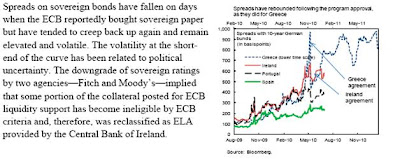
Two points:
• According to IMF, Irish yields have only been falling because the ECB have been buying bonds- other market participants don’t want to touch them (as of yesterday 10yr yields are back over 9% and closing in on the previous high). This deal is making any future market access less, not more likely
• The chart shown is the IMF’s and suggests that Irish debt yields are going the same way as Greece did after its EU/IMF programme was announced
Market yields reflect an underlying truth. Ireland is becoming less creditworthy as its resources are depleted. This economy is no being bailed out- if it were yields would be falling as the outlook improved. Irish taxpayers are bailing out EU banks – and the outlook is deteriorating because of it.

Two points:
• According to IMF, Irish yields have only been falling because the ECB have been buying bonds- other market participants don’t want to touch them (as of yesterday 10yr yields are back over 9% and closing in on the previous high). This deal is making any future market access less, not more likely
• The chart shown is the IMF’s and suggests that Irish debt yields are going the same way as Greece did after its EU/IMF programme was announced
Market yields reflect an underlying truth. Ireland is becoming less creditworthy as its resources are depleted. This economy is no being bailed out- if it were yields would be falling as the outlook improved. Irish taxpayers are bailing out EU banks – and the outlook is deteriorating because of it.
Saturday, 22 January 2011
Q&A at the doorsteps
Slí Eile: There is a distinct possibility that you will be getting more callers to the front door in the next few weeks. Be conscious that there may be a link between recent and prospective events, on the one hand, and on the other the 'Presentation of the National Recover Plan' update on the Department of Finance website here. Nothing obviously new there. It just says: 'This document relates to the National Recovery Plan 2011-2014 published on 24 November 2010.
However, the information within takes into account later data in 2010 as well as measures taken in Budget 2011.' Perhaps it a reminder to the Markets, IMF, EU, Political Parties - and voters - that the national authorities mean business. Take page 38 - composition of expenditure savings. Now you may wish to ask those friendly canvassers some questions including:
Will your party go with the broad parameters of the IMF-EU deal and the National Recovery Plan which envisages a cumulative four year 2.8billion cut in social welfare on top of the 0.9bn this year (2011)?
If not, will your party cut something else instead (public sector pay by an additional 2.8bn on top of savings already envisaged?)
If not cut other areas will your party seek negotiate the entire Plan and deal?
If the Markets, the IMF and the EU say no what is your party's 'Plan B'?
Please straight answers to straight questions. Time is of the essence.
However, the information within takes into account later data in 2010 as well as measures taken in Budget 2011.' Perhaps it a reminder to the Markets, IMF, EU, Political Parties - and voters - that the national authorities mean business. Take page 38 - composition of expenditure savings. Now you may wish to ask those friendly canvassers some questions including:
Will your party go with the broad parameters of the IMF-EU deal and the National Recovery Plan which envisages a cumulative four year 2.8billion cut in social welfare on top of the 0.9bn this year (2011)?
If not, will your party cut something else instead (public sector pay by an additional 2.8bn on top of savings already envisaged?)
If not cut other areas will your party seek negotiate the entire Plan and deal?
If the Markets, the IMF and the EU say no what is your party's 'Plan B'?
Please straight answers to straight questions. Time is of the essence.
Wednesday, 12 January 2011
Interesting IMF paper
Here is an interesting paper that formalises an idea that many of us would agree with, that inequality caused the crisis.
Unfortunately the IMF policy prescriptions seem totally separate to their analysis.
Unfortunately the IMF policy prescriptions seem totally separate to their analysis.
Wednesday, 24 November 2010
Could someone please send the IMF the Spraoi Christmas Annual?

Rory O'Farrell: During my childhood in 1980s Ireland, one of the highlights of the school year was the arrival of the Spraoi Christmas Annual. Among the many life skills it taught were ‘join the dots’ and ‘spot the difference’.
Twenty years later the IMF have produced a similar publication termed ‘Lifting Euro Area Growth: Priorities for Structural Reforms and Governance’.
Just like Spraoi it makes use of colour, this time to show Ireland’s economic problems. We have two structural reform gaps marked red, infrastructure and network regulation. Given our lack of investment in such things as broadband this is perhaps unsurprising. When it comes to labour market inefficiency we get a green light, the IMF don’t see that as a major problem.
This would suggest to me that Ireland’s labour market regulation (such as the minimum wage) does not cause a problem, but we should probably invest in infrastructure. This would also create jobs and reduce future problems of long term unemployment. On page 22 the IMF report suggests we need to
“Raise employment to avoid persistence of current high unemployment rate; and
Improve competitiveness to promote exports as a sustainable source of growth”.
Yes, they seem to have mastered joining the dots. Our infrastructure deficit and network regulation doesn’t help our competitiveness position.
However, the specific measures they suggest are as follows.
To promote employment labour market:- Introduce gradual decrease of benefits over time of unemployment spell and stricter job search requirements
- Provide more resources to the unemployment agencies (FÁS) to provide efficient job search assistance to the growing number of unemployed
- Review the level of minimum wage to make it consistent with the general fall in wages
- Reform planning and licensing systems in network industries, so as to increase competition in sheltered services sectors
- Focus public resources on high-priority projects in the knowledge-based economy
So, no plans for infrastructural investment. We just get supply side solutions for demand side problems. Have the IMF learned how to spot the difference?
Sunday, 21 November 2010
A sneak pre-view of the 4-year plan
Slí Eile: An interesting insight from former IMF director, Donal Donovan, is given here. He writes in the Irish Times, last Friday, that:
"These informal interactions – a common feature of such situations – are facilitated by the fact that most of the key personages are well known to each other as a result of interaction in other forums over the years.
So, my surmise is that yesterday the IMF team (which includes Ashoka Mody, who has led earlier IMF visits to Dublin) will have sat down with the latest drafts of the four-year and annual budget plan. (They will probably have had access to earlier versions also.)" (emphasis added)."
But what about Dáil Eireann? and what about Seán Citizen? A vital input to democratic debate is timely, relevant and reliable information. We have been poorly served on all three fronts. See for example a critique of the lack of adequate macro-economic data and forecasting capacity in the recent Joint Oireachtas Committee report here. Note, also, the extent to which false and misleading information served up the banks was cited as an issue by Fianna Fáil deputy Michael McGrath in a Dail committee hearing last Thursday. Misleading estimates of bad loans and underestimated discout rates costing billions have also been cited as a problem by Brendan Somers of NAMA.
Friday, 5 November 2010
Are the IMF so bad?
Rory O'Farrell: Obviously, they don't have such a great past record, but here is an interesting speech by Dominique Strauss-Kahn, Managing Director of the IMF (and a French socialist).
It wouldn't have been so out of place at the recent TASC conference.
It wouldn't have been so out of place at the recent TASC conference.
Friday, 15 October 2010
IMF study indicates 6 billion cuts could risk over 20,000 jobs
Tom McDonnell: It is claimed in an IMF paper ('Will It Hurt? Macroeconomic Effects of Fiscal Consolidation') that fiscal consolidation measures can be linked to increased unemployment.
Caution should be applied in the direct transfer of these findings to Ireland, as all country characteristics are different. However, we can look at some of the basic numbers.
The IMF paper states that "Fiscal consolidation typically has a contractionary effect on output. A fiscal consolidation equal to 1 percent of GDP typically reduces GDP by about 0.5 percent within two years and raises the unemployment rate by about 0.3 percentage point. Domestic demand—consumption and investment—falls by about 1 percent."
Summarising this for Ireland, one could estimate the following:
- Ireland's GDP is €159 billion;
- 1 per cent of GDP is equal to €1.6 billion
- All things being equal, TASC's €3 billion of austerity measures equals 1.89 per cent of GDP, which leads to an expected reduction in GDP of 0.94 per cent (c.€1.5 billion).
- The suggestion that Ireland should 'frontload' a €6 billion austerity package in 2011, would have an expected reduction in GDP of c.2 per cent (c.€3 billion)
- The labour force is currently 2,152,700 people
- 0.3 per cent of the labour force is 6,458. This is the level of increase in unemployment expected for every 1 per cent of GDP worth of fiscal contraction
- All things being equal, TASC's €3 billion of austerity measures (mostly on the tax side) risks increasing unemployment by 12,206
- But an austerity package of €6 billion (an additional €3 billion) doubles this to an increase of 24,412 in unemployment.
Of course, all things are not equal. TASC argues in its Budget proposals that different types of cut and different taxes have different effects on the economy. And TASC's proposals are as growth-friendly as possible, with an Economic Recovery Fund to maintain and create jobs to compensate for the deflationary impact of taxation.
Another difference in applying the IMF study to Ireland is that emigration might occur more than people adding to the live register. Nevertheless, it is reasonable to suggest that frontloading €6 billion in cuts risks over 20,000 jobs.
Caution should be applied in the direct transfer of these findings to Ireland, as all country characteristics are different. However, we can look at some of the basic numbers.
The IMF paper states that "Fiscal consolidation typically has a contractionary effect on output. A fiscal consolidation equal to 1 percent of GDP typically reduces GDP by about 0.5 percent within two years and raises the unemployment rate by about 0.3 percentage point. Domestic demand—consumption and investment—falls by about 1 percent."
Summarising this for Ireland, one could estimate the following:
- Ireland's GDP is €159 billion;
- 1 per cent of GDP is equal to €1.6 billion
- All things being equal, TASC's €3 billion of austerity measures equals 1.89 per cent of GDP, which leads to an expected reduction in GDP of 0.94 per cent (c.€1.5 billion).
- The suggestion that Ireland should 'frontload' a €6 billion austerity package in 2011, would have an expected reduction in GDP of c.2 per cent (c.€3 billion)
- The labour force is currently 2,152,700 people
- 0.3 per cent of the labour force is 6,458. This is the level of increase in unemployment expected for every 1 per cent of GDP worth of fiscal contraction
- All things being equal, TASC's €3 billion of austerity measures (mostly on the tax side) risks increasing unemployment by 12,206
- But an austerity package of €6 billion (an additional €3 billion) doubles this to an increase of 24,412 in unemployment.
Of course, all things are not equal. TASC argues in its Budget proposals that different types of cut and different taxes have different effects on the economy. And TASC's proposals are as growth-friendly as possible, with an Economic Recovery Fund to maintain and create jobs to compensate for the deflationary impact of taxation.
Another difference in applying the IMF study to Ireland is that emigration might occur more than people adding to the live register. Nevertheless, it is reasonable to suggest that frontloading €6 billion in cuts risks over 20,000 jobs.
Tuesday, 29 June 2010
More of the same
Michael Burke: There has been much discussion about the ESRI's view that Ireland will eventually recover to have a stronger growth rate than most other EU economies. The interest was sparked because some took it to be a vindication of government policy. But the ESRI forcasts are not exceptional; they're very much in line with those of the OECD, IMF and, in the short-run, the EU Commission.
But neither are they a vindication of government policy.
To take just one of the assessments, that of the IMF, in its recent annual assessmnent of the economy there were lots of encouraging words on policy. 'Assertive', 'credibility', 'resolve', 'appropriately ambitious fiscal consolidation' all get an airing in the first two paragraphs, so you get the picture.
But, just as you wouldn't ask Seamus Heaney for a inflation forecast, no-one ever reads the IMF publications for the beauty of their writing. It's the numbers we care about. Here is a summary of some the key numbers
* GDP falling by 0.5% this year
* A gradual rise in GDP growth to 3.5% in 2015
* Unemployment peaking at 13.5% this year
* But structural unemployment keeping the rate at 9% in 2015
There's one more shocking number to come, but let's deal with these first. The recession here began at the start of 2008, for the Euro Area as a whole it began one year later. The Euro Area began to recover in mid-2009 while all the official foreasts have the economy here contracting again in the first half of this year. Therefore the Irish recession will be precisely two-and-a-half years long, compared to 6 months for the Euro Area as a whole.
The forecast increase in GDP growth to 3.5% provides little cause for celebration. The last time this economy had a lower growth rate than that was in 1993, recovering from the strait-jacket of the European Exchange Rate Mechanism and an overvalued punt. In addtion, as all the forecasts agree, the recovery will be a statistical one only as net exports pick-up on the back of rising global demand (but, incidentally, nailing the nonsense about 'lack of competitiveness').
But, since the export sector relies heavily on foreign imports, because it is not especially labour-intensive and, above all, because it is so lowly-taxed, none of this statistical improvement will be reflected in domestic ativity or create jobs (or narrow the deficit). So, shockingly, unemployment is still expected to be 9% in 2015. And although the IMF does not state it, given that employment prospects are so poor, the declining unemployment rate must arise overwhelmingly from continued mass emigration.
This might be of little concern to the IMF, which states that "[Government] actions have reassured the global policy community and international financial markets." We won't dwell on the fact that Irish 10yr government bond yields were 5.6% yesterday, having started the crisis at 4.1%, nor that most other yields have fallen since that time. But at least the 'global policy community' is reassured, by which the IMF means, well, the IMF and others.
Yet the only other number of significance is the most shocking of all. The IMF arguments that prior measures are on a track 'leading towards' deficit-reduction. But not on the track itself, as they argue for further fiscal consolidation measures equivalent to 4.5% of GDP. And, if growth is not as robust as the government foecasts 'a clear possibility' the IMF says, the measures will need to be even larger.
To put this in context, the €3bn in further measures the government is talking about is 1.8% of GDP, on top of the 2008 ad 2009 budgets, emergency budget and measures which amounted to 8.9% of GDP. So, rather than the government's €3bn measures, the IMF reckons they should be at least €7.35bn, probably more. That's at least half the fiscal tightening already seen to date.
It is to repeat a fiscal tightening which led to wider, not norrower deficits (7.3% of GDP to 14.3%),and the longest, deepest recession in the Euro Area, as well as a surge in both unemployment and emigration. Repeating the same experiment and expecting a different outcome is madness.
But neither are they a vindication of government policy.
To take just one of the assessments, that of the IMF, in its recent annual assessmnent of the economy there were lots of encouraging words on policy. 'Assertive', 'credibility', 'resolve', 'appropriately ambitious fiscal consolidation' all get an airing in the first two paragraphs, so you get the picture.
But, just as you wouldn't ask Seamus Heaney for a inflation forecast, no-one ever reads the IMF publications for the beauty of their writing. It's the numbers we care about. Here is a summary of some the key numbers
* GDP falling by 0.5% this year
* A gradual rise in GDP growth to 3.5% in 2015
* Unemployment peaking at 13.5% this year
* But structural unemployment keeping the rate at 9% in 2015
There's one more shocking number to come, but let's deal with these first. The recession here began at the start of 2008, for the Euro Area as a whole it began one year later. The Euro Area began to recover in mid-2009 while all the official foreasts have the economy here contracting again in the first half of this year. Therefore the Irish recession will be precisely two-and-a-half years long, compared to 6 months for the Euro Area as a whole.
The forecast increase in GDP growth to 3.5% provides little cause for celebration. The last time this economy had a lower growth rate than that was in 1993, recovering from the strait-jacket of the European Exchange Rate Mechanism and an overvalued punt. In addtion, as all the forecasts agree, the recovery will be a statistical one only as net exports pick-up on the back of rising global demand (but, incidentally, nailing the nonsense about 'lack of competitiveness').
But, since the export sector relies heavily on foreign imports, because it is not especially labour-intensive and, above all, because it is so lowly-taxed, none of this statistical improvement will be reflected in domestic ativity or create jobs (or narrow the deficit). So, shockingly, unemployment is still expected to be 9% in 2015. And although the IMF does not state it, given that employment prospects are so poor, the declining unemployment rate must arise overwhelmingly from continued mass emigration.
This might be of little concern to the IMF, which states that "[Government] actions have reassured the global policy community and international financial markets." We won't dwell on the fact that Irish 10yr government bond yields were 5.6% yesterday, having started the crisis at 4.1%, nor that most other yields have fallen since that time. But at least the 'global policy community' is reassured, by which the IMF means, well, the IMF and others.
Yet the only other number of significance is the most shocking of all. The IMF arguments that prior measures are on a track 'leading towards' deficit-reduction. But not on the track itself, as they argue for further fiscal consolidation measures equivalent to 4.5% of GDP. And, if growth is not as robust as the government foecasts 'a clear possibility' the IMF says, the measures will need to be even larger.
To put this in context, the €3bn in further measures the government is talking about is 1.8% of GDP, on top of the 2008 ad 2009 budgets, emergency budget and measures which amounted to 8.9% of GDP. So, rather than the government's €3bn measures, the IMF reckons they should be at least €7.35bn, probably more. That's at least half the fiscal tightening already seen to date.
It is to repeat a fiscal tightening which led to wider, not norrower deficits (7.3% of GDP to 14.3%),and the longest, deepest recession in the Euro Area, as well as a surge in both unemployment and emigration. Repeating the same experiment and expecting a different outcome is madness.
Thursday, 22 April 2010
IMF links and leaks ....
Yesterday's Guardian had an interesting article by Larry Elliott on the IMF's World Economic Outlook; the IMF has stated that "In most advanced economies, fiscal and monetary policies should maintain a supportive thrust in 2010 to sustain growth and employment". Elliott notes that "The fund's comments are likely to be seized upon by Gordon Brown, who has been arguing the UK could suffer a double-dip recession if the Conservatives implemented plans for £6bn of spending cuts in an emergency post-election budget in June". Separately, a leaked copy of the IMF's report on financial sector taxes is available here, and the Tax Justice Network's reaction is here.
Wednesday, 24 March 2010
The day after the IMF's tomorrow
Michael Taft: The IMF has suggested that the Irish Government’s growth projections are too optimistic and should be scaled back. So has the EU Commission. This has grave implications for the Government’s current strategy; if growth doesn’t come right, fiscal targets will be missed, debt will pile up, unemployment will remain high and living standards low. The Government may well end up sinking further into deflationary quicksand.
The IMF has projected growth for Ireland up to 2014. While these projections were initially produced in the middle of last year, the IMF reconfirmed them in their recent World Economic Outlook. What would be that impact on the deficit given these growth projections? The following examines only the tax revenue side of the equation.

First, we find IMF growth projections much lower than the Government’s. Between 2010 and 2014, the Government expects the economy to grow by 17.4 percent in real terms; the IMF, 8.8 percent. This will have considerable implications for public finances, as tax revenue is a function of GDP – low economic growth equals low tax revenue growth.
If the Government’s ‘tax burden’ or ‘tax ratio’ holds, under the IMF scenario we would find that not only will we fail to meet the Maastricht guidelines by 2014, we will pile up considerably higher debt in the process. Under the IMF scenario, the annual deficit is unsurprisingly higher each year; by 2014 it still remains above Maastricht guideline levels by 2014.

More alarmingly, is the growth in overall debt levels. The Government expects gross debt to be at 80.8 percent of GDP. However, if the IMF projections hold, overall debt will soar to over 93 percent – a result of higher annual deficits, and lower nominal GDP. This is what the TASC letter referred to as the ‘low-growth, high debt’ future.
There are two major caveats: first, this doesn’t include higher unemployment costs. We should expect unemployment, under the IMF’s lower growth scenario, to remain higher than the Government’s forecasts. If so, spending will rise above current projected levels. Second, higher borrowing levels will incur higher debt service costs. Factor these in, and the deficit and overall debt levels will be higher still.
This is all of a piece. In a previous post, Michael Burke and I showed how the Government’s current strategy will depress future growth. That is because the Government, rather than reducing the deficit, is embedding the deficit into the economic base.
So which scenario is more likely? The IMF projections are clearly pessimistic. The Government will take some comfort from recent projections. For 2011, Bloxham is projecting 3 percent growth; Friends First 3.1 percent. IBEC, however, is slightly more cautious, with a projection of 2.1 percent while PwC projects growth at 1.8 percent.
Some comfort, yes; but even the Department of Finance warns that GDP growth may not be tax-rich. This is because growth may be driven by exports from the multi-national sector.
So do all these numbers matter? Yes, very much so. NCB’s growth projections come up only slightly less than the Government by 2014, but even this has the potential to knock the Government’s fiscal targets off course. They, too, accept that the Government will miss its 2014 target, while piling up more debt than the Government expects.
In short, the Government’s fiscal strategy is built on quicksand. Its growth projections are optimistic and it has failed to factor in the deflationary effects of its current spending cuts policies. If they resort to further fiscal tightening to make up for this, all that will happen is that they will sink even further.
And the rest of us along with them.
The IMF has projected growth for Ireland up to 2014. While these projections were initially produced in the middle of last year, the IMF reconfirmed them in their recent World Economic Outlook. What would be that impact on the deficit given these growth projections? The following examines only the tax revenue side of the equation.

First, we find IMF growth projections much lower than the Government’s. Between 2010 and 2014, the Government expects the economy to grow by 17.4 percent in real terms; the IMF, 8.8 percent. This will have considerable implications for public finances, as tax revenue is a function of GDP – low economic growth equals low tax revenue growth.
If the Government’s ‘tax burden’ or ‘tax ratio’ holds, under the IMF scenario we would find that not only will we fail to meet the Maastricht guidelines by 2014, we will pile up considerably higher debt in the process. Under the IMF scenario, the annual deficit is unsurprisingly higher each year; by 2014 it still remains above Maastricht guideline levels by 2014.

More alarmingly, is the growth in overall debt levels. The Government expects gross debt to be at 80.8 percent of GDP. However, if the IMF projections hold, overall debt will soar to over 93 percent – a result of higher annual deficits, and lower nominal GDP. This is what the TASC letter referred to as the ‘low-growth, high debt’ future.
There are two major caveats: first, this doesn’t include higher unemployment costs. We should expect unemployment, under the IMF’s lower growth scenario, to remain higher than the Government’s forecasts. If so, spending will rise above current projected levels. Second, higher borrowing levels will incur higher debt service costs. Factor these in, and the deficit and overall debt levels will be higher still.
This is all of a piece. In a previous post, Michael Burke and I showed how the Government’s current strategy will depress future growth. That is because the Government, rather than reducing the deficit, is embedding the deficit into the economic base.
So which scenario is more likely? The IMF projections are clearly pessimistic. The Government will take some comfort from recent projections. For 2011, Bloxham is projecting 3 percent growth; Friends First 3.1 percent. IBEC, however, is slightly more cautious, with a projection of 2.1 percent while PwC projects growth at 1.8 percent.
Some comfort, yes; but even the Department of Finance warns that GDP growth may not be tax-rich. This is because growth may be driven by exports from the multi-national sector.
So do all these numbers matter? Yes, very much so. NCB’s growth projections come up only slightly less than the Government by 2014, but even this has the potential to knock the Government’s fiscal targets off course. They, too, accept that the Government will miss its 2014 target, while piling up more debt than the Government expects.
In short, the Government’s fiscal strategy is built on quicksand. Its growth projections are optimistic and it has failed to factor in the deflationary effects of its current spending cuts policies. If they resort to further fiscal tightening to make up for this, all that will happen is that they will sink even further.
And the rest of us along with them.
Tuesday, 23 March 2010
IMF et al on Fiscal Stimulus
Michael Burke: Philip Lane has posted a link to a very useful IMF working paper here. The paper draws on a wide variety of leading macroeconomic models (IMF, EU, Fed, Bank of Canada, etc.) to examine the effectiveness of fiscal stimulus.
Some interesting features of the paper’s conclusion: “There are four broad conclusions flowing from our analysis.
First, there is no such thing as a simple fiscal multiplier. The response of the economy to temporary discretionary fiscal stimulus depends on a number of factors, including most importantly the type of fiscal instrument used and the extent of monetary accommodation of the higher inflation generated by the stimulus.
Second, temporary expansionary fiscal actions can be highly effective, particularly when the fiscal instrument is spending or well-targeted transfers, and when in addition monetary policy is accommodative.
Third, permanent stimulus, that is a permanent increase in deficits, is much more problematic than temporary stimulus. It leads to a long-run contraction in output, but in addition the perception that deficits will become permanent also substantially reduces short-run fiscal multipliers.
Fourth, the G20 stimulus should have significant effects on global GDP in 2009 and 2010.”
So, it seems that the rest of the world has good reason to believe in the ‘tooth-fairy’ of fiscal stimulus. No such naïveté to be found in the ranks of Irish policymaking, unfortunately.
In discriminating as to types of stimulus, the verdict is also rather clear,
“A number of results are consistent across all models.
First, the multipliers from government investment and consumption expenditures, which are roughly similar in size, are clearly larger than the multipliers from transfers, labor income taxes, consumption taxes and corporate taxes.
Second, multipliers are small for general transfers, labor income taxes and corporate taxes, and somewhat larger (but still small relative to government expenditures) for consumption
taxes.
Third, only targeted transfers come close to having multipliers similar to those of government expenditures……[Yet....]
…it is of interest to note that in none of the regions [of the world adopting fiscal stimulus] do increases in government consumption play a predominant role.”
Figs. 22 and 31 show the very large multiplier effects of government investment and (slightly lower) effects of targeted transfers to the low paid in the US economy and Figs. 64 and 73 show the same for the EU.
There is one unproven assertion in the article on government finances, evident in the phrase above ”a permanent stimulus, that is a permanent increase in deficits.” If, as the models consistently find, the effects on GDP of government consumption and investment have multipliers that stretch to 2 over more than one year when interest rates are low (and have a cumulative five-year impact of more than 5), then the effects on government tax revenues would exceed the initial outlay by some considerable degree; ie investment and government consumption can lower the deficit, not create a permanently higher one. There is too the unacknowledged benefit to government finances from a growth-related decrease in welfare spending.
The alternative approach, based on ‘Expansionary Fiscal Contraction’, is dismissed in the IMF WP. An examination of how the EFC experiment has failed Ireland can be found on this blog.
The main argument against Ireland adopting a fiscal stimulus is openness (The debt and deficit arguments do not hold since Ireland’s debt level is below that of the peer group studied and the deficit matched by some). Yet the openness argument is tested (Fig.88) and found to have no appreciable impact on the effectiveness of fiscal stimulus - perhaps, unstated by the authors, because the propensity to import is offset by both a greater propensity to export and the greater efficiency that openness brings.
Some interesting features of the paper’s conclusion: “There are four broad conclusions flowing from our analysis.
First, there is no such thing as a simple fiscal multiplier. The response of the economy to temporary discretionary fiscal stimulus depends on a number of factors, including most importantly the type of fiscal instrument used and the extent of monetary accommodation of the higher inflation generated by the stimulus.
Second, temporary expansionary fiscal actions can be highly effective, particularly when the fiscal instrument is spending or well-targeted transfers, and when in addition monetary policy is accommodative.
Third, permanent stimulus, that is a permanent increase in deficits, is much more problematic than temporary stimulus. It leads to a long-run contraction in output, but in addition the perception that deficits will become permanent also substantially reduces short-run fiscal multipliers.
Fourth, the G20 stimulus should have significant effects on global GDP in 2009 and 2010.”
So, it seems that the rest of the world has good reason to believe in the ‘tooth-fairy’ of fiscal stimulus. No such naïveté to be found in the ranks of Irish policymaking, unfortunately.
In discriminating as to types of stimulus, the verdict is also rather clear,
“A number of results are consistent across all models.
First, the multipliers from government investment and consumption expenditures, which are roughly similar in size, are clearly larger than the multipliers from transfers, labor income taxes, consumption taxes and corporate taxes.
Second, multipliers are small for general transfers, labor income taxes and corporate taxes, and somewhat larger (but still small relative to government expenditures) for consumption
taxes.
Third, only targeted transfers come close to having multipliers similar to those of government expenditures……[Yet....]
…it is of interest to note that in none of the regions [of the world adopting fiscal stimulus] do increases in government consumption play a predominant role.”
Figs. 22 and 31 show the very large multiplier effects of government investment and (slightly lower) effects of targeted transfers to the low paid in the US economy and Figs. 64 and 73 show the same for the EU.
There is one unproven assertion in the article on government finances, evident in the phrase above ”a permanent stimulus, that is a permanent increase in deficits.” If, as the models consistently find, the effects on GDP of government consumption and investment have multipliers that stretch to 2 over more than one year when interest rates are low (and have a cumulative five-year impact of more than 5), then the effects on government tax revenues would exceed the initial outlay by some considerable degree; ie investment and government consumption can lower the deficit, not create a permanently higher one. There is too the unacknowledged benefit to government finances from a growth-related decrease in welfare spending.
The alternative approach, based on ‘Expansionary Fiscal Contraction’, is dismissed in the IMF WP. An examination of how the EFC experiment has failed Ireland can be found on this blog.
The main argument against Ireland adopting a fiscal stimulus is openness (The debt and deficit arguments do not hold since Ireland’s debt level is below that of the peer group studied and the deficit matched by some). Yet the openness argument is tested (Fig.88) and found to have no appreciable impact on the effectiveness of fiscal stimulus - perhaps, unstated by the authors, because the propensity to import is offset by both a greater propensity to export and the greater efficiency that openness brings.
Thursday, 18 February 2010
We need to rethink macroeconomics
Slí Eile: In a paper by staff of the International Monetary Fund (Rethinking Macroeconomic Policy) authors Olivier Blanchard, Giovanni Dell’Ariccia, and Paolo Mauro make the case for smarter macro-economic policy. They openly acknowledge that the economics fraternity had got it wrong on some key issues. They write:
Now that the world economic system came crashing down in a matter of months in 2008 economists in general, and macro-economists in particular, have been in a state of shock. The Great Moderation from the mid-1970s gave way to the Great Recession. A partial counter-cyclical response on the part of some big players including USA, UK and Germany (and aided by the boom in demand in China) prevented the world from slipping into a major crash à la 1929.
Now, there are rumblings of the need to cut off the initial fiscal stimulus and to prioritise fiscal balance especially in those jurisdictions where the public sector debt to GDP ratio has risen sharply (notably the UK and the US). Inspiration has been provided, let it be said, by the ‘brave Irish’ who lead the way in fiscal contraction (not having done a stimulus in the first place). However, as in boom times so also in crisis times we should be wary of the advice coming from macro-economy. Blanchard et al. observe that:
The impact of fiscal contraction since October 2008, in the case of Ireland, opens up an interesting case study. Whatever the future holds, levels of debt – personal, corporate and governmental – will remain very high. It is difficult to see any large reduction in these levels any time soon. The second fact is that unemployment will remain very high and may go higher. Should there be a quick recovery in labour markets (especially in English speaking countries) it is possible that outward migration could assume very large numbers here even as the economy here is technically ‘out of recession’ from later on this year.
The multiplier impacts of fiscal contraction are worrying. All the more worrying is the lack of firm empirical work in this domain beyond what can be gleaned from ESRI working papers (documents emanating from the Department of Finance do not provide the technical detail or modelling to show that the full effect over time of recent spending cuts and tax increases have been taken into account)
Blanchard et al. put in succinctly as follows:
Finally, Blanchard et al write: ‘Identifying the flaws of existing policy is (relatively) easy. Defining a new macroeconomic policy framework is much harder.’ I could not agree more especially in regard to those working in the field of economics and related other disciplines who seek a new baby and not just the old minus the bathwater.
…we thought of monetary policy as having one target, inflation, and one instrument, the policy rate. So long as inflation was stable, the output gap was likely to be small and stable and monetary policy did its job. We thought of fiscal policy as playing a secondary role, with political constraints sharply limiting its de facto usefulness. And we thought of financial regulation as mostly outside the macroeconomic policy framework…The single-minded focus on particular problems sounds very familiar, I think, to an Irish audience. Before the current crisis, the role of the Central Bank and the Financial Regulator was passive, facilitating, and entailed non-directive counselling to banks. The model worked, so it was thought, and any lancing of the property bubble would be by way of a soft landing. Essentially, the failure was to ‘join up the dots’. People saw different parallel realities and imagined that any one or two could go pear shape but not the whole lot at the same time and in a way that showed how interconnected everything was in a way not previously realised. People were still working out of the old textbooks from the 1970s and 1980s. A previous blog has discussed this.
Now that the world economic system came crashing down in a matter of months in 2008 economists in general, and macro-economists in particular, have been in a state of shock. The Great Moderation from the mid-1970s gave way to the Great Recession. A partial counter-cyclical response on the part of some big players including USA, UK and Germany (and aided by the boom in demand in China) prevented the world from slipping into a major crash à la 1929.
Now, there are rumblings of the need to cut off the initial fiscal stimulus and to prioritise fiscal balance especially in those jurisdictions where the public sector debt to GDP ratio has risen sharply (notably the UK and the US). Inspiration has been provided, let it be said, by the ‘brave Irish’ who lead the way in fiscal contraction (not having done a stimulus in the first place). However, as in boom times so also in crisis times we should be wary of the advice coming from macro-economy. Blanchard et al. observe that:
….The rejection of discretionary fiscal policy as a countercyclical tool was particularly strong in academia. In practice, as for monetary policy, the rhetoric was stronger than the reality. Discretionary fiscal stimulus measures were generally accepted in the face of severe shocks (such as, for example, during the Japanese crisis of the early 1990s)….They go on to say that:
…As a result, the focus was primarily on debt sustainability and on fiscal rules designed to achieve such sustainability. To the extent that policymakers took a long-term view, the focus in advanced economies was on prepositioning the fiscal accounts for the looming consequences of aging…In summary, many economists and some policy-makers forgot about discretionary fiscal policy instruments along with all the other tools available (exchange rate, interest rates, regulation etc). The point is all the more relevant in a small open economy within the European Monetary Union such as Ireland.
The impact of fiscal contraction since October 2008, in the case of Ireland, opens up an interesting case study. Whatever the future holds, levels of debt – personal, corporate and governmental – will remain very high. It is difficult to see any large reduction in these levels any time soon. The second fact is that unemployment will remain very high and may go higher. Should there be a quick recovery in labour markets (especially in English speaking countries) it is possible that outward migration could assume very large numbers here even as the economy here is technically ‘out of recession’ from later on this year.
The multiplier impacts of fiscal contraction are worrying. All the more worrying is the lack of firm empirical work in this domain beyond what can be gleaned from ESRI working papers (documents emanating from the Department of Finance do not provide the technical detail or modelling to show that the full effect over time of recent spending cuts and tax increases have been taken into account)
Blanchard et al. put in succinctly as follows:
Furthermore, the wide variety of approaches in terms of the measures undertaken has made it clear that there is a lot we do not know about the effects of fiscal policy, about the optimal composition of fiscal packages, about the use of spending increases versus tax decreases, and the factors that underlie the sustainability of public debts, topics that had been less active areas of research before the crisis.However, for the sake of balance it should be pointed out that Blanchard et al. are not calling for the baby to be thrown out with the bathwater (to use their words).
..It is important to start by stating the obvious, namely, that the baby should not be thrown out with the bathwater. Most of the elements of the precrisis consensus, including the major conclusions from macroeconomic theory, still hold...Fiscal sustainability is of the essence, not only for the long term, but also in affecting expectations in the short term’ (P10).Their paper is highly nuanced and should not be cited as fundamentally at odds with orthodoxy. There is nothing in their line of argument to suggest that the Irish Government is being anything but ‘fiscally responsible’. The details of how they are going about it may be questioned from within and outside the country. But, as Enda Kenny recently said ‘we have no problems with an adjustment of €4bn.
Finally, Blanchard et al write: ‘Identifying the flaws of existing policy is (relatively) easy. Defining a new macroeconomic policy framework is much harder.’ I could not agree more especially in regard to those working in the field of economics and related other disciplines who seek a new baby and not just the old minus the bathwater.
Tuesday, 2 February 2010
Greek Tragedy II - and the tax dimension
Michael Burke: In today's Financial Times, two economists from the Breugel think-tank in Brussels argue that the best course for Greece is to call in the IMF.
The Greek economy and financial markets are bearing the brunt of concerted pressure in the Euro Area, and there are fears that a collapse there could lead to renewed speculative pressure on a number of countries including Ireland.
The possibility of an IMF intervention ought to be shameful for the architects of Europe's fiscal and monetary arrangements, since the Euro was touted as an instrument that would protect the economies of Europe from speculative pressures. 'European Solidarity' has proved a mirage. Worse, leading EU institutions have played their part in Greece's difficulties. As the authors of the FT piece note,
"One reason why things have sharply worsened is that the ECB has said that by the end of 2010 it will tighten quality requirements for bonds pledged as collateral – which risks excluding Greek bonds from repurchase agreement operations. This, and Greece’s inability so far to present a credible fiscal plan, explains the alarm in financial markets."
This unilateral move by the ECB seems wholly misplaced. If the ECB is concerned about the deterioration of asset quality in a tiny part of its portfolio, it should make its own determination about which assets can be pledged. Outsourcing this to the largely discredited ratings agencies seems like a wholly unwarranted measure, designed to increase the pressures on a Greek government which has inherited a crisis not of its own making.
Nor is the Commission blameless, having been apparently hoodwinked over a number of years by the previous Greek governmet about the size of the deficits (and debt!) in a manner that would make a primary schoolteacher blush.
The new government has bemoaned the endemic corruption in Greek society, includig government bodies, and its effect on reducing tax revenues. Perhaps the Commission could provide greater assistance as tax collectors than as macroeconomic advisers, or even auditors. In the period 1997-2006, Greek tax revenues as a proportion of GDP were 5.5% below the Euro Area average. Even in 2008, they were 4% below the average. Closing in on the average level would make a major dent in the deficit and, once the economy recovers, the debt stock too.
This low taxation is a common feature of those Euro Area countries currently in the cross hairs of the financial markets. In 2008, Spain's tax revenues were 37% of GDP, 7.8% below the Euro Area average. By contrast, in Germany they were 43.7% and in France they were 49.3%.
Of course, in 2008, Ireland's tax revenue GDP ratio was the lowest of all in the Euro Area, at 34.9%, and fully 10% below the average (Table 36). Closing in on the Euro Area average would see Ireland's deficit melt away to nothing.
The Greek economy and financial markets are bearing the brunt of concerted pressure in the Euro Area, and there are fears that a collapse there could lead to renewed speculative pressure on a number of countries including Ireland.
The possibility of an IMF intervention ought to be shameful for the architects of Europe's fiscal and monetary arrangements, since the Euro was touted as an instrument that would protect the economies of Europe from speculative pressures. 'European Solidarity' has proved a mirage. Worse, leading EU institutions have played their part in Greece's difficulties. As the authors of the FT piece note,
"One reason why things have sharply worsened is that the ECB has said that by the end of 2010 it will tighten quality requirements for bonds pledged as collateral – which risks excluding Greek bonds from repurchase agreement operations. This, and Greece’s inability so far to present a credible fiscal plan, explains the alarm in financial markets."
This unilateral move by the ECB seems wholly misplaced. If the ECB is concerned about the deterioration of asset quality in a tiny part of its portfolio, it should make its own determination about which assets can be pledged. Outsourcing this to the largely discredited ratings agencies seems like a wholly unwarranted measure, designed to increase the pressures on a Greek government which has inherited a crisis not of its own making.
Nor is the Commission blameless, having been apparently hoodwinked over a number of years by the previous Greek governmet about the size of the deficits (and debt!) in a manner that would make a primary schoolteacher blush.
The new government has bemoaned the endemic corruption in Greek society, includig government bodies, and its effect on reducing tax revenues. Perhaps the Commission could provide greater assistance as tax collectors than as macroeconomic advisers, or even auditors. In the period 1997-2006, Greek tax revenues as a proportion of GDP were 5.5% below the Euro Area average. Even in 2008, they were 4% below the average. Closing in on the average level would make a major dent in the deficit and, once the economy recovers, the debt stock too.
This low taxation is a common feature of those Euro Area countries currently in the cross hairs of the financial markets. In 2008, Spain's tax revenues were 37% of GDP, 7.8% below the Euro Area average. By contrast, in Germany they were 43.7% and in France they were 49.3%.
Of course, in 2008, Ireland's tax revenue GDP ratio was the lowest of all in the Euro Area, at 34.9%, and fully 10% below the average (Table 36). Closing in on the Euro Area average would see Ireland's deficit melt away to nothing.
Subscribe to:
Posts (Atom)