Tom McDonnell: Mr. Rehn's recent open letter on fiscal multipliers; the effects of discretionary fiscal consolidation; and the relevance of economic theory and evidence, was a truly dispiriting and perplexing intervention.
It is easy to understand why the handling of the Euro crisis has been such an unmitigated shambles with people like Mr. Rehn running the show. We deserve better.
The Commissioner is taken to task by Jonathan Portes here and by Karl Whelan here. Both contributions are well worth a read.
Confidence indeed.

Showing posts with label fiscal strategy. Show all posts
Showing posts with label fiscal strategy. Show all posts
Wednesday, 20 February 2013


Wednesday, 30 January 2013
New CEPR paper on the contribution of IMF recommendations to the ongoing crisis in Europe
The Center for Economic and Policy Research (CEPR) in Washington D.C. has published a paper examining the policy recommendations made by the IMF to European Union Countries for the years 2008-2011.
Under Article 4 of its Memorandum of Understanding, the IMF is charged with "(i) overseeing the international monetary system to ensure its effective operation and (ii) monitoring each member's compliance with its policy obligations." (IMF) As part of this 'surveillance', the fund continually monitors the economy of member countries, including country visits and consultations with stakeholders. It also makes policy recommendations.
The CEPR paper examines the advice given by the IMF over four years and finds a consistent pattern of policy recommendations, "which indicates (1) a macroeconomic policy that focuses on reducing spending and shrinking the size of government, in many cases regardless of whether this is appropriate or necessary, or may even exacerbate an economic downturn; and (2) a focus on other policy issues that would tend to reduce social protections for broad sectors of the population (including public pensions, healthcare , and employment protections), reduce labor's share of national income, and possibly increase poverty, social exclusion, and economic and social inequality as a result." (CEPR)
Its is unsurprising, perhaps, that this is the path chosen by the IMF. However, as the paper points out, the IMF is overwhelmingly influenced by European governments through its governance system and these same European governments also subscribe to broader European Union goals, such as those articulated in the Europe 2020 strategy of a sustainable and inclusive economy. The paper points to the tension between these goals of a reduction in social exclusion, an increase in research and development and climate change goals, and the fiscal consolidation and cuts to social expenditure as advocated by the IMF.
The paper recommends that the IMF engage in an Independent Evaluation Office (IEO) review of its policy advice in Europe, which might enable it to "play a constructive role in Europe's recovery" and "demonstrate the IMF's commitment to the goals of accountability and transparency in its role as 'trusted advisor'". (CEPR)
The paper can be accessed here.
Under Article 4 of its Memorandum of Understanding, the IMF is charged with "(i) overseeing the international monetary system to ensure its effective operation and (ii) monitoring each member's compliance with its policy obligations." (IMF) As part of this 'surveillance', the fund continually monitors the economy of member countries, including country visits and consultations with stakeholders. It also makes policy recommendations.
The CEPR paper examines the advice given by the IMF over four years and finds a consistent pattern of policy recommendations, "which indicates (1) a macroeconomic policy that focuses on reducing spending and shrinking the size of government, in many cases regardless of whether this is appropriate or necessary, or may even exacerbate an economic downturn; and (2) a focus on other policy issues that would tend to reduce social protections for broad sectors of the population (including public pensions, healthcare , and employment protections), reduce labor's share of national income, and possibly increase poverty, social exclusion, and economic and social inequality as a result." (CEPR)
Its is unsurprising, perhaps, that this is the path chosen by the IMF. However, as the paper points out, the IMF is overwhelmingly influenced by European governments through its governance system and these same European governments also subscribe to broader European Union goals, such as those articulated in the Europe 2020 strategy of a sustainable and inclusive economy. The paper points to the tension between these goals of a reduction in social exclusion, an increase in research and development and climate change goals, and the fiscal consolidation and cuts to social expenditure as advocated by the IMF.
The paper recommends that the IMF engage in an Independent Evaluation Office (IEO) review of its policy advice in Europe, which might enable it to "play a constructive role in Europe's recovery" and "demonstrate the IMF's commitment to the goals of accountability and transparency in its role as 'trusted advisor'". (CEPR)
The paper can be accessed here.
Thursday, 7 July 2011
Trapped in an analytical prison
Michael Taft: Seamus Coffey has written a provocative post over at Irish Economy on the recent Exchequer statement, showing that Government borrowing is not falling even after the €20 billion fiscal contraction over the last few budgets. Some of the commentators on the post find this surprising but it shouldn’t be. The TASC open letter signed by a number economists and analysts predicted this would happen. Contributors on this blog have gone through the numbers to show why this would happen. Nonetheless, the failure to reduce Government borrowing will no doubt spark renewed demands for more contraction; this may explain the Finance Minister’s warning that cuts will be even deeper than anticipated in the Programme for Government.
The problem, however, goes much deeper than argument over numbers. It goes to the heart of how we debate the economy – a debate that currently inhibits a proper understanding of fiscal contraction, public finances and economic growth. In short, we are trapped in an analytical prison.
The current debate over fiscal policy is based on a fundamental confusion – that the finances of a government are analogous to household finances. When spending in the household, exceeds income, goes the argument, the household must reduce its expenditure. People go out less, buy less, take less holidays, postpone major purchases, etc. The key point here is that if I cut my spending, this doesn’t reduce my wage or income. My wage is unaffected by me buying less books. Therefore, spending reductions are a net gain. It is a rational act at household level.
However, governments are not households. When a government cuts its spending, it cuts its revenue as well – because it cuts the economy’s revenue. This is fairly straight-forward and the ESRI has published two studies on this subject. For example, it found that cutting public sector employment equivalent to reducing spending by 0.6 percent of GDP, actually drives down the domestic economy (GNP – where our tax base lies) by over twice that amount in the short-term: -1.1 percent. Therefore, after the fall in demand and business output, and the rise in unemployment (which they measure) the actual ‘savings’ to the Government in the form of deficit reduction is minimal: 0.2 percent. We get little bang for our contraction buck, but we have weakened the economy’s ability to generate revenue in the future by the resulting deflation.
That is why, when using the ESRI measurements, we find that the Government policy of cutting over 20,000 jobs from the public sector will make almost no contribution to fiscal reduction. But it will drive more businesses out of business and more people on to the dole queues or the emigration planes.
Again, this shouldn’t be surprising. If you cut social welfare, people will spend less thus cutting domestic demand which impacts negatively on businesses reliant on that demand. Tax revenue falls, unemployment costs rise; the ‘savings’ turns out to be no such thing.
If you cut contracts to the private sector (which account for one-third of spending on public services), domestic business activity contracts. So don’t be surprised when tax revenue falls and, again, unemployment costs increase.
This is what happens in normal times (and the ESRI simulations were based on a growth base-line). But to do this at the same time as private sector output is contracting is a recipe for accelerating the recession (which is what happened) and embed low-growth into the economy going forward (which is what is happening).
All this because the current debate is based on a false analogy.
A related problem is that the debate confuses means and ends. The goal is to reduce the deficit. However, the debate obsesses over spending cuts and tax increases and measures success in the amount of (downward) fiscal adjustments we can come up with. This is known at the ‘arithmetic’ approach and we see this popping up everywhere. If we cut x, then we save x – but as we know, cuts do not equal savings. We do not debate fiscal effectiveness; we debate different numbers on the revenue and spending balance sheet and delude ourselves that we are discussing fiscal stability. As Seamus has shown, however, this is not happening.
Most crucially, we don’t even acknowledge that the nation’s balance sheet is made up of three elements – revenue, spending and investment. The latter is rarely referred to even though it has been the driving force in the Irish recession. Investment is a tool of fiscal consolidation – a down-payment on future income; an activity that drives up demand in the short-term and continues to contribute to economic growth and revenue raising in the long-term through its supply input.
We are left with a wholly inadequate framework with which to understand, never mind debate, the continuing economic and fiscal crisis. All we get, with every fresh round of bad economic and fiscal news, is call to ‘tighten’ our belt even more, take ‘tough’ decisions, and make ‘sacrifices’. It is depressing that those calls are part of the problem, not part of the solution.
What we need is a new analytical framework – a new fiscal framework if you will. One that can explain why we are still mired in this mess. One that can help explain how an economy – households and businesses – interact with fiscal and investment measures. On that can provide a platform for sustainable pathways back to economic recovery and fiscal stability.
Otherwise, we will continue to sink. And all we will get is ‘solutions’ that will sink us even further.
The problem, however, goes much deeper than argument over numbers. It goes to the heart of how we debate the economy – a debate that currently inhibits a proper understanding of fiscal contraction, public finances and economic growth. In short, we are trapped in an analytical prison.
The current debate over fiscal policy is based on a fundamental confusion – that the finances of a government are analogous to household finances. When spending in the household, exceeds income, goes the argument, the household must reduce its expenditure. People go out less, buy less, take less holidays, postpone major purchases, etc. The key point here is that if I cut my spending, this doesn’t reduce my wage or income. My wage is unaffected by me buying less books. Therefore, spending reductions are a net gain. It is a rational act at household level.
However, governments are not households. When a government cuts its spending, it cuts its revenue as well – because it cuts the economy’s revenue. This is fairly straight-forward and the ESRI has published two studies on this subject. For example, it found that cutting public sector employment equivalent to reducing spending by 0.6 percent of GDP, actually drives down the domestic economy (GNP – where our tax base lies) by over twice that amount in the short-term: -1.1 percent. Therefore, after the fall in demand and business output, and the rise in unemployment (which they measure) the actual ‘savings’ to the Government in the form of deficit reduction is minimal: 0.2 percent. We get little bang for our contraction buck, but we have weakened the economy’s ability to generate revenue in the future by the resulting deflation.
That is why, when using the ESRI measurements, we find that the Government policy of cutting over 20,000 jobs from the public sector will make almost no contribution to fiscal reduction. But it will drive more businesses out of business and more people on to the dole queues or the emigration planes.
Again, this shouldn’t be surprising. If you cut social welfare, people will spend less thus cutting domestic demand which impacts negatively on businesses reliant on that demand. Tax revenue falls, unemployment costs rise; the ‘savings’ turns out to be no such thing.
If you cut contracts to the private sector (which account for one-third of spending on public services), domestic business activity contracts. So don’t be surprised when tax revenue falls and, again, unemployment costs increase.
This is what happens in normal times (and the ESRI simulations were based on a growth base-line). But to do this at the same time as private sector output is contracting is a recipe for accelerating the recession (which is what happened) and embed low-growth into the economy going forward (which is what is happening).
All this because the current debate is based on a false analogy.
A related problem is that the debate confuses means and ends. The goal is to reduce the deficit. However, the debate obsesses over spending cuts and tax increases and measures success in the amount of (downward) fiscal adjustments we can come up with. This is known at the ‘arithmetic’ approach and we see this popping up everywhere. If we cut x, then we save x – but as we know, cuts do not equal savings. We do not debate fiscal effectiveness; we debate different numbers on the revenue and spending balance sheet and delude ourselves that we are discussing fiscal stability. As Seamus has shown, however, this is not happening.
Most crucially, we don’t even acknowledge that the nation’s balance sheet is made up of three elements – revenue, spending and investment. The latter is rarely referred to even though it has been the driving force in the Irish recession. Investment is a tool of fiscal consolidation – a down-payment on future income; an activity that drives up demand in the short-term and continues to contribute to economic growth and revenue raising in the long-term through its supply input.
We are left with a wholly inadequate framework with which to understand, never mind debate, the continuing economic and fiscal crisis. All we get, with every fresh round of bad economic and fiscal news, is call to ‘tighten’ our belt even more, take ‘tough’ decisions, and make ‘sacrifices’. It is depressing that those calls are part of the problem, not part of the solution.
What we need is a new analytical framework – a new fiscal framework if you will. One that can explain why we are still mired in this mess. One that can help explain how an economy – households and businesses – interact with fiscal and investment measures. On that can provide a platform for sustainable pathways back to economic recovery and fiscal stability.
Otherwise, we will continue to sink. And all we will get is ‘solutions’ that will sink us even further.
Tuesday, 19 October 2010
Fine Gael's 3:1 Ratio
Nat O'Connor: Fine Gael has given some useful clarity on their fiscal policy position with the declaration that they would seek €1 billion in tax increases for every €3 billion in cuts (Irish Examiner). Across the period of the four-year plan, this suggests that they would seek to close the deficit while making Ireland an even lower tax economy than it was before the boom; which can only mean the wholesale removal or reduction of public services, and significant cuts to public pay and/or numbers.
The implications of the 3:1 ratio can be spelled out in more detail once we establish just how much needs to be cut in the four-year plan.
The Opposition finance spokespersons were given access to data by the Department of Finance today. Is it just political theatre, or did the spokepersons really not know that the adjustment needs to be more than €7.5 billion over the four-year plan?
Consider, we have known for some time that the deficit is c.€19 billion (not including the banks), although it now seems that it might come closer to €20 billion. In July, the IMF's most recent report on Ireland suggests that the structural deficit is eight and a half per cent of GDP (i.e. the bit that won't go away when the economy recovers, welfare payment decrease, tax increases, etc.); which is €13.6 billion (8.5% of 2010's estimated GDP of c.€160 billion). So, it should have been obvious to them for some time that the four-year plan will have to make adjustments of c. €12-14 billion to meet the target of 3 per cent of GDP by 2014.
Note, I'm assuming that the economy will not have moved to the height of another economic cycle, so we would need to clear the entire structural deficit by 2014, assuming that at least €5 billion of a cyclical deficit remains, which will diminish with further economic growth. (€5 billion in today's money is the 3 per cent of GDP requirement under the Eurozone SGP). Arguably, the target for cutting the structural deficit could be slightly less, if the economy recovers faster and helps closes the gap. Hence, my use of the range €12-14 billion.
If we seek a €12 billion adjustment, Fine Gael's 3:1 ratio equates to €3 billion in taxation and €9 billion in cuts; €14 billion would imply €3.5 billion in tax and €10.5 billion in cuts.
A more moderate approach would be a 1:1 ratio, with an equal balance of tax and spending reductions; for €6-7 billion of each.
Patrick Honahan, before he became Governor of the Central Bank, suggested that Ireland's tax take could increase by 3 per cent of GDP (i.e. €4.8 billion) (e.g. quoted here). And that level of tax increase is just to return us to the same type of low tax economy we had before the boom. Nonetheless, if €4.8 billion was taken as an ideal level of tax increases, that would imply €7.2 billion to €9.2 billion in cuts. That is a ratio of 2:3 or almost 1:2 (depending on whether we adjust by €12 or €14 billion). Hence, Fine Gael, with only €3 or €3.5 billion in taxes, would not even reach the €4.8 billion that Patrick Honahan suggests is a credible target.
And once we have established what levels of tax and spending cuts each party wants in the four-year plan, the next question is timing; that is, should we frontload the adjustment? Or keep a more even pace? Or should be push out the deadline for fiscal adjustment by a few years? Leo Varadker of Fine Gael is on record calling for more adjustment sooner. TASC argues for a slower pace (€3 billion adjustment in 2010) to avoid damaging the economy too much in one year.
Of course, we will have to deal with more than the structural part of the deficit if we don't foster recovery in the economy!
TASC's budget proposals argue that we need to foster economic growth through targetted investment to build up human capital and intellectual capital (education, training, R&D) as well as physical infrastructure (broadband, schools, renewable energy). Speaking at the Kenmare economics conference, Leo Varadker emphasised his disagreement with the TASC proposals and signaled Fine Gael's intention to focus all investment on infrastructure (including broadband and renewable energy, but also forestry and other areas).
It would be nice if every political party could state what ratio they would choose between tax and cuts, as it would be a useful rule-of-thumb for the broad implications of their fiscal policy. Likewise, we'd need to see their timescale and what they would do to foster economic recovery.
More importantly, from TASC's perspective, it will be essential to see how each party's four-year plan would change the distribution of income and level of economic equality in Ireland. Tax change and cuts to public services affect different segments of the society differently. Whatever package of fiscal policy decisions are taken in these four-year plans will shape our society, as well as the economy, for quite some time.
The implications of the 3:1 ratio can be spelled out in more detail once we establish just how much needs to be cut in the four-year plan.
The Opposition finance spokespersons were given access to data by the Department of Finance today. Is it just political theatre, or did the spokepersons really not know that the adjustment needs to be more than €7.5 billion over the four-year plan?
Consider, we have known for some time that the deficit is c.€19 billion (not including the banks), although it now seems that it might come closer to €20 billion. In July, the IMF's most recent report on Ireland suggests that the structural deficit is eight and a half per cent of GDP (i.e. the bit that won't go away when the economy recovers, welfare payment decrease, tax increases, etc.); which is €13.6 billion (8.5% of 2010's estimated GDP of c.€160 billion). So, it should have been obvious to them for some time that the four-year plan will have to make adjustments of c. €12-14 billion to meet the target of 3 per cent of GDP by 2014.
Note, I'm assuming that the economy will not have moved to the height of another economic cycle, so we would need to clear the entire structural deficit by 2014, assuming that at least €5 billion of a cyclical deficit remains, which will diminish with further economic growth. (€5 billion in today's money is the 3 per cent of GDP requirement under the Eurozone SGP). Arguably, the target for cutting the structural deficit could be slightly less, if the economy recovers faster and helps closes the gap. Hence, my use of the range €12-14 billion.
If we seek a €12 billion adjustment, Fine Gael's 3:1 ratio equates to €3 billion in taxation and €9 billion in cuts; €14 billion would imply €3.5 billion in tax and €10.5 billion in cuts.
A more moderate approach would be a 1:1 ratio, with an equal balance of tax and spending reductions; for €6-7 billion of each.
Patrick Honahan, before he became Governor of the Central Bank, suggested that Ireland's tax take could increase by 3 per cent of GDP (i.e. €4.8 billion) (e.g. quoted here). And that level of tax increase is just to return us to the same type of low tax economy we had before the boom. Nonetheless, if €4.8 billion was taken as an ideal level of tax increases, that would imply €7.2 billion to €9.2 billion in cuts. That is a ratio of 2:3 or almost 1:2 (depending on whether we adjust by €12 or €14 billion). Hence, Fine Gael, with only €3 or €3.5 billion in taxes, would not even reach the €4.8 billion that Patrick Honahan suggests is a credible target.
And once we have established what levels of tax and spending cuts each party wants in the four-year plan, the next question is timing; that is, should we frontload the adjustment? Or keep a more even pace? Or should be push out the deadline for fiscal adjustment by a few years? Leo Varadker of Fine Gael is on record calling for more adjustment sooner. TASC argues for a slower pace (€3 billion adjustment in 2010) to avoid damaging the economy too much in one year.
Of course, we will have to deal with more than the structural part of the deficit if we don't foster recovery in the economy!
TASC's budget proposals argue that we need to foster economic growth through targetted investment to build up human capital and intellectual capital (education, training, R&D) as well as physical infrastructure (broadband, schools, renewable energy). Speaking at the Kenmare economics conference, Leo Varadker emphasised his disagreement with the TASC proposals and signaled Fine Gael's intention to focus all investment on infrastructure (including broadband and renewable energy, but also forestry and other areas).
It would be nice if every political party could state what ratio they would choose between tax and cuts, as it would be a useful rule-of-thumb for the broad implications of their fiscal policy. Likewise, we'd need to see their timescale and what they would do to foster economic recovery.
More importantly, from TASC's perspective, it will be essential to see how each party's four-year plan would change the distribution of income and level of economic equality in Ireland. Tax change and cuts to public services affect different segments of the society differently. Whatever package of fiscal policy decisions are taken in these four-year plans will shape our society, as well as the economy, for quite some time.
Thursday, 29 July 2010
The unacknowledged demise of the Government's fiscal strategy
Michael Taft: Strange how some things don’t get into the debate. For instance, the ESRI’s recent Recovery Scenarios judged the Government’s fiscal strategy a failure. It estimated that not only will the Government fail to bring public finances under control by 2014 (if we take the Maastricht guideline as the ‘control’ threshold), it will not be able to do so by 2020. Did any of this get into the debate? Were there discussions on the failure of spending cuts? No. The debate is impervious to such awkward interventions. Spending cuts are good. No amount of reality will be allowed to perturb the consensus.
The ESRI presented two growth scenarios for the Irish economy – high-growth and low-growth. In reality, the low-growth scenario is more likely for the simple reason that it is not really ‘low’. It’s lower than the Government’s projections (which have been labelled ‘optimistic’ by the IMF and the OECD) but higher than the IMF estimates. So it’s pretty much in the mid-range.
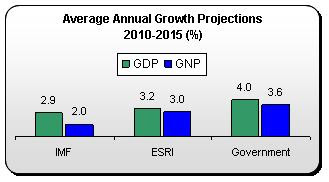
On the basis of this low-growth scenario, the ESRI says the Government cannot reach the Maastricht threshold – not by 2014, not by 2015 not even by 2020.
• By 2015 the deficit is estimated to be 4.1 percent (not counting any banking subsidies)
• By 2020 the deficit is estimated to be 4.5 percent
In addition, they estimate our overall debt levels will be 102 percent of GDP in 2015, rising to 106 percent five years later.
The reason the deficit and debt start rising after 2015 is because the ESRI estimates that real growth will start to ease off, falling from an average 3.2 percent over the next five years, to 2.1 percent afterwards. On this basis, we would have to cut the deficit to well below -3 percent by 2015, just to ensure we don’t rise above it again in a few years. They summarise the problem:
‘The lower level of economic activity would reduce government revenue from taxation while the higher unemployment rate and borrowing would increase government expenditure on welfare payments and interest payments. This would result in a significant deterioration in the general government balance . . ‘
So why, according to the ESRI, would this state of affairs come about? They first assume the economy won’t respond to increased world growth as robustly as in the past. But they also point out that a poorly functioning banking system, higher cost of capital and structural unemployment could also contribute to a low-growth scenario.
What they don’t mention is the impact of the Government’s deflationary cuts - which is strange since they point out that the Government’s €3 billion fiscal contraction in the 2011 budget will cut economic growth (by approximately 1 percent – though this was before the Government’s announcement that spending cuts, which are more deflationary, will play a more prominent role in the composition of the contraction).
It is even stranger since they have just released a revised set of fiscal multipliers, updating their paper from last year. These updated multipliers show that they previously under-estimated the impact of spending cuts on economic growth:
• A €1 billion cut in public sector wages will reduce GNP by 0.4 percent (previously it was 0.3 percent)
• A €1 billion cut in public sector employment (about 17,000 jobs) will reduce GNP growth by 1.0 percent (previously t was 0.9 percent)
These might seem marginal but given the scale of cutbacks the Government (€2.4 billion in pay cuts, €3.6 billion in non-wage consumption, €2.6 billion in investment cuts), it all adds up.
The key metric is employment and this, more than anything else, helps explain the low levels of growth and, so, the failure of the Government’s fiscal policy. The ESRI estimates that employment will grow by an average 1.3 percent between 2010 and 2015. This compares to the Government’s estimate of 2.0 percent average.
Again, this might not seem much but add it up. But by 2015, the ESRI is estimating we will have approximately 70,000 fewer jobs than the Government’s projections. When you factor in the impact on tax revenue, unemployment costs and the significant social costs of long-term and structural unemployment – you start to see why the Government’s fiscal strategy will fail.
None of this should come as any news – if we were fortunate to get the news: the IMF similarly projected the Government’s fiscal strategy will fail. So, too, did the Ernst & Young / Oxford Economics report (though they held out hope that the deficit might come under control by 2018/2019 – but only at growth rates that exceed the ESRI’s estimates).
Of course, some might be tempted to say, that after nearly €9 billion of spending cuts with the prospect of billions more planned, all we need to do is cut just that little bit more. Just dig a little deeper and we’ll get out of the hole. But that’s the problem – every new estimate, every new projection tells us that fiscal consolidation is getting further and further away the more we cut. How much longer do we go along with this ‘Boxer mentality’ in the face of an emerging consensus that the Government’s strategy is flawed at its core; that no amount of tweaking will rescue it. Indeed, further cuts, in addition to what the Government is planning, will only undermine economic and employment growth even more. What will we do then? Call for even more cuts? How deep does the hole have to get before we stop digging?
So what have got? Low growth, escalating debt, high unemployment and emigration, sluggish economy – and the failure to repair public finances; if the ESRI buried the Government’s fiscal consolidation strategy, it also buried the McCarthy report. You probably didn’t hear about that either.
That’s why my next post will deal with that.
The ESRI presented two growth scenarios for the Irish economy – high-growth and low-growth. In reality, the low-growth scenario is more likely for the simple reason that it is not really ‘low’. It’s lower than the Government’s projections (which have been labelled ‘optimistic’ by the IMF and the OECD) but higher than the IMF estimates. So it’s pretty much in the mid-range.

On the basis of this low-growth scenario, the ESRI says the Government cannot reach the Maastricht threshold – not by 2014, not by 2015 not even by 2020.
• By 2015 the deficit is estimated to be 4.1 percent (not counting any banking subsidies)
• By 2020 the deficit is estimated to be 4.5 percent
In addition, they estimate our overall debt levels will be 102 percent of GDP in 2015, rising to 106 percent five years later.
The reason the deficit and debt start rising after 2015 is because the ESRI estimates that real growth will start to ease off, falling from an average 3.2 percent over the next five years, to 2.1 percent afterwards. On this basis, we would have to cut the deficit to well below -3 percent by 2015, just to ensure we don’t rise above it again in a few years. They summarise the problem:
‘The lower level of economic activity would reduce government revenue from taxation while the higher unemployment rate and borrowing would increase government expenditure on welfare payments and interest payments. This would result in a significant deterioration in the general government balance . . ‘
So why, according to the ESRI, would this state of affairs come about? They first assume the economy won’t respond to increased world growth as robustly as in the past. But they also point out that a poorly functioning banking system, higher cost of capital and structural unemployment could also contribute to a low-growth scenario.
What they don’t mention is the impact of the Government’s deflationary cuts - which is strange since they point out that the Government’s €3 billion fiscal contraction in the 2011 budget will cut economic growth (by approximately 1 percent – though this was before the Government’s announcement that spending cuts, which are more deflationary, will play a more prominent role in the composition of the contraction).
It is even stranger since they have just released a revised set of fiscal multipliers, updating their paper from last year. These updated multipliers show that they previously under-estimated the impact of spending cuts on economic growth:
• A €1 billion cut in public sector wages will reduce GNP by 0.4 percent (previously it was 0.3 percent)
• A €1 billion cut in public sector employment (about 17,000 jobs) will reduce GNP growth by 1.0 percent (previously t was 0.9 percent)
These might seem marginal but given the scale of cutbacks the Government (€2.4 billion in pay cuts, €3.6 billion in non-wage consumption, €2.6 billion in investment cuts), it all adds up.
The key metric is employment and this, more than anything else, helps explain the low levels of growth and, so, the failure of the Government’s fiscal policy. The ESRI estimates that employment will grow by an average 1.3 percent between 2010 and 2015. This compares to the Government’s estimate of 2.0 percent average.
Again, this might not seem much but add it up. But by 2015, the ESRI is estimating we will have approximately 70,000 fewer jobs than the Government’s projections. When you factor in the impact on tax revenue, unemployment costs and the significant social costs of long-term and structural unemployment – you start to see why the Government’s fiscal strategy will fail.
None of this should come as any news – if we were fortunate to get the news: the IMF similarly projected the Government’s fiscal strategy will fail. So, too, did the Ernst & Young / Oxford Economics report (though they held out hope that the deficit might come under control by 2018/2019 – but only at growth rates that exceed the ESRI’s estimates).
Of course, some might be tempted to say, that after nearly €9 billion of spending cuts with the prospect of billions more planned, all we need to do is cut just that little bit more. Just dig a little deeper and we’ll get out of the hole. But that’s the problem – every new estimate, every new projection tells us that fiscal consolidation is getting further and further away the more we cut. How much longer do we go along with this ‘Boxer mentality’ in the face of an emerging consensus that the Government’s strategy is flawed at its core; that no amount of tweaking will rescue it. Indeed, further cuts, in addition to what the Government is planning, will only undermine economic and employment growth even more. What will we do then? Call for even more cuts? How deep does the hole have to get before we stop digging?
So what have got? Low growth, escalating debt, high unemployment and emigration, sluggish economy – and the failure to repair public finances; if the ESRI buried the Government’s fiscal consolidation strategy, it also buried the McCarthy report. You probably didn’t hear about that either.
That’s why my next post will deal with that.
Subscribe to:
Posts (Atom)