Showing posts with label public spending. Show all posts

Thursday, 27 April 2017

Good News on the Economy from Europe but a Warning?

Paul Sweeney: There is some good news on the Irish economy from Eurostat. But hidden in the text is a warning to another member state, Luxembourg, that may threaten us in the next quarter, if the European statistical police, based in Luxembourg, find out how lavish and spendthrift the government has been, and intends to continue to be, with certain public assets.


Tuesday, 2 October 2012

Choices Around Cutting Child Benefit

Nat O'Connor: Despite the helpful reminder from Joseph Stiglitz that "Austerity has almost never worked", the Government has decided to cut further and deeper in the next Budget, with reports that Minister Noonan will again prefer two-thirds spending cuts combined with one third tax increases.

There are no easy choices left for the Government, as it seeks to close the deficit through €3.5 billion of measures. While it is necessary to close the deficit, there are a couple of significant questions to be asked that provide important context for any consideration of cutting Child Benefit.

First of all, what is the Government's end goal in terms of public versus private provision of vital matters like health and education, childcare and housing, pensions and income?

Secondly, if 'everything' (including Child Benefit) is on the table for discussion, what are the values and principles that will guide the decisions about what to cut and who to tax?


As this chart shows, the net result of budgets to date has been to 'flat line' Ireland's overall level of taxation while reducing public spending. Any talk of a 'balance' between tax measures and spending in the actual effect of recent budgets is simply not true.

The figures are based on the Government's plan (in Economic and Fiscal Outlook, Budget 2012, page D.19) to end up with total revenue of 34.6 per cent of GDP and total public expenditure of 37.5 percent of GDP by 2015. While these figures might be slightly different in Budget 2013's documentation, there is little evidence of a changed strategy by Minister Noonan.

What level of public services can be delivered through spending at around 37.5 per cent of GDP?

The answer is, not anything like as much as what was delivered at the height of the boom and not the same kind of 'welfare state' as most Western European countries. The long-term EU27 average level of spending is roughly ten percentage points higher than Ireland. As such, if the Government chooses such a low target level of public spending, it should come as no surprise that some core elements of the 'social contract' between Ireland's State and its citizens are now being questioned.

One of those core elements is Universal Child Benefit. There are three clear features of this payment, which indicate fundamental values and principles: (1) It goes to all children equally; (2) It is paid to all citizens with children regardless of their income, as part of the 'return on investment' of taxation and social insurance; and (3) It is a payment from everyone to Ireland's children, regardless of whether or not they have children of their own.

Universal Child Benefit should not be considered a 'sacred cow' any more than the 12.5 per cent corporate tax rate or the existence of the Senate. However, these are major building blocks of the Irish social contract and they should not be radically changed without serious discussion of the implications.

Instead of an open discussion on the issue, there is a risk that the guiding principles underpinning Universal Child Benefit are being discarded without adequate discussion of the changed nature of Ireland's welfare state and social contract that is implied by those changes.

For example, there are endless reports that wealthy people don't need Child Benefit and should not get it. Somehow it is taken as the 'obvious' and 'easy' solution to means test Child Benefit or tax it. However, this argument sweeps aside all three guiding principles. Universal Child Benefit is a social contract, not an individual contract between a person and the State. It is only from an individualistic perspective that it makes sense to say Person A is too rich, therefore tax or cut his/her Child Benefit.

In reality, the administrative burden involved in means testing, plus the highly contentious issue of deciding who needs it and who can't have it, is expensive and fraught with difficulties. A much simpler solution is to say that, if some wealthy people don't need Child Benefit, than simply increase general taxes on wealthy people. At the end of the day, we all benefit from Ireland's children who are the future tax payers, health workers and others that we will need when we are old (whether or not we have children ourselves).

However, if we decide that Universal Child Benefit in its current form is too expensive (because of the decision by Government to target public spending at 37.5 per cent of GDP) than it is possible to imagine alternative uses of public money that would uphold the values and principles of the welfare state.

For example, if we decided that the provision of municipal crèches and pre-school education was a pressing social need (which it is) then we could provide places free-of-charge, to all children equally, regardless of their parents' means and paid for by everyone; because we will all benefit from all children in Ireland having a better start in life and better educational development.

For example, the OECD advises on the benefits of spending early on children.

This chart from another OECD presentation shows that Ireland (in 2008) had the highest net childcare costs in the OECD. No wonder so many families rely on Child Benefit payments!


What is so rarely mentioned in Ireland is that when taxes are low, people end up paying privately out their own pockets. It can be cheaper to pay more tax or social insurance to purchase certain kinds of goods and services collectively. And of course, when we pay collectively, we all share the cost of our children from whose future contributions we will all benefit. When we pay privately, the burden of paying individually is placed squarely on the shoulders of young families, who are not the best placed to carry that burden.

If we see Universal Child Benefit being systematically dismantled in the next Budget (as is suggested in recent reports), while we retain tax breaks, such as those for private pensions that massively benefit people with the highest incomes, then the fundamental values underpinning Ireland's budgetary policy need to be questioned.

The next three or four Budgets are not just about closing the deficit, they are about the nature of the future relationship and social contract between citizens and the State in Ireland for decades to come.

Tuesday, 19 October 2010

Fine Gael's 3:1 Ratio

Nat O'Connor: Fine Gael has given some useful clarity on their fiscal policy position with the declaration that they would seek €1 billion in tax increases for every €3 billion in cuts (Irish Examiner). Across the period of the four-year plan, this suggests that they would seek to close the deficit while making Ireland an even lower tax economy than it was before the boom; which can only mean the wholesale removal or reduction of public services, and significant cuts to public pay and/or numbers.

The implications of the 3:1 ratio can be spelled out in more detail once we establish just how much needs to be cut in the four-year plan.

The Opposition finance spokespersons were given access to data by the Department of Finance today. Is it just political theatre, or did the spokepersons really not know that the adjustment needs to be more than €7.5 billion over the four-year plan?

Consider, we have known for some time that the deficit is c.€19 billion (not including the banks), although it now seems that it might come closer to €20 billion. In July, the IMF's most recent report on Ireland suggests that the structural deficit is eight and a half per cent of GDP (i.e. the bit that won't go away when the economy recovers, welfare payment decrease, tax increases, etc.); which is €13.6 billion (8.5% of 2010's estimated GDP of c.€160 billion). So, it should have been obvious to them for some time that the four-year plan will have to make adjustments of c. €12-14 billion to meet the target of 3 per cent of GDP by 2014.

Note, I'm assuming that the economy will not have moved to the height of another economic cycle, so we would need to clear the entire structural deficit by 2014, assuming that at least €5 billion of a cyclical deficit remains, which will diminish with further economic growth. (€5 billion in today's money is the 3 per cent of GDP requirement under the Eurozone SGP). Arguably, the target for cutting the structural deficit could be slightly less, if the economy recovers faster and helps closes the gap. Hence, my use of the range €12-14 billion.

If we seek a €12 billion adjustment, Fine Gael's 3:1 ratio equates to €3 billion in taxation and €9 billion in cuts; €14 billion would imply €3.5 billion in tax and €10.5 billion in cuts.

A more moderate approach would be a 1:1 ratio, with an equal balance of tax and spending reductions; for €6-7 billion of each.

Patrick Honahan, before he became Governor of the Central Bank, suggested that Ireland's tax take could increase by 3 per cent of GDP (i.e. €4.8 billion) (e.g. quoted here). And that level of tax increase is just to return us to the same type of low tax economy we had before the boom. Nonetheless, if €4.8 billion was taken as an ideal level of tax increases, that would imply €7.2 billion to €9.2 billion in cuts. That is a ratio of 2:3 or almost 1:2 (depending on whether we adjust by €12 or €14 billion). Hence, Fine Gael, with only €3 or €3.5 billion in taxes, would not even reach the €4.8 billion that Patrick Honahan suggests is a credible target.

And once we have established what levels of tax and spending cuts each party wants in the four-year plan, the next question is timing; that is, should we frontload the adjustment? Or keep a more even pace? Or should be push out the deadline for fiscal adjustment by a few years? Leo Varadker of Fine Gael is on record calling for more adjustment sooner. TASC argues for a slower pace (€3 billion adjustment in 2010) to avoid damaging the economy too much in one year.

Of course, we will have to deal with more than the structural part of the deficit if we don't foster recovery in the economy!

TASC's budget proposals argue that we need to foster economic growth through targetted investment to build up human capital and intellectual capital (education, training, R&D) as well as physical infrastructure (broadband, schools, renewable energy). Speaking at the Kenmare economics conference, Leo Varadker emphasised his disagreement with the TASC proposals and signaled Fine Gael's intention to focus all investment on infrastructure (including broadband and renewable energy, but also forestry and other areas).

It would be nice if every political party could state what ratio they would choose between tax and cuts, as it would be a useful rule-of-thumb for the broad implications of their fiscal policy. Likewise, we'd need to see their timescale and what they would do to foster economic recovery.

More importantly, from TASC's perspective, it will be essential to see how each party's four-year plan would change the distribution of income and level of economic equality in Ireland. Tax change and cuts to public services affect different segments of the society differently. Whatever package of fiscal policy decisions are taken in these four-year plans will shape our society, as well as the economy, for quite some time.

Monday, 20 September 2010

Debating on the Titanic

Michael Taft: The confusion between fiscal contraction (i.e. public spending cuts) and reducing the fiscal deficit continues apace. On Morning Ireland, Caoimhghín Ó Caoláin, Sinn Féin’s Dáil leader was being interviewed on the budgetary options facing the Government. The very first question began like this:

RTE: ‘We know the Government is going to cut the deficit this year by around €3 billion ... some doubt about whether it will be a little more than that . . . ‘

This encapsulates all that is wrong with the debate over fiscal policy. For the Government is not seeking to reduce borrowing or the fiscal deficit by this amount or anything like it.

Leaving aside the impact of bank bail-outs – which should be treated as an ‘extra-ordinary’ (with special emphasis on ‘extra-ordinary’) – the Government estimates that net borrowing of central government will be:

2009: - €16,857 million
2010: - €17,346 million
2011: - €16,831 million

At best, if the Government hits its budgetary targets, central government borrowing will fall by €515 million – not €3 billion.

When we turn to the General Government Deficit (the instrument used to measure Maastricht compliance) we find the deficit falling from -€18,720 million to -€17,030. This is a fall of nearly €1.7 billion. Why the discrepancy then with the above figures? And doesn’t this show the Government is at least making some progress? Answer to the second question – no. Let’s answer the first.

The discrepancy is due to the treatment of the deficit in the Social Insurance Fund. In 2010, the Government expects the Fund to be in deficit by nearly €1.2 billion. This is factored into the General Government Deficit. In 2011, the Government expects the Fund to be in surplus again – largely because those on Jobseekers’ Benefit will have exhausted their benefit (they receive it for only nine months).

When we remove the Fund deficit, we find the difference to be approximately €500 million – the same as the Central Government borrowing.

Let’s cut to the chase: if cutting public spending resulted in an equivalent cut in the fiscal deficit we wouldn’t be having a public finance crisis. The Government has already cut nearly €9 billion from public spending. They intend to cut €2 billion plus in the next budget. If all these cuts equalled cuts in fiscal deficit, we wouldn’t be having these discussions about public finances – we’d be in clover.

The ESRI has already assessed the Government’s fiscal strategy and found it incapable of either repairing public finances (at least in this decade) or preventing the debt from spiralling out of control.

Debating a future of public spending cuts is like holding a debate on the decks of the Titanic. Equating public spending cuts with cuts in the fiscal deficit will do nothing to change the course of the ship or melt the iceberg waiting for us. There is only one option – change the captain and, for goodness sake, turn the wheel.

Wednesday, 4 August 2010

Where should we be spending?

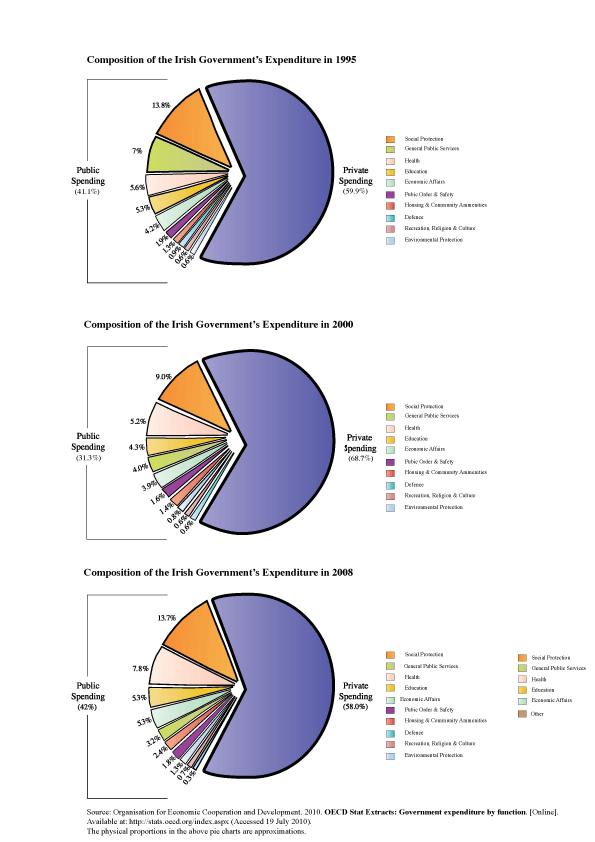
Tom McDonnell: The current economic crisis has centred attention, in some parts, on the affordability of the current levels of public spending in Ireland. Much less attention is given to where this public money is actually spent, yet other OECD countries have very different breakdowns of spending to Ireland. At the macro level the breakdown of spending in Ireland has remained unchanged since at least the early 1990s and this suggests there hasn’t been any serious reflection given in Ireland to what it is we should be prioritising. For example, there is an abundance of economic literature pointing to the long term value of education spending, yet education spending has remained unchanged as a proportion of GDP since 1995. Should we therefore be giving greater priority to education spending at the expense of other public services? It doesn’t appear that much consideration is given to issues like these and the general practice at budget time is for across the board increases in good times and across the board decreases in bad times. Ireland can no longer afford to be so laissez-faire about how we prioritise spending.

OECD data (Table 1) shows the comparative level of government spending as a proportion of GDP during the Celtic Tiger years, for Ireland and for a selection of other Western European countries. What the data shows, is that before the onset of the economic crisis, public spending was low by Western European standards. Even if we measure public spending as a proportion of GNP, instead of as a proportion of GDP, we find that public spending was still lower in Ireland than it was in the EU 15 overall.

However, focusing on aggregate public expenditure by itself only reveals so much information. Table 2 shows the breakdown of public spending in Ireland, in 2008, by functional type. The ten categories shown in the table are those of the United Nations COFOG (category of the functions of government) system of classification. The underlying data is extracted from the OECD website.

As table 2 clearly highlights, social protection measures made up by far the largest proportion of overall public spending (33 per cent) in 2008, this was followed by health spending (19 per cent) and then education spending (13 per cent) and spending on economic affairs (13 per cent). Defence spending and cultural spending were the least costly of the ten categories of expenditure.

The set of pie charts reveals the breakdown of public spending in a selection of OECD member states for 1995 and for 2008. The big shift in the composition of public spending in Ireland over this period, was a movement away from spending on general public services (down from 17 per cent in 1995 to less than 8 per cent in 2008) and towards health spending (from 14 per cent in 1995 to 19 per cent in 2008).

The reduction in general public service payments is simply a reflection of Ireland’s ever reducing debt interest burden over the course of this 13 year period. With regard to health spending, the charts show that it had increased as a proportion of total spending for all six countries.

There is clearly a wide divergence in the overall levels of public spending in these countries. But it is also useful to note the wide divergence in the priorities accorded by the different countries to the various functions of government. This reflects the absence of any universal consensus about the appropriate role of government. The composition of public spending in any individual country, as well as the aggregate amount of spending, can be seen more as a matter of choice rather than a matter of agreed technical efficiency.
For example Germany devotes over 45 per cent of public spending to social protection measures, whereas the United States devotes just 19 per cent of public spending to social protection measures. On the other hand the United States allots the highest proportion of overall public spending to education (16 per cent) and Germany the lowest proportion (9 per cent).

Geopolitical considerations can also skew the composition of public spending; for historical reasons both the United Kingdom and the United States treat their military and their defence industry as active tools of state policy and consequently defence spending is given a much higher priority in these countries than it is in Ireland. On the other the relatively high priority accorded by Ireland to economic affairs (13 per cent) is better understood as ‘catch up’ when we consider Ireland’s infrastructural deficit compared to other advanced economies. By comparison, Belgium, with a much more mature infrastructure network than Ireland, devotes only 5 per cent of public spending to economic affairs.

The point here is that the appropriate levels of public spending, and the prioritisation given to certain functions of government, are not independent of the political, historical and economic contexts of different countries. As the context changes the appropriate level and composition of public spending will also change.
In this light we can see that the general context in Ireland post 2007/2008 is one of economic collapse and rising unemployment. The result of this was that in 2008 the level of public spending exceeded 40 per cent of GDP for the first time since 1995. Needless to say as GDP and unemployment have continued to move in opposite directions, the public spending ratio has continued to increase. However to look at the public spending ratio in 2010 is misleading because it captures the extreme negative edge of the economic cycle. Instead it is more informative to look at levels of public spending over an entire economic cycle, and over the economic cycle Ireland has had a comparatively small public sector.

Returning to the composition of public spending in Ireland, it is interesting to note the similarities in the breakdown of spending in 1995 and 2008. For example, despite an interim period when the public spending ratio was reduced by a quarter, we can see that social protection measures took up almost exactly the same proportion of national output in 2008 (13.8 per cent) as they did in 1995 (13.7 per cent). Education spending was 5.3 per cent of GDP in 1995 and in 2008. Public order & safety also remains practically unchanged at 1.9 per cent. There therefore seems to be a degree of consistency in the prioritisation given to different areas of spending. General public services was the only area of public spending to decline by more than 1 per cent of GDP, and as mentioned earlier, this change is merely a reflection of Ireland’s reduced debt interest obligations. Health spending which had been particularly badly affected by the public sector cuts of the late 1980s and early 1990s was the only area of public services that increased its share of GDP by more than 1 per cent from 1995 to 2008.

What all this suggests is that there has not been a fundamental rethink or serious reflection upon about how best to prioritise public spending between the different functional areas of public service. Rather there seems to have been a general attitude of increase each spending in each department by x per cent when times are good and reduce spending in each department by y per cent when times are bad. This is not good enough and Ireland can no longer afford such unthinking decision making. There is no reason to assume that what suited Ireland in 1995 or 1955 is in any anyway appropriate for 2010. It is time for Ireland to take public spending seriously.

Tuesday, 20 July 2010

Out of the traps and into the abyss

Michael Burke: A piece in today's Guardian reports on the downgrade by Moody's, and expresses some surprise that there wasn't much of a reaction in Ireland.

The journalist goes onto to argue that the downgrade was subsumed by the latest twist in the saga of NAMA, the banks and the property speculators- who want to be bailed out but to keep all their assets too.

But the muted reaction may also have something to do with self-delusion. Mark Fielding of ISME is quoted in the piece as saying that the government is going in the right direction. And there is this quote from the financial journalist Simon Carswell, "The main story here is our problems are huge, but we are doing the right things to fix them. What Ireland has done better than any other country is that it was the first out of the traps to try and fix things. Darling and Brown went in the completely opposite way. They thought they could spend their way out of the recession."

Yet, the British economy did indeed come out of recession, and it was entirely due to increased government spending. The domestic economy expressed by GNP recovered in Q4 2009, at the same time as GDP rebounded. Government current spending and government investment rose by a combined £10.36bn during the British recession, which is greater than the £9.65bn in the recovery to date. Apart from declining imports demand, it was the only category of the national accounts which made a positive contribution to growth in 2009.

Surely, though, spending like this would have produced a huge widening of an already large deficit? By happy coincidence the British ONS also published today the June report on Public Sector Finances. And the short answer is No. In the period since the beginning of the Financial Year, the April-June 2010 public sector net borrowing is £4.6bn lower than in the same period a year ago. And the reason is that taxes are higher, up £9bn. The rolling 12-month borrowing total is down to £143bn. That's just 6 months after the Pre-Budget Report projected a £178bn for this Financial Year.

How can that happen? How can increased government spending lead to a declining public sector deficit? It's actually based on a simple lesson, painfully learnt in the 1930s, after a prolonged period of austerity measures failed to close the deficits. In a slump increased government spending increases total demand, thereby increasing taxation revenues and decreasing welfare expenditures. In short, government spending more than pays for itself- it provides a positive net return to the exchequer. And the opposite is the case; decreased government spending in a slump depresses total demand and so lowers tax revenues and increases welfare payments (even when welfare entitlements are cut).

Irish government policy was first out of the traps- and headed straight for disaster. The British, being relatively slow learners, are now emulating Dublin's policy and will reap the same dubious rewards.

Tuesday, 27 April 2010

Contractionary measures should fall on the revenue side

Tom McDonnell: Last week’s Eurostat figures officially confirmed that Ireland has the largest general government deficit as a percentage of GDP of all the EU member countries and this news will increase the already very strong likelihood that the next Budget will contain both substantial cuts in expenditure and increases in taxation.

So what are the likely effects of this contraction? An ESRI working paper presented by Thomas Conefrey at the Irish Economic Association’s Annual Conference this weekend in Belfast gives us some idea (The Behaviour of the Irish Economy: Insights from the HERMES Macro-economic Model). The ESRI paper uses a medium-term macro-economic model called HERMES to forecast the effects caused by a shock (such as an expenditure cut or a tax increase) on economic aggregates such as employment, GDP and government borrowing. As the authors acknowledge, the HERMES model does not handle how households’ expectations are formed and does not take into account how concerted policy changes alter perceptions about the Irish economy. A further caveat is that the paper is a little out of date in so far as it forecasts the effect of a shock occurring in 2009. Nonetheless the findings are still of more than academic interest.

So what are the medium term effects of a menu of possible shocks? The ESRI calibrated property, income and carbon taxes to raise €1 billion in tax revenue in 2009 and the forecast effects generated for year 6 are shown below (I use year 6 here because it is the longest range forecast). If the shock occurs in 2010 then year 6 refers to 2016.

Table 1: Year 6 effects of a €1 billion increase in tax revenue
(% change relative to benchmark)


Based purely on these forecasts it would appear that both the property tax and the carbon tax on the non-tradable sector are superior alternatives to an increase in the personal tax rate. Raising income tax appears to have the most damaging impact on employment; the most damaging impact on GNP and the smallest positive effect on the general government balance. The choice between a property tax and a carbon tax is less clear cut; however what is clear is that either option will negatively impact both growth and employment. The carbon tax will be more successful in minimising the damage to economic growth (an impact of -0.1 on GNP compared to an impact of -0.4 from the introduction of a property tax). Thus if output is the policy goal then a carbon tax seems preferable. However, pursuing a carbon tax in lieu of a property tax will come at the cost of extra jobs lost. The latest Quarterly National Household Survey estimates that there are currently 1,887,400 people in employment. Thus a decline of just 0.1% in employment is equivalent to a decline of almost 1,900 jobs.

Table 2: Year 6 effects of a €1 billion cut in public expenditure
(% change relative to benchmark)

 Table 2 shows the various impacts of a €1 billion cut in public expenditure. Unfortunately, as the authors are quick to highlight, the HERMES model’s estimated impacts of a cut in investment do not take account of the long-term supply side impact of the cut on output and productivity caused by the reduced stock of infrastructure. Thus the figures shown for the impact of a cut in public investment are not comparable to the rest of the results and are excluded from the rest of this discussion. What is clear from Table 2 however is that focussing cuts on reducing the level of wages in the public sector is a superior policy option (in terms of growth; employment and managing the deficit) to a strategy of reducing the deficit through cutting the number of public sector employees.

Tables 3, 4 and 5 summarise the year 6 effects of the five comparable policy options.

Table 3: Year 6 Effect on GNP – Ranking the Policies
% Change in GNP relative to benchmark


Table 4: Year 6 Effect on Employment – Ranking the Policies
% Change in Employment relative to benchmark


Table 5: Year 6 Effect on the Government Balance – Ranking the Policies
% Change in the Balance relative to benchmark


In a different paper presented by Vincent Hogan at the IEA conference (Expansionary Fiscal Contraction: Deja Vu All Over Again?), the author found that there is no real evidence for the historical existence of expansionary fiscal contraction. Certainly the year 6 estimates generated by the ESRI’s HERMES model bare that conclusion out. The conclusion is that contractionary policies will have negative effects on output and employment. If contraction is the policy then the goal becomes one of minimising this damage. What the rankings in Tables 3, 4 and 5 show is that the damage can be minimised by focussing fiscal rectitude on the revenue side i.e., the least damaging long term economic impacts will be obtained through tax increases rather than through expenditure cuts.

The carbon tax and property tax options appear to be the most compelling options. However it is important to also consider the effects on the real economy. For example a carbon tax (depending on how it is designed) can have adverse distributional effects. In a recent study by Callan et al., (2009) published in the Journal Energy Policy; it was found that the distributional impact of a carbon tax in Ireland is indeed regressive. From a social policy perspective carbon and property taxes should be calibrated in such a way as to avoid any regressive effects occurring. If incorrectly designed property and carbon taxes have the potential to greatly increase poverty levels and to magnify Ireland’s already high level of inequality. Thus it isn’t enough simply to decide that a carbon/property tax is the best option. There are numerous ways that €1 billion can be generated through a property/carbon tax and careful consideration must be given at the design stage to minimise any regressive impact and to ensure that such a tax does not adversely impact the poorest in society.

Tuesday, 24 November 2009

The hall of mirrors

Michael Taft: A number of commentators have referred to the fact that Irish public expenditure is ‘rising faster’ than almost any other European country; that it now gobbles up over 50 percent of our GNP. In stating this, the assumption is that to rectify the deficit we should cut public expenditure. However, when we subject this to closer inspection we find ourselves in a hall of distorting mirrors, seeing reflections of a reality that is so distorted we are in danger of losing perspective.

Yes, public expenditure, as a proportion of GNP, is rising to over 50 percent though to what extent depends on how you calculate the numbers. The following excludes payments to the Pension Reserve Fund (including the payment for this year slightly exaggerates the level of spending as it includes the 2010 payment as well). How much of the GNP does total government spending make up?

2007: 37.8 percent
2009: 51.2 percent

That is a big jump – an increase of well over a third. But what are the numbers behind the numbers – what is the real image that is potentially being distorted by this spend/GNP ratio? There are two sides to this ratio.

Side One: between 2007 and 2009, total government spending increased by €8.8 billion, or 14 percent. What are accounted for this increase? 66 percent was due to the rise in the Social Affairs budget, while 21 percent was due to the extra cost of debt service. All the rest of the Government’s budget (including public sector pay) made up only 11 percent. In other words, the increase in public expenditure is mainly recession-driven.

Side Two: and what a recession. Between 2007 and 2009, GNP has contracted by a massive €25 billion, or -13.6 percent. Compare that to a Eurozone average contraction of -3.5 percent. With the economy falling that fast and that far, public expenditure, even if it remained static, would still be rising at a relentless pace.

So let’s break down all the contributing factors to this rising GNP/debt ratio.


Nearly half the rise in the public expenditure/GNP ratio is down to the contraction in the GNP itself. Social welfare and debt servicing – both recession driven – make up another 46 percent. Public expenditure increases in all other areas make up only 6 percent.

Now here’s the kicker – the deflationary impact of public expenditure cuts mean that the actual cut actually contributes little to reduced the spending/GNP ratio. While spending may be reduced somewhat, GNP is also reduced (e.g. cutting public employment by 5 percent will save €488 million but will come at a cost of a decline in the GNP of €1.1 billion).

What we have to do is step out of this distorting hall of mirrors. The proposition that you can cut your way out of recession means we will be trapped staring at mirrors only to see shapes so distorted that they bear no resemblance to the real world.

Tuesday, 20 October 2009

How much does the State spend as a percentage of GDP?

Slí Eile: Earlier this month, at a conference of the National Economic and Social Council, Joseph Stiglitz warned against a single-minded focus on reducing public liabilities at the cost of public assets. There is an assumption abroad (in Ireland at least) that we are ‘living beyond our means’ and ‘unless we cut public spending the consequences will be terrible’. I would be surprised if a majority of persons who think much about these issues, and follow them in the media and in casual conversation, would disagree with the line that says ‘you can’t continue borrowing that amount – €400 m a week or €21bn a year (and rising)’ ‘We are borrowing to pay for 2008 public services with 2004 taxes – 5 into 3 won’t go’ ‘you can’t raise taxes much any more – businesses and hard-earning tax payers are being hammered’ ‘you will scare foreign investors and market sentiment’ ‘we have to take the pain and do our bit to get the country moving’.

None of these popular sayings have anything directly to do with recovery or job creation. Rather, they concern one issue only – ‘the country is bankrupt – we have to sort out our public finances’. By implication this equates to saying ‘we first have to sort out public finances (and banking) BEFORE we can deal with the job crisis. Indeed, many commentators will add ‘by cutting public spending and keeping a lid on taxes we can help the traded sectors of the economy to price themselves back into world markets – the main basis on which Ireland inc can grow again’.

But, will ‘adjusting’ for €4bn in the coming budget achieve its desired goal? Michael Taft has already demonstrated that public deflation will not achieve the single-minded aim of reducing public borrowing by anything other than a very modest amount. I will not repeat the analysis which can be found here.

In short, cutting public spending – especially when targeted on low to mid-income public servants (believe it or not, there are some) and social welfare recipients – will further reduce tax receipts (other things constant) and add to the volume of social welfare payments (other things constant). The fall in retail sales and tax receipts commented on this blog site is connected to the strongly deflationary impulse of the December 2008 and April 2009 budgets. The extent of the impact is unknown and would be interesting to model, empirically, if the latest data and will were there to do it.

One element missing from the debate is a consideration of the following question:
During these traumatic and uncertain times what level of public services is desirable and attainable on various assumptions and scenarios?

So, are we spending too much on public assets?

Using the latest National Accounts data for 2007 (yes) from the CSO National Income and Expenditure 2008, total spending (current and capital) by Government (central and local) was €73.8bn in 2007. This represented about 38.9% of GDP in that year – the height of the boom. Unfortunately, for some reason, it is very difficult to get a comparable estimate of total public spending in 2008 and projected for 2009. The April Supplementary Budget contained a Macroeconomic and Fiscal Framework. Table 7 in that document sets out total projected current and capital spending for 2009 (but not earlier years) and subsequent years. The total of gross current and gross capital spending (before deduction of receipts in each case) comes to €73.6bn in 2009. This latter figure is unlikely to be directly comparable with the National Accounts figure for 2007.

Taking total projected gross spending in 2009 and dividing by GDP in 2009 (using the latest ESRI forecast), you get an estimate of just 45% of GDP. Something akin to this figure has been used by economists such as Colm McCarthy. For example, An Bord Snip Nua reported (page 2) that:

In 2009, gross voted current spending (not including Central Fund expenditure such as debt service costs) will absorb 39.3% of likely GNP, the highest figure since 1983. Total Government spending (the current voted spending figure, plus debt servicing and other Central Fund expenditure, as well as Exchequer capital which includes the payment to the NPRF) will absorb 51.1% of GNP, the highest figure since 1987.

This claim has gone unchallenged and, in the absence of an explanation about how Bord Snip arrived at this estimate, we have to caution against any conclusion that public spending has jumped from about 39% of GDP in 2007 to 51% in 2009. Included in the 51% figure is the pre-payment of some €1.5bn to the National Pension Reserve Fund.

In the absence of reliable and up to date estimates of national and public accounts, the simplest approach is to add up receipts (which are easier to quantify) and then add an estimate for total borrowing in 2009. Social Justice Ireland have estimated that total income including taxes, social insurance, local government receipts will come to €47bn in 2009. If this comes to pass, it would represent 28.7% of GDP (SJI are using a higher GDP estimate to arrive at a slightly lower estimate of 27.4%)

If total borrowing comes to about €22bn in 2009 – as many commentators now expect - then total spending in 2009 is likely to be somewhere in the region of €69bn (current and capital, local and central). That would give a total public spend of very roughly 42% of GDP. I will settle for that estimate in the absence of any better data (readers may point to better estimates somewhere).

42% - sounds like a lot. It is certainly the case that some areas of public spending continue to grow – higher social welfare costs associated with growing unemployment, the cost of the pay increases across the public sector in September 2008, the impact of rising population on health and education services etc. Set against a collapse in GDP (and a spectacular one for any industrialised country since the 1930s), a significant rise in public spending as a percentage of GDP is not unexpected.

How do we close the gap between 42% and 29% (for total receipts of various kinds)? Bearing in mind that GDP will contract by a further 3% at least in 2010 (and arising from this more unemployed and more social welfare payments at current rates of payment), the challenge for any administration is to significantly raise receipts without further deflating the economy, and continue to borrow to cover those components of the deficit that correspond to (i) capital investment (for which money is usually borrowed anyway, even in good times – roughly €10bn per April figures), (ii) current spending and tax shortfalls associated with the downturn (welfare payments and reduced tax receipts) – estimates vary but could be €6bn. The remaining gap could be in the order of €6-7bn – the structural element. I think that there is a case for continuing to run a deficit of about €15bn per annum – or about 10% of GDP in 2010 - while re-targetting public spending on job-creating and job-retaining projects and maintaining the real values of social welfare payments (any short-term gains made as a result of modest HCIP falls in 2008-09 are more than cancelled out by reductions in wider social provision, plus likely impending price increases in 2011 as prices recover). The ‘structural gap’ of some €7bn needs to be tackled through a combination of measures:

Capital taxes
Income tax base widening
Tax-relief reductions (especially the most inequitable)
Local taxes
Income tax surcharges on very high incomes
Corporate tax increases to 15% and pegged for 5 years.

Yet again, we hear the often repeated claim that the yawning public sector deficit has nothing to do with the banks and NAMA. For one thing, we would not be as much in this mess were it not for the banks (thanks for the apologies emanating from Kenmare). In the second place, the recapitalisation cost of the banks is exacting its own ‘opportunity cost’ on public finances. Don’t take my word for it. The Department of Finance has revealed that:

At end-September 2009, the Exchequer deficit is €20,158 million, compared to €9,404 million at end-September last year. The year-on-year deterioration in the deficit of some €10.8 billion is primarily explained by a decline in tax receipts of €4.8 billion, the €4 billion payment to Anglo Irish Bank and €1.7 billion in respect of the frontloading of the annual contribution to the National Pensions Reserve Fund (NPRF).

A parting thought - now, suppose that the world is headed towards a double-dip recession with a downward shock to world trade and sovereign defaults spreading across Europe – what would that mean for Irish exports, for Irish tax receipts from VAT and income – and for public spending on education, health and social welfare? However unlikely such a doomsday scenario looks, it is worth bringing together a number of ‘what if’ scenarios ranging from rapid economic recovery from 2010 onwards to double-dip world slump in 2010 (and L-shaped recession for Ireland which I think is the more likely as our key trading partners pull out of recession next year and we are left to clean up on debt, NAMA and the prolonged deflationary impact of Budgets 2008-2010 and beyond).

It is not a pretty sight and nobody knows for sure what is going to happen next. Not good for confidence, trust, and job-creating investment and consumption.

We need a change of direction politically. All this deflation stuff is not good.

Wednesday, 14 October 2009

Crises: Not 5 but 7

Slí Eile: The National Economic and Social Council (NESC) has recently published its Next Steps in Addressing Ireland’s Five-Part Crisis: Combining Retrenchment with Reform. You can download the full report here and the executive summary here.

The title by-line ‘retrenchment’ with ‘reform’ gives all away. Following earlier work by the Council – which represents the various social partners – it attempts to pull together various strands of the current economic crisis and to propose an ‘integrated approach’. This is welcome. To the five-part crisis (banking, fiscal, competitiveness, unemployment and reputation) must be added a sixth dimension as pointed out by a speaker at last week’s TASC Economic Conference: a political crisis. I would even suggest a 7th: a moral crisis. Do we care enough about people, their well-being and the planet in which we survive? Markets, States and non-governmental actors have failed, so far, to act with sufficient moral responsibility.

Like all NESC documents there is a good conceptual framework underlying its work. But, inevitably, reflecting its structure, function and composition there is a strong element of ‘on the one hand and on the other hand’. Here is a sample:

It is necessary to combine unavoidable retrenchment with major reform in a range of policy areas and systems.


‘unavoidable’ mirrors a highly held view these days:
TINA – There-Is-No-Other-Way (e.g. deflation)
TOGIT – The-Only-Game-In-Town (e.g. NAMA)

Joseph Stiglitz has warned us about being intimidated. Other adjectives used in the NESC document are ‘severe retrenchment’ (p7) and ‘immediate retrenchment’ (p9)

Interestingly, the NESC document goes on to say (p60):

The deterioration in the labour market, in the lives of many households and individuals, is being compounded by falling disposable incomes and retrenchments in some areas of current public social spending.

Government has achieved savings of c10.5 billion or 6.3 per cent of GDP and published the McCarthy Report. But there continues to be a huge gap in the public finances.
Policy and public debate on the fiscal, economic and social aspects of the crisis still seem dominated by short-term, immediate and zero-sum aspects; it has not proven possible to secure support for a perspective based on long-term mutual gains.

And,
on page 61, the Report rightly draws attention to the way cuts in public spending can impact adversely on vulnerable and low-income groups.

In its response, the Government clearly sees this work of NESC as offering a talking and thinking platform on which to get buy-in for a new a ‘agreement’ (From the Govt Press Release: "In response to the challenge set out in the Report, the Government proposes to invite the Social Partners to meet to discuss whether there is sufficient basis for entering substantive negotiations to secure an agreed national response to the current economic crisis")

A classic nescism is the following:

There remains a tendency for opinion on the fiscal crisis to polarise into two camps, with one stressing the need to reduce the gap between spending and revenue and the other the need to maintain existing services and conditions. These positions tend to cancel one another out, rather than pushing the debate into new terrain in ways that makes policy decision clearer and public understanding greater.

But, in the meantime, the following questions have to be faced: The General Government Deficit is in the order of €20bn this year
Government can either (i) cut spending (ii) raise taxes (iii) borrow more or draw down on cash reserves (it is too late, apparently, to divert NPRF cash since Government diligently pre-paid next year’s amount as well as this years – called APCS – Acute Pro-Cyclical Syndrome). NESC clearly favours raising the share of taxes as % of GDP to bring us up closer to EU norms. But, it does not specify its stance on some of the major issues:
Pay cuts
Welfare cuts
Which areas of public spending would be cut
Instead it opts for ‘severe retrenchment’. Then again, it is hard to imagine the partners to NESC agreeing to a common approach on the above.

Monday, 28 September 2009

What about the other 70% ?

Slí Eile: Opinion poll data are used by the print and other media on a regular basis not only to asses trends in public opinion but to generate interest …. and news …. on topics of current attention. Seen in that light, today's Irish Times/MRBI poll offers insights into what the public think about NAMA, taxing child benefit, cutting public spending and cutting social welfare.

There is a lot of wisdom in the old joke 'If 70% of people think one way what about the other 70%?'. A lot depends on (i) the current political, economic and social context in which various issues are aired, (ii) what questions you chose to ask, (iii) what questions you chose not to ask, (iv) how you ask any given question. In other words, a lot of opinion polling is down to how you pick and frame the issues. That’s not to say that such exercises lack scientific credibility or public value. Just because one might not like a result or appear surprised about some finding is not sufficient reason to dismiss such polls.

Take the finding that :
"The Government has received reports from ‘An bord Snip Nua’ and the Commission on Taxation which will influence the Budget in December. In addressing the crisis in the public finances, should the Government put more emphasis on cutting public spending or on increasing taxes?"

70% opted for cutting public spending while 14% opted for increasing taxes (and 16% had no opinion). One assumes that these were the only possible response categories. No mistaking the message there. Almost 3 out of 4 adults would prefer spending to be cut than taxes raised. Part of the reason for this response is linked to the way in which taxes means less money in my pocket and greater hardship whereas spending is something that tends to effect others more. Added to this is the widespread notion that much of public spending is wasteful and going towards over-paid public sector workers (although if you pin this one down people will exclude most teachers, nurses and civil servants that they know). And, on top of all this, most people are swamped in a very simple but crude message arriving day after day ‘We are borrowing €400m a week, we are spending way beyond our means, the money isn’t there, the economy is banjaxed, shure why wouldn’t we cut spending we have no alternative.’ Just don’t raise class size in my childrens school, don’t cut social welfare – wouldn’t be nice or fair (75% of respondents not for cutting welfare), don’t cut the arts because they are special, don’t fire health sector workers in the hospitals my family might be using, don’t tax social welfare benefits, don’t introduce third level fees for my children, don’t close the three-teacher school down the road (its fine as it is), don’t take away school transport (petrol will be raised more as people congest the roads driving children to school).

The punch line in the poll was:
"In order to reduce the public sector pay bill, should the Government put more emphasis on redundancies or on salary cuts".
Well, with a question like that no wonder 58% said salary cuts and only 25% redundancies. Shure, nobody would want to deprive a school leaver or apprentice a job if a salary cut is the better option (but salary and wage cuts will not impact on unemployment - see other blog.

If the debate were to be framed differently then, perhaps, the answers would be a lot different.
For example, a poll commissioned by TASC (TASC Inequality Survey, carried out by Behaviour & Attitudes between May 1st and May 10th 2009) and published in July of this year showed that a majority of 85% of people in Ireland believe that wealth is distributed unfairly and ‘the Government should take active steps to reduce the gap between high and low earners’

Another survey commissioned by TASC in June 2008 found that the percentage of respondents willing to pay higher taxes to fund improved public services was 41% (compared to 9% in the 2003 Irish Times MRBI poll and 23% in the 2007 Irish Times TNS/MRBI)
The 2008 TASC Survey showed that ‘when broken down by social class, 50% of ABCI respondents professed themselves willing to pay higher taxes to fund improved public services - thus, those most able to afford increased taxes are also the most willing to do so.’

A number of key issues arise in regard to public perceptions and receptivity to increased taxes:

Fairness – that all sections of the community should share in the raising of taxes in proportion to their means and circumstances (there is a sense that this has not and is not the case while super-rich income earners avoid – or evade – tax)
Efficiency and Effectiveness in the way taxpayers money is spent (people are rightly cynical about waste when they witness – for example – the FAS debacle and official response to same)

Relevance to their needs and circumstances (if taxes were more clearly associated with delivery of public services so that people see where their money is going – especially at a local level where a range of public services could be funded by a combination of central government transfers and locally-raised taxes on businesses and households)

If it were possible to accelerate positive and constructive reform of the public services in a significant way by openness, transparency, accountability, local democratic control and participation by local authorities and local communities in pre-budget democratic deliberation then more people would be prepared to share an appropriate part of their income to fund key public services to the betterment of all. If they think that their hard-earned income is going to bail out banks, prop up dysfunctional public organisations and overpaid and incompetent senior executives and subsidies to those who can well afford to pay for a service is it any wonder that a majority say that they are not prepared to pay more taxes in answer to an either-or opinion poll question.

(Technical point: The claim that ‘The margin of error is plus or minus 3 per cent’ can be misleading in any opinion poll. Such polls generally use a method known as ‘Quota Sampling’ which increases the standard error on all estimates by the ‘Design Effect’. Suffice it to say that the +/- 3% margin is on the low side. Even without such a Design effect, any movements of around 1 up to 3 percentage points are hardly significant (hence recent media claims of a recovery of confidence in a given party by 3% points is very misleading).

Friday, 7 August 2009

Reaction to Jim O'Leary

Jim O'Leary's article in today's Irish Times, arguing that "given the enormous scale of the problem, it would be fanciful to suppose that it can be solved without at least some reductions in public spending, and anyone who doubts this cannot really be regarded as a serious participant in the public discourse on the matter", has generated quite a debate in the blogosphere. Michael Taft, of Notes on the Front and Progressive Economy, parses Mr. O'Leary's piece here, and it is also being debated on Irish Economy here.

Saturday, 25 July 2009

How much is a Billion Euro in Irish terms?

Nat O'Connor: One of the effects of the financial crisis is that it is forcing us to deal with very big numbers. We now regularly hear or read about vast sums of money being discussed, whether it is in terms of money required to maintain the banking system, proposed cuts in public spending or lost tax revenue. There is a danger that through the repetition of these big numbers we are becoming immune to their impact, similarly to how we can become inured to violence on television.

Without getting into what policies the Irish Government should or shouldn’t pursue, I would like to simply clarify what a billion euro means in real terms, in Ireland, today. I think we need a clearer picture in order to understand the enormity of the situation and the potential impact of the wide variety of policies that are being proposed.

I am going to give three brief examples to illustrate what a billion euro means and I would welcome feedback on which bits are most useful.

1/
One way to look at what a billion euro means is to see it in terms of the Government’s income and spending. The end-June 2009 Exchequer returns estimates the state’s annual revenue at €34.4 billion and its annual expenditure at €47.4 billion (divided between €40.5 billion current expenditure and €6.9 billion capital expenditure).

In these terms, one billion euro is roughly equivalent to 3% of Government revenue or 2% of its expenditure.

More specifically, one billion is more than the Government will raise in revenue from stamp duty (€980m), it is over a quarter of likely revenue from corporation tax (€3.7bn) and it is nearly 9% of VAT receipts (€11.4bn). In other words, no matter what way you look at it, one billion euro represents a sizable chunk of Ireland’s annual revenue.

Similarly, in expenditure terms, one billion euro is nearly twice the total voted expenditure of the Department of Arts, Sport and Tourism (€535m), it is more than the budget of the Department of Defence (€988m) and it is over 9% of the budget of the Department of Social and Family Affairs (€10.9bn), which is one of the three major spending Departments. So, one billion euro obviously buys a lot of what the Irish state spends money on every year.

2/
Another way to look at a billion euro is to divide it out among the Irish population. Based on Census 2006, a billion euro represents €236 for every man, woman and child in Ireland. If we restrict the population to those aged 15-64, a billion euro represents €344 per person. And perhaps more realistically, it represents €680 for every household in the country (including single person households as well as couples and households with children or other dependents). In other words, every time the Irish Government wants to spend a billion euro, this is how much money on average it needs to raise in revenue from the taxpayer.

Although, of course, it must be remembered that the Government does not only generate revenue directly from private households, but also from businesses through corporation tax, VAT, etc and from other sources.

3/
A billion euro can also be seen in terms of the distribution of wealth in Ireland.

It is equivalent to the annual earnings of 33,433 persons on the 2006 average industrial wage. And to put this number in perspective in turn: that’s about as many people who were at work in Galway City in 2006 (34,023).

A billion euro is also the equivalent to the income of 84,104 persons living on the 2007 poverty threshold of €11,890 per year.

In other words, you could employ a lot of people for a billion euro or move a great number of people out of poverty.

In contrast, one billion euro is only 1% of the €100 billion asset base (excluding residential property) of the top 1% of the Irish population in 2007, according Bank of Ireland’s Wealth of the Nation report. That is to say, a billion euro taken from the top 1% of the population would mean that this group owned 33.7% of Ireland’s wealth instead of 34%.

Monday, 20 July 2009

Is public spending in Ireland too high?

Slí Eile: Simple question. But not so straight forward when it comes to it. Too high relative to ‘what we can afford?’, ‘too high relative to what we get out of it?’, ‘too high relative to taxes, borrowing and EU rules on borrowing?’, ‘too high relative to some ideal balance of public and private endeavour?’ It’s a loaded question especially in current-day Irish political economy. Discussion about ‘economics’ used to be kind of nerdy. Now, its not only hot but very political as well.
The OECD Review of the Irish Public Service published in 2008 found that the overall level of public sector employment and spending was modest in Ireland compared to other OECD countries.

Let me answer the question first – no – public spending in Ireland is not too high. Human beings deserve five basic things in life:
1. Love
2. Health
3. Education
4. Work
5. A chance to contribute and participate to society, culture and politics

Now, ‘the State’ (not such a clear-cut concept) can’t do everything nor should it try. Neither can the ‘Market’ (not so clear-cut either). Where the balance lies is a matter of personal and societal choice, at least in democracies.

The Bord Snip/’Special Group’ Report is ideologically loaded. It starts from the simple idea that the State’s role should be kept to a minimum and proceeds on the assumption that much of existing state spending is inefficient and wasteful. Some folks on the left – I fear – have fallen for the argument that:

• Things are bad, very bad;
• We have to cut, we have to cut;
• Sure there is lots of wasteful public sector spending and employment arrangements;
• We should come across as the Nice, Respectable, Responsible and Realistic people that we are, and welcome the broad outline of the Report; and
• We will accept some cuts as necessary (and in any case tactically unavoidable) in exchange for some progressive concessions.

This is dangerous and false reasoning. In my view we should be

• defending the public services and public service workers line by line;
• defending the gains made by public sector workers in terms of employment, tenure, conditions (rather than play off one sector of society against another);
• promoting more public spending and not less in the current economic downturn in order to (i) further close the gap in terms of public services which remain very inadequate here compared to what should be considered right for a country at our level of economic development and (ii) stimulate domestic consumption and investment demand;
• reforming a public service that is inefficient, not well run in many cases, bureaucratically and centrally managed and overly politicised; and
• reducing spending in some areas only to divert it to other areas and increase the overall spending level.

The point is that public spending in Ireland is too low and not too high. We need a Bord Athbheo to:

• Revitalise public services through reform and reallocation of spending from areas and activities of waste to areas of need and new opportunity
• Completely change the existing way of organising work away from inflexible, top-down and bureaucratic work organisation practices.
At the same time, there is scope for an orderly increase in taxes on:
• Property including local-based taxes
• High-income earners via ending non-standard tax reliefs and other tax breaks not necessary for economic activity
• Carbon taxes.

An irony of the current restrictions on employment in the public sector is that a whole industry of control, sanctions and upward delegation of responsibility from lower to higher grades and from line Departments to Department of Finance is happening. This runs exactly counter to what the OECD Review team on the reform of the Irish public service recommended last year. We are going back not forward, in this regard

Monday, 13 July 2009

Challenging the narrow ground

The only reason that the government can still borrow on international markets to finance the day-to-day running of the country - some €24 billion this year out of a total spend of €60 billion or so - is that the markets believe a) that the government will stick to its commitments to cut spending, and b) that the European Central Bank stands behind Irish government debt. But the price for the ECB’s implicit guarantee is controlling our deficit, and that means cutting public spending.

Michael Taft: The above, written by Pat Leahy in the Sunday Business Post, encapsulates a lot that is wrong with the current debate over the economy. Leave aside the issue of why the NTMA has been so successful in selling Government debt, whether short or long-term. It’s enough to say that redemption yields on 5-year and 10-year bonds remain the same today as it did on February 1st – long before the Government engaged in cuts and taxes (never mind the suspicion that Mr. Leahy has not actually interviewed the spokespersons of the institutions who have so readily bought our debt to find out why they have done so).

The defining characteristic of the current debate is the way that commentators have treated economic issues in a reductionist manner. For instance, we are constantly being invited to view the economy through budgetary tables and only through budgetary tables. To bring the fiscal deficit ‘under control’ we must either cut spending, increase taxes or a combination of both. Never are more fundamental questions admitted into the debate – the effect of the recession itself, the collapse in domestic demand, the fiscal toll that unemployment is taking, the impact of lower consumption, etc. To admit these questions might lead us away from the parameters of budgetary tables and on to the fact of economic decline itself (e.g. wage maintenance, job-retention, direct employment creation, state-led investment and consumption – in other words, stimulus). It might lead to alternative analysis and programmes.

Now, Mr. Leahy takes this reductionism one step further. The issue is no longer ‘controlling the fiscal deficit’. It is narrowly and squarely about cutting public expenditure. That this overlooks the findings of the ESRI’s multiplier tables – that tax increases are, on the whole, less economically damaging and more Exchequer-friendly than spending cuts – is neither here nor there for some commentators.

The space in which the economy is being debated becomes more constricted all the time. No doubt the eventual publication of the An Bord Snip report will narrow the ground even further. All responsible debate from now on must be solely concerned with the efficacy of cuts on lowering public expenditure. Those outside that consensus are condemned as ‘fringe’ or spokespersons for interest groups (e.g. trade unions, social organisations, etc.).

The task facing progressives is to challenge not only the prescriptions of the Right; it is to challenge the very viability of a debate that is taking place far from where the economy operates. Unless we do that, we’ll be allowed to move the chess pieces on the board – but they’ll all be the same colour. And they will only move backwards.

Monday, 6 July 2009

Cuts and economic activity

Michael Taft: While we await the publication (or, at least, the drawn-out leaking) of the An Bord Snip Nua report, it is well to be reminded of the considerable limitations that public expenditure reductions will have on our fiscal deficit and, so, our borrowing requirement. The ESRI has worked through a number of policy proposals to assess their impact on economic activity. Let’s take three calculations. They assess the following three proposals:

• 5% reduction in public sector wages
• 10% cut in health and education employment
• €1 billion in public investment

Together, these would reduce public expenditure by €3 billion. This is more than the Government hopes to cut next year, and about 66 percent of Bord Snip’s total cuts, as reported in the media. No doubt these are the type and extent of cuts that many commentators have been calling for, claiming that it will considerably improve the Exchequer’s fiscal position. However, the ESRI’s conclusions suggest caution regarding the fiscal effect.

Taking these three policy initiatives together, we find that the domestic economy (GNP) would decline by -1.5 percent, consumption would fall by -1.3 percent, while unemployment would climb by 1 percent. Of course, this doesn’t take into account the impact on the quality– in the case of cutting employment – of our educational and health infrastructure.

So: further economic decline and higher unemployment resulting from these three measures. What would be the impact on the Exchequer fiscal position? Minimal. The ESRI calculates that, taken together, these measures would reduce the Exchequer borrowing requirement by 0.9 percent. To put this in perspective, the ESRI projects the borrowing requirement to be -15.6 per cent this year and -14.7 percent next year.

If taken together, the cumulative impact would be even more severe than their individual effect, as reduction of GNP is piled on reduction. The economy will be in a weaker position to confront ever higher debt. And, while accepting that the ESRI doesn’t do black humour, its warning that ‘if the external environment were to continue to be very difficult such a level of emigration might not materialise resulting in higher unemployment in the medium term’ suggests that the small reduction in the borrowing requirement might be limited even further, arising from higher social welfare costs.

Hopefully, more careful analysis of the economic impact of deflationary measures will enter the public debate. For it is becoming clearer (if it isn’t clear already) that deflating an economy through budget reductions is like running in quicksand. The more you cut, the more you sink – with little to show for in terms of controlling the fiscal deficit.

Monday, 15 June 2009

Guest post: Growing the economy

Michael Taft: UNITE the union has published a set of economic proposals – Growing the Economy – as a challenge; both to the orthodoxy which dominates the current debate, and to progressives, to start constructing an alternative framework. It is a first step towards a new narrative – but only a first step.

Its starting point is the failure of current Government policy to stop the recessionary slide (indeed, it argues that Government policy has actually deepened and lengthened the recession). Its alternative is rooted in identifying very real deficits of our productive capacity and how, by addressing these, we can at the same time create/save jobs and, so, address the fiscal deficit. In other words, it is unemployment and the lack of productive investment that is the disease, the fiscal crisis is the result:

• Our physical infrastructure is ranked as one of the worst in the industrialised world, while our social infrastructure is European in name only;

• Whatever the fall-out in the banking crisis, the immediate priority is to establish a bank dedicated to extending credit to SMEs – the first step in a broader reform of our banking structures.

• That people’s income and living standards are not an obstacle to growth but rather part of the solution – particularly those on low and average incomes; therefore, it calls for a new wage agreement, which disproportionately benefits these income groups through flat-rate payments.

• That it is cheaper to save jobs rather than create them; therefore, we need payroll subsidies for enterprises that short-time workers rather than resort to redundancy.

• That the development of an indigenous enterprise can start with an expansion of public enterprises to modernise our physical infrastructure through ICTU’s proposed State Industrial Holding Company (something Fine Gael has copied to argue that new public enterprises can create up to 100,000 jobs).

These measures can ensure that on the other side of the recession we will have a stronger infrastructure from which we can better exploit the eventual recovery in global demand; we will have saved a number of viable enterprises that would have otherwise collapsed owing to the credit crisis; that key skill-sets will have been saved through payroll subsidies and public equity; and we will have new enterprises under ICTU’s proposal – with the downstream jobs created/saved as a result.

Of course, there is a question of financing. However, as UNITE points out, our deficits and borrowing requirement are on the verge of spinning out of control under current policy (the EU Commission predicts the deficit to rise to over 15% next year). However, even on current trends, our overall debt level will remain under the Eurozone average for the next two/three years. This, in effect, is our window. By increasing our borrowing levels to European averages, we can direct expenditure towards these investments – which will reduce unemployment and increase economic activity, thus lowering the annual deficit.

A range of other measures would accompany this: increasing taxation on less-deflationary sources of revenue (unproductive capital, unearned and high incomes); reform of regressive tax expenditures; and the issuing of Economic Recovery Bonds to take advantage of our growing savings ratio.

Ultimately, UNITE claims that the way out of this crisis is productive investment, employment and growth. It has put forward a menu of other proposals (some developed here as Jim Stewart’s proposed consumer vouchers). It challenges the deflationist orthodoxy. But it is not the last word, merely the first.

Most importantly, it invites other progressives – trade unionists, left political parties, social organisations – to get into this debate with enthusiasm. There are, no doubt, other and better ways to achieve what UNITE is attempting to sketch out.

We won’t know that, however, until we engage in the hard work of constructing an alternative, a new narrative. The quicker we start that task, the better it will be for the economic debate – and for the future of the Irish economy.
Michael Taft is research officer with UNITE

Tuesday, 19 May 2009

Will a Domestic Stimulus work in a Small Open Economy like Ireland?

Sli Eile: Taoiseach Brian Cowen commented over the last weekend that the main opposition parties wants the Government to cut more while the other (minor) opposition party wants the Government to cut less. Hard to disagree with this observation. Draw your own conclusions. But, who is for not cutting at all and instead spending more? Yes, spend more but very differently and under very different arrangements with regard to how banking, public finances and corporations are run in Ireland and Europe.

Turning to political economy, the trouble with many economists is that they can only look back – to old theories, old evidence and old empirical models based on what is measurable and what was given in terms of the external environment. On the other hand, it is hard to look into the future without regard to what has happened in the past and why it happened. The 1960s were the heyday of econometric modelling as economists discovered new data sources and put all their quantitative prowess on display through the science of multi-variate statistical modelling. This was, also, the time of ‘manpower planning’ and Economic Programmes (Whitaker closer to home). The first ‘Oil Shock’ of 1973, and following it the slowdown in economic growth in the early 1980s, disturbed many of the stable empirical relationships.

The new orthodoxy was monetarism – strong medicine for a new world – allied to ever more complex modelling of micro-economic behaviour and macro-economic impacts.

We are in a muddle again as the old world dissolved in 2008. In particular, the emergence of a very different profile of industrial output, labour market structure and public-private balance emerged in Ireland in the 1990s and the present decade.

The bottom line is that it is hard to model an economic ‘readjustment’, let alone a recovery, when you in the midst of an economic tsunami. The ‘old reliables’ are gone in more ways than one.

A future blog will comment on the latest ESRI publication Recovery Scenarios for Ireland (published last week). This blog goes back to an earlier, less publicised, document that sought to quantify the impact of various policy shifts in regard to expenditure, taxation, employment as well as ‘exogenous’ shifts in competitiveness and world trade.

In a heroic attempt to model the impact of various (simplistic) adjustments to taxes, public spending and nominal wages, the authors of the ESRI paper entitled ‘The Behaviour of the Irish Economy: Insights from the HERMES macro-economic model’, (Adele Bergin, Thomas Conefrey, John Fitzgerald and Ide Kearney) have done some service in assessing the impacts of various changes on key economic outcomes such as GNP, GDP, Unemployment, Government Borrowing and price inflation. Using historical data and based on a complex forecasting model (HERMES) drawing data from another global era, they have modelled forward the projected or estimated impacts of a number of ‘shocks’ or adjustments including the following:

  • 5% cut in nominal wages

  • Cuts in public spending

  • 1% Increases in world growth

  • 1% Improvements in competitiveness

A number of salient points are in order:

  • Economics is not a perfect science – the questions you choose to ask and explore empirically are a function of your values and those underlying assumptions and interests that you hold dear;

  • Instability, uncertainty, conditionality and the impact of ‘exogenous’ variables renders standardised econometrics in the league of heroic simplicity, in spite of all its finesse and seeming complexity;

  • The past is a different place and not necessarily a sound guide to the future or present; and

  • No policy response is ideologically, politically or morally neutral.

That said, fair play to the ESRI for using the only empirical data available to assess various possible outcomes. But, empirics can never tell the full story, neither can they tell you what to do. The ESRI authors fully acknowledge the limitations (‘expectations in the model are backward looking’, p7 and ‘the unquantifiable effect on confidence’ is omitted).

The doctrine of ‘expansionary fiscal contraction’ (public spending cuts fuelling recovery of private consumption and investment) is firmly rebuked in the paper, as it had been already by Bradley and Whelan in a 1997 paper. The problem identified in many ‘growth studies’ over recent decades is that it is fiercely difficult to account for factors such as new technologies, the impact of political changes and swings in business mood. Some economists such as Harberger (1998) have distinguished between “yeast” and “mushroom” effects in explaining economic growth.

Factors such as knowledge and human capital act like yeast to increase productivity relatively evenly across the economy, while other factors such as a technological breakthrough or discovery suddenly mushroom to increase productivity more dramatically in some sectors than others. The ‘X’ factor is a lot bigger than people imagine. During the heady days of the Celtic Tiger, some growth studies identified a very large ‘unexplained’ residual in the case of Ireland, suggesting productivity increases well above what could be accounted for by standard input measures. Buried in the plot was, no doubt, the impact of temporary foreign direct investment, price transferring and international spillover effects.

The number-crunching (based on ceteris paribus on the explanatory side – all else constant while one variable is shifted but allowing for interactions in all the outcome variables) on various scenarios is summarised in the ESRI paper as follows:

Gross National Product and Gross Domestic Product would fall initially but recover in the medium- to long-term as a result of a 5% cut in nominal wages (details are summarised on page 3 of the paper).

GNP/GDP would fall initially as well as in the medium-term (to 2013) as a result of a one-off hike of €1billion in any of the following: income tax, property tax, public sector pay cuts, employment cuts and Government investment reductions. The extent of the impact varies with larger negative impacts in the case of cuts in employment, public sector pay and income tax. Carbon taxes would be mildly expansionary in the case of the GNP measure due to a reduction in profit repatriations by the manufacturing sector (but not GDP).

GNP/GDP would be higher in the medium-term as a result of either a 1% increase in world growth or a 1% improvement in competitiveness.

One of the major sources of instability is migration. Unemployment peaked at 17% in the late 1980s but would have gone much higher were it not for the huge level of outward migration at the time reflecting job opportunities in the UK and other destinations. Clearly, the same does not hold now. A safe bet is that labour supply will remain fairly ‘inelastic’, at least until green shoots of recovery appear in the UK labour market. The implications of this – not spelt out in the ESRI paper – is that any deflationary shock (recall that the ESRI scenarios entailed a €1billion shock, which is a small compared to what Government is promising us for the next 4 years) will have large and difficult-to-predict impacts on unemployment. Although the ESRI didn’t model the impacts on poverty, health and well-being it is safe to assume that these will be substantial – in the absence of any reversal of current economic policy.

Still, while modelling for a fall in employment in the education and health sectors (p20) the authors bank on ‘extensive emigration’ so that the unemployment rate would initially rise by 0.9 per cent points and fall back to 0.2 by 2015 (for a reduction of around 17,000 in the numbers employed in health and education in 2009). They acknowledge the uncertainty in the labour market situation internationally. Nobody has provided solid evidence, yet, that we are looking at return to net outward migration, and certainly nothing of the order last seen in the late-1980s (when unemployment peaked at 17% and net outward migration at 44,000 in 1989). Put another way, it is not obvious that unemployed teacher graduates or nurses can readily find employment in the UK and further afield. But, it may come to that if labour markets pick up elsewhere before the Irish labour market. And, it would seem that domestic policy is, implicitly aiming for this outcome.

Instructively, the ESRI conclude that pay cuts in the public sector have bigger bucks than employment cuts. Hence, a cut of 17,000 jobs in 2009 would save ‘only’ €500 – much less than half of what could be saved from a cut of 5% in public sector pay. The lesson they seem to be strongly hinting at is cut pay before you cut jobs.

Very crudely, if Government is promising an ‘adjustment’ of some €4 billion for each of the coming 3 years on top of the full-year adjustment of €5 billion, this year then we are looking at (very crudely) something possibly like €17 billion in total cumulative terms. In other words, a one-off impact of a €1 billion multiplied 17 times gives a downward long-run adjustment of 7 % in GNP – other things equal. Who is to know the dynamic effect of such an adjustment if it further depresses demand and undermine confidence?

Perhaps the one of the most intriguing aspects of this paper is the estimated impact of cuts in Government investment (p22). They write:

we consider the impact of a €1 billion reduction in expenditure on public investment under the National Development Plan. These results only take account of the demand side impact of the change in investment. They take no account of the longer-term supply side impact reducing national output and productivity as a result of the reduced stock of infrastructure.

Then they spell this out:

Thus the longer-term impact of this cut on output and employment would be substantially greater than shown here.

The impact on public finances is large (reducing borrowing) for a cut of €1billion in the public capital programme. The net impact on national output is very small in the medium-term (to 2015) allowing for some positive impact on private manufacturing and services in the ESRI model. However, the long-term impact on the ‘supply-side’ is unknown and unquantifiable. Put another way, cuts in the PCP (like in the Ireland of the 1950s), along with cuts in public services such as health and education, will have lasting effects and these effects will interact with the rest of the economy and society. Have we not learned the lessons from the lasting impact of health cuts in the late-1980s?

The ESRI paper standardises all the impacts into a monetary-based multiplier Table 9 (p25). The biggest long-term negative impact is -1.35 in respect of a €1b value cut in public sector employment and the strongest positive impact is 0.15 from a carbon tax hike of €1b. Underlying the ESRI analysis is:

  • An inherent assumption that deflation is a necessary part of the medicine to get back on track – (real) pay cuts, a mix of tax increases and some pruning of public investment is assumed appropriate in the circumstances; and

  • A hope that improved trade conditions in conjunction with a moderately conservative domestic fiscal stance will lift the Irish boat – in 2011 if thing go well and later if not – eventually the storm will subside and how quickly we bounce back depends on things outside our control and things inside our control.

The Paper does not deal with issues around supply-side initiatives such as training and labour market flexibility – but this can be factored into a package as well.

A problem with the ESRI one-off ‘ceteris paribus’ shocks is that in the real world everything is changing and interacting and a policy stimulus to lower unemployment and improve competitiveness and reduce borrowing in the medium-term and raise national output needs to combine a range of measures into a coherent package. However, the ESRI exercise is useful at least analytically in quantifying the separate effects of one-off shocks on the assumption that everything else on the ‘policy instrument’ side is held constant.

In conclusion one could ask why the ESRI authors chose to try some particular set of scenarios and not others. They probed the impact of cutting expenditure and wages as well as raising taxes. And, they probed the impact of improved international trade and Irish competitiveness on global markets. But, they did not probe the impact of a fiscal stimulus and still less a forensic one targeted at particular sectors and spenders within the economy. Moreover, nobody can quite model the impact of a political stimulus based on a new leadership, new hope and reform of democracy and governance in the corporate and political worlds. It could surprise everyone – even for a small open economy like Ireland with some leverage in Europe and the wider world.

As always, comments, corrections, disagreements, suggestions from the blogosphere on the above welcome.