Tom McDonnell: Various official sources (including Ministers) have been making the claim in recent days that the 2012 promissory note to the IBRC went unpaid. Sadly this is untrue.
The ECB insisted all along that it receive its ELA repayment from the IBRC on time on 31 March and this is exactly what happened. The repaid money was then destroyed/deleted/burned/expunged on time and as scheduled.
It is true that the money promised to the IBRC was initially paid to the zombie bank by the state-owned NAMA (in exchange for a 13 year government bond given to IBRC by the Irish State) rather than by the exchequer. Nevertheless it was paid using 'our' money - we own NAMA after all. Following a series of subsequent exchanges the bond is currently held by Bank of Ireland.
A slightly irritated ECB watching the shenanigans merely acknowledged that it got paid on time as expected and that it had observed certain transactions betwen various Irish state institutions.
That the promissory note was paid (by issuing a sovereign bond) is stated clearly in the Department of Finance's Medium Term Fiscal Statement. Much of the confusion may stem from the media's general failure to accurately report and explain what happened on 31 March - understandable given the byzantine nature of what occurred. Fortunately not everyone in civil society has been taken in by the official line. For example the Debt Justice Action group has a letter in today's Irish Times which draws attention to this issue.
The government's next payment to the IBRC will not be made for 108 days. There needs to be an open and honest public debate about the subsequent promissory note payments to the IBRC. All options have to be on the table.

Showing posts with label ECB. Show all posts
Showing posts with label ECB. Show all posts
Thursday, 13 December 2012


Wednesday, 2 May 2012
The Promissory Notes: Deal or No Deal? No Deal
Tom McDonnell: The ECB has informed the Irish Examiner that the Irish Government has submitted no documentation to the bank pertaining to renegotiation of the terms of the promissory notes. The report is here. The quote from the ECB is here:
"Having duly looked into this matter, we would like to inform you that the ECB did not receive any documents from the Irish Government on the renegotiation of the terms of the promissory notes."
It's important to remember no deal was actually done with the ECB leading up to March 31. As the ECB stated in response to the multi institution shenanigans and gymnastics leading up to March 31:
"The ECB is not part of it, as it is the redemption of the promissory notes and a subsequent reduction in emergency liquidity assistance provided by the Central Bank of Ireland.
The ECB also clearly stated how it expected to be paid in full and on time. Unsurprising if it never even received documents from the Irish Government.
Well done to the Examiner on ferreting out this very useful bit of information.
"Having duly looked into this matter, we would like to inform you that the ECB did not receive any documents from the Irish Government on the renegotiation of the terms of the promissory notes."
It's important to remember no deal was actually done with the ECB leading up to March 31. As the ECB stated in response to the multi institution shenanigans and gymnastics leading up to March 31:
"The ECB is not part of it, as it is the redemption of the promissory notes and a subsequent reduction in emergency liquidity assistance provided by the Central Bank of Ireland.
The ECB also clearly stated how it expected to be paid in full and on time. Unsurprising if it never even received documents from the Irish Government.
Well done to the Examiner on ferreting out this very useful bit of information.
Thursday, 26 April 2012
The ECB and the Forthcoming Referendum
Jim Stewart: A recent speech delivered by Mr Asmussen (Executive Director of the ECB) at a seminar organised by the IIEA in Dublin (The Irish Case From An ECB Perspective), gives powerful (though unintended) grounds for a no vote in the forthcoming referendum.
Mr Asmussen emphasised that from an ECB perspective it was of the “utmost importance” that all euro area countries adopt the fiscal compact to regain the confidence of markets. The overall policy can be summarised as austerity (raising taxes cutting expenditure) releases, what Paul Krugman has called the ‘confidence fairy’ and recapitalising banks and repaying senior bond holders, releases the ‘banking fairy’ – banks will once again start lending. Both policies in the absence of policies to encourage growth and investment will simply result in further stagnation. The Fiscal Treaty will make the adoption of policies supporting growth more difficult if not impossible.
Specifically in relation to Ireland, Mr Asmussen clearly outlined ECB thinking on the origins of the crisis and subsequent developments. In summary the view of the ECB is that while the crisis largely originated in Ireland, the solutions devised in conjunction with the Commission and the IMF and set out in the EU/IMF Programme for Ireland are working . The ECB has been particularly generous in its support to Ireland (“working as a true partner”), and because the programme is working there must not be any deviation from it for example in relation to the payment in full of the promissory notes, issued to finance the Irish Bank Resolution Corporation.
The following examines three claims made by Mr. Asmussen:-
1 “The Programme is on track. So far Ireland has delivered” (p.1);
2 The ECB is “a true partner” to Ireland (p.3);
3 “No other institution has provided more help to Ireland than the ECB” (p.7).
“The Programme is on track. So far Ireland has delivered”
Many might query that the EU/IMF Programme is working. Mr Asmussen states Ireland “is the only programme country that has managed to close its deficit and to return to growth last year” and cites growth last year of 0.7% and projected growth of 0.5% in 2012. But we should note projected growth (Table 1) at the time the Memorandum of Understanding was signed (16 December 2010), and on which the programme was predicated, was considerably larger than actual and projected GDP.
Mr Asmussen emphasised that from an ECB perspective it was of the “utmost importance” that all euro area countries adopt the fiscal compact to regain the confidence of markets. The overall policy can be summarised as austerity (raising taxes cutting expenditure) releases, what Paul Krugman has called the ‘confidence fairy’ and recapitalising banks and repaying senior bond holders, releases the ‘banking fairy’ – banks will once again start lending. Both policies in the absence of policies to encourage growth and investment will simply result in further stagnation. The Fiscal Treaty will make the adoption of policies supporting growth more difficult if not impossible.
Specifically in relation to Ireland, Mr Asmussen clearly outlined ECB thinking on the origins of the crisis and subsequent developments. In summary the view of the ECB is that while the crisis largely originated in Ireland, the solutions devised in conjunction with the Commission and the IMF and set out in the EU/IMF Programme for Ireland are working . The ECB has been particularly generous in its support to Ireland (“working as a true partner”), and because the programme is working there must not be any deviation from it for example in relation to the payment in full of the promissory notes, issued to finance the Irish Bank Resolution Corporation.
The following examines three claims made by Mr. Asmussen:-
1 “The Programme is on track. So far Ireland has delivered” (p.1);
2 The ECB is “a true partner” to Ireland (p.3);
3 “No other institution has provided more help to Ireland than the ECB” (p.7).
“The Programme is on track. So far Ireland has delivered”
Many might query that the EU/IMF Programme is working. Mr Asmussen states Ireland “is the only programme country that has managed to close its deficit and to return to growth last year” and cites growth last year of 0.7% and projected growth of 0.5% in 2012. But we should note projected growth (Table 1) at the time the Memorandum of Understanding was signed (16 December 2010), and on which the programme was predicated, was considerably larger than actual and projected GDP.
Table 1:
The ECB does recognise unemployment as an issue. Mr. Asmussen states, (p. 6) “worst of all, perhaps, is the fact that a large portion of the population is currently out of work”. What is not stated is that unemployment in Ireland is the second highest in what the IMF classifies as advanced Europe (IMF World Economic Outlook April 2012, Table 2.1 p. 53) at 14.4% in 2011 and is forecast at 10.5% in 2017. Examples cited by Mr Asmussen such as deregulating the market for legal and medical services (p. 5) are most unlikely (even if implemented), to “expand activity and increase employment” in any meaningful way.
The ECB is “a true partner” to Ireland;
Mr Asmussen describes the ECB “as a true partner”. In fact many of the policies implemented and required by the ECB have magnified the crisis in Ireland. In his address Mr Asmussen clarified that the ECB regarded repayment of Anglo bondholders as a key consideration to prevent negative effects to “banks in other European countries”. This clarification is strangely absent from the written statement (available here). These ‘negative effects’ are uncertain. Bondholders may have held insurance in the form of credit default swaps. Default on senior bank debt by banks in Denmark had no or very little (reported consequences) for banks in other countries (see Denmark Takes Over Second Bank to Trigger Bail-in Resolution, Bloomberg 27 June 2011) and yields on Danish Government debt are close to or below those for Germany. But the main implication of Mr Assussens comments are that the ECB sought to give preferential treatment to banks in other countries at the expense of the Irish State and Irish society. This transfer in wealth (it was a transfer as Anglo-Irish and other banks senior debt was trading far below the value at which it was redeemed before the new government took office) has helped increase the cost to the State of the bank recapitalisation to €62.8 billion by March 2012 approximately 38% of General Government gross debt. Without any bank recapitalisation Irelands Debt/GDP ratio would be approx 65% of GDP (ignoring interest savings)- amongst the lowest in the eurozone.
In February 2011 the five institutions recapitalised, held €35 billion in senior unguaranteed secured and unsecured bank debt (see Senior Debt and Subordinated Debt Issuance by Irish Credit Institutions, Central bank March 2, 2011 available here). If this were written down by 50%, the Debt/GDP ratio (as measured by the IMF), would fall from 105% for 2011 to 94%. (Note this excludes the approximately €71 billion in bonds redeemed at face value prior to February 2011). Any policies that reduce government borrowing and the Debt/GDP ratio, without advesely affecting economic growth will enhance Irelands ability to access market based funding. The ECB belief that negotiating a reduction in the cost of the promissory notes would adversely affect Ireland’s credit rating is delusional. The IMF has recently urged the need to reduce the links between sovereign debt and bank debt. In Ireland the policies of the ECB have the effect of increasing these links.
“No other institution has provided more help to Ireland than the ECB”.
The one area where ECB policy is beneficial to Ireland has been through Eurosytem liquidity provision. Mr Asmussen implies that this liquidity provision was in some sense preferential aid to Ireland. He states “Relative to the size of the economy, no other euro area country has received so much support from the Eurosytem. And no other institution has provided more help to Ireland than the ECB”. However the provision of unlimited liquidity is one of the main functions of a Central Bank and liquidity was provided to banks in Ireland fully in accordance with ECB rules (a point acknowledged by M. Asmussen) and cannot in this sense be preferential. Furthermore the benefit of this liquidity provision accrues not just to Ireland but in a monetary union given large scale interbank borrowing and the presence of a large EU owned bank sector in Ireland, throughout the monetary union. A collapse in Ireland’s banking sector would have been a calamitous event not just for Ireland but for the Eurosystem.
Mr. Asmussen states that the level of this “support” contradicts claims that the ECB “bounced” Ireland into the EU/IMF programme in late 2010. Rather the level of liquidity provision which the ECB erroneously believed was in some sense a gift or aid, exclusively to the benefit of Ireland, and the desire of the ECB to reduce this as quickly as possible were likely to be prime factors in the initiation of the EU/IMF programme. Reducing ECB liquidity provision to Irish banks remains a key policy objective of the ECB. Mr Asmussen states “There can be no doubt that the current amount of liquidity support by the ECB and the Central Bank of Ireland needs to be substantially reduced over time”.
The expressed wish to reduce the amount of eurosystem liquidity provision is not in Ireland’s current interest. A policy objective should be to maximise the amount of liquidity provision from the Eurosystem, given the risks of bank deleveraging as a response to the economic crisis. This risk has been exacerbated in Ireland by the imposition of a higher core Tier 1 capital ratio (equity/risk weighted assets) than that required by the European Banking Authority (10.5% compared with 9%) and at the same time reducing the loan to deposit ratio from 180 to 122.5% (See Central Bank, Financial Measures Support programme, p. 7 and 12).
The crisis in Ireland is largely of our own making involving multiple failures at many institutions (public and private) and at many levels, but ECB policies have magnified the crisis. Policy at the ECB and other EU institutions can and must change to support a pro-growth strategy for Europe as a whole. This is in the interest of all countries in the EU, and in the vital long run interest of Germany. Irish Government policy should be to support the likely new Hollande administration in amending the fiscal treaty and in reforming the ECB (See “Hollande seeks wider EU fiscal pact”, Financial Times April 24, 2012).
| '10 | '11 | '12; | '14 | '15 | |
| Department of Finance forecast of GOP growth, December 20101 | 0.3 | 1.7 | 3.2 | 3.0 | 2.8 |
| Actual 2010-2011 IMF forecast, 2012-2017 | -.04 | 0.7 | 0.5 | 2.0 | 2.5 |
| Department of Finance forecast of unemployment rate, December 2010 | 13.4 | 13.2 | 12.0 | 10.9 | 9.8 |
| Actual Unemployment rate for 2010-11 and IMF forecast April 2012 | 13.6 | 14.4 | 14.5 | 13.8 | 13.0 |
| Department of Finance forecast of change in total numbers at work 10th, December 2010 | -4.0 | -0.2 | 1.3 | 1.6 | 1.8 |
| IMF forecasts for change in numbers at work April 2012 | -4.2 | -2.0 | -1.0 | 0.07 | — |
The ECB does recognise unemployment as an issue. Mr. Asmussen states, (p. 6) “worst of all, perhaps, is the fact that a large portion of the population is currently out of work”. What is not stated is that unemployment in Ireland is the second highest in what the IMF classifies as advanced Europe (IMF World Economic Outlook April 2012, Table 2.1 p. 53) at 14.4% in 2011 and is forecast at 10.5% in 2017. Examples cited by Mr Asmussen such as deregulating the market for legal and medical services (p. 5) are most unlikely (even if implemented), to “expand activity and increase employment” in any meaningful way.
The ECB is “a true partner” to Ireland;
Mr Asmussen describes the ECB “as a true partner”. In fact many of the policies implemented and required by the ECB have magnified the crisis in Ireland. In his address Mr Asmussen clarified that the ECB regarded repayment of Anglo bondholders as a key consideration to prevent negative effects to “banks in other European countries”. This clarification is strangely absent from the written statement (available here). These ‘negative effects’ are uncertain. Bondholders may have held insurance in the form of credit default swaps. Default on senior bank debt by banks in Denmark had no or very little (reported consequences) for banks in other countries (see Denmark Takes Over Second Bank to Trigger Bail-in Resolution, Bloomberg 27 June 2011) and yields on Danish Government debt are close to or below those for Germany. But the main implication of Mr Assussens comments are that the ECB sought to give preferential treatment to banks in other countries at the expense of the Irish State and Irish society. This transfer in wealth (it was a transfer as Anglo-Irish and other banks senior debt was trading far below the value at which it was redeemed before the new government took office) has helped increase the cost to the State of the bank recapitalisation to €62.8 billion by March 2012 approximately 38% of General Government gross debt. Without any bank recapitalisation Irelands Debt/GDP ratio would be approx 65% of GDP (ignoring interest savings)- amongst the lowest in the eurozone.
In February 2011 the five institutions recapitalised, held €35 billion in senior unguaranteed secured and unsecured bank debt (see Senior Debt and Subordinated Debt Issuance by Irish Credit Institutions, Central bank March 2, 2011 available here). If this were written down by 50%, the Debt/GDP ratio (as measured by the IMF), would fall from 105% for 2011 to 94%. (Note this excludes the approximately €71 billion in bonds redeemed at face value prior to February 2011). Any policies that reduce government borrowing and the Debt/GDP ratio, without advesely affecting economic growth will enhance Irelands ability to access market based funding. The ECB belief that negotiating a reduction in the cost of the promissory notes would adversely affect Ireland’s credit rating is delusional. The IMF has recently urged the need to reduce the links between sovereign debt and bank debt. In Ireland the policies of the ECB have the effect of increasing these links.
“No other institution has provided more help to Ireland than the ECB”.
The one area where ECB policy is beneficial to Ireland has been through Eurosytem liquidity provision. Mr Asmussen implies that this liquidity provision was in some sense preferential aid to Ireland. He states “Relative to the size of the economy, no other euro area country has received so much support from the Eurosytem. And no other institution has provided more help to Ireland than the ECB”. However the provision of unlimited liquidity is one of the main functions of a Central Bank and liquidity was provided to banks in Ireland fully in accordance with ECB rules (a point acknowledged by M. Asmussen) and cannot in this sense be preferential. Furthermore the benefit of this liquidity provision accrues not just to Ireland but in a monetary union given large scale interbank borrowing and the presence of a large EU owned bank sector in Ireland, throughout the monetary union. A collapse in Ireland’s banking sector would have been a calamitous event not just for Ireland but for the Eurosystem.
Mr. Asmussen states that the level of this “support” contradicts claims that the ECB “bounced” Ireland into the EU/IMF programme in late 2010. Rather the level of liquidity provision which the ECB erroneously believed was in some sense a gift or aid, exclusively to the benefit of Ireland, and the desire of the ECB to reduce this as quickly as possible were likely to be prime factors in the initiation of the EU/IMF programme. Reducing ECB liquidity provision to Irish banks remains a key policy objective of the ECB. Mr Asmussen states “There can be no doubt that the current amount of liquidity support by the ECB and the Central Bank of Ireland needs to be substantially reduced over time”.
The expressed wish to reduce the amount of eurosystem liquidity provision is not in Ireland’s current interest. A policy objective should be to maximise the amount of liquidity provision from the Eurosystem, given the risks of bank deleveraging as a response to the economic crisis. This risk has been exacerbated in Ireland by the imposition of a higher core Tier 1 capital ratio (equity/risk weighted assets) than that required by the European Banking Authority (10.5% compared with 9%) and at the same time reducing the loan to deposit ratio from 180 to 122.5% (See Central Bank, Financial Measures Support programme, p. 7 and 12).
The crisis in Ireland is largely of our own making involving multiple failures at many institutions (public and private) and at many levels, but ECB policies have magnified the crisis. Policy at the ECB and other EU institutions can and must change to support a pro-growth strategy for Europe as a whole. This is in the interest of all countries in the EU, and in the vital long run interest of Germany. Irish Government policy should be to support the likely new Hollande administration in amending the fiscal treaty and in reforming the ECB (See “Hollande seeks wider EU fiscal pact”, Financial Times April 24, 2012).
Wednesday, 21 March 2012
Europe from the periphery
Paul Sweeney: These days, Europe appears to be a cold place viewed from the periphery in Ireland. We are being bailed out and supported in many ways by the Troika of the EU, ECB and IMF, but the terms imposed upon citizens largely reflect the liberal economic perspective. We are four long years into austerity. Indicators are no longer falling, but little is rising, particularly green shoots.
At this inauspicious time, a progressive vision for Europe demands a strong focus by progressive parties and organisations on the European Social Model and a clear understanding what is meant by the abused word “competitiveness.” This small western island hjas been laid low by liberal economics but,with European solidarity and support, rather than punishment and austerity, can rebound as a model member state. As progressives, we also need to consciously set out to restore the wage share in national income to improve equity, social cohesions, personal income distribution, longer term wealth distribution, macroeconomic stability and the composition of aggregate demand.
Persuading Voters that the Post-War European Social Compact is Alive and Well
Economic and social progress in Europe since the war has been remarkable. Living standards and improvements in housing, health and peoples’ security have been excellent. There had been a consensus with conservatives that national income and wealth would be shared, but with the prolonged crisis, growing numbers of conservatives no longer want to share. The cake is no longer growing – thanks to their policies - and they want to keep more of it for themselves.
But the best way to grow national income is though social solidarity, education, investment, efficient public services and equitable incomes.
Re-building the European Social Model must be the priority of all progressive forces in Europe. Many Europeans fear that governments are neglecting citizens and are obsessed by appeasing the financial markets; have a very narrow view of “competitiveness”; and with fiscal rectitude. This means that the Post-War European Social Compact appears to be dying or dead for increasing numbers of European citizens.
Apparent confirmation of its death was given by the key unelected European leader, Mario Draghi, who was quoted in the Wall Street Journal earlier this year as saying that “Europe's vaunted social model is "already gone”." Thus a clarion call for all progressive parties must be that the European Social Model is very much alive. Not alone will it continue to be a core objective in progressives’ policy implementation in government, but we should guarantee that the Social Model will be enhanced in line with economic and social progress.
The prolonged ineptitude of European leaders, predominantly conservatives, in dealing with the crisis effectively has undermined public confidence in the European project. The failure of austerity measures has led the same leaders to pursue them with more vigour, instead of learning from their mistakes. The Fiscal Compact will exacerbate the problem.
Mr. Draghi also argued that “austerity, coupled with structural change, is the only option for economic renewal”. Like ancient Greek priests, appeasing the gods with sacrifices, he wants to feed even more of our living standards to the markets, saying "Backtracking on fiscal targets would elicit an immediate reaction by the market."
On top of this deep crisis, there are great challenges with ageing populations straining pensions, rising health costs, environmental issues and much more. There is a hollowing-out of the middle with the growth in “Cool Jobs and Crap Jobs” worldwide. Solid pensionable jobs like banking, computing, parts of accounting, engineering etc. are being de-skilled and outsourced from Europe. The polarisation of jobs is a vital area which has to be addressed.
Some of these challenges may mean doing things very differently, but all can be overcome. Revitalising the Social Model is the key to rebuilding confidence in Europe. One step in this direction is to have a clear understanding of one of the most abused concepts in modern economics- “competitiveness".
Competitiveness is Poorly Understood
The most abused word in modern political economy is “competitiveness.” It is not just that each economist has a different definition, but even the same economist may define it in several ways. For most of them and for many institutions it is simply a description of short-term movements in wages. A more sophisticated definition is of short run movements in unit labour costs, but both are too often ideological, using easily available data to beat up workers and trade unions. This is now a tired abuse of what can be a helpful concept in modern economics in measuring national economic progress. Unless we all subscribe to the same understanding, we must avoid this abused word/concept.
A good definition (as given in the 2003 European Comission Report on Competitiveness) is: “Competitiveness is understood to mean high and rising standards of living of a nation with the lowest possible level of involuntary unemployment on a sustainable basis.” But this does not inform on how to measure it.
I suggest the complexity of the issue is best understood by examining the work of Ireland’s tripartite National Competitiveness Council, which represents unions, employers and Government (albeit with only one-eighth union representation). It produces an annual Benchmarking or Scorecard report covering Ireland’s competitiveness performance in a comprehensive and coherent way. It has a collection of statistical indicators against a whole-of-economy comparison to 17 other economies and the OECD or EU average. Costs and labour costs are included but they are only a small part of the overall measurement of a country’s competitiveness. It is deeply disappointing that sophisticated analysts such as the OECD, IMF etc. still define competitiveness only in terms of unit labour costs. But perhaps it is deliberately ideological?
It is worth remembering that only 9% of EU GDP is exported (measuring the exports in value added, not gross, terms), which means EU countries are very largely competing with themselves. We do buy European, already! However, competitiveness is worth benchmarking, if done properly.
A View from a Troubled Western Island
It is essential to avoid the core/periphery break up in Europe. Ireland grew from one of the poorest of the poor in Europe to one of the richest in twenty years, thanks in no small part to its membership of the Union. It is facing enormous economic problems at present, but provided we get support in facing our staggering and perhaps insurmountable private banking debts, Ireland will recover and revert to become a net contributor to the Union’s funds.
Ireland‘s economic collapse in 2008 was not due to poor competitiveness, nor to public sector profligacy, but to gross irresponsibility by a small elite in the private sector, operating within what had become an ultra-liberal economic system. It was the private banking collapse, which the government foolishly under-wrote which brought Ireland down. Commissioner Rehn demanded, in Latin, “pacta sunt servanda” and in English that the Irish taxpayers “respect your commitments and obligations”. However, these debts are not ours, but those of the private defunct banks, which our sacked government guaranteed, in our name, without our consent.
Prior to this, European banks queued up to lend to our reckless banks, while the ECB looked on benignly. Tax policy – cutting direct taxes on incomes and profits, tax breaks especially for property investment and tax-shifting – also contributed substantially to Ireland’s current economic crisis. The third factor was de-regulation.
Today Irish taxpayers are repaying the bank creditors (EU banks and hedge funds) of the six Irish banks which were socialised. This is an impossible task for 1.8 million people at work, where GDP has collapsed by over 13 per cent between 2008 and 2011, GNP by over 16 per cent and domestic demand by a staggering 24.9 per cent and is still in decline. Unemployment is at 14.6 per cent. When discouraged workers, those who would like to work full time, are included the official figure rises to 25 per cent. Youth unemployment is soaring and long term unemployment is 60.3 of the total.
When the trade unions first met the ECB, EU, IMF Troika in late 2010 when Ireland was placed in Examinership, we pointed out that Ireland has many core strengths, but that the bailout package agreed by the Government with them made the economic recovery very difficult. We said that the deflationary impacts of the measures in the package are such that growth has little chance of reviving. This has been proven to be correct - unless one gives credence to the technical definition of “the end of recession” with a few recent quarters of very weak growth in GDP. It will take many years to makes up for the fall of 13 per cent at current rates, especially with citizens’ taxes diverted to fund the apparently endless private bank bailout.
The previous government tried an experiment in Internal Devaluation because there could be no devaluation in a single currency area. Fortunately, this strategy failed.
Had it worked, the recession would be even worse. It would have sucked more demand out of the economy. Overall, the average employee who remained in work saw no decline in real hourly earnings from the beginning of 2008 when the Crash began. For some workers, in the export and other dynamic sectors, there have been small wage rises. The real losses were the considerable numbers (a huge 14 per cent fall) who lost their jobs. A recent study of how employers dealt with the total wage bill found that there had been cuts, but “however, these cuts were primarily achieved though employment reductions with relatively low contributions at the aggregate level from changes in average hourly earnings and average weekly paid hours” (see Walsh, Kieran “Wage bill change during the recession: how have employers reacted to the downturn?” Statistical and Social Enquiry Society of Ireland, February, 2012)
This relative stability in real incomes of those who kept their jobs since the Crash of 2008 has also been extremely important in ensuing that the terrible collapse in domestic demand – of one quarter in less than four years – was not worse. This is because averagely paid workers generally spend most of their incomes. The last government also cut the minimum wage by 12 per cent but the new government reversed this immediately. It also did not cut welfare rates and there is a deal with the public service whereby there will be no further pay cuts (two of which averaged 14 per cent) provided there is support for substantial change, which is occurring.
The relative stability in real incomes, in welfare rates and in public employment is the key to the explanation of why there has been no rioting in Ireland, despite our travails. It is crucial that the core economies which are performing well, act in solidarity and not in punishment to the underperforming peripherals.
Nor should we entertain the idea of a ‘two speed’ Europe, which could allow an inner core to move towards closer economic and political union supposedly “to protect the Union as a whole.” To move in that direction is to abandon solidarity and to miss this opportunity to build a cohesive Europe.
Restoring the Wage Share of National Income
The share of national income going to wages has fallen considerably in most developed countries since the early 1970s. There has been a slight reversal in recent years, but it is forecast to fall back again. One explanation for the falling labour share and rising share to capital might be that there has been an intensification of capital investment. However, against that, there has been a huge improvement in human capital with all countries seeing major increases in educational and skills attainment. It seems that the investment in human capital is not being rewarded by increases in labour’s share of national income. As less national income is going to workers, this has a secular impact on aggregate demand and thus on growth.
The issue of the decline in labour income share involves equity, social cohesion and personal income distribution, longer-term wealth distribution, macroeconomic stability and the composition of aggregate demand.
The “American Dream” of the next generation enjoying a higher standard of living than their parents has been dead since the early 1970s. Since 1975 US workers’ median incomes have not risen. There are hard lessons to be learned from America. The stagnation in incomes was masked for some time because the working and middle classes borrowed against their homes. Now the home ownership dream has turned into a nightmare for many with negative equity and big debts. It was also masked by a dramatic fall in the prices of many goods now imported from Asia which reduced the cost of living. It was further masked by the growth in dual-income families, where there had only been one earner in the past. Male, unionised and in well paid manufacturing, these American workers had previously seen themselves as firmly in the “middle class”.
The fall in labour’s share of national income was also driven by globalisation, accelerated by technology, falling prices in transport and instant communications. In turn, these trends were accentuated by liberalisation of borders and markets, especially labour markets.
The value of the fall between 1973 and 2011 is substantial in monetary terms. Even with the smallest decline which as in France of 3.5%, it is still a transfer of €71bn from labour’s share of GDP to capital. For Germany it is €137bn.[Click to enlarge table below].

The decline of trade unions and the paucity of vision and lack of ambition in progressive parties, which should be counterforces to such trends, also facilitated the stagnation of incomes of the majority, in spite of economic growth and growth in labour productivity.
There is also a view that corporations and the rich should not have to pay “too much tax” as it is a disincentive to investment. Simultaneously, people are demanding more and better public services, but have been increasingly unwilling to pay for them through taxation. The aversion of many governments and major institutions like the IMF and OECD to progressive income taxes which they now pejoratively term “taxes on labour” means that if acted upon, taxation will fail to be a redistributive mechanism. It also means that the great polarisation of incomes will continue unchecked and citizens will grow even more angry and frustrated.
A Common Fiscal Policy is key to addressing inequality, sorting out the banks and boosting demand by underwriting an EU wide stimulus programme. It may begin with a small budget overall, but a small budget in EU terms is still a lot of cash. I would go for tax coordination rather than harmonisation where member states can set rates, within bands, though a common tax base for companies makes sense in a single market.
Conclusion
The real irony in Europe is that this deep crisis was caused by neo-liberal economic policies. Yet it is conservatives who are in power in most member states. They are prolonging the crisis with the same old failed policies and general incompetence. Some are even reverting to narrow nationalism. Instead, bold action with an EU-wide stimulus and policies informed by a longer term vision of European solidarity is required.
There is a lesson in this for us all. That is to replenish our vision by going back to core ideas, sticking to them in a principled way and being innovative in our policy responses.
Part of this post is based on a a presentation given to a meeting of progressive groups, parties and individuals in the French Parliament on Friday March 16th entitled "The Renaissance of Europe". It was sponsored by four EU think-tanks: FEPF, Jean Jaures, Friedrich Ebert Stiftung and Italianieuropei. This event will be followed by seminars in Rome and Berlin in advance of the Italian and German elections.
At this inauspicious time, a progressive vision for Europe demands a strong focus by progressive parties and organisations on the European Social Model and a clear understanding what is meant by the abused word “competitiveness.” This small western island hjas been laid low by liberal economics but,with European solidarity and support, rather than punishment and austerity, can rebound as a model member state. As progressives, we also need to consciously set out to restore the wage share in national income to improve equity, social cohesions, personal income distribution, longer term wealth distribution, macroeconomic stability and the composition of aggregate demand.
Persuading Voters that the Post-War European Social Compact is Alive and Well
Economic and social progress in Europe since the war has been remarkable. Living standards and improvements in housing, health and peoples’ security have been excellent. There had been a consensus with conservatives that national income and wealth would be shared, but with the prolonged crisis, growing numbers of conservatives no longer want to share. The cake is no longer growing – thanks to their policies - and they want to keep more of it for themselves.
But the best way to grow national income is though social solidarity, education, investment, efficient public services and equitable incomes.
Re-building the European Social Model must be the priority of all progressive forces in Europe. Many Europeans fear that governments are neglecting citizens and are obsessed by appeasing the financial markets; have a very narrow view of “competitiveness”; and with fiscal rectitude. This means that the Post-War European Social Compact appears to be dying or dead for increasing numbers of European citizens.
Apparent confirmation of its death was given by the key unelected European leader, Mario Draghi, who was quoted in the Wall Street Journal earlier this year as saying that “Europe's vaunted social model is "already gone”." Thus a clarion call for all progressive parties must be that the European Social Model is very much alive. Not alone will it continue to be a core objective in progressives’ policy implementation in government, but we should guarantee that the Social Model will be enhanced in line with economic and social progress.
The prolonged ineptitude of European leaders, predominantly conservatives, in dealing with the crisis effectively has undermined public confidence in the European project. The failure of austerity measures has led the same leaders to pursue them with more vigour, instead of learning from their mistakes. The Fiscal Compact will exacerbate the problem.
Mr. Draghi also argued that “austerity, coupled with structural change, is the only option for economic renewal”. Like ancient Greek priests, appeasing the gods with sacrifices, he wants to feed even more of our living standards to the markets, saying "Backtracking on fiscal targets would elicit an immediate reaction by the market."
On top of this deep crisis, there are great challenges with ageing populations straining pensions, rising health costs, environmental issues and much more. There is a hollowing-out of the middle with the growth in “Cool Jobs and Crap Jobs” worldwide. Solid pensionable jobs like banking, computing, parts of accounting, engineering etc. are being de-skilled and outsourced from Europe. The polarisation of jobs is a vital area which has to be addressed.
Some of these challenges may mean doing things very differently, but all can be overcome. Revitalising the Social Model is the key to rebuilding confidence in Europe. One step in this direction is to have a clear understanding of one of the most abused concepts in modern economics- “competitiveness".
Competitiveness is Poorly Understood
The most abused word in modern political economy is “competitiveness.” It is not just that each economist has a different definition, but even the same economist may define it in several ways. For most of them and for many institutions it is simply a description of short-term movements in wages. A more sophisticated definition is of short run movements in unit labour costs, but both are too often ideological, using easily available data to beat up workers and trade unions. This is now a tired abuse of what can be a helpful concept in modern economics in measuring national economic progress. Unless we all subscribe to the same understanding, we must avoid this abused word/concept.
A good definition (as given in the 2003 European Comission Report on Competitiveness) is: “Competitiveness is understood to mean high and rising standards of living of a nation with the lowest possible level of involuntary unemployment on a sustainable basis.” But this does not inform on how to measure it.
I suggest the complexity of the issue is best understood by examining the work of Ireland’s tripartite National Competitiveness Council, which represents unions, employers and Government (albeit with only one-eighth union representation). It produces an annual Benchmarking or Scorecard report covering Ireland’s competitiveness performance in a comprehensive and coherent way. It has a collection of statistical indicators against a whole-of-economy comparison to 17 other economies and the OECD or EU average. Costs and labour costs are included but they are only a small part of the overall measurement of a country’s competitiveness. It is deeply disappointing that sophisticated analysts such as the OECD, IMF etc. still define competitiveness only in terms of unit labour costs. But perhaps it is deliberately ideological?
It is worth remembering that only 9% of EU GDP is exported (measuring the exports in value added, not gross, terms), which means EU countries are very largely competing with themselves. We do buy European, already! However, competitiveness is worth benchmarking, if done properly.
A View from a Troubled Western Island
It is essential to avoid the core/periphery break up in Europe. Ireland grew from one of the poorest of the poor in Europe to one of the richest in twenty years, thanks in no small part to its membership of the Union. It is facing enormous economic problems at present, but provided we get support in facing our staggering and perhaps insurmountable private banking debts, Ireland will recover and revert to become a net contributor to the Union’s funds.
Ireland‘s economic collapse in 2008 was not due to poor competitiveness, nor to public sector profligacy, but to gross irresponsibility by a small elite in the private sector, operating within what had become an ultra-liberal economic system. It was the private banking collapse, which the government foolishly under-wrote which brought Ireland down. Commissioner Rehn demanded, in Latin, “pacta sunt servanda” and in English that the Irish taxpayers “respect your commitments and obligations”. However, these debts are not ours, but those of the private defunct banks, which our sacked government guaranteed, in our name, without our consent.
Prior to this, European banks queued up to lend to our reckless banks, while the ECB looked on benignly. Tax policy – cutting direct taxes on incomes and profits, tax breaks especially for property investment and tax-shifting – also contributed substantially to Ireland’s current economic crisis. The third factor was de-regulation.
Today Irish taxpayers are repaying the bank creditors (EU banks and hedge funds) of the six Irish banks which were socialised. This is an impossible task for 1.8 million people at work, where GDP has collapsed by over 13 per cent between 2008 and 2011, GNP by over 16 per cent and domestic demand by a staggering 24.9 per cent and is still in decline. Unemployment is at 14.6 per cent. When discouraged workers, those who would like to work full time, are included the official figure rises to 25 per cent. Youth unemployment is soaring and long term unemployment is 60.3 of the total.
When the trade unions first met the ECB, EU, IMF Troika in late 2010 when Ireland was placed in Examinership, we pointed out that Ireland has many core strengths, but that the bailout package agreed by the Government with them made the economic recovery very difficult. We said that the deflationary impacts of the measures in the package are such that growth has little chance of reviving. This has been proven to be correct - unless one gives credence to the technical definition of “the end of recession” with a few recent quarters of very weak growth in GDP. It will take many years to makes up for the fall of 13 per cent at current rates, especially with citizens’ taxes diverted to fund the apparently endless private bank bailout.
The previous government tried an experiment in Internal Devaluation because there could be no devaluation in a single currency area. Fortunately, this strategy failed.
Had it worked, the recession would be even worse. It would have sucked more demand out of the economy. Overall, the average employee who remained in work saw no decline in real hourly earnings from the beginning of 2008 when the Crash began. For some workers, in the export and other dynamic sectors, there have been small wage rises. The real losses were the considerable numbers (a huge 14 per cent fall) who lost their jobs. A recent study of how employers dealt with the total wage bill found that there had been cuts, but “however, these cuts were primarily achieved though employment reductions with relatively low contributions at the aggregate level from changes in average hourly earnings and average weekly paid hours” (see Walsh, Kieran “Wage bill change during the recession: how have employers reacted to the downturn?” Statistical and Social Enquiry Society of Ireland, February, 2012)
This relative stability in real incomes of those who kept their jobs since the Crash of 2008 has also been extremely important in ensuing that the terrible collapse in domestic demand – of one quarter in less than four years – was not worse. This is because averagely paid workers generally spend most of their incomes. The last government also cut the minimum wage by 12 per cent but the new government reversed this immediately. It also did not cut welfare rates and there is a deal with the public service whereby there will be no further pay cuts (two of which averaged 14 per cent) provided there is support for substantial change, which is occurring.
The relative stability in real incomes, in welfare rates and in public employment is the key to the explanation of why there has been no rioting in Ireland, despite our travails. It is crucial that the core economies which are performing well, act in solidarity and not in punishment to the underperforming peripherals.
Nor should we entertain the idea of a ‘two speed’ Europe, which could allow an inner core to move towards closer economic and political union supposedly “to protect the Union as a whole.” To move in that direction is to abandon solidarity and to miss this opportunity to build a cohesive Europe.
Restoring the Wage Share of National Income
The share of national income going to wages has fallen considerably in most developed countries since the early 1970s. There has been a slight reversal in recent years, but it is forecast to fall back again. One explanation for the falling labour share and rising share to capital might be that there has been an intensification of capital investment. However, against that, there has been a huge improvement in human capital with all countries seeing major increases in educational and skills attainment. It seems that the investment in human capital is not being rewarded by increases in labour’s share of national income. As less national income is going to workers, this has a secular impact on aggregate demand and thus on growth.
The issue of the decline in labour income share involves equity, social cohesion and personal income distribution, longer-term wealth distribution, macroeconomic stability and the composition of aggregate demand.
The “American Dream” of the next generation enjoying a higher standard of living than their parents has been dead since the early 1970s. Since 1975 US workers’ median incomes have not risen. There are hard lessons to be learned from America. The stagnation in incomes was masked for some time because the working and middle classes borrowed against their homes. Now the home ownership dream has turned into a nightmare for many with negative equity and big debts. It was also masked by a dramatic fall in the prices of many goods now imported from Asia which reduced the cost of living. It was further masked by the growth in dual-income families, where there had only been one earner in the past. Male, unionised and in well paid manufacturing, these American workers had previously seen themselves as firmly in the “middle class”.
The fall in labour’s share of national income was also driven by globalisation, accelerated by technology, falling prices in transport and instant communications. In turn, these trends were accentuated by liberalisation of borders and markets, especially labour markets.
The value of the fall between 1973 and 2011 is substantial in monetary terms. Even with the smallest decline which as in France of 3.5%, it is still a transfer of €71bn from labour’s share of GDP to capital. For Germany it is €137bn.[Click to enlarge table below].

The decline of trade unions and the paucity of vision and lack of ambition in progressive parties, which should be counterforces to such trends, also facilitated the stagnation of incomes of the majority, in spite of economic growth and growth in labour productivity.
There is also a view that corporations and the rich should not have to pay “too much tax” as it is a disincentive to investment. Simultaneously, people are demanding more and better public services, but have been increasingly unwilling to pay for them through taxation. The aversion of many governments and major institutions like the IMF and OECD to progressive income taxes which they now pejoratively term “taxes on labour” means that if acted upon, taxation will fail to be a redistributive mechanism. It also means that the great polarisation of incomes will continue unchecked and citizens will grow even more angry and frustrated.
A Common Fiscal Policy is key to addressing inequality, sorting out the banks and boosting demand by underwriting an EU wide stimulus programme. It may begin with a small budget overall, but a small budget in EU terms is still a lot of cash. I would go for tax coordination rather than harmonisation where member states can set rates, within bands, though a common tax base for companies makes sense in a single market.
Conclusion
The real irony in Europe is that this deep crisis was caused by neo-liberal economic policies. Yet it is conservatives who are in power in most member states. They are prolonging the crisis with the same old failed policies and general incompetence. Some are even reverting to narrow nationalism. Instead, bold action with an EU-wide stimulus and policies informed by a longer term vision of European solidarity is required.
There is a lesson in this for us all. That is to replenish our vision by going back to core ideas, sticking to them in a principled way and being innovative in our policy responses.
Part of this post is based on a a presentation given to a meeting of progressive groups, parties and individuals in the French Parliament on Friday March 16th entitled "The Renaissance of Europe". It was sponsored by four EU think-tanks: FEPF, Jean Jaures, Friedrich Ebert Stiftung and Italianieuropei. This event will be followed by seminars in Rome and Berlin in advance of the Italian and German elections.
Wednesday, 25 January 2012
The Promissory Notes
Tom McDonnell: The IBRC promissory notes have attracted a lot of attention in recent days. Karl Whelan, Seamus Coffey, the Nama Wine Lake contributors, the Debt Justice Action Group and many others have all highlighted and explained this issue very well. Here is a brief primer (click on bottom right to view in full screen mode):
Monday, 12 December 2011
Euro lacks a government banker, not a lender of last resort
This article by Thomas Palley, of the New America Foundation's Economic Growth Programme, was published in the FT Economists' Forum on December 9th
Sinéad Pentony: It crunch time (again) for the Eurozone, so this article by Thomas Palley is timely, as he articulates the causes of the Eurozone debt crisis and the solutions that are needed, differently from many of the other voices in the debate.
Palley argues that the euro has a lender of last resort – the ECB – but what’s lacking is a government banker, like the Federal Reserve or Bank of England, which helps finance budget deficits and keeps rates low on government debt. Thus explaining why the US and UK can borrow at lower rates than countries such as Spain, which has a similar deficit and debt profile, but its under speculative attack.
Palley points the finger at the “euro’s neoliberal birthmark”, which laid the foundation for a diminished role of the state and enhanced power of the market. He goes on to argue that previously, national banking systems were masters of the bond market, but the euro’s architecture makes bond markets masters of national governments – and this is the problem that must be solved through the creation of a government banker.
Sinéad Pentony: It crunch time (again) for the Eurozone, so this article by Thomas Palley is timely, as he articulates the causes of the Eurozone debt crisis and the solutions that are needed, differently from many of the other voices in the debate.
Palley argues that the euro has a lender of last resort – the ECB – but what’s lacking is a government banker, like the Federal Reserve or Bank of England, which helps finance budget deficits and keeps rates low on government debt. Thus explaining why the US and UK can borrow at lower rates than countries such as Spain, which has a similar deficit and debt profile, but its under speculative attack.
Palley points the finger at the “euro’s neoliberal birthmark”, which laid the foundation for a diminished role of the state and enhanced power of the market. He goes on to argue that previously, national banking systems were masters of the bond market, but the euro’s architecture makes bond markets masters of national governments – and this is the problem that must be solved through the creation of a government banker.
Thursday, 24 November 2011
One more roll of the dice
Tom McDonnell: There seems to be a growing consensus (finally) that only the ECB has the capacity to end the immediate crisis in the Euro zone. The French are now pushing ECB intervention as indeed are the Spanish, Italian and Belgians. Our leaders will get maybe one more roll of the dice to save the Euro. Unfortunately the Merkel doctrine of "no lender of last resort", "no fiscal transfers", and no "countercyclical fiscal mechanism" may yet prevent a happy ending to this story. No number of agreed Treaty changes about interference in national budgets and imposing discipline is going to change that fact.
To prevent meltdown of the currency some form of Treaty change is required to alter the mandate of the ECB. Treaty change to make the ECB a lender of last resort and the introduction of Eurobonds should be expedited. If tighter fiscal oversight is the price then it is worth paying.
Treaty proposals and changes seem inevitable and in that context it is the responsibility of the Irish Government to fully engage with this process to ensure that the proposed new rules and decision making architecture are fit for purpose and consistent with long-term recovery. There is a danger that the events of the last eighteen months have permanently changed the decision making process in Europe in a way that excludes small countries. This is a disturbing development that needs to be reversed.
To prevent meltdown of the currency some form of Treaty change is required to alter the mandate of the ECB. Treaty change to make the ECB a lender of last resort and the introduction of Eurobonds should be expedited. If tighter fiscal oversight is the price then it is worth paying.
Treaty proposals and changes seem inevitable and in that context it is the responsibility of the Irish Government to fully engage with this process to ensure that the proposed new rules and decision making architecture are fit for purpose and consistent with long-term recovery. There is a danger that the events of the last eighteen months have permanently changed the decision making process in Europe in a way that excludes small countries. This is a disturbing development that needs to be reversed.
Friday, 18 November 2011
Solving the Euro Crisis without Germany Paying More
Nat O'Connor: It seems that domestic politics in Germany are focused on dealing with a perception by German taxpayers that they are at risk of 'paying' for the euro crisis.
Yet, there seem to be obvious political institutional solutions, using the ECB, that could help resolve the immediate euro crisis without the Germans having to 'pick up the bill'.
First of all, and partially an aside, it is calculated by German development bank, Kreditanstalt für Wiederaufbau (cited by the influential Hans Böckler Stiftung, bottom of page 5, in German), that Germany benefitted from having the euro, as a relatively weaker currency than the Deutschmark would have been. They argue Germany benefited by €50-60 billion in the last two years by not having their own currency (which would have been stronger and therefore raised the cost and lowered the competitiveness of their exports). Although this argument is circulating within Germany, it is not influencing the European debate as much as it should.
Secondly, even leaving aside this important line of argument about the less-often-calculated benefits to Germany, there is the obvious solution to any euro crisis: change the rules governing the European Central Bank (ECB). Currently the ECB is constrained to only focus on inflation. It should have a new mandate: to remain strongly independent, but to also focus on maximising employment and also act as a lender of last resort, which John Bruton spoke about very clearly on RTÉ Morning Ireland yesterday (17 Nov).
What the lender of last resort means is that the ECB would buy the government bonds of any state that is having a hard time getting a sustainable rate of interest on the private markets. Of course, if some countries benefit from this facility more than others, that would be effectively a form of fiscal transfer between eurozone members. The ECB would remain independent and could not be instructed when to buy bonds, but it would still be open to excess use.
The risk (to Germany and other stronger economies) is that currently weaker economies (like Italy, Greece or Ireland) might lean heavily on this facility instead of making the necessary (and politically difficult) structural reforms in their own economies and public spending.
One possible solution (and this is open to constructive criticism as I may have missed an equally obvious flaw!) is for a simple mechanism to be instated to resolve this: the ECB could simply keep track of how much each country benefits from it acting as lender of last resort. This record could in turn affect the annual contributions each country has to make to the EU. So although stronger countries like Germany would pay in the short term, this would be equalised in the long term by relatively poorer countries paying a little over the odds in their annual payments to the EU for a period of years (or decades if necessary). Such a mechanism should provide a disincentive for countries to lean too heavily on the lender of last resort and be obliged to make harder domestic decisions. Yet it would prevent the kind of unnessary crisis that Italy and others are facing at this time. (Note that Italy has been running a Government surplus, not a deficit - as I think John Bruton pointed out in the above interview).
The proposal of such an equalisation mechanism might also be the sugar-coating necessary for German voters to accept the need for the ECB to have as full a mandate as the Bank of England or US Federal Reserve.
Yet, there seem to be obvious political institutional solutions, using the ECB, that could help resolve the immediate euro crisis without the Germans having to 'pick up the bill'.
First of all, and partially an aside, it is calculated by German development bank, Kreditanstalt für Wiederaufbau (cited by the influential Hans Böckler Stiftung, bottom of page 5, in German), that Germany benefitted from having the euro, as a relatively weaker currency than the Deutschmark would have been. They argue Germany benefited by €50-60 billion in the last two years by not having their own currency (which would have been stronger and therefore raised the cost and lowered the competitiveness of their exports). Although this argument is circulating within Germany, it is not influencing the European debate as much as it should.
Secondly, even leaving aside this important line of argument about the less-often-calculated benefits to Germany, there is the obvious solution to any euro crisis: change the rules governing the European Central Bank (ECB). Currently the ECB is constrained to only focus on inflation. It should have a new mandate: to remain strongly independent, but to also focus on maximising employment and also act as a lender of last resort, which John Bruton spoke about very clearly on RTÉ Morning Ireland yesterday (17 Nov).
What the lender of last resort means is that the ECB would buy the government bonds of any state that is having a hard time getting a sustainable rate of interest on the private markets. Of course, if some countries benefit from this facility more than others, that would be effectively a form of fiscal transfer between eurozone members. The ECB would remain independent and could not be instructed when to buy bonds, but it would still be open to excess use.
The risk (to Germany and other stronger economies) is that currently weaker economies (like Italy, Greece or Ireland) might lean heavily on this facility instead of making the necessary (and politically difficult) structural reforms in their own economies and public spending.
One possible solution (and this is open to constructive criticism as I may have missed an equally obvious flaw!) is for a simple mechanism to be instated to resolve this: the ECB could simply keep track of how much each country benefits from it acting as lender of last resort. This record could in turn affect the annual contributions each country has to make to the EU. So although stronger countries like Germany would pay in the short term, this would be equalised in the long term by relatively poorer countries paying a little over the odds in their annual payments to the EU for a period of years (or decades if necessary). Such a mechanism should provide a disincentive for countries to lean too heavily on the lender of last resort and be obliged to make harder domestic decisions. Yet it would prevent the kind of unnessary crisis that Italy and others are facing at this time. (Note that Italy has been running a Government surplus, not a deficit - as I think John Bruton pointed out in the above interview).
The proposal of such an equalisation mechanism might also be the sugar-coating necessary for German voters to accept the need for the ECB to have as full a mandate as the Bank of England or US Federal Reserve.
Thursday, 17 November 2011
Embracing "Deadly Sins"
Tom McDonnell: Eurointelligence is reporting that Wolfgang Franz, chairperson of the group of economic counsellors to the German government, is warning that...further ECB purchases of government bonds from the crisis countries would be “a deadly sin".
At a time when rational technocratic responses to the crisis are required, it is disturbing that this is the type of language being used by senior advisers. It may well be a sin to impose tens of billions of private banking debt on a workforce of 1.8 million people. And it may well be a sin to unleash chaos by allowing the Euro to fall because of a dogmatic and intransigent interpretation of the role of the ECB. But changing the mechanisms and protocols of the broken machine that is the currency union is not a sin.
The ECB is now the most important institution in the EU. Its ‘discretion‘ over when and how much it will buy sovereign bonds in the secondary market provides it with the power to topple democratic Governments. Its foolish decisions to increase interest rates earlier this year increased instability, and showed a willingness to put narrow price stability concerns above the wider health of the Euro zone economy and the well being of its citizens. The interest rate increases betrayed a breathtaking failure to understand the seriousness and systemic nature of the debt crisis. The bank has consistently blocked the write down of Irish banking debt. It argues against creating moral hazard and 'dangerous precedents'. Yet it refuses to acknowledge the moral hazard it itself is engendering, by dogmatically insisting reckless lenders escape the consequences of their own actions in contravention of the basic rules of the market. ECB policy effectively reduces the expected ‘cost’ of bad lending and therefore encourages less prudent lending in the future. It is one thing to have an independent central bank. It is quite another to have an incompetent central bank with the power and willingness to threaten and take down Governments it dislikes.
Turning the ECB into a guaranteed lender of last resort for sovereigns would greatly erode its discretionary power and would help end the short-term crisis by ensuring a guaranteed supply of affordable funding for troubled sovereigns. While this could arguably be accomplished through the express wish of the European Council in the short-run (under certain provisions of the Lisbon Treaty), it would almost certainly require treaty change in the medium to long term. Even in the short-run it is clear there is immense hostility to the idea. Jens Weidmann of the Bundesbank gives the German position here, and it is reflective of the view of many core countries. There is little appetite for a changed ECB mandate in the core.
This has existential implications for the Euro because the whole make-up of the Euro zone as it is currently designed is incoherent, fundamentally flawed, and ultimately unsustainable. Even if the ECB was transformed into a normal central bank tomorrow, that in itself would be insufficient to end the crisis. We would still require mechanisms to ensure the survival of systemically important financial institutions, while in the medium term we would need centralised and tighter regulation of the financial sector as well as protocols for winding up insolvent financial institutions.
If the currency union is to work successfully for all member countries in the long term there has to be mechanisms in place for the Europeanization of banking debt, as well as mechanisms for a centralised counter cyclical fiscal mechanism funded from a Euro zone wide tax, for example a Financial Transaction Tax. In a non-optimal currency area such as the Euro zone there must also be a mechanism for compensating less competitive economies for enduring the millstone of a too-strong currency they cannot devalue. This means fiscal transfers. These necessary changes are deeply unpalatable for many in Europe.
The quid pro quo to all these changes would be deeper fiscal integration, more intrusive fiscal oversight for all 17 countries and the creation of a Euro zone finance ministry. Governments could still, as they saw fit, retain the freedom to pursue a low tax/low spend agenda or a high tax/high spend agenda. However they would be required to refrain from running structural deficits. Sustainable fiscal policy should be a goal of Government in any case. Thus as long as a centralised fiscal mechanism is securely in place at the Euro zone level, both to counter-cyclically combat recessions and to provide funding for strategic investment, these fiscal constraints ought not be a major burden for a responsible Government.
Of course deeper integration within the Euro zone will force us to finally address head on the fraught political issue of the trilemma. That issue is beyond the scope of this particular blog post, but for an excellent discussion of the trilemma facing Europe you can read Kevin O'Rourke here and here.
At a time when rational technocratic responses to the crisis are required, it is disturbing that this is the type of language being used by senior advisers. It may well be a sin to impose tens of billions of private banking debt on a workforce of 1.8 million people. And it may well be a sin to unleash chaos by allowing the Euro to fall because of a dogmatic and intransigent interpretation of the role of the ECB. But changing the mechanisms and protocols of the broken machine that is the currency union is not a sin.
The ECB is now the most important institution in the EU. Its ‘discretion‘ over when and how much it will buy sovereign bonds in the secondary market provides it with the power to topple democratic Governments. Its foolish decisions to increase interest rates earlier this year increased instability, and showed a willingness to put narrow price stability concerns above the wider health of the Euro zone economy and the well being of its citizens. The interest rate increases betrayed a breathtaking failure to understand the seriousness and systemic nature of the debt crisis. The bank has consistently blocked the write down of Irish banking debt. It argues against creating moral hazard and 'dangerous precedents'. Yet it refuses to acknowledge the moral hazard it itself is engendering, by dogmatically insisting reckless lenders escape the consequences of their own actions in contravention of the basic rules of the market. ECB policy effectively reduces the expected ‘cost’ of bad lending and therefore encourages less prudent lending in the future. It is one thing to have an independent central bank. It is quite another to have an incompetent central bank with the power and willingness to threaten and take down Governments it dislikes.
Turning the ECB into a guaranteed lender of last resort for sovereigns would greatly erode its discretionary power and would help end the short-term crisis by ensuring a guaranteed supply of affordable funding for troubled sovereigns. While this could arguably be accomplished through the express wish of the European Council in the short-run (under certain provisions of the Lisbon Treaty), it would almost certainly require treaty change in the medium to long term. Even in the short-run it is clear there is immense hostility to the idea. Jens Weidmann of the Bundesbank gives the German position here, and it is reflective of the view of many core countries. There is little appetite for a changed ECB mandate in the core.
This has existential implications for the Euro because the whole make-up of the Euro zone as it is currently designed is incoherent, fundamentally flawed, and ultimately unsustainable. Even if the ECB was transformed into a normal central bank tomorrow, that in itself would be insufficient to end the crisis. We would still require mechanisms to ensure the survival of systemically important financial institutions, while in the medium term we would need centralised and tighter regulation of the financial sector as well as protocols for winding up insolvent financial institutions.
If the currency union is to work successfully for all member countries in the long term there has to be mechanisms in place for the Europeanization of banking debt, as well as mechanisms for a centralised counter cyclical fiscal mechanism funded from a Euro zone wide tax, for example a Financial Transaction Tax. In a non-optimal currency area such as the Euro zone there must also be a mechanism for compensating less competitive economies for enduring the millstone of a too-strong currency they cannot devalue. This means fiscal transfers. These necessary changes are deeply unpalatable for many in Europe.
The quid pro quo to all these changes would be deeper fiscal integration, more intrusive fiscal oversight for all 17 countries and the creation of a Euro zone finance ministry. Governments could still, as they saw fit, retain the freedom to pursue a low tax/low spend agenda or a high tax/high spend agenda. However they would be required to refrain from running structural deficits. Sustainable fiscal policy should be a goal of Government in any case. Thus as long as a centralised fiscal mechanism is securely in place at the Euro zone level, both to counter-cyclically combat recessions and to provide funding for strategic investment, these fiscal constraints ought not be a major burden for a responsible Government.
Of course deeper integration within the Euro zone will force us to finally address head on the fraught political issue of the trilemma. That issue is beyond the scope of this particular blog post, but for an excellent discussion of the trilemma facing Europe you can read Kevin O'Rourke here and here.
Tuesday, 23 August 2011
Guaranteed Lender of Last Resort
Tom McDonnell: The often useful VOXEU resource has produced a number of constructive pieces on the debt crisis in the last week or so.
Paul DeGrauwe does a good job of describing the inherent fragility of the Eurozone as currently designed. His main proposal is the establishment of a guaranteed lender of last resort for government bonds. The ECB being the natural candidate to take on this role.
Charles Wyplosz argues there are really just two possibilities to solve the crisis. The first possibility, echoing DeGrauwe, is to make the ECB perform the function of a guaranteed lender of last resort. In this scenario the ECB would simply guarantee the rollover of maturing sovereign debt at face value. The second possibility is to pursue one of the many variations of the Eurobond option that currently has Merkel and the Bundesbank wailing against the dying of the light. Audio version of Wyplosz is here.
Stefano Micossi argues here that fiscal union is inevitable and urges using the ECB to purchase distressed sovereign debt. Micossi also emphasises the importance of using the EFSF to issue union-bonds backed by the joint guarantee of all Eurozone member states.
Paul DeGrauwe does a good job of describing the inherent fragility of the Eurozone as currently designed. His main proposal is the establishment of a guaranteed lender of last resort for government bonds. The ECB being the natural candidate to take on this role.
Charles Wyplosz argues there are really just two possibilities to solve the crisis. The first possibility, echoing DeGrauwe, is to make the ECB perform the function of a guaranteed lender of last resort. In this scenario the ECB would simply guarantee the rollover of maturing sovereign debt at face value. The second possibility is to pursue one of the many variations of the Eurobond option that currently has Merkel and the Bundesbank wailing against the dying of the light. Audio version of Wyplosz is here.
Stefano Micossi argues here that fiscal union is inevitable and urges using the ECB to purchase distressed sovereign debt. Micossi also emphasises the importance of using the EFSF to issue union-bonds backed by the joint guarantee of all Eurozone member states.
Monday, 27 June 2011
Cost/benefit analysis of complying with the ECB’s wishes
Tom McDonnell: Namawinelake has put up part of the transcript from Minister Noonan's interview yesterday on 'The Week' programme. Evidently the ECB doesn't threaten sovereign countries. Except when it does.
On the ECB stonewalling of burning bondholders Namawinelake makes the following reasonable statement:
"The point of this is we have serious economic considerations on the bonds but we also have serious considerations on what the cuts and austerity will do to our society. And it is logical, is it not, that there is some tipping point in the cost/benefit analysis of complying with the ECB’s wishes that we say “that’s not worth it”. If bondholders cost us €1tn then the decision might be black and white. If the cost was €1m, it would also be black-and-white at the other end. I tend to think that the costs are too much and when we consider the sort of society we’ll have with the cuts and taxes, the larger class sizes, the lower healthy life expectancy, the fear and fact of crime.
So let’s have the debate, acknowledge the ECB funding of our banks (which is not costing the ECB a penny though there is risk), consider the savings, consider Plan B and its costs and benefits, set out the likely cuts and taxes and then decide for better or worse to accept this or not.."
Over at Economic Incentives
Seamus Coffey takes a look at default options and concludes:
"it does not seem that default could generate the required savings to make it a viable policy option.."
These are debates whose time has come. Of course events may overtake everything. Reuters (citing Markit) reported on friday that five-year credit default swaps on Greek government debt rose 138bp to 2025bp, implying a more than 80% default probability.
On the ECB stonewalling of burning bondholders Namawinelake makes the following reasonable statement:
"The point of this is we have serious economic considerations on the bonds but we also have serious considerations on what the cuts and austerity will do to our society. And it is logical, is it not, that there is some tipping point in the cost/benefit analysis of complying with the ECB’s wishes that we say “that’s not worth it”. If bondholders cost us €1tn then the decision might be black and white. If the cost was €1m, it would also be black-and-white at the other end. I tend to think that the costs are too much and when we consider the sort of society we’ll have with the cuts and taxes, the larger class sizes, the lower healthy life expectancy, the fear and fact of crime.
So let’s have the debate, acknowledge the ECB funding of our banks (which is not costing the ECB a penny though there is risk), consider the savings, consider Plan B and its costs and benefits, set out the likely cuts and taxes and then decide for better or worse to accept this or not.."
Over at Economic Incentives
Seamus Coffey takes a look at default options and concludes:
"it does not seem that default could generate the required savings to make it a viable policy option.."
These are debates whose time has come. Of course events may overtake everything. Reuters (citing Markit) reported on friday that five-year credit default swaps on Greek government debt rose 138bp to 2025bp, implying a more than 80% default probability.
Thursday, 19 May 2011
The economic consequences of the ECB - "an unrepayable debt is an unrepayable debt"
Tom McDonnell: It seems the war dogs of the ECB have threatened to cut off Greece’s access to liquidity if it defaults. Jean-Claude Trichet even attacked Jean-Claude Juncker for daring to say what everybody knows. Greece need to restructure yet the ECB continues to insist that the circus must go on.
Zsolt Darvas, Jean Pisani-Ferry and André Sapirrover at Voxeu have helpfully run the numbers on the Greek debt, and their findings uncategorically show that Greece cannot support its debts.
Even the following three measures:
1. a lowering of the interest rate on all official EU loans,
2. maturity extensions on EU and IMF loans, and
3. the repurchase by the European Financial Stability Facility (EFSF) of all sovereign bonds held by the ECB at market value and the retrocession of the corresponding haircut to the issuing country ...
...would not be sufficient to return Greece to solvency. Under their most optimistic scenario, bringing public debt down to 60% of GDP by 2034 would require the country to maintain a 6% primary surplus every year for 20 years. The more cautious scenario estimates a 10.9% primary surplus would be required. Finally, they find that the haircut on marketable public debt necessary to return Greece to solvency would be in the range of 30%.
And the Financial Time’s Alphaville column points to research from Barclays capital estimating that a 67% haircut must be made on Greek debt in 2012 to push Greece towards sustainability.
The Euro zone has badly mishandled this crisis from day one. Its policy of providing a loan facility in exchange for extreme austerity has failed. The design of its chosen panacea, the European Stabilization Mechanism, simply makes it less likely that the peripherals will be able to return to the market in the short-to-medium term. Greece will remain a ward of the official lenders for the foreseeable future unless it restructures. A change of policy is now needed.
Unfortunately what we are getting is ‘blame the victim’ rhetoric. Chancellor Merkel’s seems to be playing the ‘lazy southern Europeans’ angle -
“[There’s also an issue] that people in countries such as Greece, Spain and Portugal should not be able to retire earlier than Germans – rather, everyone should labour equally – that is important. [...] We cannot have one currency, while some people enjoy very lengthy holidays and others have very short holidays.”
Hopefully these threats and abuse are signs that the issue of the inevitable Greek restructuring is finally coming to a head.
Viable solutions will have to address the core problem, which is that the current architecture of the monetary union is dysfunctional and inherently unstable. Europe’s great currency project cannot survive without fundamental reform. As Paul De Grauwe puts it, “A monetary union can only function if there is a collective mechanism of mutual support and control.”
Zsolt Darvas, Jean Pisani-Ferry and André Sapirrover at Voxeu have helpfully run the numbers on the Greek debt, and their findings uncategorically show that Greece cannot support its debts.
Even the following three measures:
1. a lowering of the interest rate on all official EU loans,
2. maturity extensions on EU and IMF loans, and
3. the repurchase by the European Financial Stability Facility (EFSF) of all sovereign bonds held by the ECB at market value and the retrocession of the corresponding haircut to the issuing country ...
...would not be sufficient to return Greece to solvency. Under their most optimistic scenario, bringing public debt down to 60% of GDP by 2034 would require the country to maintain a 6% primary surplus every year for 20 years. The more cautious scenario estimates a 10.9% primary surplus would be required. Finally, they find that the haircut on marketable public debt necessary to return Greece to solvency would be in the range of 30%.
And the Financial Time’s Alphaville column points to research from Barclays capital estimating that a 67% haircut must be made on Greek debt in 2012 to push Greece towards sustainability.
The Euro zone has badly mishandled this crisis from day one. Its policy of providing a loan facility in exchange for extreme austerity has failed. The design of its chosen panacea, the European Stabilization Mechanism, simply makes it less likely that the peripherals will be able to return to the market in the short-to-medium term. Greece will remain a ward of the official lenders for the foreseeable future unless it restructures. A change of policy is now needed.
Unfortunately what we are getting is ‘blame the victim’ rhetoric. Chancellor Merkel’s seems to be playing the ‘lazy southern Europeans’ angle -
“[There’s also an issue] that people in countries such as Greece, Spain and Portugal should not be able to retire earlier than Germans – rather, everyone should labour equally – that is important. [...] We cannot have one currency, while some people enjoy very lengthy holidays and others have very short holidays.”
Hopefully these threats and abuse are signs that the issue of the inevitable Greek restructuring is finally coming to a head.
Viable solutions will have to address the core problem, which is that the current architecture of the monetary union is dysfunctional and inherently unstable. Europe’s great currency project cannot survive without fundamental reform. As Paul De Grauwe puts it, “A monetary union can only function if there is a collective mechanism of mutual support and control.”
Thursday, 10 February 2011
Who benefits?
Michael Burke: This is from the IMF’s latest Interim Staff Report (in effect making sure the Dublin government is doing as it’s told). To quote one section of the IMF Report: [click to enlarge]
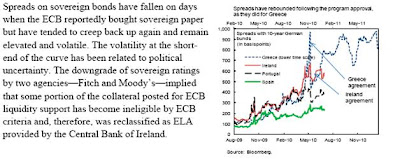
Two points:
• According to IMF, Irish yields have only been falling because the ECB have been buying bonds- other market participants don’t want to touch them (as of yesterday 10yr yields are back over 9% and closing in on the previous high). This deal is making any future market access less, not more likely
• The chart shown is the IMF’s and suggests that Irish debt yields are going the same way as Greece did after its EU/IMF programme was announced
Market yields reflect an underlying truth. Ireland is becoming less creditworthy as its resources are depleted. This economy is no being bailed out- if it were yields would be falling as the outlook improved. Irish taxpayers are bailing out EU banks – and the outlook is deteriorating because of it.

Two points:
• According to IMF, Irish yields have only been falling because the ECB have been buying bonds- other market participants don’t want to touch them (as of yesterday 10yr yields are back over 9% and closing in on the previous high). This deal is making any future market access less, not more likely
• The chart shown is the IMF’s and suggests that Irish debt yields are going the same way as Greece did after its EU/IMF programme was announced
Market yields reflect an underlying truth. Ireland is becoming less creditworthy as its resources are depleted. This economy is no being bailed out- if it were yields would be falling as the outlook improved. Irish taxpayers are bailing out EU banks – and the outlook is deteriorating because of it.
Friday, 26 February 2010
Ireland's private debt - is it time to default?
An Saoi: The Central Bank estimates that Irish private debt is €372,000M. The funding of this massive amount is rapidly going to become the key issue in the very near future. Irish resident deposits are just €64,489M from households and €31,024M from Irish business, a total of €95,513M. Even after NAMA, the banks will still be left with loans of more than €300,000M.
Where do they get the money from? Well, I came across the table below on the website of the German magazine Der Spiegel, which explains all. We are drowning in German money.
As can be seen from the graphic, the Germans have lent just over €3,000 per Greek and €2,000 per Italian, compared to about €42,000 for each resident of this State. Now, if I were German I would be dropping one of the “I” in PIIGS, because the Irish position is more akin to that of Iceland than Portugal, Italy Greece or Spain.
Effectively, all future activity in the Irish economy is completely dependent on the view taken by the Treasurers of a handful of German financial institutions. There are huge questions for the Central Bank and their German counterparts as to how these two countries became tied together in this embrace of debt/death.

To put the Irish position into perspective, each Icelander owes approx. €9,000 to the UK arising from the default of their banks, and a further €4,000 to the Netherlands arising out of their State guarantee. The Icelandic people are voting on whether to renege on that deal, and have won the vociferous support of John Kay in his Financial Times column this week to do so. Our debt to the Germans is more than three times greater than that of Iceland to the UK and the Netherlands.
I would suggest that it is time for us to take similar action. Forget about this referendum about children’s rights, we need a referendum to give our children a future. Let us renege on our German debts!
However, this will not happen. The ECB appears to have a friend in the top job in the Central Bank, and the initial investigation into what went wrong will of course be managed by Mr. Regling, who may be predisposed to protect the interests of Germany. You can read his CV here, or you can read a summary in the Oireachtas press release, which states that:
“Mr Regling is a member of the Issing Commission, appointed by Chancellor Merkel in 2008 to advise the German Government on the reform of financial regulation. The Committee completed its work in March 2009.
From 2001 to 2008 he was Director General for Economic and Financial Affairs of the European Commission. Before that, he was a Director General in the German Ministry of Finance where he worked for more than a decade on Economic and Monetary Union in Europe. He also worked in the International Monetary Fund for more than a decade.”
Where do they get the money from? Well, I came across the table below on the website of the German magazine Der Spiegel, which explains all. We are drowning in German money.
As can be seen from the graphic, the Germans have lent just over €3,000 per Greek and €2,000 per Italian, compared to about €42,000 for each resident of this State. Now, if I were German I would be dropping one of the “I” in PIIGS, because the Irish position is more akin to that of Iceland than Portugal, Italy Greece or Spain.
Effectively, all future activity in the Irish economy is completely dependent on the view taken by the Treasurers of a handful of German financial institutions. There are huge questions for the Central Bank and their German counterparts as to how these two countries became tied together in this embrace of debt/death.

To put the Irish position into perspective, each Icelander owes approx. €9,000 to the UK arising from the default of their banks, and a further €4,000 to the Netherlands arising out of their State guarantee. The Icelandic people are voting on whether to renege on that deal, and have won the vociferous support of John Kay in his Financial Times column this week to do so. Our debt to the Germans is more than three times greater than that of Iceland to the UK and the Netherlands.
I would suggest that it is time for us to take similar action. Forget about this referendum about children’s rights, we need a referendum to give our children a future. Let us renege on our German debts!
However, this will not happen. The ECB appears to have a friend in the top job in the Central Bank, and the initial investigation into what went wrong will of course be managed by Mr. Regling, who may be predisposed to protect the interests of Germany. You can read his CV here, or you can read a summary in the Oireachtas press release, which states that:
“Mr Regling is a member of the Issing Commission, appointed by Chancellor Merkel in 2008 to advise the German Government on the reform of financial regulation. The Committee completed its work in March 2009.
From 2001 to 2008 he was Director General for Economic and Financial Affairs of the European Commission. Before that, he was a Director General in the German Ministry of Finance where he worked for more than a decade on Economic and Monetary Union in Europe. He also worked in the International Monetary Fund for more than a decade.”
Tuesday, 2 February 2010
Greek Tragedy II - and the tax dimension
Michael Burke: In today's Financial Times, two economists from the Breugel think-tank in Brussels argue that the best course for Greece is to call in the IMF.
The Greek economy and financial markets are bearing the brunt of concerted pressure in the Euro Area, and there are fears that a collapse there could lead to renewed speculative pressure on a number of countries including Ireland.
The possibility of an IMF intervention ought to be shameful for the architects of Europe's fiscal and monetary arrangements, since the Euro was touted as an instrument that would protect the economies of Europe from speculative pressures. 'European Solidarity' has proved a mirage. Worse, leading EU institutions have played their part in Greece's difficulties. As the authors of the FT piece note,
"One reason why things have sharply worsened is that the ECB has said that by the end of 2010 it will tighten quality requirements for bonds pledged as collateral – which risks excluding Greek bonds from repurchase agreement operations. This, and Greece’s inability so far to present a credible fiscal plan, explains the alarm in financial markets."
This unilateral move by the ECB seems wholly misplaced. If the ECB is concerned about the deterioration of asset quality in a tiny part of its portfolio, it should make its own determination about which assets can be pledged. Outsourcing this to the largely discredited ratings agencies seems like a wholly unwarranted measure, designed to increase the pressures on a Greek government which has inherited a crisis not of its own making.
Nor is the Commission blameless, having been apparently hoodwinked over a number of years by the previous Greek governmet about the size of the deficits (and debt!) in a manner that would make a primary schoolteacher blush.
The new government has bemoaned the endemic corruption in Greek society, includig government bodies, and its effect on reducing tax revenues. Perhaps the Commission could provide greater assistance as tax collectors than as macroeconomic advisers, or even auditors. In the period 1997-2006, Greek tax revenues as a proportion of GDP were 5.5% below the Euro Area average. Even in 2008, they were 4% below the average. Closing in on the average level would make a major dent in the deficit and, once the economy recovers, the debt stock too.
This low taxation is a common feature of those Euro Area countries currently in the cross hairs of the financial markets. In 2008, Spain's tax revenues were 37% of GDP, 7.8% below the Euro Area average. By contrast, in Germany they were 43.7% and in France they were 49.3%.
Of course, in 2008, Ireland's tax revenue GDP ratio was the lowest of all in the Euro Area, at 34.9%, and fully 10% below the average (Table 36). Closing in on the Euro Area average would see Ireland's deficit melt away to nothing.
The Greek economy and financial markets are bearing the brunt of concerted pressure in the Euro Area, and there are fears that a collapse there could lead to renewed speculative pressure on a number of countries including Ireland.
The possibility of an IMF intervention ought to be shameful for the architects of Europe's fiscal and monetary arrangements, since the Euro was touted as an instrument that would protect the economies of Europe from speculative pressures. 'European Solidarity' has proved a mirage. Worse, leading EU institutions have played their part in Greece's difficulties. As the authors of the FT piece note,
"One reason why things have sharply worsened is that the ECB has said that by the end of 2010 it will tighten quality requirements for bonds pledged as collateral – which risks excluding Greek bonds from repurchase agreement operations. This, and Greece’s inability so far to present a credible fiscal plan, explains the alarm in financial markets."
This unilateral move by the ECB seems wholly misplaced. If the ECB is concerned about the deterioration of asset quality in a tiny part of its portfolio, it should make its own determination about which assets can be pledged. Outsourcing this to the largely discredited ratings agencies seems like a wholly unwarranted measure, designed to increase the pressures on a Greek government which has inherited a crisis not of its own making.
Nor is the Commission blameless, having been apparently hoodwinked over a number of years by the previous Greek governmet about the size of the deficits (and debt!) in a manner that would make a primary schoolteacher blush.
The new government has bemoaned the endemic corruption in Greek society, includig government bodies, and its effect on reducing tax revenues. Perhaps the Commission could provide greater assistance as tax collectors than as macroeconomic advisers, or even auditors. In the period 1997-2006, Greek tax revenues as a proportion of GDP were 5.5% below the Euro Area average. Even in 2008, they were 4% below the average. Closing in on the average level would make a major dent in the deficit and, once the economy recovers, the debt stock too.
This low taxation is a common feature of those Euro Area countries currently in the cross hairs of the financial markets. In 2008, Spain's tax revenues were 37% of GDP, 7.8% below the Euro Area average. By contrast, in Germany they were 43.7% and in France they were 49.3%.
Of course, in 2008, Ireland's tax revenue GDP ratio was the lowest of all in the Euro Area, at 34.9%, and fully 10% below the average (Table 36). Closing in on the Euro Area average would see Ireland's deficit melt away to nothing.
Thursday, 1 October 2009
Two reasons to vote yes
Jim Stewart
Reason 1
The Global Financial Stability Report by the IMF published on 30 September shows that, in February/March this year, the ECB was financing 7% of total assets of domestic banks in Ireland (IMF Report Figure 1.15). This was at a time when Irish banks had great difficulty in obtaining funds elsewhere. It is larger than for any other country in the Eurozone. This financing is provided by the ECB for periods up to one year. The rate of interest is just 1%. Because of improved credit conditions, both the main banks have recently issued new bonds. In contrast to the interest rate charged by the ECB, the yield on the recent three year bond issue by AIB was 4.735% and was described as ‘expensive’ by Dolmen stockbrokers.
Reason 2
Under the NAMA process, it is proposed that loans with a book value of €77 billion will be acquired by NAMA for €54 billion. The loans will be paid for by issuing short term (six months) Government debt to the banks in exchange for the loans. The banks may then exchange these loans for cash with the ECB at a current cost of 1%. The State will pay interest of 1.5% on the bond issues, meaning the banks will make a small margin (0.5%), although the banks will lose interest income on those loans paying interest. In future years, these rates are likely to change as ECB interest rates change. Thus, the banks will exchange illiquid assets for liquid assets. There is a large implicit subsidy in this financing arrangement. It is most unlikely that the Irish State would be able to issue €54 billion in bonds yielding 1.5% which would be highly liquid and readily exchangeable for cash. For every 1% increase in yield that the State would be obliged to pay to ensure liquidity, interest costs on €54 billion would increase by €540 million per annum. The NAMA process is subject to risk and uncertainty but it is not feasible without the support of the ECB.
As pointed out by Antoin Murphy and others the difference between Ireland and Iceland is not one letter but three – ECB.
Reason 1
The Global Financial Stability Report by the IMF published on 30 September shows that, in February/March this year, the ECB was financing 7% of total assets of domestic banks in Ireland (IMF Report Figure 1.15). This was at a time when Irish banks had great difficulty in obtaining funds elsewhere. It is larger than for any other country in the Eurozone. This financing is provided by the ECB for periods up to one year. The rate of interest is just 1%. Because of improved credit conditions, both the main banks have recently issued new bonds. In contrast to the interest rate charged by the ECB, the yield on the recent three year bond issue by AIB was 4.735% and was described as ‘expensive’ by Dolmen stockbrokers.
Reason 2
Under the NAMA process, it is proposed that loans with a book value of €77 billion will be acquired by NAMA for €54 billion. The loans will be paid for by issuing short term (six months) Government debt to the banks in exchange for the loans. The banks may then exchange these loans for cash with the ECB at a current cost of 1%. The State will pay interest of 1.5% on the bond issues, meaning the banks will make a small margin (0.5%), although the banks will lose interest income on those loans paying interest. In future years, these rates are likely to change as ECB interest rates change. Thus, the banks will exchange illiquid assets for liquid assets. There is a large implicit subsidy in this financing arrangement. It is most unlikely that the Irish State would be able to issue €54 billion in bonds yielding 1.5% which would be highly liquid and readily exchangeable for cash. For every 1% increase in yield that the State would be obliged to pay to ensure liquidity, interest costs on €54 billion would increase by €540 million per annum. The NAMA process is subject to risk and uncertainty but it is not feasible without the support of the ECB.
As pointed out by Antoin Murphy and others the difference between Ireland and Iceland is not one letter but three – ECB.
Monday, 13 July 2009
Challenging the narrow ground
The only reason that the government can still borrow on international markets to finance the day-to-day running of the country - some €24 billion this year out of a total spend of €60 billion or so - is that the markets believe a) that the government will stick to its commitments to cut spending, and b) that the European Central Bank stands behind Irish government debt. But the price for the ECB’s implicit guarantee is controlling our deficit, and that means cutting public spending.
Michael Taft: The above, written by Pat Leahy in the Sunday Business Post, encapsulates a lot that is wrong with the current debate over the economy. Leave aside the issue of why the NTMA has been so successful in selling Government debt, whether short or long-term. It’s enough to say that redemption yields on 5-year and 10-year bonds remain the same today as it did on February 1st – long before the Government engaged in cuts and taxes (never mind the suspicion that Mr. Leahy has not actually interviewed the spokespersons of the institutions who have so readily bought our debt to find out why they have done so).
The defining characteristic of the current debate is the way that commentators have treated economic issues in a reductionist manner. For instance, we are constantly being invited to view the economy through budgetary tables and only through budgetary tables. To bring the fiscal deficit ‘under control’ we must either cut spending, increase taxes or a combination of both. Never are more fundamental questions admitted into the debate – the effect of the recession itself, the collapse in domestic demand, the fiscal toll that unemployment is taking, the impact of lower consumption, etc. To admit these questions might lead us away from the parameters of budgetary tables and on to the fact of economic decline itself (e.g. wage maintenance, job-retention, direct employment creation, state-led investment and consumption – in other words, stimulus). It might lead to alternative analysis and programmes.
Now, Mr. Leahy takes this reductionism one step further. The issue is no longer ‘controlling the fiscal deficit’. It is narrowly and squarely about cutting public expenditure. That this overlooks the findings of the ESRI’s multiplier tables – that tax increases are, on the whole, less economically damaging and more Exchequer-friendly than spending cuts – is neither here nor there for some commentators.
The space in which the economy is being debated becomes more constricted all the time. No doubt the eventual publication of the An Bord Snip report will narrow the ground even further. All responsible debate from now on must be solely concerned with the efficacy of cuts on lowering public expenditure. Those outside that consensus are condemned as ‘fringe’ or spokespersons for interest groups (e.g. trade unions, social organisations, etc.).
The task facing progressives is to challenge not only the prescriptions of the Right; it is to challenge the very viability of a debate that is taking place far from where the economy operates. Unless we do that, we’ll be allowed to move the chess pieces on the board – but they’ll all be the same colour. And they will only move backwards.
Michael Taft: The above, written by Pat Leahy in the Sunday Business Post, encapsulates a lot that is wrong with the current debate over the economy. Leave aside the issue of why the NTMA has been so successful in selling Government debt, whether short or long-term. It’s enough to say that redemption yields on 5-year and 10-year bonds remain the same today as it did on February 1st – long before the Government engaged in cuts and taxes (never mind the suspicion that Mr. Leahy has not actually interviewed the spokespersons of the institutions who have so readily bought our debt to find out why they have done so).
The defining characteristic of the current debate is the way that commentators have treated economic issues in a reductionist manner. For instance, we are constantly being invited to view the economy through budgetary tables and only through budgetary tables. To bring the fiscal deficit ‘under control’ we must either cut spending, increase taxes or a combination of both. Never are more fundamental questions admitted into the debate – the effect of the recession itself, the collapse in domestic demand, the fiscal toll that unemployment is taking, the impact of lower consumption, etc. To admit these questions might lead us away from the parameters of budgetary tables and on to the fact of economic decline itself (e.g. wage maintenance, job-retention, direct employment creation, state-led investment and consumption – in other words, stimulus). It might lead to alternative analysis and programmes.
Now, Mr. Leahy takes this reductionism one step further. The issue is no longer ‘controlling the fiscal deficit’. It is narrowly and squarely about cutting public expenditure. That this overlooks the findings of the ESRI’s multiplier tables – that tax increases are, on the whole, less economically damaging and more Exchequer-friendly than spending cuts – is neither here nor there for some commentators.
The space in which the economy is being debated becomes more constricted all the time. No doubt the eventual publication of the An Bord Snip report will narrow the ground even further. All responsible debate from now on must be solely concerned with the efficacy of cuts on lowering public expenditure. Those outside that consensus are condemned as ‘fringe’ or spokespersons for interest groups (e.g. trade unions, social organisations, etc.).
The task facing progressives is to challenge not only the prescriptions of the Right; it is to challenge the very viability of a debate that is taking place far from where the economy operates. Unless we do that, we’ll be allowed to move the chess pieces on the board – but they’ll all be the same colour. And they will only move backwards.
Thursday, 28 May 2009
Surely we can do better than this?
Sli Eile: Writing in the Irish Times, Michael Casey a former chief economist with the Central Bank argues that a ‘Change of Government will not solve our economic woes’. He goes on to list seven reasons why there is little an alternative Government can do:
We lack the power to devalue currency or change interest rates (just as well?)
Public finances are stuck between a hard rock and a hard place (cut and be damned or reflate and be damned, it is said)
Social partnership will not, cannot, deliver an ‘appropriate incomes policy’ (what would that look like if it included all incomes?)
Public Sector reform will take years (if not decades?) to deliver
Toxic Banking is a poisoned chalice and nobody wants to drink from it (before, during or after NAMA has run its course in 20 something)
‘No political party has formulated an alternative industrial policy’ (not entirely true actually)
‘Most important economic decisions are made in Brussels, Frankfurt and Washington’ (it used to be London, and that was a key argument for joining the Common Market’)
And there the article ends. Is that all that there is to say? One may argue with many of the above claims, but there is an underlying truth – business as usual is gone and in a post-recession world we are left standing on our own two feet. I contest that these two feet should be:
- A new economic policy based on internationally traded services and products with completely new indigenous public, private and community enterprises;
- A new social and democratic contract that will replace the existing model of partnership and ensure the provision of a basic income for all and a 21st century European level of public services.
But how will this be paid for? And how will we dig ourselves out of the present financial hole? And where will be the political momentum come from?
What has progressive economics to offer? What could contributors to this blog suggest? What have non-readers who prefer to read irisheconomy.ie to say?
What is the minimum that a progressive coalition of economists, thinkers, politicians and social commentators and activists could agree on? Let's see. How about a set of ‘contestable’ statements to start a debate:
1 Banking – get this right as a top priority. It is a complex area but you don’t need to be a financial whiz kid to arrive at an obvious conclusion – only full ownership and control of Banking by the State can save this sector and the rest of the economy. Why wait for it to happen, and then say it is our only option. I appreciate that not everyone agrees with this …..
2 Fiscal policy – public finances are in dire straits and nobody denies this (at least since the start of this year). So, let's raid the rich (and not so rich) with much higher capital, new property, local residential and high-income taxes, while closing as many of the tax loopholes and reliefs which have long outlived their economic usefulness (if they every really had any). At the same time increase (yes!) public spending in a planned and strategic way to improve public services, capital infrastructure and job-retention and training while increasing public borrowing through a brokered ‘off-balance’ approach.
3 Jobs – a fiscal stimulus carefully targeted and forensically tested could arrest at least some of the jobs haemorrhage. Although there are no magic solutions, let's accelerate a programme of investment in select areas of research and development and link these to new enterprises – temporarily nationalising those firms that still have a viable future but are about to close, aiding firms in trouble through a new credit agency, converting unused land banks into productive social use and identifying potentially new growth areas for international services such as education, health and green technology. Fine Gael have made some valuable proposals in regard to a slate of new State companies and green technology (Rebuilding Ireland - a New Era for the Irish Economy)
4 Public Services - we need more, and not less, by way of health, education and protection against poverty. We are still among the most prosperous countries in the world but we need to move from being a society of nouveau riche and haves and have nots to a society where citizens and communities share the cost of providing an acceptable level of income, nurture, care and protection.
5 Reform of Corporations and Public Services
Linked to a reformed and enhanced public service is the need to democratise institutions (as well as reform public sector institutions, work practices and responsiveness). Our education and health sectors (to take just two examples) remain profoundly undemocratic and exclusionist in spite of all the talk about customers and inclusion. Likewise, the workplace needs to become a place where skills, team-working and decision-making are not the preserve of the shareholders or the managerial elite. Openness, transparency and accountability must reach into every public, private and voluntary organisations (but especially those in receipt of State subsidies or in charge of delivering some part of public or social services).
A new deal for a new Ireland. Five principles to start a national and international/EU debate. Who is up for it? Comments, disagreements, suggestions?
Or should we resign ourselves to waiting out the storm and someone else (IMF, ECB, EIB, ECion, London, Washington) will bail us out eventually ….? Surely we can do better than this.
We lack the power to devalue currency or change interest rates (just as well?)
Public finances are stuck between a hard rock and a hard place (cut and be damned or reflate and be damned, it is said)
Social partnership will not, cannot, deliver an ‘appropriate incomes policy’ (what would that look like if it included all incomes?)
Public Sector reform will take years (if not decades?) to deliver
Toxic Banking is a poisoned chalice and nobody wants to drink from it (before, during or after NAMA has run its course in 20 something)
‘No political party has formulated an alternative industrial policy’ (not entirely true actually)
‘Most important economic decisions are made in Brussels, Frankfurt and Washington’ (it used to be London, and that was a key argument for joining the Common Market’)
And there the article ends. Is that all that there is to say? One may argue with many of the above claims, but there is an underlying truth – business as usual is gone and in a post-recession world we are left standing on our own two feet. I contest that these two feet should be:
- A new economic policy based on internationally traded services and products with completely new indigenous public, private and community enterprises;
- A new social and democratic contract that will replace the existing model of partnership and ensure the provision of a basic income for all and a 21st century European level of public services.
But how will this be paid for? And how will we dig ourselves out of the present financial hole? And where will be the political momentum come from?
What has progressive economics to offer? What could contributors to this blog suggest? What have non-readers who prefer to read irisheconomy.ie to say?
What is the minimum that a progressive coalition of economists, thinkers, politicians and social commentators and activists could agree on? Let's see. How about a set of ‘contestable’ statements to start a debate:
1 Banking – get this right as a top priority. It is a complex area but you don’t need to be a financial whiz kid to arrive at an obvious conclusion – only full ownership and control of Banking by the State can save this sector and the rest of the economy. Why wait for it to happen, and then say it is our only option. I appreciate that not everyone agrees with this …..
2 Fiscal policy – public finances are in dire straits and nobody denies this (at least since the start of this year). So, let's raid the rich (and not so rich) with much higher capital, new property, local residential and high-income taxes, while closing as many of the tax loopholes and reliefs which have long outlived their economic usefulness (if they every really had any). At the same time increase (yes!) public spending in a planned and strategic way to improve public services, capital infrastructure and job-retention and training while increasing public borrowing through a brokered ‘off-balance’ approach.
3 Jobs – a fiscal stimulus carefully targeted and forensically tested could arrest at least some of the jobs haemorrhage. Although there are no magic solutions, let's accelerate a programme of investment in select areas of research and development and link these to new enterprises – temporarily nationalising those firms that still have a viable future but are about to close, aiding firms in trouble through a new credit agency, converting unused land banks into productive social use and identifying potentially new growth areas for international services such as education, health and green technology. Fine Gael have made some valuable proposals in regard to a slate of new State companies and green technology (Rebuilding Ireland - a New Era for the Irish Economy)
4 Public Services - we need more, and not less, by way of health, education and protection against poverty. We are still among the most prosperous countries in the world but we need to move from being a society of nouveau riche and haves and have nots to a society where citizens and communities share the cost of providing an acceptable level of income, nurture, care and protection.
5 Reform of Corporations and Public Services
Linked to a reformed and enhanced public service is the need to democratise institutions (as well as reform public sector institutions, work practices and responsiveness). Our education and health sectors (to take just two examples) remain profoundly undemocratic and exclusionist in spite of all the talk about customers and inclusion. Likewise, the workplace needs to become a place where skills, team-working and decision-making are not the preserve of the shareholders or the managerial elite. Openness, transparency and accountability must reach into every public, private and voluntary organisations (but especially those in receipt of State subsidies or in charge of delivering some part of public or social services).
A new deal for a new Ireland. Five principles to start a national and international/EU debate. Who is up for it? Comments, disagreements, suggestions?
Or should we resign ourselves to waiting out the storm and someone else (IMF, ECB, EIB, ECion, London, Washington) will bail us out eventually ….? Surely we can do better than this.
Friday, 27 February 2009
Trichet's narrow notions of competitiveness
Paul Sweeney: Yesterday, I got to shake the hand of the 5th most powerful man in the world - reluctantly!
Yesterday, JC Trichet, the President of the European Central Bank, said by Newsweek magazine to the 5th most powerful man in the world, made a speech in Dublin. As he left the meeting, I was introduced to him, and I shook his hand, but reluctantly. I suspect that he was somewhat reluctant to shake my hand too, as he heard I was with the Irish Congress of Trade Unions.
Here was a very powerful man in a world economy which is in deep crisis, who had just given a speech on Competitiveness which was straight from the 1980s. It was not economics but pure political economy, serving the interests of the Irish employers and government in their attempts to cut wages. His main message was that we must keep labour costs down.
It was straight from the 1980s understanding of competitiveness because it was the kind economics that Ireland left well behind, back then. It focused largely on cost competitiveness and then on wages, with some reference to unit labour costs. “I believe there should be more public awareness that insufficient attention of wage setting to current and expected productivity developments makes any correction to previous losses of competitiveness more painful in terms of output and employment losses,” he said. He also said “As I mentioned before, wage restraint would help a lot.”
M Trichet did not, however, advocate cuts, like some indigenous economists. He called for “wage setting to take account of the competitiveness and labour market conditions” (not unreasonable) in a what he termed a “responsible and timely manner”. And he said that “national authorities should pursue courageous policies of spending restraint especially in the case of public wages.”
So the government that messed up the economy with light regulation and pro-cyclical policies during the boom is now courageous?
He pointed out that many of Ireland’s fundamental economic strengths have not gone away and the economy is well placed when the international recovery occurs. But he said our success was due to a number of factors, including “a business-friendly regulatory environment.” I thought, reading the papers and listening to the radio, that our business-friendly regulatory environment was the reason Ireland is in deep trouble! Clearly, I was misled! It’s the overpaid workers!
Ireland, fortunately, developed a comprehensive view of what makes a country competitive, in the late 1980s - and Ireland moved on. For a while it became the Celtic Tiger, basing its economics on a whole world view of this complex issue. With a shared view of the total complexity of competitiveness, employers and unions and politicians worked together in a form of Social Partnership to push up employment massively, together with profits and real wages.
Back in 1982, in reaction to a government sponsored report on Competitiveness, by the Three Wise Men, I, with a group of other economists, the Socialist Economists, published Jobs and Wages: the True Story of Competitiveness. In a booklet, we set out the framework for a real comprehensive understanding of what makes a country competitive, from productivity, a functioning banking and insurance systems, good roads and interconnectedness, education and even advocated social partnership! The Irish government later actually set up a social partnership body called the National Competitiveness Council, as the behest of the employers, to analyse the issues on a continuous basis. It has produced excellent work in the area for many years.
However, in recent weeks, some Irish economists, who, believe it or not, avoided the area, (except to pepper reports with the word, 'competitiveness') have come back into it, but like M Trichet, have taken up where the so-called Three Wise Men left off – back 30 years ago.
For a group of economists, the panacea for all our problems appears to be wage cuts (for employees only; only occasionally for others). Now this is understandable because they can measure movements in wages. Economists love to measure things! They hate the impact of institutional and political factors on economies as they cant measure them. Wages are very measurable. One economist just sticks up a graph on total costs, which as we all know have been rising fast and concludes, without blushing, that Ireland’s competitiveness is heading south and wages should be cut (consumer costs are way above the EU average here – 14% above for goods and 21% for services in the EU27 or as high as 33% for consumer services).
Irish costs are way above the EU average, but the reasons are, much more complex than wages. On the other hand, wages have risen faster here than in other EU countries, but in a later blog, I will address this issue in some depth.
The emphasis on wages by economists and by M Trichet is worrying. If we, as a country, are to redefine competitiveness simply as wages, or even unit labour costs or even total costs, we will have lost our shared understanding of an important and real issue which makes our economy work.
It is the naked class nature of their analysis which is worrying. Will we soon stop shaking hands?
Paul Sweeney is Economic Advisor to ICTU
Yesterday, JC Trichet, the President of the European Central Bank, said by Newsweek magazine to the 5th most powerful man in the world, made a speech in Dublin. As he left the meeting, I was introduced to him, and I shook his hand, but reluctantly. I suspect that he was somewhat reluctant to shake my hand too, as he heard I was with the Irish Congress of Trade Unions.
Here was a very powerful man in a world economy which is in deep crisis, who had just given a speech on Competitiveness which was straight from the 1980s. It was not economics but pure political economy, serving the interests of the Irish employers and government in their attempts to cut wages. His main message was that we must keep labour costs down.
It was straight from the 1980s understanding of competitiveness because it was the kind economics that Ireland left well behind, back then. It focused largely on cost competitiveness and then on wages, with some reference to unit labour costs. “I believe there should be more public awareness that insufficient attention of wage setting to current and expected productivity developments makes any correction to previous losses of competitiveness more painful in terms of output and employment losses,” he said. He also said “As I mentioned before, wage restraint would help a lot.”
M Trichet did not, however, advocate cuts, like some indigenous economists. He called for “wage setting to take account of the competitiveness and labour market conditions” (not unreasonable) in a what he termed a “responsible and timely manner”. And he said that “national authorities should pursue courageous policies of spending restraint especially in the case of public wages.”
So the government that messed up the economy with light regulation and pro-cyclical policies during the boom is now courageous?
He pointed out that many of Ireland’s fundamental economic strengths have not gone away and the economy is well placed when the international recovery occurs. But he said our success was due to a number of factors, including “a business-friendly regulatory environment.” I thought, reading the papers and listening to the radio, that our business-friendly regulatory environment was the reason Ireland is in deep trouble! Clearly, I was misled! It’s the overpaid workers!
Ireland, fortunately, developed a comprehensive view of what makes a country competitive, in the late 1980s - and Ireland moved on. For a while it became the Celtic Tiger, basing its economics on a whole world view of this complex issue. With a shared view of the total complexity of competitiveness, employers and unions and politicians worked together in a form of Social Partnership to push up employment massively, together with profits and real wages.
Back in 1982, in reaction to a government sponsored report on Competitiveness, by the Three Wise Men, I, with a group of other economists, the Socialist Economists, published Jobs and Wages: the True Story of Competitiveness. In a booklet, we set out the framework for a real comprehensive understanding of what makes a country competitive, from productivity, a functioning banking and insurance systems, good roads and interconnectedness, education and even advocated social partnership! The Irish government later actually set up a social partnership body called the National Competitiveness Council, as the behest of the employers, to analyse the issues on a continuous basis. It has produced excellent work in the area for many years.
However, in recent weeks, some Irish economists, who, believe it or not, avoided the area, (except to pepper reports with the word, 'competitiveness') have come back into it, but like M Trichet, have taken up where the so-called Three Wise Men left off – back 30 years ago.
For a group of economists, the panacea for all our problems appears to be wage cuts (for employees only; only occasionally for others). Now this is understandable because they can measure movements in wages. Economists love to measure things! They hate the impact of institutional and political factors on economies as they cant measure them. Wages are very measurable. One economist just sticks up a graph on total costs, which as we all know have been rising fast and concludes, without blushing, that Ireland’s competitiveness is heading south and wages should be cut (consumer costs are way above the EU average here – 14% above for goods and 21% for services in the EU27 or as high as 33% for consumer services).
Irish costs are way above the EU average, but the reasons are, much more complex than wages. On the other hand, wages have risen faster here than in other EU countries, but in a later blog, I will address this issue in some depth.
The emphasis on wages by economists and by M Trichet is worrying. If we, as a country, are to redefine competitiveness simply as wages, or even unit labour costs or even total costs, we will have lost our shared understanding of an important and real issue which makes our economy work.
It is the naked class nature of their analysis which is worrying. Will we soon stop shaking hands?
Paul Sweeney is Economic Advisor to ICTU
Subscribe to:
Posts (Atom)