Tom O'Connor: Doomsday scenarios have been painted recently by Prof. Morgan Kelly and others concerning the need to abandon to EU/IMF deal on the one hand or totally repudiate the debt on the other. Kelly has suggested we abandon the bailout and balance the exchequer books immediately. Balancing the books immediately is not an option however.
The newly elected Fine Gael TD Paschal Donohoe has warned against abandoning the bailout, predicting huge cuts in social welfare. The Central Bank Governor, Paddy Honohan is defending the bailout and fighting to save his reputation. There is a huge amount of kneejerk-ism around and people taking sides. I attempt in this post to stand back and examine evidence which might inform the way forward.
Let’s start with the most radical scenario, Argentina: In 2002, it had developed a triple financial crisis in terms of its unmanageable fiscal deficit, banks which were broke and ultimately a government external debt crisis as a result. To a large extent, this is where Ireland is right now. In January 2002, Argentina essentially abruptly defaulted on $81.8 billion of its external debt without consultation with creditors.
This led to a run on the banks. It wiped out the savings of citizens. It dramatically increased the cost of borrowing by the government and deflated the size of the economy by 25% in one year from 2001 to 2002. The collapse of the currency greatly indebted the country also, as much of it was denominated in dollars.
For many years afterwards, Argentinean credit has been more costly in its bond spreads. Bond debt has been more costly there and in Ecuador, far higher than in other countries which had restructured their debt with creditors in advance, such as Ukraine (1998) and Uruguay (2003).
Argentina and Ecuador also imposed large haircuts on the debt on which it defaulted, far higher than that of countries which had negotiated in advance. Ukraine and Uruguay imposed lower haircuts and in the years that followed, their bond spreads were lower. This means that they could subsequently borrow more cheaply as a reflection of the greater level of international trust in these countries.
Nonetheless all four countries did eventually formally agree repayment terms with the IMF, either pre-default or post-default. This happened under the IMF’s Sovereign Debt Restructuring Mechanism (SDRM). According to Professor Nouriel Roublini, at this point the European Union should examine this mechanism as the way forward for debt restructuring, and not be wasting its time looking for new legal mechanisms.
Working on his evidence as well as that contained in work by De Paoli (2006), Gelos (2004) and others, there is strong evidence to suggest that the preferred option is a partial and negotiated restructuring of debt in advance of a default. The term ‘restructuring’ sounds more positive and is more advantageous.
Nonetheless, a negotiated ‘restructuring’ is still a default according to the eminent work of Reinhart and Rogoff (2009). The benefits of lower bond spreads in the years following a ‘restructuring’ or ‘exchange offer’ (Roubini) of a restructured debt are augmented by a significantly less negative impact on growth in the years ahead on the ability raise finance internationally. This negotiated mechanism (as in the SDRM) reduces ‘deadweight costs’ also such as costly legal proceedings. It is infinitely better than allowing a country to stumble towards default to the destruction of its economy. This resembles death by a thousand cuts.
Taking this eminent advice on board, I would suggest that the EU/IMF deal needs to rescinded and replaced with Ireland cutting a deal on external debt, including sovereign debt and the debts of the Irish Banks.
The current bailout offers bad terms for Ireland. The prospect of repaying 70 billion worth of bank debt without any deal on writing down the bonds involved, at a rate of interest of 5.8% cannot be done, particularly as it will have to be paid in conjunction with sovereign exchequer debt. The repayment of 8 billion a year in interest is off the scale.
On the basis of the evidence from international experience, the bailout needs to be replaced by an IMF led Sovereign Debt Restructuring Mechanism (SDRM). Many Irish economists have pointed to the fact that under the current bailout, Ireland will become insolvent by 2014. The country cannot sit back and wait for this to happen. Instead, it needs to offer, along with other euro zone countries in danger of default, what Roubini terms a ‘pre-emptive, pre-default exchange rate offer’.
Without a default, national debt will be 225 billion in 2014 and our GDP according to the Dept of Finance will be only 184, a debt/GDP ratio of 122%. This figure 225 does not include NAMA. This 184 debt would include 70 billion of bank debt if we include the recapitalisations from 2008 till then. At that point, the sustained debt would be over twice the international solvency rule of thumb whereby a country needs to keep its debt below 60% of GDP.
The Roubini Pre-Default Exchange Offer under existing IMF rules should be done in the same was as was done in Pakistan, Uruguay or Ukraine and in many other countries in recent years. The EU/IMF deal should be cast aside.
This would be a partial default. It needs to be planned with creditors. A haircut of at least 50% on the bank debt of 70 billion needs to be agreed right away. Haircuts of this magnitude have been proposed by Rogoff and Roubini.
Exchequer debt needs to be extended well beyond the 7.5 years of average maturity which exists under the EU/IMF deal. A significant cut in the interest rate on sovereign external debt will also be necessary alongside a possible haircut also. The 160 billion owed to the ECB by Irish banks will also need to be restructured. These are some of the areas of ‘offer’ that the Irish government needs to make to its creditors.
Another international model which might inform the default is that of South East Asia in the late 1990s. After receiving IMF funds, they opted out of their quasi-fixed exchange rate with the dollar and devalued significantly. They recovered economically far more quickly than Hong Kong which stuck with the dollar. If Ireland sticks with the euro under a default, its recovery will take longer, as happened in Hong Kong. By contrast, the devaluation of the currencies in Thailand, Indonesia and South Korea greatly added stimulation to their economic recovery.
This scenario would help greatly in avoiding severe cutbacks in wages, social welfare payments and public spending. The scale of future GNP increases is also key to preventing punitive measures been implemented by the Irish government on its population. A significant economic stimulus is needed in this regard.
Despite the warnings of some commentators however, the published evidence does not necessarily support the inevitability that pay rates in the public sector and social welfare payments will automatically be dramatically cut in the event of a default.
If a default is ‘offered’ pre-emptively by a country in negotiation with creditors and particularly under the IMF (SDRM), recovery may happen within three years according to the in-depth research by Reinhart and Rogoff of Harvard. With access to capital markets within months and growth restored quickly, penal cuts to public pay and welfare are not in any way an inevitable and may in fact be prevented.
After a default, countries are not ‘blacked’ for finance for long periods and usually can access market finance within four months in many cases, according to a study by Gelos (2004). An exhaustive World Bank study by Zettelmeyer and Sturzenegger (2007) also echoes the view that default is far from a doomsday scenario. Many countries recovered quickly despite the negative effects on economic growth and the increased cost of borrowing. Argentina and Russia are cases in point.
In addition, it may well be the case that the blanket austerity being demanded by the EU and IMF under the bailout plan would be a lot worse and more punitive on those not responsible for the problem, than would a structured default where Ireland exerts more control on its own affairs.
It is obvious that Greece Will negotiate a default very soon. It seems increasingly likely that the EU cannot hold back the tide of default. The Portuguese bailout may never fully even get off the blocks and it certainly does not look sustainable.
The Irish government needs to stop burying its head in the sand and posturing about a possible lowering of the interest rate in the bailout. This bailout will not work. Modelling from other countries demonstrates that a negotiated default needs to happen as soon as possible. This will give the economy a better chance of bouncing back quickly, a lesson that has been learned from Japan’s stubbornness in this regard heretofore.
A Debt Audit Commission was set up in Ecuador in 2007. Some unions, academics and civil society groups have been calling for one to be set up in Ireland. This will determine the fairest course of action on defaulting. This could inform the way forward.
this piece originally appeared in the Irish Examiner

Showing posts with label government bonds. Show all posts
Showing posts with label government bonds. Show all posts
Thursday, 12 May 2011


Wednesday, 11 May 2011
A chink of light ...
Michael Burke: In the furore about the recent Morgan Kelly article in the Irish Times, in which he advocates a debt default, there has been very little light and much heat generated. The worst response I have seen (there may be others), in terms of lack of logic, was that from former Taoiseach John Bruton, who argued that the ECB would go bust if this state defaulted on any part of its debt. Some should tell the chair of the IFSC Ireland that central banks can’t go bust from a default in the currency which they produce.
But there was one chink of light. Strangely, the NTMA has issued an ‘Information Note on Ireland’s Debt’. No-one can recall one these strangely-titled notes ever having been issued before. For any information on this topic we should be grateful, although it seems some of the thanks should be directed towards Prof. Kelly.
In the note, point 3, it refers to the holdings of government debt by residency, and produces a truncated version of a table that first appeared in the Central Bank’s Quarterly Bulletin. Below the fuller version from the Bank’s Bulletin is reproduced (Table E3).
 One of the key arguments against any type of default is the damage this will do to the ordinary citizens of Ireland/Europe (the location being somewhat moveable). In effect, we are being asked to do the right thing by the widows and orphans of Dublin, or Dresden.
The table shows this concern to be misplaced. TotaI government debt at the end of 2010 was €90.1bn. If we take only Irish residents, the overwhelming bulk of the €16bn in debt held was by MFIs (monetary financial institution; banks) and the central bank. Only €252mn was held directly by households and a further €1.774bn mainly on their behalf by insurance and pension funds. So, just over €2bn held by Irish ‘widows and orphans’- most of whom aren’t, of course. Many will be very wealthy individuals who have built substantial private pensions to supplement their not-ungenerous state pensions, mainly via a tax cost to the Exchequer, ie other taxpayers.
The holdings of pensions and insurance funds have fallen significantly over the last year from already low levels. This reflects the exit of mainstream investors from the Irish government bond market. We were repeatedly told that cuts to government spending would restore the confidence of the markets. The measures of confidence are that Irish 10yr yields are now at a new high of 10.65% and the ratings’ agencies have downgraded sovereign debt again, to one notch above ‘junk’ status.
Most mainstream investment funds, certainly any managing pensions, are prevented by their investment restrictions from investing in such low-grade debt. The high yield on the debt reflects the exit of these investors. The recent downgrades are likely to produce a further decline in these holdings. But, since every sale requires a buyer some other type of entities must be increasing their holdings. Among residents this increase has been by MFIs and the central bank.
The bulk of government debt is held overseas, €74bn of €90bn. While the ECB has increased its holdings of government debt, this has been almost exclusively in the form of collateral posted by Irish and other banks in return for short-term lending from the ECB. The same investment restrictions on junk or near-junk apply to European mainstream funds as to Irish ones. They too will have been forced to divest as the credit downgrades were accumulating.
Therefore, the new buyers cannot have come from the ranks of mainstream investors. The types of funds that can purchase near-junk debt are specialist funds in ‘distressed debt’ sometimes known as vulture funds, hedge funds and others. These are not the savings vehicles for widows or orphans, but for the extremely rich.
Turning to bank debt, the same argument applies with even more force. All the main deposit-taking Irish banks have been downgraded to junk status. Mainstream investors are simply not allowed to invest in their debt- their investment mandates preclude it. The holders of that debt, aside from central banks and each other, will therefore be the same roll-call of parasitic speculators.
It is also to these funds that Irish taxpayer will be paying the proceeds of ‘promissory notes’ to fund Anglo Irish debts. This will incur €3.1bn per annum for a total cost of €43.3bn until 2015, assuming a very favourable fall in government borrowing rates. Anglo is not now and never has been a bank which performed any useful function and there is no logical reason for taxpayers to accept this imposition.
A chink of light has been let in on the State’s debts. What is revealed reinforces the case for default.
But there was one chink of light. Strangely, the NTMA has issued an ‘Information Note on Ireland’s Debt’. No-one can recall one these strangely-titled notes ever having been issued before. For any information on this topic we should be grateful, although it seems some of the thanks should be directed towards Prof. Kelly.
In the note, point 3, it refers to the holdings of government debt by residency, and produces a truncated version of a table that first appeared in the Central Bank’s Quarterly Bulletin. Below the fuller version from the Bank’s Bulletin is reproduced (Table E3).

The table shows this concern to be misplaced. TotaI government debt at the end of 2010 was €90.1bn. If we take only Irish residents, the overwhelming bulk of the €16bn in debt held was by MFIs (monetary financial institution; banks) and the central bank. Only €252mn was held directly by households and a further €1.774bn mainly on their behalf by insurance and pension funds. So, just over €2bn held by Irish ‘widows and orphans’- most of whom aren’t, of course. Many will be very wealthy individuals who have built substantial private pensions to supplement their not-ungenerous state pensions, mainly via a tax cost to the Exchequer, ie other taxpayers.
The holdings of pensions and insurance funds have fallen significantly over the last year from already low levels. This reflects the exit of mainstream investors from the Irish government bond market. We were repeatedly told that cuts to government spending would restore the confidence of the markets. The measures of confidence are that Irish 10yr yields are now at a new high of 10.65% and the ratings’ agencies have downgraded sovereign debt again, to one notch above ‘junk’ status.
Most mainstream investment funds, certainly any managing pensions, are prevented by their investment restrictions from investing in such low-grade debt. The high yield on the debt reflects the exit of these investors. The recent downgrades are likely to produce a further decline in these holdings. But, since every sale requires a buyer some other type of entities must be increasing their holdings. Among residents this increase has been by MFIs and the central bank.
The bulk of government debt is held overseas, €74bn of €90bn. While the ECB has increased its holdings of government debt, this has been almost exclusively in the form of collateral posted by Irish and other banks in return for short-term lending from the ECB. The same investment restrictions on junk or near-junk apply to European mainstream funds as to Irish ones. They too will have been forced to divest as the credit downgrades were accumulating.
Therefore, the new buyers cannot have come from the ranks of mainstream investors. The types of funds that can purchase near-junk debt are specialist funds in ‘distressed debt’ sometimes known as vulture funds, hedge funds and others. These are not the savings vehicles for widows or orphans, but for the extremely rich.
Turning to bank debt, the same argument applies with even more force. All the main deposit-taking Irish banks have been downgraded to junk status. Mainstream investors are simply not allowed to invest in their debt- their investment mandates preclude it. The holders of that debt, aside from central banks and each other, will therefore be the same roll-call of parasitic speculators.
It is also to these funds that Irish taxpayer will be paying the proceeds of ‘promissory notes’ to fund Anglo Irish debts. This will incur €3.1bn per annum for a total cost of €43.3bn until 2015, assuming a very favourable fall in government borrowing rates. Anglo is not now and never has been a bank which performed any useful function and there is no logical reason for taxpayers to accept this imposition.
A chink of light has been let in on the State’s debts. What is revealed reinforces the case for default.
Thursday, 10 February 2011
Who benefits?
Michael Burke: This is from the IMF’s latest Interim Staff Report (in effect making sure the Dublin government is doing as it’s told). To quote one section of the IMF Report: [click to enlarge]
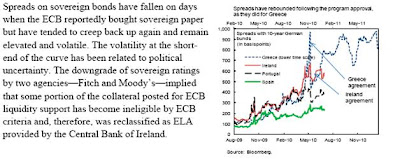
Two points:
• According to IMF, Irish yields have only been falling because the ECB have been buying bonds- other market participants don’t want to touch them (as of yesterday 10yr yields are back over 9% and closing in on the previous high). This deal is making any future market access less, not more likely
• The chart shown is the IMF’s and suggests that Irish debt yields are going the same way as Greece did after its EU/IMF programme was announced
Market yields reflect an underlying truth. Ireland is becoming less creditworthy as its resources are depleted. This economy is no being bailed out- if it were yields would be falling as the outlook improved. Irish taxpayers are bailing out EU banks – and the outlook is deteriorating because of it.

Two points:
• According to IMF, Irish yields have only been falling because the ECB have been buying bonds- other market participants don’t want to touch them (as of yesterday 10yr yields are back over 9% and closing in on the previous high). This deal is making any future market access less, not more likely
• The chart shown is the IMF’s and suggests that Irish debt yields are going the same way as Greece did after its EU/IMF programme was announced
Market yields reflect an underlying truth. Ireland is becoming less creditworthy as its resources are depleted. This economy is no being bailed out- if it were yields would be falling as the outlook improved. Irish taxpayers are bailing out EU banks – and the outlook is deteriorating because of it.
Thursday, 4 November 2010
A better way
Michael Burke: As the population braces itself for another round of swingeing cuts, the government and the overwhelming majority of the media continue to make this claim: That larger cuts will reassure financial markets, allow NTMA to resume borrowing once more and lead to lower interest rates.
Over at the Irish Economy, Colm McCarthy has been expounding his opinion that the government isn't cutting enough, and that more is needed to actually reassure the financial markets.
However, this market participant actually thinks the cuts are undermining Irish credit-worthiness, so making the situation worse: "Nick Stamenkovic, a fixed-income strategist at the Edinburgh-based RIA Capital Markets, told Bloomberg: "The biggest worry about Ireland is the growth picture. Investors are fretting that the actual growth implication of these fiscal consolidation measures may make it more difficult for budget deficit targets to be achieved".
Meanwhile, Sinn Féin leader in the Dáil Caoimhghín Ó Caoláin said at the launch of that party's pre-Budget submission: "The key to recovery is the provision of stimulus to get the economy moving again by protecting and creating jobs and ensuring that those on lower incomes are not pushed into poverty, thus further depressing the economy."
There you have it. Four competing views of the situation: how is any citizen supposed to arrive at an informed view? Well, perhaps recent history should be our guide.
Through those 5 budgetary packages €14.6bn has been withdrawn from the economy, each package larger than the previous one and increasingly loaded towards spending cuts. We will know soon enough how large the current package will be, and the obligation to report this to the EU means we will know (most of) the detail well before December 7. But it looks like being at least the equivalent of last year's 'last big push' of 4€bn.
Using Exchequer Statements (which are not complete, but widely aired) we know that total tax revenue fell by €7.8bn in 2009, while the deficit excluding bank bailouts and NPRF payments widened by €8.3bn. At the same time GDP fell by €20.3bn.
On this basis, we can test the four propositions. First up, the Government.
Let's call it the Lenihan Claim. It argues that its actions saved the economy from a far worse fate (despite the fact that every other Euro Area economy adopted measures to boost the economy in 2009, and they have been out of recession with deficits falling for over a year). But had they done nothing, this €10.6bn of tightening by 2009 would not have happened. In which case the deficit would have widened to €10.6bn + €8.3bn, which equals €18.9bn. Does anyone, even in the government believe that the government is responsible for nearly the entirety of output in this State? €18.9bn of a total €20.3bn. This is a nonsense.
Secondly, let's look at Mr Stamenkovic's view. We'll call it the Market Reality. His argument is that the markets believe that the fiscal policy are damaging growth to such a degree that it is counterproductive, the decline in activity hits both tax revenues and forces up welfare payments to outweigh the 'saving' made by the cuts. How can we test this? One way would be SF submission there is an annex dealing with precisely this question. It uses Philip Lane's first year multiplier of 1.24 and the DoF's 0.6 estimate of the sensitivity of government finances (that's how much both taxes and outlays are affected by changes in GDP). Now, these are estimates based on long-run behavior; this and the current crisis may push both of these estimates higher. But using these to illustrate the point:- this would mean that a €10.6bn fiscal contraction would lead to a €13.14bn decline in GDP, which in turn makes government finances €7.9bn worse off. The actual 'saving' is just €2.7bn- and the economy is much worse.
Surely, then the third bite-the-bullet option is correct?, to be known as McCarthy's Misconception. This is the advocacy of the ambulance-chasing attorney; Your Honour, my client says multipliers don't exist, even if they exist they are very small, even if they are not small it's too late now to deploy them. Having vociferously argued the first two points over a prolonged period (and brought us the priceless assertion in his cuts Report that the deficit, 'would be eliminated by 2011'), the case rests now on the last proposition: OK, maybe large cuts yield only small savings, but that only shows we need extremely large cuts. But this neglects one small point arising from the Lane (and other models). This is that the negative impact of the cuts accumulates over a prolonged period, 1.61 in Year 2, 1.13 in Year 3 and so on. Therefore the damage to government finances accumulates too over a prolonged period. It only begins to turn positive on a net basis when a decade has nearly passed, by using a series of questionable assumptions about private sector confidence and ‘crowding in’. In that case long after the IMF have been called in.
The fourth option recognises the reality, that cuts don't equal savings because they hurt the economy, which in turn hurts government finances. This is the Sinn Fein Appeal to the poor and the workers of Ireland, but also to all progressives and those who simply care about the plight of their fellow citizens and the country in which they live. It is credible because it is based on analysis of this economy from one of its leading economists and the DoF itself. This shows that investment combined with a tax reform which sees the rich making a greater contribution than the poor to financing recovery is not only fair, but the only practical approach. Michael Taft raised some criticisms here of the submission and they are certainly worthy of debate. But the political framework is the key.
As was the case with TASC's recent proposals for Budget 2011, the starting-point is that the current way of approaching this is unfair, increases unemployment and does nothing to promote recovery. There is a growing conviction that there is a better way.
Over at the Irish Economy, Colm McCarthy has been expounding his opinion that the government isn't cutting enough, and that more is needed to actually reassure the financial markets.
However, this market participant actually thinks the cuts are undermining Irish credit-worthiness, so making the situation worse: "Nick Stamenkovic, a fixed-income strategist at the Edinburgh-based RIA Capital Markets, told Bloomberg: "The biggest worry about Ireland is the growth picture. Investors are fretting that the actual growth implication of these fiscal consolidation measures may make it more difficult for budget deficit targets to be achieved".
Meanwhile, Sinn Féin leader in the Dáil Caoimhghín Ó Caoláin said at the launch of that party's pre-Budget submission: "The key to recovery is the provision of stimulus to get the economy moving again by protecting and creating jobs and ensuring that those on lower incomes are not pushed into poverty, thus further depressing the economy."
There you have it. Four competing views of the situation: how is any citizen supposed to arrive at an informed view? Well, perhaps recent history should be our guide.
Through those 5 budgetary packages €14.6bn has been withdrawn from the economy, each package larger than the previous one and increasingly loaded towards spending cuts. We will know soon enough how large the current package will be, and the obligation to report this to the EU means we will know (most of) the detail well before December 7. But it looks like being at least the equivalent of last year's 'last big push' of 4€bn.
Using Exchequer Statements (which are not complete, but widely aired) we know that total tax revenue fell by €7.8bn in 2009, while the deficit excluding bank bailouts and NPRF payments widened by €8.3bn. At the same time GDP fell by €20.3bn.
On this basis, we can test the four propositions. First up, the Government.
Let's call it the Lenihan Claim. It argues that its actions saved the economy from a far worse fate (despite the fact that every other Euro Area economy adopted measures to boost the economy in 2009, and they have been out of recession with deficits falling for over a year). But had they done nothing, this €10.6bn of tightening by 2009 would not have happened. In which case the deficit would have widened to €10.6bn + €8.3bn, which equals €18.9bn. Does anyone, even in the government believe that the government is responsible for nearly the entirety of output in this State? €18.9bn of a total €20.3bn. This is a nonsense.
Secondly, let's look at Mr Stamenkovic's view. We'll call it the Market Reality. His argument is that the markets believe that the fiscal policy are damaging growth to such a degree that it is counterproductive, the decline in activity hits both tax revenues and forces up welfare payments to outweigh the 'saving' made by the cuts. How can we test this? One way would be SF submission there is an annex dealing with precisely this question. It uses Philip Lane's first year multiplier of 1.24 and the DoF's 0.6 estimate of the sensitivity of government finances (that's how much both taxes and outlays are affected by changes in GDP). Now, these are estimates based on long-run behavior; this and the current crisis may push both of these estimates higher. But using these to illustrate the point:- this would mean that a €10.6bn fiscal contraction would lead to a €13.14bn decline in GDP, which in turn makes government finances €7.9bn worse off. The actual 'saving' is just €2.7bn- and the economy is much worse.
Surely, then the third bite-the-bullet option is correct?, to be known as McCarthy's Misconception. This is the advocacy of the ambulance-chasing attorney; Your Honour, my client says multipliers don't exist, even if they exist they are very small, even if they are not small it's too late now to deploy them. Having vociferously argued the first two points over a prolonged period (and brought us the priceless assertion in his cuts Report that the deficit, 'would be eliminated by 2011'), the case rests now on the last proposition: OK, maybe large cuts yield only small savings, but that only shows we need extremely large cuts. But this neglects one small point arising from the Lane (and other models). This is that the negative impact of the cuts accumulates over a prolonged period, 1.61 in Year 2, 1.13 in Year 3 and so on. Therefore the damage to government finances accumulates too over a prolonged period. It only begins to turn positive on a net basis when a decade has nearly passed, by using a series of questionable assumptions about private sector confidence and ‘crowding in’. In that case long after the IMF have been called in.
The fourth option recognises the reality, that cuts don't equal savings because they hurt the economy, which in turn hurts government finances. This is the Sinn Fein Appeal to the poor and the workers of Ireland, but also to all progressives and those who simply care about the plight of their fellow citizens and the country in which they live. It is credible because it is based on analysis of this economy from one of its leading economists and the DoF itself. This shows that investment combined with a tax reform which sees the rich making a greater contribution than the poor to financing recovery is not only fair, but the only practical approach. Michael Taft raised some criticisms here of the submission and they are certainly worthy of debate. But the political framework is the key.
As was the case with TASC's recent proposals for Budget 2011, the starting-point is that the current way of approaching this is unfair, increases unemployment and does nothing to promote recovery. There is a growing conviction that there is a better way.
Friday, 15 October 2010
How to deal with the bond markets
Jim Stewart: Recent Government policy decisions (postponing the monthly bond auction, recapitalisation of banks, etc. and other announcements) have been evaluated in terms of changes in Irish Government bond yields - a rise indicating poor policy and a fall good policy. The problem with such analysis is that bond yields are determined by forces that may be only loosely connected to economic policy. Trading in Government debt is once again dominated by hedge funds (Financial Times, 15 September 2010). This may partly explain volatility in the prices and hence yields on government debt. Greek bonds although yields are the highest in the eurozone, provided the highest eurozone bond returns over the entire month of September.
The Minister for Finance stated on September 30 that subordinated bond holders will suffer losses in both Anglo-Irish and INBS via resolution and reorganisation legislation. At the same time, he specifically stated that there would be no ‘legislative’ changes in relation to senior bond holders. However, negotiation with bond holders does not require legislation or permission from any other body, and the Regulator, Matthew Elderfield, on October 6th raised the possibility of negotiating with senior bond holders.
The Financial Times, in an interview with the Minister for Finance (October 12), reported that, typically, a voluntary negotiation with bond holders is done to ensure that it does not constitute a default as regards credit default swaps - instruments which apart from enabling speculation in bond values may also provide insurance in the event of default . This raises the issue of why holders of such bonds who have also purchased Credit Default Swaps on those bonds, would enter into negotiations which would result in a diminution of the value of their investment without recourse to the guarantees given by the counterparties of credit default swaps. In this case, in the event of ‘default’, the counterparties of credit default swaps would make large losses. Who are they? Most likely Goldman Sachs, Merrill Lynch, etc. Hence we can expect representatives of such institutions to be vociferous in their condemnation of burden-sharing policies with owners of bank bonds, and rather emphasise ‘austerity' (see reports of speech by Peter Sutherland http://www.independent.ie, September 25). Yet such policies must be pursued. The greater the loss faced by existing bondholders, the lower the required capital contribution to banks by the State, and the lower government borrowing. As a result, the greater the likelihood that the cost of future state borrowing will fall. There is a clear distinction between the existing debts of the nationalized banks and State debt. What is bad for the former is good for the latter.
In the coming months, the State should pursue strategies that drive down the market price of existing debt of the now nationalized banks. This can only be done in the context of the removal of guarantees on existing debt.
Will Ireland be ‘Shut Out’ of the Bond Markets?
Given the high cost and volatility, the decision ‘not to proceed’ with bond auctions scheduled for October and November is rational. The minister stated, that “as the NTMA is fully funded until late June 2011 the Agency has decided not to proceed with bond auctions” until early 2011.
The NTMA has a policy of prefunding, so that cash balances at the end of June amounted to €20 billion (NTMA). This is explained by the NTMA, who state that “maintaining large cash balances has underpinned investor confidence and provided valuable flexibility in the timing of its borrowing”. The NTMA are also quoted as stating that, if they do not issue debt, the market will interpret this as a signal that the Government cannot issue debt.
Policy pursued up to September 30 appeared to be that new debt must be issued every month to ensure the overfunding position remains. So, even though interest rates on Irish government debt rose throughout 2010, the NTMA continued to issue debt. Rather than signalling that the government cannot issue debt, this policy may have signalled that the NTMA held non-public information which would be adverse for bond prices.
The NTMA should suspend bond auctions until there is greater certainty (for example in relation to future government policies). This may mean suspending auctions until March next year or later. Reduced uncertainty will result in some convergence of Irish bond yields with eurozone bond yields. It is also possible that speculative forces in the bond market will diminish and will result in greater convergence in eurozone bond yields. This means rising German yields and falls in the yields of peripheral countries such as Ireland and Portugal.
An issue that may arise is that uncertainty rather than diminishing may continue to exist, for example in relation to the formation of a new government, or the policies of a new Government. Hence it is desirable that financing the deficit is less dependent on external investors (international investors hold 85% of long term debt). One solution is to use the remaining funds (€14 billion) in the National Pension Reserve Fund after providing for bank funding, to provide support for the Irish bond market.
Establishing the National Pension Reserve Fund was misguided (although hailed by some such as the current Governor of the Central Bank, as the most important policy decision for a decade). Transfers of resources (bread, haircuts, etc.) to future retirees can only come from future output. The best way to safeguard current and future pensions is to ensure that the current and future economy is as productive as possible.
Borrowing to invest in equities and other risky assets is equivalent to the State behaving like a hedge fund. There is a national crisis. In this crisis the National Pension Reserve Fund should be utilised. One way is to announce that the investment policy will change, so that from the New Year the National Pension Reserve Fund will be used to purchase new Government debt if prospective yields are above some stated figure (say 5%). If Ireland remains part of the Euro system (which is highly likely), such returns would be much higher than those achieved to date. Volatility and risk would be reduced.
In the longer term the State is likely to have high levels of borrowing for some time. Current policies to reduce borrowing by cutting expenditure will perversely have the effect of increasing the need for borrowing and may depress property prices further, as well as bank capital. Even if policies change, the legacy of the banking and economic crisis will still ensure high future levels of borrowing. At the same time, it is likely that the extra premium payable on Irish Government debt will remain.
To finance this deficit a greater proportion of government borrowing should and can be sourced internally. For example, investment choice in the proposed new auto-enrolment pension scheme should be limited to the purchase of Irish Government debt. Apart from financing the exchequer deficit until pension payments must be made (10-15 years), this would also have the effect of reducing costs and risk. In effect this new proposed supplementary scheme would then become a type of PAYG system, but with pension payments more closely tied to contributions and returns.
Some commentators, and no doubt some (Department of Finance) officials, would welcome IMF/EU intervention, as cuts could be presented as being externally imposed. The difficult task of increasing efficiency in the public sector by negotiating and implementing necessary change, would be seen as no longer necessary. The existing Department of Finance/McCarthy report on Public Sector Numbers and Expenditures and the forthcoming Department of Finance/McCarthy report on privatization would form a major part of any imposed IMF/EU intervention.
But IMF/EU intervention similar to that in Greece is unlikely. However closer monitoring by the ECB, and EU bodies is certain. This will lead to policy changes but in addition considerable negotiating skills are required to try to ensure that external policies, encourage rather than hinder the prospects for economic success. There needs to be careful monitoring of policies and economic data in other EU countries, in particular those in the eurozone so that Ireland can be presented as ‘average’ rather than an outlier.
The issues discussed above are holding policies. What is needed is a fundamental change in economic policy.
The Minister for Finance stated on September 30 that subordinated bond holders will suffer losses in both Anglo-Irish and INBS via resolution and reorganisation legislation. At the same time, he specifically stated that there would be no ‘legislative’ changes in relation to senior bond holders. However, negotiation with bond holders does not require legislation or permission from any other body, and the Regulator, Matthew Elderfield, on October 6th raised the possibility of negotiating with senior bond holders.
The Financial Times, in an interview with the Minister for Finance (October 12), reported that, typically, a voluntary negotiation with bond holders is done to ensure that it does not constitute a default as regards credit default swaps - instruments which apart from enabling speculation in bond values may also provide insurance in the event of default . This raises the issue of why holders of such bonds who have also purchased Credit Default Swaps on those bonds, would enter into negotiations which would result in a diminution of the value of their investment without recourse to the guarantees given by the counterparties of credit default swaps. In this case, in the event of ‘default’, the counterparties of credit default swaps would make large losses. Who are they? Most likely Goldman Sachs, Merrill Lynch, etc. Hence we can expect representatives of such institutions to be vociferous in their condemnation of burden-sharing policies with owners of bank bonds, and rather emphasise ‘austerity' (see reports of speech by Peter Sutherland http://www.independent.ie, September 25). Yet such policies must be pursued. The greater the loss faced by existing bondholders, the lower the required capital contribution to banks by the State, and the lower government borrowing. As a result, the greater the likelihood that the cost of future state borrowing will fall. There is a clear distinction between the existing debts of the nationalized banks and State debt. What is bad for the former is good for the latter.
In the coming months, the State should pursue strategies that drive down the market price of existing debt of the now nationalized banks. This can only be done in the context of the removal of guarantees on existing debt.
Will Ireland be ‘Shut Out’ of the Bond Markets?
Given the high cost and volatility, the decision ‘not to proceed’ with bond auctions scheduled for October and November is rational. The minister stated, that “as the NTMA is fully funded until late June 2011 the Agency has decided not to proceed with bond auctions” until early 2011.
The NTMA has a policy of prefunding, so that cash balances at the end of June amounted to €20 billion (NTMA). This is explained by the NTMA, who state that “maintaining large cash balances has underpinned investor confidence and provided valuable flexibility in the timing of its borrowing”. The NTMA are also quoted as stating that, if they do not issue debt, the market will interpret this as a signal that the Government cannot issue debt.
Policy pursued up to September 30 appeared to be that new debt must be issued every month to ensure the overfunding position remains. So, even though interest rates on Irish government debt rose throughout 2010, the NTMA continued to issue debt. Rather than signalling that the government cannot issue debt, this policy may have signalled that the NTMA held non-public information which would be adverse for bond prices.
The NTMA should suspend bond auctions until there is greater certainty (for example in relation to future government policies). This may mean suspending auctions until March next year or later. Reduced uncertainty will result in some convergence of Irish bond yields with eurozone bond yields. It is also possible that speculative forces in the bond market will diminish and will result in greater convergence in eurozone bond yields. This means rising German yields and falls in the yields of peripheral countries such as Ireland and Portugal.
An issue that may arise is that uncertainty rather than diminishing may continue to exist, for example in relation to the formation of a new government, or the policies of a new Government. Hence it is desirable that financing the deficit is less dependent on external investors (international investors hold 85% of long term debt). One solution is to use the remaining funds (€14 billion) in the National Pension Reserve Fund after providing for bank funding, to provide support for the Irish bond market.
Establishing the National Pension Reserve Fund was misguided (although hailed by some such as the current Governor of the Central Bank, as the most important policy decision for a decade). Transfers of resources (bread, haircuts, etc.) to future retirees can only come from future output. The best way to safeguard current and future pensions is to ensure that the current and future economy is as productive as possible.
Borrowing to invest in equities and other risky assets is equivalent to the State behaving like a hedge fund. There is a national crisis. In this crisis the National Pension Reserve Fund should be utilised. One way is to announce that the investment policy will change, so that from the New Year the National Pension Reserve Fund will be used to purchase new Government debt if prospective yields are above some stated figure (say 5%). If Ireland remains part of the Euro system (which is highly likely), such returns would be much higher than those achieved to date. Volatility and risk would be reduced.
In the longer term the State is likely to have high levels of borrowing for some time. Current policies to reduce borrowing by cutting expenditure will perversely have the effect of increasing the need for borrowing and may depress property prices further, as well as bank capital. Even if policies change, the legacy of the banking and economic crisis will still ensure high future levels of borrowing. At the same time, it is likely that the extra premium payable on Irish Government debt will remain.
To finance this deficit a greater proportion of government borrowing should and can be sourced internally. For example, investment choice in the proposed new auto-enrolment pension scheme should be limited to the purchase of Irish Government debt. Apart from financing the exchequer deficit until pension payments must be made (10-15 years), this would also have the effect of reducing costs and risk. In effect this new proposed supplementary scheme would then become a type of PAYG system, but with pension payments more closely tied to contributions and returns.
Some commentators, and no doubt some (Department of Finance) officials, would welcome IMF/EU intervention, as cuts could be presented as being externally imposed. The difficult task of increasing efficiency in the public sector by negotiating and implementing necessary change, would be seen as no longer necessary. The existing Department of Finance/McCarthy report on Public Sector Numbers and Expenditures and the forthcoming Department of Finance/McCarthy report on privatization would form a major part of any imposed IMF/EU intervention.
But IMF/EU intervention similar to that in Greece is unlikely. However closer monitoring by the ECB, and EU bodies is certain. This will lead to policy changes but in addition considerable negotiating skills are required to try to ensure that external policies, encourage rather than hinder the prospects for economic success. There needs to be careful monitoring of policies and economic data in other EU countries, in particular those in the eurozone so that Ireland can be presented as ‘average’ rather than an outlier.
The issues discussed above are holding policies. What is needed is a fundamental change in economic policy.
Monday, 20 September 2010
Lessons from abroad
Michael Burke: There is an imminent danger with regard to government finances. The government and its supporters have repeatedly argued that their policy would have the following effects:- revive growth, correct government finances, bring down borrowing costs and prevent a disaster such as being excluded from financial markets like Greece/the IMF being called in.
In turn, each of the negative consequences they have warned of has come to pass, as a consequences of their policies. GNP growth (the bit that policy, not world trade, directly influences) continues to contract. Government finances continue to deteriorate. Borrowing costs continue to soar, so much that there is genuine concern about NTMA's forthcoming bond auction.
In a previous post, Michael Taft used the analogy of the Titanic heading for the iceberg http://www.progressive-economy.ie/2010/09/debating-on-titanic.html . The government can see the iceberg, like the rest of us and its response? Full steam ahead....stoke the boilers with another €3bn. Mr Honohan says it should be more, as if concerned the iceberg should slip out of our course before we reach it.
What would be the result if the engines were thrown into reverse: instead of cuts there was increased spending? How would the economy, government finances and international markets look then? European experience might be useful.
One thing economies do have in common with large ships is that that they take time to respond to changes in direction. In particular, on the whole taxation revenues are a lagging indicator of activity- they are paid after the event, sometimes a long time afterwards. But we know that in Europe, or more accurately the Euro Area most governments increased their spending in response to the recession (many also increased their minimum wage too, just like the older textbooks said they should). The fruits of that policy can be seen in the 2nd half of last year and this.
Take the case of Spain. It had a sizeable fiscal stimulus in 2009 equivalent to 2.3% of GDP. This ECB publication details the bailouts in the EU. This was before it was strong-armed by the EU, the financial markets, the ratings agencies and the banking interests these both represent into cutting public spending. A very modest improvement in the economy has since taken place, but this contrasts with Ireland's continued contraction in GNP. Spain's central government deficit has almost halved in the first 7 months of this year as tax revenues have rebounded sharply. Because of this improvement, bond yields are falling in Spain even while they are rising here. 10yr yields in Spain are now more than 2% low than Irish yields having been the same earlier in the year, half that change having taken place in the last 4 weeks. Bond investors respond to those tax and deficit data.
Or France, where the stimulus was equivalent to 1% of GDP and the growth rebound has been more robust (partly because the measures have not yet been undone, as they have in Spain). The budget deficit is ¤100bn lower in the first 7 months of this year than last, a decline of 22.8%. And of course, yields are less than half of Irish yields.
Germany is the same, a fiscal stimulus of 1.4% of GDP and record growth in Q2. The Federal structure means that the time la for the improvement in government finances will be greater- both the spending was delayed as much of it devolved to regional Laender and the tax revenues will also be delayed. In any event the deficit is on course to widen to just 3.5% of GDP this year.
The same pattern is true all across those Euro Area economies where government spending was increased (as well as being the case in the US and Britain; the deficit is lower as a result of increased spending).
Now, whenever there is an attempt to draw lessons from international experience, the cry goes up that 'N is not Ireland'. Well of, course. Every concrete situation is a unique combination of general circumstances. Not two phenomenon are exactly alike- otherwise they would not be separate phenomenon. The objection usually boils down to two points. First is the issue of 'leakage', this economy's propensity to import. This has already been dealt with elsewhere, and 90% of Ireland's imports are inputs for production, and the value created from that is what accounts for its wealth-creation, including overwhelmingly its exports. The other objection as that Ireland's position in the markets is a function of its uniquely large bank bailout.
But this does not explain its unique status as remaining in (domestic) recession nor the fact that tax revenues continues to contract. The fact is, the bank bailout, which is a millstone, is not much correlated to yields either, since Greece had no bank bailout to speak of and Belgium- which had the next biggest bank bailout- has not come under any market pressure at all. Instead, it is the disastrous impact of fiscal policy on the economy and the effect that this has had on government finances which is the driving force behind the ongoing risis in Ireland.
It is indeed time to reverse course.
In turn, each of the negative consequences they have warned of has come to pass, as a consequences of their policies. GNP growth (the bit that policy, not world trade, directly influences) continues to contract. Government finances continue to deteriorate. Borrowing costs continue to soar, so much that there is genuine concern about NTMA's forthcoming bond auction.
In a previous post, Michael Taft used the analogy of the Titanic heading for the iceberg http://www.progressive-economy.ie/2010/09/debating-on-titanic.html . The government can see the iceberg, like the rest of us and its response? Full steam ahead....stoke the boilers with another €3bn. Mr Honohan says it should be more, as if concerned the iceberg should slip out of our course before we reach it.
What would be the result if the engines were thrown into reverse: instead of cuts there was increased spending? How would the economy, government finances and international markets look then? European experience might be useful.
One thing economies do have in common with large ships is that that they take time to respond to changes in direction. In particular, on the whole taxation revenues are a lagging indicator of activity- they are paid after the event, sometimes a long time afterwards. But we know that in Europe, or more accurately the Euro Area most governments increased their spending in response to the recession (many also increased their minimum wage too, just like the older textbooks said they should). The fruits of that policy can be seen in the 2nd half of last year and this.
Take the case of Spain. It had a sizeable fiscal stimulus in 2009 equivalent to 2.3% of GDP. This ECB publication details the bailouts in the EU. This was before it was strong-armed by the EU, the financial markets, the ratings agencies and the banking interests these both represent into cutting public spending. A very modest improvement in the economy has since taken place, but this contrasts with Ireland's continued contraction in GNP. Spain's central government deficit has almost halved in the first 7 months of this year as tax revenues have rebounded sharply. Because of this improvement, bond yields are falling in Spain even while they are rising here. 10yr yields in Spain are now more than 2% low than Irish yields having been the same earlier in the year, half that change having taken place in the last 4 weeks. Bond investors respond to those tax and deficit data.
Or France, where the stimulus was equivalent to 1% of GDP and the growth rebound has been more robust (partly because the measures have not yet been undone, as they have in Spain). The budget deficit is ¤100bn lower in the first 7 months of this year than last, a decline of 22.8%. And of course, yields are less than half of Irish yields.
Germany is the same, a fiscal stimulus of 1.4% of GDP and record growth in Q2. The Federal structure means that the time la for the improvement in government finances will be greater- both the spending was delayed as much of it devolved to regional Laender and the tax revenues will also be delayed. In any event the deficit is on course to widen to just 3.5% of GDP this year.
The same pattern is true all across those Euro Area economies where government spending was increased (as well as being the case in the US and Britain; the deficit is lower as a result of increased spending).
Now, whenever there is an attempt to draw lessons from international experience, the cry goes up that 'N is not Ireland'. Well of, course. Every concrete situation is a unique combination of general circumstances. Not two phenomenon are exactly alike- otherwise they would not be separate phenomenon. The objection usually boils down to two points. First is the issue of 'leakage', this economy's propensity to import. This has already been dealt with elsewhere, and 90% of Ireland's imports are inputs for production, and the value created from that is what accounts for its wealth-creation, including overwhelmingly its exports. The other objection as that Ireland's position in the markets is a function of its uniquely large bank bailout.
But this does not explain its unique status as remaining in (domestic) recession nor the fact that tax revenues continues to contract. The fact is, the bank bailout, which is a millstone, is not much correlated to yields either, since Greece had no bank bailout to speak of and Belgium- which had the next biggest bank bailout- has not come under any market pressure at all. Instead, it is the disastrous impact of fiscal policy on the economy and the effect that this has had on government finances which is the driving force behind the ongoing risis in Ireland.
It is indeed time to reverse course.
Monday, 6 September 2010
Compare and contrast
Michael Burke: The yield on Irish 10-year government debt climbed to 5.7% by close of trading on Friday. This is shown in the chart here. This is back close to the high of 5.85% last seen before the multilateral €750bn bailout of European banks last seen in May. That bailout had the effect of temporarily pushing yields sharply lower- interest on Irish 10yr debt fell then by nearly a 1% as the immediate risk of debt default seemed to have been averted. The resurgence in interest rate costs implies the perceived risk of default has risen once more, back towards its peak.
The yield spread over Germany has widened to 350bps (or 3.5%). Other Euro Area borrowers who can still access the markets have also seen their yields rise and spreads widen; Italy (140bps over Germany), Spain (170bps), and Portugal (330bps). But none has quite the yield premium over Germany of Irish government debt. Only Greece, which cannot borrow in the market, has a higher 10yr yield premium (920bps).
These interest rates ultimately reflect the likely costs of sovereign borrowing in the market. As such, irrespective of any action by the credit ratigs' agencies, they are determined by the average market perception of the creditworthiness of the borrower.
A Wall Street Journal article earlier this year commending the government's austerity policies received much attention. It relied heavily on the fact that Spanish short-term yields were higher than Ireland's, although this is more an indicator of immediate default risk than ultimate creditworthiness. But Irish 2yr yields have since risen sharply and, despite a modest recent retreat, now stand at 3.25%. By comparison, 2yr yields in Spain are currently 2%. This indicates that both Ireland's creditworthiness is seen as lower and its risk of default is higher than that of Spain.
Supporters of the austerity policy have persistently claimed that there is no alternative; to do otherwise would cause yields to rise intolerably higher and increase the risk of being shut out of financial markets altogether. But it is the austerity policy, combined with repeated bank bailouts, that have created just such a situation. The policy has clearly failed, not least because tax revenues have not revived.
By contrast, in countries such as France, the budget deficit has fallen because tax receipts have revived by €60bn in the latest 3 months compared to a year ago. This reflects the prior stimulus measures the government had adopted. A similar pattern is evident in all the countries that adopted stimulus measures, as tax revenues have revived. In Germany, combined Laender and Federal tax revenues are up 2.1% in 2010 to data compared to the same months in 2009, which the Finance Ministry attributes to the prior government spending programme. Of course, all these government now have 10yr yields below 3% - fraction of Irish yields.
The mantra of the second-rate bookkeeper, that 'we can't afford a stimulus package' is the opposite of reality. The proof (negative in Ireland's case) arises from those countries that did adopt these measures; growth has resumed, taxes revived, yields lowered and the deficit has not widened with stimulus measures, it has narrowed.
The yield spread over Germany has widened to 350bps (or 3.5%). Other Euro Area borrowers who can still access the markets have also seen their yields rise and spreads widen; Italy (140bps over Germany), Spain (170bps), and Portugal (330bps). But none has quite the yield premium over Germany of Irish government debt. Only Greece, which cannot borrow in the market, has a higher 10yr yield premium (920bps).
These interest rates ultimately reflect the likely costs of sovereign borrowing in the market. As such, irrespective of any action by the credit ratigs' agencies, they are determined by the average market perception of the creditworthiness of the borrower.
A Wall Street Journal article earlier this year commending the government's austerity policies received much attention. It relied heavily on the fact that Spanish short-term yields were higher than Ireland's, although this is more an indicator of immediate default risk than ultimate creditworthiness. But Irish 2yr yields have since risen sharply and, despite a modest recent retreat, now stand at 3.25%. By comparison, 2yr yields in Spain are currently 2%. This indicates that both Ireland's creditworthiness is seen as lower and its risk of default is higher than that of Spain.
Supporters of the austerity policy have persistently claimed that there is no alternative; to do otherwise would cause yields to rise intolerably higher and increase the risk of being shut out of financial markets altogether. But it is the austerity policy, combined with repeated bank bailouts, that have created just such a situation. The policy has clearly failed, not least because tax revenues have not revived.
By contrast, in countries such as France, the budget deficit has fallen because tax receipts have revived by €60bn in the latest 3 months compared to a year ago. This reflects the prior stimulus measures the government had adopted. A similar pattern is evident in all the countries that adopted stimulus measures, as tax revenues have revived. In Germany, combined Laender and Federal tax revenues are up 2.1% in 2010 to data compared to the same months in 2009, which the Finance Ministry attributes to the prior government spending programme. Of course, all these government now have 10yr yields below 3% - fraction of Irish yields.
The mantra of the second-rate bookkeeper, that 'we can't afford a stimulus package' is the opposite of reality. The proof (negative in Ireland's case) arises from those countries that did adopt these measures; growth has resumed, taxes revived, yields lowered and the deficit has not widened with stimulus measures, it has narrowed.
Friday, 27 August 2010
The excuse factory
Michael Taft: During the Greek debt crisis, we were constantly told that we weren’t Spain or Portugal or Italy, that the international markets were treating us differently, better, because we had taken the difficult fiscal decisions (i.e. spending cuts). This was despite the fact that the main indices showed otherwise, that we were competing with Portugal for the worst bond performance once Greece exited the market. It was just one more case of commentators making excuses, after they had spent all last year assuring us that if we took harsh economic medicine, our borrowing costs would fall.
The excuses keep coming. Our deteriorating bond performance is due to S&P’s ill-informed ratings downgrade. Another excuse: it’s not so much that Irish bonds are weakening; the gap between the German 10-year bonds has more to do with the fall in German yields.
First, our bond performance was in pretty poor shape even before the downgrade. It was already 323 basis points above German bonds prior to S&P’s announcement – well above the level at which some commentators suggest we should all start drinking ouzo.
Second, the growing spread between Irish and German bonds is a combination of falling German yields and rising Irish yields. But 60 percent of the gap that has grown since August 16th has been deteriorating Irish bonds – not the fall in German yields.
I’m sure when the whole thing goes over the edge many of our commentators will find more scapegoats (I suggest here that it could be culinary).
One could despair of even getting a factual description of the problem, never mind an analysis that bears some relationship with reality. All we will get is ever more excuses from people who claimed that the bank guarantee was ‘bold and visionary’, that deflationary policies would please the international markets, that our bank bail-out policy is ‘affordable and manageable’ and that we are, finally, back in recovery mode.
Thank god it’s Friday.
The excuses keep coming. Our deteriorating bond performance is due to S&P’s ill-informed ratings downgrade. Another excuse: it’s not so much that Irish bonds are weakening; the gap between the German 10-year bonds has more to do with the fall in German yields.
First, our bond performance was in pretty poor shape even before the downgrade. It was already 323 basis points above German bonds prior to S&P’s announcement – well above the level at which some commentators suggest we should all start drinking ouzo.
Second, the growing spread between Irish and German bonds is a combination of falling German yields and rising Irish yields. But 60 percent of the gap that has grown since August 16th has been deteriorating Irish bonds – not the fall in German yields.
I’m sure when the whole thing goes over the edge many of our commentators will find more scapegoats (I suggest here that it could be culinary).
One could despair of even getting a factual description of the problem, never mind an analysis that bears some relationship with reality. All we will get is ever more excuses from people who claimed that the bank guarantee was ‘bold and visionary’, that deflationary policies would please the international markets, that our bank bail-out policy is ‘affordable and manageable’ and that we are, finally, back in recovery mode.
Thank god it’s Friday.
Monday, 19 July 2010
Moody's downgrades - an investment upgrade required
Michael Burke: Moody's ratings' agency has just downgraded Irish government debt. The move brings it into line with the other agencies' assessments. The Irish Times reports that a combination of factors is involved including liabilities arsing from the bank bailout, weak growth prospects and and a substantial increase in the debt/GDP ratio.
However, Dietmar Hornung, Moody's lead analyst for Ireland, was a bit more categorical. He said, "Today’s downgrade is primarily driven by the Irish government’s gradual but significant loss of financial strength, as reflected by its deteriorating debt affordability." So, while there are a serious of contributory elements, the downgrade is primarily a function of the weakness of government finances, highlighted by deteriorating debt affordability.
The weakness of taxation revenues reflects the ongoing weakness of the domestic economy- the sector that the government chooses to tax. But the affordability of debt is no less serious. As existing debt government debt matures it has to be replaced by new debt issuance, and, now at higher interest rates. At the same time, borrowing is required to meet the tax-induced widening of the deficit. On top of this, the government, who can in no way risk the country's international reputation by borrowing a cent for investment purposes, can repeatedly find the resources to provide further bank bailouts.
All of this is leading towards disastrous outcomes. This is reflected in the market interest rates on government debt, and does not support the idea widely promoted that the economy is being rewarded for its fiscal austerity drive.
The market interest rate on Irish 10yr government debt is now 5.5%. By comparison the market interest rate on German 10yr government debt is 2.59% and Spain's 10yr debt yields 4.62%.
So, a €10bn 10yr bond issued by NTMA would cost, more or less, €15.5bn in interest and debt repayments over the life of the bond, whereas it would cost the German Treasury €12.6bn, Spain €14.6bn. There are auctions of Irish government debt scheduled for tomorrow, where we will see how great these 'rewards' are.
Worse, the combination of extremely high deficits and economic contraction is pushing the debt burden ever higher. ESRI is forecasting that general government debt will increase by 20% of GDP this year and 8% next. In the impossible event that no new deficits were incurred thereafter, the domestic (taxed) part of the economy would have to grow at 5.5% in nominal terms simply to keep pace with interest costs. The ESRI forecasts for GNP are for a cumulative fall in nominal GNP of 0.5% over the next two years.
If any business were obliged to borrow at above its competitors' rates, it would ensure that there was a significant positive return on that borrowing. That would be the only way to ensure solvency. Luckily, there is a slew of productive investments that can be undertaken that yield an economic and fiscal return way above the break-even level of 5.5%. They are set out in the NDP. In the Mid-Term Evaluation of the National Development Plan (Fitzgerald & Morgenroth) it places the average annual return on investment at between 14% and 18%, depending on the composition of the investment. If the obligation is to borrow at 5.5%, it makes sense to invest only where there is a much higher return. Investment in the areas, sectors and projects identified by the NDP would close the deficit.
However, Dietmar Hornung, Moody's lead analyst for Ireland, was a bit more categorical. He said, "Today’s downgrade is primarily driven by the Irish government’s gradual but significant loss of financial strength, as reflected by its deteriorating debt affordability." So, while there are a serious of contributory elements, the downgrade is primarily a function of the weakness of government finances, highlighted by deteriorating debt affordability.
The weakness of taxation revenues reflects the ongoing weakness of the domestic economy- the sector that the government chooses to tax. But the affordability of debt is no less serious. As existing debt government debt matures it has to be replaced by new debt issuance, and, now at higher interest rates. At the same time, borrowing is required to meet the tax-induced widening of the deficit. On top of this, the government, who can in no way risk the country's international reputation by borrowing a cent for investment purposes, can repeatedly find the resources to provide further bank bailouts.
All of this is leading towards disastrous outcomes. This is reflected in the market interest rates on government debt, and does not support the idea widely promoted that the economy is being rewarded for its fiscal austerity drive.
The market interest rate on Irish 10yr government debt is now 5.5%. By comparison the market interest rate on German 10yr government debt is 2.59% and Spain's 10yr debt yields 4.62%.
So, a €10bn 10yr bond issued by NTMA would cost, more or less, €15.5bn in interest and debt repayments over the life of the bond, whereas it would cost the German Treasury €12.6bn, Spain €14.6bn. There are auctions of Irish government debt scheduled for tomorrow, where we will see how great these 'rewards' are.
Worse, the combination of extremely high deficits and economic contraction is pushing the debt burden ever higher. ESRI is forecasting that general government debt will increase by 20% of GDP this year and 8% next. In the impossible event that no new deficits were incurred thereafter, the domestic (taxed) part of the economy would have to grow at 5.5% in nominal terms simply to keep pace with interest costs. The ESRI forecasts for GNP are for a cumulative fall in nominal GNP of 0.5% over the next two years.
If any business were obliged to borrow at above its competitors' rates, it would ensure that there was a significant positive return on that borrowing. That would be the only way to ensure solvency. Luckily, there is a slew of productive investments that can be undertaken that yield an economic and fiscal return way above the break-even level of 5.5%. They are set out in the NDP. In the Mid-Term Evaluation of the National Development Plan (Fitzgerald & Morgenroth) it places the average annual return on investment at between 14% and 18%, depending on the composition of the investment. If the obligation is to borrow at 5.5%, it makes sense to invest only where there is a much higher return. Investment in the areas, sectors and projects identified by the NDP would close the deficit.
Tuesday, 15 June 2010
Krugman & lying eyes
Michael Burke: Paul Krugman, writing in the New York Times, asks whether fiscal austerity measures actually reassure the financial markets. This question is of course extremely pertinent to this economy. Not only has the FF-led government led the way in slash&burn economics in Europe, but this has become a defining totem of its economic policy - that the cuts are necessary to reassure financial markets.
Government policy was recently commended by the Wall Street Journal, and duly got a widespread airing. Krugman's analysis is very different and by implication much more critical of policy. I'm guessing his piece will get much less of an airing on the radio shows and might not be reproduced by the Irish Times. Just a hunch.
But who is right, the WSJ, or the NYT's Nobel-winning economist? The only way to judge is in their treatment of facts. Specifically, both articles refer to the reaction in the bond market to Dublin's economic policy, and the contrast with that of Madrid. Krugman points out that Irish 10yr bond yields are higher than Spanish ones, despite the fact that the latter had to be recently strong-armed into fiscal austerity and there has been a public backlash against the measures. He also points that Irish Credit Default Swap rates are higher than Spanish ones. Although these are less reliable guides than bond yields, because they are smaller, more illiquid markets, they do indicate that more speculators are betting on an Irish default than on a Spanish one. Helpfully, Krugman provides links to Bloomberg charts, so the facts at least cannot be contested. In neither case can it be argued that the fiscal austerity here has provided greater reassurance to the markets.
But what of the Murdoch-owned WSJ? It certainly uses lots of facts to support its argument that policy here is correct, and should be emulated. But how it uses those facts is less than rigorous.
To take the key area of disputed ground, bond yields, this is what the WSJ says in its opening paragraph, "SPANISH TWO-year government bond yields climbed five basis points to 2.47 per cent on Monday morning, after Fitch last week cut Spain’s triple-A credit rating to double-A-plus. Ireland, on the other hand, has been making do with its diminished Fitch rating of double A-minus since November. And yet yesterday morning the yield on its two-year government bond was at 1.77 per cent, down seven basis points from the day before, though its 10-year yields remain elevated." The full piece can be read here.
It is perfectly true that Spanish 2-year government yields are higher than Irish ones. But the WSJ article glossed over the fact that Spanish 10-year yields are significantly lower as they have been throughout the crisis. This is shown in the chart below.
Yields

10-year yields are the accepted benchmark for government debt, as prudent government borrowers attempt to lengthen the maturity of its debt precisely to avoid being hurt by wild short-term swings in market sentiment. Less than 20% of government debt is held at short-term maturities like 2 years, the bulk held at much longer maturities. So, while the WSJ treated us to a daily commentary on Irish 2yr yield movements, it passed over a key fact; that Irish long-term yields are higher than Spain's where it counts, which is where most of the borrowing is done. The grudging admission was that Irish 10yr yields 'remain elevated'.
All the crisis-hit countries in Western Europe, Greece, Spain, Portugal and Italy are suffering a fate that has already befallen Eastern Europe. International bodies such as the ECB, European Commission, IMF, etc. insist on austerity policies to reassure financial markets. Sometimes local governments are happy to oblige, others need arm-twisting. But the austerity doesn't reassure financial markets, so more of the same is demanded, and yields rise because bond investors think that the risk of default is rising, as Krugman points out.
Within that general trend, there seem to be favoured countries and not so favoured ones. These are the ones under attack and whose 2year yields are pushed higher as governments find it hard to access short-term funds. But it seems to have little to do with deficits- Italy's deficit is expected to be 5.3% of GDP this year the same as Belgium's, compared to 8% for France and 11.7% for Ireland. And it seems to have precious little to do with debt levels either, with Spain's debt at 64.9% of GDP this year, compared to 77.3% for Ireland, 78.8% for Germany, 83.6% for France, and 99% for Belgium. It does have a lot to do with the scale and foreign assets of each country's banking system, but that's another story http://socialisteconomicbulletin.blogspot.com/2010/06/parasite-threatens-host-impact-of.html .
Irish 10yr yields were the highest in the EU for most of 2009, as austerity was being implemented, in contrast to the rest of the Euro Area, where various types of stimulus measures were attempted. The reassurance that bond investors need is that you can meet interest payments and repay debt as it falls due. For governments that can only come from tax revenues.
Krugman ends with a question, should you believe what everyone knows, or your own lying eyes?
Government policy was recently commended by the Wall Street Journal, and duly got a widespread airing. Krugman's analysis is very different and by implication much more critical of policy. I'm guessing his piece will get much less of an airing on the radio shows and might not be reproduced by the Irish Times. Just a hunch.
But who is right, the WSJ, or the NYT's Nobel-winning economist? The only way to judge is in their treatment of facts. Specifically, both articles refer to the reaction in the bond market to Dublin's economic policy, and the contrast with that of Madrid. Krugman points out that Irish 10yr bond yields are higher than Spanish ones, despite the fact that the latter had to be recently strong-armed into fiscal austerity and there has been a public backlash against the measures. He also points that Irish Credit Default Swap rates are higher than Spanish ones. Although these are less reliable guides than bond yields, because they are smaller, more illiquid markets, they do indicate that more speculators are betting on an Irish default than on a Spanish one. Helpfully, Krugman provides links to Bloomberg charts, so the facts at least cannot be contested. In neither case can it be argued that the fiscal austerity here has provided greater reassurance to the markets.
But what of the Murdoch-owned WSJ? It certainly uses lots of facts to support its argument that policy here is correct, and should be emulated. But how it uses those facts is less than rigorous.
To take the key area of disputed ground, bond yields, this is what the WSJ says in its opening paragraph, "SPANISH TWO-year government bond yields climbed five basis points to 2.47 per cent on Monday morning, after Fitch last week cut Spain’s triple-A credit rating to double-A-plus. Ireland, on the other hand, has been making do with its diminished Fitch rating of double A-minus since November. And yet yesterday morning the yield on its two-year government bond was at 1.77 per cent, down seven basis points from the day before, though its 10-year yields remain elevated." The full piece can be read here.
It is perfectly true that Spanish 2-year government yields are higher than Irish ones. But the WSJ article glossed over the fact that Spanish 10-year yields are significantly lower as they have been throughout the crisis. This is shown in the chart below.
Yields

10-year yields are the accepted benchmark for government debt, as prudent government borrowers attempt to lengthen the maturity of its debt precisely to avoid being hurt by wild short-term swings in market sentiment. Less than 20% of government debt is held at short-term maturities like 2 years, the bulk held at much longer maturities. So, while the WSJ treated us to a daily commentary on Irish 2yr yield movements, it passed over a key fact; that Irish long-term yields are higher than Spain's where it counts, which is where most of the borrowing is done. The grudging admission was that Irish 10yr yields 'remain elevated'.
All the crisis-hit countries in Western Europe, Greece, Spain, Portugal and Italy are suffering a fate that has already befallen Eastern Europe. International bodies such as the ECB, European Commission, IMF, etc. insist on austerity policies to reassure financial markets. Sometimes local governments are happy to oblige, others need arm-twisting. But the austerity doesn't reassure financial markets, so more of the same is demanded, and yields rise because bond investors think that the risk of default is rising, as Krugman points out.
Within that general trend, there seem to be favoured countries and not so favoured ones. These are the ones under attack and whose 2year yields are pushed higher as governments find it hard to access short-term funds. But it seems to have little to do with deficits- Italy's deficit is expected to be 5.3% of GDP this year the same as Belgium's, compared to 8% for France and 11.7% for Ireland. And it seems to have precious little to do with debt levels either, with Spain's debt at 64.9% of GDP this year, compared to 77.3% for Ireland, 78.8% for Germany, 83.6% for France, and 99% for Belgium. It does have a lot to do with the scale and foreign assets of each country's banking system, but that's another story http://socialisteconomicbulletin.blogspot.com/2010/06/parasite-threatens-host-impact-of.html .
Irish 10yr yields were the highest in the EU for most of 2009, as austerity was being implemented, in contrast to the rest of the Euro Area, where various types of stimulus measures were attempted. The reassurance that bond investors need is that you can meet interest payments and repay debt as it falls due. For governments that can only come from tax revenues.
Krugman ends with a question, should you believe what everyone knows, or your own lying eyes?
Monday, 7 June 2010
Irish debt ... finally, some healthy scepticism
Michael Taft: Just because some people don’t get it – that shouldn’t stop us from getting it. Colm ‘Digger’ McCarthy was at it again, calling upon the nation to dig an even deeper hole. We have engaged in deflationary policies in order to please the markets. This obviously isn’t working. What’s the solution? More deflationary policies.
‘ . . . the government needs to re-state as forcefully as possible its commitment to fiscal consolidation, and to ignore the irresponsible cacophony of demands for additional spending. We will be lucky if we can borrow enough to keep the show on the road.’
Along the way, certain facts have to be ignored and unsubstantiated assertions repeated. For instance, the deflationary interventions last year produced benefit to Irish borrowing costs. It didn’t – as shown here. Borrowing costs increased after each ‘budget’ the Government introduced (February pension levy/spending cuts, April emergency budget, 2010 budget).
Then we got the ‘We’re not Spain, Italy or Portugal’. No, we were worse, despite some commentators’ determination not to read the indices. Of course, they had to say this because admitting things were going south would beg questions about the efficacy of deflationary policies.
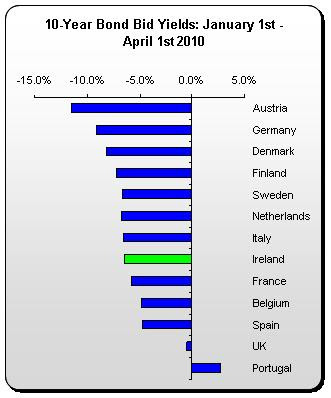
Now we’re getting a ‘We were doing the right thing, the markets knew we are doing the right thing but the Euro crisis was outside our control and we unfortunately got swept into the maelstrom.’
Under this narrative, Irish debt was improving up to April – proof that the markets were satisfied. The problem for this narrative is that all EU-15 countries debt was improving (save for Greece and Portugal); but Ireland was improving less than most other nations. And some of those countries whose debt didn’t improve as much in percentage terms as Ireland’s (e.g. Belgium and France) – well, their borrowing costs were much, much lower than ours to start with.
Still, the spin continues. Only this morning we have this gem from the Irish Independent:
‘ASIDE from bond yields that aren't as high as others in the eurozone, the rewards for Ireland's early frugality have been slow to come.’
What index could they possible be referring to? Excluding Greece (who’s not in the market), Irish 10-Year spreads are the worst in the EU-15. According to the Irish Times Saturday index Irish 10-spread came in at 2.53. Next in line is Portugal at 2.51. Every other country is well below.
False narrative, missed facts, bad prescriptions; at least some commentators are starting to express reservations. Peter Bacon said:
‘It is unclear if Europe can sustain fiscal consolidation in the medium term without a growth strategy running in parallel.’
Alan McQuaid said:
‘The 5% interest rate is going too high. My view is that the markets are not buying into the austerity strategy. Telling everybody to get to 3% in two or three years risks knocking the stuffing out of the economy.’
In addition, the Sunday Tribune reports:
‘Ben May, a European economist at Capital Economics in London, warned it would be tough for Ireland to meet the 3% target by 2014 because economic growth rates would unlikely rise back up to historical levels.’
And in the Sunday Business Post, David McWilliams posed the issue this way in arguing for an immediate close down of Anglo Irish:
‘The reason the markets will support closing down Anglo is that markets have no interest in an Ireland that turns itself into a debt-servicing machine to pay for the mistakes of yesterday . . The financial markets are investors who want growth, who want to invest in the real wealth of Ireland and the real wealth of this country . . No investor minds a government spending €20 billion on education and infrastructure because it means the balance sheet will have an asset opposite the debt. But on our national balance sheet opposite the €20 billion is Anglo, with its treasure chest of worthless land and sites. This simple accounting identity scares people.’
At least, in a few quarters, scepticism over deflationary policies is being raised.
We may not be reaching a consensus on a new macro-economic framework – one which emphasises investment, growth, employment, and tax-driven fiscal consolidation. But more and more are starting to ask the difficult questions.
That’s a start.
‘ . . . the government needs to re-state as forcefully as possible its commitment to fiscal consolidation, and to ignore the irresponsible cacophony of demands for additional spending. We will be lucky if we can borrow enough to keep the show on the road.’
Along the way, certain facts have to be ignored and unsubstantiated assertions repeated. For instance, the deflationary interventions last year produced benefit to Irish borrowing costs. It didn’t – as shown here. Borrowing costs increased after each ‘budget’ the Government introduced (February pension levy/spending cuts, April emergency budget, 2010 budget).
Then we got the ‘We’re not Spain, Italy or Portugal’. No, we were worse, despite some commentators’ determination not to read the indices. Of course, they had to say this because admitting things were going south would beg questions about the efficacy of deflationary policies.

Now we’re getting a ‘We were doing the right thing, the markets knew we are doing the right thing but the Euro crisis was outside our control and we unfortunately got swept into the maelstrom.’
Under this narrative, Irish debt was improving up to April – proof that the markets were satisfied. The problem for this narrative is that all EU-15 countries debt was improving (save for Greece and Portugal); but Ireland was improving less than most other nations. And some of those countries whose debt didn’t improve as much in percentage terms as Ireland’s (e.g. Belgium and France) – well, their borrowing costs were much, much lower than ours to start with.
Still, the spin continues. Only this morning we have this gem from the Irish Independent:
‘ASIDE from bond yields that aren't as high as others in the eurozone, the rewards for Ireland's early frugality have been slow to come.’
What index could they possible be referring to? Excluding Greece (who’s not in the market), Irish 10-Year spreads are the worst in the EU-15. According to the Irish Times Saturday index Irish 10-spread came in at 2.53. Next in line is Portugal at 2.51. Every other country is well below.
False narrative, missed facts, bad prescriptions; at least some commentators are starting to express reservations. Peter Bacon said:
‘It is unclear if Europe can sustain fiscal consolidation in the medium term without a growth strategy running in parallel.’
Alan McQuaid said:
‘The 5% interest rate is going too high. My view is that the markets are not buying into the austerity strategy. Telling everybody to get to 3% in two or three years risks knocking the stuffing out of the economy.’
In addition, the Sunday Tribune reports:
‘Ben May, a European economist at Capital Economics in London, warned it would be tough for Ireland to meet the 3% target by 2014 because economic growth rates would unlikely rise back up to historical levels.’
And in the Sunday Business Post, David McWilliams posed the issue this way in arguing for an immediate close down of Anglo Irish:
‘The reason the markets will support closing down Anglo is that markets have no interest in an Ireland that turns itself into a debt-servicing machine to pay for the mistakes of yesterday . . The financial markets are investors who want growth, who want to invest in the real wealth of Ireland and the real wealth of this country . . No investor minds a government spending €20 billion on education and infrastructure because it means the balance sheet will have an asset opposite the debt. But on our national balance sheet opposite the €20 billion is Anglo, with its treasure chest of worthless land and sites. This simple accounting identity scares people.’
At least, in a few quarters, scepticism over deflationary policies is being raised.
We may not be reaching a consensus on a new macro-economic framework – one which emphasises investment, growth, employment, and tax-driven fiscal consolidation. But more and more are starting to ask the difficult questions.
That’s a start.
Wednesday, 31 March 2010
The 'I'm really getting tired of this nonsense' guide to bond yield trends
Michael Taft: There are others who will discuss intelligently the fall-out from Ireland’s financial Black Hole Day (Sli Eile, Stephen Kinsella and Nat O’Connor on this blog for instance). One thing that struck me during the Finance Minister’s robust, if economically-challenged, interview on Prime Time was his contention that things were, like, totally cool. Why? Since he announced the massive give-away, bond yields hadn’t moved. Wow. He made his announcement at 4:30 pm and by 10:00 pm bond yields hadn’t moved. This proved that not only that the international markets were not ‘concerned’ with our financial black hole, they were positively chill (or they just go to bed early).
One could really get tired of this. There’s an eerie anthropomorphic quality to discussions on bond markets. Apparently, these markets can ‘feel’, ‘be happy’, ‘become angry’, ‘contemplate’, etc. and on and on. The trend of commentary usually goes like this: ‘the markets will be concerned if the Government doesn’t get tough on trade unionists, the poor, public spending and businesses in debt’. And when the Government does do tough guy stuff, the bond markets ‘approve’ and so, are at peace.
All this comes from the sound-bite school of deep, thoughtful analysis. Tracking bond yields can tell us many things – and it’s amazing that what it usually tells us is what we want it to tell us: vide the Finance Minister last night. So in that spirit I have constructed my own way of explaining bond yield trends. I have used the gross redemption yields for 10-year plus bonds on the last day of the month, sourced from ISEQ (one of many ways to track borrowing costs). This is what the ‘markets’ are telling me.
APRIL 2008: We are still innocent. The ESRI has yet to discover the recession and predict 3.1 percent growth for 2009. There is talk of property prices but we are assured it will be a soft, gentle landing. AIB is trading at €13.25. In another country baseball season is starting and little boys will be playing well into the bright summer evenings.
Bond Yield: 4.40
SEPTEMBER 2008: The boys of summer are still playing baseball but the financial dogs in the street are muttering something about Irish banks and insolvencies. The Sunday Independent declares that if anything goes wrong, whatever that might be, it will of course be the fault of trade unions. Bank Guarantee announced at the end of the month. Markets don’t have time to react before month’s end because they go to bed early.
Bond Yield: 4.60
OCTOBER 2008: Bankers say everything is fine and they don’t need equity; the markets get worried. AIB trades at €5.00 but no one is fired. Bringing forward the Budget doesn’t help either – especially this budget.
Bond Yield: 4.84
DECEMBER 2009: Markets get less jittery. All that hysterics about the state being exposed to hundred of billions of bank Euros fade away. ISME calls for the suppression of trade unions. Their competitors, the Small Firms Association, call ISME weak on the issue of trade unions.
Bond Yield: 4.47
JANUARY 2009: Everything goes haywire. Markets up in arms. Is it because Anglo-Irish is nationalised or because the Government, only a few days before, was going to pump billions in it because they believed it was still viable? The markets unsure whether the Government was colluding in a tissue of lies and deceit or are just plain idiots. Live Register experiences biggest jump in two decades.
Bond Yield: 5.54
FEBRUARY 2009: The Government goes macho. They kick the unions out of Government buildings in the early morning (and don’t even call them a cab). The Finance Minister announces a pension levy on public sector workers and cuts in the number of special need teachers. Pumped abs and testosterone everywhere. Commentators note that even the weather has improved. The markets, however . . .
Bond Yield: 5.57
MARCH 2009: The Tánaiste declares the Government has public finances under control. No one, not even the omnipotent markets, knows what to make of this.
Bond Yield: 5.45
APRIL 2009: Just to prove the Tánaiste was right, the Government introduces an emergency budget. The markets don’t understand – consumer spending is collapsing, businesses reliant on domestic sales are collapsing; and the Government takes even more money out of people’s pockets. There’s counter-intuitive and there’s counter-intuitive; and then there’s Fianna Fail.
Bond Yield: 5.28
JUNE 2009: The markets reconsider the Government’s emergency budget and their deflationary strategy of cutting €11 billion out of an already debilitated economy over the next four years.
Bond Yield: 5.84
AUGUST 2009: For months the three major credit rating agencies have been downgrading Irish Government debt and are threatening more. Commentators are horrified and claim we’ll never be able to borrow again ever, the Sunday Independent blames trades unions, employers demand the minimum wage be cut (though no one can figure out how this will get cheaper money). The markets, however, prove they have a sense of humour.
Bond Yield: 4.68
THE AUTUMN RUN-UP TO THE BUDGET - NOVEMBER 2009: Everyone is giddy. If the Government keeps their promise to implement a puppy-crunching, Bruce Lee, in-your-face, take-no-prisoners budget, the markets will smile and investors will actually pay us to borrow from them. The Taoiseach promises blood, sweat and bankruptcies, the Tánaiste claims that what ever makes us redundant only makes us stronger; the Minister for Health (sic) goes one better and threatens IMF tanks in every town square in the country if we don’t take the pain.
Bond Yield: 5.16
DECEMBER 2010: The Government introduces a puppy-crunching, Bruce Lee, in-your-face, take-no-prisoners budget.
Bond Yield: 5.18
[For a few weeks everyone’s attention is on Greece and those irrational Greek workers striking and marching in the streets because they don’t want to be the fall-guys and fall-gals for maintaining a strong Euro, Germany’s current account surplus and finance capital’s hopes for a return to Alpha status.]
MARCH 30th 4:30 – 10: 00 pm: The Minister declares markets are totally cool with him shovelling up to €20 billion in Anglo-Irish (proves what shrewd market players the Cabinet are), that the economy has turned the corner, unemployment is stabilising and we’ll return to growth this year. Recession? What recession? The only recession is in your mind, dude.
Bond Yield: Moved not one cent according to the Minister.
* * *
All that – all that courageous action the Government has taken that has so impressed the markets – and bond yields are worse than when we started on this dismal path. Of course, there will be those who will claim that if the Government didn’t take courageous action, borrowing costs would have been worse. If so, then why is it high bond yields got worse every time they did?
That’s one way of looking at all this. For another perspective have a read of Michael Burke’s take on borrowing costs and the Government’s deflationary policies. You might have your own perspective. If so, go on to the Irish Stock Exchange website and build your own story.
But, please, just don’t make the markets ‘nervous’.
One could really get tired of this. There’s an eerie anthropomorphic quality to discussions on bond markets. Apparently, these markets can ‘feel’, ‘be happy’, ‘become angry’, ‘contemplate’, etc. and on and on. The trend of commentary usually goes like this: ‘the markets will be concerned if the Government doesn’t get tough on trade unionists, the poor, public spending and businesses in debt’. And when the Government does do tough guy stuff, the bond markets ‘approve’ and so, are at peace.
All this comes from the sound-bite school of deep, thoughtful analysis. Tracking bond yields can tell us many things – and it’s amazing that what it usually tells us is what we want it to tell us: vide the Finance Minister last night. So in that spirit I have constructed my own way of explaining bond yield trends. I have used the gross redemption yields for 10-year plus bonds on the last day of the month, sourced from ISEQ (one of many ways to track borrowing costs). This is what the ‘markets’ are telling me.
APRIL 2008: We are still innocent. The ESRI has yet to discover the recession and predict 3.1 percent growth for 2009. There is talk of property prices but we are assured it will be a soft, gentle landing. AIB is trading at €13.25. In another country baseball season is starting and little boys will be playing well into the bright summer evenings.
Bond Yield: 4.40
SEPTEMBER 2008: The boys of summer are still playing baseball but the financial dogs in the street are muttering something about Irish banks and insolvencies. The Sunday Independent declares that if anything goes wrong, whatever that might be, it will of course be the fault of trade unions. Bank Guarantee announced at the end of the month. Markets don’t have time to react before month’s end because they go to bed early.
Bond Yield: 4.60
OCTOBER 2008: Bankers say everything is fine and they don’t need equity; the markets get worried. AIB trades at €5.00 but no one is fired. Bringing forward the Budget doesn’t help either – especially this budget.
Bond Yield: 4.84
DECEMBER 2009: Markets get less jittery. All that hysterics about the state being exposed to hundred of billions of bank Euros fade away. ISME calls for the suppression of trade unions. Their competitors, the Small Firms Association, call ISME weak on the issue of trade unions.
Bond Yield: 4.47
JANUARY 2009: Everything goes haywire. Markets up in arms. Is it because Anglo-Irish is nationalised or because the Government, only a few days before, was going to pump billions in it because they believed it was still viable? The markets unsure whether the Government was colluding in a tissue of lies and deceit or are just plain idiots. Live Register experiences biggest jump in two decades.
Bond Yield: 5.54
FEBRUARY 2009: The Government goes macho. They kick the unions out of Government buildings in the early morning (and don’t even call them a cab). The Finance Minister announces a pension levy on public sector workers and cuts in the number of special need teachers. Pumped abs and testosterone everywhere. Commentators note that even the weather has improved. The markets, however . . .
Bond Yield: 5.57
MARCH 2009: The Tánaiste declares the Government has public finances under control. No one, not even the omnipotent markets, knows what to make of this.
Bond Yield: 5.45
APRIL 2009: Just to prove the Tánaiste was right, the Government introduces an emergency budget. The markets don’t understand – consumer spending is collapsing, businesses reliant on domestic sales are collapsing; and the Government takes even more money out of people’s pockets. There’s counter-intuitive and there’s counter-intuitive; and then there’s Fianna Fail.
Bond Yield: 5.28
JUNE 2009: The markets reconsider the Government’s emergency budget and their deflationary strategy of cutting €11 billion out of an already debilitated economy over the next four years.
Bond Yield: 5.84
AUGUST 2009: For months the three major credit rating agencies have been downgrading Irish Government debt and are threatening more. Commentators are horrified and claim we’ll never be able to borrow again ever, the Sunday Independent blames trades unions, employers demand the minimum wage be cut (though no one can figure out how this will get cheaper money). The markets, however, prove they have a sense of humour.
Bond Yield: 4.68
THE AUTUMN RUN-UP TO THE BUDGET - NOVEMBER 2009: Everyone is giddy. If the Government keeps their promise to implement a puppy-crunching, Bruce Lee, in-your-face, take-no-prisoners budget, the markets will smile and investors will actually pay us to borrow from them. The Taoiseach promises blood, sweat and bankruptcies, the Tánaiste claims that what ever makes us redundant only makes us stronger; the Minister for Health (sic) goes one better and threatens IMF tanks in every town square in the country if we don’t take the pain.
Bond Yield: 5.16
DECEMBER 2010: The Government introduces a puppy-crunching, Bruce Lee, in-your-face, take-no-prisoners budget.
Bond Yield: 5.18
[For a few weeks everyone’s attention is on Greece and those irrational Greek workers striking and marching in the streets because they don’t want to be the fall-guys and fall-gals for maintaining a strong Euro, Germany’s current account surplus and finance capital’s hopes for a return to Alpha status.]
MARCH 30th 4:30 – 10: 00 pm: The Minister declares markets are totally cool with him shovelling up to €20 billion in Anglo-Irish (proves what shrewd market players the Cabinet are), that the economy has turned the corner, unemployment is stabilising and we’ll return to growth this year. Recession? What recession? The only recession is in your mind, dude.
Bond Yield: Moved not one cent according to the Minister.
* * *
All that – all that courageous action the Government has taken that has so impressed the markets – and bond yields are worse than when we started on this dismal path. Of course, there will be those who will claim that if the Government didn’t take courageous action, borrowing costs would have been worse. If so, then why is it high bond yields got worse every time they did?
That’s one way of looking at all this. For another perspective have a read of Michael Burke’s take on borrowing costs and the Government’s deflationary policies. You might have your own perspective. If so, go on to the Irish Stock Exchange website and build your own story.
But, please, just don’t make the markets ‘nervous’.
Thursday, 17 December 2009
The Dutch experience
Michael Burke: There is a very useful post here on the reflationary policies in The Netherlands. The Dutch join a long list of European countries engaged in reflation. The effects are clear; rebounding economic activity, stabilising/declining government deficits and much lower bond yields than Ireland.
Wednesday, 9 December 2009
Austerity and the financial markets
Michael Burke: Financial markets have a great many faults. But they can frequently provide a signal of their participants’ collective thinking with much greater clarity than their cheerleaders and their ideologues. This is especially the case currently, with regard to the risks of increased government spending. Most governments are currently engaged in a policy of reflation. Yet there are already parties seeking office, in Britain and elsewhere, who favour a policy of fiscal contraction.
In Ireland, the Party of Austerity is already in power. We are frequently told that bond market investors are demanding Ireland’s unique austerity experiment, and that otherwise they will refuse to purchase the government debt. Finance Minister Lenihan has said that that taking “decisive action” on the budget deficit was a priority for the Government and it would “signal to international investors that the Irish Government possesses the ability to take the necessary action”.
Let us ignore here the impositions of Maastricht of 3% borrowing and 60% debt in relation to GDP. Everyone else has in Europe has as they go about attempting to reflate their economies. Instead, for bond investors, it is easy to put a number to the fear and greed that drives financial markets. The latter, greed, is what they demand in the form of the yield on government debt at auction. The former, fear, concerns the risk to the principal sum in the form of default. And the two are related.
Yields on benchmark Irish government debt were 4.85% as of close of business on Friday December 4 (all yields from Financial Times, December 7, page 29). That’s considerably below the peak of 6.02% in January of this year. That must surely mean that the bond market is reassured by the austerity measures to date? Well, no. The first ‘decisive’ austerity measures from the FF/Green government were in October 2008, and yet yields soared in January of this year.
It can be useful, in judging the financial market impact of policy, to look at yield spreads. The riskier the asset, the higher the spread, and movement in the spread signals a change in the perception of that risk (the fear/greed factors again). The yield spread of Irish 10year debt over the European benchmark German debt is a very sizeable 1.62% (or 162 basis points, or bps in the jargon). That represents a very large, additional cost to the Irish taxpayer and compares to the next highest yield spread of Italy of 0.79%. Only Greece has a higher spread in Europe, of 1.71%.
But a key fact is that this yield spread has been widening against Irish taxpayers. Over the past 12 months German yields have risen by 0.19%, while Irish yields have risen by 0.62%.
Now, against a possible charge of unfairness, it should be admitted right away that, if financial markets are in a panic, the riskier asset will be harder hit than the safer one. In this case the riskier asset would be Irish debt and the safer one German debt. But we have already seen that the big sell-off occurred in January, and in fact most yields have been declining since.
It is possible to develop this point further, by using a more direct parallel with Ireland’s debt. A comparison with Belgium is a very useful one because:
a. Belgium is a middling Euro Area economy, with its yield spread close to the average of the Euro Area, below Italy, Spain, Portugal, and others, and above that of France, The Netherlands, Austria
b. Belgium has a much higher government debt than Ireland but a much lower current budget deficit, and, crucially,
c. For virtually the whole of 2008, the yield spread between Belgium and Ireland was, for the reasons in (b.) almost identical, usually within or 1 or 2 bps of each other.
However, that is no longer the case. Belgium’s yield spread over Germany is now 0.33%, or approximately one-fifth of Ireland’s. The Irish government’s Pre-Budget Outlook estimates an increase in net debt this year of €26bn. With Belgian, rather than Irish yields at that maturity, Irish taxpayers would save approximately €340mn next year, and every year for the lifetime of the debt.
But there is a striking feature of the divergence in Belgian and Irish benchmark yields. The thrust of fiscal policy for the two economies has been diametrically opposed; Belgium in common with the overwhelming majority of leading economies in the Euro Area and elsewhere has been attempting to reflate its economy with a combination of increases in government spending and temporary tax cuts, amounting to 3.6% of GDP. The judgement here is that the former are likely to be more productive. But Ireland has engaged in a unique contractionary experiment, amounting to 6.4% of GDP once the December 2009 Budget is included, in order, we are told, to reassure bond markets. Yet the verdict seems clear. Irish yields have risen compared to Belgian yields. As far as the bond markets are concerned, Ireland has become a relatively riskier bet because of its austerity policy, not despite it.
In case there should be any doubt, a closer examination of the Belgian/Irish yield spread confirms this analysis. As mentioned previously, for nearly the whole of 2008 the yields were almost identical. However, they began to part company in October 2008, precisely the time of the first Irish austerity budget, which was brought forward to “reassure financial markets“. From a yield spread of zero at the beginning of October 2008, it began to move against Irish taxpayers, to 0.25% at the end of that month, to 0.75% by the middle of December, to 1.30% currently.
Now, if you ask most bond investors and certainly most government bond analysts (as they are, daily, in all the media outlets) they will say the Irish government is doing the right thing, biting the bullet, upfront pain, and so on. All this proves is you don’t need to be well-versed in accurate economic theory to buy a bond, nor to be employed at a stockbrokers which sells them. But it helps if you can see what’s actually happening. There are honourable exceptions. According to Michael O’Sullivan, head of asset allocation at Credit Suisse Private Banking, “Arguably the Irish bond market is being saved at the expense of Irish society”.In reality, both are facing potential disaster as a consequence of the same disastrous policies.
Belgian reflation has led to falling forecasts for the deficit (because of stronger growth), while Irish fiscal contraction has led rising deficit forecasts (because of weaker growth). According to the European Commission, the difference between Ireland’s and Belgian’s budget deficits in 2008, when yields were the same, was 6% of GDP (Ireland 7.2%, Belgium 1.2%) and is now expected to be 9% in 2010, with Ireland’s rising and Belgium’s falling. At the same time Irish yields have been rising compared to Belgium’s.
The market verdict is clear. Reflation is the route back to government solvency; fiscal contraction increases costs and can lead to disaster.
In Ireland, the Party of Austerity is already in power. We are frequently told that bond market investors are demanding Ireland’s unique austerity experiment, and that otherwise they will refuse to purchase the government debt. Finance Minister Lenihan has said that that taking “decisive action” on the budget deficit was a priority for the Government and it would “signal to international investors that the Irish Government possesses the ability to take the necessary action”.
Let us ignore here the impositions of Maastricht of 3% borrowing and 60% debt in relation to GDP. Everyone else has in Europe has as they go about attempting to reflate their economies. Instead, for bond investors, it is easy to put a number to the fear and greed that drives financial markets. The latter, greed, is what they demand in the form of the yield on government debt at auction. The former, fear, concerns the risk to the principal sum in the form of default. And the two are related.
Yields on benchmark Irish government debt were 4.85% as of close of business on Friday December 4 (all yields from Financial Times, December 7, page 29). That’s considerably below the peak of 6.02% in January of this year. That must surely mean that the bond market is reassured by the austerity measures to date? Well, no. The first ‘decisive’ austerity measures from the FF/Green government were in October 2008, and yet yields soared in January of this year.
It can be useful, in judging the financial market impact of policy, to look at yield spreads. The riskier the asset, the higher the spread, and movement in the spread signals a change in the perception of that risk (the fear/greed factors again). The yield spread of Irish 10year debt over the European benchmark German debt is a very sizeable 1.62% (or 162 basis points, or bps in the jargon). That represents a very large, additional cost to the Irish taxpayer and compares to the next highest yield spread of Italy of 0.79%. Only Greece has a higher spread in Europe, of 1.71%.
But a key fact is that this yield spread has been widening against Irish taxpayers. Over the past 12 months German yields have risen by 0.19%, while Irish yields have risen by 0.62%.
Now, against a possible charge of unfairness, it should be admitted right away that, if financial markets are in a panic, the riskier asset will be harder hit than the safer one. In this case the riskier asset would be Irish debt and the safer one German debt. But we have already seen that the big sell-off occurred in January, and in fact most yields have been declining since.
It is possible to develop this point further, by using a more direct parallel with Ireland’s debt. A comparison with Belgium is a very useful one because:
a. Belgium is a middling Euro Area economy, with its yield spread close to the average of the Euro Area, below Italy, Spain, Portugal, and others, and above that of France, The Netherlands, Austria
b. Belgium has a much higher government debt than Ireland but a much lower current budget deficit, and, crucially,
c. For virtually the whole of 2008, the yield spread between Belgium and Ireland was, for the reasons in (b.) almost identical, usually within or 1 or 2 bps of each other.
However, that is no longer the case. Belgium’s yield spread over Germany is now 0.33%, or approximately one-fifth of Ireland’s. The Irish government’s Pre-Budget Outlook estimates an increase in net debt this year of €26bn. With Belgian, rather than Irish yields at that maturity, Irish taxpayers would save approximately €340mn next year, and every year for the lifetime of the debt.
But there is a striking feature of the divergence in Belgian and Irish benchmark yields. The thrust of fiscal policy for the two economies has been diametrically opposed; Belgium in common with the overwhelming majority of leading economies in the Euro Area and elsewhere has been attempting to reflate its economy with a combination of increases in government spending and temporary tax cuts, amounting to 3.6% of GDP. The judgement here is that the former are likely to be more productive. But Ireland has engaged in a unique contractionary experiment, amounting to 6.4% of GDP once the December 2009 Budget is included, in order, we are told, to reassure bond markets. Yet the verdict seems clear. Irish yields have risen compared to Belgian yields. As far as the bond markets are concerned, Ireland has become a relatively riskier bet because of its austerity policy, not despite it.
In case there should be any doubt, a closer examination of the Belgian/Irish yield spread confirms this analysis. As mentioned previously, for nearly the whole of 2008 the yields were almost identical. However, they began to part company in October 2008, precisely the time of the first Irish austerity budget, which was brought forward to “reassure financial markets“. From a yield spread of zero at the beginning of October 2008, it began to move against Irish taxpayers, to 0.25% at the end of that month, to 0.75% by the middle of December, to 1.30% currently.
Now, if you ask most bond investors and certainly most government bond analysts (as they are, daily, in all the media outlets) they will say the Irish government is doing the right thing, biting the bullet, upfront pain, and so on. All this proves is you don’t need to be well-versed in accurate economic theory to buy a bond, nor to be employed at a stockbrokers which sells them. But it helps if you can see what’s actually happening. There are honourable exceptions. According to Michael O’Sullivan, head of asset allocation at Credit Suisse Private Banking, “Arguably the Irish bond market is being saved at the expense of Irish society”.In reality, both are facing potential disaster as a consequence of the same disastrous policies.
Belgian reflation has led to falling forecasts for the deficit (because of stronger growth), while Irish fiscal contraction has led rising deficit forecasts (because of weaker growth). According to the European Commission, the difference between Ireland’s and Belgian’s budget deficits in 2008, when yields were the same, was 6% of GDP (Ireland 7.2%, Belgium 1.2%) and is now expected to be 9% in 2010, with Ireland’s rising and Belgium’s falling. At the same time Irish yields have been rising compared to Belgium’s.
The market verdict is clear. Reflation is the route back to government solvency; fiscal contraction increases costs and can lead to disaster.
Thursday, 3 December 2009
Current government policy is misguided
Jim Stewart: The current stated policy of the Government is to reduce the fiscal deficit as a percentage of GDP to 3% or under by 2014 (formerly 2013). This target is unlikely to be achieved and the attempt to do so will delay recovery..
According to the recent OECD report on Ireland, almost every other country in the OECD has pursued a policy of a fiscal stimulus to varying degrees (OECD, p. 52 and fig.2.3). Even countries which are likely to have a higher deficit as a percentage of GDP than Ireland such as the UK are pursuing a fiscal stimulus policy. A member of the MPC in the UK is quoted in the Financial Times (17/11/09) as stating “it would be a mistake for government to rush too quickly to unwind fiscal deficits.” While recognising the deficit should be reduced, this is seen as “a long term project” that is over five years or more. Those countries that have pursued a fiscal stimulus policy such as the UK and Germany, have recorded recent increases in output.
All the larger countries in the Eurozone will have a budget deficit in 2009 greater than 3%. The forecast average for the Eurozone for 2010 is 6.9% (http/www.euractiv.com/en/euro/). It is likely that all will have a debt/GDP ratio greater than 60% in 2010 (Finland may be an exception). The forecast average debt/GDP for all eurozone countries for 2010 is 88.2%. The forecast debt/GDP ratio for Ireland is 78% (excluding cash balances held by the NTMA and the NPRF it is 51%)[*see note below]. It is likely that several countries in the Eurozone will have a fiscal deficit greater than 3% in 2014.
What is our Borrowing Requirement?
The Pre-Budget Outlook (See Department of Finance, November 2009, Table 6) estimates the Exchequer Balance to be €25.75 billion for 2009, but €3 billion of this relates to a payment to the NPRF in order to provide the banks with extra capital. This expenditure represents a financial transfer to a state agency (NPRF) which used the funds for a financial investment. This investment is most likely to result in a net gain (but the gain accrues to the NPRF rather than the Exchequer, and should be excluded from any analysis of the underlying or structural balance). A further €9 billion relates to capital expenditure. Assuming this capital expenditure has positive net present values it should again be excluded from the underlying or structural imbalance.

The NTMA has a policy of over funding. Free cash balances in December 2007 were €4.7 billion, €20 billion in December 2008, were almost €30 billion in October (NTMA Press Release 6/10/09) and Are likely to be higher now. There is very little economic analysis of this strategy. A policy of over-borrowing adds to the interest bill. Assuming a gross cost of 4.5%, and a 1% rate of interest earned on depositing funds with the ECB results in a net cost of 3.5%. On cash balances of €30 billion this would amount to annual cost of approx. €1 billion thus increasing the current budget deficit. It may also result in a slightly higher interest rate because of increased supply. It does however indicate no issue with raising debt. This is consistently demonstrated in bids for Irish government at a multiple of amounts on offer. The interest rate on Irish Government 10 year bonds has since the start of the banking crisis in November 2008, remained around 1% above the average Eurozone bond yield, but the differential has fallen compared with Germany (see diagram), and is lower than Greece since 13th November. Recent rises in Irish Government debt yields following the Dubai crisis, are unlikely to be lasting. Sovereign debt in the Eurozone area is unlikely to be the next subprime crisis, and will not result in the breakup of the Eurozone. Those who consider this to be the case (See Financial Times articles by Wolfgang Munchau 30/11/2009 and Gillian Tett 23/11/2009), underestimate the political and economic investment in creating the Eurozone, especially by Germany.
Expenditure Cuts Alone Will not Solve the Problem
Expenditure cuts alone cannot be the sole basis for a rational economic strategy. This is so in particular because a little more than half the projected deficit is accounted for by current spending and the rest by capital expenditure and contributions to the NPRF which in turn funded the banks. Cutting capital expenditure without assessing its role in the future economic success is neither sensible nor prudent.
There is however scope for reducing current expenditure. The Report largely produced by the Department of Finance (misleadingly called the McCarthy Report as many of the chapters are very similar to responses by the Department of Finance to proposals from individual departments, see:- Department of Finance - Evaluation Papers from Department of Finance) does have several sensible suggestions, for example, reducing the number of reports that are translated into Irish, ceasing payments into the National Pension Reserve Fund, amalgamating the Pensions Regulator with the Financial Regulator, reducing added years in public sector pension entitlements).
The case for solving the economic crisis by expenditure cuts alone has not been made. Other policies are needed.
My next post will suggest some policy options.
*Note: This excludes liabilities of semi-state companies such as Anglo-Irish Bank and loans issued to NAMA but the same conventions apply in measuring debt/GDP ratios in other Eurozone countries.
According to the recent OECD report on Ireland, almost every other country in the OECD has pursued a policy of a fiscal stimulus to varying degrees (OECD, p. 52 and fig.2.3). Even countries which are likely to have a higher deficit as a percentage of GDP than Ireland such as the UK are pursuing a fiscal stimulus policy. A member of the MPC in the UK is quoted in the Financial Times (17/11/09) as stating “it would be a mistake for government to rush too quickly to unwind fiscal deficits.” While recognising the deficit should be reduced, this is seen as “a long term project” that is over five years or more. Those countries that have pursued a fiscal stimulus policy such as the UK and Germany, have recorded recent increases in output.
All the larger countries in the Eurozone will have a budget deficit in 2009 greater than 3%. The forecast average for the Eurozone for 2010 is 6.9% (http/www.euractiv.com/en/euro/). It is likely that all will have a debt/GDP ratio greater than 60% in 2010 (Finland may be an exception). The forecast average debt/GDP for all eurozone countries for 2010 is 88.2%. The forecast debt/GDP ratio for Ireland is 78% (excluding cash balances held by the NTMA and the NPRF it is 51%)[*see note below]. It is likely that several countries in the Eurozone will have a fiscal deficit greater than 3% in 2014.
What is our Borrowing Requirement?
The Pre-Budget Outlook (See Department of Finance, November 2009, Table 6) estimates the Exchequer Balance to be €25.75 billion for 2009, but €3 billion of this relates to a payment to the NPRF in order to provide the banks with extra capital. This expenditure represents a financial transfer to a state agency (NPRF) which used the funds for a financial investment. This investment is most likely to result in a net gain (but the gain accrues to the NPRF rather than the Exchequer, and should be excluded from any analysis of the underlying or structural balance). A further €9 billion relates to capital expenditure. Assuming this capital expenditure has positive net present values it should again be excluded from the underlying or structural imbalance.

The NTMA has a policy of over funding. Free cash balances in December 2007 were €4.7 billion, €20 billion in December 2008, were almost €30 billion in October (NTMA Press Release 6/10/09) and Are likely to be higher now. There is very little economic analysis of this strategy. A policy of over-borrowing adds to the interest bill. Assuming a gross cost of 4.5%, and a 1% rate of interest earned on depositing funds with the ECB results in a net cost of 3.5%. On cash balances of €30 billion this would amount to annual cost of approx. €1 billion thus increasing the current budget deficit. It may also result in a slightly higher interest rate because of increased supply. It does however indicate no issue with raising debt. This is consistently demonstrated in bids for Irish government at a multiple of amounts on offer. The interest rate on Irish Government 10 year bonds has since the start of the banking crisis in November 2008, remained around 1% above the average Eurozone bond yield, but the differential has fallen compared with Germany (see diagram), and is lower than Greece since 13th November. Recent rises in Irish Government debt yields following the Dubai crisis, are unlikely to be lasting. Sovereign debt in the Eurozone area is unlikely to be the next subprime crisis, and will not result in the breakup of the Eurozone. Those who consider this to be the case (See Financial Times articles by Wolfgang Munchau 30/11/2009 and Gillian Tett 23/11/2009), underestimate the political and economic investment in creating the Eurozone, especially by Germany.
Expenditure Cuts Alone Will not Solve the Problem
Expenditure cuts alone cannot be the sole basis for a rational economic strategy. This is so in particular because a little more than half the projected deficit is accounted for by current spending and the rest by capital expenditure and contributions to the NPRF which in turn funded the banks. Cutting capital expenditure without assessing its role in the future economic success is neither sensible nor prudent.
There is however scope for reducing current expenditure. The Report largely produced by the Department of Finance (misleadingly called the McCarthy Report as many of the chapters are very similar to responses by the Department of Finance to proposals from individual departments, see:- Department of Finance - Evaluation Papers from Department of Finance) does have several sensible suggestions, for example, reducing the number of reports that are translated into Irish, ceasing payments into the National Pension Reserve Fund, amalgamating the Pensions Regulator with the Financial Regulator, reducing added years in public sector pension entitlements).
The case for solving the economic crisis by expenditure cuts alone has not been made. Other policies are needed.
My next post will suggest some policy options.
*Note: This excludes liabilities of semi-state companies such as Anglo-Irish Bank and loans issued to NAMA but the same conventions apply in measuring debt/GDP ratios in other Eurozone countries.
Sunday, 29 November 2009
Ireland and Dubai
Paul Sweeney: The Irish economy could collapse? Is this possible? The editorial in Saturday’s Financial Times (28th November 2009), on Dubai, implied that it was possible.
It said: "Markets will not soon return to the panic of September 2008: the financial sector now has state backstops. But because of these guarantees, fearful investors have started to worry about how safe sovereign debt is. Investors are growing nervous about Greece and Ireland in particular."
Last week, interest rates on Greek and Irish government bonds rose, whereas they fell for many other states.
The fall of Dubai is another blow to the neo-liberal economic paradigm. Dubai was hailed as the golden boy of free market capitalism ... which it was not. The myth of free markets, low taxes and no regulation was underwritten at every turn by the Dubai state itself.
Only a few weeks ago, Dubai was selling itself as a threat to the 'over-regulated and over-taxed' City of London. Not alone had Dubai weathered the global financial hurricane, but it was the place for mobile firms to go to avoid regulation and taxes, according to the Dubai International Financial Centre, in a gig two weeks ago in London.
The link between Ireland and Dubai is that Dubai's collapse has focused attention on Ireland (and Greece) as potential defaulters on sovereign debt.
This is not likely. Yes, the government’s guarantees to the banks were risky, NAMA is risky; but we are in the EU; in the Euro; sit on the ECB board; we already have €31bn in state borrowing ready for next year, and don’t really need to go to the markets for more borrowings. Most of the economy is still sound (aside from banking and construction, and both are being sorted - sort of). But markets are fickle. They are too often run by lemmings who all follow each other (over the cliff, occasionally), and the current scare on Ireland is misplaced.
Dubai is an autocratic desert state which only gets 2% of its revenue from oil and gas. The rest is construction, retailing and wholesaling – hardly leading economic sectors.
Dubai was also hoping to attract investment in its banks. It was planning to be a safe haven for rich people running from volatile areas. By implication, it was after illicit money from drugs, tax evasion and crime. Now that Switzerland is finally being hammered on its bank secrecy laws by the OECD, the US and the EU, new havens like Dubai were not welcomed by those of us who pay our taxes and want to continue the move from casino capitalism.
It is run by an autocrat, Sheik Mohammed al Maktoum, who has a few horses here. It is run with little transparency.
The indoor desert ski resorts, palm-shaped reclaimed islands - not to mention the 'World of Islands' - should, like Sean Dunne’s Ballsbridge ego-mania, have warned off any potential investors with sense. It had tried to diversify into tourism, property, tax free zones, trade, transport and banking, but was wildly over-optimistic.
Dubai has debts of $80bn - a huge amount for a small country. It is now (after a delay) being helped out by Abu Dubai, within the United Arab Emirates, because it is thought the autocratic ruler Maktoum did not want to admit the model of free-wheeling desert capitalism had failed.
Dubai’s collapse wiped a significant 2.3 per cent of the FT100 and 3.8 per cent off the Nikkei, and yields on bonds also fell significantly.
Ireland has a sea of troubles but, if we can pull together and deal with them equitably, we won't fall as far as Dubai. The extension of the Recovery Period beyond 2013, advocated by the Congress of Trade Unions, opposed by all classical economists (we [we?] must have lots of harsh pain, quickly, for redemption!) and quietly conceded by Government, is a very hopeful sign. A less deflationary Budget will also help us recover faster.
It said: "Markets will not soon return to the panic of September 2008: the financial sector now has state backstops. But because of these guarantees, fearful investors have started to worry about how safe sovereign debt is. Investors are growing nervous about Greece and Ireland in particular."
Last week, interest rates on Greek and Irish government bonds rose, whereas they fell for many other states.
The fall of Dubai is another blow to the neo-liberal economic paradigm. Dubai was hailed as the golden boy of free market capitalism ... which it was not. The myth of free markets, low taxes and no regulation was underwritten at every turn by the Dubai state itself.
Only a few weeks ago, Dubai was selling itself as a threat to the 'over-regulated and over-taxed' City of London. Not alone had Dubai weathered the global financial hurricane, but it was the place for mobile firms to go to avoid regulation and taxes, according to the Dubai International Financial Centre, in a gig two weeks ago in London.
The link between Ireland and Dubai is that Dubai's collapse has focused attention on Ireland (and Greece) as potential defaulters on sovereign debt.
This is not likely. Yes, the government’s guarantees to the banks were risky, NAMA is risky; but we are in the EU; in the Euro; sit on the ECB board; we already have €31bn in state borrowing ready for next year, and don’t really need to go to the markets for more borrowings. Most of the economy is still sound (aside from banking and construction, and both are being sorted - sort of). But markets are fickle. They are too often run by lemmings who all follow each other (over the cliff, occasionally), and the current scare on Ireland is misplaced.
Dubai is an autocratic desert state which only gets 2% of its revenue from oil and gas. The rest is construction, retailing and wholesaling – hardly leading economic sectors.
Dubai was also hoping to attract investment in its banks. It was planning to be a safe haven for rich people running from volatile areas. By implication, it was after illicit money from drugs, tax evasion and crime. Now that Switzerland is finally being hammered on its bank secrecy laws by the OECD, the US and the EU, new havens like Dubai were not welcomed by those of us who pay our taxes and want to continue the move from casino capitalism.
It is run by an autocrat, Sheik Mohammed al Maktoum, who has a few horses here. It is run with little transparency.
The indoor desert ski resorts, palm-shaped reclaimed islands - not to mention the 'World of Islands' - should, like Sean Dunne’s Ballsbridge ego-mania, have warned off any potential investors with sense. It had tried to diversify into tourism, property, tax free zones, trade, transport and banking, but was wildly over-optimistic.
Dubai has debts of $80bn - a huge amount for a small country. It is now (after a delay) being helped out by Abu Dubai, within the United Arab Emirates, because it is thought the autocratic ruler Maktoum did not want to admit the model of free-wheeling desert capitalism had failed.
Dubai’s collapse wiped a significant 2.3 per cent of the FT100 and 3.8 per cent off the Nikkei, and yields on bonds also fell significantly.
Ireland has a sea of troubles but, if we can pull together and deal with them equitably, we won't fall as far as Dubai. The extension of the Recovery Period beyond 2013, advocated by the Congress of Trade Unions, opposed by all classical economists (we [we?] must have lots of harsh pain, quickly, for redemption!) and quietly conceded by Government, is a very hopeful sign. A less deflationary Budget will also help us recover faster.
Wednesday, 16 September 2009
Creditworthiness: Ireland v Peru
Brian Lucey is quoted in the Irish Times as saying “Right now we’re seen as being less creditworthy than Peru.”
“Peru, of course, has natural gas, oil and literally mountains of gold. But they can give it to Peru or they can give it to Ireland.”
This is not correct.
The Financial Times (15/9/09) quotes the yield on Irish Government debt at 3.35% for bonds redeemed in January 2014 and quotes the yield on Peruvian Government debt for bonds redeemed one year later (February 2015) as 4.40%. Yields rise as the maturity of the bond extends, hence an equivalent maturity bond from Peru will yield slightly less than 4.4%. but more than on Irish Government debt.
Earlier this year Moody’s reduced Irelands credit rating to AA1 and Standard and Poors reduced Irelands credit rating from AAA to AA+. The Peruvian bond quoted in the above example is assigned a rating by Moody’s of Ba1 and by Standard and Poors BBB-
On these two standard measures of creditworthiness (yield on government bonds and credit rating) Peru is less creditworthy than Ireland.
“Peru, of course, has natural gas, oil and literally mountains of gold. But they can give it to Peru or they can give it to Ireland.”
This is not correct.
The Financial Times (15/9/09) quotes the yield on Irish Government debt at 3.35% for bonds redeemed in January 2014 and quotes the yield on Peruvian Government debt for bonds redeemed one year later (February 2015) as 4.40%. Yields rise as the maturity of the bond extends, hence an equivalent maturity bond from Peru will yield slightly less than 4.4%. but more than on Irish Government debt.
Earlier this year Moody’s reduced Irelands credit rating to AA1 and Standard and Poors reduced Irelands credit rating from AAA to AA+. The Peruvian bond quoted in the above example is assigned a rating by Moody’s of Ba1 and by Standard and Poors BBB-
On these two standard measures of creditworthiness (yield on government bonds and credit rating) Peru is less creditworthy than Ireland.
Subscribe to:
Posts (Atom)