Tom McDonnell: There seems to be a growing consensus (finally) that only the ECB has the capacity to end the immediate crisis in the Euro zone. The French are now pushing ECB intervention as indeed are the Spanish, Italian and Belgians. Our leaders will get maybe one more roll of the dice to save the Euro. Unfortunately the Merkel doctrine of "no lender of last resort", "no fiscal transfers", and no "countercyclical fiscal mechanism" may yet prevent a happy ending to this story. No number of agreed Treaty changes about interference in national budgets and imposing discipline is going to change that fact.
To prevent meltdown of the currency some form of Treaty change is required to alter the mandate of the ECB. Treaty change to make the ECB a lender of last resort and the introduction of Eurobonds should be expedited. If tighter fiscal oversight is the price then it is worth paying.
Treaty proposals and changes seem inevitable and in that context it is the responsibility of the Irish Government to fully engage with this process to ensure that the proposed new rules and decision making architecture are fit for purpose and consistent with long-term recovery. There is a danger that the events of the last eighteen months have permanently changed the decision making process in Europe in a way that excludes small countries. This is a disturbing development that needs to be reversed.

Thursday, 24 November 2011


Monday, 21 November 2011
Let's Have More Budget Transparency
Nat O'Connor: Seán Whelan on RTÉ Six One News last Friday quipped that democratically elected representatives were the first to see Michael Noonan's budget proposals... except that they were not our elected representatives, but those of the German people.
It is unfortunate that the Dáil did not receive the draft papers before the Bundestag, but a more important lesson from the episode is that there is every reason to increase the transparency of budget documentation and proposals from now on.
Irish democracy did not collapse because draft proposals on VAT increases and other measures were circulated before the Government met to consider them. Instead, the democratic process was strengthened by their release.
Strong democracy is when everyone has the right to participate in the decisions affecting themselves and, crucially, the resources they need to do so. Information is just one of the essential resources people need to understand and meaningfully participate; through discussion, lobbying, etc.
Consider the traditional budget process, by way of contrast:
1. All proposals are initially developed in secret by the Department of Finance. (Drafts may or may not be circulated, but certainly not to Opposition spokespersons or the public).
2. Government Ministers are briefed by the Minister for Finance in a meeting of the Government, and may even be asked to agree proposals at the same meeting - without access to alternative expert opinion, advice, etc. Even if they do not agree them in the same meeting, they have only days to seek advice and cannot avail of a richer public discussion with analysis from all perspectives.
3. Some, all or none of the budget proposals may be discussed by Government Ministers with their colleagues on the backbenches of the Dáil. Advice from chosen experts may or may not be sought, at the discretion of each Minister.
4. The final Budget is kept secret until read out by the Minister for Finance on Budget Day. In fairness, the IMF/EU obligation to publish a four-year plan has created more openness.
5. Opposition spokespersons and economic commentators prepare most of their responses in the absence of information about the Budget proposals, often based on rumours or leaks. They are only given minutes to prepare a response to the actual proposals, and must make off-the-cuff responses without research or advice. This makes for shallow analysis that tends to highlight more immediate proposals, or more populist concerns, while neglecting deeper effects on the economy and society.
6. The Dáil votes on the Budget without most of the TDs having read the documents. Strictly speaking, TDs vote on a series of 'financial resolutions' based on the Budget speech. There will be (limited) time for discussion later when the annual Finance Bill, Social Welfare Bill, etc are introduced to make most the resolutions into law. However, votes on resolutions are sufficient for measures that come into effect at midnight. And legislation is sometimes rushed through the Dáil; like last year's Social Welfare Bill the very next day.
Traditional Budget secrecy is seriously flawed and undemocratic. It is also a hugely inefficient and impractical way to run the Government in an advanced economy!
For example, the proposal to raise VAT by 2 percentage points has a range of complex effects on the economy. It requires TDs to know what goods and services attract the standard rate of VAT, as well as to know that VAT dampens employment in the economy less than income tax but more than wealth taxes. The regressive nature of VAT also needs to be explained - that is, that people on lower incomes pay proportionately more of their incomes. It takes time to put together analysis and briefings for those making the decisions, let along for those whose lives will be affected by them.
This year by accident (and again because of the IMF/EU loan) we have a new and improved process:
1. Draft proposals from the Department of Finance are aired in public.
2. Economic analysts (including think-tanks), sectoral lobbyists and the general public are given time to reflect on these proposals and respond to them. An informed public debate is possible.
3. The members of the Government and TDs on both sides of the Dáil can learn from the public discussion and expert analysis. The Government has the option of fine-tuning or even changing proposals.
4. The Budget Day proposals are likely to be less of a surprise and Opposition spokespersons will have had access to information and advice to prepare more detailed and considered responses.
5. TDs have had the benefit of public discussion and contact from their constituents before voting on the Budget.
Does anyone have a problem with making this more open approach permanent?
There are a couple of issues raised by more openness, but in balance I don't think they outweigh the benefits.
The Government is not weakened in its ability to choose to accept or modify proposals. Getting more feedback from lobbies, experts and constituents can only be a good thing. The Government is not exhibiting weakness by changing proposals in the face of evidence, although they would have to justify decisions that appear to simply cave in to politically powerful lobby groups.
(In practice, capitulation to lobbyists tends to happen between Budget Day and the final Finance Act three months later, which often contains quite different proposals - especially on the minutae of tax law - than were in the Budget. However, media and public scrutiny of the Finance Act is very limited).
One tricky issue relates to the 'midnight' proposals: changes that will apply with near immediate effect. For example, excise might change at midnight to prevent people stocking up on alcohol beforehand.
Whether people should get more than a couple of hours warning on such changes is an open question. It may be more effective for raising revenue, but it is arguably more democratic if people know what's being proposed and have a chance to react to it (even if that reaction is a trip to the off-licence). After all, the Government can never fully predict the 'behavioural' effects of Budget changes. And the short-term loss of excise revenue may be off-set by longer-term public understanding and acceptance of how we pay for the services provided by our state.
And if there really are some new taxes that require secrecy before being announced 'with immediate effect', good quality analysis on the day can be preserved through 'lock ins'. They do this in Canada. Several hours before the budget announcements, a selection of Opposition spokespersons and their advisors are locked into a room without mobile phones but with a copy of the budget documents. In another room, a selection of journalists and economic analysts are likewise locked in with the budget. The result is that Opposition responses and expert analysis can be based on the detail of what's being proposed.
Voting on how public money is spent is one of the main purposes of parliament and the Constitution of Ireland makes it very clear that the Government can only spend money in line with budgets agreed by the Dáil.
There is every reason why the vital scrutiny of public money should be as open as possible.
It is unfortunate that the Dáil did not receive the draft papers before the Bundestag, but a more important lesson from the episode is that there is every reason to increase the transparency of budget documentation and proposals from now on.
Irish democracy did not collapse because draft proposals on VAT increases and other measures were circulated before the Government met to consider them. Instead, the democratic process was strengthened by their release.
Strong democracy is when everyone has the right to participate in the decisions affecting themselves and, crucially, the resources they need to do so. Information is just one of the essential resources people need to understand and meaningfully participate; through discussion, lobbying, etc.
Consider the traditional budget process, by way of contrast:
1. All proposals are initially developed in secret by the Department of Finance. (Drafts may or may not be circulated, but certainly not to Opposition spokespersons or the public).
2. Government Ministers are briefed by the Minister for Finance in a meeting of the Government, and may even be asked to agree proposals at the same meeting - without access to alternative expert opinion, advice, etc. Even if they do not agree them in the same meeting, they have only days to seek advice and cannot avail of a richer public discussion with analysis from all perspectives.
3. Some, all or none of the budget proposals may be discussed by Government Ministers with their colleagues on the backbenches of the Dáil. Advice from chosen experts may or may not be sought, at the discretion of each Minister.
4. The final Budget is kept secret until read out by the Minister for Finance on Budget Day. In fairness, the IMF/EU obligation to publish a four-year plan has created more openness.
5. Opposition spokespersons and economic commentators prepare most of their responses in the absence of information about the Budget proposals, often based on rumours or leaks. They are only given minutes to prepare a response to the actual proposals, and must make off-the-cuff responses without research or advice. This makes for shallow analysis that tends to highlight more immediate proposals, or more populist concerns, while neglecting deeper effects on the economy and society.
6. The Dáil votes on the Budget without most of the TDs having read the documents. Strictly speaking, TDs vote on a series of 'financial resolutions' based on the Budget speech. There will be (limited) time for discussion later when the annual Finance Bill, Social Welfare Bill, etc are introduced to make most the resolutions into law. However, votes on resolutions are sufficient for measures that come into effect at midnight. And legislation is sometimes rushed through the Dáil; like last year's Social Welfare Bill the very next day.
Traditional Budget secrecy is seriously flawed and undemocratic. It is also a hugely inefficient and impractical way to run the Government in an advanced economy!
For example, the proposal to raise VAT by 2 percentage points has a range of complex effects on the economy. It requires TDs to know what goods and services attract the standard rate of VAT, as well as to know that VAT dampens employment in the economy less than income tax but more than wealth taxes. The regressive nature of VAT also needs to be explained - that is, that people on lower incomes pay proportionately more of their incomes. It takes time to put together analysis and briefings for those making the decisions, let along for those whose lives will be affected by them.
This year by accident (and again because of the IMF/EU loan) we have a new and improved process:
1. Draft proposals from the Department of Finance are aired in public.
2. Economic analysts (including think-tanks), sectoral lobbyists and the general public are given time to reflect on these proposals and respond to them. An informed public debate is possible.
3. The members of the Government and TDs on both sides of the Dáil can learn from the public discussion and expert analysis. The Government has the option of fine-tuning or even changing proposals.
4. The Budget Day proposals are likely to be less of a surprise and Opposition spokespersons will have had access to information and advice to prepare more detailed and considered responses.
5. TDs have had the benefit of public discussion and contact from their constituents before voting on the Budget.
Does anyone have a problem with making this more open approach permanent?
There are a couple of issues raised by more openness, but in balance I don't think they outweigh the benefits.
The Government is not weakened in its ability to choose to accept or modify proposals. Getting more feedback from lobbies, experts and constituents can only be a good thing. The Government is not exhibiting weakness by changing proposals in the face of evidence, although they would have to justify decisions that appear to simply cave in to politically powerful lobby groups.
(In practice, capitulation to lobbyists tends to happen between Budget Day and the final Finance Act three months later, which often contains quite different proposals - especially on the minutae of tax law - than were in the Budget. However, media and public scrutiny of the Finance Act is very limited).
One tricky issue relates to the 'midnight' proposals: changes that will apply with near immediate effect. For example, excise might change at midnight to prevent people stocking up on alcohol beforehand.
Whether people should get more than a couple of hours warning on such changes is an open question. It may be more effective for raising revenue, but it is arguably more democratic if people know what's being proposed and have a chance to react to it (even if that reaction is a trip to the off-licence). After all, the Government can never fully predict the 'behavioural' effects of Budget changes. And the short-term loss of excise revenue may be off-set by longer-term public understanding and acceptance of how we pay for the services provided by our state.
And if there really are some new taxes that require secrecy before being announced 'with immediate effect', good quality analysis on the day can be preserved through 'lock ins'. They do this in Canada. Several hours before the budget announcements, a selection of Opposition spokespersons and their advisors are locked into a room without mobile phones but with a copy of the budget documents. In another room, a selection of journalists and economic analysts are likewise locked in with the budget. The result is that Opposition responses and expert analysis can be based on the detail of what's being proposed.
Voting on how public money is spent is one of the main purposes of parliament and the Constitution of Ireland makes it very clear that the Government can only spend money in line with budgets agreed by the Dáil.
There is every reason why the vital scrutiny of public money should be as open as possible.
Bad plan, false arguments
Michael Taft: The Minister for Finance’s comments justifying VAT increases are deeply worrying, for they evince either considerable unfamiliarity with basic economic facts; or considerable indifference to such facts in pursuit of a particular agenda. Here’s what he had to say on RTE (22 minutes in):
‘It (the VAT increase) will apply to everybody who purchases things but obviously rich people have a lot more disposable income than poor people and rich people will buy a lot more and will pay a lot more VAT. There’s no VAT of any sort on food and poor people spend a very large proportion of their budget on food so it will not impact as much on the poor as on the well-off people.’
This is wrong. Full stop. It is well known that consumption taxes impact on lower income groups more as they consume most of their income. Indeed, the Minister (or his advisors) would be well aware of a recent study published in the Economic and Social Review in the summer, ‘The Distributional Effects of Value Added Tax in Ireland’ by ESRI researchers Eimear Leahy, Sean Lyons and Richard Tol. They studied the impact of VAT and VAT rises on income deciles – from the lowest 10 percent income to the top (this is a tabular estimate of Figure 10 in the report).
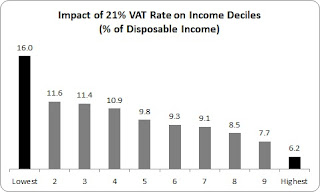
Unsurprisingly, the 21 percent VAT rate has a higher impact on the disposable income of the lowest income groups (16 percent), compared to the highest income groups (6.2 percent). Again, unsurprisingly, average income groups also face a higher burden than high income groups.
This is consistent with the findings from the study by the Combat Poverty Agency/ESRI, which showed that ten years ago total VAT and excise taxes made up more than 20 percent of the gross income of the lowest decile, compared to less than 10 percent of the highest income groups.
So the 21 percent VAT rate hits the lowest income households by more than two-and-a-half times the highest income groups. So much for the Minister’s claim.
But the ESRI researchers also measured the impact of increasing the VAT rate to 23 percent – as the Minister is proposing (again, a tabular estimate of Figure 10 in the report).

Increasing VAT will impact harder on lower income groups – by 1 percent compared to less than 0.4 percent for higher income groups. Again, so much for the Minister’s groundless claim that increasing VAT ‘will not impact as much on the poor as on the well-off people.’
Budget 2011 was bad enough. The low-paid were disproportionately hit through the introduction of the Universal Charge and the reduction of personal tax credits (which amounted to a flat-rate increase in income tax).
But the Minister’s planned VAT rate is even worse for it will not just hit people at work. It will hit everyone, including those on social protection payments (pensioners, widows/ers, unemployed, lone parents, etc.). And the lowest decile group is made up of people living in some of the worst forms of absolute deprivation.
All this has to be set in the wider context. This year, social protection recipients of working age (that is, excluding pensioners) saw their real payments – after inflation – fall by -5.2 percent. Whatever about the leaks regarding Budget 2012, we can reasonably assume that social protection payments will not increase. With the Government’s projected inflation rate, real payments will fall by -1.2 percent. That’s just a start.
Now add in the VAT increases and real incomes will fall further. And that’ s before the myriad of cuts and freezes are applied to child payments, rent and mortgage supplements, etc. It’s looking like another grim year for the poorest in society.
If I were Minister and wanted to protect the living standards of the highest income groups in the state, I would be doing exactly what Michael Noonan is doing – increasing VAT and introducing flat-rate taxes on households. That’s the ticket.
‘It (the VAT increase) will apply to everybody who purchases things but obviously rich people have a lot more disposable income than poor people and rich people will buy a lot more and will pay a lot more VAT. There’s no VAT of any sort on food and poor people spend a very large proportion of their budget on food so it will not impact as much on the poor as on the well-off people.’
This is wrong. Full stop. It is well known that consumption taxes impact on lower income groups more as they consume most of their income. Indeed, the Minister (or his advisors) would be well aware of a recent study published in the Economic and Social Review in the summer, ‘The Distributional Effects of Value Added Tax in Ireland’ by ESRI researchers Eimear Leahy, Sean Lyons and Richard Tol. They studied the impact of VAT and VAT rises on income deciles – from the lowest 10 percent income to the top (this is a tabular estimate of Figure 10 in the report).

Unsurprisingly, the 21 percent VAT rate has a higher impact on the disposable income of the lowest income groups (16 percent), compared to the highest income groups (6.2 percent). Again, unsurprisingly, average income groups also face a higher burden than high income groups.
This is consistent with the findings from the study by the Combat Poverty Agency/ESRI, which showed that ten years ago total VAT and excise taxes made up more than 20 percent of the gross income of the lowest decile, compared to less than 10 percent of the highest income groups.
So the 21 percent VAT rate hits the lowest income households by more than two-and-a-half times the highest income groups. So much for the Minister’s claim.
But the ESRI researchers also measured the impact of increasing the VAT rate to 23 percent – as the Minister is proposing (again, a tabular estimate of Figure 10 in the report).

Increasing VAT will impact harder on lower income groups – by 1 percent compared to less than 0.4 percent for higher income groups. Again, so much for the Minister’s groundless claim that increasing VAT ‘will not impact as much on the poor as on the well-off people.’
Budget 2011 was bad enough. The low-paid were disproportionately hit through the introduction of the Universal Charge and the reduction of personal tax credits (which amounted to a flat-rate increase in income tax).
But the Minister’s planned VAT rate is even worse for it will not just hit people at work. It will hit everyone, including those on social protection payments (pensioners, widows/ers, unemployed, lone parents, etc.). And the lowest decile group is made up of people living in some of the worst forms of absolute deprivation.
All this has to be set in the wider context. This year, social protection recipients of working age (that is, excluding pensioners) saw their real payments – after inflation – fall by -5.2 percent. Whatever about the leaks regarding Budget 2012, we can reasonably assume that social protection payments will not increase. With the Government’s projected inflation rate, real payments will fall by -1.2 percent. That’s just a start.
Now add in the VAT increases and real incomes will fall further. And that’ s before the myriad of cuts and freezes are applied to child payments, rent and mortgage supplements, etc. It’s looking like another grim year for the poorest in society.
If I were Minister and wanted to protect the living standards of the highest income groups in the state, I would be doing exactly what Michael Noonan is doing – increasing VAT and introducing flat-rate taxes on households. That’s the ticket.
Friday, 18 November 2011
Solving the Euro Crisis without Germany Paying More
Nat O'Connor: It seems that domestic politics in Germany are focused on dealing with a perception by German taxpayers that they are at risk of 'paying' for the euro crisis.
Yet, there seem to be obvious political institutional solutions, using the ECB, that could help resolve the immediate euro crisis without the Germans having to 'pick up the bill'.
First of all, and partially an aside, it is calculated by German development bank, Kreditanstalt für Wiederaufbau (cited by the influential Hans Böckler Stiftung, bottom of page 5, in German), that Germany benefitted from having the euro, as a relatively weaker currency than the Deutschmark would have been. They argue Germany benefited by €50-60 billion in the last two years by not having their own currency (which would have been stronger and therefore raised the cost and lowered the competitiveness of their exports). Although this argument is circulating within Germany, it is not influencing the European debate as much as it should.
Secondly, even leaving aside this important line of argument about the less-often-calculated benefits to Germany, there is the obvious solution to any euro crisis: change the rules governing the European Central Bank (ECB). Currently the ECB is constrained to only focus on inflation. It should have a new mandate: to remain strongly independent, but to also focus on maximising employment and also act as a lender of last resort, which John Bruton spoke about very clearly on RTÉ Morning Ireland yesterday (17 Nov).
What the lender of last resort means is that the ECB would buy the government bonds of any state that is having a hard time getting a sustainable rate of interest on the private markets. Of course, if some countries benefit from this facility more than others, that would be effectively a form of fiscal transfer between eurozone members. The ECB would remain independent and could not be instructed when to buy bonds, but it would still be open to excess use.
The risk (to Germany and other stronger economies) is that currently weaker economies (like Italy, Greece or Ireland) might lean heavily on this facility instead of making the necessary (and politically difficult) structural reforms in their own economies and public spending.
One possible solution (and this is open to constructive criticism as I may have missed an equally obvious flaw!) is for a simple mechanism to be instated to resolve this: the ECB could simply keep track of how much each country benefits from it acting as lender of last resort. This record could in turn affect the annual contributions each country has to make to the EU. So although stronger countries like Germany would pay in the short term, this would be equalised in the long term by relatively poorer countries paying a little over the odds in their annual payments to the EU for a period of years (or decades if necessary). Such a mechanism should provide a disincentive for countries to lean too heavily on the lender of last resort and be obliged to make harder domestic decisions. Yet it would prevent the kind of unnessary crisis that Italy and others are facing at this time. (Note that Italy has been running a Government surplus, not a deficit - as I think John Bruton pointed out in the above interview).
The proposal of such an equalisation mechanism might also be the sugar-coating necessary for German voters to accept the need for the ECB to have as full a mandate as the Bank of England or US Federal Reserve.
Yet, there seem to be obvious political institutional solutions, using the ECB, that could help resolve the immediate euro crisis without the Germans having to 'pick up the bill'.
First of all, and partially an aside, it is calculated by German development bank, Kreditanstalt für Wiederaufbau (cited by the influential Hans Böckler Stiftung, bottom of page 5, in German), that Germany benefitted from having the euro, as a relatively weaker currency than the Deutschmark would have been. They argue Germany benefited by €50-60 billion in the last two years by not having their own currency (which would have been stronger and therefore raised the cost and lowered the competitiveness of their exports). Although this argument is circulating within Germany, it is not influencing the European debate as much as it should.
Secondly, even leaving aside this important line of argument about the less-often-calculated benefits to Germany, there is the obvious solution to any euro crisis: change the rules governing the European Central Bank (ECB). Currently the ECB is constrained to only focus on inflation. It should have a new mandate: to remain strongly independent, but to also focus on maximising employment and also act as a lender of last resort, which John Bruton spoke about very clearly on RTÉ Morning Ireland yesterday (17 Nov).
What the lender of last resort means is that the ECB would buy the government bonds of any state that is having a hard time getting a sustainable rate of interest on the private markets. Of course, if some countries benefit from this facility more than others, that would be effectively a form of fiscal transfer between eurozone members. The ECB would remain independent and could not be instructed when to buy bonds, but it would still be open to excess use.
The risk (to Germany and other stronger economies) is that currently weaker economies (like Italy, Greece or Ireland) might lean heavily on this facility instead of making the necessary (and politically difficult) structural reforms in their own economies and public spending.
One possible solution (and this is open to constructive criticism as I may have missed an equally obvious flaw!) is for a simple mechanism to be instated to resolve this: the ECB could simply keep track of how much each country benefits from it acting as lender of last resort. This record could in turn affect the annual contributions each country has to make to the EU. So although stronger countries like Germany would pay in the short term, this would be equalised in the long term by relatively poorer countries paying a little over the odds in their annual payments to the EU for a period of years (or decades if necessary). Such a mechanism should provide a disincentive for countries to lean too heavily on the lender of last resort and be obliged to make harder domestic decisions. Yet it would prevent the kind of unnessary crisis that Italy and others are facing at this time. (Note that Italy has been running a Government surplus, not a deficit - as I think John Bruton pointed out in the above interview).
The proposal of such an equalisation mechanism might also be the sugar-coating necessary for German voters to accept the need for the ECB to have as full a mandate as the Bank of England or US Federal Reserve.
Thursday, 17 November 2011
Embracing "Deadly Sins"
Tom McDonnell: Eurointelligence is reporting that Wolfgang Franz, chairperson of the group of economic counsellors to the German government, is warning that...further ECB purchases of government bonds from the crisis countries would be “a deadly sin".
At a time when rational technocratic responses to the crisis are required, it is disturbing that this is the type of language being used by senior advisers. It may well be a sin to impose tens of billions of private banking debt on a workforce of 1.8 million people. And it may well be a sin to unleash chaos by allowing the Euro to fall because of a dogmatic and intransigent interpretation of the role of the ECB. But changing the mechanisms and protocols of the broken machine that is the currency union is not a sin.
The ECB is now the most important institution in the EU. Its ‘discretion‘ over when and how much it will buy sovereign bonds in the secondary market provides it with the power to topple democratic Governments. Its foolish decisions to increase interest rates earlier this year increased instability, and showed a willingness to put narrow price stability concerns above the wider health of the Euro zone economy and the well being of its citizens. The interest rate increases betrayed a breathtaking failure to understand the seriousness and systemic nature of the debt crisis. The bank has consistently blocked the write down of Irish banking debt. It argues against creating moral hazard and 'dangerous precedents'. Yet it refuses to acknowledge the moral hazard it itself is engendering, by dogmatically insisting reckless lenders escape the consequences of their own actions in contravention of the basic rules of the market. ECB policy effectively reduces the expected ‘cost’ of bad lending and therefore encourages less prudent lending in the future. It is one thing to have an independent central bank. It is quite another to have an incompetent central bank with the power and willingness to threaten and take down Governments it dislikes.
Turning the ECB into a guaranteed lender of last resort for sovereigns would greatly erode its discretionary power and would help end the short-term crisis by ensuring a guaranteed supply of affordable funding for troubled sovereigns. While this could arguably be accomplished through the express wish of the European Council in the short-run (under certain provisions of the Lisbon Treaty), it would almost certainly require treaty change in the medium to long term. Even in the short-run it is clear there is immense hostility to the idea. Jens Weidmann of the Bundesbank gives the German position here, and it is reflective of the view of many core countries. There is little appetite for a changed ECB mandate in the core.
This has existential implications for the Euro because the whole make-up of the Euro zone as it is currently designed is incoherent, fundamentally flawed, and ultimately unsustainable. Even if the ECB was transformed into a normal central bank tomorrow, that in itself would be insufficient to end the crisis. We would still require mechanisms to ensure the survival of systemically important financial institutions, while in the medium term we would need centralised and tighter regulation of the financial sector as well as protocols for winding up insolvent financial institutions.
If the currency union is to work successfully for all member countries in the long term there has to be mechanisms in place for the Europeanization of banking debt, as well as mechanisms for a centralised counter cyclical fiscal mechanism funded from a Euro zone wide tax, for example a Financial Transaction Tax. In a non-optimal currency area such as the Euro zone there must also be a mechanism for compensating less competitive economies for enduring the millstone of a too-strong currency they cannot devalue. This means fiscal transfers. These necessary changes are deeply unpalatable for many in Europe.
The quid pro quo to all these changes would be deeper fiscal integration, more intrusive fiscal oversight for all 17 countries and the creation of a Euro zone finance ministry. Governments could still, as they saw fit, retain the freedom to pursue a low tax/low spend agenda or a high tax/high spend agenda. However they would be required to refrain from running structural deficits. Sustainable fiscal policy should be a goal of Government in any case. Thus as long as a centralised fiscal mechanism is securely in place at the Euro zone level, both to counter-cyclically combat recessions and to provide funding for strategic investment, these fiscal constraints ought not be a major burden for a responsible Government.
Of course deeper integration within the Euro zone will force us to finally address head on the fraught political issue of the trilemma. That issue is beyond the scope of this particular blog post, but for an excellent discussion of the trilemma facing Europe you can read Kevin O'Rourke here and here.
At a time when rational technocratic responses to the crisis are required, it is disturbing that this is the type of language being used by senior advisers. It may well be a sin to impose tens of billions of private banking debt on a workforce of 1.8 million people. And it may well be a sin to unleash chaos by allowing the Euro to fall because of a dogmatic and intransigent interpretation of the role of the ECB. But changing the mechanisms and protocols of the broken machine that is the currency union is not a sin.
The ECB is now the most important institution in the EU. Its ‘discretion‘ over when and how much it will buy sovereign bonds in the secondary market provides it with the power to topple democratic Governments. Its foolish decisions to increase interest rates earlier this year increased instability, and showed a willingness to put narrow price stability concerns above the wider health of the Euro zone economy and the well being of its citizens. The interest rate increases betrayed a breathtaking failure to understand the seriousness and systemic nature of the debt crisis. The bank has consistently blocked the write down of Irish banking debt. It argues against creating moral hazard and 'dangerous precedents'. Yet it refuses to acknowledge the moral hazard it itself is engendering, by dogmatically insisting reckless lenders escape the consequences of their own actions in contravention of the basic rules of the market. ECB policy effectively reduces the expected ‘cost’ of bad lending and therefore encourages less prudent lending in the future. It is one thing to have an independent central bank. It is quite another to have an incompetent central bank with the power and willingness to threaten and take down Governments it dislikes.
Turning the ECB into a guaranteed lender of last resort for sovereigns would greatly erode its discretionary power and would help end the short-term crisis by ensuring a guaranteed supply of affordable funding for troubled sovereigns. While this could arguably be accomplished through the express wish of the European Council in the short-run (under certain provisions of the Lisbon Treaty), it would almost certainly require treaty change in the medium to long term. Even in the short-run it is clear there is immense hostility to the idea. Jens Weidmann of the Bundesbank gives the German position here, and it is reflective of the view of many core countries. There is little appetite for a changed ECB mandate in the core.
This has existential implications for the Euro because the whole make-up of the Euro zone as it is currently designed is incoherent, fundamentally flawed, and ultimately unsustainable. Even if the ECB was transformed into a normal central bank tomorrow, that in itself would be insufficient to end the crisis. We would still require mechanisms to ensure the survival of systemically important financial institutions, while in the medium term we would need centralised and tighter regulation of the financial sector as well as protocols for winding up insolvent financial institutions.
If the currency union is to work successfully for all member countries in the long term there has to be mechanisms in place for the Europeanization of banking debt, as well as mechanisms for a centralised counter cyclical fiscal mechanism funded from a Euro zone wide tax, for example a Financial Transaction Tax. In a non-optimal currency area such as the Euro zone there must also be a mechanism for compensating less competitive economies for enduring the millstone of a too-strong currency they cannot devalue. This means fiscal transfers. These necessary changes are deeply unpalatable for many in Europe.
The quid pro quo to all these changes would be deeper fiscal integration, more intrusive fiscal oversight for all 17 countries and the creation of a Euro zone finance ministry. Governments could still, as they saw fit, retain the freedom to pursue a low tax/low spend agenda or a high tax/high spend agenda. However they would be required to refrain from running structural deficits. Sustainable fiscal policy should be a goal of Government in any case. Thus as long as a centralised fiscal mechanism is securely in place at the Euro zone level, both to counter-cyclically combat recessions and to provide funding for strategic investment, these fiscal constraints ought not be a major burden for a responsible Government.
Of course deeper integration within the Euro zone will force us to finally address head on the fraught political issue of the trilemma. That issue is beyond the scope of this particular blog post, but for an excellent discussion of the trilemma facing Europe you can read Kevin O'Rourke here and here.
Wednesday, 16 November 2011
Is the government hiding more austerity?
Michael Taft: The Government may be hiding up to €800 in austerity measures in their recent Medium-Term Fiscal Statement (MTFS). I use the term ‘may’ because documents prepared by the Department of Finance can sometimes be frustrating exercises in ambiguity. However, on any logical reading of the document, it appears there is under-the-counter austerity which the Government is not admitting to. Indeed, there may be €800 million more spending cuts than is necessary to achieve the Government’s new €3.8 billion fiscal consolidation target.
The potential sleight-of-hand occurs in the category described variously as ‘Carry Forward’ or ‘Carry Over’ or ‘Additional Impact’. This refers to the amount of money – from a tax measure or a spending cut - that only comes on stream in the following year. Two examples will help clarify this:
Taxation: in Budget 2011, cutting personal tax credits was projected to raise €585 million. However, it will only raise €435 million in 2011; the remainder - €150 million – will not be realised until next year. This is because tax is collected in arrears. There’s nothing under-hand about this, it is part of the budgetary process.
Current Spending: similar to tax, there are some spending measures where the full ‘savings’ is not realised until the following year. For instance, in Budget 2011 the 4 percent cut in Student Support Scheme grant rates was projected to ‘save’ €51 million in a full year, but only €22 million in 2011; the remainder, €29 million, will be realised in 2012. Again, there is nothing unusual in this.
Accounting for this is pretty straight-forward and is done every year in the Summary of Budget measures. The Government simply states the amount of tax revenue or spending cut it will achieve in the year in question, and put the carry-forward amount into the following year. That gives us the total amount of ‘consolidation’ that takes place in any particular year.
This is where the Government may be hiding up to €1 billion in austerity measures. Let’s first look at current spending, stepping carefully through this statistical forest. Fianna Fail’s National Recovery Plan gives a fairly transparent accounting of the consolidation they planned.

In 2012, Fianna Fail planned to cut €1.3 billion. However, there is the ‘Additional Impact’, or carry forward from Budget 2011 amounting to €400 million. This gives a total of €1.7 billion in current spending cuts. This €400 million carry forward estimate is confirmed in Budget 2011, where the carry forward of all spending cut measures is more precisely projected at €457 million. But the point is that while the total current expenditure cuts come to €1.7 billion, only €1.3 billion is ‘new’ for 2012.
Now let’s turn to the current Government’s MTFS. Here the issue is not so straight-forward.

In the row entitled ‘Current’, the Government intends to cut €1.45 billion. That also seems straight-forward enough. However, there is no mention of a carry forward or ‘additional impact’ that was referred to in the National Recovery Plan and projected in Budget 2011.
So is the €1.45 billion in current spending cuts inclusive of the €400 million carry-forward from Budget 2011? If so, then the Government only intends to cut €1,045 million this year. However, if it does not include the carry forward, then the Government’s total current spending consolidation is actually €1.85 billion.
I suspect it is the latter, for the Government has used the carry-forward category for Tax measures as the table indicates. That it doesn’t use it for current spending suggests they will cut €1.45 this year and pocket the extra €400 million from last year, hoping that no one notices.
When we come to taxation, the sleight-of-hand becomes more obvious. As seen in the table above, the Government intends to raise €1 billion in 2012. There is a carry forward of €600 million from Budget 2011. This comes to a total of €1.6 billion tax consolidation for 2011. It seems straight-forward, right? Well, no. And the Government partially admits to the statistical trickery.
Footnote 5 in the final row beside the carry-forward of ‘0.6’ in the 2012 column reads:
‘The Universal Social Charge is also expected to deliver an additional €0.4 billion in revenues in 2012. While this is not part of the €3.8 billion consolidation package, it is captured in the budgetary projections.’
This is an incredible statement. Translated, it reads: ‘the €400 million carry forward in the Universal Social Charge has been included in the budget for 2012. But we’re not going to include it in this table.’
Why not? It is a carry-forward, the same as any other tax. You can see that in the Summary of 2011 Budget Measures where it was projected to be €435 million (Page B.6).
Even the EU Commission, in its 2nd quarterly review of the bail-out deal (Table on page 11 of the text), listed the total tax carry forward from 2011 at €1.1 billion. It saw fit to include the USC. But not the Government.
The reason why they did not include the USC in their table– and this is my speculation – is that it would raise the amount of total taxation consolidation to €2 billion, rather than €1.6 billion. And the optics of this would be bad. So to make the taxation measures look less than what they actually are, they just consigned part of the carry forward tax revenue to a footnote.
Here is my reconstruction of the Government’s consolidation package inclusive of all carry forwards:

The austerity package for 2012 appears to be €800 million more than what the Government is admitting to. If so, there are €800 million more cuts in current and capital spending than are actually needed, even to reach the Government’s new consolidation target of €3,800 million. €800 million less cuts is something to consider – more hospital services, more education services, and more capital investment (which means more jobs today and down the line). Is Labour aware that the Fine Gael Minister for Finance is trying to cut €800 million more than is necessary even by his own benchmark?
However, the Government may dispute all this. If so, then it should clarify the situation. They only have to answer two questions:
• Do the current spending cuts for 2012 include the spending cuts carry forward of €400 million from Budget 2011?
• How much is the total tax carry forward (including the USC) from 2011?
Answering these questions would settle the matter raised here. However, if they choose to obfuscate and ignore then it will be a sign that the Government is not committed to an open and transparent budgetary process.
And when people ask, why does it feel worse than what we were told, the answer will be simple: because they weren’t told the whole truth of the matter.
The potential sleight-of-hand occurs in the category described variously as ‘Carry Forward’ or ‘Carry Over’ or ‘Additional Impact’. This refers to the amount of money – from a tax measure or a spending cut - that only comes on stream in the following year. Two examples will help clarify this:
Taxation: in Budget 2011, cutting personal tax credits was projected to raise €585 million. However, it will only raise €435 million in 2011; the remainder - €150 million – will not be realised until next year. This is because tax is collected in arrears. There’s nothing under-hand about this, it is part of the budgetary process.
Current Spending: similar to tax, there are some spending measures where the full ‘savings’ is not realised until the following year. For instance, in Budget 2011 the 4 percent cut in Student Support Scheme grant rates was projected to ‘save’ €51 million in a full year, but only €22 million in 2011; the remainder, €29 million, will be realised in 2012. Again, there is nothing unusual in this.
Accounting for this is pretty straight-forward and is done every year in the Summary of Budget measures. The Government simply states the amount of tax revenue or spending cut it will achieve in the year in question, and put the carry-forward amount into the following year. That gives us the total amount of ‘consolidation’ that takes place in any particular year.
This is where the Government may be hiding up to €1 billion in austerity measures. Let’s first look at current spending, stepping carefully through this statistical forest. Fianna Fail’s National Recovery Plan gives a fairly transparent accounting of the consolidation they planned.

In 2012, Fianna Fail planned to cut €1.3 billion. However, there is the ‘Additional Impact’, or carry forward from Budget 2011 amounting to €400 million. This gives a total of €1.7 billion in current spending cuts. This €400 million carry forward estimate is confirmed in Budget 2011, where the carry forward of all spending cut measures is more precisely projected at €457 million. But the point is that while the total current expenditure cuts come to €1.7 billion, only €1.3 billion is ‘new’ for 2012.
Now let’s turn to the current Government’s MTFS. Here the issue is not so straight-forward.

In the row entitled ‘Current’, the Government intends to cut €1.45 billion. That also seems straight-forward enough. However, there is no mention of a carry forward or ‘additional impact’ that was referred to in the National Recovery Plan and projected in Budget 2011.
So is the €1.45 billion in current spending cuts inclusive of the €400 million carry-forward from Budget 2011? If so, then the Government only intends to cut €1,045 million this year. However, if it does not include the carry forward, then the Government’s total current spending consolidation is actually €1.85 billion.
I suspect it is the latter, for the Government has used the carry-forward category for Tax measures as the table indicates. That it doesn’t use it for current spending suggests they will cut €1.45 this year and pocket the extra €400 million from last year, hoping that no one notices.
When we come to taxation, the sleight-of-hand becomes more obvious. As seen in the table above, the Government intends to raise €1 billion in 2012. There is a carry forward of €600 million from Budget 2011. This comes to a total of €1.6 billion tax consolidation for 2011. It seems straight-forward, right? Well, no. And the Government partially admits to the statistical trickery.
Footnote 5 in the final row beside the carry-forward of ‘0.6’ in the 2012 column reads:
‘The Universal Social Charge is also expected to deliver an additional €0.4 billion in revenues in 2012. While this is not part of the €3.8 billion consolidation package, it is captured in the budgetary projections.’
This is an incredible statement. Translated, it reads: ‘the €400 million carry forward in the Universal Social Charge has been included in the budget for 2012. But we’re not going to include it in this table.’
Why not? It is a carry-forward, the same as any other tax. You can see that in the Summary of 2011 Budget Measures where it was projected to be €435 million (Page B.6).
Even the EU Commission, in its 2nd quarterly review of the bail-out deal (Table on page 11 of the text), listed the total tax carry forward from 2011 at €1.1 billion. It saw fit to include the USC. But not the Government.
The reason why they did not include the USC in their table– and this is my speculation – is that it would raise the amount of total taxation consolidation to €2 billion, rather than €1.6 billion. And the optics of this would be bad. So to make the taxation measures look less than what they actually are, they just consigned part of the carry forward tax revenue to a footnote.
Here is my reconstruction of the Government’s consolidation package inclusive of all carry forwards:

The austerity package for 2012 appears to be €800 million more than what the Government is admitting to. If so, there are €800 million more cuts in current and capital spending than are actually needed, even to reach the Government’s new consolidation target of €3,800 million. €800 million less cuts is something to consider – more hospital services, more education services, and more capital investment (which means more jobs today and down the line). Is Labour aware that the Fine Gael Minister for Finance is trying to cut €800 million more than is necessary even by his own benchmark?
However, the Government may dispute all this. If so, then it should clarify the situation. They only have to answer two questions:
• Do the current spending cuts for 2012 include the spending cuts carry forward of €400 million from Budget 2011?
• How much is the total tax carry forward (including the USC) from 2011?
Answering these questions would settle the matter raised here. However, if they choose to obfuscate and ignore then it will be a sign that the Government is not committed to an open and transparent budgetary process.
And when people ask, why does it feel worse than what we were told, the answer will be simple: because they weren’t told the whole truth of the matter.
German Think-tanks, Ireland and the European Crisis
Nat O'Connor: The Taoiseach, Enda Kenny, is making an official visit to Berlin today. As well as meeting Chancellor Angela Merkel, he will speak to the Konrad Adenauer Stiftung (see also, their UK branch).
The Stiftungen (aka think-tanks, foundations) are central to the German political landscape. They are independent of the political parties, but there is one political Stiftung per party, as well as a range of other ones.
I've been reviewing what the different German foundations have to say about the Irish situation and the euro crisis (with the assistance of our intern, Nina Roβmann). What this review shows is that, unlike the rather one-dimensional view that's often reported about what 'Germany says', there is a lively and nuanced policy debate going on in Germany. What follows are some highlights of this debate.
The Konrad Adenauer Stiftung (KAS) is linked to Angela Merkel's Christian Democrat party. Fine Gael, especially in the European parliament, has fashioned itself as a Christian democratic party, although there are important historical differences in the origins of most continental parties of this type. Also, mainstream Irish liberal economics would be far to the right of the German mainstream.
KAS's economic policy is centred on the 'social market economy', regulated markets balanced with social protection and responsibility towards wider society. In terms of Ireland, KAS has identified the emigration of workers as one of the major challenges Ireland faces. They identify cuts to child benefits and public sector wages as hitting ordinary households. They point to €114.7 billion of German claims in Irish banks and the direct repercussions to German banks if these were not repaid.
In their wider analysis, they ask: Is Ireland a new Greece? But they answer 'no'. They explain Ireland's crisis as one of refinancing, whereas the Greek crisis is explained as having more problems of lost competitiveness and structural problems. In one paper, KAS argues against a political union at EU level. They do advocate structural and fiscal reforms in deficit countries and complain that the 'no bailot clause' of the EU treaties was undermined (Article 125 of the Treaty of the Functioning of the EU). However, in a more recent paper KAS's chairman makes an argument for economic government at EU level, which is a changed position.
The other large political foundation is the Friedrich Ebert Stiftung (main site in German only), linked to the social democratic party. The Friedrich Ebert Stiftung (FES) has a different perspective on Ireland and the crisis. Their analysis is that the establishment of monetary union without political union has brought the EU to the brink of collapse. They argues that it is false to claim wage policies in deficit countries are responsibile for the current account imbalances. Instead they point to global economic and financial factors. They argue that Ireland's pro-cyclical spending cuts only aggravated the crisis here and harmed the welfare state.
FES argue that before countries like Ireland lower their wages, relatively low wage countries like Germany have to raise theirs. They also criticise the unequal distribution of wealth in Ireland. FES call for better co-ordination of fiscal and social policies across EU member states, including harmonised corporation tax.
On the wider crisis, FES criticises the policies imposed by the EU on deficit countries, and it warns that this will only lead to rising unemployment, cuts in social services and growing euroscepticism within European trade union and labour movements. FES proposes a four-part change: 1. A European New Deal infrastructure investment strategy for employment; 2. some form of economic government at EU level, including stronger democracy at EU level; 3. co-ordination of wage, fiscal and social policies across Europe; and 4. Eurobonds as a new way of financing government debt. FES argue against a 'growth' strategy for Europe per se, but a strategy for sustainable prosperity based on a real culture of solidarity.
The other four Stiftungen are Heinrich Böll (green), Friedrich Naumann (liberal), Rosa Luxemburg (democratic socialist) and Hanns Seidel (Christian social union).
Heinrich Böll Stiftung (HBS) view Ireland's tax policies as negative. They identify the migration of German companies and jobs to Ireland due to lower taxes. They advocate saving German banks who suffered from 'toxic' Irish stocks. However, they argue that there is of course no alternative to saving Ireland, and the lesson learned should be the establishment of common fiscal and economic policy. They note the German Green Party's Gerhart Schick's call for Ireland to raise corporation tax, not VAT. He also stated that the rich in Ireland have profited above average and should now share their wealth, and that spreading out the burden of the crisis is unfair, as the poor are hit hardest. In another publication, HBS criticise the cuts to unemployment benefit and eduction in Ireland.
On the wider crisis, HBS see a federal EU as necessary and the natural consequence of monetary union. However, they note the evidence of a lack of support for this. They also note the fear of 'Germanisation' of economic policy, and they call for more attention to be paid to the banking sector.
The other foundations have less to say about Ireland in particular, but have their own analyses of the European crisis.
Friedrich Naumann Stiftung (FNS) strongly condemns the violation of the EU's no bailout clause. They argue that the current crisis is not about the euro currency, but about public debt. They argue that any move to European co-ordination of economic and financial policies would be like a 'centrally-planned economy' and they compare any such regulatory framework with George Orwell's 1984. FNS argue the pressure being exerted on Greece by the markets (i.e. by us as free citizens) to get its public finances in order is viewed by the Greek government as slavery which must be resisted.
FNS point out that the global ratings agencies (e.g. Standard & Poors, Moody's and Fitch) are in a conflict of interest when they provide consulting alongside credit rating of states at the same time. FNS also have a paper supporting private currencies to compete with the state's monopoly on currency.
The Rosa Luxemburg Stiftung (RLS) identifies a balance to be struck between the fears of many on the Left of neo-liberal economic policy, and the potential benefits of closer European integration for citizens and society. At one RLS conference, the Jesuit social ethicist Friedhelm Hengsbach SJ argues that the ongoing debate on the EU 'transfer union' is absurd as mechanisms like the European cohesion fund, whose aim it is to balance inequalities among member states, are already in place. He criticises austerity and calls instead for co-ordination of employment, growth, financial, fiscal, wage and social policy. However, he is against common EU economic governance.
RLS argues that the Greek crisis has been oversimplified. The many differences in development in Greece underlie the problems they face, not just wage cost competition. The lack of a social union in the EU permitted redistribution from the bottom to the top, and they call for an EU wide structural policy to trigger a conversion process to help them develop what they lack in public administration, legal framework, social security, regulation, company strength, banking, procurement, infrastructure, etc.
Hanns Seidel stiftung (HSS) focuses more on its core mission, supporting "the democratic and civic education of the German people with a Christian basis". They argue for free personality development and autonomy as well as social responsibility and solidarity. They argue this mission is more important than ever, since requirements for more autonomy, a new "culture of independence" and an "active society of citizens" are increasingly evolving.
The existence of the democracy education foundations is a requirement of the post-war constitution, as is their funding by the state. While this originated as an idea imposed by the Allies that the Germans needed to be 'taught democracy', the Stiftungen have evolved into a major resource for the German political system, and they carry out a wide range of policy research. The foundations also invest a lot of their resources around the world engaged in democracy education.
The funding of the Stiftungen is linked to the long-term success of their political party in parliament, so they have an incentive to supply them with policies that will be successful in the long-term, not just in advance of the next election. This investment pays dividends to the German policy-makers by providing them with a range of well-researched options. This also provides the German public with a more nuanced debate, which is helpful in building public support for pragmatic solutions.
The Stiftungen (aka think-tanks, foundations) are central to the German political landscape. They are independent of the political parties, but there is one political Stiftung per party, as well as a range of other ones.
I've been reviewing what the different German foundations have to say about the Irish situation and the euro crisis (with the assistance of our intern, Nina Roβmann). What this review shows is that, unlike the rather one-dimensional view that's often reported about what 'Germany says', there is a lively and nuanced policy debate going on in Germany. What follows are some highlights of this debate.
The Konrad Adenauer Stiftung (KAS) is linked to Angela Merkel's Christian Democrat party. Fine Gael, especially in the European parliament, has fashioned itself as a Christian democratic party, although there are important historical differences in the origins of most continental parties of this type. Also, mainstream Irish liberal economics would be far to the right of the German mainstream.
KAS's economic policy is centred on the 'social market economy', regulated markets balanced with social protection and responsibility towards wider society. In terms of Ireland, KAS has identified the emigration of workers as one of the major challenges Ireland faces. They identify cuts to child benefits and public sector wages as hitting ordinary households. They point to €114.7 billion of German claims in Irish banks and the direct repercussions to German banks if these were not repaid.
In their wider analysis, they ask: Is Ireland a new Greece? But they answer 'no'. They explain Ireland's crisis as one of refinancing, whereas the Greek crisis is explained as having more problems of lost competitiveness and structural problems. In one paper, KAS argues against a political union at EU level. They do advocate structural and fiscal reforms in deficit countries and complain that the 'no bailot clause' of the EU treaties was undermined (Article 125 of the Treaty of the Functioning of the EU). However, in a more recent paper KAS's chairman makes an argument for economic government at EU level, which is a changed position.
The other large political foundation is the Friedrich Ebert Stiftung (main site in German only), linked to the social democratic party. The Friedrich Ebert Stiftung (FES) has a different perspective on Ireland and the crisis. Their analysis is that the establishment of monetary union without political union has brought the EU to the brink of collapse. They argues that it is false to claim wage policies in deficit countries are responsibile for the current account imbalances. Instead they point to global economic and financial factors. They argue that Ireland's pro-cyclical spending cuts only aggravated the crisis here and harmed the welfare state.
FES argue that before countries like Ireland lower their wages, relatively low wage countries like Germany have to raise theirs. They also criticise the unequal distribution of wealth in Ireland. FES call for better co-ordination of fiscal and social policies across EU member states, including harmonised corporation tax.
On the wider crisis, FES criticises the policies imposed by the EU on deficit countries, and it warns that this will only lead to rising unemployment, cuts in social services and growing euroscepticism within European trade union and labour movements. FES proposes a four-part change: 1. A European New Deal infrastructure investment strategy for employment; 2. some form of economic government at EU level, including stronger democracy at EU level; 3. co-ordination of wage, fiscal and social policies across Europe; and 4. Eurobonds as a new way of financing government debt. FES argue against a 'growth' strategy for Europe per se, but a strategy for sustainable prosperity based on a real culture of solidarity.
The other four Stiftungen are Heinrich Böll (green), Friedrich Naumann (liberal), Rosa Luxemburg (democratic socialist) and Hanns Seidel (Christian social union).
Heinrich Böll Stiftung (HBS) view Ireland's tax policies as negative. They identify the migration of German companies and jobs to Ireland due to lower taxes. They advocate saving German banks who suffered from 'toxic' Irish stocks. However, they argue that there is of course no alternative to saving Ireland, and the lesson learned should be the establishment of common fiscal and economic policy. They note the German Green Party's Gerhart Schick's call for Ireland to raise corporation tax, not VAT. He also stated that the rich in Ireland have profited above average and should now share their wealth, and that spreading out the burden of the crisis is unfair, as the poor are hit hardest. In another publication, HBS criticise the cuts to unemployment benefit and eduction in Ireland.
On the wider crisis, HBS see a federal EU as necessary and the natural consequence of monetary union. However, they note the evidence of a lack of support for this. They also note the fear of 'Germanisation' of economic policy, and they call for more attention to be paid to the banking sector.
The other foundations have less to say about Ireland in particular, but have their own analyses of the European crisis.
Friedrich Naumann Stiftung (FNS) strongly condemns the violation of the EU's no bailout clause. They argue that the current crisis is not about the euro currency, but about public debt. They argue that any move to European co-ordination of economic and financial policies would be like a 'centrally-planned economy' and they compare any such regulatory framework with George Orwell's 1984. FNS argue the pressure being exerted on Greece by the markets (i.e. by us as free citizens) to get its public finances in order is viewed by the Greek government as slavery which must be resisted.
FNS point out that the global ratings agencies (e.g. Standard & Poors, Moody's and Fitch) are in a conflict of interest when they provide consulting alongside credit rating of states at the same time. FNS also have a paper supporting private currencies to compete with the state's monopoly on currency.
The Rosa Luxemburg Stiftung (RLS) identifies a balance to be struck between the fears of many on the Left of neo-liberal economic policy, and the potential benefits of closer European integration for citizens and society. At one RLS conference, the Jesuit social ethicist Friedhelm Hengsbach SJ argues that the ongoing debate on the EU 'transfer union' is absurd as mechanisms like the European cohesion fund, whose aim it is to balance inequalities among member states, are already in place. He criticises austerity and calls instead for co-ordination of employment, growth, financial, fiscal, wage and social policy. However, he is against common EU economic governance.
RLS argues that the Greek crisis has been oversimplified. The many differences in development in Greece underlie the problems they face, not just wage cost competition. The lack of a social union in the EU permitted redistribution from the bottom to the top, and they call for an EU wide structural policy to trigger a conversion process to help them develop what they lack in public administration, legal framework, social security, regulation, company strength, banking, procurement, infrastructure, etc.
Hanns Seidel stiftung (HSS) focuses more on its core mission, supporting "the democratic and civic education of the German people with a Christian basis". They argue for free personality development and autonomy as well as social responsibility and solidarity. They argue this mission is more important than ever, since requirements for more autonomy, a new "culture of independence" and an "active society of citizens" are increasingly evolving.
The existence of the democracy education foundations is a requirement of the post-war constitution, as is their funding by the state. While this originated as an idea imposed by the Allies that the Germans needed to be 'taught democracy', the Stiftungen have evolved into a major resource for the German political system, and they carry out a wide range of policy research. The foundations also invest a lot of their resources around the world engaged in democracy education.
The funding of the Stiftungen is linked to the long-term success of their political party in parliament, so they have an incentive to supply them with policies that will be successful in the long-term, not just in advance of the next election. This investment pays dividends to the German policy-makers by providing them with a range of well-researched options. This also provides the German public with a more nuanced debate, which is helpful in building public support for pragmatic solutions.
Monday, 14 November 2011
MTFS (III) - Sensitivity of government finances
Michael Burke: Having criticised the government’s talk of improvement in government finances and the economy on the basis of the MTFS forecasts, the document does contain an important step forward. Apart from one small reference in a long-ago SPU, there has never been any official estimate of the sensitivity of government finances to changes in GDP. There is now.

This clearly shows that a 1% increase in GDP leads to a 0.6% improvement in government finances (as a % of GDP) in the first year (2012). An increase of 1% of GDP in the first year leads to a lower deficit from 8.6% of GDP to 8% of GDP. [This was what the earlier SPU said, which was strongly disputed by many, including Karl Whelan here.
But it gets better. The table also shows that for the 1% increase in GDP is an increasing sensitivity of government finances, 1.1% in 2013 rising to 2.1% by 2015. These are in effect the compounding effects of growth on government finances, as the level of GDP grows and both tax revenues and government outlays improve.
At the very least this vindicates the original assertion on the sensitivity of government finances which is crucial to the argument of all those who favour stimulus. That, first, government investment leads to much stronger growth and, second, that this stronger growth leads to much improved government finances (60 cents for every €1 increase in output in the first year, rising to €2.1 over 4 years).
It also points a way to resolving the crisis. Austerity is not only proving hugely damaging but is not delivering deficit-reduction. Growth can.

This clearly shows that a 1% increase in GDP leads to a 0.6% improvement in government finances (as a % of GDP) in the first year (2012). An increase of 1% of GDP in the first year leads to a lower deficit from 8.6% of GDP to 8% of GDP. [This was what the earlier SPU said, which was strongly disputed by many, including Karl Whelan here.
But it gets better. The table also shows that for the 1% increase in GDP is an increasing sensitivity of government finances, 1.1% in 2013 rising to 2.1% by 2015. These are in effect the compounding effects of growth on government finances, as the level of GDP grows and both tax revenues and government outlays improve.
At the very least this vindicates the original assertion on the sensitivity of government finances which is crucial to the argument of all those who favour stimulus. That, first, government investment leads to much stronger growth and, second, that this stronger growth leads to much improved government finances (60 cents for every €1 increase in output in the first year, rising to €2.1 over 4 years).
It also points a way to resolving the crisis. Austerity is not only proving hugely damaging but is not delivering deficit-reduction. Growth can.
Friday, 11 November 2011
The need for climate change legislation, or, the best laid plans . . . need a big stick
Aoife Ní Lochlainn: Minister Phil Hogan has responded to claims that he “has no intention of introducing legislation to set out Ireland’s stall on how we are going to tackle the fundamental challenge of climate change.” Dismissing concerns over the delay of legislation, he argues that “policy development to underpin deeper mitigation is the most urgent issue and must therefore be the immediate priority. This is an entirely sensible approach”.
As argued by many commentators over the past week, this “sensible approach”, is at completely odds with the approach taken not only by the last Government, but also by the opposition, of which he was a member.
The previous Government introduced the Climate Change Response Bill in December 2010, following the publication of a framework document in 2009. During 2010, the Department of the Environment engaged in a public consultation on the bill, which was concluded in January 2011.
Running concurrently with the Government legislative process, the Oireachtas Joint Committee on Climate Change and Energy Security produced its own all-party proposals for legislation and a Private Members Bill was introduced by the opposition in December 2010. Between these two processes, the objectives and design of possible climate change legislation had plenty of airing and consultation over the past three years.
At the dawn of 2011, therefore, one could perhaps have been forgiven for thinking that there was a level of political consensus on this issue and that we would see the passing of a climate change bill in the following twelve months or so. The Minister, however, has changed his mind.
The Minister defends his decision by arguing that it is more important to develop policy to underpin legislation, than to develop the legislation itself. There is, however, no barrier to policy development in parallel with the creation and enacting of legislation and a great many issues can be worked out through the legislative process. Here, the debate may seem like it is descending into the pedantic discussions of the policy wonk, but with regards to climate change, where time is genuinely of the essence, such discussions take on great importance.
Aside from the setting of targets (which evolve at the international level), climate change legislation has the value of ensuring that Government, at all levels can be obligated to plan for climate change mitigation and adaptation. The idea of the obligation to plan is of great importance. Targets may change, but it is our ability to direct the machinery of Government towards climate change actions over the next decade or so which will ultimately ensure that we are in a position to meet those targets, whatever they may be. The abandonment of sectoral targets, points to a level of proposed ministerial responsibility which will be far below what is required to meet those targets that we already have.
Eminent economist James K. Galbraith, who spoke recently at the TASC Annual Conference, tackles the issue of planning for climate change mitigation and adaptation in his 2008 work, the Predatory State. He argues: “either the problem of climate change will be planned out, by a public authority acting with public power, or it will be planned away by private corporations whose priorities lie in selling coal, oil and gas-burning cars. If the latter happens, then within a century or two, the industrial or developed world as we have come to know it, may no longer be around. Nor will many of the people whose lives that world has showed itself, uniquely, capable of supporting. The transition will inevitably be ugly.”
In one way we are well used to planning. From the development of T.J. Whitakers Programme for Economic Recovery to the current four year plans, we seem to churn out plans on an almost annual basis. We've had our fair share of national plans, sectoral plans, spatial plans and indeed climate change plans. These plans did little to stop a rise in emissions, unsustainable development and economic collapse. Our current four year plan is designed to provide international funders and the public alike with confidence in the direction of the Irish economy. But what gives us the confidence that Ireland will adhere to this four year plan? The big stick that is the IMF/EU/ECB. Legislation could provide a similar big stick for climate change policy development and implementation.
So why is it important to act now on legislation? Well, first it provides a signal that Ireland is serious about tackling climate change. This signal is important at a national and international level, it shows the international diplomatic community that Ireland will make every effort to reduce emissions and it shows the international business community that Ireland is a good place in which to invest if your business is green or has a strong corporate social and environmental agenda.
The second important reason why this should not be delayed is that we are at a critical juncture in our economic development. Budget 2012 will make some important decisions on spending and tax. In particular, decisions which have an impact on our ability to reduce our emissions, such as those on public transport infrastructure. There have been suggestions, for example, that public transport subsidies will be cut, further eroding our public transport services. What level of carbon tax are we likely to see and how will the proposed sale of the ESB impact on our ambitious renewables targets and plans? Will the Government introduce further measures to support the development of a green economy through support for research and development and through tax policy?
Yesterday saw the launch of the Infrastructure and Capital Investment Plan 2012-16. As had been widely anticipated, the Government has decided to delay (or drop) key public transport investment, such as Metro North, the DART Underground, and sections of the Western Rail Corridor. Investment in public transport infrastructure will decrease from 15% of the capital envelope to 8% of the capital envelope. Investment in roads, on the other hand will increase from 16% of the capital envelope to 17% of the capital envelope.
You may or may not have been a cheerleader for every proposed public transport project, however, you cannot but agree that the Government has prioritised roads over public transport. Arguing that the spend on roads is old and the spend on public transport is new is classic obfuscation. Clearly, the choices that were made on capital expenditure were not made with climate change in mind.
If we had a decision-making structure which included the obligation to plan on a national and sectoral basis, those decisions could be made subject to evaluation on the basis of their climate change impacts and then maybe we would be making different decisions. The obligation to report annually on climate change measures and establishment of an expert advisory body or commission (a feature in both bills) which in turn would publish reports would greatly enhance both the quality of debate on climate change and the transparency of decision-making.
It will be interesting to see what measures Minister Hogan will introduce in his upcoming carbon budget statement: if he chooses to give one, the lack of climate change legislation means that he is not obligated to.
Even within the straitjacket of the EU/IMF/ ECB programme, there are choices that the Government can make, issues it can prioritise. It can choose to prioritise climate change. Not having the structures in place means that the Government will not be obligated (other than through existing international targets) to consider climate change impacts when making decisions. The Minister has abolished Comhar, the Council for Sustainable Development and shifted its responsibilities to NESC. While this is a new area of work for NESC, it has been mandated by the Minister to undertake a “study to inform the policy development process”.
The Minister hopes that this review will be completed by the end of 2012. It is highly unlikely that the study will be completed and possible legislation enacted before preparations for Budget 2013. Therefore, we are looking at two years of budgetary actions before a climate change framework is in place. Budgets 2012 and 2013 will see overall cuts to capital spending of approximately €1.3bn and cuts in current spending of €3.15bn. There will also be new €2bn raised in new tax measures.
This is one of the many reasons to be dismayed at the Minister’s about turn on climate change legislation.
It need not be so; two climate change bills have already been produced and are ready for debate in the Oireachtas. One of them will have undergone extensive discussions by senior officials at the inter-departmental level and consultation with the public. The other has been debated in an open forum at the cross party level in the Oireachtas. It should not be beyond the ability of Government to introduce one of the bills and guide it through the houses, amending it to its desired specifications, while at the same time conducting new policy development.
Yesterday the International Energy Agency warned that the world is headed for irreversible climate change in five years. The world will “build so many fossil-fuelled power stations, energy-guzzling factories and inefficient buildings in the next five years that it will become impossible to hold global warming to safe levels, and the last chance of combating dangerous climate change will be ‘lost forever’.” The message is clear, we cannot afford to postpone climate change measures, we must take action now and that means ensuring that decisions taken at the highest and lowest level of Government are taken with climate change in mind.
As argued by many commentators over the past week, this “sensible approach”, is at completely odds with the approach taken not only by the last Government, but also by the opposition, of which he was a member.
The previous Government introduced the Climate Change Response Bill in December 2010, following the publication of a framework document in 2009. During 2010, the Department of the Environment engaged in a public consultation on the bill, which was concluded in January 2011.
Running concurrently with the Government legislative process, the Oireachtas Joint Committee on Climate Change and Energy Security produced its own all-party proposals for legislation and a Private Members Bill was introduced by the opposition in December 2010. Between these two processes, the objectives and design of possible climate change legislation had plenty of airing and consultation over the past three years.
At the dawn of 2011, therefore, one could perhaps have been forgiven for thinking that there was a level of political consensus on this issue and that we would see the passing of a climate change bill in the following twelve months or so. The Minister, however, has changed his mind.
The Minister defends his decision by arguing that it is more important to develop policy to underpin legislation, than to develop the legislation itself. There is, however, no barrier to policy development in parallel with the creation and enacting of legislation and a great many issues can be worked out through the legislative process. Here, the debate may seem like it is descending into the pedantic discussions of the policy wonk, but with regards to climate change, where time is genuinely of the essence, such discussions take on great importance.
Aside from the setting of targets (which evolve at the international level), climate change legislation has the value of ensuring that Government, at all levels can be obligated to plan for climate change mitigation and adaptation. The idea of the obligation to plan is of great importance. Targets may change, but it is our ability to direct the machinery of Government towards climate change actions over the next decade or so which will ultimately ensure that we are in a position to meet those targets, whatever they may be. The abandonment of sectoral targets, points to a level of proposed ministerial responsibility which will be far below what is required to meet those targets that we already have.
Eminent economist James K. Galbraith, who spoke recently at the TASC Annual Conference, tackles the issue of planning for climate change mitigation and adaptation in his 2008 work, the Predatory State. He argues: “either the problem of climate change will be planned out, by a public authority acting with public power, or it will be planned away by private corporations whose priorities lie in selling coal, oil and gas-burning cars. If the latter happens, then within a century or two, the industrial or developed world as we have come to know it, may no longer be around. Nor will many of the people whose lives that world has showed itself, uniquely, capable of supporting. The transition will inevitably be ugly.”
In one way we are well used to planning. From the development of T.J. Whitakers Programme for Economic Recovery to the current four year plans, we seem to churn out plans on an almost annual basis. We've had our fair share of national plans, sectoral plans, spatial plans and indeed climate change plans. These plans did little to stop a rise in emissions, unsustainable development and economic collapse. Our current four year plan is designed to provide international funders and the public alike with confidence in the direction of the Irish economy. But what gives us the confidence that Ireland will adhere to this four year plan? The big stick that is the IMF/EU/ECB. Legislation could provide a similar big stick for climate change policy development and implementation.
So why is it important to act now on legislation? Well, first it provides a signal that Ireland is serious about tackling climate change. This signal is important at a national and international level, it shows the international diplomatic community that Ireland will make every effort to reduce emissions and it shows the international business community that Ireland is a good place in which to invest if your business is green or has a strong corporate social and environmental agenda.
The second important reason why this should not be delayed is that we are at a critical juncture in our economic development. Budget 2012 will make some important decisions on spending and tax. In particular, decisions which have an impact on our ability to reduce our emissions, such as those on public transport infrastructure. There have been suggestions, for example, that public transport subsidies will be cut, further eroding our public transport services. What level of carbon tax are we likely to see and how will the proposed sale of the ESB impact on our ambitious renewables targets and plans? Will the Government introduce further measures to support the development of a green economy through support for research and development and through tax policy?
Yesterday saw the launch of the Infrastructure and Capital Investment Plan 2012-16. As had been widely anticipated, the Government has decided to delay (or drop) key public transport investment, such as Metro North, the DART Underground, and sections of the Western Rail Corridor. Investment in public transport infrastructure will decrease from 15% of the capital envelope to 8% of the capital envelope. Investment in roads, on the other hand will increase from 16% of the capital envelope to 17% of the capital envelope.
You may or may not have been a cheerleader for every proposed public transport project, however, you cannot but agree that the Government has prioritised roads over public transport. Arguing that the spend on roads is old and the spend on public transport is new is classic obfuscation. Clearly, the choices that were made on capital expenditure were not made with climate change in mind.
If we had a decision-making structure which included the obligation to plan on a national and sectoral basis, those decisions could be made subject to evaluation on the basis of their climate change impacts and then maybe we would be making different decisions. The obligation to report annually on climate change measures and establishment of an expert advisory body or commission (a feature in both bills) which in turn would publish reports would greatly enhance both the quality of debate on climate change and the transparency of decision-making.
It will be interesting to see what measures Minister Hogan will introduce in his upcoming carbon budget statement: if he chooses to give one, the lack of climate change legislation means that he is not obligated to.
Even within the straitjacket of the EU/IMF/ ECB programme, there are choices that the Government can make, issues it can prioritise. It can choose to prioritise climate change. Not having the structures in place means that the Government will not be obligated (other than through existing international targets) to consider climate change impacts when making decisions. The Minister has abolished Comhar, the Council for Sustainable Development and shifted its responsibilities to NESC. While this is a new area of work for NESC, it has been mandated by the Minister to undertake a “study to inform the policy development process”.
The Minister hopes that this review will be completed by the end of 2012. It is highly unlikely that the study will be completed and possible legislation enacted before preparations for Budget 2013. Therefore, we are looking at two years of budgetary actions before a climate change framework is in place. Budgets 2012 and 2013 will see overall cuts to capital spending of approximately €1.3bn and cuts in current spending of €3.15bn. There will also be new €2bn raised in new tax measures.
This is one of the many reasons to be dismayed at the Minister’s about turn on climate change legislation.
It need not be so; two climate change bills have already been produced and are ready for debate in the Oireachtas. One of them will have undergone extensive discussions by senior officials at the inter-departmental level and consultation with the public. The other has been debated in an open forum at the cross party level in the Oireachtas. It should not be beyond the ability of Government to introduce one of the bills and guide it through the houses, amending it to its desired specifications, while at the same time conducting new policy development.
Yesterday the International Energy Agency warned that the world is headed for irreversible climate change in five years. The world will “build so many fossil-fuelled power stations, energy-guzzling factories and inefficient buildings in the next five years that it will become impossible to hold global warming to safe levels, and the last chance of combating dangerous climate change will be ‘lost forever’.” The message is clear, we cannot afford to postpone climate change measures, we must take action now and that means ensuring that decisions taken at the highest and lowest level of Government are taken with climate change in mind.
MTFS (II) - It's official, there is no recovery
Michael Burke: The government is focused on deficit-reduction. But it is failing to reduce the deficit.
There is an extraordinary discrepancy between the dominant ideas about the current state of the economy, the official and widespread ‘narrative’.
The MTFS states that says nominal GDP will be €155.25bn in 2011, with real GDP growth of 1% (Table 3.1, p, 22).

Yet the CSO's latest quarterly national accounts shows that nominal GDP was €39,032mn in Q1 and €39,553mn in Q2 (Table 5, extract below). If growth were zero in Qs 3 & 4 (€39,553mn), then nominal GDP for the year would be €157,691mn, much higher than the €155,250mn Noonan has forecast.

The actual outturn for nominal GDP in 2010 was €155,992. The government forecast is now €155,250. This is a contraction. Yet the whole document talks about a 'shallow recovery gathering momentum'.
Similarly, the forecast is for 1% real GDP growth. But real GDP in Q1 and Q2 was €40,315mn and €40,944mn (Table 1). Again, if growth is zero in Q3 & Q4 (stays at €40,944mn) then the total for 2011 will be €163,147mn. This would be 2% growth over 2010 total €159.906bn. To register a real GDP increase in 2011 of 1%, the economy has to contract sharply in the second half of this year. Alternatively, the Minister already has sight of sharp downward revisions to the recorded growth in the first two quarters of this year.
In either event, talk of a ‘shallow recovery gathering momentum’ is pure fiction, and the MTFS forecasts are rendered entirely without merit.
There is an extraordinary discrepancy between the dominant ideas about the current state of the economy, the official and widespread ‘narrative’.
The MTFS states that says nominal GDP will be €155.25bn in 2011, with real GDP growth of 1% (Table 3.1, p, 22).

Yet the CSO's latest quarterly national accounts shows that nominal GDP was €39,032mn in Q1 and €39,553mn in Q2 (Table 5, extract below). If growth were zero in Qs 3 & 4 (€39,553mn), then nominal GDP for the year would be €157,691mn, much higher than the €155,250mn Noonan has forecast.

The actual outturn for nominal GDP in 2010 was €155,992. The government forecast is now €155,250. This is a contraction. Yet the whole document talks about a 'shallow recovery gathering momentum'.
Similarly, the forecast is for 1% real GDP growth. But real GDP in Q1 and Q2 was €40,315mn and €40,944mn (Table 1). Again, if growth is zero in Q3 & Q4 (stays at €40,944mn) then the total for 2011 will be €163,147mn. This would be 2% growth over 2010 total €159.906bn. To register a real GDP increase in 2011 of 1%, the economy has to contract sharply in the second half of this year. Alternatively, the Minister already has sight of sharp downward revisions to the recorded growth in the first two quarters of this year.
In either event, talk of a ‘shallow recovery gathering momentum’ is pure fiction, and the MTFS forecasts are rendered entirely without merit.
Thursday, 10 November 2011
MTFS (I) - Things are getting worse, not better.
Michael Burke: The forecasts for both the deficit and for the debt level have worsened since April. The government’s Medium Term Fiscal Statement (MTFS) includes a series of forecasts. These show the projections for both the defict and for the debt level. This is despite the fact that the State has found €3.6bn, equivalent to 2.3% of GDP, from an accounting error at the NTMA.
First, here is the main forecast table in April’s Stability and Growth Pact Update (SPU).

Here is the similar section in Friday’s MTFS.

After 2013 all the debt levels are higher. In every year except next year the forecast deficit levels are higher. Importantly, the deficit is now expected to be 10.3% this year, when it was expected to be 10% in April.
The trend is for things to continue to get worse. Less than a year ago, the forecasts were much rosier. The table below is taken from the Information Note on the Economic and Budgetary Outlook 2011-2014 issued by the DoF November 2010.

These forecasts only stretch to 2014. The central forecast for the deficit for 2014 was then 2.8%. In the recent MTFS it is now 5%. A year ago the debt level for 2014 was projected to be 85.5% of GDP. Now it is projected to be 117% of GDP. The very worst debt level was forecast to be 106% of GDP in 2012. In Friday’s MTFS this is now the starting-point for this year’s debt- and the profile is to for increases over three years.
So, after all the misery the forecasts for the deficit are getting worse. And what was the worst-case scenario for the debt is now the starting-point from which the debt is still expected to deteriorate. Even in its own terms, ‘austerity’ isn’t working.
First, here is the main forecast table in April’s Stability and Growth Pact Update (SPU).

Here is the similar section in Friday’s MTFS.

After 2013 all the debt levels are higher. In every year except next year the forecast deficit levels are higher. Importantly, the deficit is now expected to be 10.3% this year, when it was expected to be 10% in April.
The trend is for things to continue to get worse. Less than a year ago, the forecasts were much rosier. The table below is taken from the Information Note on the Economic and Budgetary Outlook 2011-2014 issued by the DoF November 2010.

These forecasts only stretch to 2014. The central forecast for the deficit for 2014 was then 2.8%. In the recent MTFS it is now 5%. A year ago the debt level for 2014 was projected to be 85.5% of GDP. Now it is projected to be 117% of GDP. The very worst debt level was forecast to be 106% of GDP in 2012. In Friday’s MTFS this is now the starting-point for this year’s debt- and the profile is to for increases over three years.
So, after all the misery the forecasts for the deficit are getting worse. And what was the worst-case scenario for the debt is now the starting-point from which the debt is still expected to deteriorate. Even in its own terms, ‘austerity’ isn’t working.
Tuesday, 8 November 2011
Ireland, Iceland and banks
Paul Sweeney: A most interesting and unexpected link here. Of all places, the IMF website has a short piece on Iceland. The key difference between us, besides the letter, is that up there “the decision not to make taxpayers liable for bank losses was right, economists say.”
The piece says private creditors ended up shouldering most of the losses relating to the failed banks, and today Iceland is experiencing a moderate recovery. Unemployment is declining, and the government was able to return to the capital markets earlier this year
The welfare state greatly helped, and benefits were redirected to lower income groups, according to Stefán Ólafsson of the University of Iceland. “The result was that inequality in Iceland actually decreased during the program,” he said.
In contrast to Ireland’s orthodox approach, Nobel winner in economics, Joseph Stiglitz of Columbia University, endorsed Iceland’s policy response: “What Iceland did was right. It would have been wrong to burden future generations with the mistakes of the financial system.”
Another Nobel winner, Paul Krugman said that “despite warnings that economic Armageddon would follow Iceland’s decision not to accept liability for the losses of private banks, credit default swaps on sovereign debt are now much lower in Iceland than in Ireland, where the state assumed full responsibility for bank losses”.
Krugman compares and contrasts us to Iceland though he uses slides without comment. Thus we can see the fall in say wages in Iceland, compared to here, due largely, one assumes to its ability to devalue. Devaluation is of course a crude a cut in earnings but it hits all except most of those in exporting businesses.
Here, the attempt by the previous government at internal devaluation - of wages only – failed. Happily for employees and for many others in business, this failure to depress/cut private sector wages also helped to sustain a modicum of domestic demand.
The piece says private creditors ended up shouldering most of the losses relating to the failed banks, and today Iceland is experiencing a moderate recovery. Unemployment is declining, and the government was able to return to the capital markets earlier this year
The welfare state greatly helped, and benefits were redirected to lower income groups, according to Stefán Ólafsson of the University of Iceland. “The result was that inequality in Iceland actually decreased during the program,” he said.
In contrast to Ireland’s orthodox approach, Nobel winner in economics, Joseph Stiglitz of Columbia University, endorsed Iceland’s policy response: “What Iceland did was right. It would have been wrong to burden future generations with the mistakes of the financial system.”
Another Nobel winner, Paul Krugman said that “despite warnings that economic Armageddon would follow Iceland’s decision not to accept liability for the losses of private banks, credit default swaps on sovereign debt are now much lower in Iceland than in Ireland, where the state assumed full responsibility for bank losses”.
Krugman compares and contrasts us to Iceland though he uses slides without comment. Thus we can see the fall in say wages in Iceland, compared to here, due largely, one assumes to its ability to devalue. Devaluation is of course a crude a cut in earnings but it hits all except most of those in exporting businesses.
Here, the attempt by the previous government at internal devaluation - of wages only – failed. Happily for employees and for many others in business, this failure to depress/cut private sector wages also helped to sustain a modicum of domestic demand.
The Flaw - essential viewing
PE doesn't generally post film promos - but we're making an exception in the case of The Flaw, which airs tonight (November 8th) in the True Stories slot on More4 at 10 p.m. The film delves into the root causes of the financial crisis, telling the story of what happens when the rich keep getting richer. To quote Stephen Lambert, writing in the Huffington Post:
The title refers to Alan Greenspan's admission in his testimony before Congress that he had discovered "a flaw in the model that I perceived is the critical functioning structure that defines how the world works so to speak." A humbled Greenspan admitted that it had been a mistake to put so much faith in the self-correcting power of free markets and that he had failed to anticipate the self-destructive nature of wanton mortgage lending and the housing and credit bubble it generated. Greenspan had taken the view that the central bank shouldn't question increasing asset prices, it should only take action when they started to fall. He cut interest rates and tried to boost activity whenever there was the slightest drop. And, of course, boosting economic activity is just a euphemism for trying to encourage consumers and businesses to borrow even more.
The film highlights the fact that the only other time in the last century when top earners had such a high share of total income was just before the Great Crash. The share of total American income going to the top 1% peaked in 1929 at about 22%. After the Crash and the start of World War II it fell steadily so that by the 1970s the top 1% were receiving only 9% of national income. But then it started to rise again; in the last ten years it has shot up like a 4th of July rocket to about the same level as in 1929. This increase can largely be explained by the credit bubble that Greenspan presided over.
Click here to read the rest of Lambert's review, and here to watch a trailer.
The title refers to Alan Greenspan's admission in his testimony before Congress that he had discovered "a flaw in the model that I perceived is the critical functioning structure that defines how the world works so to speak." A humbled Greenspan admitted that it had been a mistake to put so much faith in the self-correcting power of free markets and that he had failed to anticipate the self-destructive nature of wanton mortgage lending and the housing and credit bubble it generated. Greenspan had taken the view that the central bank shouldn't question increasing asset prices, it should only take action when they started to fall. He cut interest rates and tried to boost activity whenever there was the slightest drop. And, of course, boosting economic activity is just a euphemism for trying to encourage consumers and businesses to borrow even more.
The film highlights the fact that the only other time in the last century when top earners had such a high share of total income was just before the Great Crash. The share of total American income going to the top 1% peaked in 1929 at about 22%. After the Crash and the start of World War II it fell steadily so that by the 1970s the top 1% were receiving only 9% of national income. But then it started to rise again; in the last ten years it has shot up like a 4th of July rocket to about the same level as in 1929. This increase can largely be explained by the credit bubble that Greenspan presided over.
Click here to read the rest of Lambert's review, and here to watch a trailer.
Monday, 7 November 2011
Turning phrases in the face of reality
Michael Taft: So we have more austerity and less growth, more debt and less jobs, more spending cuts and less investment – welcome to the Government’s Medium-Term Fiscal Statement.
You have to hand it to the authors of the Four-Year Plan – they can really turn a phrase in the face of reality. Try this one on:
‘The economy has returned to growth. The Government's strategy is to return the public finances to a sound position and thereby create the essential conditions for strong and sustainable employment growth.’
One could write scores of posts on this one simple statement. I’ll do a few but for now what really caught my eye was ‘strong and sustainable employment’ growth. Let’s see what the 4-Year plan means by ‘strong’. You can read the rest of this post here:
You have to hand it to the authors of the Four-Year Plan – they can really turn a phrase in the face of reality. Try this one on:
‘The economy has returned to growth. The Government's strategy is to return the public finances to a sound position and thereby create the essential conditions for strong and sustainable employment growth.’
One could write scores of posts on this one simple statement. I’ll do a few but for now what really caught my eye was ‘strong and sustainable employment’ growth. Let’s see what the 4-Year plan means by ‘strong’. You can read the rest of this post here:
Friday, 4 November 2011
Some inequality stats
Jim O'Donnell: For inequality Stattos, some interesting reading while you wait for the Government to publish its Pre-Budget Outlook.
The US Congressional Budget Office has reently published its Trends in the Distribution of (US) Household Income between 1979 and 2007. The top 1% saw their household income increase by 275% over the period (Fig I, CBO) with the increase for the top 0.1% being even more dramatic (Fig II, sourced here).
Clearly, Emmanuel Saez's Evolution of Top Incomes in the US could do with updating!
Fig I

Fig II

Elsewhere, the Bertelsmann Foundation published the OECD Social Justice Index by the Social Governance Indicators Network. The usual suspects - Iceland, Norway, Denmark, Sweden, Finland, Netherlands - top the social justice weighted index. Ireland is just below the OECD average and proudly ahead of Italy, US, Mexico etc.
Oddly enough, or perhaps not, the same countries topped the Sustainable Governance index produced by the SGI earlier this year. These similar ratings may of course be unrelated and either score may be because it's cold up there in winter! Ireland again comes in half way at 16th out of 31.
Finally, in the UK, Income Data Services report that FTSE 100 Directors increased their earnings by 49% to £2.7m in the last financial year. This comes on top of a 55% increase in the previous financial year.
CEOs saw their income increase by only 43%, to £3.9m, and 35% respectively.
A scattering of tents in the City or Wall Street seems a lonely and inadequate response.
Jim O'Donnell is a member of the TASC Board and currently a Senior Administrator with the GUE/NGL Group in the European Parliament
The US Congressional Budget Office has reently published its Trends in the Distribution of (US) Household Income between 1979 and 2007. The top 1% saw their household income increase by 275% over the period (Fig I, CBO) with the increase for the top 0.1% being even more dramatic (Fig II, sourced here).
Clearly, Emmanuel Saez's Evolution of Top Incomes in the US could do with updating!
Fig I

Fig II

Elsewhere, the Bertelsmann Foundation published the OECD Social Justice Index by the Social Governance Indicators Network. The usual suspects - Iceland, Norway, Denmark, Sweden, Finland, Netherlands - top the social justice weighted index. Ireland is just below the OECD average and proudly ahead of Italy, US, Mexico etc.
Oddly enough, or perhaps not, the same countries topped the Sustainable Governance index produced by the SGI earlier this year. These similar ratings may of course be unrelated and either score may be because it's cold up there in winter! Ireland again comes in half way at 16th out of 31.
Finally, in the UK, Income Data Services report that FTSE 100 Directors increased their earnings by 49% to £2.7m in the last financial year. This comes on top of a 55% increase in the previous financial year.
CEOs saw their income increase by only 43%, to £3.9m, and 35% respectively.
A scattering of tents in the City or Wall Street seems a lonely and inadequate response.
Jim O'Donnell is a member of the TASC Board and currently a Senior Administrator with the GUE/NGL Group in the European Parliament
Thursday, 3 November 2011
Spinning our tax wheels
Michael Taft: The Exchequer statement out yesterday shows tax revenue falling short of target. The headline rate shows tax revenue at end October falling €184 million, or 0.7 percent, below profile. However, when we dig deeper into the numbers, there is a more depressing message coming through; namely, that we are spinning our wheels in a deflationary ditch despite Government moves to boost revenue.
While tax revenue falls short of targets, when we compare with last year, revenue has increased by nearly €2 billion, or 8 percent. Or has it? The Universal Social Charge, which is counted in the income tax category, includes the Health Levy which it replaced. However, last year the Health Levy was not counted as revenue; rather, it was counted as a Departmental Balance and would have been subsumed under Net Expenditure. So to get a proper read, we have to factor in this accounting change.
According to the Minister for Health, €1,422 million in Health levies was collected up to the end of October last year. When accounting for that we find that:
Tax Revenue is only €552 million ahead of last year (not the €2 billion shown in the Exchequer statement and reproduced in media reports).
This means tax revenue is only 2.2 percent of target, not 8 percent as reported. However, there is more. Since the targets were set, changes were introduced in the Jobs Initiative in May. The main changes that concern us here are the reduction in the VAT rate and the new Pension Levy. The Pension Levy has raised €490 million (under the Stamp Duty heading) which was not envisaged when the targets were set. As well, the reduction in the VAT rate is estimated to cost €120 million in 2011.
For the purposes of the following exercise I have assumed that the VAT rate reduction has cost the Exchequer €80 million to end-October. If these changes weren’t made we might find that tax revenue would have only been €142 million ahead of last year – or about a ½ percent.
When we compare this year’s outturn with the targets, assuming these changes weren’t made (the targets haven’t changed to accommodate these new measures) we find that tax revenue falls €594 million below target – or 2.2 percent below target.
Whichever comparison we use, once we have factored in Health Levy, reduction in the VAT rate and the new Pension Levy, tax revenue is disappointing – barely above last year’s outturn and below targets. But we have to set this in context.
In Budget 2011, the Government introduced new tax measures designed to raise €1,406 million in 2011. The big ticket items were also regressive: cutting personal tax credits and cutting the standard rate tax band (€830 million).
So the Government increased taxation by €1.4 billion and during the year increased taxation again by over €400 million. And, yet, tax revenue is under-performing, barely lifting itself above last year’s level.
This is a sign, not of an economy recovering, but of an economy spinning its wheels in a deflationary ditch.
While tax revenue falls short of targets, when we compare with last year, revenue has increased by nearly €2 billion, or 8 percent. Or has it? The Universal Social Charge, which is counted in the income tax category, includes the Health Levy which it replaced. However, last year the Health Levy was not counted as revenue; rather, it was counted as a Departmental Balance and would have been subsumed under Net Expenditure. So to get a proper read, we have to factor in this accounting change.
According to the Minister for Health, €1,422 million in Health levies was collected up to the end of October last year. When accounting for that we find that:
Tax Revenue is only €552 million ahead of last year (not the €2 billion shown in the Exchequer statement and reproduced in media reports).
This means tax revenue is only 2.2 percent of target, not 8 percent as reported. However, there is more. Since the targets were set, changes were introduced in the Jobs Initiative in May. The main changes that concern us here are the reduction in the VAT rate and the new Pension Levy. The Pension Levy has raised €490 million (under the Stamp Duty heading) which was not envisaged when the targets were set. As well, the reduction in the VAT rate is estimated to cost €120 million in 2011.
For the purposes of the following exercise I have assumed that the VAT rate reduction has cost the Exchequer €80 million to end-October. If these changes weren’t made we might find that tax revenue would have only been €142 million ahead of last year – or about a ½ percent.
When we compare this year’s outturn with the targets, assuming these changes weren’t made (the targets haven’t changed to accommodate these new measures) we find that tax revenue falls €594 million below target – or 2.2 percent below target.
Whichever comparison we use, once we have factored in Health Levy, reduction in the VAT rate and the new Pension Levy, tax revenue is disappointing – barely above last year’s outturn and below targets. But we have to set this in context.
In Budget 2011, the Government introduced new tax measures designed to raise €1,406 million in 2011. The big ticket items were also regressive: cutting personal tax credits and cutting the standard rate tax band (€830 million).
So the Government increased taxation by €1.4 billion and during the year increased taxation again by over €400 million. And, yet, tax revenue is under-performing, barely lifting itself above last year’s level.
This is a sign, not of an economy recovering, but of an economy spinning its wheels in a deflationary ditch.
Wednesday, 2 November 2011
TASC Pre-Budget Submission
Aoife Ní Lochlainn: With the conclusion of the latest round of elections and referendums, public attention will now turn to the upcoming four year plan and Budget 2012. As usual, the budget rumour mill has been churning since early summer and various kites are in full flight: €1bn cut in welfare spending, €1bn cut in capital spend, a hike in VAT, and so on. This will be the Government’s first budget, and thus it presents an opportunity to make a decisive break with the past and to show that, although it is required by the EU/IMF deal to make savings in the order of €3.6bn, it can take a different, more progressive path to recovery.
TASC, in its Pre-Budget Submission launched yesterday, suggests a number of policy proposals aimed at reducing the deficit, supporting jobs and protecting low-income groups. Since the advent of the economic crisis, successive budgets have focused narrowly on closing the deficit, to the detriment of both low-income groups and the economy as a whole. The ranks of those on low incomes have swelled over the past number of years with increased unemployment and decreases in earnings, and it is here that the pain of recession is felt most keenly.
As demonstrated by a recent analysis conducted by TASC, the introduction of the Universal Social Charge (USC) and the decrease in social welfare payments meant that those on lower incomes were left disproportionally worse off by Budget 2011. Not only do reductions in the incomes of the lower paid increase inequality, but they also lead to reductions in aggregate demand, which of course has knock-on effects for our economy.
Planning to cut the deficit should not preclude investing in people and infrastructure. If Ireland is to emerge from this crisis in the next few years we will need to ensure that we have a well-educated, highly skilled labour force ready for work. If we are to attract investment and return to growth we need to continue to improve our infrastructure. TASC is proposing that the Government take €1.2bn from the National Pension Reserve Fund and invest in education, skills and training. Capital spending should be maintained at its current level.
Current spending should also be kept at its current level. There are certainly savings to be made in the public sector, but any efficiencies gained should be re-invested so that frontline services are maintained and low income groups are protected.
The Celtic Tiger years left our taxation system unbalanced and disproportionally reliant on consumption and transaction taxes. With the recession and the collapse of the housing market, this has lead to a serious erosion of our tax revenues. While the previous Government had begun to address some of these imbalances by increasing income tax, introducing a carbon tax and beginning the process of reducing harmful tax expenditures, there remains a lot more the current Government can do to create a more stable and equitable taxation system. As mentioned above, the introduction of the USC in Budget 2011 disproportionally affected lower earners; the Government should ensure that any changes in taxation do not further disadvantage these groups. In particular, the Government can remove the remaining property-based ‘Legacy Reliefs’ on non-residential property and cut the level at which individuals and companies can claim interest rates against tax for residential properties. A reduction from 75% to 40% will yield in the order of €350m for the exchequer.
TASC's proposals target mainly passive income, which means that they are less harmful to economic growth. The introduction of a property tax, for example, based on valuations rather than a flat tax, can raise a billion Euro per annum. If such a tax is equality proofed, i.e., incorporating a system of deferrals for those who cannot pay is introduced, it is a more equitable way of raising revenue than an increase in income taxes which hit low to middle income earners. Ireland is in the minority of developed nations in not having any form of recurrent property tax. Our reliance on property transaction taxes (stamp duty) rather than a recurrent property tax can be said to have contributed to the housing bubble, along with the bogeymen of lax regulation, bad planning and harmful property reliefs. The Government should also look at ways in which our taxation system can help address environmental concerns. A modest increase in the carbon levy for example, coupled with other emissions reductions policies will help Ireland lower its carbon emissions.
Finally, TASC has made proposals to save €2bn a year from 2012 to 2023 by restructuring the Anglo Irish promissory notes. These promissory notes are not covered by the EU-IMF deal and therefore the Government could argue with its European counterparts that any restructuring would not constitute a breaking of the deal. Saving €2bn per annum over the next decade would bring a massive boost to the economy and help narrow the deficit, ensuring that the need for damaging cuts and tax increases can be reduced.
TASC, in its Pre-Budget Submission launched yesterday, suggests a number of policy proposals aimed at reducing the deficit, supporting jobs and protecting low-income groups. Since the advent of the economic crisis, successive budgets have focused narrowly on closing the deficit, to the detriment of both low-income groups and the economy as a whole. The ranks of those on low incomes have swelled over the past number of years with increased unemployment and decreases in earnings, and it is here that the pain of recession is felt most keenly.
As demonstrated by a recent analysis conducted by TASC, the introduction of the Universal Social Charge (USC) and the decrease in social welfare payments meant that those on lower incomes were left disproportionally worse off by Budget 2011. Not only do reductions in the incomes of the lower paid increase inequality, but they also lead to reductions in aggregate demand, which of course has knock-on effects for our economy.
Planning to cut the deficit should not preclude investing in people and infrastructure. If Ireland is to emerge from this crisis in the next few years we will need to ensure that we have a well-educated, highly skilled labour force ready for work. If we are to attract investment and return to growth we need to continue to improve our infrastructure. TASC is proposing that the Government take €1.2bn from the National Pension Reserve Fund and invest in education, skills and training. Capital spending should be maintained at its current level.
Current spending should also be kept at its current level. There are certainly savings to be made in the public sector, but any efficiencies gained should be re-invested so that frontline services are maintained and low income groups are protected.
The Celtic Tiger years left our taxation system unbalanced and disproportionally reliant on consumption and transaction taxes. With the recession and the collapse of the housing market, this has lead to a serious erosion of our tax revenues. While the previous Government had begun to address some of these imbalances by increasing income tax, introducing a carbon tax and beginning the process of reducing harmful tax expenditures, there remains a lot more the current Government can do to create a more stable and equitable taxation system. As mentioned above, the introduction of the USC in Budget 2011 disproportionally affected lower earners; the Government should ensure that any changes in taxation do not further disadvantage these groups. In particular, the Government can remove the remaining property-based ‘Legacy Reliefs’ on non-residential property and cut the level at which individuals and companies can claim interest rates against tax for residential properties. A reduction from 75% to 40% will yield in the order of €350m for the exchequer.
TASC's proposals target mainly passive income, which means that they are less harmful to economic growth. The introduction of a property tax, for example, based on valuations rather than a flat tax, can raise a billion Euro per annum. If such a tax is equality proofed, i.e., incorporating a system of deferrals for those who cannot pay is introduced, it is a more equitable way of raising revenue than an increase in income taxes which hit low to middle income earners. Ireland is in the minority of developed nations in not having any form of recurrent property tax. Our reliance on property transaction taxes (stamp duty) rather than a recurrent property tax can be said to have contributed to the housing bubble, along with the bogeymen of lax regulation, bad planning and harmful property reliefs. The Government should also look at ways in which our taxation system can help address environmental concerns. A modest increase in the carbon levy for example, coupled with other emissions reductions policies will help Ireland lower its carbon emissions.
Finally, TASC has made proposals to save €2bn a year from 2012 to 2023 by restructuring the Anglo Irish promissory notes. These promissory notes are not covered by the EU-IMF deal and therefore the Government could argue with its European counterparts that any restructuring would not constitute a breaking of the deal. Saving €2bn per annum over the next decade would bring a massive boost to the economy and help narrow the deficit, ensuring that the need for damaging cuts and tax increases can be reduced.
Monday, 31 October 2011
State Investment Bank
Sean O Riain: Michael O’Sullivan and I have an article in today’s Irish Times arguing for a state investment bank. Some links to supporting materials are below.
Allocation of bank lending by sector and poor investment record is discussed here
Role of the state and the weakness of private sector in providing ‘productive investment’ from 2000-8 is documented by Rossa White of Davys here
Patrick Honohan's QEC article on the limited role of finance in Ireland’s economic success of the 1990s is here
Research on the effectiveness of grant aid:
Manufacturing in the 1980s:
O’Malley, E., K.A. Kennedy, and R. O’Donnell. 1992. Report to the Industrial Policy Review Group on the Impact of the Industrial Development Agencies Dublin, Stationery Office (not available online)
Software in the 1990s:
Ó Riain, S. 2004. The Politics of High Tech Growth: Developmental Network States in the Global Economy (Structural Analysis in the Social Sciences 23) New York/ Cambridge: Cambridge University Press. (this link to the most relevant parts vis google books may work)
Manufacturing in the 1990s:
Girma, S., H. Gorg, E. Strobl, F. Walsh, 2008. “Creating jobs through public subsidies: An empirical analysis” Labour Economics 15, 6, 1179-1199
Already noted above, this piece provides data on how state funding stimulated private investment funding in the late 1990s and after the dot.com bubble.
Allocation of bank lending by sector and poor investment record is discussed here
Role of the state and the weakness of private sector in providing ‘productive investment’ from 2000-8 is documented by Rossa White of Davys here
Patrick Honohan's QEC article on the limited role of finance in Ireland’s economic success of the 1990s is here
Research on the effectiveness of grant aid:
Manufacturing in the 1980s:
O’Malley, E., K.A. Kennedy, and R. O’Donnell. 1992. Report to the Industrial Policy Review Group on the Impact of the Industrial Development Agencies Dublin, Stationery Office (not available online)
Software in the 1990s:
Ó Riain, S. 2004. The Politics of High Tech Growth: Developmental Network States in the Global Economy (Structural Analysis in the Social Sciences 23) New York/ Cambridge: Cambridge University Press. (this link to the most relevant parts vis google books may work)
Manufacturing in the 1990s:
Girma, S., H. Gorg, E. Strobl, F. Walsh, 2008. “Creating jobs through public subsidies: An empirical analysis” Labour Economics 15, 6, 1179-1199
Already noted above, this piece provides data on how state funding stimulated private investment funding in the late 1990s and after the dot.com bubble.
Thursday, 27 October 2011
Towards a Second Republic
Peadar Kirby: Despite promises of the imminent announcement of a constitutional convention in the spring of next year and of plans for local government reform, the dynamic of reform has lost momentum since the last election. And, as the staunch defence of Ireland’s low corporation tax rate indicates, the reform agenda remains narrow and has entirely failed to address what needs to be done to move beyond the neoliberal development model that is centrally responsible for the present crisis. In other words, the reform debate needs to be broadened to examine the wider links between the political and administrative system, the nature of the Irish economy and its leading sectors, and the ways in which civil society acts either as an agent for change or for resisting change. We need a focus on Ireland’s political economy options as part of the move towards a second republic.
In our forthcoming book entitled ‘Towards a Second Republic: Irish Politics after the Celtic Tiger’ (Pluto Press), Mary Murphy and I offer an analysis of the ways in which the Irish collapse had its roots in the political and administrative system. Not only did these grossly mismanage the Celtic Tiger boom, but they have created a particular model of development, highly dependent on foreign investment and very resistant to taxing the huge profits made in Ireland so as to fund decent public infrastructure and services. For too long, civil society has acquiesced in this subservience to global capital, failing to put pressure on the state to respond more adequately to the needs of the many vulnerable in Irish society. As a result, we have created a society blighted by gross inequalities and based on a growth model that emitted high levels of greenhouse gases thus making it unsustainable. The book examines the challenges in an all-Ireland context, analysing whether the second republic will overcome partition and be an all-island state.
It identifies two alternative models being promoted by sectors of civil and political society. Foremost among these is a developmental social democratic model, espoused by organised sectors of civil society and by some among the political left while the ecological or Green movement seeks a model that can loosely be called an ethical or ecological socialism. While this latter seems less feasible now, the dramatic impacts of climate change and of peak oil over coming years may well create conditions that make such a model more realisable. Mary and I draw on developments in the European Union and elsewhere in the world to offer lessons for the challenges and possibilities now facing us in Ireland. The book’s final chapters examine what forces exist in today’s Irish politics and society to promote a new model and what the prospects are for its realisation.
A debate on the book takes place in the Oak Room of the Mansion House, Dawson Street, Dublin at 6:00 p.m. on Thursday, November 3rd. In addition to Mary and myself, contributors will include Professor Kathleen Lynch (UCD), Catherine Murphy TD, Fintan O’Toole (Irish Times), David Begg (ICTU). All are welcome. Copies of the book will be available at a special discounted price of €15.
In our forthcoming book entitled ‘Towards a Second Republic: Irish Politics after the Celtic Tiger’ (Pluto Press), Mary Murphy and I offer an analysis of the ways in which the Irish collapse had its roots in the political and administrative system. Not only did these grossly mismanage the Celtic Tiger boom, but they have created a particular model of development, highly dependent on foreign investment and very resistant to taxing the huge profits made in Ireland so as to fund decent public infrastructure and services. For too long, civil society has acquiesced in this subservience to global capital, failing to put pressure on the state to respond more adequately to the needs of the many vulnerable in Irish society. As a result, we have created a society blighted by gross inequalities and based on a growth model that emitted high levels of greenhouse gases thus making it unsustainable. The book examines the challenges in an all-Ireland context, analysing whether the second republic will overcome partition and be an all-island state.
It identifies two alternative models being promoted by sectors of civil and political society. Foremost among these is a developmental social democratic model, espoused by organised sectors of civil society and by some among the political left while the ecological or Green movement seeks a model that can loosely be called an ethical or ecological socialism. While this latter seems less feasible now, the dramatic impacts of climate change and of peak oil over coming years may well create conditions that make such a model more realisable. Mary and I draw on developments in the European Union and elsewhere in the world to offer lessons for the challenges and possibilities now facing us in Ireland. The book’s final chapters examine what forces exist in today’s Irish politics and society to promote a new model and what the prospects are for its realisation.
A debate on the book takes place in the Oak Room of the Mansion House, Dawson Street, Dublin at 6:00 p.m. on Thursday, November 3rd. In addition to Mary and myself, contributors will include Professor Kathleen Lynch (UCD), Catherine Murphy TD, Fintan O’Toole (Irish Times), David Begg (ICTU). All are welcome. Copies of the book will be available at a special discounted price of €15.
Wednesday, 26 October 2011
Martin Wolf's open letter to Mario Draghi
"You must choose between two paths: the orthodox one leads towards failure; the unorthodox one should lead towards success.
The eurozone confronts a set of complex longer-term challenges. But the members will not get the chance to make needed adjustments and implement required reforms if it does not survive. The immediate requirements include putting Greece on a sustainable path; avoiding a meltdown in public debt markets of several large countries; and preventing a collapse of banks. Of these, it is the last two that matter." You can read the rest of Martin Wolf's open letter to Mario Draghi here.
The eurozone confronts a set of complex longer-term challenges. But the members will not get the chance to make needed adjustments and implement required reforms if it does not survive. The immediate requirements include putting Greece on a sustainable path; avoiding a meltdown in public debt markets of several large countries; and preventing a collapse of banks. Of these, it is the last two that matter." You can read the rest of Martin Wolf's open letter to Mario Draghi here.
Subscribe to:
Posts (Atom)