Gerry Hughes: In the National Pensions Framework document the Government points out that between 2004 and 2009 it increased the State Pension (Contributory) by almost two and a half times more than the increase in average industrial earnings and by nearly four times more than the increase in the Consumer Price Index. The increase in the real value of the State Pension resulted in a sharp fall in the risk of poverty for older people from 27 per cent to just over 11 per cent and in consistent poverty from 3.9 per cent to 1.4 per cent.
The strong effect on poverty rates of Government support for the public pension system contrasts with the weak effect on coverage rates of Government support for the private pension system by the introduction in 2003 of tax advantages for Personal Retirement Savings Accounts. Overall coverage of private pensions showed only a marginal increase from 52 per cent in Q1 2002 to 54 per cent in Q1 2008, according to the framework document. The National Pensions Policy Initiative target of 70 per cent coverage for those in employment aged 30 to 65, which was set in 1998, has not been attained. Coverage for this group increased from 59 per cent in Q1 2002 to only 61 per cent in Q1 2008.
The success of the policy of preventing poverty for older people by increasing the benefits of the public pension system is recognised in the framework document by a statement that “the Government will seek to sustain the value of the State Pension at 35 per cent of average weekly earnings and will support this through the PRSI contribution system. “ The Government also recognises that the PRSI system minimises administration costs, is relatively simple to understand and ensures security. However, instead of proposing to develop the public system to build on these strengths the Government simply asserts that the solution to Ireland’s pension problems is to introduce a new auto-enrolment, privately managed, supplementary pension scheme for all employees not covered by an appropriate occupational scheme. The contributions, amounting to 8 per cent for each employee (employee 4 per cent, employer 2 per cent, State 2 per cent), would be collected through the PRSI system and handed over in a competitive process to private pension providers.
No reason is given for why the pensions industry, and the Irish pensions industry in particular, should be rewarded in this way. In the financial crisis of 2008 Irish pension funds had the worst performance of national pension funds in 37 OECD and non-OECD countries. The Irish pension funds lost 37 per cent of the nominal value of their assets, or €27 billion, compared with an average loss of 20 per cent in the OECD area. Employees availing of the auto-enrolment scheme could be exposed to similar losses in the future because “the Government will not,…, provide any guarantees on investment returns.”
The framework document also proposes phased increases in the retirement age. Implementing these increases would reduce the expected lifetime value of the State Pension by 5.5 per cent for current workers aged 62 to 65, by 11 per cent for those aged 50 to 55 and by 16.5 per cent for those aged 49 or younger. At a time when people are reeling from shocks to the financial system, when many employers with DB schemes are reneging on their promise to provide a secure income in retirement and there has been a collapse in the value of pension assets in DC schemes, these are significant losses for the State to impose on employees who have fulfilled their part of the implicit intergenerational Pay As You Go contract on public pensions.
The intention of the proposed auto-enrolment scheme is to assist those in the lower to middle income range to make their own arrangements to bridge the gap and bring their post-retirement income up to the Government’s target of 50 per cent of pre-retirement income. The auto-enrolment scheme is unlikely to enable middle income employees to do this because the proposed contribution rate of 8 per cent is too low. An analysis in the Green Paper on Pensions shows that the average contributor to a PRSA is paying 10.5 per cent of salary and that this is not nearly enough to provide a replacement rate of 50 per cent of pay from a combination of a voluntary private and a mandatory flat-rate State pension.
The TCD Pension Policy Research Group has argued in Choosing Your Future, and Tasc has argued in Making Pensions Work for People, that there is an option available to the Government which would build on the success of the social insurance model in preventing pensioner poverty and provide replacement rates of 50 per cent of pre-retirement income for workers on middle incomes. This is the mandatory State earnings-related option analysed in the National Pensions Review published in 2005. It would provide a flat-rate pension of 34 per cent of average industrial earnings and a supplementary earnings-related payment that would provide an overall benefit close to the 50 per cent target for middle income workers. The total additional contribution required for this option would be 5 per cent to be paid by equal contributions by the employee and the employer of 2.5 per cent of earnings.
Regrettably, the framework document ignores most of the evidence in favour of the superiority of the social insurance system in delivering pensions and opts instead to reward the most incompetent private pensions industry in the OECD.

Tuesday, 6 April 2010


Saturday, 3 April 2010
Crucifixion Friday
An Saoi: The Irish title for Good Friday is Aoine an Chéasta or 'Crucifixion Friday'. I gather that the traditional method of crucifixion involved a slow painful death and of course the English word “excruciating” literally “out of crucifixion” describes it perfectly.
As a country we are in an excruciating condition, having been financially crucified by this unholy alliance of Fianna Fáil, the builder/developers and the banks. There is certain appropriateness to the issuance of the first quarter tax figures today.
I go through the taxes in more detail below, but I have a firstly set out my revised projections. The Dept. of Finance still seem happy to stand over the figures they issued just eight weeks ago, which are already 3.5 per cent behind profile.

I commented last month that the Corporation Tax figures seemed to be a matter of concern not just to me, but also to the Dept. of Finance. There has been a complete collapse this month, which has forced me to slash my estimate by 33 per cent to just €2,000M. However I will come back to this figure again after seeing the May figures. There are signs that many multi-nationals have decided that they can move from a low tax regime here to a no tax regime also here, using the increasing number of incentives on offer to them.
I have also adjusted upwards the Excise and VAT figures. The adjustments are based on the take up of the car scrappage scheme. What a pity that instead of a scheme sucking in imports, we did not decide to encourage activities with almost 100 per cent local input, such as slashing VAT on restaurants and hotels.
Capital Gains Tax is well ahead of profile but far below the position of last or earlier years. But all of the other taxes show little signs of life in the zombie that is the Irish economy. The additional CGT payments may be the result of a small number of investors crystallising gains previously sheltered in investment holding companies.
The Government are assuming that there will be a pick up later in the year, which will lead to higher taxes, but as retail lending rates increase and households get their personal balance sheets in order, it is very hard to see this happening. Employment numbers continue to fall and it is hard to see where the extra demand will come from.
This month I decided to see what some other commentators have said about the tax forecast. To hell with the realists/pessimists and read what an optimist has to say!
A little while ago, I was sent a copy of Bloxham’s Irish Quarterly Economic Outlook. Alan McQuaid has always been a little bit of an optimist but he surpassed himself here. His tax forecast is extraordinary, see Table below, and is €675M higher than the Dept. of Finance’s total and over €3,500M away from my figures.
He is suggesting that the decline in GDP will be just 0.8 per cent in 2010 and of 3 per cent in GNP. He also is suggesting a much lower borrowing requirement than anyone else.

April is a very quiet tax month and there will be just two figures worth watching, Income Tax to see how the monthly PAYE returns are doing and also the Excise figures for the influence of the car scrappage scheme. May is however a key month with large VAT & Corporation Tax payments due. Any further slippage in the figures will be clear by then and require immediate action. Last month I suggested “Mini-budget and further pay cuts in June? Because there will certainly be no pick up!” Spending is below profile, however it is unclear how much of this was weather-related or for other reasons. Also many planned cutbacks have not yet happened, for example in the Health Service. Many voluntary hospitals and other institutions have only recently received their budgets and are still in discussions with the HSE. I am personally aware of one institution where approx. 10 per cent of frontline staff will be gone by year-end, unless the subvention is increased.
As a country we are in an excruciating condition, having been financially crucified by this unholy alliance of Fianna Fáil, the builder/developers and the banks. There is certain appropriateness to the issuance of the first quarter tax figures today.
I go through the taxes in more detail below, but I have a firstly set out my revised projections. The Dept. of Finance still seem happy to stand over the figures they issued just eight weeks ago, which are already 3.5 per cent behind profile.
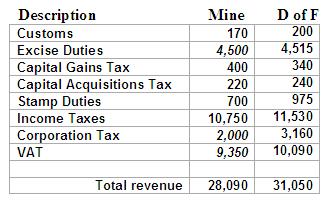
I commented last month that the Corporation Tax figures seemed to be a matter of concern not just to me, but also to the Dept. of Finance. There has been a complete collapse this month, which has forced me to slash my estimate by 33 per cent to just €2,000M. However I will come back to this figure again after seeing the May figures. There are signs that many multi-nationals have decided that they can move from a low tax regime here to a no tax regime also here, using the increasing number of incentives on offer to them.
I have also adjusted upwards the Excise and VAT figures. The adjustments are based on the take up of the car scrappage scheme. What a pity that instead of a scheme sucking in imports, we did not decide to encourage activities with almost 100 per cent local input, such as slashing VAT on restaurants and hotels.
Capital Gains Tax is well ahead of profile but far below the position of last or earlier years. But all of the other taxes show little signs of life in the zombie that is the Irish economy. The additional CGT payments may be the result of a small number of investors crystallising gains previously sheltered in investment holding companies.
The Government are assuming that there will be a pick up later in the year, which will lead to higher taxes, but as retail lending rates increase and households get their personal balance sheets in order, it is very hard to see this happening. Employment numbers continue to fall and it is hard to see where the extra demand will come from.
This month I decided to see what some other commentators have said about the tax forecast. To hell with the realists/pessimists and read what an optimist has to say!
A little while ago, I was sent a copy of Bloxham’s Irish Quarterly Economic Outlook. Alan McQuaid has always been a little bit of an optimist but he surpassed himself here. His tax forecast is extraordinary, see Table below, and is €675M higher than the Dept. of Finance’s total and over €3,500M away from my figures.
He is suggesting that the decline in GDP will be just 0.8 per cent in 2010 and of 3 per cent in GNP. He also is suggesting a much lower borrowing requirement than anyone else.

April is a very quiet tax month and there will be just two figures worth watching, Income Tax to see how the monthly PAYE returns are doing and also the Excise figures for the influence of the car scrappage scheme. May is however a key month with large VAT & Corporation Tax payments due. Any further slippage in the figures will be clear by then and require immediate action. Last month I suggested “Mini-budget and further pay cuts in June? Because there will certainly be no pick up!” Spending is below profile, however it is unclear how much of this was weather-related or for other reasons. Also many planned cutbacks have not yet happened, for example in the Health Service. Many voluntary hospitals and other institutions have only recently received their budgets and are still in discussions with the HSE. I am personally aware of one institution where approx. 10 per cent of frontline staff will be gone by year-end, unless the subvention is increased.
Friday, 2 April 2010
Bank shareholders bailed out, welfare recipients to pay
Michael Burke: There is clearly a degree of dissembling that is taking place regarding the bank nationalisation, smokesceens about leaving the Euro, or how bank debt will impair our credit rating (the government has already done that), and perhaps the biggest of all, that the cost of 'oblterating' Anglo-Irish would be huge and would be incurred by the State.
It is therefore important to establish some of the key points of the bail-out:
* the State will add €33bn in debt in order to bail-out bank shareholders and bondholders. This is true whether the debt is issued in the form of promissory notes, IOUs, or sovereign bonds
* the State has removed €10.6bn from the economy in spending cuts and tax increases
gven that nominal GDP was €163.5bn over the course of 2009 and nominal GNP was €131.4, the bank bailout was 20% of GDP and the fiscal contraction was 6.4% of GDP (not including December’s effort)
* for those who insist on using the GNP denominator, the proportions were 25% bank bailout and 8% fiscal contraction (it would be wholly inconsistent to use two different denominators for government finances and the bank bail-out, since both debts must be met from the same income stream, mainly taxes)
* likewise, it is important to use nominal measures, since, unfortuantely the debts cannot be serviced in CSO-2007 euros, but must be met from the actual incomes received, by corporates, households and the government in 2009 euros and beyond. This inconvenient truth is regularly ignored by advocates of competitive deflation; real debts increase as prices and incomes fall
* the €33bn is a fraud in the strictest sense; ie payment of an extremely large sum of money for something that is worthless. Without the government guarantee all the shares in the banks receiving capital would be revalued at zero, likewise the majority of the bonds. The government has increased taxpayers' stake in nothing
* the €33bn is, and I know many scourges of the public sector are fond of these type of comparisons, equivalent to the 3 largest voted departmental spending areas combined, health & children, social & family and education & science, with room to cover arts, sports & tourism as well as the communication, energy and natural resources budgets for 2009 too,
* if issued as four-year debt (assuming a speedy resolution of the banking crisis) the annual cost would be €925mn, for 4 years, or more realistically, if issued at 10yrs, the annual interest bill based on prevailing interest rates would be €1.475bn, slightly more than the Employment, Trade & Enterprise budget
It is hard to imagine which Irish entitities could absorb all the additional State borrowing, implying that foreign ownership of Irish government (or quasi-goernment) debt will increase. While there was a €29.3bn trade surplus in 2009, net factor income from abroad was -€31.9bn. Increased foreign indebtedness will tend to increase the net capital outflow via debt interest payments, pushing a (virtually non-taxed) export-led recovery even further back on the horizon.
Clearly, the project represents a huge transfer of weatlh from the poor to the rich. In the modern era, this usually takes place in some under-developed economy by a Western power and is little reported. It is rarely done so blatantly within a Western economy; so one for the record books.
So what should progressives argue for as an alternative? The key to the situation, and the reason Mr Lenihan's assertion about 'obliteration' is a falsehood, is the bank guarantee. Without it there would be no possible contagion from the banks to government debt. And wthout it there would be no bank shareholders, either.
Their holding would be valued at their true worth, that is zero. It is probably also true that zero would be the share price without the latest lifeline from taxpayers, since any residual value in the shares was premised on the expectation for further slugs of taxpayer money as required.
Therefore, the shareholders would be wiped out and most of the bondholders too by either a withdrawal of the guarantee, or even charging a realistic price for it, or the repatration of the capital injections. Since the taxpayer is now the largest shareholder, emergency legislaion should be prepared to do both those things and at the same time, protect the deposits of the banks' customers by seizing them.
The new entitities would be owned by the State, as now yet rigorously managed, but could then form the basis of a banking sector which did not jeopardise depositors, engaged in prudent balance sheet management, not casino capitalism, and was directed to invest in the most productive areas of the economy, delivering large returns for the shareholder; the taxpayer, and large economic benefits for all.
It is therefore important to establish some of the key points of the bail-out:
* the State will add €33bn in debt in order to bail-out bank shareholders and bondholders. This is true whether the debt is issued in the form of promissory notes, IOUs, or sovereign bonds
* the State has removed €10.6bn from the economy in spending cuts and tax increases
gven that nominal GDP was €163.5bn over the course of 2009 and nominal GNP was €131.4, the bank bailout was 20% of GDP and the fiscal contraction was 6.4% of GDP (not including December’s effort)
* for those who insist on using the GNP denominator, the proportions were 25% bank bailout and 8% fiscal contraction (it would be wholly inconsistent to use two different denominators for government finances and the bank bail-out, since both debts must be met from the same income stream, mainly taxes)
* likewise, it is important to use nominal measures, since, unfortuantely the debts cannot be serviced in CSO-2007 euros, but must be met from the actual incomes received, by corporates, households and the government in 2009 euros and beyond. This inconvenient truth is regularly ignored by advocates of competitive deflation; real debts increase as prices and incomes fall
* the €33bn is a fraud in the strictest sense; ie payment of an extremely large sum of money for something that is worthless. Without the government guarantee all the shares in the banks receiving capital would be revalued at zero, likewise the majority of the bonds. The government has increased taxpayers' stake in nothing
* the €33bn is, and I know many scourges of the public sector are fond of these type of comparisons, equivalent to the 3 largest voted departmental spending areas combined, health & children, social & family and education & science, with room to cover arts, sports & tourism as well as the communication, energy and natural resources budgets for 2009 too,
* if issued as four-year debt (assuming a speedy resolution of the banking crisis) the annual cost would be €925mn, for 4 years, or more realistically, if issued at 10yrs, the annual interest bill based on prevailing interest rates would be €1.475bn, slightly more than the Employment, Trade & Enterprise budget
It is hard to imagine which Irish entitities could absorb all the additional State borrowing, implying that foreign ownership of Irish government (or quasi-goernment) debt will increase. While there was a €29.3bn trade surplus in 2009, net factor income from abroad was -€31.9bn. Increased foreign indebtedness will tend to increase the net capital outflow via debt interest payments, pushing a (virtually non-taxed) export-led recovery even further back on the horizon.
Clearly, the project represents a huge transfer of weatlh from the poor to the rich. In the modern era, this usually takes place in some under-developed economy by a Western power and is little reported. It is rarely done so blatantly within a Western economy; so one for the record books.
So what should progressives argue for as an alternative? The key to the situation, and the reason Mr Lenihan's assertion about 'obliteration' is a falsehood, is the bank guarantee. Without it there would be no possible contagion from the banks to government debt. And wthout it there would be no bank shareholders, either.
Their holding would be valued at their true worth, that is zero. It is probably also true that zero would be the share price without the latest lifeline from taxpayers, since any residual value in the shares was premised on the expectation for further slugs of taxpayer money as required.
Therefore, the shareholders would be wiped out and most of the bondholders too by either a withdrawal of the guarantee, or even charging a realistic price for it, or the repatration of the capital injections. Since the taxpayer is now the largest shareholder, emergency legislaion should be prepared to do both those things and at the same time, protect the deposits of the banks' customers by seizing them.
The new entitities would be owned by the State, as now yet rigorously managed, but could then form the basis of a banking sector which did not jeopardise depositors, engaged in prudent balance sheet management, not casino capitalism, and was directed to invest in the most productive areas of the economy, delivering large returns for the shareholder; the taxpayer, and large economic benefits for all.
Wednesday, 31 March 2010
Banks: elsewhere on the web ....
Over at Ireland after Nama, Declan Curran asks some pertinent questions. On Irish Economy, Karl Whelan takes a look at The Good, the Bad and the Ugly. Meanwhile, Ronan Lyons points out that the first tranche of loans may not be representative, and that subsequent tranches may show significantly larger discounts.
The 'I'm really getting tired of this nonsense' guide to bond yield trends
Michael Taft: There are others who will discuss intelligently the fall-out from Ireland’s financial Black Hole Day (Sli Eile, Stephen Kinsella and Nat O’Connor on this blog for instance). One thing that struck me during the Finance Minister’s robust, if economically-challenged, interview on Prime Time was his contention that things were, like, totally cool. Why? Since he announced the massive give-away, bond yields hadn’t moved. Wow. He made his announcement at 4:30 pm and by 10:00 pm bond yields hadn’t moved. This proved that not only that the international markets were not ‘concerned’ with our financial black hole, they were positively chill (or they just go to bed early).
One could really get tired of this. There’s an eerie anthropomorphic quality to discussions on bond markets. Apparently, these markets can ‘feel’, ‘be happy’, ‘become angry’, ‘contemplate’, etc. and on and on. The trend of commentary usually goes like this: ‘the markets will be concerned if the Government doesn’t get tough on trade unionists, the poor, public spending and businesses in debt’. And when the Government does do tough guy stuff, the bond markets ‘approve’ and so, are at peace.
All this comes from the sound-bite school of deep, thoughtful analysis. Tracking bond yields can tell us many things – and it’s amazing that what it usually tells us is what we want it to tell us: vide the Finance Minister last night. So in that spirit I have constructed my own way of explaining bond yield trends. I have used the gross redemption yields for 10-year plus bonds on the last day of the month, sourced from ISEQ (one of many ways to track borrowing costs). This is what the ‘markets’ are telling me.
APRIL 2008: We are still innocent. The ESRI has yet to discover the recession and predict 3.1 percent growth for 2009. There is talk of property prices but we are assured it will be a soft, gentle landing. AIB is trading at €13.25. In another country baseball season is starting and little boys will be playing well into the bright summer evenings.
Bond Yield: 4.40
SEPTEMBER 2008: The boys of summer are still playing baseball but the financial dogs in the street are muttering something about Irish banks and insolvencies. The Sunday Independent declares that if anything goes wrong, whatever that might be, it will of course be the fault of trade unions. Bank Guarantee announced at the end of the month. Markets don’t have time to react before month’s end because they go to bed early.
Bond Yield: 4.60
OCTOBER 2008: Bankers say everything is fine and they don’t need equity; the markets get worried. AIB trades at €5.00 but no one is fired. Bringing forward the Budget doesn’t help either – especially this budget.
Bond Yield: 4.84
DECEMBER 2009: Markets get less jittery. All that hysterics about the state being exposed to hundred of billions of bank Euros fade away. ISME calls for the suppression of trade unions. Their competitors, the Small Firms Association, call ISME weak on the issue of trade unions.
Bond Yield: 4.47
JANUARY 2009: Everything goes haywire. Markets up in arms. Is it because Anglo-Irish is nationalised or because the Government, only a few days before, was going to pump billions in it because they believed it was still viable? The markets unsure whether the Government was colluding in a tissue of lies and deceit or are just plain idiots. Live Register experiences biggest jump in two decades.
Bond Yield: 5.54
FEBRUARY 2009: The Government goes macho. They kick the unions out of Government buildings in the early morning (and don’t even call them a cab). The Finance Minister announces a pension levy on public sector workers and cuts in the number of special need teachers. Pumped abs and testosterone everywhere. Commentators note that even the weather has improved. The markets, however . . .
Bond Yield: 5.57
MARCH 2009: The Tánaiste declares the Government has public finances under control. No one, not even the omnipotent markets, knows what to make of this.
Bond Yield: 5.45
APRIL 2009: Just to prove the Tánaiste was right, the Government introduces an emergency budget. The markets don’t understand – consumer spending is collapsing, businesses reliant on domestic sales are collapsing; and the Government takes even more money out of people’s pockets. There’s counter-intuitive and there’s counter-intuitive; and then there’s Fianna Fail.
Bond Yield: 5.28
JUNE 2009: The markets reconsider the Government’s emergency budget and their deflationary strategy of cutting €11 billion out of an already debilitated economy over the next four years.
Bond Yield: 5.84
AUGUST 2009: For months the three major credit rating agencies have been downgrading Irish Government debt and are threatening more. Commentators are horrified and claim we’ll never be able to borrow again ever, the Sunday Independent blames trades unions, employers demand the minimum wage be cut (though no one can figure out how this will get cheaper money). The markets, however, prove they have a sense of humour.
Bond Yield: 4.68
THE AUTUMN RUN-UP TO THE BUDGET - NOVEMBER 2009: Everyone is giddy. If the Government keeps their promise to implement a puppy-crunching, Bruce Lee, in-your-face, take-no-prisoners budget, the markets will smile and investors will actually pay us to borrow from them. The Taoiseach promises blood, sweat and bankruptcies, the Tánaiste claims that what ever makes us redundant only makes us stronger; the Minister for Health (sic) goes one better and threatens IMF tanks in every town square in the country if we don’t take the pain.
Bond Yield: 5.16
DECEMBER 2010: The Government introduces a puppy-crunching, Bruce Lee, in-your-face, take-no-prisoners budget.
Bond Yield: 5.18
[For a few weeks everyone’s attention is on Greece and those irrational Greek workers striking and marching in the streets because they don’t want to be the fall-guys and fall-gals for maintaining a strong Euro, Germany’s current account surplus and finance capital’s hopes for a return to Alpha status.]
MARCH 30th 4:30 – 10: 00 pm: The Minister declares markets are totally cool with him shovelling up to €20 billion in Anglo-Irish (proves what shrewd market players the Cabinet are), that the economy has turned the corner, unemployment is stabilising and we’ll return to growth this year. Recession? What recession? The only recession is in your mind, dude.
Bond Yield: Moved not one cent according to the Minister.
* * *
All that – all that courageous action the Government has taken that has so impressed the markets – and bond yields are worse than when we started on this dismal path. Of course, there will be those who will claim that if the Government didn’t take courageous action, borrowing costs would have been worse. If so, then why is it high bond yields got worse every time they did?
That’s one way of looking at all this. For another perspective have a read of Michael Burke’s take on borrowing costs and the Government’s deflationary policies. You might have your own perspective. If so, go on to the Irish Stock Exchange website and build your own story.
But, please, just don’t make the markets ‘nervous’.
One could really get tired of this. There’s an eerie anthropomorphic quality to discussions on bond markets. Apparently, these markets can ‘feel’, ‘be happy’, ‘become angry’, ‘contemplate’, etc. and on and on. The trend of commentary usually goes like this: ‘the markets will be concerned if the Government doesn’t get tough on trade unionists, the poor, public spending and businesses in debt’. And when the Government does do tough guy stuff, the bond markets ‘approve’ and so, are at peace.
All this comes from the sound-bite school of deep, thoughtful analysis. Tracking bond yields can tell us many things – and it’s amazing that what it usually tells us is what we want it to tell us: vide the Finance Minister last night. So in that spirit I have constructed my own way of explaining bond yield trends. I have used the gross redemption yields for 10-year plus bonds on the last day of the month, sourced from ISEQ (one of many ways to track borrowing costs). This is what the ‘markets’ are telling me.
APRIL 2008: We are still innocent. The ESRI has yet to discover the recession and predict 3.1 percent growth for 2009. There is talk of property prices but we are assured it will be a soft, gentle landing. AIB is trading at €13.25. In another country baseball season is starting and little boys will be playing well into the bright summer evenings.
Bond Yield: 4.40
SEPTEMBER 2008: The boys of summer are still playing baseball but the financial dogs in the street are muttering something about Irish banks and insolvencies. The Sunday Independent declares that if anything goes wrong, whatever that might be, it will of course be the fault of trade unions. Bank Guarantee announced at the end of the month. Markets don’t have time to react before month’s end because they go to bed early.
Bond Yield: 4.60
OCTOBER 2008: Bankers say everything is fine and they don’t need equity; the markets get worried. AIB trades at €5.00 but no one is fired. Bringing forward the Budget doesn’t help either – especially this budget.
Bond Yield: 4.84
DECEMBER 2009: Markets get less jittery. All that hysterics about the state being exposed to hundred of billions of bank Euros fade away. ISME calls for the suppression of trade unions. Their competitors, the Small Firms Association, call ISME weak on the issue of trade unions.
Bond Yield: 4.47
JANUARY 2009: Everything goes haywire. Markets up in arms. Is it because Anglo-Irish is nationalised or because the Government, only a few days before, was going to pump billions in it because they believed it was still viable? The markets unsure whether the Government was colluding in a tissue of lies and deceit or are just plain idiots. Live Register experiences biggest jump in two decades.
Bond Yield: 5.54
FEBRUARY 2009: The Government goes macho. They kick the unions out of Government buildings in the early morning (and don’t even call them a cab). The Finance Minister announces a pension levy on public sector workers and cuts in the number of special need teachers. Pumped abs and testosterone everywhere. Commentators note that even the weather has improved. The markets, however . . .
Bond Yield: 5.57
MARCH 2009: The Tánaiste declares the Government has public finances under control. No one, not even the omnipotent markets, knows what to make of this.
Bond Yield: 5.45
APRIL 2009: Just to prove the Tánaiste was right, the Government introduces an emergency budget. The markets don’t understand – consumer spending is collapsing, businesses reliant on domestic sales are collapsing; and the Government takes even more money out of people’s pockets. There’s counter-intuitive and there’s counter-intuitive; and then there’s Fianna Fail.
Bond Yield: 5.28
JUNE 2009: The markets reconsider the Government’s emergency budget and their deflationary strategy of cutting €11 billion out of an already debilitated economy over the next four years.
Bond Yield: 5.84
AUGUST 2009: For months the three major credit rating agencies have been downgrading Irish Government debt and are threatening more. Commentators are horrified and claim we’ll never be able to borrow again ever, the Sunday Independent blames trades unions, employers demand the minimum wage be cut (though no one can figure out how this will get cheaper money). The markets, however, prove they have a sense of humour.
Bond Yield: 4.68
THE AUTUMN RUN-UP TO THE BUDGET - NOVEMBER 2009: Everyone is giddy. If the Government keeps their promise to implement a puppy-crunching, Bruce Lee, in-your-face, take-no-prisoners budget, the markets will smile and investors will actually pay us to borrow from them. The Taoiseach promises blood, sweat and bankruptcies, the Tánaiste claims that what ever makes us redundant only makes us stronger; the Minister for Health (sic) goes one better and threatens IMF tanks in every town square in the country if we don’t take the pain.
Bond Yield: 5.16
DECEMBER 2010: The Government introduces a puppy-crunching, Bruce Lee, in-your-face, take-no-prisoners budget.
Bond Yield: 5.18
[For a few weeks everyone’s attention is on Greece and those irrational Greek workers striking and marching in the streets because they don’t want to be the fall-guys and fall-gals for maintaining a strong Euro, Germany’s current account surplus and finance capital’s hopes for a return to Alpha status.]
MARCH 30th 4:30 – 10: 00 pm: The Minister declares markets are totally cool with him shovelling up to €20 billion in Anglo-Irish (proves what shrewd market players the Cabinet are), that the economy has turned the corner, unemployment is stabilising and we’ll return to growth this year. Recession? What recession? The only recession is in your mind, dude.
Bond Yield: Moved not one cent according to the Minister.
* * *
All that – all that courageous action the Government has taken that has so impressed the markets – and bond yields are worse than when we started on this dismal path. Of course, there will be those who will claim that if the Government didn’t take courageous action, borrowing costs would have been worse. If so, then why is it high bond yields got worse every time they did?
That’s one way of looking at all this. For another perspective have a read of Michael Burke’s take on borrowing costs and the Government’s deflationary policies. You might have your own perspective. If so, go on to the Irish Stock Exchange website and build your own story.
But, please, just don’t make the markets ‘nervous’.
How much are the bank bailouts going to cost us?
Nat O'Connor: There is a lack of clarity about just how much the bank bailout will cost ordinary people. But based on recent news, the estimated costs are huge.
The Irish Independent states that "Every man, woman and child in the State will have to pay an average of €2,000 every year just to service interest payments on borrowings to pay for the bank bailout, estimated to cost €40bn."
In fairness, it's not clear that we have enough information to know that yet. If the banks raise their own capital we won't need to borrow as much. Also, if we part-recapitalise the banks out of the National Pension Reserve Fund (which is what we did before) we will borrow less again. But let's tease out the scale of what borrowing €40 billion would mean.
Unfortunately, not every man, woman and child in Ireland has an income. So will paying the bill fall on the shoulders of Ireland's 1.6 million households, rather than its 4.5 million people? The costs then comes out at roughly €5,600 per year per household. But with state pensioners and other people living on social welfare on incomes of around €12,000, are we talking about halving their incomes and plunging hundreds of thousands of people into destitution?
Alternatively, we could look at the 1.9 million people in employment, who would have to take on an average of €4,600 each (with couples, where both partners are employed, taking on €9,200).
Average earnings for someone in employment in Ireland in 2009 were around €36,300 per year (CSO). So, for example, a single person on this income, already on c. €29,500 after tax, will see their final income fall to around €24,900. (Of course those on lower incomes might pay less, and those on higher incomes might pay more... this is just the average cost applied to the average income).
The cost to those in employment is likely to be lessened by further cuts in public expenditure (social welfare cuts, cuts to pensions, cuts to public capital expenditure, cuts to public services of all kinds, etc). Except that these cuts will also reduce quality of life, health, education, and increase households' costs to fill the gap created by the absence of public services.
And this is just to pay the interest on the loans to bail out the banks.
All the above assumes that NAMA will work and we will only have to pay the interest on the loans for a period of years. If NAMA makes a loss, or further bank bailouts are required, the burden of paying for all this will increase.
If that wasn't bad enough, some people will be further affected by mortgage interest increases. The Belfast Telegraph suggests that AIB "will respond to its latest bailout by raising mortgage rates by a further 1.5% this year." That's on top of this week's 0.5 per cent increase. Assuming the other banks follow suit, that will increase pressure on tens of thousands of households.
Not every household is affected by this double squeeze, but it is hard to see how households will be able to afford to pay another couple of thousand extra per year on their mortgage repayments, alongside bearing the tax increases to pay the interest on the loans to bail out the banks.
It is possible that we could see a major wave of mortgage default and repossession, which would trigger a further crisis in the banks, and a need for further recapitalisation. Those who don't default are likely to be paying way more than they can comfortably afford to keep their homes; all to avoid the nightmare of selling their homes at a low price, while still owing the bank the balance of their original (massive) mortgage loans.
In a year or so, the State could own all or most of the banks, but the citizens who own the State will be paying increased charges to the banks as customers at the same time as paying taxes for the loans to own them. The burden of paying the interest on the loans will all but rule out any productive investment in better infrastructure, better education, etc. Most of our potential for investment will be tied up for years in paying for the mistakes made by past governments.
There is a need for much more accurate information to be made available on exactly how the Government plans on paying for the banks and at what point it would be cheaper to let some of them go bust. We need to know exactly how much households will have to pay and what will be the opportunity cost in cuts to public services and the loss of a generation's ability to invest in a better future. At present we can only speculate. But based on the figures currently in the news, it's a perverse and gloomy situation and we haven't gotten to the bottom of it yet.
The Irish Independent states that "Every man, woman and child in the State will have to pay an average of €2,000 every year just to service interest payments on borrowings to pay for the bank bailout, estimated to cost €40bn."
In fairness, it's not clear that we have enough information to know that yet. If the banks raise their own capital we won't need to borrow as much. Also, if we part-recapitalise the banks out of the National Pension Reserve Fund (which is what we did before) we will borrow less again. But let's tease out the scale of what borrowing €40 billion would mean.
Unfortunately, not every man, woman and child in Ireland has an income. So will paying the bill fall on the shoulders of Ireland's 1.6 million households, rather than its 4.5 million people? The costs then comes out at roughly €5,600 per year per household. But with state pensioners and other people living on social welfare on incomes of around €12,000, are we talking about halving their incomes and plunging hundreds of thousands of people into destitution?
Alternatively, we could look at the 1.9 million people in employment, who would have to take on an average of €4,600 each (with couples, where both partners are employed, taking on €9,200).
Average earnings for someone in employment in Ireland in 2009 were around €36,300 per year (CSO). So, for example, a single person on this income, already on c. €29,500 after tax, will see their final income fall to around €24,900. (Of course those on lower incomes might pay less, and those on higher incomes might pay more... this is just the average cost applied to the average income).
The cost to those in employment is likely to be lessened by further cuts in public expenditure (social welfare cuts, cuts to pensions, cuts to public capital expenditure, cuts to public services of all kinds, etc). Except that these cuts will also reduce quality of life, health, education, and increase households' costs to fill the gap created by the absence of public services.
And this is just to pay the interest on the loans to bail out the banks.
All the above assumes that NAMA will work and we will only have to pay the interest on the loans for a period of years. If NAMA makes a loss, or further bank bailouts are required, the burden of paying for all this will increase.
If that wasn't bad enough, some people will be further affected by mortgage interest increases. The Belfast Telegraph suggests that AIB "will respond to its latest bailout by raising mortgage rates by a further 1.5% this year." That's on top of this week's 0.5 per cent increase. Assuming the other banks follow suit, that will increase pressure on tens of thousands of households.
Not every household is affected by this double squeeze, but it is hard to see how households will be able to afford to pay another couple of thousand extra per year on their mortgage repayments, alongside bearing the tax increases to pay the interest on the loans to bail out the banks.
It is possible that we could see a major wave of mortgage default and repossession, which would trigger a further crisis in the banks, and a need for further recapitalisation. Those who don't default are likely to be paying way more than they can comfortably afford to keep their homes; all to avoid the nightmare of selling their homes at a low price, while still owing the bank the balance of their original (massive) mortgage loans.
In a year or so, the State could own all or most of the banks, but the citizens who own the State will be paying increased charges to the banks as customers at the same time as paying taxes for the loans to own them. The burden of paying the interest on the loans will all but rule out any productive investment in better infrastructure, better education, etc. Most of our potential for investment will be tied up for years in paying for the mistakes made by past governments.
There is a need for much more accurate information to be made available on exactly how the Government plans on paying for the banks and at what point it would be cheaper to let some of them go bust. We need to know exactly how much households will have to pay and what will be the opportunity cost in cuts to public services and the loss of a generation's ability to invest in a better future. At present we can only speculate. But based on the figures currently in the news, it's a perverse and gloomy situation and we haven't gotten to the bottom of it yet.
Tuesday, 30 March 2010
Groundhog Day
Stephen Kinsella: Super Tuesday has been and gone. Even those of us who study Irish public policy and the Irish economy on a daily basis were taken aback by the scale of the wealth transfers from state to private banks. What does it all mean? I’m a professional economist folks–don’t try this at home.
As I mentioned on Drivetime this evening, the injection of capital, combined with the government guarantee and NAMA, is supposed to heal banks’ balance sheets enough to get them into a position where they can borrow cheaply from abroad, and so resume lending again.
Finally, notice the precise imprecision: promissory notes are being issued for several billions, but spread out over ‘10 or 15 years’. Surely we can do better? Not to worry though, we’ll have another crack at it, when groundhog day rolls around again.
As I mentioned on Drivetime this evening, the injection of capital, combined with the government guarantee and NAMA, is supposed to heal banks’ balance sheets enough to get them into a position where they can borrow cheaply from abroad, and so resume lending again.
My opinion is that this increase in lending won’t happen, because canny investors know that residential loan defaults are on the way. We’ll have a groundhog day. This is not the one big moment to sort out our banking sector. This is a stage in a process, and nothing more. We’ll see the outright nationalisation of AIB by the end of 2010.
NAMA is getting going with its big 10 debtors, transferring 16 billion euros worth of loans in the next few weeks, representing perhaps 20% of the overall loans to be transferred by the end of the year. In particular, Anglo transfers €10bn at 50% discount, AIB transfers €3.29bn (43%), BoI transfers €1.93bn (35%), Nationwide transfers €670m (58%), and EBS transfers €140m (37%). Overall, the haircut is 47%. We need to be careful with that 47% discount number (or ‘haircut’) everyone is talking about. As usual, the bigger haircut, the greater the hole to fill in balance sheets to be filled by taxpayer’s money. While it might be the weighted average of the discounts being applied to each bank as the Minister says, we can’t back out the prices NAMA is going to pay for the loans in, say, AIB or Anglo. Update: Karl Whelan has more on this issue.
Notice also the rhetorical shift. We knew after guaranteeing the liabilities of the banks that a bad bank or asset management vehicle like NAMA was necessary, but also a further injection of capital and perhaps even full scale nationalisation. We were told NAMA was the only game in town, and all other options were not to be considered. Those who argued for nationalisation were derided or ignored. Now it looks highly likely that at least AIB, Anglo, INM, and EBS will be nationalised by the end of 2010, with the state taking a large piece of BoI as well.
Finally, notice the precise imprecision: promissory notes are being issued for several billions, but spread out over ‘10 or 15 years’. Surely we can do better? Not to worry though, we’ll have another crack at it, when groundhog day rolls around again.
Moral overload?
Slí Eile: No sooner was the ink dry on the Public Service Agreement (2010-2014) than the next news story broke on - NAMA. It just never dies down. We have now moved from dealing in billions to tens of billions. In Weimar Republic style numbers inflation we are moving into funny money territory. Except it is not funny for anyone. It is staggering. The figures dwarf any possible savings in public sector pay bill by a large multiple that the financial implications of the new deal on the public service (if is passed by union members) pale into insignificance. The negotiators deserve credit for their efforts. But, there is one snag - its paragraph 28 on page 9 - the very last sentence in the main document. It reads:
Worryingly, the Labour Party have pointed out (Strategic Investment Bank) that:
The implementation of this Agreement is subject to no currently unforeseen budgetary deterioration.O dear. I think we might have just had an unforeseen budgetary deterioration over the six o clock news this evening. Even Minister Lenihan admits that this has serious implications for taxpayers (contrary to the McCarthyite dictum that NAMA and the fiscal crisis have nothing to do with each other). NAMA has everything to do with the crisis because it is going to magnify the mountain of debt, contraction and cost-cutting imposed by a general slump. With GNP falling at an annual rate of over 12%, tax receipts under-shooting for most months there is every prospect of an early budget or an early election or an early bank collapse or all three. Either we keep on feeding the junkie called Anglo or we allow the junkie to die. Pretty stark. But, the problem right now for Government is whether it can deliver on all of its promises to:
- not cut public sector pay before 2014
- reduce the General Government Deficit to 3% of GDP by 2014
- keep the Anglo junkie fed with €10bn every few months (does anyone believe that another shot will not be demanded - we are in free fall)
- and keep the economy from contracting by another 10-12% this year (the forecast for a decline of 3% but that remains to be seen).
Worryingly, the Labour Party have pointed out (Strategic Investment Bank) that:
At the same time, Ireland’s fiscal position and the restrictions imposed by theWhere does that leave us if people are saying that we are under siege on all sides and to such an extent that we cannot invest our way out of this crisis along with other policy measures?
Stability and Growth Pact (SGP) represent a major constraint. There is little prospect that the level of investment necessary to improve our infrastructure can take place in the next decade given the current state of the public finances. And even without the fiscal crisis, the SGP, which includes public capital investment as part of its limit for the budget deficit, would restrict the State from making the necessary investments.
Monday, 29 March 2010
Guest Post by Gerry O'Hanlon S.J.: Asking the Right Question
Gerry O’Hanlon: We are understandably concerned about economic recovery in Ireland these days. But given that ‘recovery’ might be taken to imply a return to a previously desirable state, perhaps we need to reframe the question that we ask. If we ask ‘how do we recover’, we are in danger, in our public discourse, of letting conventional indicators like a pick-up in retail sales, an increase in property values, a rise in consumer sentiment, even – the Holy Grail! – growth in GDP and GNP, become the sole normative criteria for what might too easily become a return to ‘business as usual’. That would be a pity. Given what we have learned about the serious flaws in our ‘business as usual’ model, it might be better to ask a different sort of question that might push us in a more radical direction – so, for example, ‘how do we create a new economic model that is sustainable’?
The predominantly neo-liberal, infinite-growth model of the recent past has let us down. It was shot through with an economism which meant that an obsession with economic growth trumped so many other human values. It was riddled with inequalities both within and between nations, in ways which made solidarity unsustainable. And its focus on consumption did serious damage to our planet, as well as failing to make us happier.
In this context the reflections of the former Chief Rabbi of Ireland, David Rosen, are apt. Rosen quotes an old Jewish commentary on those who, according to chapter 11 of the Book of Genesis, showed hubris in attempting to build The Tower of Babel up to the heavens – ‘if in the course of building, a human being fell and was even killed, no one batted an eyelid: but if a brick fell and shattered, they all sat down and cried’. In other words, in this story of an ancient industrial collapse, work and growth were more important than human beings, and the enterprise went to the heads of its developers, showing ‘a profoundly distorted sense of values in which human life and dignity are subordinated to material achievements’.
Of course ‘material achievements’ are important: we want a future where people can work, where basic needs are satisfied, where human dignity is respected. But can that perhaps be done within a vision of the future articulated in terms of ‘prosperity without growth’ (Professor Tim Jackson), a ‘steady-state economy’ (Hermann Daly), ‘the richness of sufficiency’ (Bangkok letter of ecumenical group of Asian Churches in 1999)? And within that vision perhaps we need to create a culture which values society as well as the individual, a culture of the common good that respects solidarity and fairness and that commits itself to responsibility for inter-generational care of the earth?
That kind of new vision, those kinds of values, would have concrete implications. Banks would need to recognise that they have obligations to all stake-holders, not just to share-holders, that they have a social function in serving the ‘real economy’. Financial traders would need to be regulated in such a way that short-termism is eschewed – the introduction of a Tobin or Robin Hood tax on international currency and financial transactions might be a relatively simple and effective first step in this respect. Our economic priority should be to favour labour rather than capital, to put work and jobs as a prime target, and to consider salary caps or more progressive redistributive tax policies in order to bring about greater equality. It is estimated that CEOs in the USA were paid 344 times the average worker’s wage in 2007, as against 42 times in 1989. Why shouldn't we take up the suggestion of Paula Clancy of TASC and consider what it would be like if a policy objective was inserted in the Constitution that limited the top 20 per cent in Ireland to an income of 10 times, or even 5 times, that of the bottom 20 per cent?
The New Economics Foundation (The Great Transition, 2009) has tried to spell out concretely what such an economic model, with those kinds of values, might mean for Britain. They speak in terms of a fall of GDP by a third (to 2001 levels); of a four-day working week, to allow for full employment with less economic activity and to give a better work-life balance; market prices reflecting social and environmental costs; a redistribution of income to Danish levels of equality; capital markets functioning in such a way that company profitability would be linked to social and environmental value, so that share prices for listed companies would reflect this – and so on. All this would be premised on a democratic national determination of what the UK as a society deemed to be of social and environmental value, with government retaining the right to make determinations between competing interests. The net result, they estimate, would be a growth in ‘real value’, despite a reduction in consumption and economic growth.
Are we doing enough to raise these kinds of questions and research these kinds of solutions in Ireland? What is involved is a change of culture; a political class which is capable of the kind of leadership given at the height of the Northern Ireland crisis when a more radical approach was taken; a religious input that transcends the evil evidenced in Murphy and Ryan, not to mention the mediocrity of the kind of social conservatism so common in post-independence Ireland but which – as Habermas, Putnam, Rawls and Sandal all acknowledge – can draw on inspirational sources of self-transcendence which encourage believers to engage in a critique of the status quo and to join with fellow-citizens in the search for a better way forward.
Gerry O’Hanlon, S.J., Jesuit Centre for Faith and Justice, author of recently published Theology in the Irish Public Square, Dublin: Columba Press, 2010.
The predominantly neo-liberal, infinite-growth model of the recent past has let us down. It was shot through with an economism which meant that an obsession with economic growth trumped so many other human values. It was riddled with inequalities both within and between nations, in ways which made solidarity unsustainable. And its focus on consumption did serious damage to our planet, as well as failing to make us happier.
In this context the reflections of the former Chief Rabbi of Ireland, David Rosen, are apt. Rosen quotes an old Jewish commentary on those who, according to chapter 11 of the Book of Genesis, showed hubris in attempting to build The Tower of Babel up to the heavens – ‘if in the course of building, a human being fell and was even killed, no one batted an eyelid: but if a brick fell and shattered, they all sat down and cried’. In other words, in this story of an ancient industrial collapse, work and growth were more important than human beings, and the enterprise went to the heads of its developers, showing ‘a profoundly distorted sense of values in which human life and dignity are subordinated to material achievements’.
Of course ‘material achievements’ are important: we want a future where people can work, where basic needs are satisfied, where human dignity is respected. But can that perhaps be done within a vision of the future articulated in terms of ‘prosperity without growth’ (Professor Tim Jackson), a ‘steady-state economy’ (Hermann Daly), ‘the richness of sufficiency’ (Bangkok letter of ecumenical group of Asian Churches in 1999)? And within that vision perhaps we need to create a culture which values society as well as the individual, a culture of the common good that respects solidarity and fairness and that commits itself to responsibility for inter-generational care of the earth?
That kind of new vision, those kinds of values, would have concrete implications. Banks would need to recognise that they have obligations to all stake-holders, not just to share-holders, that they have a social function in serving the ‘real economy’. Financial traders would need to be regulated in such a way that short-termism is eschewed – the introduction of a Tobin or Robin Hood tax on international currency and financial transactions might be a relatively simple and effective first step in this respect. Our economic priority should be to favour labour rather than capital, to put work and jobs as a prime target, and to consider salary caps or more progressive redistributive tax policies in order to bring about greater equality. It is estimated that CEOs in the USA were paid 344 times the average worker’s wage in 2007, as against 42 times in 1989. Why shouldn't we take up the suggestion of Paula Clancy of TASC and consider what it would be like if a policy objective was inserted in the Constitution that limited the top 20 per cent in Ireland to an income of 10 times, or even 5 times, that of the bottom 20 per cent?
The New Economics Foundation (The Great Transition, 2009) has tried to spell out concretely what such an economic model, with those kinds of values, might mean for Britain. They speak in terms of a fall of GDP by a third (to 2001 levels); of a four-day working week, to allow for full employment with less economic activity and to give a better work-life balance; market prices reflecting social and environmental costs; a redistribution of income to Danish levels of equality; capital markets functioning in such a way that company profitability would be linked to social and environmental value, so that share prices for listed companies would reflect this – and so on. All this would be premised on a democratic national determination of what the UK as a society deemed to be of social and environmental value, with government retaining the right to make determinations between competing interests. The net result, they estimate, would be a growth in ‘real value’, despite a reduction in consumption and economic growth.
Are we doing enough to raise these kinds of questions and research these kinds of solutions in Ireland? What is involved is a change of culture; a political class which is capable of the kind of leadership given at the height of the Northern Ireland crisis when a more radical approach was taken; a religious input that transcends the evil evidenced in Murphy and Ryan, not to mention the mediocrity of the kind of social conservatism so common in post-independence Ireland but which – as Habermas, Putnam, Rawls and Sandal all acknowledge – can draw on inspirational sources of self-transcendence which encourage believers to engage in a critique of the status quo and to join with fellow-citizens in the search for a better way forward.
Gerry O’Hanlon, S.J., Jesuit Centre for Faith and Justice, author of recently published Theology in the Irish Public Square, Dublin: Columba Press, 2010.
Lies, Damn Lies & Irish Economic Statistics - A Basic Lesson in Corporate Tax Planning
An Saoi: I have had enough of all of those stockbroker economists & politicians who lecture us incessantly that exports are the key to getting us out of their economic mess. I decided to put together this note on “Irish” exports, or more correctly Ireland’s role in worldwide tax planning. You will doubtless have heard that “Irish” exports have fallen very little through this depression. This post tries to explain why.
Please make the effort to read it all; I have tried my best to keep it as simple as possible.
The diagrams below show a basic simple structure used by many multi-nationals to avoid paying tax. Sales are booked through an Irish trading company for perhaps the whole of Europe, and the profits are quickly hoovered into another “Irish” company, but this one is actually in a tax haven. It is sometimes referred to as a “double Irish”.
Let us say a US multi-national wants to set up an Irish trading subsidiary or as they are normally described by the IDA a “European Headquarters”. Instead of setting up one company however it sets up two, a trading sub, which will carry out the activity and a holding company, which will move its centre of management and control to a tax haven, let us say the Bahamas, directly after formation. This company is Irish Registered and Non-Resident or an IRNR.
The IRNR will own the license or intellectual property required by the trading company and issues a sub-license to a Dutch BV.
The Dutch BV passes on a sub-license to the Irish trading company. This avoids the IRNR being deemed to be resident in Ireland and thus taxable in this State. It is the reason you interpose a Dutch BV, which acts as a conduit to get the profits tax free up to the IRNR.
The Irish trading company “sells” the license, goods or whatever the company makes or does throughout Europe, paying local subsidiaries a small commission to do the marketing. It passes most of the profit upwards in the form of a royalty payment. Instead of paying a tax rate of 12.5%, it actually has a tax rate of about 3% or even less.
The US accepts that companies are resident in the country where the company is resident, but Ireland looks at its so-called “centre of management and control”. The haven company therefore is Irish as far as the Yanks are concerned, but is not consider Irish by the Revenue Commissioners.
Fig. 1

Fig. 2

Kathleen Barrington of the Sunday Business Post described here how NCR washed most of its profits through Ireland and Simon Bowers writing in the Guardian showed how Google books all its sales through Google Ireland Ltd here.
Tax avoidance is a serious issue, which as an Oxfam publication issued in March 2009 showed costs lives. Ireland is a prime player in world tax avoidance because we happily co-operate with many of the largest multi-nationals, by not just allowing these types of structures, but actually marketing the country as the place to locate.
The accounts of the Irish trading entity would look something like this. This is not an extreme example, but should give a flavour of the type of “exports” we really produce.

(*I have assumed that Depreciation = Capital Allowances)
Please make the effort to read it all; I have tried my best to keep it as simple as possible.
The diagrams below show a basic simple structure used by many multi-nationals to avoid paying tax. Sales are booked through an Irish trading company for perhaps the whole of Europe, and the profits are quickly hoovered into another “Irish” company, but this one is actually in a tax haven. It is sometimes referred to as a “double Irish”.
Let us say a US multi-national wants to set up an Irish trading subsidiary or as they are normally described by the IDA a “European Headquarters”. Instead of setting up one company however it sets up two, a trading sub, which will carry out the activity and a holding company, which will move its centre of management and control to a tax haven, let us say the Bahamas, directly after formation. This company is Irish Registered and Non-Resident or an IRNR.
The IRNR will own the license or intellectual property required by the trading company and issues a sub-license to a Dutch BV.
The Dutch BV passes on a sub-license to the Irish trading company. This avoids the IRNR being deemed to be resident in Ireland and thus taxable in this State. It is the reason you interpose a Dutch BV, which acts as a conduit to get the profits tax free up to the IRNR.
The Irish trading company “sells” the license, goods or whatever the company makes or does throughout Europe, paying local subsidiaries a small commission to do the marketing. It passes most of the profit upwards in the form of a royalty payment. Instead of paying a tax rate of 12.5%, it actually has a tax rate of about 3% or even less.
The US accepts that companies are resident in the country where the company is resident, but Ireland looks at its so-called “centre of management and control”. The haven company therefore is Irish as far as the Yanks are concerned, but is not consider Irish by the Revenue Commissioners.
Fig. 1

Fig. 2

Kathleen Barrington of the Sunday Business Post described here how NCR washed most of its profits through Ireland and Simon Bowers writing in the Guardian showed how Google books all its sales through Google Ireland Ltd here.
Tax avoidance is a serious issue, which as an Oxfam publication issued in March 2009 showed costs lives. Ireland is a prime player in world tax avoidance because we happily co-operate with many of the largest multi-nationals, by not just allowing these types of structures, but actually marketing the country as the place to locate.
The accounts of the Irish trading entity would look something like this. This is not an extreme example, but should give a flavour of the type of “exports” we really produce.

(*I have assumed that Depreciation = Capital Allowances)
Friday, 26 March 2010
DDDA Reports
Wednesday, 24 March 2010
The day after the IMF's tomorrow
Michael Taft: The IMF has suggested that the Irish Government’s growth projections are too optimistic and should be scaled back. So has the EU Commission. This has grave implications for the Government’s current strategy; if growth doesn’t come right, fiscal targets will be missed, debt will pile up, unemployment will remain high and living standards low. The Government may well end up sinking further into deflationary quicksand.
The IMF has projected growth for Ireland up to 2014. While these projections were initially produced in the middle of last year, the IMF reconfirmed them in their recent World Economic Outlook. What would be that impact on the deficit given these growth projections? The following examines only the tax revenue side of the equation.

First, we find IMF growth projections much lower than the Government’s. Between 2010 and 2014, the Government expects the economy to grow by 17.4 percent in real terms; the IMF, 8.8 percent. This will have considerable implications for public finances, as tax revenue is a function of GDP – low economic growth equals low tax revenue growth.
If the Government’s ‘tax burden’ or ‘tax ratio’ holds, under the IMF scenario we would find that not only will we fail to meet the Maastricht guidelines by 2014, we will pile up considerably higher debt in the process. Under the IMF scenario, the annual deficit is unsurprisingly higher each year; by 2014 it still remains above Maastricht guideline levels by 2014.

More alarmingly, is the growth in overall debt levels. The Government expects gross debt to be at 80.8 percent of GDP. However, if the IMF projections hold, overall debt will soar to over 93 percent – a result of higher annual deficits, and lower nominal GDP. This is what the TASC letter referred to as the ‘low-growth, high debt’ future.
There are two major caveats: first, this doesn’t include higher unemployment costs. We should expect unemployment, under the IMF’s lower growth scenario, to remain higher than the Government’s forecasts. If so, spending will rise above current projected levels. Second, higher borrowing levels will incur higher debt service costs. Factor these in, and the deficit and overall debt levels will be higher still.
This is all of a piece. In a previous post, Michael Burke and I showed how the Government’s current strategy will depress future growth. That is because the Government, rather than reducing the deficit, is embedding the deficit into the economic base.
So which scenario is more likely? The IMF projections are clearly pessimistic. The Government will take some comfort from recent projections. For 2011, Bloxham is projecting 3 percent growth; Friends First 3.1 percent. IBEC, however, is slightly more cautious, with a projection of 2.1 percent while PwC projects growth at 1.8 percent.
Some comfort, yes; but even the Department of Finance warns that GDP growth may not be tax-rich. This is because growth may be driven by exports from the multi-national sector.
So do all these numbers matter? Yes, very much so. NCB’s growth projections come up only slightly less than the Government by 2014, but even this has the potential to knock the Government’s fiscal targets off course. They, too, accept that the Government will miss its 2014 target, while piling up more debt than the Government expects.
In short, the Government’s fiscal strategy is built on quicksand. Its growth projections are optimistic and it has failed to factor in the deflationary effects of its current spending cuts policies. If they resort to further fiscal tightening to make up for this, all that will happen is that they will sink even further.
And the rest of us along with them.
The IMF has projected growth for Ireland up to 2014. While these projections were initially produced in the middle of last year, the IMF reconfirmed them in their recent World Economic Outlook. What would be that impact on the deficit given these growth projections? The following examines only the tax revenue side of the equation.

First, we find IMF growth projections much lower than the Government’s. Between 2010 and 2014, the Government expects the economy to grow by 17.4 percent in real terms; the IMF, 8.8 percent. This will have considerable implications for public finances, as tax revenue is a function of GDP – low economic growth equals low tax revenue growth.
If the Government’s ‘tax burden’ or ‘tax ratio’ holds, under the IMF scenario we would find that not only will we fail to meet the Maastricht guidelines by 2014, we will pile up considerably higher debt in the process. Under the IMF scenario, the annual deficit is unsurprisingly higher each year; by 2014 it still remains above Maastricht guideline levels by 2014.

More alarmingly, is the growth in overall debt levels. The Government expects gross debt to be at 80.8 percent of GDP. However, if the IMF projections hold, overall debt will soar to over 93 percent – a result of higher annual deficits, and lower nominal GDP. This is what the TASC letter referred to as the ‘low-growth, high debt’ future.
There are two major caveats: first, this doesn’t include higher unemployment costs. We should expect unemployment, under the IMF’s lower growth scenario, to remain higher than the Government’s forecasts. If so, spending will rise above current projected levels. Second, higher borrowing levels will incur higher debt service costs. Factor these in, and the deficit and overall debt levels will be higher still.
This is all of a piece. In a previous post, Michael Burke and I showed how the Government’s current strategy will depress future growth. That is because the Government, rather than reducing the deficit, is embedding the deficit into the economic base.
So which scenario is more likely? The IMF projections are clearly pessimistic. The Government will take some comfort from recent projections. For 2011, Bloxham is projecting 3 percent growth; Friends First 3.1 percent. IBEC, however, is slightly more cautious, with a projection of 2.1 percent while PwC projects growth at 1.8 percent.
Some comfort, yes; but even the Department of Finance warns that GDP growth may not be tax-rich. This is because growth may be driven by exports from the multi-national sector.
So do all these numbers matter? Yes, very much so. NCB’s growth projections come up only slightly less than the Government by 2014, but even this has the potential to knock the Government’s fiscal targets off course. They, too, accept that the Government will miss its 2014 target, while piling up more debt than the Government expects.
In short, the Government’s fiscal strategy is built on quicksand. Its growth projections are optimistic and it has failed to factor in the deflationary effects of its current spending cuts policies. If they resort to further fiscal tightening to make up for this, all that will happen is that they will sink even further.
And the rest of us along with them.
Tuesday, 23 March 2010
IMF et al on Fiscal Stimulus
Michael Burke: Philip Lane has posted a link to a very useful IMF working paper here. The paper draws on a wide variety of leading macroeconomic models (IMF, EU, Fed, Bank of Canada, etc.) to examine the effectiveness of fiscal stimulus.
Some interesting features of the paper’s conclusion: “There are four broad conclusions flowing from our analysis.
First, there is no such thing as a simple fiscal multiplier. The response of the economy to temporary discretionary fiscal stimulus depends on a number of factors, including most importantly the type of fiscal instrument used and the extent of monetary accommodation of the higher inflation generated by the stimulus.
Second, temporary expansionary fiscal actions can be highly effective, particularly when the fiscal instrument is spending or well-targeted transfers, and when in addition monetary policy is accommodative.
Third, permanent stimulus, that is a permanent increase in deficits, is much more problematic than temporary stimulus. It leads to a long-run contraction in output, but in addition the perception that deficits will become permanent also substantially reduces short-run fiscal multipliers.
Fourth, the G20 stimulus should have significant effects on global GDP in 2009 and 2010.”
So, it seems that the rest of the world has good reason to believe in the ‘tooth-fairy’ of fiscal stimulus. No such naïveté to be found in the ranks of Irish policymaking, unfortunately.
In discriminating as to types of stimulus, the verdict is also rather clear,
“A number of results are consistent across all models.
First, the multipliers from government investment and consumption expenditures, which are roughly similar in size, are clearly larger than the multipliers from transfers, labor income taxes, consumption taxes and corporate taxes.
Second, multipliers are small for general transfers, labor income taxes and corporate taxes, and somewhat larger (but still small relative to government expenditures) for consumption
taxes.
Third, only targeted transfers come close to having multipliers similar to those of government expenditures……[Yet....]
…it is of interest to note that in none of the regions [of the world adopting fiscal stimulus] do increases in government consumption play a predominant role.”
Figs. 22 and 31 show the very large multiplier effects of government investment and (slightly lower) effects of targeted transfers to the low paid in the US economy and Figs. 64 and 73 show the same for the EU.
There is one unproven assertion in the article on government finances, evident in the phrase above ”a permanent stimulus, that is a permanent increase in deficits.” If, as the models consistently find, the effects on GDP of government consumption and investment have multipliers that stretch to 2 over more than one year when interest rates are low (and have a cumulative five-year impact of more than 5), then the effects on government tax revenues would exceed the initial outlay by some considerable degree; ie investment and government consumption can lower the deficit, not create a permanently higher one. There is too the unacknowledged benefit to government finances from a growth-related decrease in welfare spending.
The alternative approach, based on ‘Expansionary Fiscal Contraction’, is dismissed in the IMF WP. An examination of how the EFC experiment has failed Ireland can be found on this blog.
The main argument against Ireland adopting a fiscal stimulus is openness (The debt and deficit arguments do not hold since Ireland’s debt level is below that of the peer group studied and the deficit matched by some). Yet the openness argument is tested (Fig.88) and found to have no appreciable impact on the effectiveness of fiscal stimulus - perhaps, unstated by the authors, because the propensity to import is offset by both a greater propensity to export and the greater efficiency that openness brings.
Some interesting features of the paper’s conclusion: “There are four broad conclusions flowing from our analysis.
First, there is no such thing as a simple fiscal multiplier. The response of the economy to temporary discretionary fiscal stimulus depends on a number of factors, including most importantly the type of fiscal instrument used and the extent of monetary accommodation of the higher inflation generated by the stimulus.
Second, temporary expansionary fiscal actions can be highly effective, particularly when the fiscal instrument is spending or well-targeted transfers, and when in addition monetary policy is accommodative.
Third, permanent stimulus, that is a permanent increase in deficits, is much more problematic than temporary stimulus. It leads to a long-run contraction in output, but in addition the perception that deficits will become permanent also substantially reduces short-run fiscal multipliers.
Fourth, the G20 stimulus should have significant effects on global GDP in 2009 and 2010.”
So, it seems that the rest of the world has good reason to believe in the ‘tooth-fairy’ of fiscal stimulus. No such naïveté to be found in the ranks of Irish policymaking, unfortunately.
In discriminating as to types of stimulus, the verdict is also rather clear,
“A number of results are consistent across all models.
First, the multipliers from government investment and consumption expenditures, which are roughly similar in size, are clearly larger than the multipliers from transfers, labor income taxes, consumption taxes and corporate taxes.
Second, multipliers are small for general transfers, labor income taxes and corporate taxes, and somewhat larger (but still small relative to government expenditures) for consumption
taxes.
Third, only targeted transfers come close to having multipliers similar to those of government expenditures……[Yet....]
…it is of interest to note that in none of the regions [of the world adopting fiscal stimulus] do increases in government consumption play a predominant role.”
Figs. 22 and 31 show the very large multiplier effects of government investment and (slightly lower) effects of targeted transfers to the low paid in the US economy and Figs. 64 and 73 show the same for the EU.
There is one unproven assertion in the article on government finances, evident in the phrase above ”a permanent stimulus, that is a permanent increase in deficits.” If, as the models consistently find, the effects on GDP of government consumption and investment have multipliers that stretch to 2 over more than one year when interest rates are low (and have a cumulative five-year impact of more than 5), then the effects on government tax revenues would exceed the initial outlay by some considerable degree; ie investment and government consumption can lower the deficit, not create a permanently higher one. There is too the unacknowledged benefit to government finances from a growth-related decrease in welfare spending.
The alternative approach, based on ‘Expansionary Fiscal Contraction’, is dismissed in the IMF WP. An examination of how the EFC experiment has failed Ireland can be found on this blog.
The main argument against Ireland adopting a fiscal stimulus is openness (The debt and deficit arguments do not hold since Ireland’s debt level is below that of the peer group studied and the deficit matched by some). Yet the openness argument is tested (Fig.88) and found to have no appreciable impact on the effectiveness of fiscal stimulus - perhaps, unstated by the authors, because the propensity to import is offset by both a greater propensity to export and the greater efficiency that openness brings.
Creating a smart society
Colm O'Doherty: The grade inflation in the formal education system controversy failed to get to grips with the critical issue around what constitutes knowledge and more importantly what is it for. The dominant thinking on education and knowledge infrastructure is that formal education is a commodity which generates economic growth through the market place. Our education system is now in thrall to a global phenomenon-building knowledge capital.
Economists define capital as that which has been invested. In the past a different type of investment generated economic growth. Investment of financial assets in physical capital - plant buildings and machinery- has been superseded by investment in human capital –education and training. Resources committed by governments or organizations or individuals to education and training are treated as investments within a capitalistic framework.
Formal education is increasingly viewed as a vehicle for investment , yielding individual wealth creation opportunities rather than social and cultural goods. Irish third level institutions are inordinately proud of the academic capitalism which not only informs their research strategies but their teaching and learning methodologies as well. Innovation and technology parks, enterprise centres, entrepreneurial boot camps and other commercialised forms of knowledge infrastructure rule the roost. The expansionist agenda of the marketeers is warmly embraced by third level institutions. Commerce has succeeded in capturing higher education by replacing educators with managers.
The essence of Enlightenment thinking is that knowledge is power but within our groves of academe the inverse relation also holds - power is knowledge. Power defines not only a certain conception of reality but all aspects of reality – physical, economic, social and environmental. Managerial power is based on ideas which have been developed chiefly in the worlds of manufacturing and commerce. There is no evidence that this approach to formal education produces smart citizens or more importantly a smart society. Students' “learning” is managed on behalf of the commercial sector by administratively tasked operatives. This process results in intellectual mediocrity rather than innovation, or enterprise or authentic learning.
Real learning is, however, taking place outside of the formal education system. Non formal and informal learning gained through volunteering is, according to a recent EU Report, Volunteering in the E.U., promoting social and economic cohesion. The Report provides evidence that, right across Europe, volunteering is a particularly powerful means to develop citizens commitment to their society and to its political life. Not only does volunteering make a direct contribution to our economy (between 1% and 2% of GDP), but it provides education and training opportunities that deliver significant added benefits to volunteer , local communities and society in general. Volunteer work provides important employment training and a pathway into the labour force. It is also a useful way for young people to test out potential careers and therefore make an informed choice about future education and training pathways.
There is now a growing body of evidence indicating that well-being is better correlated with equality, health, work satisfaction and positive relationships than with marginal gains in income. Our crash has revealed the folly of relying on financial markets to steer and supply both economic and social development. In the education sector, the ascendancy of an economic or business model has contributed to a fragile and brittle culture of competitive individualism where what counts as knowledge is determined by economic vicissitudes. The only way to rescue this situation is through a rehabilitation of the belief in education as an expression of collective action for the benefits of interdependence and generalised wellbeing.
The state needs to discontinue its present educational policy of using third level institutions as a funding conduit for opportunist capitalism. This is not smart behaviour. On the other hand, Volunteering in the EU provides us with a framework for post crash learning based on a politics of common interest. The E.U. Report calls for the non formal and informal learning accruing from volunteering to be taken into account when measuring the well-being and the wealth of Member States. Volunteering provides a platform for pursuing both individual and collective well- being and making them mutually supportive.
It is somewhat ironic, given the evidence of the value of volunteering to the development of a smart society, that the government is disbanding 180 voluntary management boards in the Community Development Programme. An unintended consequence of our formal educational policy is the creation of a disconnect between competitive individualism and collective life. This damages the community and trust which are vital to the smooth running of an economy. A new educational agenda incorporating the values of non formal and informal learning is a better bet for post crash civic renewal and sustainable improvement in levels of collective well-being than the boom and bust possessive individualism of the so called smart economy.
Economists define capital as that which has been invested. In the past a different type of investment generated economic growth. Investment of financial assets in physical capital - plant buildings and machinery- has been superseded by investment in human capital –education and training. Resources committed by governments or organizations or individuals to education and training are treated as investments within a capitalistic framework.
Formal education is increasingly viewed as a vehicle for investment , yielding individual wealth creation opportunities rather than social and cultural goods. Irish third level institutions are inordinately proud of the academic capitalism which not only informs their research strategies but their teaching and learning methodologies as well. Innovation and technology parks, enterprise centres, entrepreneurial boot camps and other commercialised forms of knowledge infrastructure rule the roost. The expansionist agenda of the marketeers is warmly embraced by third level institutions. Commerce has succeeded in capturing higher education by replacing educators with managers.
The essence of Enlightenment thinking is that knowledge is power but within our groves of academe the inverse relation also holds - power is knowledge. Power defines not only a certain conception of reality but all aspects of reality – physical, economic, social and environmental. Managerial power is based on ideas which have been developed chiefly in the worlds of manufacturing and commerce. There is no evidence that this approach to formal education produces smart citizens or more importantly a smart society. Students' “learning” is managed on behalf of the commercial sector by administratively tasked operatives. This process results in intellectual mediocrity rather than innovation, or enterprise or authentic learning.
Real learning is, however, taking place outside of the formal education system. Non formal and informal learning gained through volunteering is, according to a recent EU Report, Volunteering in the E.U., promoting social and economic cohesion. The Report provides evidence that, right across Europe, volunteering is a particularly powerful means to develop citizens commitment to their society and to its political life. Not only does volunteering make a direct contribution to our economy (between 1% and 2% of GDP), but it provides education and training opportunities that deliver significant added benefits to volunteer , local communities and society in general. Volunteer work provides important employment training and a pathway into the labour force. It is also a useful way for young people to test out potential careers and therefore make an informed choice about future education and training pathways.
There is now a growing body of evidence indicating that well-being is better correlated with equality, health, work satisfaction and positive relationships than with marginal gains in income. Our crash has revealed the folly of relying on financial markets to steer and supply both economic and social development. In the education sector, the ascendancy of an economic or business model has contributed to a fragile and brittle culture of competitive individualism where what counts as knowledge is determined by economic vicissitudes. The only way to rescue this situation is through a rehabilitation of the belief in education as an expression of collective action for the benefits of interdependence and generalised wellbeing.
The state needs to discontinue its present educational policy of using third level institutions as a funding conduit for opportunist capitalism. This is not smart behaviour. On the other hand, Volunteering in the EU provides us with a framework for post crash learning based on a politics of common interest. The E.U. Report calls for the non formal and informal learning accruing from volunteering to be taken into account when measuring the well-being and the wealth of Member States. Volunteering provides a platform for pursuing both individual and collective well- being and making them mutually supportive.
It is somewhat ironic, given the evidence of the value of volunteering to the development of a smart society, that the government is disbanding 180 voluntary management boards in the Community Development Programme. An unintended consequence of our formal educational policy is the creation of a disconnect between competitive individualism and collective life. This damages the community and trust which are vital to the smooth running of an economy. A new educational agenda incorporating the values of non formal and informal learning is a better bet for post crash civic renewal and sustainable improvement in levels of collective well-being than the boom and bust possessive individualism of the so called smart economy.
Monday, 22 March 2010
Fiscal recklessness and the TINA mantra
Tom McDonnell: The startling change in mood that has come upon the Irish people in this post Tiger era is reminiscent of a hangover after the ball. Indeed the drunken sense of hubris during the boom was such that our leaders seemed to have genuinely felt we had moved beyond such trivialities as economic cycles. The Government had reached such arrogant heights that Bertie Ahern even saw fit to recommend suicide to those few with the clarity of vision and understanding to warn of the impending collapse. Questioning the narrative was forbidden. Just as questioning the narrative that ‘there is no alternative’ (the TINA mantra) is now forbidden.
The Government was asleep at the wheel. Budgeting and economic planning had become so dysfunctional under Brian Cowen and Charlie McCreevy that the country’s public finances had become reliant on a single commodity rising in price year-on-year. A decade of giveaways had opened up a huge structural fiscal deficit which could remain hidden provided that the value of this one asset kept on surging. But asset prices move in cycles, and when the property crash inevitably took place (and it was inevitable) it was suddenly revealed to all that Ireland had a gaping hole in its public finances. It’s important to understand that this gaping hole already existed at the time the crisis struck. The crisis merely removed the illusion. During a time of unprecedented boom the Government had done all of the wrong things. They pursued pro-cyclical policies to remain in power, and now the taxpayer is left with the bill. The result of these policies is that at a time of severe economic crisis we have no nest egg available to provide any sort of stimulus. We are told that there is no alternative to the strategy of slash and burn.
But what is done is done, and the important question now is what can be learned from this folly. How can we ensure that our public finances are never mismanaged so badly in the future? Part of the difficulty with Keynesian demand management is that during those times of economic boom a purely self-interested political party will run pro-cyclical policies. Irish economic history is littered with such examples. Instead of seeking to manage the economy with the long term interests of the country at heart the party in power is concerned with maximising the number of jobs and maximising growth levels at precisely the time of the next election regardless of the consequences. The long term health and sustainability of the economy is therefore sacrificed to ensure present day electoral success. As Irish economic history has shown, the party in power cannot be trusted not to abuse long term sustainability in this way.
To prevent history repeating itself, there is an argument for governments being deprived of the power to buy elections at the expense of the long term. One option for achieving this aim would be a Constitutional amendment.
The details of such a Constitutional amendment would be up for debate but one possibility would be to require the Government to run a minimum budget surplus equal to half the previous year’s rate of GNP growth. To ensure long term planning, the government would also be required to set out indicative budgets for the next three to five years. Finally, the Constitutional amendment would set up an independent group of experts with the power to veto the budget if the Government’s estimates of both revenue and expenditure are unrealistic or are heavily reliant on temporary phenomena such as asset price swings. Politicians would, of course, still have power to decide levels and composition of tax/expenditure.
These changes should ensure more long term economic planning and would guarantee that the option exists during times of recession to engage in demand management through massive capital expenditure increases. We would not be in the perverse position of needing to slash and burn at exactly the time when capital projects are likely to have their greatest economic net benefit. Instead of the current ‘There is No Alternative’ (TINA) strategy there could have been a strategy focused on job creation.
No one disputes that the budget does have to be balanced in the long term, but to ignore the jobs crisis will devastate a generation and compromise Ireland’s economic future by running down the national store of human capital. Addressing the jobs crisis will involve the up skilling of a whole generation of former construction workers. This will be expensive but it has to be done. The old jobs aren’t coming back and the alternative to up skilling is to condemn these cohorts to long term unemployment or emigration.
So where is future economic growth to come from? The Government’s strategy is evidently to place all of its hopes on export led growth. They hope that Ireland will grab a larger slice of the international market through improving competitiveness and that this improved competitiveness will be achieved primarily through downwards pressure on wages. One side effect of this downwards pressure will be to reduce consumption in the short term but the Government is hoping that the increase in net exports will outweigh this drop in consumption. Brian Lenihan has already signalled that we can expect a further €3billion in cuts this year in the form of a drop of 1€billion in capital investment and a drop of €2billion in current expenditure. So the vicious circle of economic contraction seems set to continue. Of course Brian Cowen is still claiming that the NAMA exercise will increase the flows of private credit in the economy. However the sad reality is that the International Monetary Fund is telling the Government that NAMA will not lead to a significant increase in lending by the banks. NAMA and underlying issues may end up impairing the economy for years to come.
So what is to be done? In an ideal world we would be in a position to engage in a stimulus to deal with the jobs crisis. The ESRI’s fiscal multipliers from last April and the Benetrix/Lane historical multipliers both show that investment can be effective in generating jobs and growth despite Ireland’s status as a small open economy. However the sheer seriousness of the fiscal position will make demand stimulation extraordinarily difficult to fund through borrowing. But the jobs crisis must now be given equal precedence with the fiscal crisis. The real question then becomes one of whether the potential damage to the fiscal position is outweighed by the benefits of a stimulus.
Targeted investment chosen on the basis of strict cost benefit criteria must now be pursued. Investment projects with long term productivity enhancing benefits can, by increasing growth and creating jobs, actually improve the public finances. With levels of private investment so low at the moment, the likelihood of crowding out is minimal. Also, as actual output in the economy is lower than potential output the likelihood of capital projects successfully increasing growth is higher than usual. The Government can begin to move in this direction by reversing its planned cut of 1€billion in the capital budget. However alternative sources of funding for job creation projects must also be pursued and dipping into the National Pension Reserve Fund must now seriously be considered as a source of funding for as long as the crisis continues. At the same time a commitment should be made to start repaying the money to the NPRF once the crisis has passed.
Finally there must be recognition that the goal of economic policy is not economic growth per se but sustainable improvements in the quality of life of citizens. With this understanding in mind, it becomes clear that a more holistic approach to budgeting is appropriate. Economic growth is one indicator of progress, but so too are equality, long term environmental sustainability, job creation, health, education and other life outcomes. In the long term the budget must be designed with a mind to the impact on these areas, and the budget must be designed within the constraints of prudent fiscal policy.
Tom McDonnell is Policy Analyst with TASC
The Government was asleep at the wheel. Budgeting and economic planning had become so dysfunctional under Brian Cowen and Charlie McCreevy that the country’s public finances had become reliant on a single commodity rising in price year-on-year. A decade of giveaways had opened up a huge structural fiscal deficit which could remain hidden provided that the value of this one asset kept on surging. But asset prices move in cycles, and when the property crash inevitably took place (and it was inevitable) it was suddenly revealed to all that Ireland had a gaping hole in its public finances. It’s important to understand that this gaping hole already existed at the time the crisis struck. The crisis merely removed the illusion. During a time of unprecedented boom the Government had done all of the wrong things. They pursued pro-cyclical policies to remain in power, and now the taxpayer is left with the bill. The result of these policies is that at a time of severe economic crisis we have no nest egg available to provide any sort of stimulus. We are told that there is no alternative to the strategy of slash and burn.
But what is done is done, and the important question now is what can be learned from this folly. How can we ensure that our public finances are never mismanaged so badly in the future? Part of the difficulty with Keynesian demand management is that during those times of economic boom a purely self-interested political party will run pro-cyclical policies. Irish economic history is littered with such examples. Instead of seeking to manage the economy with the long term interests of the country at heart the party in power is concerned with maximising the number of jobs and maximising growth levels at precisely the time of the next election regardless of the consequences. The long term health and sustainability of the economy is therefore sacrificed to ensure present day electoral success. As Irish economic history has shown, the party in power cannot be trusted not to abuse long term sustainability in this way.
To prevent history repeating itself, there is an argument for governments being deprived of the power to buy elections at the expense of the long term. One option for achieving this aim would be a Constitutional amendment.
The details of such a Constitutional amendment would be up for debate but one possibility would be to require the Government to run a minimum budget surplus equal to half the previous year’s rate of GNP growth. To ensure long term planning, the government would also be required to set out indicative budgets for the next three to five years. Finally, the Constitutional amendment would set up an independent group of experts with the power to veto the budget if the Government’s estimates of both revenue and expenditure are unrealistic or are heavily reliant on temporary phenomena such as asset price swings. Politicians would, of course, still have power to decide levels and composition of tax/expenditure.
These changes should ensure more long term economic planning and would guarantee that the option exists during times of recession to engage in demand management through massive capital expenditure increases. We would not be in the perverse position of needing to slash and burn at exactly the time when capital projects are likely to have their greatest economic net benefit. Instead of the current ‘There is No Alternative’ (TINA) strategy there could have been a strategy focused on job creation.
No one disputes that the budget does have to be balanced in the long term, but to ignore the jobs crisis will devastate a generation and compromise Ireland’s economic future by running down the national store of human capital. Addressing the jobs crisis will involve the up skilling of a whole generation of former construction workers. This will be expensive but it has to be done. The old jobs aren’t coming back and the alternative to up skilling is to condemn these cohorts to long term unemployment or emigration.
So where is future economic growth to come from? The Government’s strategy is evidently to place all of its hopes on export led growth. They hope that Ireland will grab a larger slice of the international market through improving competitiveness and that this improved competitiveness will be achieved primarily through downwards pressure on wages. One side effect of this downwards pressure will be to reduce consumption in the short term but the Government is hoping that the increase in net exports will outweigh this drop in consumption. Brian Lenihan has already signalled that we can expect a further €3billion in cuts this year in the form of a drop of 1€billion in capital investment and a drop of €2billion in current expenditure. So the vicious circle of economic contraction seems set to continue. Of course Brian Cowen is still claiming that the NAMA exercise will increase the flows of private credit in the economy. However the sad reality is that the International Monetary Fund is telling the Government that NAMA will not lead to a significant increase in lending by the banks. NAMA and underlying issues may end up impairing the economy for years to come.
So what is to be done? In an ideal world we would be in a position to engage in a stimulus to deal with the jobs crisis. The ESRI’s fiscal multipliers from last April and the Benetrix/Lane historical multipliers both show that investment can be effective in generating jobs and growth despite Ireland’s status as a small open economy. However the sheer seriousness of the fiscal position will make demand stimulation extraordinarily difficult to fund through borrowing. But the jobs crisis must now be given equal precedence with the fiscal crisis. The real question then becomes one of whether the potential damage to the fiscal position is outweighed by the benefits of a stimulus.
Targeted investment chosen on the basis of strict cost benefit criteria must now be pursued. Investment projects with long term productivity enhancing benefits can, by increasing growth and creating jobs, actually improve the public finances. With levels of private investment so low at the moment, the likelihood of crowding out is minimal. Also, as actual output in the economy is lower than potential output the likelihood of capital projects successfully increasing growth is higher than usual. The Government can begin to move in this direction by reversing its planned cut of 1€billion in the capital budget. However alternative sources of funding for job creation projects must also be pursued and dipping into the National Pension Reserve Fund must now seriously be considered as a source of funding for as long as the crisis continues. At the same time a commitment should be made to start repaying the money to the NPRF once the crisis has passed.
Finally there must be recognition that the goal of economic policy is not economic growth per se but sustainable improvements in the quality of life of citizens. With this understanding in mind, it becomes clear that a more holistic approach to budgeting is appropriate. Economic growth is one indicator of progress, but so too are equality, long term environmental sustainability, job creation, health, education and other life outcomes. In the long term the budget must be designed with a mind to the impact on these areas, and the budget must be designed within the constraints of prudent fiscal policy.
Tom McDonnell is Policy Analyst with TASC
Economically damaging and fiscally irrelevant
Michael Burke & Michael Taft: It is often stated that to reduce the fiscal deficit we must cut public spending. There is an assumption, never substantiated, that cuts equal savings. However, the evidence shows otherwise: public spending cuts will not significantly reduce the fiscal deficit and, in some scenarios, may actually increase it.
In April 2009 the ESRI assessed the economic impact of various fiscal measures (tax increases, spending cuts) on a number of variables over a six year period: GDP/GNP growth, consumption, employment, output, wages, borrowing, etc. On the basis of their estimates we will assess the impact of the Government’s current spending cuts on growth and the deficit up to 2014.
Impact on GDP
Since the 2009 budget the Government has announced slightly more than €6 billion in current spending cuts. These include wage cuts, employment reductions, cuts in purchases of goods and services, and social transfer cuts.
Public sector wage cuts: the ESRI estimates that the first year impact of public sector wage cuts on GDP was – 0.335, or -0.2 percent That is, for every €1 billion reduction in public sector wages, the GDP falls by €335 million. This is primarily due to reduced consumer spending (falling by 0.8 percent or approximately €700 million) with a knock-on effect on employment (a loss of 0.1 percent, or approximately 2,000 jobs).
The ESRI also projected that the deflationary effect accelerates – so that by the fifth year the impact on GDP is approximately -0.774, or -0.4 percent of GDP causing further loss in consumer spending and employment.
Other current spending cuts: The ESRI only provides a simulation for employment cuts. Here, they estimate a first year impact of -1.179, or -0.7 percent: for every €1 billion reduction through job losses, the GDP declines by €1,179 million. The driving force behind this impact is the loss of employment – 1 percent, or approximately 19,000 jobs in the first year. There is only a slight easing of the deflationary effect through the years. In the fifth year, the impact is estimated to be approximately -1.165 or -0.6 percent of GDP.
The ESRI does not provide simulations for reduction in government consumption or social transfers. Therefore, we will use the employment reduction multiplier as a proxy. This can be justified on the following grounds:
The fiscal shock from increasing government non-wage consumption was projected by Lane and Benetrix to have a first-year multiplier of in excess of 2.0. While it cannot be assumed the opposite will hold (an equivalent negative multiplier from a cut in consumption), it does show the Irish economy is very sensitive to this type of shock (given that Lane-Benetrix was measuring over a period of 20 years, this impact is likely to be higher during a recession).
While there are no Irish measurements for social transfers, in the US extension of unemployment benefits and transfers to food stamp recipients had higher multipliers (1.64 and 1.73 respectively) than other forms of spending increases or tax reductions. This should not be surprising. The size of the multipliers is directly related to the ‘propensity to consume’; i.e. what proportion of each additional € in income is consumed and what is saved. Transfers to the poor or low-paid are likely to have a stimulative effect since they are obliged to consume a greater proportion of their incomes. Again, while not assuming the opposite is true here, it is expected that such cuts will provoke a significant negative shock among groups with a high propensity to consumer.
Therefore, we find the following (assuming, for the purposes of this exercise, that the cuts of €6 billion took place in 2009 and taking the Government’s growth projection as the base-line):

The first year impact will result in a GDP decline of €4.9 billion, or -3 percent of GDP. In the long-term, the decline accelerates to a decline of €6.4 billion or -3.1 of GDP. These are significantly deflationary.
Impact on Borrowing Requirement
Turning to the impact on the borrowing requirement (EBR), the ESRI simulations estimate that:
(a) A reduction of €1 billion through public sector wage cuts, results in a reduction of 0.3 percent in the EBR in the first year. Because of the acceleration of the deflationary impact, this falls to 0.2 percent in the fifth year.
(b) A reduction of €1 billion through public sector employment losses results in a reduction in the EBR of 0.2 percent in the first year. By the second year, this is reduced to a mere 0.1 percent and continues at this level through to the fifth year.
Therefore, we find the impact on the EBR to be:

The Government’s current spending cuts reduce the EBR by 1.4 percent in the first year; declining to a mere 0.8 percent by the fifth year.

It is important to put this in perspective. The Government intends to reduce the General Government Balance by 8.7 percent of GDP between 2009 and 2014 (a reduction of 7.3 percent in the Exchequer balance).
Yet, the ESRI estimates that current spending cuts will, after factoring in the deflationary impact on the economy, make only the smallest of contributions to that reduction.
However, the ESRI simulations themselves may seriously under-estimate the debilitating impact on the economy and, therefore, over-estimate the reduction in borrowing.
• First, the ESRI simulations are based on long-run average behaviour, which includes both booms and busts. Fiscal tightening in a recession, when there is already spare capacity, will have a greater depressing effect than the same during a boom.
• Second, the ESRI model may assume certain behaviour – ‘crowding in’ of private investment, lower bond yields, increased economic activity, emigration levels – which may not occur. Factors such as the continuing credit crunch, household deleveraging, structural deficits in our infrastructure and indigenous enterprise base may overwhelm such theoretical assumptions.
• Third, the ESRI measures impact in tranches of €1 billion. However, when these tranches are multiplied (e.g. the impact of the April Budget tax/levy increases was €2.8 billion) the cumulative impact may be higher.
• Fourth, the ESRI simulations analyse fiscal measures in isolation. When combinations of these measures are introduced the cumulative impact may be higher.
• Fifth, when access to credit is constrained, the depressing impact on activity arising from fiscal contraction is also likely to be amplified.
In other words, such are the downside risks to the ESRI estimates, that we may experience perverse results: that the fiscal deficit burden may actually rise as a result of public spending cuts.
Conclusion
The Department of Finance is correct: quantifying impacts ‘requires a combination of econometric model simulations and judgement’. Judgement and experience tells us that cutting spending during a recession (a) reduces economic activity and (b) reduces tax revenue and increases unemployment costs. That this occurs is beyond doubt; what we need to do is find the extent.
We have shown that ‘savings’ are minimal and the impact on GDP severe. And such is the fractional impact on borrowing there is a distinct downside possibility that such cuts will increase the deficit burden. This is reinforced when we note the deflationary impact on the domestic economy is even more severe. Whereas GDP will decline by -3.1 percent by 2014 as a result of the current spending cuts, GNP will decline by -3.8 percent. This is what the TASC letter referred to as ‘a low-growth, high debt future’.
Cuts do not equal savings. Cuts degrade economic activity with only a marginal impact on borrowing. The next time a commentator says ‘we’re borrowing €400 million a week’ as a justification for more spending cuts, they can easily be answered: cutting spending won’t affect that ‘€400 million a week’ and it may only make things worse.
To bring the deficit under control we need another alternative – one based on growth and not deflation.
In April 2009 the ESRI assessed the economic impact of various fiscal measures (tax increases, spending cuts) on a number of variables over a six year period: GDP/GNP growth, consumption, employment, output, wages, borrowing, etc. On the basis of their estimates we will assess the impact of the Government’s current spending cuts on growth and the deficit up to 2014.
Impact on GDP
Since the 2009 budget the Government has announced slightly more than €6 billion in current spending cuts. These include wage cuts, employment reductions, cuts in purchases of goods and services, and social transfer cuts.
Public sector wage cuts: the ESRI estimates that the first year impact of public sector wage cuts on GDP was – 0.335, or -0.2 percent That is, for every €1 billion reduction in public sector wages, the GDP falls by €335 million. This is primarily due to reduced consumer spending (falling by 0.8 percent or approximately €700 million) with a knock-on effect on employment (a loss of 0.1 percent, or approximately 2,000 jobs).
The ESRI also projected that the deflationary effect accelerates – so that by the fifth year the impact on GDP is approximately -0.774, or -0.4 percent of GDP causing further loss in consumer spending and employment.
Other current spending cuts: The ESRI only provides a simulation for employment cuts. Here, they estimate a first year impact of -1.179, or -0.7 percent: for every €1 billion reduction through job losses, the GDP declines by €1,179 million. The driving force behind this impact is the loss of employment – 1 percent, or approximately 19,000 jobs in the first year. There is only a slight easing of the deflationary effect through the years. In the fifth year, the impact is estimated to be approximately -1.165 or -0.6 percent of GDP.
The ESRI does not provide simulations for reduction in government consumption or social transfers. Therefore, we will use the employment reduction multiplier as a proxy. This can be justified on the following grounds:
The fiscal shock from increasing government non-wage consumption was projected by Lane and Benetrix to have a first-year multiplier of in excess of 2.0. While it cannot be assumed the opposite will hold (an equivalent negative multiplier from a cut in consumption), it does show the Irish economy is very sensitive to this type of shock (given that Lane-Benetrix was measuring over a period of 20 years, this impact is likely to be higher during a recession).
While there are no Irish measurements for social transfers, in the US extension of unemployment benefits and transfers to food stamp recipients had higher multipliers (1.64 and 1.73 respectively) than other forms of spending increases or tax reductions. This should not be surprising. The size of the multipliers is directly related to the ‘propensity to consume’; i.e. what proportion of each additional € in income is consumed and what is saved. Transfers to the poor or low-paid are likely to have a stimulative effect since they are obliged to consume a greater proportion of their incomes. Again, while not assuming the opposite is true here, it is expected that such cuts will provoke a significant negative shock among groups with a high propensity to consumer.
Therefore, we find the following (assuming, for the purposes of this exercise, that the cuts of €6 billion took place in 2009 and taking the Government’s growth projection as the base-line):

The first year impact will result in a GDP decline of €4.9 billion, or -3 percent of GDP. In the long-term, the decline accelerates to a decline of €6.4 billion or -3.1 of GDP. These are significantly deflationary.
Impact on Borrowing Requirement
Turning to the impact on the borrowing requirement (EBR), the ESRI simulations estimate that:
(a) A reduction of €1 billion through public sector wage cuts, results in a reduction of 0.3 percent in the EBR in the first year. Because of the acceleration of the deflationary impact, this falls to 0.2 percent in the fifth year.
(b) A reduction of €1 billion through public sector employment losses results in a reduction in the EBR of 0.2 percent in the first year. By the second year, this is reduced to a mere 0.1 percent and continues at this level through to the fifth year.
Therefore, we find the impact on the EBR to be:

The Government’s current spending cuts reduce the EBR by 1.4 percent in the first year; declining to a mere 0.8 percent by the fifth year.

It is important to put this in perspective. The Government intends to reduce the General Government Balance by 8.7 percent of GDP between 2009 and 2014 (a reduction of 7.3 percent in the Exchequer balance).
Yet, the ESRI estimates that current spending cuts will, after factoring in the deflationary impact on the economy, make only the smallest of contributions to that reduction.
However, the ESRI simulations themselves may seriously under-estimate the debilitating impact on the economy and, therefore, over-estimate the reduction in borrowing.
• First, the ESRI simulations are based on long-run average behaviour, which includes both booms and busts. Fiscal tightening in a recession, when there is already spare capacity, will have a greater depressing effect than the same during a boom.
• Second, the ESRI model may assume certain behaviour – ‘crowding in’ of private investment, lower bond yields, increased economic activity, emigration levels – which may not occur. Factors such as the continuing credit crunch, household deleveraging, structural deficits in our infrastructure and indigenous enterprise base may overwhelm such theoretical assumptions.
• Third, the ESRI measures impact in tranches of €1 billion. However, when these tranches are multiplied (e.g. the impact of the April Budget tax/levy increases was €2.8 billion) the cumulative impact may be higher.
• Fourth, the ESRI simulations analyse fiscal measures in isolation. When combinations of these measures are introduced the cumulative impact may be higher.
• Fifth, when access to credit is constrained, the depressing impact on activity arising from fiscal contraction is also likely to be amplified.
In other words, such are the downside risks to the ESRI estimates, that we may experience perverse results: that the fiscal deficit burden may actually rise as a result of public spending cuts.
Conclusion
The Department of Finance is correct: quantifying impacts ‘requires a combination of econometric model simulations and judgement’. Judgement and experience tells us that cutting spending during a recession (a) reduces economic activity and (b) reduces tax revenue and increases unemployment costs. That this occurs is beyond doubt; what we need to do is find the extent.
We have shown that ‘savings’ are minimal and the impact on GDP severe. And such is the fractional impact on borrowing there is a distinct downside possibility that such cuts will increase the deficit burden. This is reinforced when we note the deflationary impact on the domestic economy is even more severe. Whereas GDP will decline by -3.1 percent by 2014 as a result of the current spending cuts, GNP will decline by -3.8 percent. This is what the TASC letter referred to as ‘a low-growth, high debt future’.
Cuts do not equal savings. Cuts degrade economic activity with only a marginal impact on borrowing. The next time a commentator says ‘we’re borrowing €400 million a week’ as a justification for more spending cuts, they can easily be answered: cutting spending won’t affect that ‘€400 million a week’ and it may only make things worse.
To bring the deficit under control we need another alternative – one based on growth and not deflation.
Benchmarking Working Europe
The European Trade Union Institute (Brussels) has recently brought out a publication comparing European countries in areas such as income, unemployment, and social protection, amongst others.
It can be bought or downloaded from here.
It can be bought or downloaded from here.
Friday, 19 March 2010
Jobs and recovery
Tom O'Connor: The Labour Party are holding a public seminar in Cork tomorrow on solutions to Ireland's economic crisis. The speakers including myself will look at the causes of Ireland’s economic crisis and solutions to it with a particular emphasis on job creation and national recovery.
I will be focusing on jobs and national recovery. My starting position is that to tolerate 430,000 unemployed on the live register is economically disastrous for the economy. Just as importantly, it is morally and socially unacceptable.
Two years ago this June I predicted in the national media that unless the economy received a significant short term stimulation, that it would spiral downwards in to recession.
I said (Summer 2008) on national radio that this would be accompanied by constant increases in unemployment and a resultant falling tax take and widening hole in the public finances. It was obvious two years ago that this perilous situation, in the absence of economic stimulation, would necessitate further cuts, more economic depression, more unemployment, more falls in tax takes, increased deficits and then more cuts......in a spiral downwards.
In the summer of 2008 a huge hole was opening in the government finances: reports at that time were that it was running a deficit of 4 billion. By the start of December, the government stated that it’s deficit for the first 11 months of 2008 was 8 billion. In fact, its end of year deficit for 2008 was 12.7 billion.
The government announced in its October 2008 budget that it expected the end of year deficit for 2009 to be 13.4 billion. In the extra budget in April, the government forecasted and far bigger end of 2009 deficit of 20.35 billion. On the sixth of January 2010, the government announced that the final end of year deficit for 2009 was 24.6 billion.
In May 2008 as the government’s finances started to deteriorate, live register unemployment stood at 201,800 (deficit 4 billion). In February 2009 live register unemployment was 352,453 (deficit of 12.7 billion). In January 2010, this figure was 436,936 (deficit of 24.6 billion) and in February it was 436,956.
That amounts to clear evidence for the cuts- economic depression- unemployment- falling tax takes- ballooning budget deficit prediction. The overall government tax take at end of 2007 amounted to around 47.8 billion (unemployment 198,000 Feb 08). At the end of 2008, with the recession after starting in June, this figure was 41.6 billion (Feb 09 352,000 unemployed). By the end of 2009, the tax take came in at 33 billion (unemployment 437,000 Jan 2010).
So, the government tax take fell by 15 billion over the 24 months in 2008 and 2009 accompanied by a rise in unemployment of 240,000 over the period. Over that period, the budget deficit rose from 1.6 billion to 24.6 billion. In 2009, the government also spend 4 billion out of exchequer funds to recapitalise Anglo Irish Bank. Consequently, 19 billon of the total accumulated deficit from the end of 2007 to 2009 can be accounted for by a huge tax fall, due to untreated unemployment and 4 billion spent on Anglo Irish Bank.
This is a critical observation: it shows that the government’s finances are mostly caused by a fall in aggregate demand due to the recession. Were it not for unemployment and Anglo Irish Bank, our government deficit would have accumulated only to 6 billion over 2 years, which does mean that some tightening is needed, but this is not the main problem. The main problem is unemployment.
The government should have tackled this head on. It still needs to. All the opposition parties and social partners in the past two years have called for the government to stimulate the economy: Fine Gael and Labour proposed stimulus packages in last summer’s local elections worth around 13 and 5 billion respectively. The Greens called for a 2 billion sustainable energy stimulus package last autumn. The Irish Congress of Trades Unions, the Construction Industry Federation and the Irish Small and Medium sized Enterprise associations have all called for similar interventions.
But the Irish government will is ignoring these and the experience of other countries such as the USA, the UK and Australia. It is doing this principally because it wants to ‘correct ‘what it and others perceive as a structural weakness in the economy, living wages. Its solution is to leave unemployment high and with no or negative inflation alongside cuts in social welfare, people will work for a lower minimum wage and wage cuts will become widespread. This will not succeed as countries in Eastern Europe, China and elsewhere will always work for a fraction of even these lower wages.
The solution is not to have very high wages either but living wages. These wages can be maintained by securing a competitive advantage and technological advantage over other countries engaged in lower knowledge work. Productivity and profits for business can be kept up in this way. Significant government investment is needed in high knowledge areas coupled with synchronised up skilling. This is one part of the stimulus package which will be sustainable. The other is the investment in key infrastructural areas which are badly needed: mental health services with the implementation of Vision for Change (700 million); schools building programmes and others.
This can work as follows: There are about 350 incubated companies mainly in the high knowledge area at the moment and the government has been and continues to pour 1 billion a year in to them from exchequer funding. There are over 10,000 researchers, including PhDs working here. The areas which a high proportion of these are researching are new areas for global demand for the next 12 years according to the government’s Expert Strategy Group Report: Ahead of the Curve. Some of the areas identified are:
• Sustainable energy (govt cut SEI budget in April!!)
• Telematics
• Biomedical devices
• Biopharma (govt cut funding for courses!!)
• High quality food exports
• Health and education services for export
Research clusters here need to be mainstreamed or ‘spun out’ in to the Irish economy. Other business ideas should also be considered. There were 13 companies ‘spun out’ as fully fledged trading companies. However, once they are spun out, they are at the mercy of venture capitalists to secure capital. This restricts their growth to employing only about 8 people per company, as they need to grow slowly, resulting from venture and other capital investment in them as businesses, which is far too low. Indigenous small high knowledge companies of this type are kept small or else bought up by huge global companies who can then make handsome gains on the research and development that was paid for by the Irish state.
This then further weakens our indigenous company base and makes us more and more susceptible to global economic shocks where global companies shut down and set up elsewhere. It also involves a knowledge stripping of Irish companies which the Irish taxpayer has paid for which delivers the innovation profits to companies based in New York or elsewhere. This may make a handful of Irish entrepreneurs immensely wealth overnight after the takeover of one of these Irish companies but this delivers poor returns to the country.
Paradoxically, given the recession, we have an opportunity to try to redress this problem to some extent. If the Irish government were to use some or all of the 5 billion left in the National Pension Reserve Fund to spin hundreds of high knowledge companies on the market with sufficient capital to allow them to become large players rather than fledgling ones employing less than 10 people, a significant opportunity for long-term sustainability of Irish owned high knowledge companies could for the first time be created.
Fledgling companies are currently bought out by huge global companies because they are too small to survive despite their excellent business ideas. They do not have the economies of scale to compete seriously. The government now has an opportunity to spin out large companies with a large capital and asset base to allow them to compete on their own on International markets.
These in turn, within a reasonably short period of time, can employ hundreds of workers each at the very least and become internationally sustainable. In turn, his would contribute to an improvement in our balance of payments as these Irish companies would not engage in either transfer pricing or profit repatriation, which most of the large global Trans National Corporations do.
The chain of events needed might look like the following:
• Government needs 5 billion at least stimulus 2010 + 2011
• Companies should be vetted and viable one’s aided within 3 months
• Government should give 50% grants in return for shares to be redeemed over 10 years and 50% in loans
• High quality retraining should happen in parallel through state training agencies to match the skills needs necessary
• Re-training allowance of 330 euros
• Priority should be given to indigenous
• Viable and strong State Owned Enterprises which would pay dividends to state and should be part of this
• A state Development Bank should be set and work alongside higher budgets for Enterprise Ireland.
The alternative of not investing significant resources from the NPRF and significant employment creation is: most of the 10,000 researchers including PhDs will continue to do more post docs as they do now or emigrate; there will still be only a trickle of a dozen or less than 20 most which will be spun out in to the market and because of their small venture capital funding and small size they will employ less than 10 people and then get taken over by TNCS who will reap the benefits of years of Research and Development which will have cost the state up to 3 billion Euros and where the Irish state acts as a nursery for global capital. Once knowledge has been harvested, these companies may then site elsewhere.
A plan of this nature could create thousands of jobs. It would create sustainable employment and start the process of making Ireland a leader and not a follower. It would be attractive to all social partners, benefitting workers and entrepreneurs. It would also give to country an opportunity to start breaking the high risk twin dependence on both construction and global capital
Global companies will always play a huge part in Irish economic development, but we need to start the process of taking control of our own economic affairs and through large Irish companies, in high knowledge areas going forward, such as sustainable energy, biomedical, telematics and food, we can start to insulate the country from the economic shocks which cause recessions. In this way, the current recession can be used as an economic opportunity.
I will be focusing on jobs and national recovery. My starting position is that to tolerate 430,000 unemployed on the live register is economically disastrous for the economy. Just as importantly, it is morally and socially unacceptable.
Two years ago this June I predicted in the national media that unless the economy received a significant short term stimulation, that it would spiral downwards in to recession.
I said (Summer 2008) on national radio that this would be accompanied by constant increases in unemployment and a resultant falling tax take and widening hole in the public finances. It was obvious two years ago that this perilous situation, in the absence of economic stimulation, would necessitate further cuts, more economic depression, more unemployment, more falls in tax takes, increased deficits and then more cuts......in a spiral downwards.
In the summer of 2008 a huge hole was opening in the government finances: reports at that time were that it was running a deficit of 4 billion. By the start of December, the government stated that it’s deficit for the first 11 months of 2008 was 8 billion. In fact, its end of year deficit for 2008 was 12.7 billion.
The government announced in its October 2008 budget that it expected the end of year deficit for 2009 to be 13.4 billion. In the extra budget in April, the government forecasted and far bigger end of 2009 deficit of 20.35 billion. On the sixth of January 2010, the government announced that the final end of year deficit for 2009 was 24.6 billion.
In May 2008 as the government’s finances started to deteriorate, live register unemployment stood at 201,800 (deficit 4 billion). In February 2009 live register unemployment was 352,453 (deficit of 12.7 billion). In January 2010, this figure was 436,936 (deficit of 24.6 billion) and in February it was 436,956.
That amounts to clear evidence for the cuts- economic depression- unemployment- falling tax takes- ballooning budget deficit prediction. The overall government tax take at end of 2007 amounted to around 47.8 billion (unemployment 198,000 Feb 08). At the end of 2008, with the recession after starting in June, this figure was 41.6 billion (Feb 09 352,000 unemployed). By the end of 2009, the tax take came in at 33 billion (unemployment 437,000 Jan 2010).
So, the government tax take fell by 15 billion over the 24 months in 2008 and 2009 accompanied by a rise in unemployment of 240,000 over the period. Over that period, the budget deficit rose from 1.6 billion to 24.6 billion. In 2009, the government also spend 4 billion out of exchequer funds to recapitalise Anglo Irish Bank. Consequently, 19 billon of the total accumulated deficit from the end of 2007 to 2009 can be accounted for by a huge tax fall, due to untreated unemployment and 4 billion spent on Anglo Irish Bank.
This is a critical observation: it shows that the government’s finances are mostly caused by a fall in aggregate demand due to the recession. Were it not for unemployment and Anglo Irish Bank, our government deficit would have accumulated only to 6 billion over 2 years, which does mean that some tightening is needed, but this is not the main problem. The main problem is unemployment.
The government should have tackled this head on. It still needs to. All the opposition parties and social partners in the past two years have called for the government to stimulate the economy: Fine Gael and Labour proposed stimulus packages in last summer’s local elections worth around 13 and 5 billion respectively. The Greens called for a 2 billion sustainable energy stimulus package last autumn. The Irish Congress of Trades Unions, the Construction Industry Federation and the Irish Small and Medium sized Enterprise associations have all called for similar interventions.
But the Irish government will is ignoring these and the experience of other countries such as the USA, the UK and Australia. It is doing this principally because it wants to ‘correct ‘what it and others perceive as a structural weakness in the economy, living wages. Its solution is to leave unemployment high and with no or negative inflation alongside cuts in social welfare, people will work for a lower minimum wage and wage cuts will become widespread. This will not succeed as countries in Eastern Europe, China and elsewhere will always work for a fraction of even these lower wages.
The solution is not to have very high wages either but living wages. These wages can be maintained by securing a competitive advantage and technological advantage over other countries engaged in lower knowledge work. Productivity and profits for business can be kept up in this way. Significant government investment is needed in high knowledge areas coupled with synchronised up skilling. This is one part of the stimulus package which will be sustainable. The other is the investment in key infrastructural areas which are badly needed: mental health services with the implementation of Vision for Change (700 million); schools building programmes and others.
This can work as follows: There are about 350 incubated companies mainly in the high knowledge area at the moment and the government has been and continues to pour 1 billion a year in to them from exchequer funding. There are over 10,000 researchers, including PhDs working here. The areas which a high proportion of these are researching are new areas for global demand for the next 12 years according to the government’s Expert Strategy Group Report: Ahead of the Curve. Some of the areas identified are:
• Sustainable energy (govt cut SEI budget in April!!)
• Telematics
• Biomedical devices
• Biopharma (govt cut funding for courses!!)
• High quality food exports
• Health and education services for export
Research clusters here need to be mainstreamed or ‘spun out’ in to the Irish economy. Other business ideas should also be considered. There were 13 companies ‘spun out’ as fully fledged trading companies. However, once they are spun out, they are at the mercy of venture capitalists to secure capital. This restricts their growth to employing only about 8 people per company, as they need to grow slowly, resulting from venture and other capital investment in them as businesses, which is far too low. Indigenous small high knowledge companies of this type are kept small or else bought up by huge global companies who can then make handsome gains on the research and development that was paid for by the Irish state.
This then further weakens our indigenous company base and makes us more and more susceptible to global economic shocks where global companies shut down and set up elsewhere. It also involves a knowledge stripping of Irish companies which the Irish taxpayer has paid for which delivers the innovation profits to companies based in New York or elsewhere. This may make a handful of Irish entrepreneurs immensely wealth overnight after the takeover of one of these Irish companies but this delivers poor returns to the country.
Paradoxically, given the recession, we have an opportunity to try to redress this problem to some extent. If the Irish government were to use some or all of the 5 billion left in the National Pension Reserve Fund to spin hundreds of high knowledge companies on the market with sufficient capital to allow them to become large players rather than fledgling ones employing less than 10 people, a significant opportunity for long-term sustainability of Irish owned high knowledge companies could for the first time be created.
Fledgling companies are currently bought out by huge global companies because they are too small to survive despite their excellent business ideas. They do not have the economies of scale to compete seriously. The government now has an opportunity to spin out large companies with a large capital and asset base to allow them to compete on their own on International markets.
These in turn, within a reasonably short period of time, can employ hundreds of workers each at the very least and become internationally sustainable. In turn, his would contribute to an improvement in our balance of payments as these Irish companies would not engage in either transfer pricing or profit repatriation, which most of the large global Trans National Corporations do.
The chain of events needed might look like the following:
• Government needs 5 billion at least stimulus 2010 + 2011
• Companies should be vetted and viable one’s aided within 3 months
• Government should give 50% grants in return for shares to be redeemed over 10 years and 50% in loans
• High quality retraining should happen in parallel through state training agencies to match the skills needs necessary
• Re-training allowance of 330 euros
• Priority should be given to indigenous
• Viable and strong State Owned Enterprises which would pay dividends to state and should be part of this
• A state Development Bank should be set and work alongside higher budgets for Enterprise Ireland.
The alternative of not investing significant resources from the NPRF and significant employment creation is: most of the 10,000 researchers including PhDs will continue to do more post docs as they do now or emigrate; there will still be only a trickle of a dozen or less than 20 most which will be spun out in to the market and because of their small venture capital funding and small size they will employ less than 10 people and then get taken over by TNCS who will reap the benefits of years of Research and Development which will have cost the state up to 3 billion Euros and where the Irish state acts as a nursery for global capital. Once knowledge has been harvested, these companies may then site elsewhere.
A plan of this nature could create thousands of jobs. It would create sustainable employment and start the process of making Ireland a leader and not a follower. It would be attractive to all social partners, benefitting workers and entrepreneurs. It would also give to country an opportunity to start breaking the high risk twin dependence on both construction and global capital
Global companies will always play a huge part in Irish economic development, but we need to start the process of taking control of our own economic affairs and through large Irish companies, in high knowledge areas going forward, such as sustainable energy, biomedical, telematics and food, we can start to insulate the country from the economic shocks which cause recessions. In this way, the current recession can be used as an economic opportunity.
Thursday, 18 March 2010
Another take on healthcare
"There is a startling commonality between the root causes and defects of the ongoing banking crisis and those that continue to gain momentum within our health system. There are lessons to be learned." Read the rest of Professor Ray Kinsella's take on our healthcare system - and what can be done to fix it - here.
Subscribe to:
Posts (Atom)